Search results for The

When we categorize people into “races,” we do so using a number of physical characteristics, but especially skin color. Our racial system is based on the idea that skin color is a clearly distinguishing trait, especially when we use terms like “black” and “white,” which we generally conceive of as opposite colors.

Of course, because race is socially constructed, there’s actually enormous diversity within the categories we’ve created, and great overlap between them, as we’ve forced all humans on earth into just a few groupings.  And terms like “black” and “white” don’t really describe the shades of actual human skin.

Artist and photographer Angelica Dass has an art project, Humanae, that illustrates the tremendous diversity in skin color (via co.CREATE, sent in by Dolores R., Mike R., and YetAnotherGirl. She uses an 11×11 pixel of individuals’ faces to match them to a specific color in the Pantone color system, which catalogs thousands of hues and is used in many types of manufacturing to standardize and match colors. She then takes a photo of them in front of a background of their Pantone color.

Currently the project is very heavily focused on people we’d generally categorize as White — there are a few individuals from other groups, but not many, and in no way does it represent “every skin tone,” as I’ve seen it described in some places. So that’s a major caveat.

That said, I do think the project shows how reductive our system of classifying people by skin tone is, when you look at the range of colors even just among Whites — why does it make sense to throw most of these people into one category and say they’re all physically the same in a meaningful way that separates them from everyone else (and then connect those supposedly shared physical traits to non-physical ones)? And which part of the body do we use to do so, since many of us have various shades on our bodies? Or which time of year, since many of us change quite a bit between summer and winter?

Maru sent in a similar example; French artist Pierre David created “The Human Pantone,” using 40 models. We think racial categories make sense because we generally think of the extremes, but by showing individuals arranged according to hue, the project highlights the arbitrariness of racial boundaries. Where, exactly, should the dividing lines be?

Via TAXI.

Gwen Sharp is an associate professor of sociology at Nevada State College. You can follow her on Twitter at @gwensharpnv.

A while back I was summoned for jury duty and found myself being considered for a case against a young Latina with a court translator.  She was accused of selling counterfeit Gucci and Chanel purses on the street in L.A.  After introducing the case, the judge asked: “Is any reason why you could not objectively apply the law?” My hand shot up.

I said:

I have to admit, I’m kind of disgusted that state resources are being used to protect the corporate interests of Chanel and Gucci.

Then I gave a spiel about corruption in the criminal justice system and finished up with:

I think that society should be protecting its weakest members, not penalizing them for trivial infractions. There is no way in good conscience I could give that girl a criminal record, I don’t care if she’s guilty. Some things are more important than the rules.

I was summarily dismissed.

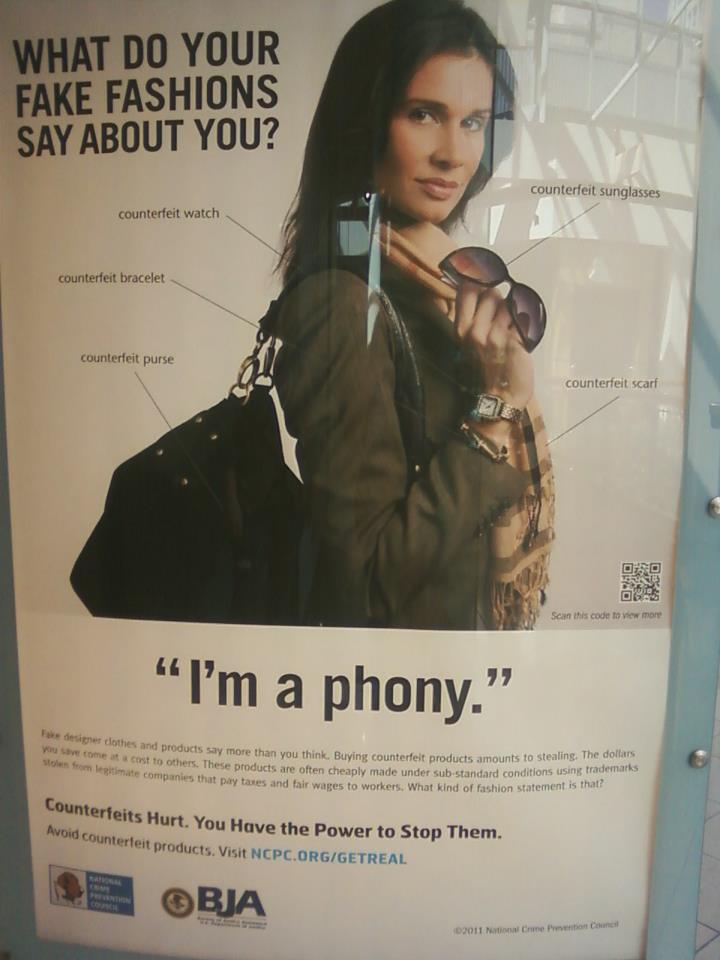
Criminal prosecutions are one way to decrease counterfeiting and, yes, protect corporate interests and Shaynah H. sent in another: shame.  This National Crime Prevention Council/Bureau of Justice Assistance ad, spotted in a mall in Portland, tells you that if you buy knock-offs, you are “a phony.”

Yikes.  I would have preferred “savvy” or “cost-conscious.”  But, no, the message is clear.  You are a fake person, a liar, a hypocrite.  You are insincere and pretentious.  You are an impostor.  (All language borrowed from the word’s definition.)  And these are not something that anyone wants to be.

But, honestly, why does anyone care?

I suspect that counterfeits don’t really cut into Chanel’s profits directly.  The people who buy bags that costs thousands of dollars are not going to try to save some pennies by buying a knock-off.  Or, to put it the inverse way, the people who are buying the counterfeits wouldn’t suddenly be buying the originals if their supply ran out.

Instead, policing the counterfeiters is a response to a much more intangible concern, something Pierre Bourdieu called “cultural capital.”  You see, a main reason why people spend that kind of money on handbags is to be seen as the kind of person who does.  The handbags are a signal to others that they are “that kind” of person, the kind that can afford a real Gucci.  The products, then, are ways that people put boundaries between themselves and lesser others.

But, when lesser others can buy knock-offs on the street in L.A. and just parade around as if they can buy Gucci too!  Well, then the whole point of buying Gucci is lost!  If the phony masses can do it, it no longer serves to distinguish the elites from the rest of us.

In this sense, Chanel and Gucci are very interested in reducing counterfeiting; the rich people who buy their products will only do so if buying them proves that they’re special.

Lisa Wade, PhD is an Associate Professor at Tulane University. She is the author of American Hookup, a book about college sexual culture; a textbook about gender; and a forthcoming introductory text: Terrible Magnificent Sociology. You can follow her on Twitter and Instagram.

Wired describes the new documentary, The Mechanical Bride, as a “moving, weirdly human exploration of artificial companionship.”  Directed by Allison de Fren, explores the range of mechanical brides, from robots to Real Dolls (NSFW), and the “technosexuals who love them.” I can’t wait to see it.

Trailer:

Bonus clip:

The Mechanical Bride will be screened at the Fantasia International Film Festival in Montreal (July 19-August 7).

Lisa Wade, PhD is an Associate Professor at Tulane University. She is the author of American Hookup, a book about college sexual culture; a textbook about gender; and a forthcoming introductory text: Terrible Magnificent Sociology. You can follow her on Twitter and Instagram.

I’m reposting this piece from 2008 in solidarity with Lisa Wade (no relation), whose (non-white) child was described by his teacher as  “the evolutionary link between orangutans and humans.”  It’s an amateur history of the association of Black people with primates. Please feel free to clarify or correct my broad description of many centuries of thought.

The predominant colonial theory of race was the great chain of being, the idea that human races could be lined up from most superior to most inferior.  That is, God, white people, and then an arrangement of non-white people, with blacks at the bottom.

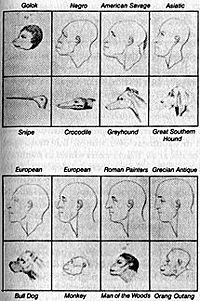
Consider this drawing that appeared in Charles White’s An Account of the Regular Gradation in Man, and in Different Animals and Vegetables (1799). On the bottom of the image (but the top of the chain) are types of Europeans, Romans, and Greeks.  On the top (but the bottom of the chain) are “Asiatics,” “American Savages,” and “Negros.”  White wrote: “In whatever respect the African differs from the European, the particularity brings him nearer to the ape.”

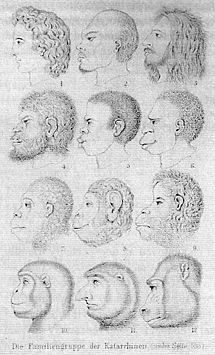
Nearly 70 years later, in 1868, Ernst Haeckel’s Natürliche Schöpfungsgeschichte was published.  in the book, this image appeared (his perfect person, by the way, was German, not Greek):


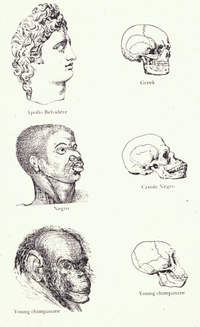
In this image, we see a depiction of the great chain of being with Michelangelo’s sculpture of David Apollo Belvedere at the top (the most perfect human), a black person below, and an ape below him.

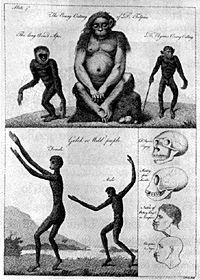
Notice that there seems to be some confusion over where the chain ends.  Indeed, there was a lot of discussion as to where to draw the line.  Are apes human?  Are blacks?  Carolus Linneaus, that famous guy who developed the classification system for living things, wasn’t sure.  In his book Systema Naturae (1758), he published this picture, puzzling over whether the things that separating apes from humans were significant.

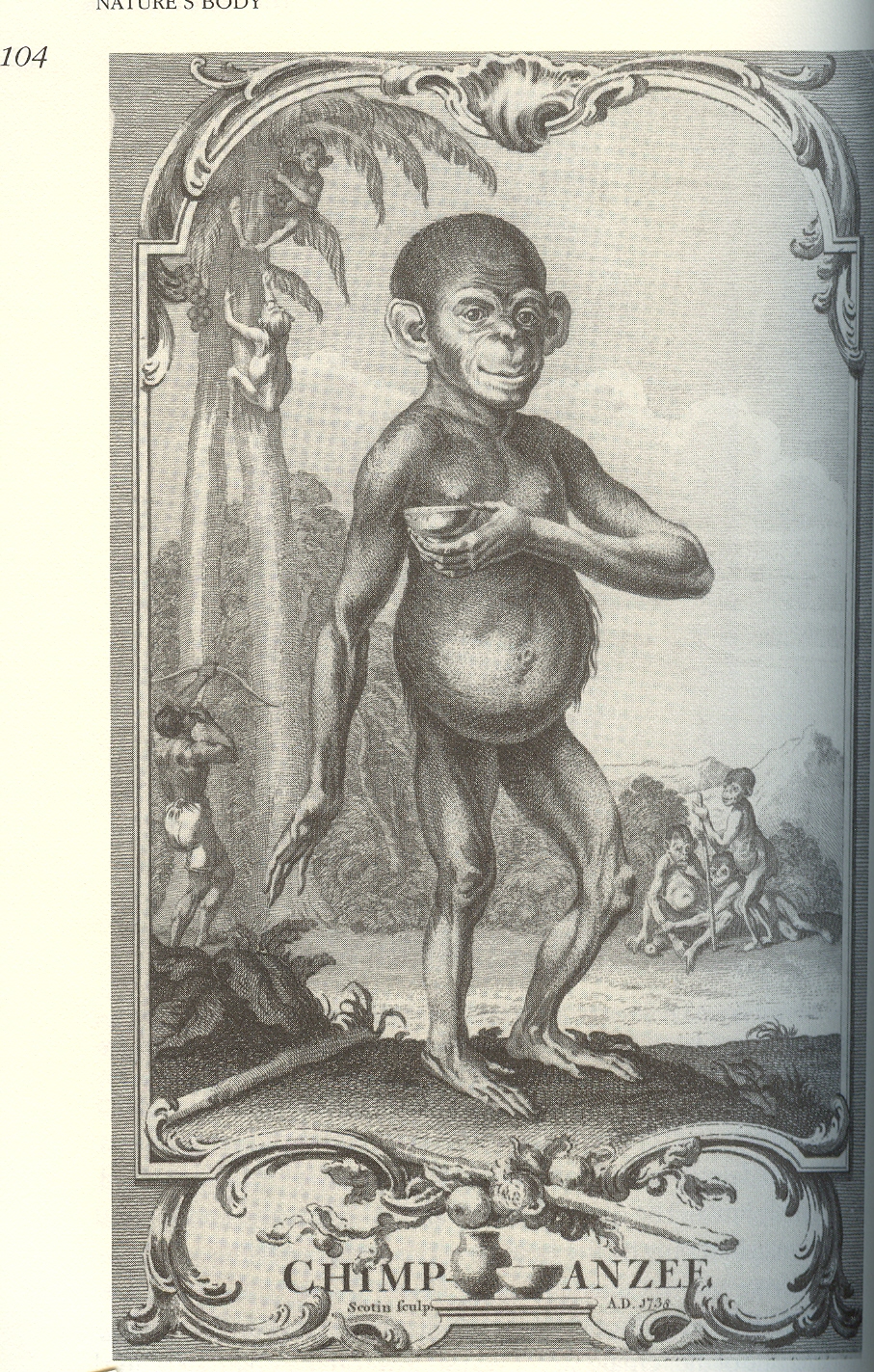
In this picture (also appearing in White 1799) are depictions of apes in human-like positions (walking, using a cane).  Notice also the way in which the central figure is feminized (long hair, passive demeanor, feminized body) so as to make her seem more human.

Here we have a chimpanzee depicted drinking a cup of tea.  This is Madame Chimpanzee.  She was a travelling attraction showing how human chimps could be.

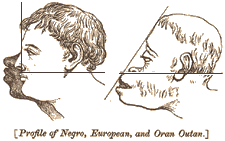
In any case, while they argued about where to draw the line, intellectuals of the day believed that apes and blacks were very similar.  In this picture, from a book by Robert Knox called The Races of Men (1851), the slant of the brow is used to draw connections between the “Negro” and the “Oran Outan” and differences between those two and the “European.”

The practice of depicting the races hierarchically occurred as late as the early 1900s as we showed in a previous post.

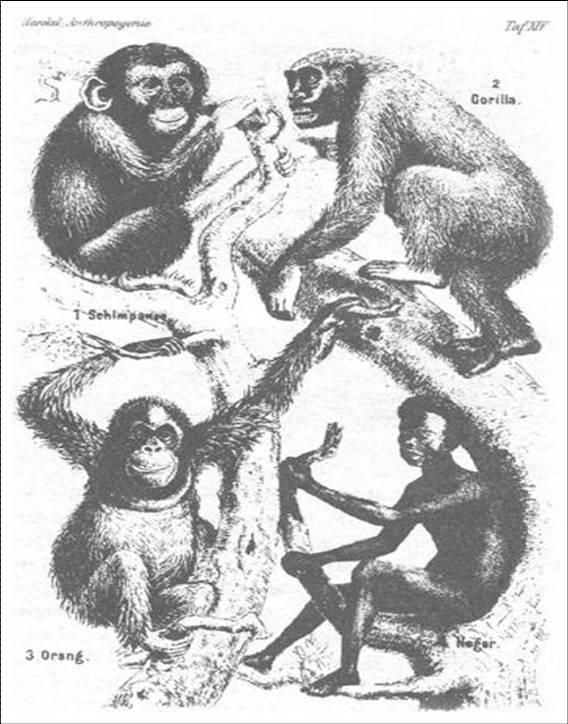
NEW! Nov ’09) The image below appeared in the The Evolution of Man (1874 edition) as part of an argument that blacks are evolutionarily close to apes (source):HLFig2
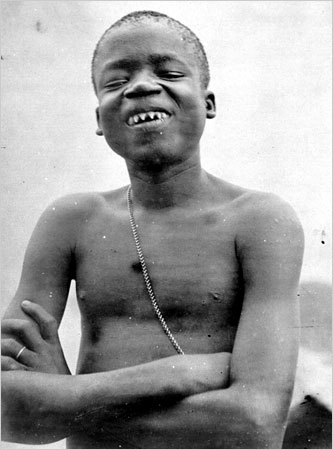
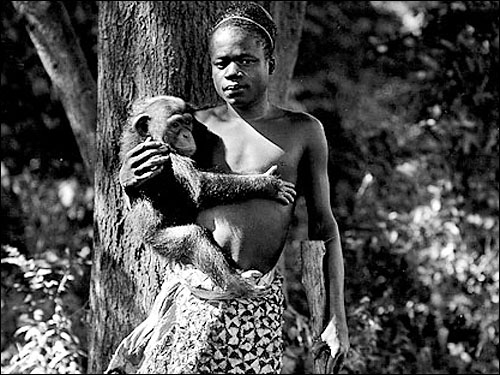
During this same period, African people were kept in zoos alongside animals.  These pictures below are of Ota Benga, a Congolese Pygmy who spent some time as an attraction in a zoo in the early 1900s (but whose “captivity” was admittedly controversial at the time).  (There’s a book about him that I haven’t read.  So I can’t endorse it, but I will offer a link.)  Ota Benga saw most of his tribe, including his wife and child, murdered before being brought to the Bronx Zoo.  (It was customary for the people of his tribe to sharpen their teeth.)

The theorization of the great chain of being was not just for “science” or “fun.”  It was a central tool in justifying efforts to colonize, enslave, and even exterminate people.  If it could be established that certain kinds of people were indeed less than, even less than human, then it was acceptable to treat them as such.

This is a “generalizable tactic of oppression,” by the way.  During the period of intense anti-Irish sentiment in the U.S. and Britain, the Irish were routinely compared to apes as well.

So, there you have it.  Connections have been drawn between black people and primates for hundreds of years.  Whatever else you want to think about modern instances of this association — the one Wade and her child are suffering now, but also the Obama sock monkey, the Black Lil’ Monkey doll, and a political cartoon targeting Obama — objections are not just paranoia.

(I’m sorry not to provide a full set of links.  I’ve collected them over the years for my Race and Ethnicity class.  But a lot of the images and information came from here.)

Lisa Wade, PhD is an Associate Professor at Tulane University. She is the author of American Hookup, a book about college sexual culture; a textbook about gender; and a forthcoming introductory text: Terrible Magnificent Sociology. You can follow her on Twitter and Instagram.

Referring to the controversy over Pluto’s demotion, in this quick video C.G.P. Grey does a fun job of explaining why the icy rock is no longer a planet.  He closes with a discussion of why properly categorizing objects in space with words like “planets” may always elude us.  It’s a great example of social construction.

Via Blame it on the Voices.  For lots more examples, see our Pinterest pages on the social construction of everything and the social construction of race.

Lisa Wade, PhD is an Associate Professor at Tulane University. She is the author of American Hookup, a book about college sexual culture; a textbook about gender; and a forthcoming introductory text: Terrible Magnificent Sociology. You can follow her on Twitter and Instagram.

Cross-posted at Montclair SocioBlog.

What’s familiar isn’t so bad, even if it’s bad.

One of the things I remember from my days in the crim biz is that people’s perceptions of crime don’t have a lot to do with actual crime rates.  This was back in the high-crime decades, and people were more afraid of crime than they are now.  But people felt safer in their own neighborhoods than in other neighborhoods, even when their own neighborhoods had a higher crime rate.

These were the days when I would give someone directions to my building — “Get off the IRT* at 72nd St…” — and they would often ask, “Is it safe?”

“Of course it’s safe.  It’s my neighborhood,” I would say, “I live here. I ought to know.”   Yet when I would go to a party in the East 20s or, God forbid, Brooklyn, I would emerge from the subway and follow the directions with a certain sense of apprehension and caution.

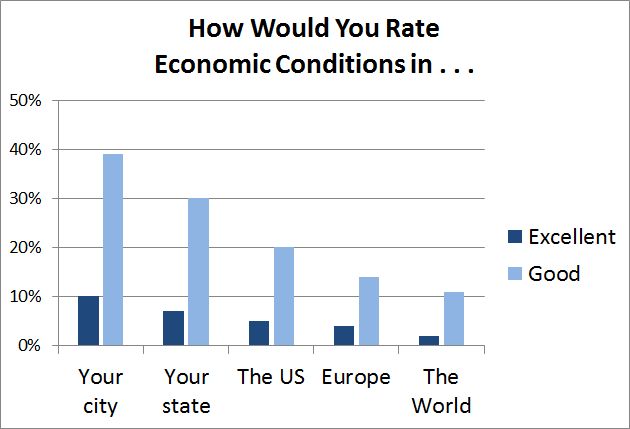
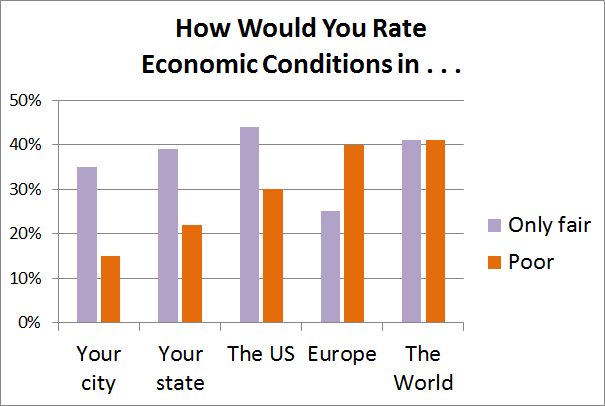
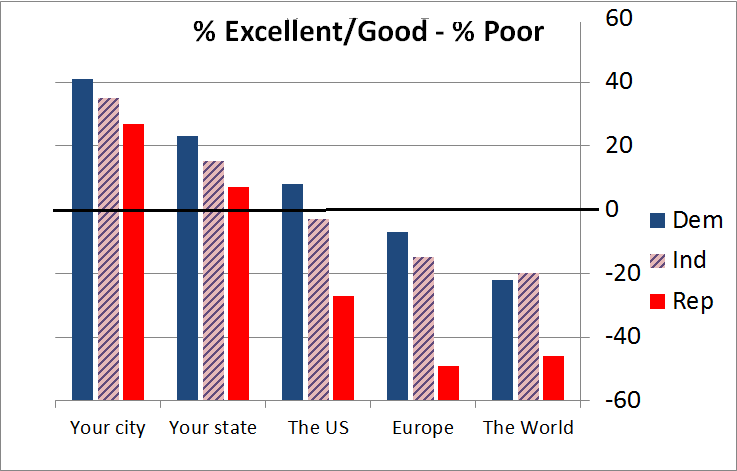
Apparently, the same link between far and fear holds true for people’s perceptions of economic well-being.  A recent Gallup poll asked people how the economy was in places ranging from their own city or area to the world generally.  The closer to home, the better the economy.  The farther from home, the lower the percent of people rating economic conditions as excellent or good.And the farther from home, the higher the percent of people rating economic conditions as “only fair” or poor.Republicans were the most pessimistic about the economy, regardless of location.  Democrats were the most sanguine, with Independents in between. The graph shows the percent who rated the economy positively minus the percent who rated it Poor.This obviously has nothing to do with familiarity but with contempt.  Apparently, for Republicans, a Democrat – especially a Kenyan socialist Democrat – in the White House means that the economy must be bad everywhere.

* These old subway line designations – IRT, BMT, IND – are no longer in official use.  But when did the MTA jettison them?  If you know the answer, please tell me.

———————

UPDATE, June 22 Andrew Gelman has formatted the data as line graphs, making the comparisons and trends clearer.  He has also added his own observations – things I wish I had known or thought of.

Cross-posted at Jezebel.

I’ve been watching the response to Anne-Marie Slaughter’s Why Women Still Can’t Have It All roll out across the web.  Commentators are making excellent points, but E.J. Graff at The American Prospect sums it up nicely:

Being both a good parent and an all-out professional cannot be done the way we currently run our educational and work systems… Being a working parent in our society is structurally impossible. It can’t be done right… You’ll always be failing at something — as a spouse, as a parent, as a worker. Just get used to that feeling.

In other words, the cards are stacked against you and it’s gonna suck.

And it’s true, trust me, as someone who’s currently knee-deep in the literature on parenting and gender, I’m pleased to see the structural contradictions between work and parenting being discussed.

But I’m frustrated about an invisibility, an erasure, a taboo that goes unnamed.  It seems like it should at least get a nod in this discussion.  I’m talking about the one really excellent solution to the clusterf@ck that is parenting in America.

Don’t. Have. Kids.

No really — just don’t have them.

Think about it.  The idea that women will feel unfulfilled without children and die from regret is one of the most widely-endorsed beliefs in America.  It’s downright offensive to some that a woman would choose not to have children.  Accusations of “selfishness” abound.  It’s a given that women will have children, and many women will accept it as a given.

But we don’t have to.  The U.S. government fails to support our childrearing efforts with sufficient programs (framing it as a “choice” or “hobby”), the market is expensive (child care costs more than college in most states), and we’re crammed into nuclear family households (making it difficult to rely on extended kin, real or chosen).  And the results are clear: raising children changes the quality of your life.  In good ways, sure, but in bad ways too.

Here are findings from the epic data collection engine that is the World Values Survey, published in Population and Development Review. If you live in the U.S., look at the blue line representing “liberal” democracies (that’s what we are).  The top graph shows that, among 20-39 year olds, having one child is correlated with a decrease in happiness, having two a larger decreases, and so on up to four or more.  If you’re 40 or older, having one child is correlated with a decrease in happiness and having more children a smaller one.  But even the happiest people, with four or more children, are slightly less happy than those with none at all.

Don’t shoot the messenger.

Long before Slaughter wrote her article for The Atlantic, when she floated the idea of writing it to a female colleague, she was told that it would be a “terrible signal to younger generations of women.”  Presumably, this is because having children is compulsory, so it’s best not to demoralize them.  Well, I’ll take on that Black Badge of Dishonor.  I’m here to tell still-childless women (and men, too) that they can say NO if they want to.  They can reject a lifetime of feeling like they’re “always… failing at something.”

I wish it were different. I wish that men and women could choose children and know that the conditions under which they parent will be conducive to happiness.  But they’re not.  As individuals, there’s little we can do to change this, especially in the short term.  We can, however, try to wrest some autonomy from the relentless warnings that we’ll be pathetically-sad-forever-and-ever if we don’t have babies.  And, once we do that, we can make a more informed measurement of the costs and benefits.

Some of us will choose to spend our lives doing something else instead.  We’ll learn to play the guitar, dance the Flamenco (why not?), get more education, travel to far away places, write a book, or start a welcome tumblr.  We can help raise our nieces and nephews, easing the burden on our loved ones, or focus on nurturing our relationships with other adults.  We can live in the cool neighborhoods with bad school districts and pay less in rent because two bedrooms are plenty.  We can eat out, sleep in, and go running.  We can have extraordinary careers, beautiful relationships, healthy lives, and lovely homes.  My point is: there are lots of great things to do in life… having children is only one of them.

Just… think about it.  Maybe you can spend your extra time working to change the system for the better.  Goodness knows parents will be too tired to do it.

Lisa Wade, PhD is an Associate Professor at Tulane University. She is the author of American Hookup, a book about college sexual culture; a textbook about gender; and a forthcoming introductory text: Terrible Magnificent Sociology. You can follow her on Twitter and Instagram.

In May of this year the baseball team at Our Lady of Sorrows, a high school charter in Arizona, was scheduled to play a championship game against Mesa Preparatory Academy.  Claiming a religious tenet forbidding co-ed sports, they forfeited the final game of the season.  Mesa’s second baseman, you see, was a 15-year-old named Paige Sultzbach.

This was not an isolated incident.  In 2011 a high school threatened to forfeit a junior varsity football game unless a girl on the opposing team, Mina Johnson, sat out.  Johnson, a five-foot-two-inch 172-pound linebacker on the opposing team, had “gain[ed] a reputation in the league as a standout junior varsity player”; she sacked a six-foot quarterback in her very first game. Nevertheless, not wanting to be the cause of a lost opportunity for her team to play, Johnson sat out.  The opposing team still lost to hers 60 to zero, but apparently that was less humiliating than losing to a girl.

In my sociology of gender textbook I discuss the practice of segregating sports by gender.  Both those on the political left and political right tend to think this is a good idea.  Conservatives tend to think that women are more fragile than men, while liberals want women to have the same opportunities.

Ensuring that men never compete alongside or with women, however, also ensures that the belief that men would always win goes unchallenged.  In other words, because we already assume that men would win any competition with women, it is men, not women, who have the most to lose from de-segregating sports.  If women lose, the status quo — believing women are physically inferior to men — simply remains in place.  But if men lose, the assumption of male superiority is undermined.

Women’s participation in non-team sports, of course, potentially challenges these assumptions in a different way.  While some of these sports try to write rules that ensure that women never measure up to men (e.g., body building has a cap on how muscular women can be), others lay these comparisons bare, which brings us to Sarah Robles.  Robles, a weightlifter, out-lifted all Americans of both sexes at last year’s world championships.  “On her best day,” writes Buzzfeed, “she can lift more than 568 pounds — that’s roughly five IKEA couches, 65 gallons of milk, or one large adult male lion.” Here she is lifting 278 pounds.

The Buzzfeed article focuses on how a main source of revenue — corporate sponsorship — is likely out of reach for Robles.  Companies don’t like to support athletes who challenge our beliefs about men and women.  And Robles certainly does.  She’s proof that women can compete with men, at their own games even, and win.

Thanks to Kari for the tip!

Lisa Wade, PhD is an Associate Professor at Tulane University. She is the author of American Hookup, a book about college sexual culture; a textbook about gender; and a forthcoming introductory text: Terrible Magnificent Sociology. You can follow her on Twitter and Instagram.