Search results for The

Clayton W. alerted us to this September’s issue of Harper’s Bazaar. Paul Goude decided to photograph Naomi Campbell as if she were in Africa with animals.  Clayton writes that it “…very nearly turns her into some sort of animal.”  Below are some images from the photo shoot, courtesy of Womanist Musings (via Feministing):

image[3]

On this cover of Vibe, Lil’ Kim is posed animalistically and, it is asserted, she is “ready to roar”:

NEW! Naomi Campbell, is also put in leopard print in this photo in the December 2008 issue of Russian Vogue (found here):
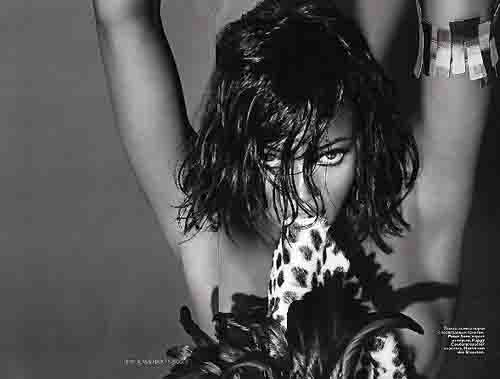
Naomi-Campbell

ALSO NEW! Iman with a cheetah, and with a cheetah print scarf on her head, as photographed by Peter Beard, 1985 (found here):
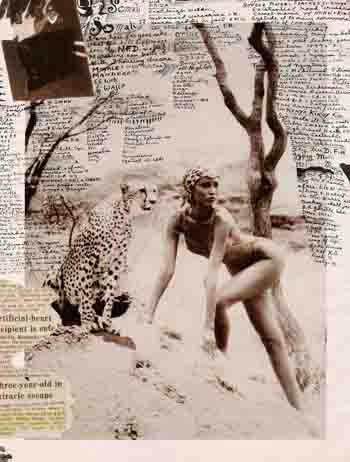
Iman-Cheetah-Peter-Beard-1985

ALSO ALSO NEW! These two pictures of Grace Jones (from here) involve animalization (explicitly in the second case). These images may not be safe for work, so I’ve put them after the jump, along with another example:

more...


This clip from The Daily Show nicely illustrates how ridiculous and utterly meaningless the statistics we encounter can be:

This probably goes without saying, but there are multiple problems here:

1. Viewers of these shows are a self-selected group who are quite likely watching because they agree with the hosts to some degree, so it wouldn’t be surprising they’d agree with the hosts’ views.

2. Viewers who care enough to text are an even more unusual group, likely to be those who feel most passionately about an issue.

3. Only those people watching the show and are able to text right then are able to vote.

4. The wording of the questions is clearly intended to lead to a particular answer, using leading phrases like “are you outraged,” which responsible social scientists would never use–any question that uses something along the lines of “don’t you agree” or “wouldn’t you say that” makes it more likely the respondents will, indeed, agree with the point.

5. The hosts actively cajole viewers to give a specific answer if they aren’t getting as many of that answer as they wanted.

Of course, the hosts aren’t trying to present factual, useful information and almost certainly know very well that they’re manipulating questions to get results that will appear to overwhelmingly support their position. But we’re inundated with “statistics” such as these every day that are completely meaningless, but many many people don’t know how to evaluate them. This little clip shows some of the things a person should look for as an indication that a number was created to support a particular viewpoint and should be viewed with extreme skepticism, if not dismissed altogether.

Gwen Sharp is an associate professor of sociology at Nevada State College. You can follow her on Twitter at @gwensharpnv.

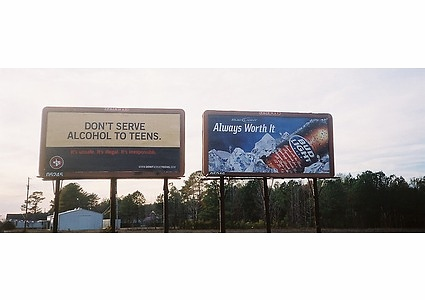
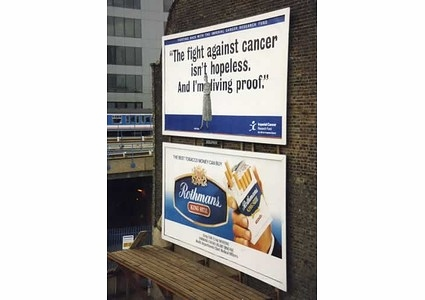
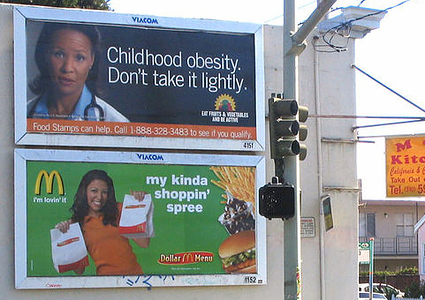
In a list of 15 contrasting billboards on Buzzfeed, I found these three:

Picture1Picture2Picture3

I usually think of public service announcements as a form of education.  Presumably there’s a harmful ignorance out there somewhere that can be corrected.  But these contrasts bring into stark relief the fact that public service announcements aren’t only fighting ignorance, they’re fighting corporations.  The battle isn’t just between misinformation and information, it’s between for-profit and non-profit organizations.

—————————

Lisa Wade is a professor of sociology at Occidental College. You can follow her on Twitter and Facebook.

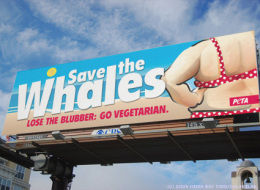
Often when we have an image related to PETA we add it to one of our existing posts, since they tend to be similar–mostly sexualizing women or showing them as bloody meat. But Jessica B. and Dmitriy T.M. told us about a PETA billboard that takes a different angle, and I thought it was worth its very own post:

s-SAVE-THE-WHALES-large

Found at The Huffington Post.

This is just…ugh. Erg. !!! ??? !!!

I’m sorry, but that’s the most coherent I can be about this. I’m sure our commenters will be able to make more useful points about it.

Well, ok, I have one more thought: the implication is that being a vegetarian will automatically make you lose weight. That’s just dumb, or more likely intentionally misleading.

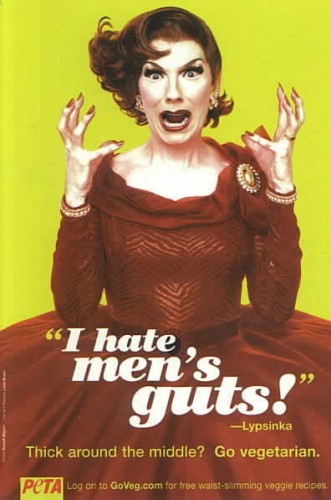
UPDATE: Anomie let me know that there’s at least one version about men (found here):

41963

Two more examples with men here.

Related posts: women in (fake) lettuce bikinis, Dutch animal rights ad shows stripper brutally murdered, not sexualizing older women, PETA ad banned from Superbowl, women as bloody packaged meat, Holocaust on Your Plate campaign, using domestic violence to oppose animal abuse, Christina Applegate naked, more naked celebrities, and leftist balkanization.

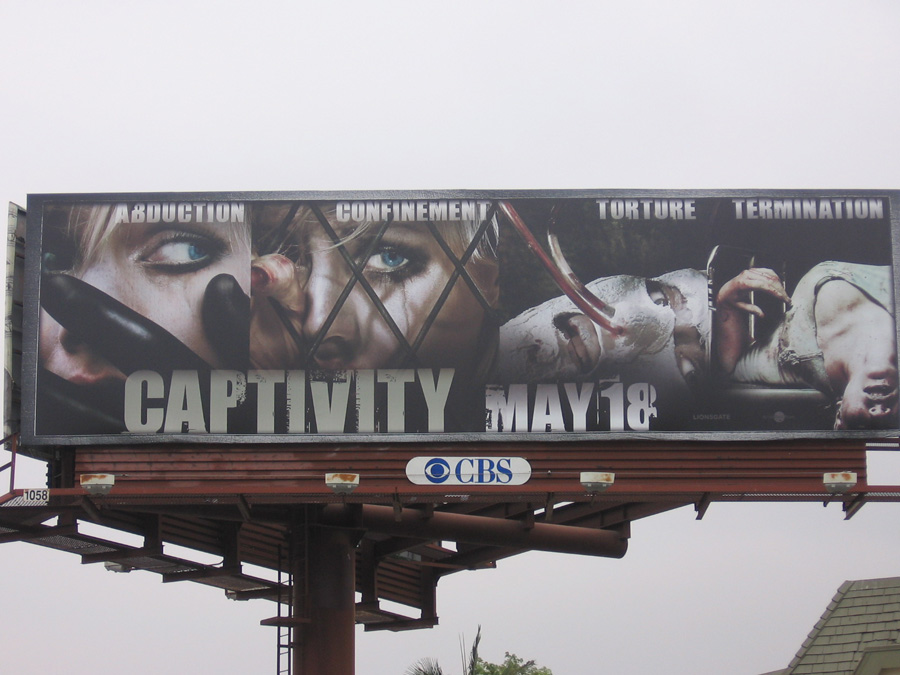
Matt C. snapped some pictures of the advertising campaign for the movie Captivity (2007) in Los Angeles.  According to this billboard, it’s about abduction, confinement, torture, and termination:

banned2

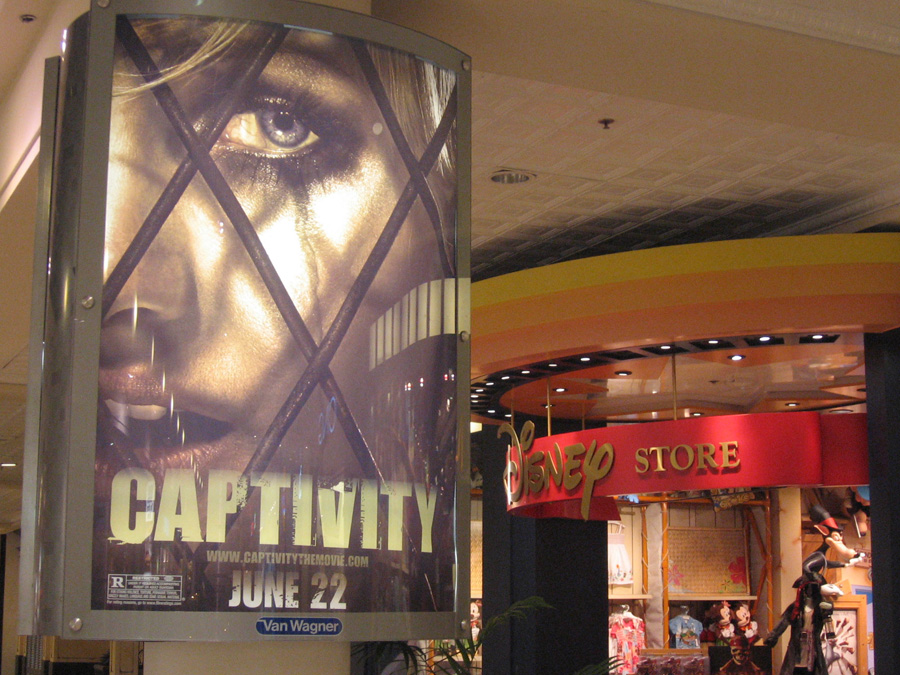
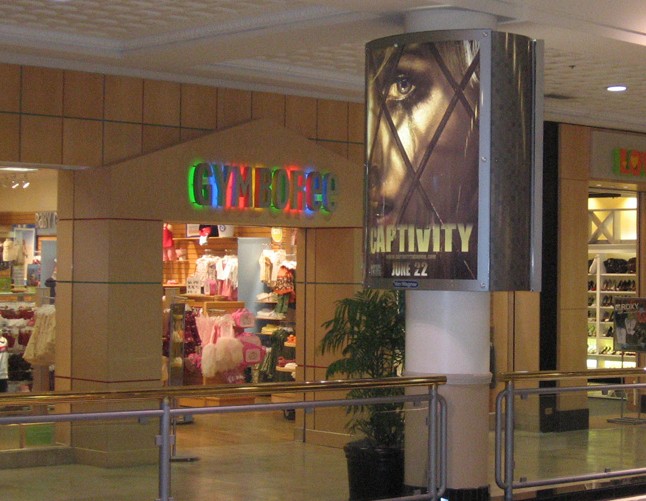
What Matt found interesting was that some of this advertising was placed immediately outside of stores that cater to small children and their parents.  Check it out:
disney
gymboree
Does this suggest to you that we have become so desensitized to violent imagery that no one thinks to, or is empowered to, object when such images are placed at the entrance to children’s spaces?  Or, is the image in question considered tame compared with other imagery we regularly consume (the billboard, for example) and, therefore, unremarkable?

More pictures on Matt’s blog.

—————————

Lisa Wade is a professor of sociology at Occidental College. You can follow her on Twitter and Facebook.

In my Intro to Soc course I assign K.R. Thompson’s article “Handling the Stigma of Handling the Dead: Morticians and Funeral Directors” (Deviant Behavior 1991, v. 12, p. 403-429). Thompson looked at how those involved in preparing the dead for burial and planning funerals try to manage the negative perceptions they suspect much of the public has of them. Language was a major way they tried to do this–redefining themselves as “funeral directors” rather than “morticians” or “undertakers,” referring to dead people as “the deceased” rather than “the body” or “the corpse,” “casket” rather than “coffin,” and so on. The point was to try to reduce the association with death–to never blatantly refer to death at all.

They also tried to avoid what they felt were stereotypes of funeral directors. Some mentioned trying not to wear black suits, and one man went so far as to keep hand warmers in his pockets so his hands would be warm when he shook family members’ hands–a reaction to what he said was a belief that funeral directors have cold, clammy hands. Others lived in a different town than where they worked and tried to keep their careers secret.

All of this was an attempt to avoid the stigma often placed on those who handle the dead (found in many cultures). We often suspect those who do so, thinking they must be creepy to be willing to do that kind of work. In addition, funeral directors are often depicted as unethical individuals who profit from a family’s pain and who can manipulate people while they are emotionally vulnerable.

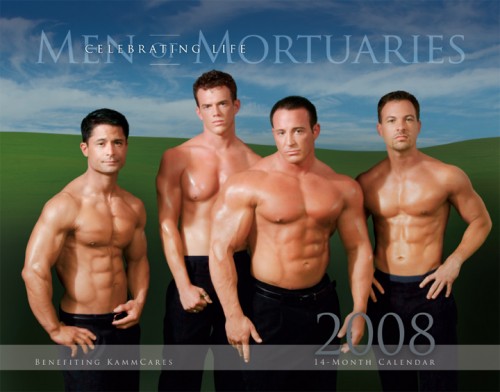
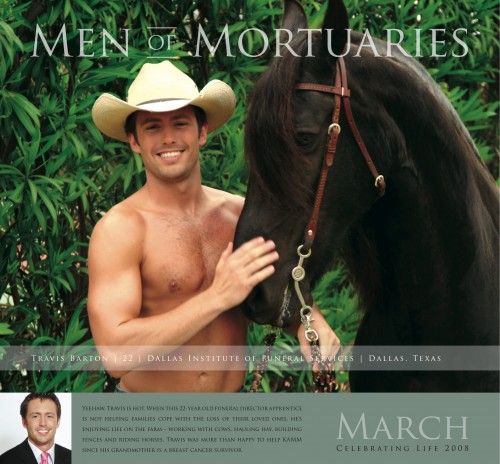
I thought of that article when Lisa sent me a link to an article in Obit Magazine about the 2008 Men of Mortuaries calendar, which raised money for a breast-cancer charity:

1256_men of mort cover

9239_March With Copy

The article directly discusses stereotypes:

Aren’t undertakers old, gray of complexion, gaunt and, well, creepy?

Four hundred morticians and funeral directors from across the country who defy that stereotype sent applications to Kenneth McKenzie’s funeral home in Long Beach, Ca., to vie for a month in the calendar…

Also:

McKenzie sees the calendars as a humorous way to dispel the notion that morticians “are gray-haired and hunchbacked with no personality.”

Interestingly, the article does use the word “mortician,” so apparently some in the industry are still comfortable with the term. But overall, I think the calendar and the quotes from the article demonstrate the effort to manage stigma quite well.

CLARIFICATION: In light of a previous post about a calendar featuring nudity, some commenters are conversing about whether this calendar is objectifying or humanizing. That is an interesting, appropriate question and certainly worth discussing. I wanted to clarify, though, that I wasn’t trying to answer that particular question in this post. I only meant to suggest that the calendar was an example of an attempt at humanizing funeral directors in order to manage perceived stigma, which isn’t the same as saying it’s a good or effective attempt (or a bad or ineffective one, for that matter).

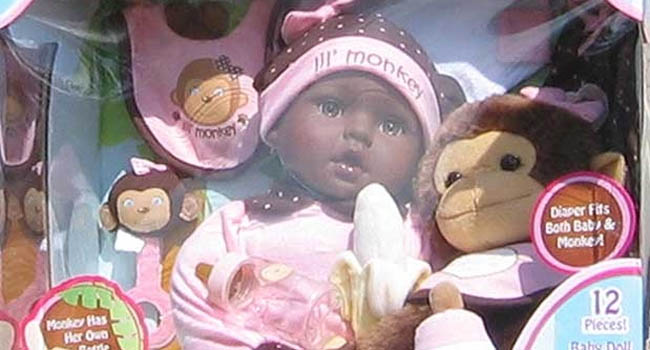
Associations of black people with monkeys and apes have been used for centuries to make them seem less-than-human and justify hatred and exploitation.  This associations continue to be propagated (e,g., here, here, and here).  This week Costco pulled the black “Lil’ Monkey” baby doll from its shelves, along with its white “Pretty Panda” counterpart, as a result of protests that it was racist.

48606415

As you can see, the black doll has on a hat that says “lil’ monkey,” is surrounded by products that have monkeys on them, as well as a stuffed monkey.  A peeled banana points at the child’s mouth.

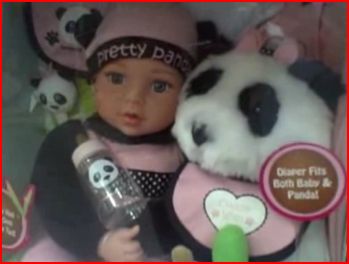
Here is the white counterpart, the “Pretty Panda” doll:

Capture

The manufacturer of the dolls is claiming that there was no intention to be racist.  Specifically, they argued:

We don’t think in that way. We don’t operate in that kind of thinking.

Social psychologists have shown, robustly, that any given member of a society, even those who are the target of negative stereotypes, will hold pre-conscious stereotypical beliefs common in that society.  (If you’d like to test your own unconscious biases, and see aggregate test results of others, I highly recommend Harvard’s Project Implicit.)

The fact that we are all racist already, whether we like it or not, is the point that the manufacturer completely misses.  They do think in that way.  We all do.  Not thinking in that way consciously doesn’t mean that racism didn’t play a role in the manufacturing of a black Lil’ Monkey doll.  In fact, their defense actually makes things worse.  Their refusal to think about racism, in favor of a defensive reaction, is as racist as the doll itself.  We can’t fight racism unless we’re prepared to admit that we hold unconscious biases.

By the way, in my opinion, the proper response should have been: “Oh hell, we messed up bad. You are absolutely right. We are really bleeping sorry,” but with stronger curse words. And also: “Can I say I’m sorry again? In addition to racist, we were profoundly insensitive to centuries of violent hatred… and it is simply not okay.”

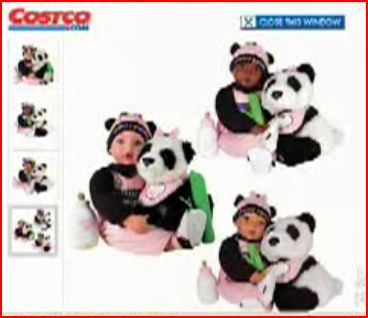
UPDATE: Commenters alerted me to alternative media coverage that made it clear that “Pretty Panda” and “Lil’ Monkey” dolls both came in black, white, and “Hispanic”:

Capture

Capture2

I’m not sure why none of the media coverage I came across noted this.

In any case, I think this raises an even more interesting question: Does the history of associating black people with primates, and I will refer you again to this post, actually make any product that does so problematic?  Does the fact that the doll comes in white and Hispanic erase any concerns about the fact that the black doll exists?

As usual, our readers are quick to ask difficult questions and this discussion is already well under way in the comments.  What do you think?

Images from here, here, and here, via Resist Racism.

UPDATE: Comments on this post have been closed.

—————————

Lisa Wade is a professor of sociology at Occidental College. You can follow her on Twitter and Facebook.

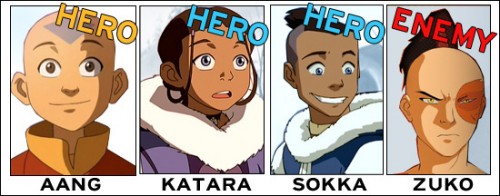
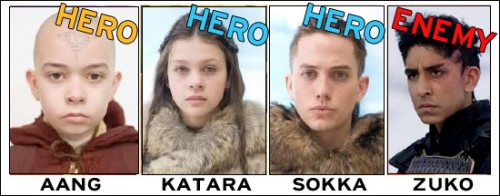
Jen S. emailed us about the controversy surrounding casting for the movie version of Nickelodeon’s cartoon “Avatar: The Last Airbender.” Jen describes the cartoon:

[It’s] set in a fantasy Asian world that also incorporated the philosophies, cultures, martial arts, and writing of a pan-Asian world. Multiple groups were brought in like the Media Action Network for Asian Americans and a master of Chinese calligraphy to bring an authentic Asian feel to the world and this was the main thing that made the cartoon an award winner. It was non European based and wasn’t afraid to use characters of Asian and Inuit cultures as the lead characters.

Fans of the series protested when it became clear that the cast for the movie was overwhelmingly Caucasian. The “bad” character, Zuko, was originally played by Jesse McCartney, a White actor/musician, but when he pulled out of the movie the role went to Dev Patel:

castingchars

castingactors

Jen says that in the cartoon, the “evil” characters were lighter-skinned than the heroes, but the casting has reversed that, and apparently several of the Asian-inspired elements from the cartoon have been removed for the movie because “they wanted to make the world ‘more diverse’ than the show and apparently that means an all white lead cast.”

Commenting in an article, Jackson Rathbone, the actor who plays Sokka, said,

I think it’s one of those things where I pull my hair up, shave the sides, and I definitely need a tan…

It’s unclear to me if he was saying he needs to do those things to look Asian enough to play the role, or was arguing that Sokka isn’t specifically Asian so Rathbone can play him, and either way it misses the point, but I suppose an actor isn’t likely to make an argument that someone else should have gotten their role instead of them.

The animatic editor of the cartoon series expressed disappointment that none of the main “good” protagonists will be played by Asian characters.

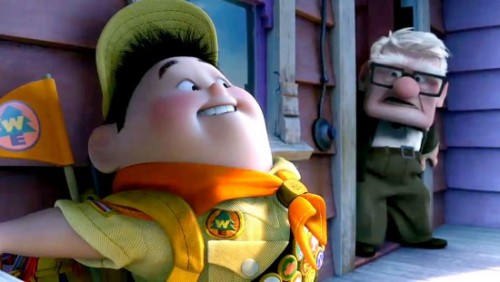
This reminded me of the debate about the Pixar movie “Up” that came out earlier this summer. One of the two main characters, and the only child, is Asian-American:

russell-pixar-550x311

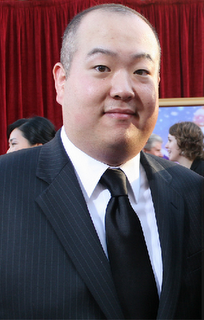
The character was apparently partially based on Pixar animator Pete Sohn:

peter_sohn

Before the movie came out, I read an article in a magazine in which industry insiders expressed doubt about whether non-Asian kids would identify with an Asian-American character. The gist of the comments was that the movie might fail because kids might not like watching an Asian-American lead. Of course, the movie went on to gross over $287 million in the U.S. and $367 million worldwide by early August.

In another example, when faced with criticism of casting Whites as the main characters in “21,” a movie based on a book about actual Asian-American college students, the movie’s producer said,

Believe me, I would have loved to cast Asians in the lead roles, but the truth is, we didn’t have access to any bankable Asian American actors that we wanted…If I had known how upset the Asian American community would be about this, I would have picked a different story to film.

There were no bankable Asian American actors…that they “wanted.” None of the men on this page, for instance, are bankable. And the solution to concerns raised by Asian Americans about the lack of roles for Asian American actors isn’t to provide them more leads, or at least seriously engage in a discussion about the issue…it’s to pack up your toys and go film something else.

There are many other examples of movies in which characters that were Asian or Asian American in the source material (book, TV series, etc.) are played by Whites in the movie adaptation; the links above describe many of them. There still seems to be an assumption that male Asian American actors won’t appeal to a general audience, that they aren’t “bankable,” and that it’s therefore preferable to cast relatively unknown White actors over Asian American actors who may be more recognizable. It’ll be interesting to see if the Korean-American actor who plays one of the non-vampire characters in “Twilight” will now get as many opportunities as Jackson Rathbone, who also stars in the movie (but, from what I understand, actually has a less prominent role and smaller speaking part).

In a comment, reader Julian says,

And I have to wonder why no one has pointed out that in the original (animation), though all the characters are non-Caucasian, the only one with “slanted” or upturned eyes is the Bad Guy. Though lighter skinned, he looks like the one least likely to be able to “pass” as white to me. This strikes me as odd, and even weirder that no one has mentioned it, especially among all this talk of erasing/demonizing PoC.

Matt K. adds,

…I do recall that in anime, one shorthand for identifying good vs. evil characters is eyes. Good characters have huge eyes, round faces, and so forth. Evil characters have pointy chins and narrow eyes. Of course, of interest in a lot of anime is how so many of the characters look white…but that’s probably another story.

And Adam says,

I don’t think Up is a good counter-example given that it is narratively structured around colonialism in Latin America. I mean, was there even ONE single Latin American person in the film or even any refrence to the people who must have lived on the land they were tredding across and the sacred species whom they had been hunting/rescuing. No. Not to mention the dogs were racialized via popular physiognomy.

Also see our post on gender in Pixar films.