Search results for The

Hellman’s Mayonnaise, a brand owned by the multinational corporation Unilever, currently has an “eat local” campaign in Canada. As part of it, they put out this video (found at BrandFreak) highlighting how much food Canada imports:

Hellmann’s – It’s Time for Real from CRUSH on Vimeo.

What I find odd here is that Unilever owns a large number of food brands (as well as non-food ones), including Hellman’s, Wishbone, Ben & Jerry’s, Bertolli, Lipton, Knorr, and Slim-Fast (check here for some images of organic brands owned by Unilever). The Lipton web page notes that Lipton is “…making a big splash in the global beverages market…” The main Unilever food page announces,

We have the heritage and knowledge to move effortlessly between cuisines and countries.

So on the one hand, according to wikipedia,

The company promotes sustainability and started a sustainable agriculture programme in 1998.[7] In May 2007 it became the first tea company to commit to sourcing all its tea in a sustainable manner, employing the Rainforest Alliance, an international environmental NGO, to certify its tea estates in East Africa, as well as third-party suppliers in Africa and other parts of the world. It declared its aim to have all Lipton Yellow Label and PG Tips tea bags sold in Western Europe certified by 2010, followed by all Lipton tea bags globally by 2015.

Covalence, an ethical reputation ranking agency, placed Unilever at the top of its ranking based on positive versus negative news coverage for 2007.

Those are admirable goals by any standard, and food/globalization activists often push for that type of responsible corporate citizenship.

On the other hand…Unilever owns 400+ brands, many of which are dependent upon global sourcing and distribution; they in no way contribute to or encourage local eating, and if people really began eating locally, Unilever’s market share would suffer dramatically. And there are questions about how well it lives up to its sustainability goals.

We’ve seen these contradictions from Unilever before: the company owns both Axe and Dove, brands that are often marketed in ways that conflict with one another.

One way to look at this is that Unilever is making efforts to encourage sustainability and other policies that many critics would appreciate, within a global marketplace that constrains their efforts. The more cynical view is that such contradictory messages in effect allow corporations to “have it all.” Don’t care about sustainability, working conditions, and so on? Chances are you’re buying Unilever brands by default. But if you do care about such issues, you can feel good about buying at least some Unilever brands–those that have a marketing strategy designed to appeal to you. And doing so in no way threatens Unilever’s overall profitability.

So, readers, whatcha think?
We’ve posted in the past about how cigarettes have been marketed to women: as ways to lose weight, a form of personal liberation (more examples of this marketing theme here and here) as a way to calm down stressed moms, and doctor-approved methods of clearing up skin problems.

A while back Emily M. sent us a link to an article at the Onion A.V. Club that shows how men have been portrayed in cigarette ads. They provide a nice comparison to female-oriented marketing campaigns.

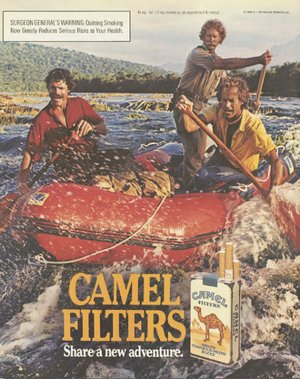
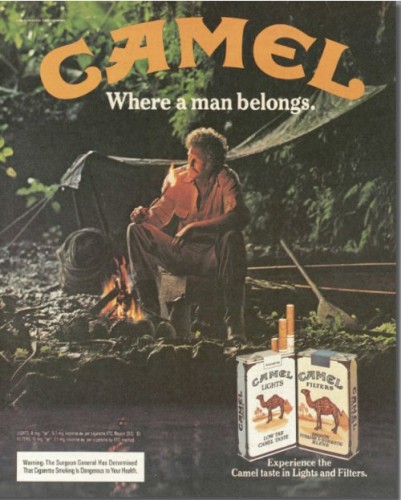
A recurring theme is that of a men as rugged individualists who go out and explore wild, remote, presumably dangerous places on their own. The Marlboro Man is the most familiar example, but Camel’s “where a man belongs” campaign also stressed this image:

camelguy1_jpg_595x1000_q85

Another major theme we see is cigarettes as facilitators of male bonding:

camelguys_jpg_300x1000_q85


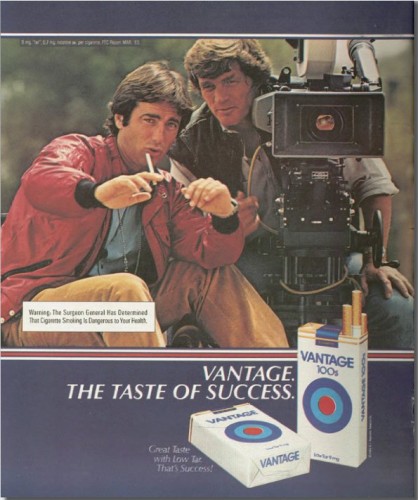
Other times we see men smoking as they do Really Intense Work:

vantageguy2_jpg_595x1000_q85

Also see our post on Tiparillo cigarettes as a way to get hot women and Skoal use as male bonding that will get you out of a speeding ticket.

Gwen Sharp is an associate professor of sociology at Nevada State College. You can follow her on Twitter at @gwensharpnv.

Etan B. sent in this ad (found Etan’s blog) that the CDU, a conservative German political party, is using to compare its candidate, Vera Lengsefeld, to Angela Merkel. The ad shows a photo of Merkel on the left and Lengsfeld on the right. Both women are in dresses that reveal cleavage (the photo of Merkel generated a lot of discussion when it first appeared about whether she was dressed too sexily):

merkel

The text on the left, across the image of Merkel, says “We have more to offer,” the implication being, of course, that the conservative party has more to rely on than cleavage. Lengsfeld explained the ad this way:

If only a tenth of them also look at the content of my policies, I will have reached many more people than I could have done with classic street canvassing.

UPDATE: Now I’m confused. Elena says,

Merkel is the chairwoman of the CDU. Both women belong to the same party, and according to the ad both have “[more] to offer”.

I apologize for the confusion about Merkel’s party–I read in two different places the account I gave above. So I guess the CDU is basically saying you should vote for it because it has candidates that are sexy? I kinda think that’s actually worse than what I originally thought it was. Elena, thanks so much for the clarification!

You can also read an article about the controversial ad at NPR.

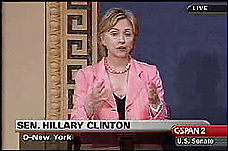
As Etan points out, it’s reminiscent of the scrutiny Hillary Clinton received after she wore this outfit on the Senate floor:

PH2007071902669

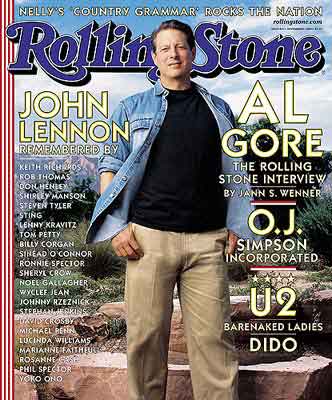
As far as men go, in 2000 Rolling Stone was accused of airbrushing this cover photo of Al Gore to make his crotch bulge bigger (via):

gorepak3

So there are lots of examples of efforts to delegitimize political candidates by focusing on their looks or sexuality, but the Lengsfeld one is the most blatant I’ve seen recently.

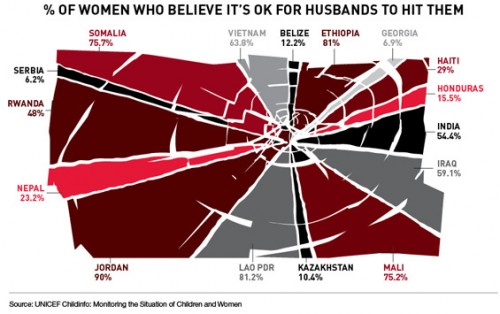
Teresa C. sent in this image created using UNICEF data to show what percent of women surveyed in various countries said it was acceptable for their husbands to hit them:

international-womens-attitudes-towards-domestic-v-28079-1250786064-13

(Found at BuzzFeed.)

You can find the data and a breakdown of UNICEF data collection methods here. The data for many more countries are available there too. I can’t quite figure out why these particular countries were used in the image; they aren’t all of the countries with the highest percentages. As far as I can tell, the UNICEF data table only includes numbers for the “developing” nations and some countries from eastern Europe, which is UNICEF’s focus. But I do wonder what the numbers would be if you asked women in the U.S. a question along the lines of “is it ever acceptable for a man to hit a woman?” or “can you think of any situation where it might be understandable that a man would hit his wife or girlfriend?” You might get higher “support” for violence against women than you’d think. The UNICEF page doesn’t provide the wording of this question, which would be interesting to know.

That’s not to downplay the issue of women justifying or accepting violence against women, just that those of us in the “developed” nations need to be sure not to pat ourselves on the back too much about how enlightened we are about domestic violence.

And I can’t help but dislike the image, in that at first glance it would appear to be a pie chart in which all of the sections add up to 100%; really a bar graph would be a better way to illustrate this. But then, I had a dissertation advisor with a 5-page single-spaced document outlining his standards for data presentation.

UPDATE: Reader P. makes the point I was getting at above (that the wording might greatly impact how much “support” you find for violence against women) much better than I did:

What they were actually asked, in the MICS and the DHS (the two primary sources for the data), was this question:

“Sometimes a husband is annoyed or angered by things that his wife does.  In your opinion, is a husband justified in hitting or beating his wife in the following situations:

– If she goes out with out telling him?
– If she neglects the children?
– If she argues with him?
– If she refuses sex with him?
– If she burns the food?”

I bet you get very different rates for different “justifications,” which is important both for data-gathering/presentation and for anti-domestic violence campaigns. And, again, I bet if you broke down various “reasons” for hitting a woman, I bet you’d get higher-than-expected acceptance of them in countries in the “developed” countries that weren’t presented in the table.

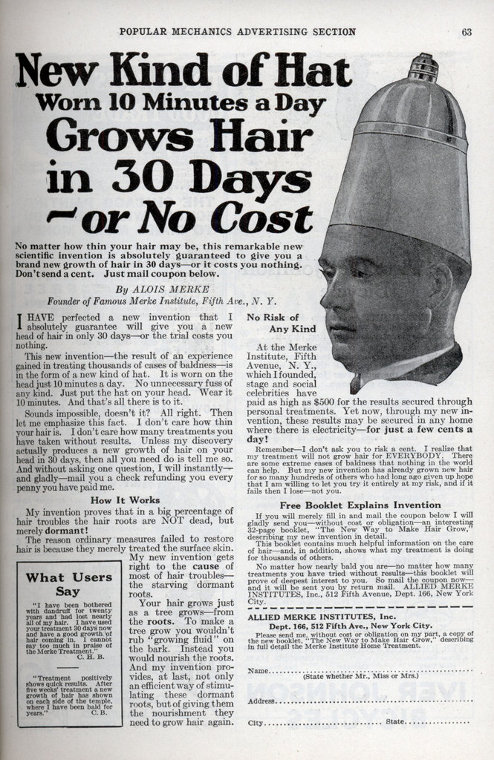
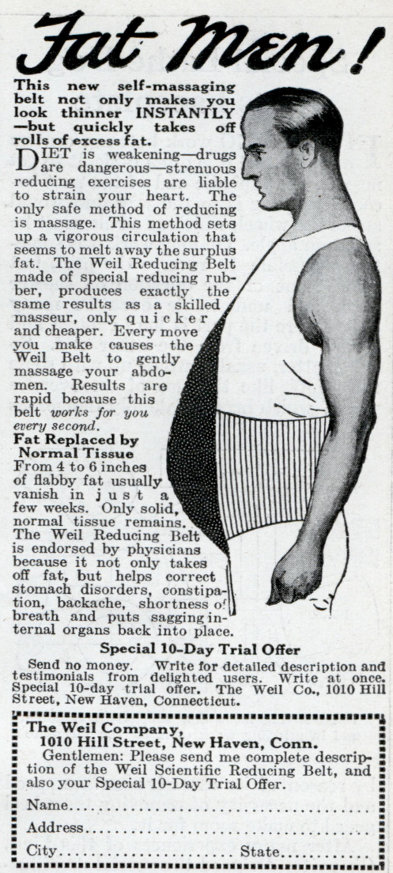
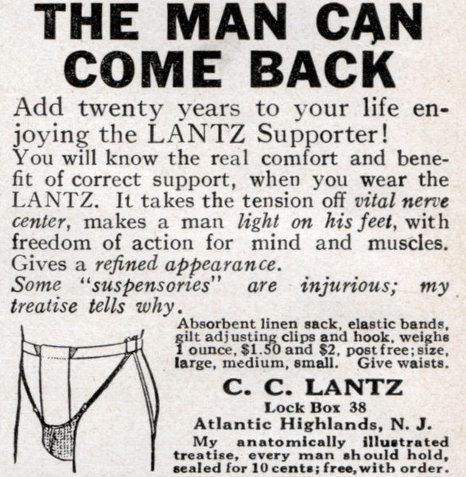
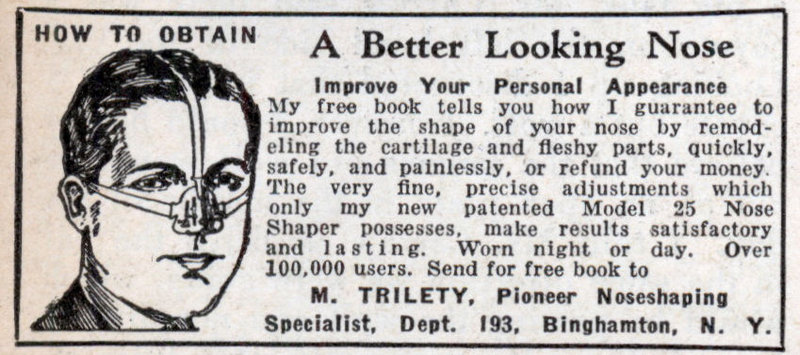
The vintage ads from The Art of Manliness, submitted by Dmitrity T.M., reveal that we have been trying to use technology to change our appearance for quite some time.  Cosmetic surgeries are a brave new world of personal body modification, but they do not represent a break from the past, so much as a historical trajectory.

hat

fat_men1

lrg_man_can_come_back

lrg_better_nose

—————————

Lisa Wade is a professor of sociology at Occidental College. You can follow her on Twitter and Facebook.

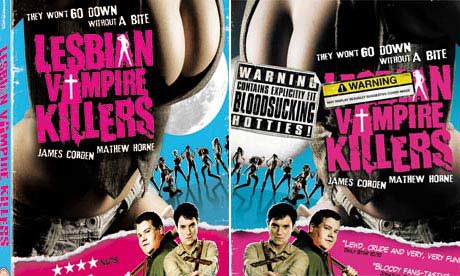
Giorgos S. sent us a link to a story in the Guardian about the cover of DVDs of the movie “Lesbian Vampire Killers.” Some stores are carrying censored versions. Giorgos says he’s seen the censored version at Borders stores in the U.K.:

Lesbian-Vampire-Killers-c-001

So apparently the phrase “they won’t go down without a bite” is fine, and major cleavage requires just a tad bit of coverage with a sticker that says “Warning: Contains explicitly fit bloodsucking hotties!” The sticker that nearly entirely obscures the word “lesbian” says, “Warning: may display sexually suggestive cover image.”

The distributors blame stores, saying a number of large retailers requested that they obscure particular parts of the cover. The stores say they didn’t request that the word “lesbian” be hidden. I suppose we’ll never know what happened there. It does crack me up that you’d be willing to sell a movie called “Lesbian Vampire Killers,” but then be worried about the cover.

The issue of censorship leaves aside, of course, the content of the film itself. This may surprise you, but it was apparently widely negatively reviewed. IMDb summarizes the plot thusly:

Their women having been enslaved by the local pack of lesbian vampires thanks to an ancient curse, the remaining menfolk of a rural town send two hapless young lads out onto the moors as a sacrifice.

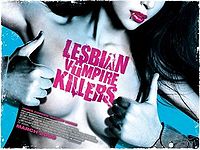
Here’s the original marketing poster:

200px-Lesbian_vampire_killers_film

I like how her nipples have been photoshopped out (unless lesbian vampires have nipples on the sides of their boobs).

If anyone’s seen it, I’d be interested to know if it portrays lesbians as ridiculously as I suspect it does.

See also: airbrushing out men’s nipples.

Kitty sent us this cover for Wad, an “urban fashion and culture magazine.”

retro_image

It kind of sums things up, doesn’t it?

1. Women are objects.
2. Women are for consumption.
3. Women are violable.
4. Women are interchangable.
5. Women are rewards.
6. Violence against women is cute and funny.

Anything else?

UPDATE!  In our comments, KJK notes that there appears to have been a male version of the cover too.  There is no #10 and no text beneath the magazine title… so I’m a little confused as to whether it was a cover.  The production quality seems the same, though.  For what it’s worth, here it is:

WAD

—————————

Lisa Wade is a professor of sociology at Occidental College. You can follow her on Twitter and Facebook.

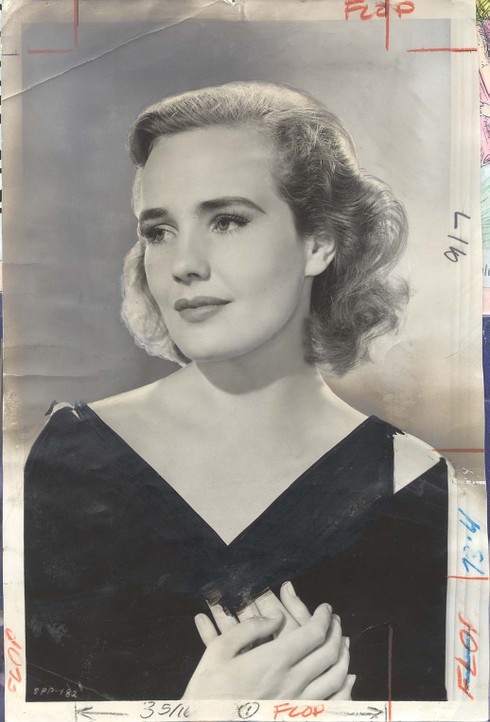
Larry Harnisch of the L.A. Times blog The Daily Mirror sent in some old images from the Times archives that show how photos of stars were touched up to show less skin. Here’s one of Frances Farmer (from Larry’s post about her):

frances_farmer_1940_0910_flowing_go

The image comes from the 1940 movie “Flowing Gold.” Apparently it was considered too revealing and the Times had someone draw in a dress above her wrap…with what appears to be a black magic marker.

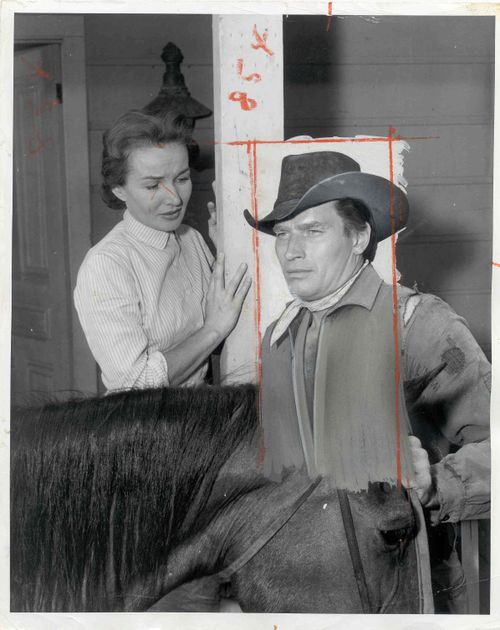
Charlton Heston was also retroactively covered up. Both of the following images come from The Daily Mirror. This is a still from a 1957 episode of “Shlitz Playhouse.” Someone very obviously, and badly, drew a shirt on him:

6a00d8341c630a53ef01156f112b81970c-500wi

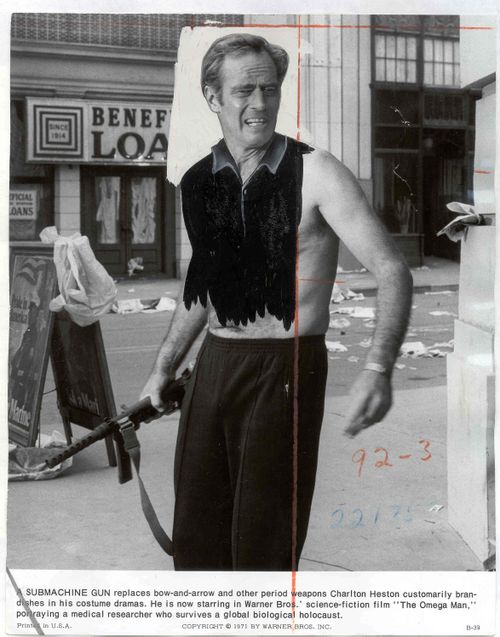
Though the photo was touched up by the L.A. Times staff, it’s not clear whether it actually appeared in the paper. This photo most definitely did, however; it accompanied a review of “The Omega Man” from August 27, 1971. They did an even better job with the shirt this time:

6a00d8341c630a53ef01157008260e970b-500wi

It provides some perspective on how ideas of how much uncovered skin is appropriate to run in a mainstream media outlet have changed over the years. It’s also interesting that both men’s and women’s chests were covered. But mostly they just crack me up. The last one is my favorite.

Also check out the post about Sacha Baron Cohen naked on the cover of GQ and spoofing magazine covers that have naked people on them.