Search results for The


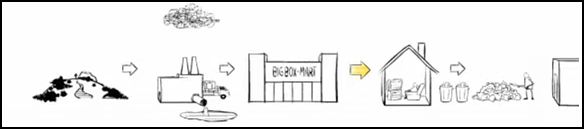
We previously posted Annie Leonard’s breakthrough video, The Story of Stuff, and a follow up, The Story of Bottled Water. Kraig H. sent along another by Leonard on how cap and trade will not stop climate change:

Lisa Wade, PhD is an Associate Professor at Tulane University. She is the author of American Hookup, a book about college sexual culture; a textbook about gender; and a forthcoming introductory text: Terrible Magnificent Sociology. You can follow her on Twitter and Instagram.

I wish I could spend all of my time in New Orleans, my favorite city in the world, so my friends are kind enough to send anything they run across that involves the Crescent City. Two friends forwarded a recent New York Times article on the rise of “sissy bounce,” a new take on bounce — an energetic form of rap/hip hop that originated in New Orleans. “Sissy bounce” refers to a handful of transgendered/gay rappers, some of whom perform in drag. Katey Red and Big Freedia are two of the biggest names in “sissy bounce.”

Like New Orleans itself, the effects of “sissy bounce” are visceral — raw and invigorating, and its club success surely represents an important interruption in a genre known for its homophobia. Looking beyond its woman-hating name, the mere presence of individuals in “sissy bounce” who challenge norms of masculinity and sexuality in bounce is a move toward gay equity.

But I take exception to Times reporter, Jonathan Dee’s claim that “sissy bounce… creates an atmosphere of sexual liberation — for women.”  He describes the typical “sissy bounce” scene: women gathered around the performer, grabbing their ankles and hoisting their gyrating arses in the air.  Dee deems this sexually liberating because, he argues, the female attendees are dancing “for Freedia.” That may well be the case, but videos and pictures from the Times article also show a constant group of men gathered on the perimeter, leering — snapping photos, filming, and shining flashlights on the dancer’s body parts.

Transgender/gay rappers spitting arguably misogynistic lyrics over a sea of throbbing female posteriors while a crowd of men looks on is not sexual liberation. It’s the same old tired show where women’s sexuality revolves around pleasuring the male gaze.


Caroline Heldman is a professor of politics at Occidental College. You can follow her at her blog and on Twitter and Facebook.

This is not a major social issue, and I am not going to make it one. Rather, I think the way this story is being presented in the media effectively illustrates how race matters and is constructed in particular social contexts. Among track and field (“athletics”) aficionados, the 100 meters is frequently considered the premier event. At the elite level, the 100 meters is a power sprint, measuring fast twitch, explosive, kinetic energy manifested through meticulously honed technique.

For males, breaking the 10-second mark is still a colossal accomplishment. One might not think so since track and field doesn’t get much media attention in general (at least not in the United States), and when it does, we’re now more accustomed to watching Usain Bolt blast away his competitors, seemingly cruising to numerous sub-10-second performances (his world record currently stands at 9.58). A few weeks ago sprinter Christophe Lemaitre won France’s national competition with a time of 9.98 second, squeaking below that 10-second mark.  A typical headline of Lemaitre’s accomplishment (from Reuters.com, July 9, 2010):

Lemaitre first white man to run 100m in under 10 seconds

And from the article:

PARIS (Reuters) – France’s Christophe Lemaitre became the first white man to run the 100 meters in under 10 seconds when he clocked 9.98 on Friday, the French athletics federation said.

Lemaitre, 20, set his time during the French championships in Valence, southern France.

“He is the first white man to run the 100 meters in less than 10 seconds,” Jean-Philippe Manzelle, French athletics Federation press officer, told Reuters.

There have been other white sprinters who have excelled at the world level in recent years. Lolo Jones comes to mind in the 100m hurdles; Jeremy Wariner dominated the open 400m in recent years. And if we’re talking sprinters of “outlier” ethnicities in general, Liu Xiang of China recently held the world record in the 110m hurdles. But the early discourse around Lemaitre could be a bit more pointed in the way he is being constructed through the media as a great white hope.

When should race matter in sport, and when it does, how should it be discussed? In this case, at the very least, Lemaitre’s race is framed such that his being “white” is of greater importance than his win. As the track and field season moves on and should Lemaitre continue to run sub-10-second times, I expect to see increased media coverage about his whiteness. He is not going to beat Usain Bolt or America’s top sprinters at international competitions. But on the European circuit, I expect he will make waves. Mainstream media discussion of his success or failure should be interesting to follow.

————————-

David Mayeda is adjunct faculty at Hawaii Pacific University in the Department of Sociology and Legal Studies, where he will also come on board as Assistant Professor this coming fall semester.  His recent book publications include Celluloid Dreams: How Film Shapes America and Fighting for Acceptance: Mixed Martial Artists and Violence in American Society.  He also blogs at The Grumpy Sociologist.

If you would like to write a post for Sociological Images, please see our Guidelines for Guest Bloggers.

Lisa Wade, PhD is an Associate Professor at Tulane University. She is the author of American Hookup, a book about college sexual culture; a textbook about gender; and a forthcoming introductory text: Terrible Magnificent Sociology. You can follow her on Twitter and Instagram.

Jamie Keiles is a new high school graduate from Pennsylvania who embarked on a fantastic project: trying to live according to the advice of Seventeen magazine… and blogging about it.

Her insights are many and she’s funny and accessible. The whole blog is worth reading.  And you can check out her new project at Teenagerie.

In this post, however, I wanted to highlight her analysis of the ad content of the June/July 2010 issue. She writes:

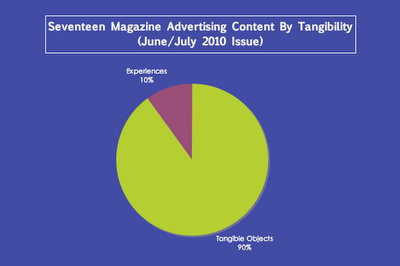
Magazines profit from ad sales more than they do from newsstand sales or subscriptions. From a business standpoint, the essential purpose of magazines (or television, or radio) is to round up a group of similarly demographic’d consumers that advertisers can easily target. I figured that the advertising content might have something to say about what the average Seventeen reader is imagined to be like. In the 171 page issue, there were 91 ad spaces. Here is how the content broke down:

So… mostly, as Jamie puts it, “stuff that makes you look better.” Jamie then broke it down by advertisements for products and ones for experiences:

She ponders:

I’m not heading toward any sort of conclusive argument with these graphs. Just thought it was an interesting exercise to explore how low the bar is set for Seventeen readers when it comes to what advertisers think will interest them. Products advertised definitely skew more toward tangible than experiential, and more toward short-term use than long-term investment. It would be interesting to do a similar data sample with the Economist or the New York Times. Wonder if this way of thinking is something that applies to all demographics, or mostly just teens.

Lisa Wade, PhD is an Associate Professor at Tulane University. She is the author of American Hookup, a book about college sexual culture; a textbook about gender; and a forthcoming introductory text: Terrible Magnificent Sociology. You can follow her on Twitter and Instagram.
Following up on our most recent re-cap of data analysis from OkCupid, sent in by Sara P. and an Anonymous Reader, in this post I summarize their findings on reported sexual orientation and recorded messaging.

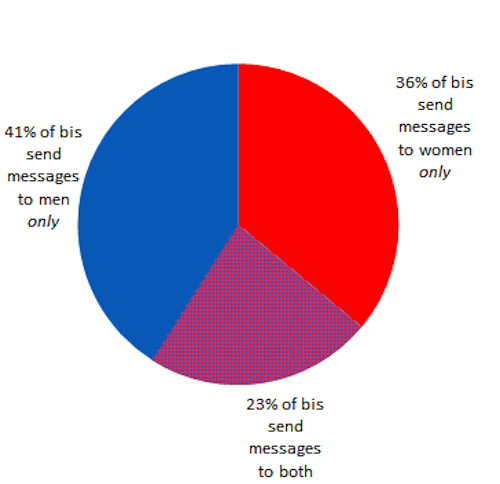
It turns out that a whopping 80% of all users who identify as bisexual message men or women, but not both.

The reasons for this are likely complex, diverse, and not immediately obvious.

Blogger Christian Rudder’s hypothesis:

This suggests that bisexuality is often either a hedge for gay people or a label adopted by straights to appear more sexually adventurous to their (straight) matches. You can actually see these trends in action…

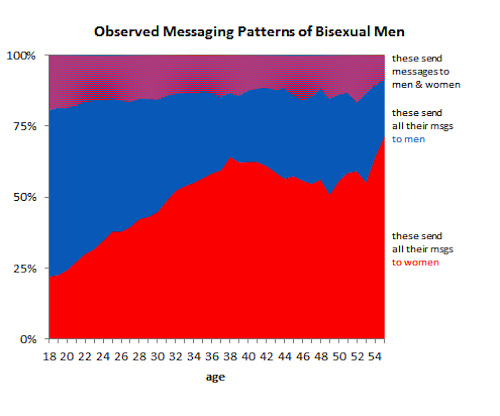
The figure below plots age against the percent of self-identified bisexual men who message both men and women, only women, or only men.  The percent that are bi in practice as well as theory message both men and women drops by about half between the ages of 18 and 54 (from about 20% to about 10%), but men in their 30s and early 40s are much more likely to message only women.  Ticking biological clocks and hopes for a wife and kids perhaps?

The narrowing blue swatch may reflect the possibility that men who once identified as bisexual have come to terms with being plain ol’ gay (but the data isn’t longitudinal, so it may be a cohort thing instead of a life stage thing).

Or perhaps the distribution is the result of an interaction between age and who it’s easy to meet.  Maybe young bisexual guys have an easy time meeting women and turn to the internet to meet men; whereas men in their 30s and beyond find it easy to meet men and so turn to the internet to meet women?

Other ideas?

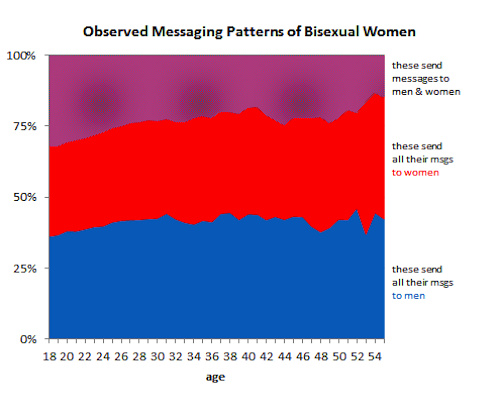
For women who identify as bisexual, the percentages messaging both men and women, just women, and just men show less of a trend across age.

Overall, however, 75% of women who identify as bisexual are not messaging both men and women.  Rudder suggests that there may be a social desirability factor here; that is, that straight women know that men are into bisexual chicks and, so, they claim to be bi in order to appeal to the dudes.

UPDATE: I recommend reading the comments thread for a great discussion of sexual fluidity, the meaningulness of labels like “bisexuality,” and lots more good ideas for why this data looks like it does.

Also from OK Cupid: the racial politics of dating, what women want, how attractiveness matters, age, gender, and the shape of the dating pool, older women want more sex, and the lies love-seekers tell.

Lisa Wade, PhD is an Associate Professor at Tulane University. She is the author of American Hookup, a book about college sexual culture; a textbook about gender; and a forthcoming introductory text: Terrible Magnificent Sociology. You can follow her on Twitter and Instagram.

Last week I linked to the first episode of the 1972 BBC documentary, Ways of Seeing (thanks again to Christina W.).  The second episode, partially embedded below offers an art historian’s perspective on the objectification of women in European art and advertising, starting with paintings of nude women.  “To be naked,” he argues, “is to be oneself.  To be nude is to be seen naked by others and yet not recognized for oneself. A nude has to be seen as an object in order to be a nude… they are there to feed an appetite, not to have any of their own.”

And there’s a very provocative statement about hair and hairlessness (down there) in the midst.

Parts One and Two of Four:

Lisa Wade, PhD is an Associate Professor at Tulane University. She is the author of American Hookup, a book about college sexual culture; a textbook about gender; and a forthcoming introductory text: Terrible Magnificent Sociology. You can follow her on Twitter and Instagram.
The Washington Post recently posted a report called Top Secret America that looks at the proliferation of government organizations (many related to intelligence gathering) that require top-secret clearance and are largely unknown by the public and even many officials. Not surprisingly, the largest concentration is outside Washington, D.C.:

All of these places exist just outside Washington in what amounts to the capital of an alternative geography of the United States, one defined by the concentration of top-secret government organizations and the companies that do work for them. This Fort Meade cluster is the largest of a dozen such clusters across the United States that are the nerve centers of Top Secret America and its 854,000 workers.

Debate about the role of intelligence in protecting the country occurs only when something goes wrong and the government investigates, or when an unauthorized disclosure of classified information turns into news.

The existence of these clusters is so little known that most people don’t realize when they’re nearing the epicenter of Fort Meade’s, even when the GPS on their car dashboard suddenly begins giving incorrect directions, trapping the driver in a series of U-turns, because the government is jamming all nearby signals.

The site has an interactive map where you can see the locations of government (red) and associated private company (blue) locations:

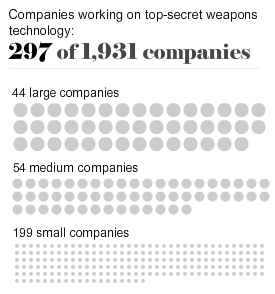
You can also look at networks between agencies and companies working on different programs. Here’s some info on top-secret weapons development:

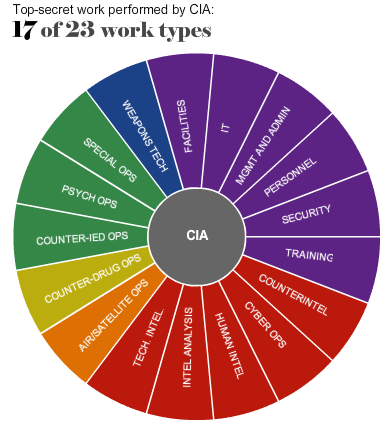
Types of work the CIA does:

There’s a database where you can look up contracted companies for each program or type of work, including location, who they work with, annual revenues, and more.

According to the editor, they spent two years on the investigation and each location is corroborated by at least two public records. They also talked to government officials about security concerns:

Because of the nature of this project, we allowed government officials to see the Web site several months ago and asked them to tell us of any specific concerns. They offered none at that time. As the project evolved, we shared the Web site’s revised capabilities. Again, we asked for specific concerns. One government body objected to certain data points on the site and explained why; we removed those items. Another agency objected that the entire Web site could pose a national security risk but declined to offer specific comments.

We made other public safety judgments about how much information to show on the Web site. For instance, we used the addresses of company headquarters buildings, information which, in most cases, is available on companies’ own Web sites, but we limited the degree to which readers can use the zoom function on maps to pinpoint those or other locations.

I would think there would be ultra-super-mega top-secret locations that their investigation couldn’t uncover because there wouldn’t be public records about them.

Re-posted at Drawing On Indians.

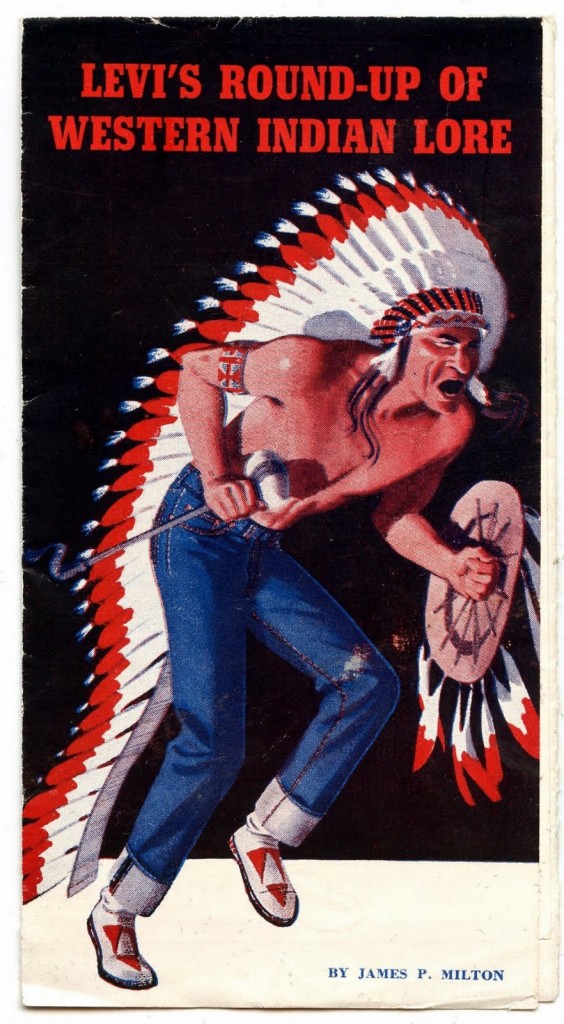
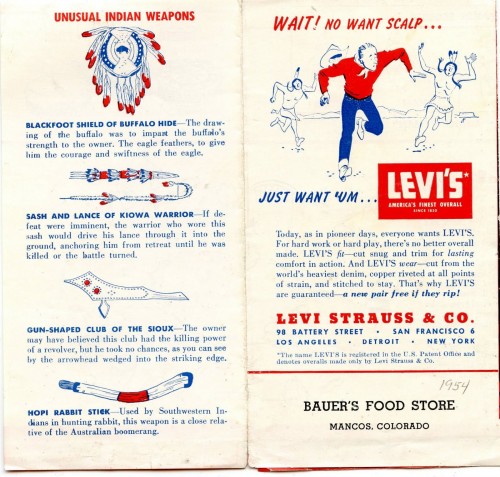
Rob Walker (author of the fascinating book Buying In: What We Buy and Who We Are) sent me a link to a post at Drinkin’ and Dronin’ of a 1954 Levi Strauss brochure about “western Indian lore.” It’s a nice round-up of stereotypes and appropriations of Native Americans. We start off with an angry, bare-chested (and Levis-clad) man with a tomahawk, shield, moccasins, and headdress; I’d guess he’s supposed to be a warrior doing a war dance:

Then some descriptions of items associated with different tribes and the obligatory broken English (“just want ‘um”) familiar to anyone who watched The Lone Ranger and paid attention to Tonto:

I have no idea how accurate their descriptions of “unusual Indian weapons” are, but the overall tone of the brochure doesn’t inspire a lot of confidence.

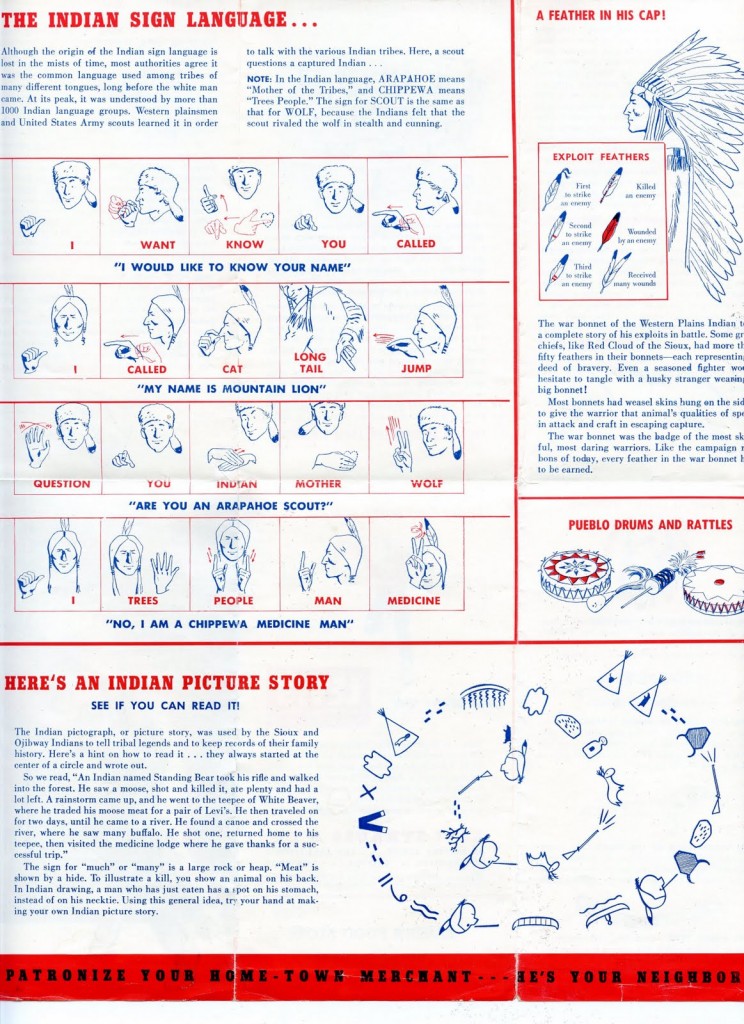
And we have a lesson on “the Indian sign language,” the origins of which are “lost in the mists of time”:

Related posts: Potowatamis didn’t have a word for “global business center,” “discovering” Newfoundland, appropriation of Native Americans in fashion, teaching kids how to be American Indians, marketing the Vancouver Olympics, ice skaters dress up like Australian aborigines, native cultures in Avatar, Poca-Hotness, Indian costume for your dog, Indian Halloween costumes, Disney depicts Native Americans, “my skin is dark but my heart is white,” American Indians on t-shirts, sports mascots, Playmobil’s American Indian family, Howe Nissan’s American Indian statue, the “crying Indian” anti-litter PSA, Native Americans in Italian anti-immigration posters, and more American Indian dolls.

Also check out Adrienne K.’s blog Native Appropriations for lots of examples.