Search results for The

I found this Levi’s ad a while back and kept forgetting to post it:
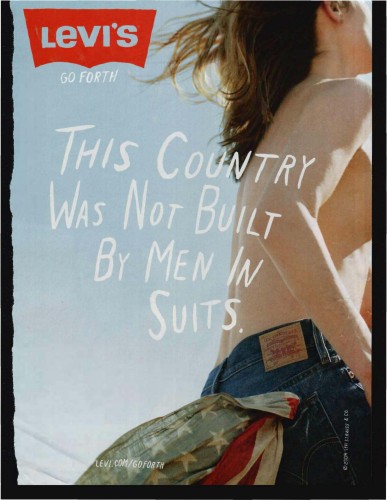
What I think is interesting is the implicit class element, in which “men in suits” (presumably middle- and upper-middle-class white-collar workers) are less authentically American. The message is that hard working, jeans-wearing people are true Americans (notice the flag). Of course, it’s also a commentary on masculinity; the type of men who dominate economic and political life today are, from this perspective, lesser men compared to earlier generations of blue-collar workers.

For other examples of class and masculinity in ads, see old vs. new money in a Smirnoff video, upper-class dogs are sissies, and Acura says trust-fund money is out.

Etan B. sent in an interesting case of both stereotyping women (generally as annoying) and interpreting everything they do through the lens of gender difference. Dan Steinberg posted an article on D.C. Sports Blog, a blog of the Washington Post, about comments yesterday by Rob Dibble, a sports commentator for Fox News and for the D.C. baseball team the Nationals on the Mid-Atlantic Sports Network channel during televised games. Dibble was apparently fascinated by the fact that a group of women attended the game and, like, talked and stuff. Here are the women to whom he repeatedly referred (he’s also the one who circled them on the screen so viewers could clearly see them):

Steinberg transcribed some of Dibble’s comments:

Those ladies right behind there, they haven’t stopped talking the whole game…They have some conversation going on. Right here…There must be a sale tomorrow going on here or something….Their husbands are going man, don’t bring your wife next time.

Then:

…now they’re back there, they’re eating ice cream and talking at the same time…

Later:

…they’re right there, still talking…

And:

I was just thinking, those women, there’s a new series, Real Housewives of D.C., that just came out…Maybe they’re filming an episode?

This is a perfect example of the way we interpret behavior depending on the gender of the person engaging in it. While I’m by no means a big fan, I have been to baseball games, everything from my nephew’s Little League game for 6-year-olds (seriously hilarious, since the kids mostly run from the ball, stare into space, and have very little idea what’s going on) to major-league games. Everyone eats and talks during the game, at the same time, even. Quite a few spectators consume a lot of beer, after which their conversations become more animated. Sure, they pay more attention at some times than others, but going to a baseball game is a pretty social event that does not involve staring intently at the field at all moments. In fact, the very fact that Dibble was making all these comments means he wasn’t focusing solely on events on the field himself.

But these mundane activities drew Dibble’s attention because women were doing them. Since he stereotypes women as not having a real interest in baseball, their presence, and willingness to talk and eat food, and then talk more, is a sign that they aren’t there for the right reasons and are probably ruining the game for the men around them. They must be talking about typically girly things like shopping. Or maybe they’re there because they’re part of a TV show! That is definitely the most logical explanation.

In a society where gender differences are emphasized, and where femininity is devalued, anything women do may be viewed negatively, even when (or because) men do the exact same thing. The things these women did would almost certainly go unnoticed if a group of men did them, and wouldn’t have attention drawn to them throughout the game. But because it was women, eating and talking becomes noteworthy and bizarre, if not outright annoying, and their presence at all requires explanation.

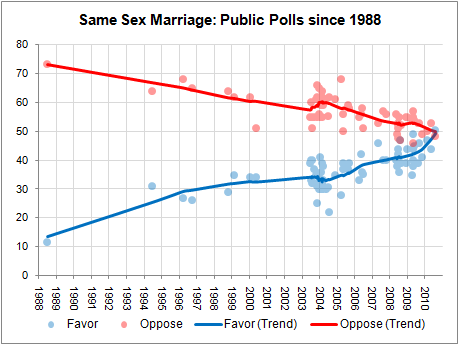
Nate Silver at FiveThirtyEight posted this graph that shows changes in attitudes toward same-sex marriage over time (each dot represents a poll Silver considers reliable). As he points out, there seems to be an acceleration in positive attitudes toward same-sex marriage:

CNN just conducted the first poll showing that a majority of Americans believe same-sex marriage should be legal. That’s just one poll, and we’ll need to see more data, obviously. But we can clearly see that an increasing number of polls show the % favoring same-sex marriage at or above 45%. A regression of all the polls shows a 4 percentage point increase in the last 16 months alone. If this trend continues, we should be nearing the point where differences in support for and opposition to same-sex marriage would fall within the margin of error.

Silver suggests that activism among gay and lesbian rights groups, including a specific push for recognition of same-sex marriages, has led to more acceptance:

Something to bear in mind is that it’s only been fairly recently that gay rights groups — and other liberals and libertarians — shifted toward a strategy of explicitly calling for full equity in marriage rights, rather than finding civil unions to be an acceptable compromise…it seems that, in general, “having the debate” is helpful to the gay marriage cause…

Of course, presuming this trend continues and we soon have a majority (even if not an overwhelming one) of Americans supporting legalization of same-sex marriage, that does not necessarily translate into legalization. Acceptance of same-sex marriage is surely unevenly distributed across the U.S. If legalization is left to the states, we can assume some will be much more likely to accept same-sex marriages than others, continuing the patchwork system we have now where gays and lesbians may find themselves married in one state but unmarried if they go on vacation to a neighboring one. National legislation to legalize same-sex marriage would be strongly opposed by a number of legislators from districts where acceptance is below the national average; I’m guessing that even many Democrats, who are usually depicted as more friendly to gay and lesbian rights than Republicans, would not go so far as to vote to legalize gay marriage in the near future. During the campaign, Obama and Biden clearly stated that they supported civil unions but not marriage for same-sex couples.

On the other hand, the federal judicial system could take this out of the hands of Congress and the Senate, or individual states; same-sex marriage could be legalized whether or not a majority of Americans supported it. But short of that, while changes in public attitudes toward same-sex marriage certainly present an encouraging picture for supporters, I think legislative action to actually legalize it is likely to lag significantly behind overall public acceptance.

Previously we’ve posted on the sexy makeovers recently given to Dora the Explorer, Strawberry Shortcake, Holly Hobby, and the Sun Maid.  Here we have three more.

Lisa Frank

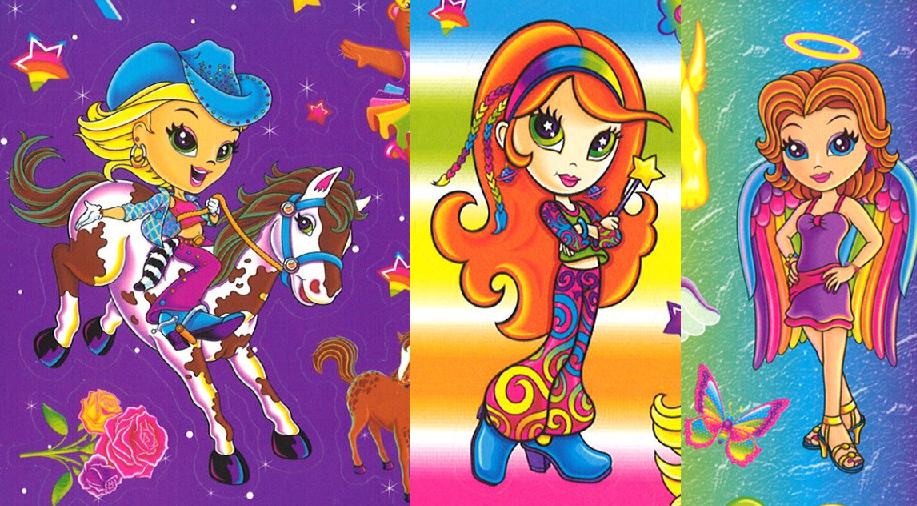
Andy Wright at the SF Weekly recently posted about a new look for Lisa Frank art.  If you’re a woman in your 30s, like me, you probably remember this art vividly.  As Wright describes it, it “…was a branded line of school supplies consisting of Trapper Keepers and folders that looked like they were designed by a six-year-old girl on acid.”

When I was a kid, Lisa Frank didn’t include any people. But today it appears that they’ve added, well this:

Wright: “I have to wonder if little girls actually are more interested in bizarrely proportioned nymphets dressed like sexy hippies than a righteous day-glo tiger cub.”

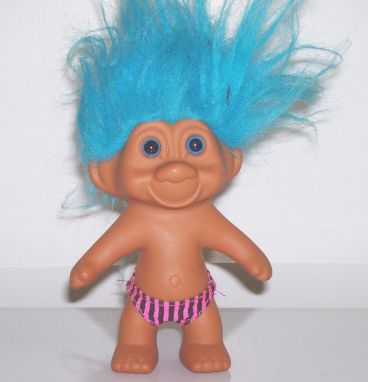
Trolls, now Trollz

Remember Trolls?  Growing up, I remember them looking something like this (source):

But apparently now they look like this (source):

Cabbage Patch Kids

This is a vintage Cabbage Patch Kid from 1983 (source):

This is the front page of the website today:

They still make “Classic” Cabbage Patch Kids, but now they also make “Pop ‘N Style”:

Lisa Wade, PhD is an Associate Professor at Tulane University. She is the author of American Hookup, a book about college sexual culture; a textbook about gender; and a forthcoming introductory text: Terrible Magnificent Sociology. You can follow her on Twitter and Instagram.

Martin Hart-Landsberg, at Reports from the Economic Front, offers a provocative hypothesis.  He observes that job loss in the U.S. has been tremendous. One in 20 jobs has disappeared.  Still, Congress drug its feet approving an extension of unemployment benefits.  The extension has been approved, but benefits are hardly generous (on average, $309 a month week).  Further, millions of unemployed people are not collecting unemployment because they’re not eligible under current policy.

Hart-Landsberg asks why there is a lack of “meaningful national efforts” to address the suffering of workers and their families?

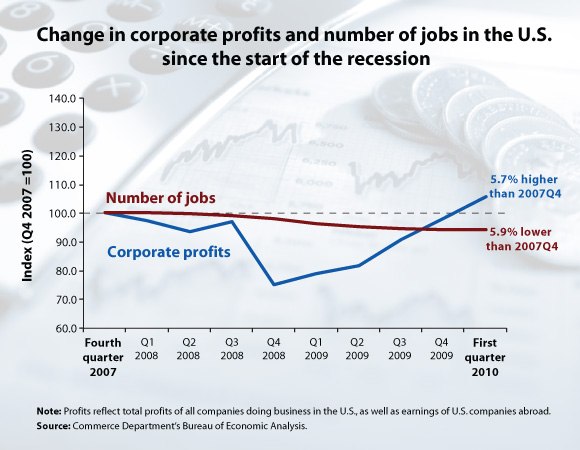
His hypothesis:  Economic policy is not responsive to workers’ needs.  Instead, it is heavily driven by what is best for corporations.  And, it turns, out, corporations are doing swimmingly during the recession.  They took a beating at first, but their profits are up.  Downsizing appears to have benefited them.  Consider this chart from the Economic Policy Institute (EPI):

The EPI concurs with Hart-Landsberg.  Looking at this data, Lawrence Mishel concludes:

When employers are able to recover their profits many years before their employees can even hope to attain the income and employment levels they had  prior to recession’s devastation, economic policy is clearly skewed in favor of corporations and not workers.

Lisa Wade, PhD is an Associate Professor at Tulane University. She is the author of American Hookup, a book about college sexual culture; a textbook about gender; and a forthcoming introductory text: Terrible Magnificent Sociology. You can follow her on Twitter and Instagram.

White people should worry about racism.  They should worry about racism because it’s wrong.  But if that’s not enough of a motivation, they should worry about it for their own damn good.  Philip Cohen of Family Inequality shows us how so with a discussion of a recent paper published in the Journal of the American Society of Nephrology.

The Figure below illustrates the percentage of black (grey bar) and white (white bar) residents who went into end-stage renal disease (kidney failure; ESRD) before ever seeing a doctor specializing in kidneys (a nephrologist).  As we move from left to right, the zip codes in which patients live becomes increasingly populated by black people.

What we see is that, in any given neighborhood, black people are always less likely to get access to a kidney specialist before their kidneys fail; but also that white people living in a neighborhood with a higher percentage of blacks are less likely than whites in a more white neighborhood to see a specialist.  So much so that whites living in neighborhoods that are more than 50% black are less likely to see a specialist than blacks living in neighborhoods that are less than 25% black.

Cohen specifies that…

…the relationship still holds even when individual socioeconomic status, and local-area socioeconomic status, are controlled. So it’s not just a poverty effect.

Somehow places that are “blacker”, even when they are not poor, are serviced with inferior health care compared to places that are “whiter.”  And everyone suffers for it (though not necessarily equally).

Lisa Wade, PhD is an Associate Professor at Tulane University. She is the author of American Hookup, a book about college sexual culture; a textbook about gender; and a forthcoming introductory text: Terrible Magnificent Sociology. You can follow her on Twitter and Instagram.

Crystal and Corina C. sent in this image of an ad for Snack Factory Pretzel Crisps that recently appeared around NYC (from The Gothamist):

The ads led to some local resistance among those who felt the tagline, while meant to refer to the size of the pretzels, also links to ideas about body size. Here’s a video of a man making some modifications to one of the ads (from Salon):

According to NYC the Blog,

Responding to the criticisms via Twitter, Pretzel Crisps insisted they are just “using the word ‘thin’ in a creative way to describe our product,” and people are “interpreting [the ads] in their own way.”

Later they made another statement:

We hope people noticed what isn’t in the ads: No extra thin, scantily clad female models; No mention of dieting programs, points, etc… Our website and facebook page are all about EATING. We talk about pairing our product in different ways for appetizers. We want people to eat.

Finally, Pretzel Crisps announced they’re taking down the ads.

What struck me was the importance of social media in this whole process. Sites such as NYC the Blog publicized the resistance, magnifying its effect (would the company have even known about the guy pasting images to their ad if he hadn’t gotten NYC the Blog to post his video of it?); Pretzel Thins responded via Twitter; and the ongoing publicity of the criticisms as well as complaints to the company (which are a lot easier to make as a response to a tweet than if you have to look up contact info and get in touch individually) eventually led the company to end the ad campaign.

For a different example of resistance, see Lisa’s recent post on an astroturf protest campaign.

UPDATE: Well. As commenter Rebecca pointed out, they replaced those ads with new ones that indicate they may not have quite gotten the point of the criticisms (via Jezebel):

Way back in June, Eszter H., Eric B., and Kasia G. sent in an image that the Chicago Tribune ran, in early June, of Philadelphia Flyers hockey player Chris Pronger wearing a figure-skating skirt with a sparkly hem, referring to him as “Chrissy” and including the line “Looks like Tarzan, skates like Jane” (image from USA Today):

The Tribune was counting on the fact that femininity is stigmatized for men; thus, they don’t have to say anything meaningful about Pronger or make a specific claim. Just linking him to femininity — through clothing, name, and language — is enough to make fun of him. Of course, this isn’t just about mocking Pronger. By default, using femininity to ridicule men involves devaluing women and things associated with us. Someone who “skates like Jane” — that is, like a girl — is laughable.

Angela Ruggiero, head of the U.S. women’s hockey team, clearly understood the connection and didn’t appreciate it (from ESPN):

“I’d like to see that editor out on skates. I’ll take them one-on-one on the ice any day,” three-time Olympic medalist Angela Ruggiero told The Associated Press. “They obviously have never seen women’s hockey and are living in the dark ages.”

Ruggiero found out about the poster via Twitter and expressed disappointment and anger that such demeaning portrayals of women and hockey are still being made.

It’s a great example of the use of femininity as stigma, a process that harms both men (who have to eschew anything associated with women) and women (who are encouraged to perform a devalued and often ridiculed gender ideal).