
Search results for The

Allegra K. suggested that we take a look at Palin-based pro-conservative message from PalinPAC for this past November’s election. The nearly-two-minute commercial is an excellent example of a gender-specific populism. We recently discussed populism in response to Christine O’Donnell’s “I’m Not a Witch, I’m You” commercial.  Populism is, by definition, in opposition to elitism.  Political populists believe that the average person is better suited to lead than the exceptional person.  In this ad, Palin attempts to personify not just the average person, but the average mom.  Allegra writes:

Throughout the video, numerous women are pictured. However, they are a specific type: they are the “real” women; not models, or especially good-looking, dressed up, or even business or political figures. They are “average moms”…

The average woman, according to Palin, is the American hockey mom (just like her), who is (supposedly) middle class, an at-home mom, who cooks and cleans, takes her multiple children to school, and then to after school sports, probably drives a mini van, and uses Clorox on her sons’ jerseys after they get muddy at practice.  Palin puts the power of change in their hands because, she says, “moms just kinda know when somethin’s wrong.”

A “just kinda know” kind of knowledge (based on the notion of female intuition) is a great example of Palin’s gendered populist message.

Lisa Wade, PhD is an Associate Professor at Tulane University. She is the author of American Hookup, a book about college sexual culture; a textbook about gender; and a forthcoming introductory text: Terrible Magnificent Sociology. You can follow her on Twitter and Instagram.

In a fantastic example of the way being single is stigmatized, Rachel K. took a photo of this ad she saw at a bus stop in Toronto:

I’m afraid this is the last post you will get from me. You see, I’m single, and it’s just occurred to me how very much my life sucks, with no one to give me sparkly things. I am going to drop everything and dedicate myself full-time to finding a mate.

I mean, really. It’s an interesting assumption that being unmarried (I presume that’s an engagement ring) means you are “alone.” And I’d say that what sucks isn’t being “alone,” it’s being told constantly that you must be sad and miserable since you aren’t coupled up.

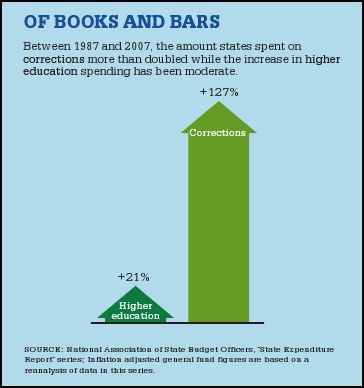
The number of Americans under correctional control has more than tripled since the 1980s, up to 1 in 31 U.S. citizens.  And the U.S. incarcerates six times more of its citizens than many European countries.  As you might imagine, this is very expensive.  Between 1987 and 2007, the amount spent on corrections increased by 127%.  To put this in perspective, the amount spent on higher education has only increased 21%.

The Pew Center illustrates the disparity:

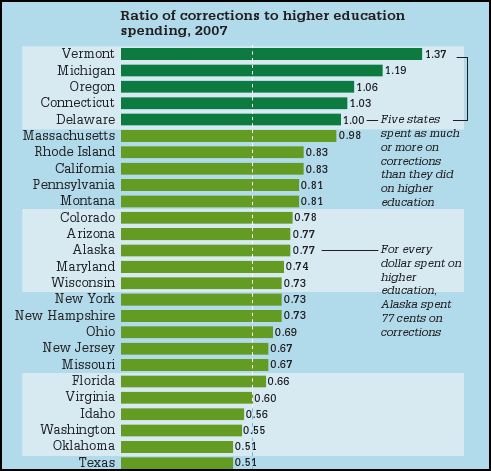
States varied in the ratio of corrections to college spending.  The dark green bars (Vermont, Michigan, Oregon, Connecticut, and Delaware) are for states that spend as much or more on higher education than corrections corrections as on higher education The rest spend less.  Minnesota has the most extreme ratio; it spent 17 cents on higher education for every dollar it spent on corrections. Vermont has the most extreme ratio, Minnesota the least:

[Sorry for the initial confusion with the graph.]

Lisa Wade, PhD is an Associate Professor at Tulane University. She is the author of American Hookup, a book about college sexual culture; a textbook about gender; and a forthcoming introductory text: Terrible Magnificent Sociology. You can follow her on Twitter and Instagram.

In this video, which I found via my friend Captain Crab, Kate O’Beirne (editor of the National Review) attacked the federal subsidized school breakfast and lunch programs. She did so by stating that parents who would find the program necessary must be “criminally negligent,” since they can’t put food on the table:

Transcript (via):

The federal school lunch program and now breakfast program and I guess in Washington DC, dinner program are pretty close to being sacred cows… broad bipartisan support. And if we’re going to ask more of ourselves, my question is what poor excuse for a parent can’t rustle up a bowl of cereal and a banana? I just don’t get why millions of school children qualify for school breakfasts unless we have a major wide spread problem with child neglect.

You know, I mean if that’s how many parents are incapable of pulling together a bowl of cereal and a banana, then we have problems that are way bigger than… that problem can’t be solved with a school breakfast, because we have parents who are just criminally… ah… criminally negligent with respect to raising children.

It’s an excellent example of the stigmatization of poverty: letting your kids go to class hungry would make you a bad parent, but taking advantage of programs set up to be sure kids don’t go to class hungry (and thus less able to learn) also makes you a bad parent. The problem here isn’t structural, or even about poverty. The problem, from O’Beirne’s manner of framing it, is that individuals who enroll their children in such programs are, by default, negligent “poor excuses” for parents.


Religious people around the world express their devotion to God(s) in widely disparate ways. When children are raised in a particular religious institution, then, it is not enough to believe; they must also learn how to worship as others around them do.

The amazing one-minute video below shows Ava Grace, a child of about two, at Ignited Church in Lakeland, Florida (source).  The clip beautifully illustrates the socialization of children into particular kinds of worship.  With hand motions, body movements, and facial expressions, this child is doing a wonderful job learning the culturally-specific rules guiding the performance of devotion.

See also: The Evangelical Habitus. Via Blame it on the Voices.

Lisa Wade, PhD is an Associate Professor at Tulane University. She is the author of American Hookup, a book about college sexual culture; a textbook about gender; and a forthcoming introductory text: Terrible Magnificent Sociology. You can follow her on Twitter and Instagram.
Cross-posted at Ms.

Previously we’ve posted on the sexy makeovers recently given to Dora the Explorer, Strawberry Shortcake, Holly Hobby, Lisa Frank, Trolls, Cabbage Patch Kids, and the Sun Maid.  Here we have three more.

My Little Pony

The original My Little Pony, chubby and adorable (source):

Today they’re thinner, with an open mouth, more provocative stances, and more responsive positions (source):

Rainbow Brite

Vintage Rainbow Brite:

Rainbow Brite today:

Finally, Monika alerted us to the new look for Candy Land.  First, vintage Candy Land.

1949:


1955:


1962 Candy Land book:

2005:

From the website of Candy Land today:

Lisa Wade, PhD is an Associate Professor at Tulane University. She is the author of American Hookup, a book about college sexual culture; a textbook about gender; and a forthcoming introductory text: Terrible Magnificent Sociology. You can follow her on Twitter and Instagram.

Alex W. sent in a 1972 ad for Weyenberg Massagic shoes (a version of which was reprinted in Ms. magazine in 1974, after appearing in Playboy). The ad uses subtle imagery and text to imply that if men buy the right footwear, women will be so entranced that they will remain in their natural habitat, the floor (more specifically, as reader Jamie points out, at your feet), just for the chance to gaze at the beautiful product:

Michael Konczal summarizes a depressing story for today’s unemployed and all of us in nations hardest hit by the current recession (via ginandtacos).

Till von Wachter, Jae Song and Joyce Manchester show that unemployment’s negative effect on your pocketbook persists long after re-employment. The figure below shows what happened to the incomes of people who did and did not lose their job during the 1982 recession. It shows that those that lost their jobs (the grey line) saw a decrease in earnings that has yet to recover. Controlling for inflation, on average the unemployed make less now than they did before they lost their jobs 20 years ago.

Quotes Konczal:

…the net loss to a displaced worker with six years of job tenure is approximately $164,000, which exceeds 20 percent of the average lifetime earnings of these workers. These future earnings losses dwarf the losses associated from the period of unemployment itself.

This same pattern can be found at the society level. Michael Greenstone and Adam Looney made the same comparison across countries that were hit the hardest by the recession (purple line) and countries hit less hard (green line). The incomes of individuals in the hardest hit nations were harmed long-term:

Greenstone and Looney show the same pattern for the unemployment rate:

Lisa Wade, PhD is an Associate Professor at Tulane University. She is the author of American Hookup, a book about college sexual culture; a textbook about gender; and a forthcoming introductory text: Terrible Magnificent Sociology. You can follow her on Twitter and Instagram.