Search results for The


Andi M. sent in a video created by J.C. Penney called “The Doghouse.” The ad tells the story of men sent to the doghouse by their wives for various bad behaviors, but mostly for giving bad Christmas gifts. A bad gift is a non-romantic gift, or a gift that is related to housework, or that implies a woman needs to lose weight or change her appearance:

As Andi points out, the ad portrays men as idiots or even actively mean-spirited. But I’m also interested in the way we define what are appropriate gifts for women. We often see “practical” gifts as perfectly acceptable to give to men. But increasingly, gifts for women are supposed to be essentially romantic, a symbol of love, not usefulness, a cultural trend the jewelry industry, in particular, has encouraged and benefited from.

In this ad, we have several “bad” gifts — more computer memory, a vacuum cleaner, facial hair remover, and a work-out accessory. All are presented as equally idiotic choices for men to make. So getting a woman something that might significantly improve her computer is just the same as giving her something to work out with, while actively mocking her body and eating habits. Any non-romantic gift is risky, even if accompanied by an attempt to be sweet (see the poor computer memory guy).

I’ve discussed before research on low-income women who complain when they feel that men waste money on romantic but non-essential gifts rather than stuff they actually need. On the other hand, I asked one of my classes about what they would consider an acceptable gifts, and I was (probably stupidly) surprised that many of the women in the class were adamant that useful or helpful items were nice to get, but only in addition to a romantic gift, never as the “main” gift itself. A couple said they’d feel bad if their female friends were showing off jewelry they got for Valentine’s Day or Christmas and they didn’t have anything to show, because their friends would assume their boyfriends/husbands weren’t romantic or didn’t love them very much. So it was less about whether they wanted jewelry than that they knew other women did, and thus feared their friends would judge their relationships if they didn’t get the right gift to “prove” they had good partners.

I think ads like this both reflect and reinforce this social pressure to buy the “right” kind of gifts for women. J.C. Penney tapped into an existing cultural norm about what kinds of gifts women want, and then reinforces it by presenting jewelry as the only means available to men to get out of the doghouse, and shows all women as being in complete agreement about what an acceptable gift is.

UPDATE: Reader Josh Leo pointed out that the ad also portrays the doghouse as a place men are tortured by having to do feminine things:

…all they are fed in “the doghouse” is Quiche and Chai Latte’s. This is clearly a statement that these foods are feminine an almost a form of torture for “Real Men.”



In this six-minute video from the New York Times, past residents and developers describe how Times Square was transformed from “the sleaziest block in America” to the corporate palace that it is today.  Thanks to Dmitriy T.M. for the submission!

Lisa Wade, PhD is an Associate Professor at Tulane University. She is the author of American Hookup, a book about college sexual culture; a textbook about gender; and a forthcoming introductory text: Terrible Magnificent Sociology. You can follow her on Twitter and Instagram.

Back in September, I posted about some maps put together by Eric Fischer, using 2000 Census data, showing the racial/ethnic makeup of selected cities. As Jeff H., Eluned J., and Dmitriy T.M. pointed out, the NYT now has up an interactive map where you can see the racial/ethnic composition of any Census tract, using more updated Census Bureau data from 2005 to 2009. For instance, here’s a map of the neighboring cities of Midland and Odessa, Texas, which I picked for no reason other than that I just watched an episode of Friday Night Lights, which is set in a fictionalized version:

Color key:

You can zoom in to get quite detailed information about individual neighborhoods. I zoomed in as far as I could on Miami (each dot now represents 50 people):

There’s also a tab that says “View More Maps.” It allows you to select to see just the distribution of Whites, Blacks, Hispanics, Asians, or the foreign-born population. Here’s the map of the Hispanic population of Las Vegas:

As you can see, if you hover over a Census tract, you can get specific data on its racial/ethnic makeup.

The foreign-born population of Seattle (if you hover over a tract, it will tell you the % foreign-born, as well as the % increase in the foreign-born population since 2000):

A great resource. Although I tried to look up my home town, and even zooming in to the smallest scale, it’s too small to have any data available.

In the late 1800s, one suffering from impotence, addiction to morphine, or belly aches might be prescribed John Pemberton’s French Wine of Coca.   The wine concoction contained caffeine and 8 1/2 milligrams of cocaine (equivalent to snorting about 1/2 line).

(source)

(source)

Prohibition’s arrival in Atlanta in 1886 led Pemberton to re-write his recipe to exclude the alcohol.  Pemberton advertised it as the “great national temperance beverage.”  In 1903, when cocaine was outlawed, Pemberton had to rework his recipe again.  Coca Cola, as we know it, was born.

See The Digital Deli Online for more.

Lisa Wade, PhD is an Associate Professor at Tulane University. She is the author of American Hookup, a book about college sexual culture; a textbook about gender; and a forthcoming introductory text: Terrible Magnificent Sociology. You can follow her on Twitter and Instagram.

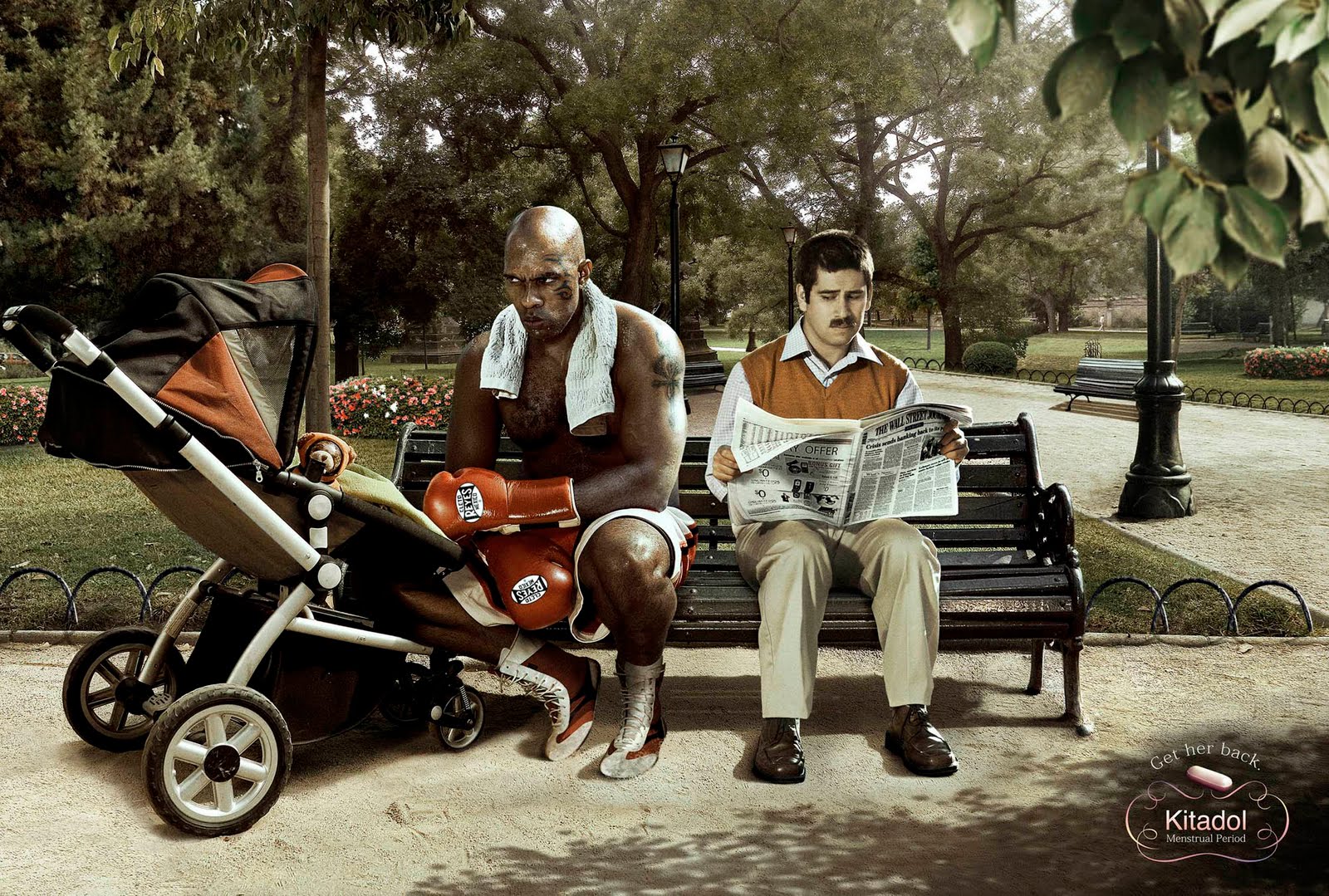
Dmitriy T.M. sent in a Chilean ad for menstrual relief pills, posted at Copyranter. The ad plays on the old trope that during their periods, women turn into savage beasts, unrecognizable compared to their normal selves. In this case, menstruating women turn into burly, hairy, enormous Vikings:

Going with the same theme, another ads for the same company depicted a woman as a large Black boxer:

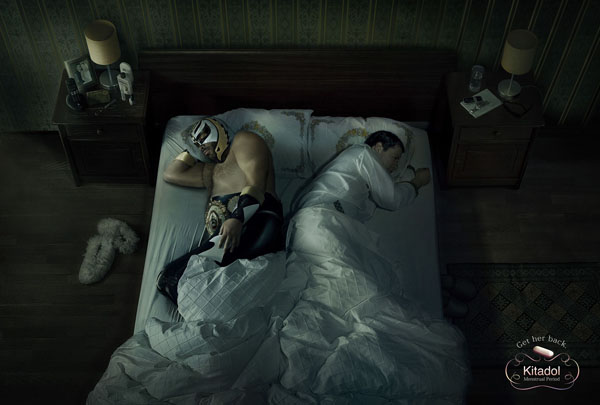
And another includes a Mexican wrestler:

What I find fascinating here is the presentation of menstruation as something that masculinizes women. We’re talking about a biological process unique to women, the foundation of women’s ability to reproduce; if you were a biological essentialist, you could argue that it is, in fact, the essence of womanhood. Yet here, the message is that menstruation steals femininity, temporarily turning women into large, intimidating, unattractive, violent non-women who must be managed and tamed by the men in their lives, with the help of the right medication.


In the 2-and-a-half-minute video below, sent in by Lisa G., a decorated concert violinist named Joshua Bell plays in a Metro station at L’Enfant Plaza in Washington D.C. for 45 minutes. Over 1,000 people walk by without turning their heads, 27 give money, and 7 people stop to listen for a minute or more (source).  Lisa G. summarizes:

Bell recalls that an awkward moment ensued every time he was done with a song because no one applauded or even acknowledged his existence because to these passengers he was just another street performer begging him for a dollar.

What makes Joshua Bell worth listening to?  The experiment points to the importance of context.   How do we know that we are listening to a master musician?   One important clue is where they are playing, and how expensive it is to have the opportunity to listen.   In a concert hall full of seats paid for with large bills, Bell’s talent is authenticated by the arbiters of taste who are the gatekeepers of the venue. Concert-goers do not necessarily know whether or why Bell is any good. They rely on the arbiters to determine who is worth listening to. And listening to who it is that is worth listening to provides them with expensive, and therefore scarce, cultural cred. They have seen Bell in concert (“oh and it was glorious!”); have you?

But in the Metro, Bell is no one. The context of the Metro fails to authenticate Bell’s music. Everyone can listen, thus hearing offers no distinction at all. And almost no one cares.

Lisa Wade, PhD is an Associate Professor at Tulane University. She is the author of American Hookup, a book about college sexual culture; a textbook about gender; and a forthcoming introductory text: Terrible Magnificent Sociology. You can follow her on Twitter and Instagram.


In Deadly Persuasion, Jean Kilbourne discusses the tactics of car advertisers.  Cars, she argues, are offered as keys to happiness.  Often they are anthromorphized, even positioned as a lover or a soul mate.

In this commercial, sent in by Jennifer G., we see just this sort of advertising. The car is described with the words “luxury,” “fire,” “bold,” and “daring.” It is, indeed, “…capable of moving your soul…”

The idea that we are moved by this advertising might seem patently ridiculous.  Phil Patton of the New York Times, however, reports the findings of a Mercedes/Roper survey:

…36 percent of Americans said they loved their car and 23 percent considered their car their best friend. The poll found that 12 percent of respondents said their car understood them better than their significant other.

Lisa Wade, PhD is an Associate Professor at Tulane University. She is the author of American Hookup, a book about college sexual culture; a textbook about gender; and a forthcoming introductory text: Terrible Magnificent Sociology. You can follow her on Twitter and Instagram.

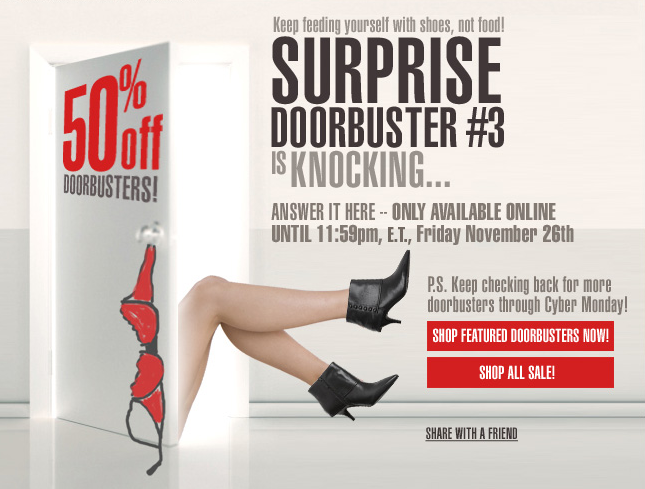
Chloe L. sent along an analysis of a post-Thanksgiving advertisement she received in the mail:

The ad, Chloe points out, manages to cover quite a bit of ground.   The tag line at the very top (“Keep feeding yourself with shoes, not food!”) tells women to forgo eating in favor of figurative consumption. This resonates with the cultural expectation that women’s primary purpose is to be, as Chloe puts it, “aesthetically pleasing for others.” She is also presented as a sexualized object. Chloe again:

Though we cannot see more than legs, we know that it is a woman by her feminine high-heeled booties and shaved legs… [she] is presumably naked with her bra hanging on the door knob.

The image, then, harmonizes nicely with the copy; both suggest that women should make strong efforts to shape and display their bodies in ways that conform to cultural expectations.

Lisa Wade, PhD is an Associate Professor at Tulane University. She is the author of American Hookup, a book about college sexual culture; a textbook about gender; and a forthcoming introductory text: Terrible Magnificent Sociology. You can follow her on Twitter and Instagram.