Search results for The

After Gwen posted her fascinating discussion of the way that people who are reliant on public transportation are inconvenienced or isolated (based on photos sent in by Lynne Shapiro), David F. sent a link to an article in The Columbus Dispatch about the public transportation in downtown Columbus.   Downtown developers, it reports, oppose a plan by the Central Ohio Transit Authority (COTA) to build a transfer station.  The reporter writes:

Downtown developers have complained that COTA passengers waiting for transfers near Broad and High streets, and buses lining the curbs make the area less attractive for retail stores and their customers.

Translation: no one wants to see buses and the people who ride them.

Because, you see, when the buses stop there, those kind of people are there waiting for the bus:

(Image at Google)

One of these developers, Cleve Ricksecker, explains:

Transit-dependent riders who are going through Downtown, for whatever reason, don’t shop… Large numbers of people waiting for a transfer can be intimidating for someone walking down the sidewalk.

Translation: People who buy things want to be protected from knowing about and interacting with people who are too poor to buy things.

Much better to make life more difficult for people who ride the bus.

Lisa Wade, PhD is an Associate Professor at Tulane University. She is the author of American Hookup, a book about college sexual culture; a textbook about gender; and a forthcoming introductory text: Terrible Magnificent Sociology. You can follow her on Twitter and Instagram.
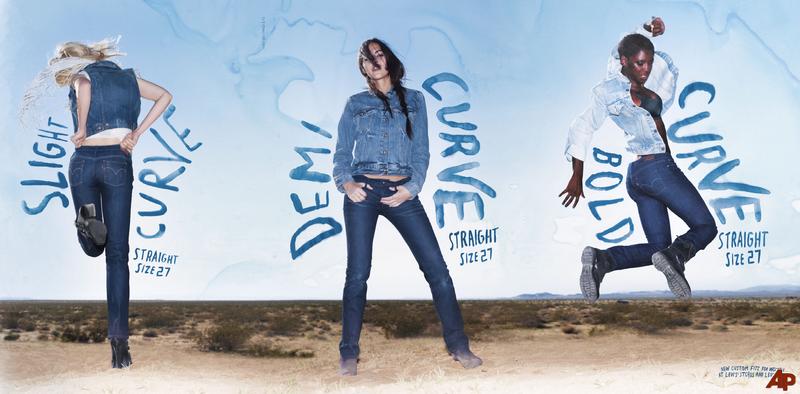
Hope and Kristi P. sent in another example of the way the idea of a “curvy” shape is associated with non-White bodies. This Levi’s ad for their Curve ID jeans shows models whose skin color gets progressively darker as they move from less to more curvy styles:

Notice also that curvy here means primarily having a larger butt. All three models are show in size 27 jeans, which generally are equivalent to about a size 4 (though of course, sizes vary greatly) — certainly larger than the average runway model, but still very small.

Question: does anyone have examples of non-White men depicted as uniquely or systematically “curvy,” or is this applied only to women?

These vintage Lucky Strike cigarette ads posted at the Stanford  School of Medicine collection tell both women and men that they can lose weight if they reach for a smoke instead of a sweet

I’ve never seen any contemporary cigarette advertising using this idea to sell to men; but we have and do see the “slims” meme in advertising cigarettes to women.

Lisa Wade, PhD is an Associate Professor at Tulane University. She is the author of American Hookup, a book about college sexual culture; a textbook about gender; and a forthcoming introductory text: Terrible Magnificent Sociology. You can follow her on Twitter and Instagram.

The two google maps below — showing Las Vegas and Laguna Woods — help us understand the extent of the foreclosure crisis in the U.S. (at HuffPo).    Each red dot represents a foreclosure.

Las Vegas, NV:

Laguna Woods, CA:

These illustrations are nicely complemented by our posts featuring the empty housing grids of California City andhalf-home foreclosures, or the dilemma of the duplex.

Lisa Wade, PhD is an Associate Professor at Tulane University. She is the author of American Hookup, a book about college sexual culture; a textbook about gender; and a forthcoming introductory text: Terrible Magnificent Sociology. You can follow her on Twitter and Instagram.


David Sparks created this video that uses blue and red to show shifts in voting patterns (Democratic vs. Republican) in all the presidential elections since 1920:

Sparks points out several interesting patterns that emerge:

1. Voting in urban areas often differs from other parts of their states (for example, Salt Lake City stands out from the rest of Utah, as did San Francisco from the rest of California in 1980).

2. We can see the South swing from solidly Democratic to predictably Republican (as Sparks highlights, the 1924 and 2004 maps are nearly inverted).

3. Despite clear patterns (such as the South going Republican, a coasts vs. interior voting split), we often see fairly drastic shifts between one presidential election and the next, as well as temporary disruptions to the overall trend (for instance, the reliably Republican South went Democratic in 1980).

As Sparks puts,

More broadly, this video is a reminder that what constitutes “politics as usual” is always in flux, shifting sometimes abruptly. The landscape of American politics is constantly evolving,  as members of the two great parties battle for electoral supremacy.

He also has a thorough explanation of his methodology for creating the map, if you’re interested.

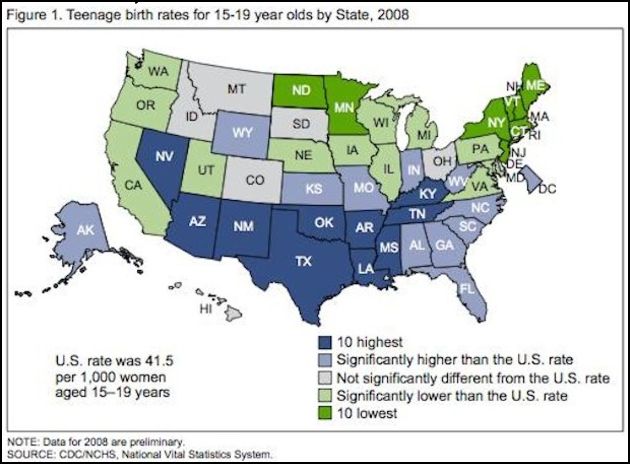
The Centers for Disease Control report that pregnancy rates for U.S. girls age 15-19 vary quite significantly by state: from 66/1,000 in Mississippi to 20/1,000 in New Hampshire (dark and light green represent states with teen pregnancy rates lower than the U.S. average; dark and light purple represent states in which it is higher):

The map shows that, on average, southern states tend to have higher teen pregnancy rates than others.

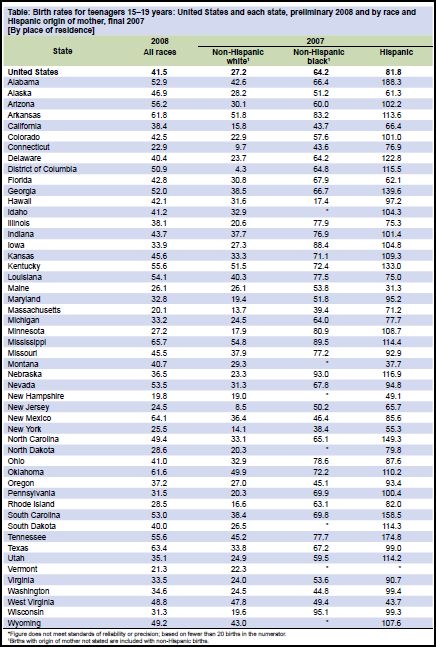
The Centers for Disease Control reports that the disparity can be explained, in part, by the fact that Blacks and Latinos tend to have higher rates of teen pregnancy than other racial groups such that states with higher proportions of Blacks and Latinos would have higher rates.  However, rates among different racial/ethnic populations also vary quite tremendously by state.  Among white teenagers the teen pregnancy rate ranged from 4/1,000 (in the District of Columbia) to 55/1,000 (in Mississippi), among Black teenagers, it ranged from 17/1,000 (in Hawaii) to 95/1,000 (in Wisconsin), and among Latinas it ranged from 31/1,000 (in Maine) to 188/1,000 (in Alabama).

Race, then, doesn’t predict differences in rates of teen pregnancy all by itself.  In fact, White teenagers are more likely to get pregnant in some states than Black and Latina teenagers in others.  There must be something region- or state-specific driving teen pregnancy rates.

The CDC doesn’t mention sex education, but Mike Lillis at The Hill compared teen pregnancy rates to a sex education policy report by the Guttmacher Institute.  He writes:

All five states with the highest teen birth rates have adopted policies requiring that abstinence be stressed when taught as part of sex education, HIV education or both, the group found. Only one of the five states (New Mexico) mandates that sex education be a part of students’ curriculum.

Of the four states with the lowest teen birth rates, none requires that abstinence be stressed to students, according to Guttmacher.

For your perusal, the CDC data, by state and race (# of pregnancies/1,000 girls 15-19):

Hat tip to Annie Shields at Ms. magazine.

Lisa Wade, PhD is an Associate Professor at Tulane University. She is the author of American Hookup, a book about college sexual culture; a textbook about gender; and a forthcoming introductory text: Terrible Magnificent Sociology. You can follow her on Twitter and Instagram.

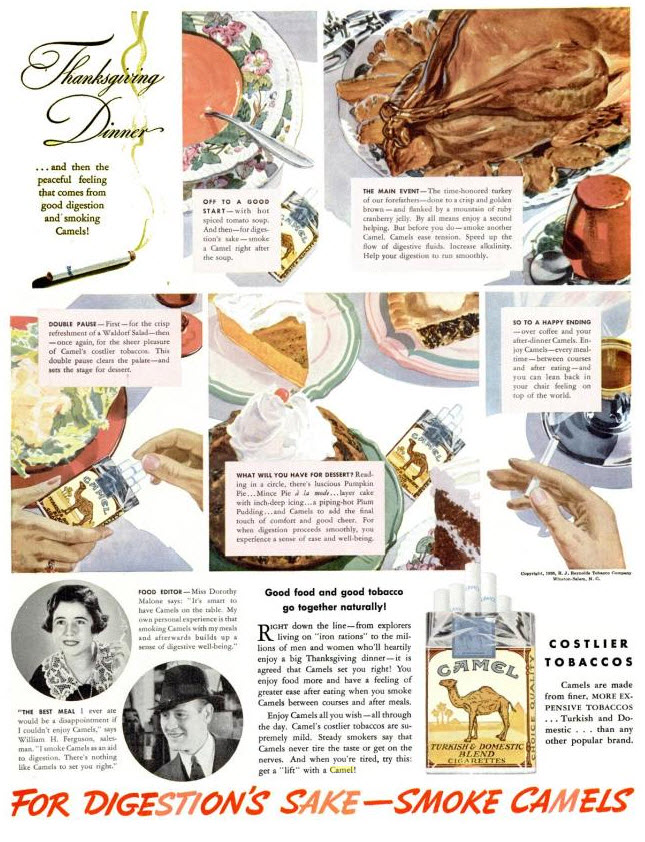
Elizabeth McM. sent in this Life magazine ad from 1936 in which Camel cigarettes are argued to facilitate digestion.  Accordingly, you should smoke at least one between every course!  The ad (text below):

fordigestionssakeI am hard pressed to imagine that such an ad would fly today.  That these ads would not only be un-palatable, but impermissible, is evidence that the power of corporations is not absolute.

Text:

Thanksgiving Dinner… and then the peaceful feeling that comes from good digestion and smoking Camels!

OFF TO A GOOD START — with hot spiced tomato soup.  And then–for digestion’s sake–smoke a Camel right after the soup.

THE MAIN EVENT — The time-honoured turkey of our forefathers–done to a crisp and golden brown–and flanked by a mountain of ruby cranberry jelly.  By all means enjoy a second helping.  But before you do–smoke another Camel.  Camels ease tension.  Speed up the flow of digestive fluids.  Increase alkalinity.  Help your digestion to run smoothly.

DOUBLE PAUSE — First–for the crisp refreshment of a Waldorf Salad–then–once again, for the sheer pleasure of Camel’s costlier tobaccos.  This double pause clears the palate–and sets the stage for desert.

WHAT WILL YOU HAVE FOR DESSERT? Reading in a circle, there’s luscious Pumpkin Pie… Mince Pie a la mode… layer cake with inch-deep icing… a piping-hot Plum Pudding… and Camels to add the final touch of comfort and good cheer.  For when digestion proceeds smoothly,  you experience a sense of ease and well-being.

SO TO A HAPPY ENDING — over coffee and your after-dinner Camels.  Enjoy Camels–every mealtime–between courses and after eating–and you can lean back in your chair feeling on top of the world.

Capture2

FOOD EDITOR — Miss Dorothy Malone says: “It’s smart to have Camels on the table.  My own personal experience is that smoking Camels with my meals and afterwards builds up a sense of digestive well-being.”

“THE BEST MEAL I ever ate would be a disappointment if I coldn’t enjoy Camels,” says William H. Ferguson, salesman. “I smoke Camels as an aid to digestion.  There’s nothing like Camel’s to set you right.”

Good food and good tobacco go together naturally!

Right down the line–from explorers living on “iron rations” to the millions of men and women who’ll heartily enjoy a big Thanksgiving dinner–it is agreed that Camels set you right!  You enjoy more food more and have a feeling of greater ease after eating when you smoke Camels between courses and after meals.

Enjoy Camels all you wish–all through the day.  Camel’s costlier tobaccos as supremely mild.  Steady smokers say that Camel’s never tire the taste or get on the nerves.  And when you’re tired, try this: get a “lift” with a Camel!

COSTLIER TOBACCOS

Camels are made from finer, MORE EXPENSIVE TOBACCOS . . . Turkish and Domestic . . . than any other popular brand.

FOR DIGESTION’S SAKE — SMOKE CAMELS

Lisa Wade, PhD is an Associate Professor at Tulane University. She is the author of American Hookup, a book about college sexual culture; a textbook about gender; and a forthcoming introductory text: Terrible Magnificent Sociology. You can follow her on Twitter and Instagram.

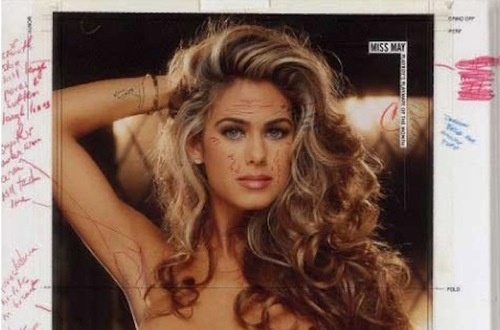
Dmitriy T.M. sent in a post by Irin Carmon at Jezebel about Playboy memorabilia up for auction, including images of centerfolds with editorial comments for the Photoshopper to fix various problematic aspects of the photos. The marked-up images gives us a peek into the process of creating a centerfold, as well as the scrutiny applied to literally every aspect of the models’ bodies, which are found wanting in a dizzying array of ways, with their blatant imperfections resulting from being actual living humans.

This one includes instructions to fix her large pores and soften her laugh lines (see the top left):

The rest of these images are *definitely* Not  Safe for Work, so beware:

more...