Search results for The

Advertisers have mystified chocolate, portraying it as an intoxicant possessing the power to comfort, reward and satisfy women’s sexual desires. In doing so, these ads instruct the viewer to frame and interpret their own chocolate cravings in ways that overcome any resistance to consuming it.

To begin, consider this commercial for Dove:

Consider, also, this ad for Ferrero Rocher:

In particular, advertisers portray chocolate as satisfying female sexual desires. Such advertisements lead female viewers to understand their own desire for chocolate as a natural expression of their sexy femininity.  The association of chocolate with luxury and the upper classes renders this sexuality socially acceptable. The symbolic sex is not that of the “crude lower class,” but the refined upper-class.

Text:

NOW IT CAN last longer THAN YOU CAN resist.

UNWRAP.  INDULGE.  REPEAT.

The misconception that chocolate is an aphrodisiac is exploited by these advertisements. The idea that chocolate contains chemicals that are similar to the mild-altering components found in ecstasy and marijuana, and evoke a feeling similar to falling in love, is now widespread.  In actuality, studies have found that the amounts of these mood-enhancing chemicals are at such a low level that it is unlikely they lead to the euphoria that some feel when they consume chocolate. The findings of what could be called “chocolate propaganda research,” then, are negligible.  Yet, marketing continues to perpetuate chocolate’s association with love and sex and its implied special relevance to women.

The association is so ubiquitous that it was mocked in an Axe commercial.  Screenshot:

So why the insistence on indulgence?

Chocolate marketing must overcome the chief factor inhibiting women’s consumption: the fact that consumption of a fat, sweet food is inherently taboo for women, who are supposed to watch their weight.  As a result, advertisers have replaced this food taboo with a sexual one. They have turned chocolate into a sexual, self-indulgent, private experience that invokes a taboo similar to that of masturbation. The intent is to equip her with an automatic inner-response to overcome her moment of self-restraint: the belief that chocolate consumption represents and enhances her femininity via satisfying her sexually, but tastefully, of course.  Advertisers, then, overcome viewer resistance by shaping how they interpret and frame their own desires.

————————–

Jamal Fahim graduated from Occidental College in 2010 with a major in Sociology and a minor in Film and Media Studies. He was a member and captain of the Occidental Men’s Tennis team. After he graduated, Jamal moved from San Francisco to Los Angeles with the intention of working in the film industry as a producer. His interests include film, music, digital design, anime, Japanese culture, improvising, acting, and of course, chocolate!

If you would like to write a post for Sociological Images, please see our Guidelines for Guest Bloggers.

When companies advertise their products in largely segregated markets, they can tell different, even opposing stories to different groups of people with confidence that the messages will reach their intended audience, and not the unintended one. In an earlier post, for example, we showed how Basil Hayden Bourbon, Miller Lite, and Crown Royal were advertised differently in separated markets.

I was reminded of this phenomenon when DPK, as well as Sean M. of Santa Fe College, submitted this ad for Coca Cola in China.   The ad ran during the 2008 Olympics.  In fact, the Coca Cola company has partnered with the Olympics for over 80 years, so the fact that they advertised there isn’t surprising; they spent $75 million dollars advertising in China that year.

The slogan, “Red Around the World,” clearly references the color of Coca Cola marketing, but it is also the color China uses to represent itself, as well as the color associated with communism.  Meanwhile, the visual of the ad invokes communist propaganda.  Coca Cola appears to be solidly on China’s side in this ad, even leading the charge towards a Chinese communist take-over of the world (if I may be a bit dramatic).

This is in stark contrast to the long-standing effort by Coca Cola to market itself as a distinctly American drink.

I am supposing here that the ability to target their marketing to the Chinese (even during the Olympics?) offered Coca Cola some protection from a backlash against the company from both the left and the right (based on the argument that Coca Cola is pro-China/pro-communism/anti-human rights).

Lisa Wade, PhD is an Associate Professor at Tulane University. She is the author of American Hookup, a book about college sexual culture; a textbook about gender; and a forthcoming introductory text: Terrible Magnificent Sociology. You can follow her on Twitter and Instagram.

AWARD NOMINATION CALL FOR ANECDOTES:

We mentioned earlier this month that sociologists Michael Kimmel and Abby Kinchy are nominating us for the American Sociological Association’s Distinguished Contributions to Teaching Award.  The award is given to sociologists who have made “a significant impact on the manner in which sociology is taught at a regional, state, national, or international level.”   Kimmel and Kinchy are seeking short anecdotes or testimonials from sociologists who have found Sociological Images to be useful in the classroom.  We are so pleased at the response so far, and want to make one final, humble solicitation for such anecdotes.  They can be emailed to Abby Kinchy (kincha@rpi.edu) or added right here in the comments.

Thank you all again for making our blog so very rewarding for us both.

LOTS OF FUN NEWS:

The next essay in our ongoing feature in Contexts magazine, Skull Face and the Self-Fulfilling Stereotype, has been published (based on a previous post). If you’d like a copy of the essay, feel free to email us (socimages@contexts.org) and we’ll send it along.  See the list of all of our Contexts essays here.

We are indebted to David Mayeda for writing a review of Sociological Images for Teaching Sociology.  Thank you, Dr. Mayeda, for all your kind words!

We are super excited to report that the Ms. magazine blog has begun partially syndicating our work.  If you’re a reader of their blog, you may have seen us pop up there already.

And we were tickled to hear our post on the worldwide penetration of Facebook used as a source in a Scientific American podcast (we’re in the Totally Bogus quiz at about 21:45).

Finally, this is your monthly reminder that we’re on Twitter and Facebook.  Let us invade your everyday life and be your friend!

Lisa Wade, PhD is an Associate Professor at Tulane University. She is the author of American Hookup, a book about college sexual culture; a textbook about gender; and a forthcoming introductory text: Terrible Magnificent Sociology. You can follow her on Twitter and Instagram.

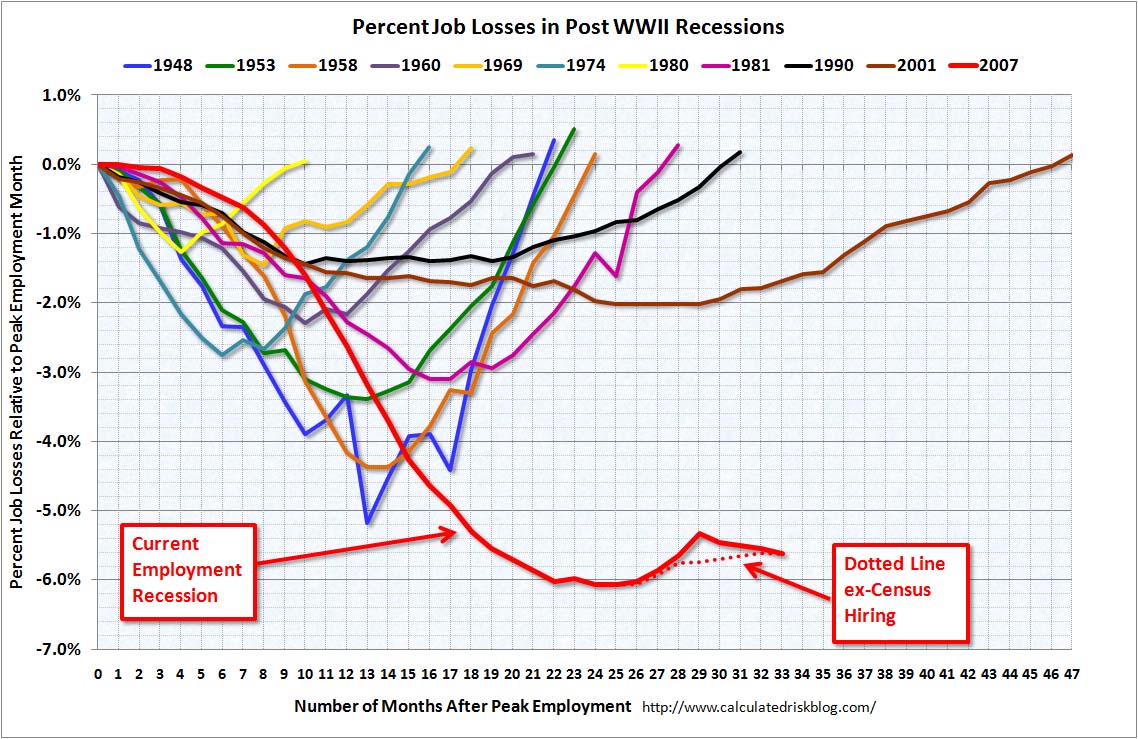
Kelsey C., a master’s student at the University of Colorado-Boulder, sent in this image from Calculated Risk showing the percent of jobs lost in each recession since 1948, relative to the peak of the pre-recession job market. In terms of the percent of jobs lost, the current recession is by far the worst we’ve seen since World War II:

The Bureau of Labor Statistics has a detailed report on employment (or the lack thereof) as of October 2010 available — including information on length of unemployment, numbers working part-time because they can’t find full-time work, labor force participation broken down by race/ethnicity, sex, and educational attainment, Veteran status, disability status, and more!

Prolific sender-inner Dmitriy T.M. sent in a link to a story at Slate showing increases in rates of U.S. adults of diabetes between 2004 and 2008, as well as the distinct regional variations. You can look at maps individually or watch a time-lapse slide show.

Percent of adults diagnosed with diabetes in 2004:

2008:

The change is pretty dramatic for such a short time period. I presume differences in poverty rates, access to health care, and nutritional differences all play a part. Any demographers or public health scholars out there with insights?

The CDCP has the data available for download, and you can play around with different maps (# of adults instead of % and so on).

UPDATE: Reader Arielle says,

Please clarify the type of diabetes this graph is discussing (I assume it’s Type 2). As it stands, you’re perpetuating two myths: one, that all types of diabetes are affected by “poverty rates, access to health care, and nutritional differences” (Type 1 is an autoimmune disease and has nothing to do with lifestyle), and two, that only children are diagnosed with (or have) Type 1 diabetes.

Here’s a problem: neither the CDCP nor the Salon Slate article specify. They say “adult diabetes,” meaning individuals over the age of 18 who are diagnosed with diabetes (so not necessarily adult onset diabetes). I think that would mean either Type 1 or Type 2. But I’d take the data with a little caution since the source doesn’t make that absolutely clear.

UPDATE 2: Chris points out an important element of what might be going on here:

More significantly one of the comments on Slate (not Salon) said that the diagnostic standard for diabetes recently dropped from 140 to 124.  That’s going to add a LOT of people to the second map if the transition occurred between 2004 and 2008.

That would make a lot of sense, because quite honestly, I just couldn’t figure out how the overall numbers had increased so rapidly in just 4 years. This is a great example of the social construction of health and disease: we are constantly defining and redefining what does and doesn’t count as unhealthy, which can dramatically affect statistics on the topic without there necessarily being a large change in the overall state of the population.

Cross-posted at Jezebel.

A new report from the Centers for Disease Control (via Family Inequality) reveals that boys report less sex education than girls.

What teenagers report learning from school:

What teenagers report learning from their parents:

Compared to boys, then, girls report more guidance from school and significantly more from their parents. This probably reflects cultural ideas that boys naturally desire sex, have a positive sense of their own sexuality, and that nothing really bad can happen to them; in contrast, the risk that sex poses to girls’ reputations and the possibility of sexual violence and pregnancy often shape how educators and parents manage their emerging sexualities.

Or it might be an artifact of self-reporting.  Thoughts?

See also our popular post on STI, pregnancy, and abortion rates in the U.S. versus select European countries (hint: the U.S. doesn’t come out smelling like roses).

Lisa Wade, PhD is an Associate Professor at Tulane University. She is the author of American Hookup, a book about college sexual culture; a textbook about gender; and a forthcoming introductory text: Terrible Magnificent Sociology. You can follow her on Twitter and Instagram.

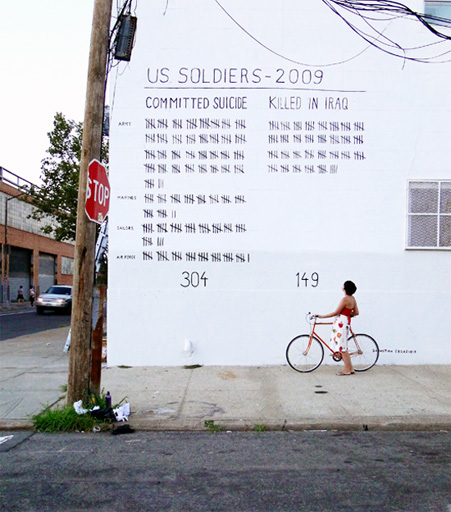
Jose Marichal at Thick Culture put up another great example of what he calls “engaged public space,” or the quiet but political use of public spaces to inform and incite.  Writes Marichal:

This tally of military suicides is outside the studio of Brooklyn artist Sebastian Errasuriz. Its power comes from its simplicity.

See also our post on political (versus historical) roadside markers.

Lisa Wade, PhD is an Associate Professor at Tulane University. She is the author of American Hookup, a book about college sexual culture; a textbook about gender; and a forthcoming introductory text: Terrible Magnificent Sociology. You can follow her on Twitter and Instagram.


Dmitriy T.M. sent in a video where Hans Rosling illustrates changes in wealth and life expectancy in 200 countries over the past 200 years, all in four minutes. Pretty neat!