Search results for The

Jessica L., a doctoral candidate in sociology at Kent State and traveling adjunct instructor at Lewis University and Indiana University Northwest, let us know that the New York Times has an interesting interactive map that uses Census data from 1880 to 2000 to show where various immigrant groups have settled. You can select area of origin (some specific, such as China, others very broad, such as “All Africa”) and see where individuals from that area were living in the U.S. for different years (because of changes in Census categories and data gathering, information isn’t available for all groups for all years).

The German-born population in 1880:
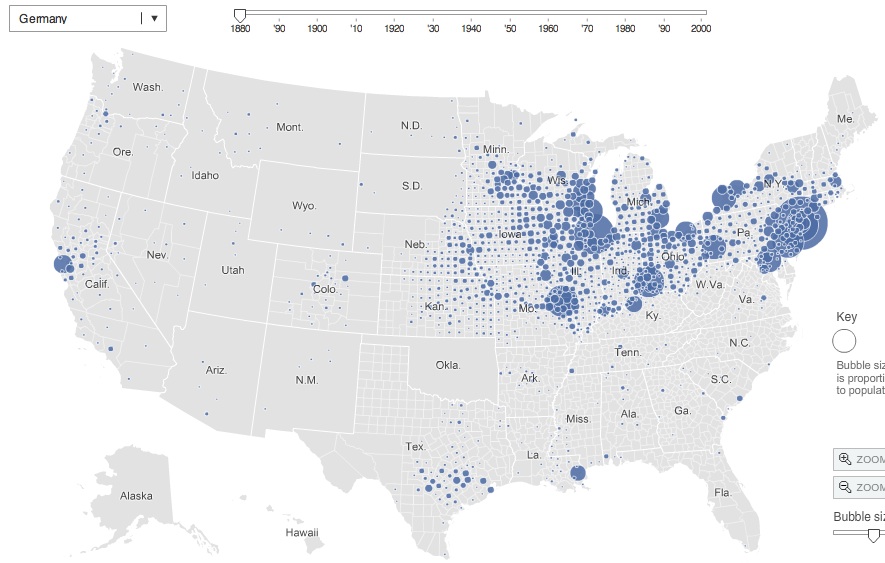
If you go to the NYT site, you can roll over the circles to get the specific population.

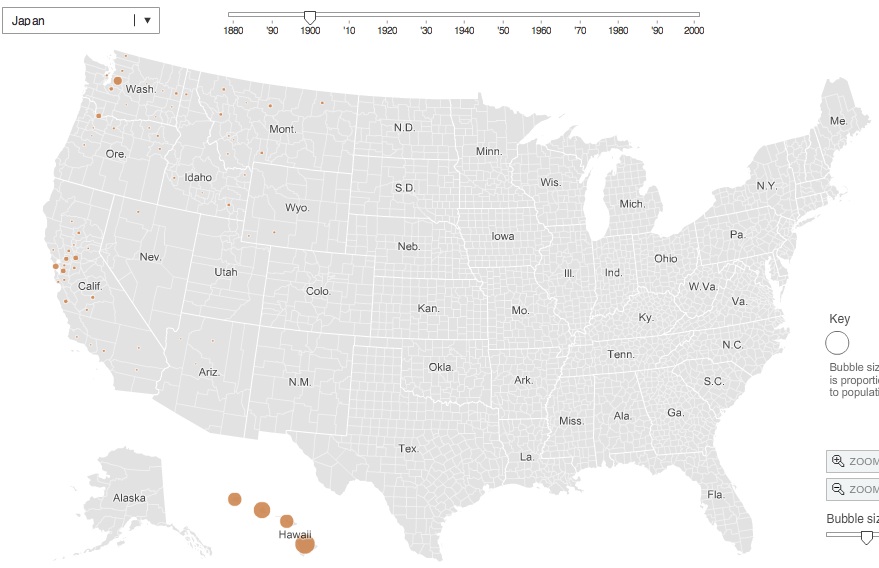
The Japanese-born population in 1900, indicating immigration to Hawaii and, to a lesser extent, California and Washington to work in agriculture:
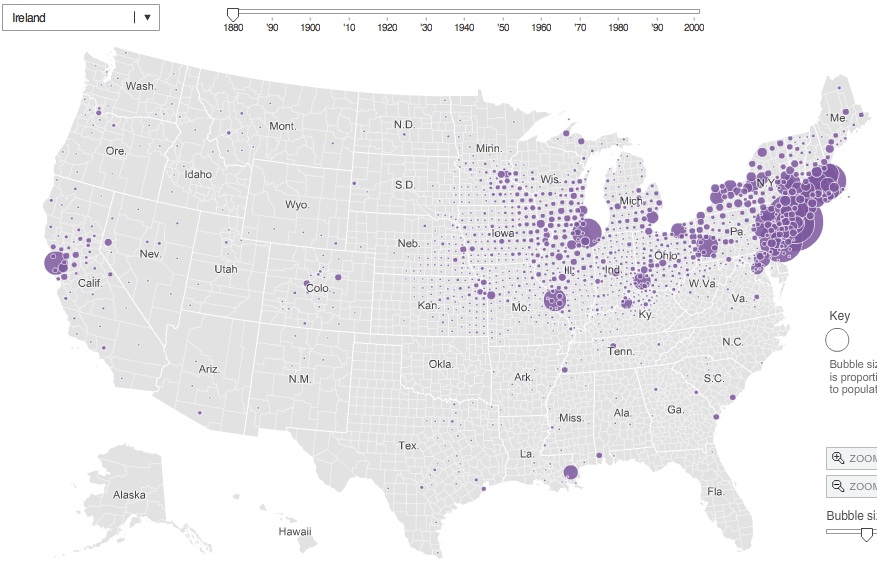
The map also lets you trace the rise and fall of some immigration streams. For instance, in 1880 there were 198,595 people born in Ireland living just in Manhattan alone:
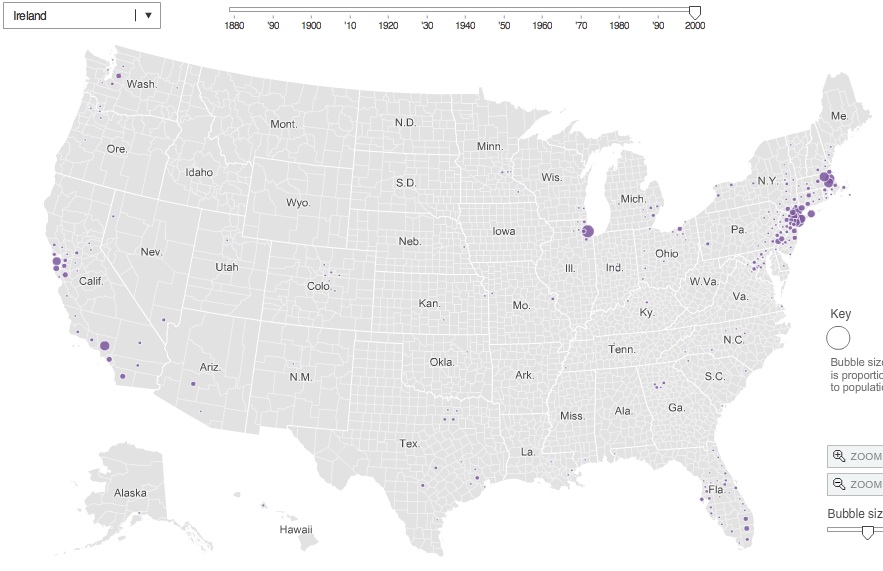
By 2000, the Irish-born population in the U.S. was tiny, and only 4,147 of them lived in Manhattan:
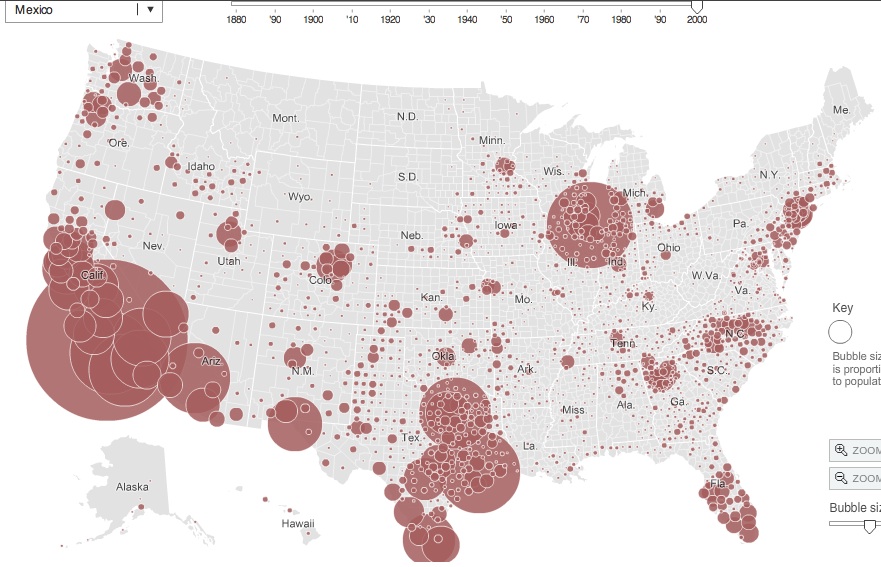
The Mexican-born population in 2000:
When Jessie Dress of Austin, Texas started the project Fa(t)shion February for Femmes and Friends, she was responding to what she perceived as a gap in the online community celebrating “fatshion,” or fashion for fat-identified people.   She explains, “I don’t feel like the fatshion blogs I see really represent the kind of radical queer fashion that I’m into and that feels like my community.”   Jessie committed to posting “outfits of the day” (OOTD) every day in February.  Her intention was to celebrate and draw attention to three kinds of politicized fashion projects – first, fatshion;  second, the fashion of femme-identified queers; and finally, the fashion of allies of both fat and femme-identified people.

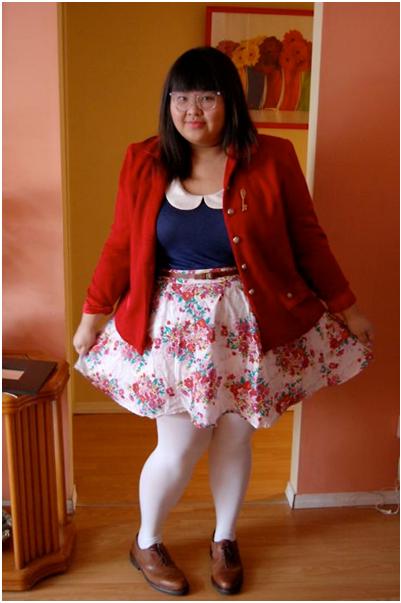
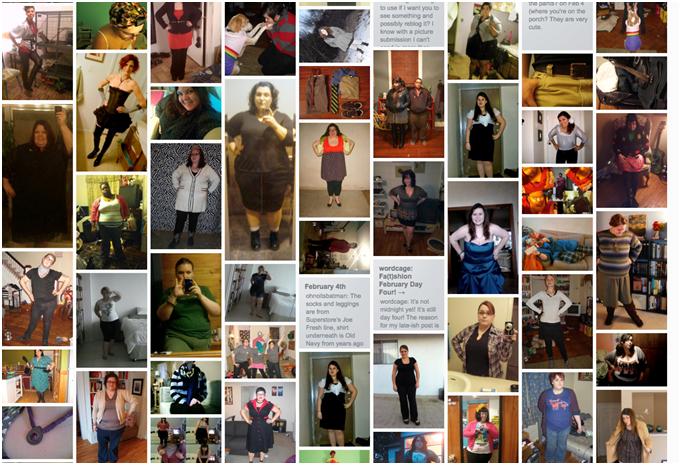
The result was Fa(t)shion February for Femmes & Friends – an inclusive space for posting OOTD for those who find themselves outside the mainstream fashion ideal.  What started as her small personal project with a close group of friends has since exploded, with over 350 people participating in some way – a number that grows by the day:

Fa(t)shion February participant Gazel (of Gazelma)

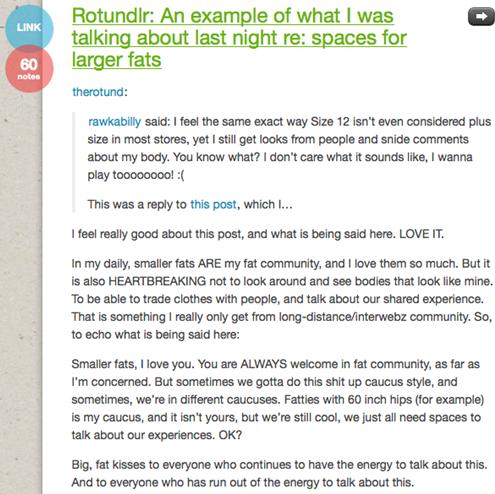
The aim of the project is to “queer” fashion in a number of ways – to celebrate the subversive possibility of fashion.  What’s exciting about how the Fa(t)shion February project has developed is the many different ways this aim has been realized.  For example, an amazing conversation has emerged through the project regarding the  “fat experience.”  Fa(t)shion February was created to be explicitly inclusive of those who are often missing from the fatshion dialogue – that is, individuals on the fattest end of the fat spectrum.  This privileging of “bigger fats” is an attempt to further radicalize the fatshion phenomenon, but it has come with its own set of dilemmas.  Some users expressed fear of participation because they aren’t “fat enough” or aren’t fat-identified.  In response to a conversation on The Rotund, Jessie wrote on her tumblr,

The kinds of difficult – but incredibly important – dialogues that are happening in and around the project are part of what makes it succeed in its mission to use fashion as a tool of social activism and community building.

[The rest of the post is after the jump just because it’s somewhat long.]

more...

Dan Dickerman sent in two great videos that juxtapose nicely. The first is an advertisement for Chrysler, featuring Eminem, that focuses on how Detroit is the “Motor City,” a place that knows cars, now and always. To contrast is a Daily Show interview with Paul Clemens about his book covering the disassembling of car plants in Detroit and the moving of car and car part production from American to elsewhere and out of the hands of American companies into the hands of companies owned by citizens of other countries. Together, they show the often vast discrepancy between the simple public brand and the complex corporate reality of many car companies.

The commercial:

Clemens on The Daily Show:

Lisa Wade, PhD is an Associate Professor at Tulane University. She is the author of American Hookup, a book about college sexual culture; a textbook about gender; and a forthcoming introductory text: Terrible Magnificent Sociology. You can follow her on Twitter and Instagram.

“What’s the deal with all those songs in Bollywood?”

I’ve found that the most consistently misunderstood aspect of Bollywood (and, indeed, all popular Indian cinema) is the way lip-synced songs are used within the narrative of the film. American viewers in particular tend to find this an almost insurmountable obstacle to appreciating Bollywood films on their own merits. Why might Bollywood be ignored by the Western film community even as mass entertainment from places like China (kung fuand wuxia films) and Japan (anime) have been embraced?

I think the problem may lie in an association of Bollywood with Broadway-style American musicals and their sugar happy appropriate-for-all-ages content (due to heavy censorship during the heyday of the American musical). Bollywood films are not appropriate-for-all-ages. While they do have to pass through a Censor Board and explicit references to things like sex are going to be snipped if a film is to have an all-ages certificate, films can and do discuss a wide variety of serious issues using lip-synced songs. For example, the film Roti Kapada aur Makaan (Food, Clothes, and Shelter, 1974) is, among other things, a tough look at how the drive to stay out of poverty can lead a person to an immoral life. It has songs in which the actors lip sync and it also has a really disturbing rape scene and a bittersweet ending. Dil Se (From the Heart, 2000) is an intense film about terrorism. It has songs where the actors lip sync; it also has explosions and tough social commentary.

This clip from Dil Se, for example, shows how Amar is romanticizing the war zone he has been sent to cover as a reporter. We see his inner thoughts expressed through song in a way that couldn’t be easily duplicated in a Hollywood film (please forgive the advertisement):


So, Bollywood films are not all cheerful or what we might consider ‘family-friendly’ and the endings to the films are sometimes really unpleasant. Still, I still hear Western film buffs argue that lip-synced songs somehow make a film unrealistic. Let’s get one thing straight — the use of music in Western films is no more realistic than in Bollywood films.

Bollywood songs usually function like a soliloquy out of a Shakespeare play. The songs are designed to express a character’s inner feelings in a metaphorical way. A couple, for example, might be shown singing a duet in a lush meadow in Europe. Indian audiences implicitly understand that the couple has not actually been teleported to Switzerland or The Netherlands. The fantasy location and the song are designed to show how that first blush of love feels to the people involved. In another examples of a fantasy teleport song, in Kabhi Kushi Kabhie Gham (2001) you clearly see Rahul in a shop in India and then suddenly he and Anjali are cavorting around the pyramids in Egypt:


This, however, is no less realistic than your classic Hollywood movie song montage that features a couple falling in love using a series of different scenes set to “I Can’t Help Falling in Love With You.” Likewise, previously recorded songs used as part of a background score are an accepted convention in Western film. We don’t walk around hearing music matched to our mood in real life, but Westerners accept the fantasy in movies because it’s familiar.

Soundtracks and falling-in-love montages do not happen in real life but we have learned to ignore the artifice of the tools to appreciate the stories told. The only difference between those things and Bollywood songs is that is that Western viewers have no experience with the Bollywood song form.


———————————

About 15 years ago, a friend gave Filmi Girl a cassette tape with the soundtrack from the 1980s hit Bollywood film Maine Pyaar Kiye and she was hooked. A few years later, she began watching the films the songs were centered around, and after realizing that her real life friends were uninterested in hearing her gush about Aamir, Preity and Rani, she started a blog.  The 31-year-old librarian now spends her limited free time reading about her latest interest and watching large amounts of deliciously, over-the-top Indian films. Read more Bollywood for Beginner posts at Filmi Girl.


If you would like to write a post for Sociological Images, please see our Guidelines for Guest Bloggers.

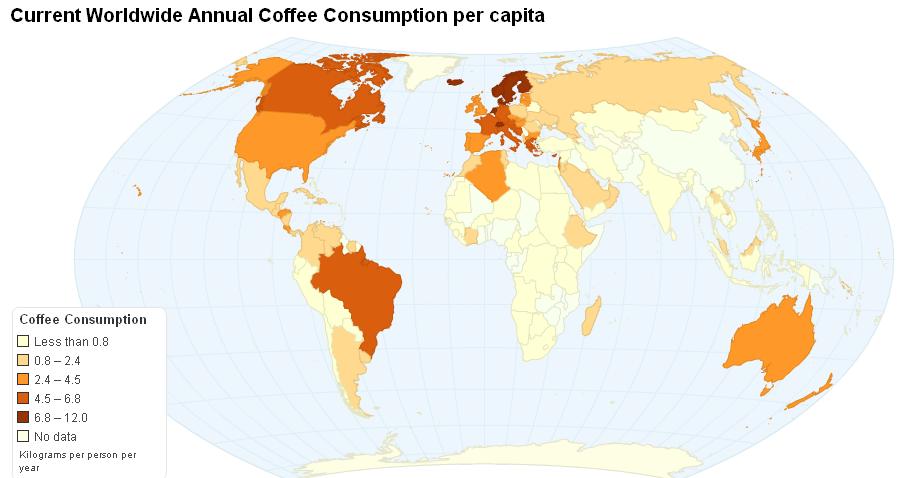
Recently I posted some maps showing global alcohol consumption. As a follow-up, here’s a map, via Blame It on the Voices, showing global consumption of coffee (with the rather major omission of China, among other nations, due to lack of data):

Consumption is measured in kilograms and, as ChartsBin explains, “Weight is presented as Green Bean Equivalent (GBE). 1 pound roasted coffee = 1.19 pounds of green coffee beans.”

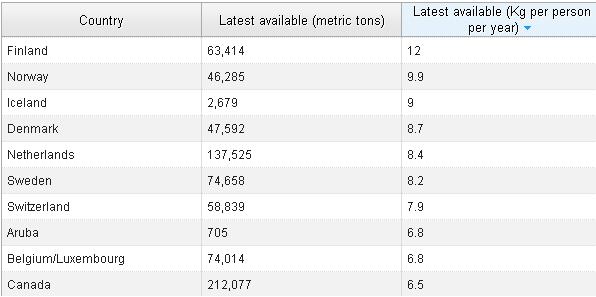
Scandinavians drink the most coffee, on average. Based on the most recent available data, Finland, at 12 kg GBE each per year, tops the charts, and Norway, Denmark, and Sweden also make it into the top 10 (from ChartsBin):

The U.S. comes in at #26, consuming 4 kg/person annually. Apparently we’re too busy drinking beer to get serious about coffee.

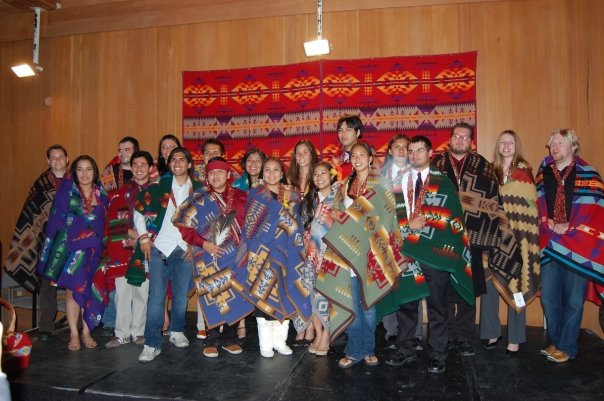
Last night I was cold. So cold, in fact, that I had to pull out not one, but two, of my Pendleton blankets to add some extra warmth to my bed. As I shook them out and laid them on my bed, I thought about how special these blankets are to me–one was a graduation gift, the other a thank you gift for serving on a panel about the “Future of Indian Education.” In many Native communities, Pendleton blankets are associated with important events, and have been for hundreds of years. They are given as gifts at graduations, at powwow give-aways, as thank you gifts, in commemoration of births and deaths, you name it. In addition, I’ve always associated the patterns with Native pride — a way for Natives to showcase their heritage in their home decor, coats, purses, etc. There’s something just distinctly Native about Pendleton to me.

Stanford Native Graduation from a couple years ago:

But recently, Pendleton prints and fabrics have started popping up everywhere. It started with Opening Ceremony’s Pendleton line in 2010, and now Urban Outfitters has started carrying a Pendelton linecelebrities are wearing Pendleton coats, and Native-themed home decor is apparently all the rage.  Now Pendleton has announced their newest collaboration, The Portland Collection, which fashion blogs are proclaiming will be the big thing for 2011.

So what’s the problem? I openly admit that a lot of these designs are adorable, and I would fully sport them (that bag! I love!), if I had a spare $1000 or so. I can’t cry straight up cultural appropriation, because…well, it’s complicated.

Pendelton has been supplying Natives with blankets and robes with Indian designs since the late 1800’s, which the “history” section of their website outlines:

A study of the color and design preferences of local and Southwest Native Americans resulted in vivid colors and intricate patterns. Trade expanded from the Nez Perce nation near Pendleton to the Navajo, Hopi and Zuni nations. These Pendleton blankets were used as basic wearing apparel and as a standard of value for trading and credit among Native Americans. The blankets also became prized for ceremonial use.

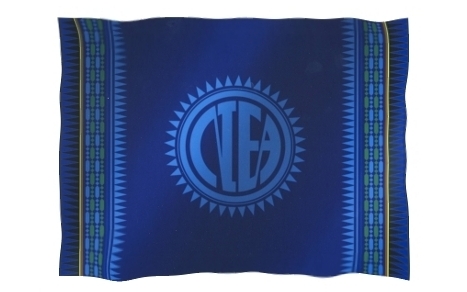
It’s almost a symbiotic relationship — they saw a market in Native communities, and Native communities stepped up and bought, traded, and sold the blankets, incorporating them into “traditional” cultural activities. Pendleton has also maintained close ties with Native communities and causes, making commemorative blankets for organizations like the National Museum of the American Indian and the National Indian Education Association. They work with Native artists to design the special edition blankets, and even donate some of the proceeds to the causes.

(NIEA 40th anniversary blanket)

But then, on the other hand, they go off and do things like design a $5000 blanket with White Buffalo hair, which many tribes consider extremely sacred and definitely off-limits to commercial sale.

I do appreciate Pendleton’s relationship with Native communities. I love my blankets, and love even more what they represent.

However, seeing hipsters march down the street in Pendleton clothes, seeing these bloggers ooh and ahh over how “cute” these designs are, and seeing non-Native models all wrapped up in Pendleton blankets makes me upset. It’s a complicated feeling, because I feel ownership over these designs as a Native person, but on a rational level I realize that they aren’t necessarily ours to claim. To me, it just feels like one more thing non-Natives can take from us — like our land, our moccasins, our headdresses, our beading, our religions, our names, our cultures weren’t enough? you gotta go and take Pendleton designs too?

Then there’s the whole economic stratification issue of it too, these designs are expensive. The new Portland collection ranges from $48 for a tie to over $700 for a coat, the Opening Ceremony collection was equally, if not more, costly. It almost feels like rubbing salt in the wound, when poverty is rampant in many Native communities, to say “oh we designed this collection based on your culture, but you can’t even afford it!”

So I don’t know. Are all of these designs cultural appropriation? Should I ignore the twinge in my stomach every time I see a Pendleton pattern in the Urban Outfitters window? Should I embrace it as the mainstream fashion scene finally catching up with what we Natives have known since the 1800’s?

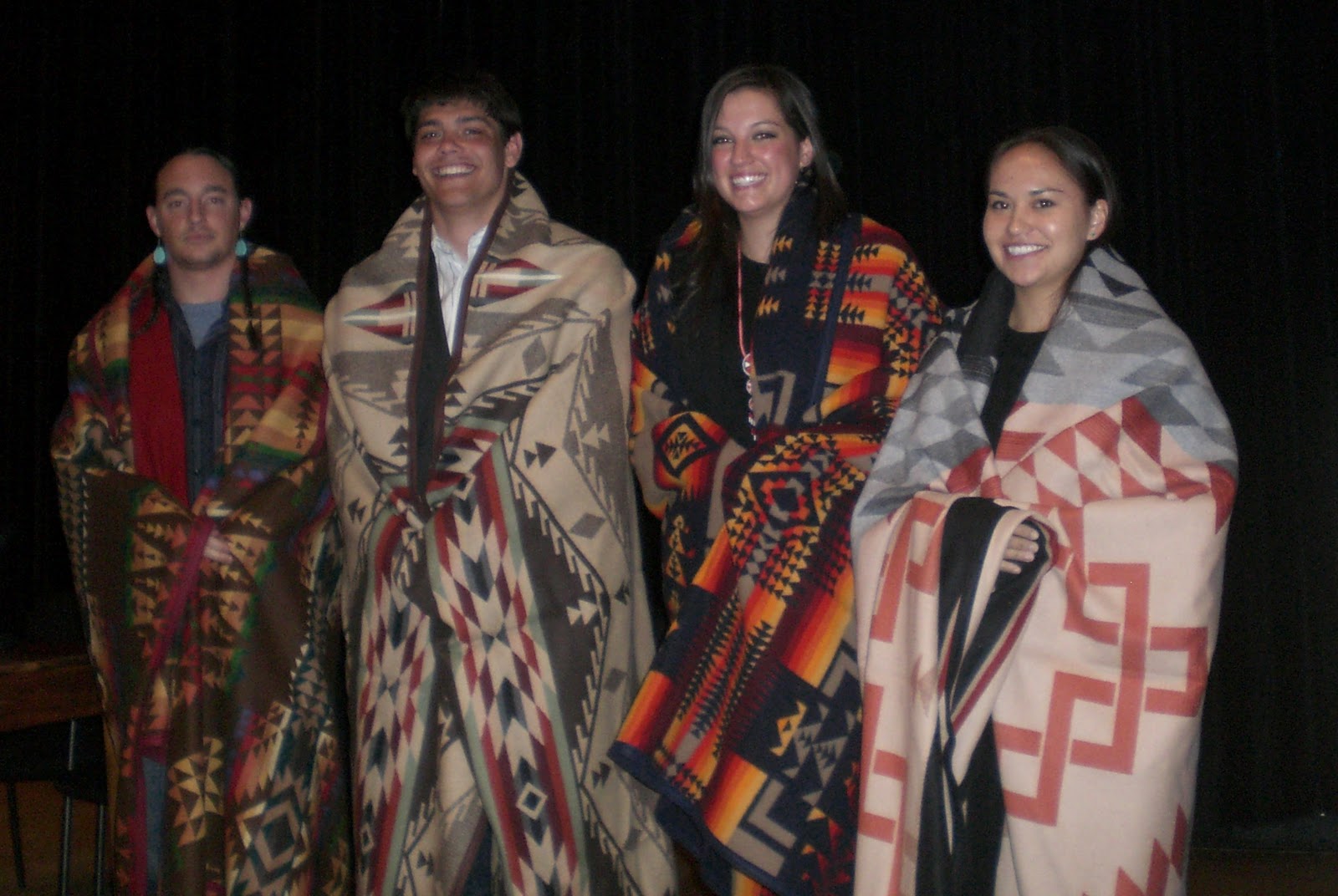
Personally, the bottom line is that I would rather associate Pendleton with Native pride and commemorating important events…
(our panel last year)

…than with hipsters, high fashion, and flash-in-the-pan trends. But I’m obviously conflicted. What do you think? Are these designs and trends ok, or do I have a right to be upset?

(Thanks to Precious for getting me thinking about this!)
Adrienne K. is a member of the Cherokee Nation of Oklahoma and a graduate student in Boston, where she studies access to higher education for Native students. In her free time, she blogs about cultural appropriation and use of Indigenous cultures, traditions, languages, and images in popular culture, advertising, and everyday life at Native Appropriations.

Cross-Posted at BagNewsNotes.

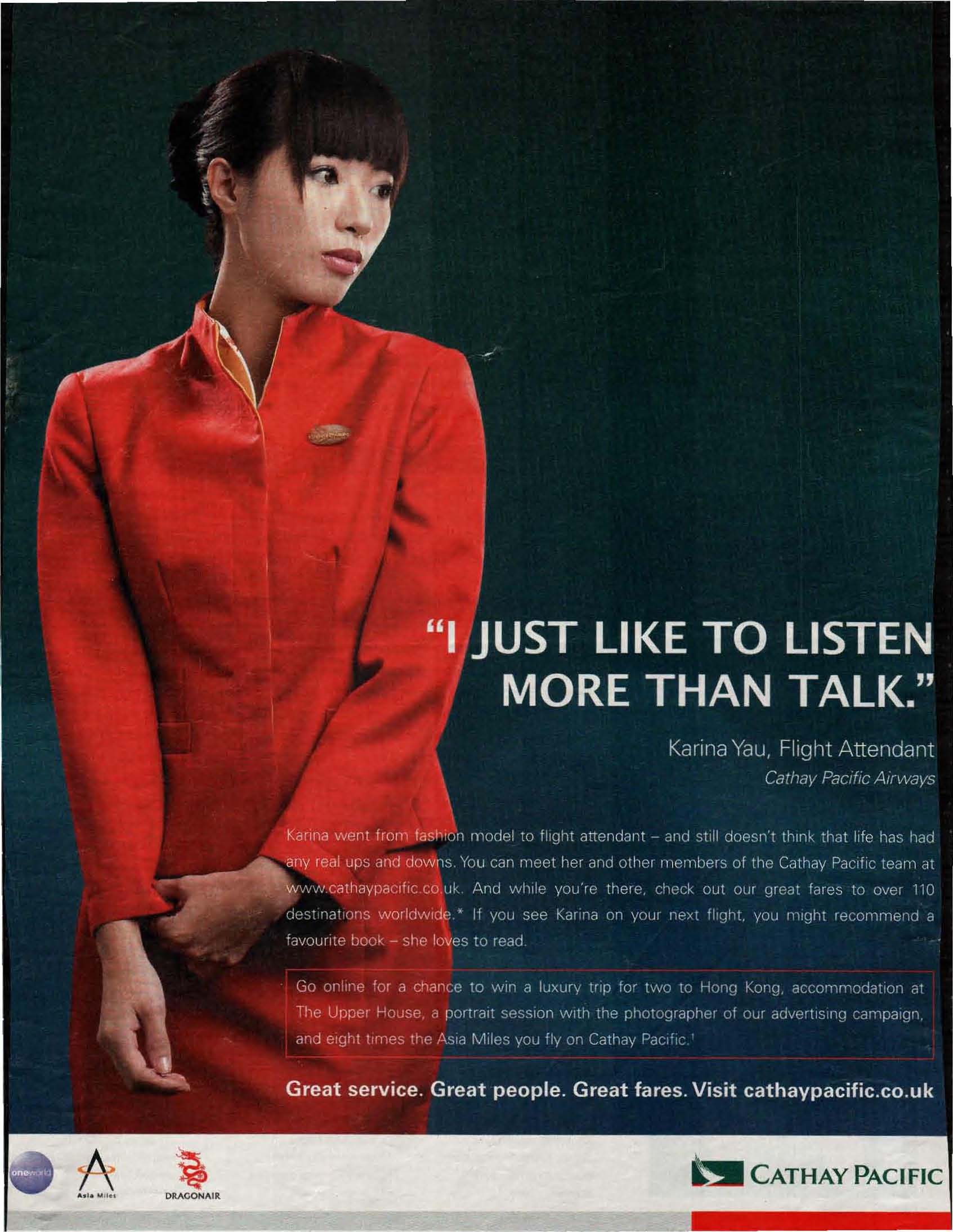
We have posted in the past about how airlines use images of female flight attendants in ads to appeal to customers with promises of caretaking, eye candy, flirtation, and emotion work. Katrin sent in another example. This Cathay Pacific ad, which appeared in the U.K.,  presents Karina Yau, a flight attendant, to customers as the perfect caretaking woman — one who just wants to listen to you, not talk:

Notice also the passive stance — arms pulled into the body, her face turned away and eyes averted, hand fiddling with her coat sleeve. The text reads:

Karina went from fashion model to flight attendant — and still doesn’t think that life has had any real ups and downs. You can meet her and other members of the Cathay Pacific team at www.cathaypacific.co.uk. And while you’re there, check out our great fares to over 110 destinations worldwide. If you see Karina on your next flight, you might recommend a favourite book — she loves to read.

A post on the Cathay Pacific blog about Yau describes her as “modest.” At Cathay’s website you can “meet the team who go the extra mile to make you feel special.” It includes photos and bios of some employees, and I found Yau’s. The text they chose to highlight reinforces the emotion work she engages in for customers — “of course” she “smiled and apologised immediately.”

The ad and the features present customers with the promise of more than just a flight attendant who will do her job well. This flight attendant is the ideal of femininity: she’s beautiful (a former model), she’s submissive (apologizes immediately!), and she’s interested in you — your thoughts, your taste in books — whoever you are.

I wonder to what degree this draws on a specifically racialized femininity — the stereotypical depiction of Asian women as particularly submissive and docile. But since this ad ran in the U.K., I don’t know if that stereotype is as relevant. Readers, what say you?

Thelittlepecan let us know that the World Health Organization has out a new report about global alcohol consumption, as well as the consequences of that consumption. Overall consumption varies significantly, with the highest levels in Russia and much of Europe and the lowest in northern Africa through Asia (the consumption figures exclude tourists):

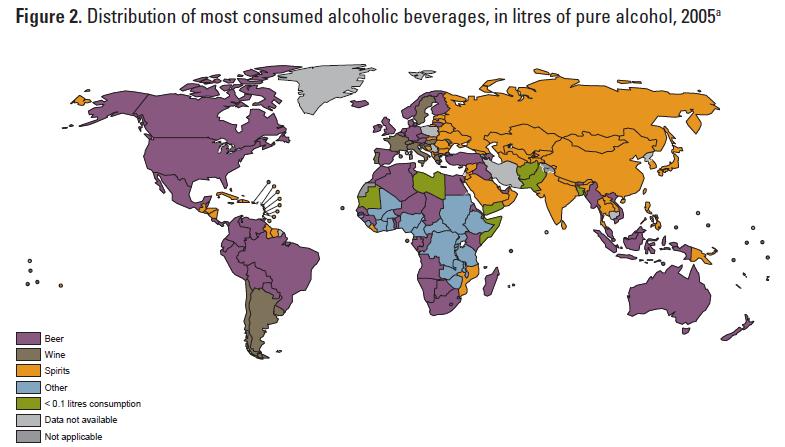
There are also clear differences in the most-consumed type of alcoholic drinks:

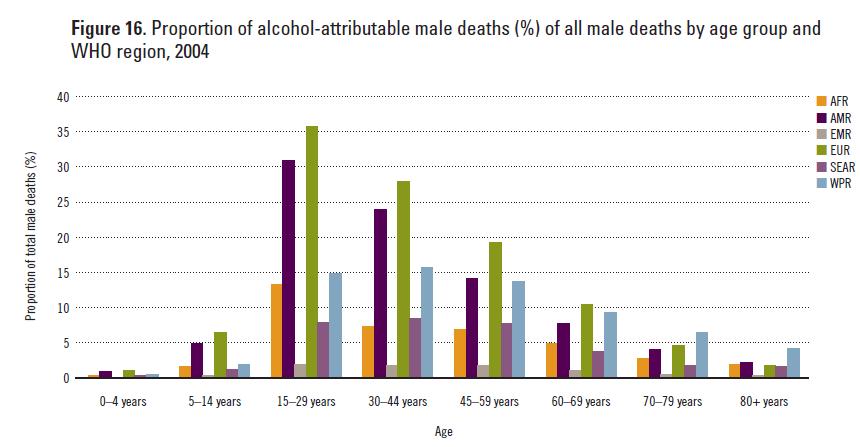
The report also looks at what proportion of all male deaths are related to alcohol consumption, broken down by region, age, and sex. Globally, alcohol-related problems are the leading cause of death for males aged 15-59. For the regions, AFR = Africa, AMR = Americas, EMR = Eastern Mediterranean, EUR = Europe, SEAR = South East Asia, and WPR = Western Pacific:

Clearly the Americas and Europe stand out, though this is  likely because those regions have lower death rates from many sources that are still prevalent in many parts of the world and, thus, alcohol-related ones show up more prominently.

Differences in blood-alcohol limits for drivers:

If you’re interested in more details, you can also get profiles of individual countries in each region at the WHO website.