Search results for The

Every year, at the first faculty meeting, representatives of the registrar tell us what percentage of the incoming class is [insert variable in which we are interested, such as American Indian, working class, international, etc].  They compare it to last year’s percentage.  This drives me crazy because they do so as if comparing the last two data points in a sequence is indicative of a trend. But to determine whether or not there is a trend, and therefore whether the increase or decrease in the percentage of [insert variable in which we are interested] significant relative to last year, depends on more than two data points!

xkcd does an excellent job of illustrating just how two data points can be utterly meaningless, even wildly fallacious.

Other great xkcd cartoons: attribution and the in group, on statistical significance, correlation or causation, and the minimal group paradigm.

Originally posted in 2009.

Lisa Wade, PhD is an Associate Professor at Tulane University. She is the author of American Hookup, a book about college sexual culture; a textbook about gender; and a forthcoming introductory text: Terrible Magnificent Sociology. You can follow her on Twitter and Instagram.
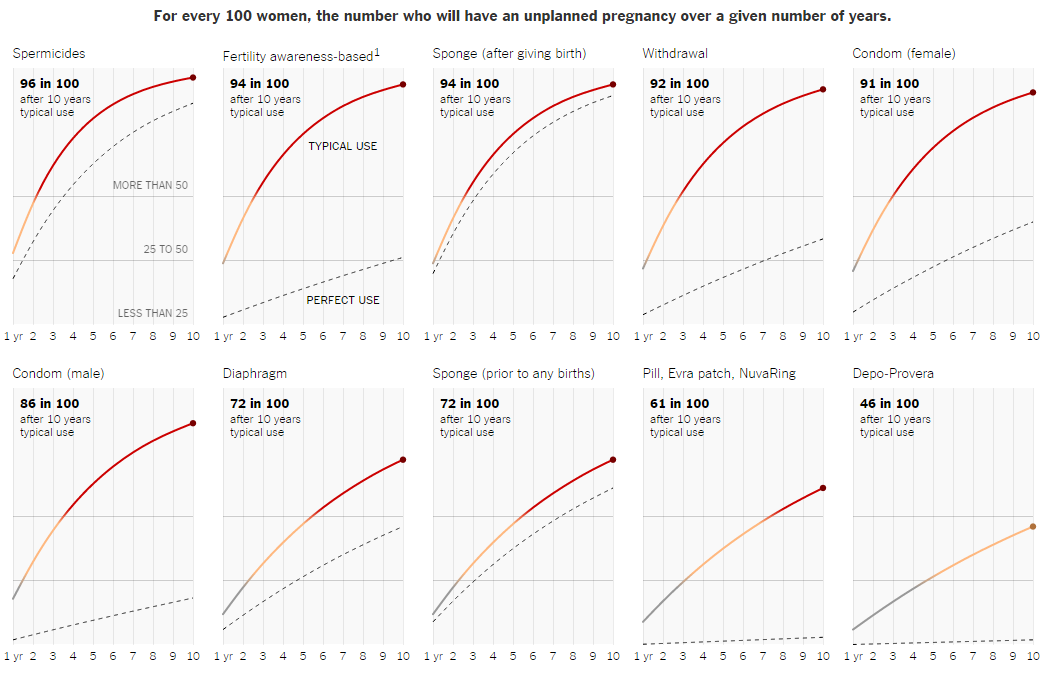
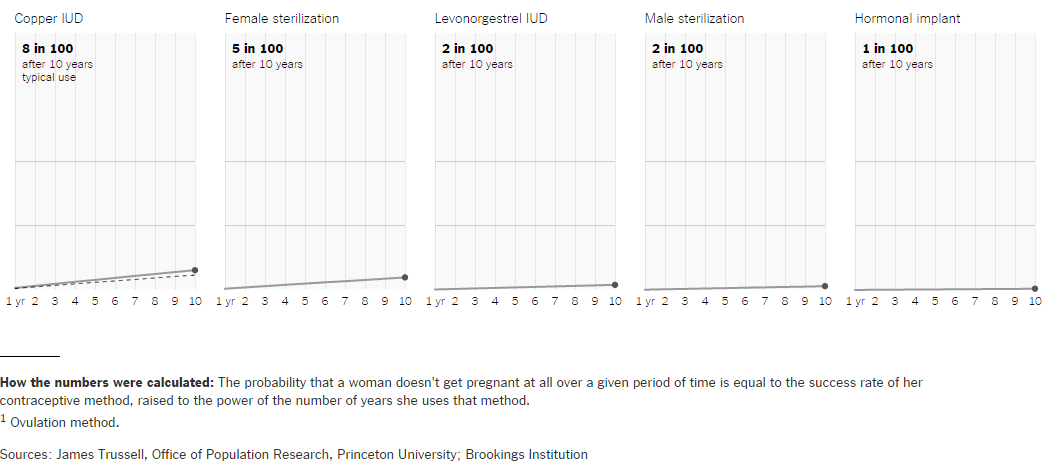
This week the New York Times published an interactive that illustrates the likelihood of pregnancy despite contraceptive use. Risk is divvied up by method, for perfect and typical use, and added up over ten years. The results are a little terrifying (click to see larger or go here to explore):

23

Somewhere around half of all pregnancies are unintended.  This is why. It’s hard enough to use contraceptives perfectly but, even when we do, the risk of failure is very real.

Male condoms are the safer sex favorite. But, even when used perfectly, almost one in five women will get pregnant over a ten year period. With typical use, more than four out of five. Withdrawal, one primary foil against which male condoms are usually recommended, is only slightly less effective at preventing pregnancy, as typically used.

The favorite of Americans — The Pill, as well as some other hormonal methods — is more effective than the condom, but not nearly as much as we think it is. Under ideal conditions, only three in 100 will get pregnant over ten years; in reality, almost two-thirds — 61 in 100 — will end up pregnant.

Only the most human-error resistant methods — the IUD, hormonal implants, and sterilization — near 100% effectiveness. These are permanent or semi-permanent and not real options for a large proportion of sexually active Americans during at least some parts of their lives.

Discussions of the right to an abortion and the ease with which they can be attained needs to be had with this information at the forefront of the discussion. Unintended pregnancies happen all the time to everyone.

Cross-posted at Pacific Standard.

Lisa Wade, PhD is an Associate Professor at Tulane University. She is the author of American Hookup, a book about college sexual culture; a textbook about gender; and a forthcoming introductory text: Terrible Magnificent Sociology. You can follow her on Twitter and Instagram.
What do we mean when we say “we”? Or more to the point, what does the president mean when he uses that word?

The Atlantic has an interactive graphic (here) showing the relative frequencies of words in State of the Union addresses. (“Addresses” because I’m choosing my words carefully. These were not “speeches” until Wilson. Before that, it was written text only.) Here “we” is.

The rise of “we” seems to parallel the rise of big government, starting with Wilson and our entry into a world war, followed by a brief (10-year) decline. Then FDR changes everything.  “We,” i.e., the people as represented by the government, are doing a lot more.

Sorting the data by frequency shows that even in the big-We era, big-government Democrats use it more than do Republicans.  (JFK used We less frequently than did the GOP presidents immediately before and after him. But then, it was JFK who said not to ask what the government could do for us.)

Other words are less puzzling. Freedom is a core American value, but of late (the last five or six presidents), it’s the Republicans who really let it ring.

As with We, Freedom gets a big boost with FDR, but Freedom for Reagan and the Bushes is not exactly FDR’s four freedoms – Freedom of speech, Freedom of religion, Freedom from want, Freedom from fear – especially the last two. Nor is it the kind of freedom LBJ might have spoken of in the civil rights era, a freedom that depended greatly on the actions of the federal government.  Instead, for conservatives since Reagan, freedom means the freedom to do what you want, especially to make as much money as you can, unbothered by government rules, and to pay less in taxes.

Freedom in this sense is what Robert Bellah calls “utilitarian individualism.”  As the word count shows, freedom was not such a central concern in the first 150 years of the Republic. Perhaps it became a concern for conservatives in recent years because they see it threatened by big government.  In any case, for much of our history, that tradition of individualism was, according to Bellah, tempered by another tradition – “civic republicanism,” the assumption that a citizen has an interest not just in individual pursuits but in public issues of the common good as well.

That sense of a public seems to have declined. Even the “collectivist” Democrats of recent years use the term only about one-tenth as much as did the Founding Fathers. Washington, Adams, Jefferson, Madison – their SOTUs had more than ten publics for every freedom.

I checked one other word because of its relevance to the argument that the U.S. is “a Christian nation,” founded on religious principles by religious people, and that God has always been an essential part of our nation.

The Almighty, at least in State of the Union addresses, is something of a Johnny-come-lately. Like We, He gets a big boost with the advent of big government. FDR out-Godded everybody before or since, except of course, the Bushes and Reagan.

Thank you and God bless you, and God bless the United States of America.

—————

Update: I just noticed that the two “Gods” in that sentence work out to a rate of 200-300 per million. If tag lines like that are included as part of the text, that accounts for the higher rate since FDR. It’s not about big government, it’s about radio. Prior to radio, the audience for the SOTU was Congress. Starting with FDR, the audience was the American people. Unfortunately, I don’t know whether these closing lines, which have now become standard, are included in the database. If they are included, the differences among presidents in the radio-TV era, may be more a matter of the denominator of the rate (length of speeches) than of the numerator (God). FDR averaged about 3500 per SOTU. Reagan and the Bushes are in the 4000-6000 range. Clinton and Obama average about 7000. So it’s possible that the difference that looks large on the graph is merely the difference between a single God-bless closing and a double.

Jay Livingston is the chair of the Sociology Department at Montclair State University. You can follow him at Montclair SocioBlog or on Twitter.

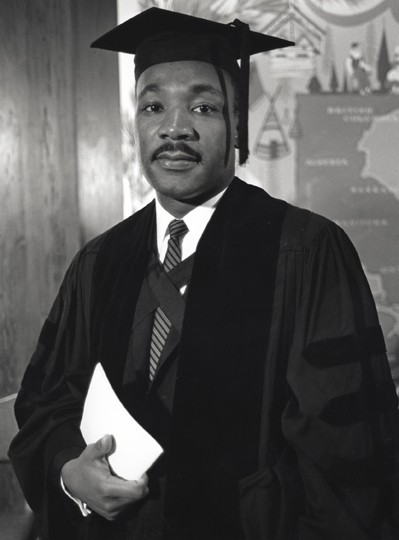
B.A. in Sociology, Morehouse College, Class of 1948. 

Our annual Martin Luther King Jr. Day post, courtesy of The King Center.

Lisa Wade, PhD is an Associate Professor at Tulane University. She is the author of American Hookup, a book about college sexual culture; a textbook about gender; and a forthcoming introductory text: Terrible Magnificent Sociology. You can follow her on Twitter and Instagram.

Check out the comic by Stacy, who blogs at maraglen.tumblr.com.

Lisa Wade, PhD is an Associate Professor at Tulane University. She is the author of American Hookup, a book about college sexual culture; a textbook about gender; and a forthcoming introductory text: Terrible Magnificent Sociology. You can follow her on Twitter and Instagram.

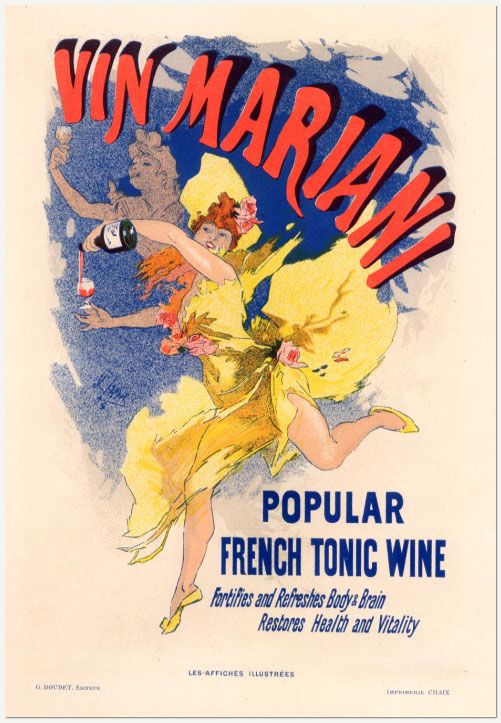
You may be familiar with the fact that the coca in Coca-Cola was originally cocaine. But did you know that the reason we infused such a beverage with the drug in the first place was because of prohibition? Cocaine cola replaced cocaine wine. In fact, when it was debuted in 1886, it was described as “Coca-Cola: The Temperance Drink.”

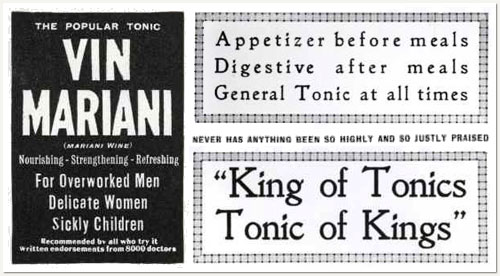
The first mass marketed cocaine product was Vin Mariani, a cocaine-infused Bordeaux introduced in the 1860s. Legal and requiring no prescription, it was believed to “restore health and vitality” and I’m sure it felt like it did. Wikipedia reports that it included 7.2 mg of cocaine per ounce; comparatively, a line snorted is about 25 mg.

3 4

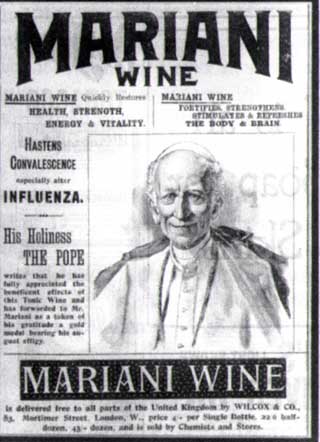
Yes, Vin Mariani was good for men, women, and children. The “tonic of kings!” Even the Pope! He loved it so much he called it a “benefactor of humanity” and gave it a Vatican Gold Medal:

2

But he was just the most eminent of its fans. Mariani’s media blitz included endorsements from Sarah Bernhardt, H.G. Wells, Ulysses S. Grant, Queen Victoria, the Empress of Russia, Thomas Edison, and the then-President of the United States, William McKinley. Jules Verne reportedly joked: “Since a single bottle of Mariani’s extraordinary coca wine guarantees a lifetime of 100 years, I shall be obliged to live until the year 2700!”

Vin Mariani dominated the market, but there was an American chemist, John Smith Pemberton, who made a competing product: Pemberton’s French Wine Coca. He described it as an “intellectual beverage.” Pemberton was located in — you guessed it, Atlanta — and the state enacted temperance legislation in 1885. Hence, Coca-Cola was born.

Cross-posted at Pacific Standard.

Lisa Wade, PhD is an Associate Professor at Tulane University. She is the author of American Hookup, a book about college sexual culture; a textbook about gender; and a forthcoming introductory text: Terrible Magnificent Sociology. You can follow her on Twitter and Instagram.

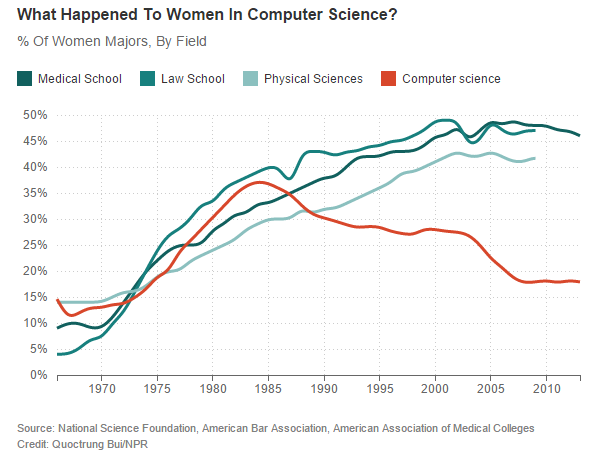
The original compute-ers, people who operated computing machines, were mostly women. At that period of history, most typists were women and their skills seemed to transfer from that job to the next. As late as the second half of the 1960s, women were seen as naturals for working with computers. As Grace Hopper explained in a 1967 Cosmopolitan article:

It’s just like planning dinner. You have to plan ahead and schedule everything so it’s ready when you need it. Programming requires patience and the ability to handle detail. Women are “naturals” at computer programming.

But then, this happened:

1

Computer programming was masculinized.

The folks at NPR, who made the chart, interviewed information studies professor Jane Margolis. She interviewed hundreds of computer science majors in the 1990s, right after women started dropping out of the field. She found that having a personal computer as a kid was a strong predictor of choosing the major, and that parents were much more likely to buy a PC for their sons than they were for their daughters.

This may have been related to the advertising at the time. From NPR:

These early personal computers weren’t much more than toys. You could play pong or simple shooting games, maybe do some word processing. And these toys were marketed almostentirely to men and boys. This idea that computers are for boys became a narrative.

By the 1990s, students in introductory computer science classes were expected to have some experience with computers. The professors assumed so, inadvertently punishing students who hadn’t been so lucky, disproportionately women.

So it sounds like that’s at least part of the story.

Lisa Wade, PhD is an Associate Professor at Tulane University. She is the author of American Hookup, a book about college sexual culture; a textbook about gender; and a forthcoming introductory text: Terrible Magnificent Sociology. You can follow her on Twitter and Instagram.

Flashback Friday.

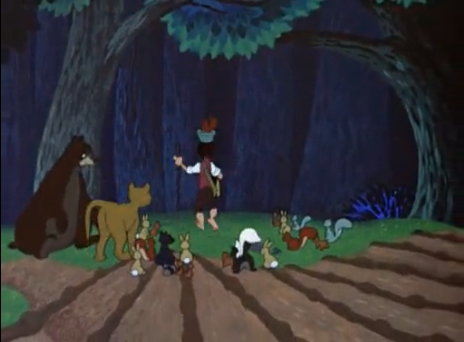
If you’re like me, you probably grew up hearing a charming story about John Chapman, aka Johnny Appleseed, in which he planted apples across America so that no one would ever go hungry again. The image, overall, is of an eccentric but kindly man who went around planting apples so pioneers could have fresh, healthy fruit to eat. Here’s the 1948 version of the story from Disney, if you have 15 minutes:


Johnny Appleseed-1948 by Kanker76

In his book The Botany of Desire, Michael Pollan discusses Johnny Appleseed. He really did exist, and he did travel around the frontier planting apples from apple seeds and later selling the apples to pioneers (and apparently giving lots of trees away, too). He was, by all accounts, extremely eccentric, wearing sackcloth as a tunic for clothing, going barefoot much of the time, and so on. He was a vegetarian, though I don’t know if chipmunks and other animals pranced around in the woods with him.

3

But there’s a little detail the Disney movie and all the kids’ books about Johnny Appleseed got wrong. His apples weren’t for eating. They were for liquor.

Apples don’t grow “true” from seeds — that is, if you plant a Granny Smith apple seed, the tree that grows will not produce Granny Smith apples (the vast majority of the time, anyway). The only way to be sure what kind of apples a tree will produce is to graft limbs onto it from another apple tree that has the kind of apples you want. Most trees that grow from seeds produce smallish apples that are bitter and very much unlike the glowing waxed fruit we’ve come to associate with health and a good diet. People would not want to eat those apples. But what they could do with them is turn them into apple cider, alcoholic apple cider.

For much of American history, alcoholic beverages were widely consumed by both adults and children. Before clean water was necessarily available, it was safer to drink alcohol, particularly in cities.

So how did we go from apples as source of liquor to apples as healthy fresh fruit? According to The Straight Dope,

We stopped drinking apples and started eating them in the early 1900s. The Women’s Christian Temperance Union publicized the evils of alcohol, the movement towards Prohibition was gaining momentum, and the apple industry saw the need to re-position the apple… We can thank prohibition for shifting the image of the apple to the healthy, wholesome, American-as-apple-pie fruit that it is today.

Anyway, it’s sort of a funny instance of both the way we sanitize history and of re-branding. Most of us, raised on images of Laura Ingalls Wilder, can’t imagine early pioneers drinking alcohol all day and happily giving it to their children, or that there might be legitimate reasons for doing so (protecting your kids from getting dysentery from polluted water, for instance). And apples have become such an icon of health that the idea of campaigns against them as sources of liquor is unimaginable.

Originally posted in 2009.

Gwen Sharp is an associate professor of sociology at Nevada State College. You can follow her on Twitter at @gwensharpnv.