Search results for The

For the last week of December, we’re re-posting some of our favorite posts from 2011. Originally cross-posted at Ms.

————————

The cover of this month’s Dossier Journal magazine has caused a great stir.  In a matter of a few hours, five readers — Andrew, Jessica B., anthropology professor Kristina Kilgroveartist Thomas Gokey, and my brilliant colleague, music professor David Kasunic — all sent in a link.  Here’s what all the fuss is about:

(source)

The model is a man named Andrej Pejic, with hair and make-up usually seen only on women, sliding his shirt off his back.  Some might say that he is gender-ambiguous and the image deliberately blurs gender; are we seeing a chest or small breasts?  It is not immediately apparent.

Both Barnes & Noble and Borders “bagged” the magazine, like they do pornographic ones, such that one can see the title of the magazine but the rest of the cover is hidden.  Barnes and Noble said that the magazine came that way, representatives for Dossier say that the bookstore “chains” required them to do it (source).  Non-ambiguously-male chests pepper most magazine racks, but this man’s chest hints at boobs.  And so he goes under.

What’s going on?

Explaining why it is legal for men to be shirtless in public but illegal for women to do the same, most Americans would probably refer to the fact that women have breasts and men have chests.  Breasts, after all, are… these things. They incite us, disgust us, send us into grabby fits.  They’re just so there.  They force us to contend with them; they’re bouncy or flat or pointy or pendulous and sometimes they’re plain missing!  They demand their individuality!  Why won’t they obey some sort of law and order!

Much better to contain those babies.

Chests… well they do have those haunting nipples… but they’re just less unruly, right? Not a threat to public order at all.

So, there you have it.  Men have chests and women have breasts and that’s why topless women are indecent.

Of course it’s not that straightforward.

It’s not true that women have breasts and men have chests. Many men have chests that look a bit or even a lot like breasts (there is a thriving cosmetic surgery industry around this fact).  Meanwhile, many women are essentially “flat chested,” while the bustiness of others is an illusion created by silicone or salt water.  Is it really breasts that must be covered?  Clearly not. All women’s bodies are targeted by the law, and men’s bodies are given a pass, breasty or chesty as they may be.

Unless.

Unless that man’s gender is ambiguous; unless he does just enough femininity to make his body suspect.  Indeed, the treatment of the Dossier coverreveals that the social and legislative ban on public breasts rests on a jiggly foundation.  It’s not simply that breasts are considered pornographic.  It’s that we’re afraid of women and femininity and female bodies and, if a man looks feminine enough, he becomes, by default, obscene.

Lisa Wade, PhD is an Associate Professor at Tulane University. She is the author of American Hookup, a book about college sexual culture; a textbook about gender; and a forthcoming introductory text: Terrible Magnificent Sociology. You can follow her on Twitter and Instagram.

For the last week of December, we’re re-posting some of our favorite posts from 2011.

————————

In Sway: The Irresistible Pull of Irrational Behavior, Ori and Rom Brafman discuss a contestant on Qui Veut Gagner des Millions?, the French version of Who Wants to Be a Millionaire?, who asks the audience for help with the question, “Which of these revolves around the Earth?” His options are the sun, the moon, Venus, and Mars. While it might be surprising that he doesn’t know, more shocking is the result of the audience poll — 56% say the sun:

How can we explain this? The easiest answer, and the video’s title, is that French people appear to be stupid, or were never informed about the Copernican Revolution. But the Brafmans have an explanation based on different cultural attitudes toward reality shows and, ultimately, ideas about fairness.

The general outlines of Who Wants to Be a Millionaire? are the same regardless of country. But distinct cultural patterns have emerged in how audiences act when asked for help. In the U.S., contestants can count on the audience’s goodwill; regardless of the question asked, audiences appear to do their best to help contestants out and the Brafmans report that data shows the audience is right over 90% of the time. I must admit it had never occurred to me that audiences would do anything other than try to be helpful. Though I don’t watch game shows now, as a kid I regularly watched The Price Is Right, among others, with my family, and we always inherently rooted for the contestant, cringing if they seemed to make a bad choice and rejoicing if they won big. We truly wanted these complete strangers to win.

But not all national audiences are so cooperative. When the show was introduced in Russia, contestants quickly learned to be wary of asking the audience for help because Russian audiences frequently mislead them, intentionally giving the wrong answer. It doesn’t seem to have anything to do with the players or the questions they ask for help on.

In France, audiences seem to fall in the middle. They don’t regularly attempt to trick players, as Russian (and according to my googling, Ukrainian) audiences do. But unlike U.S. audiences, they don’t seem willing to help under any circumstances, either. They appear to intentionally give the wrong answer if the contestant asks for help on a question the audience perceives as too easy. If they think the player ought to know the answer they give the wrong response, apparently thinking the contestant deserves to lose if they’re so stupid. In the video you can hear audience laughter when Henri decides to go with the results of the audience poll.

Ori and Rom Brafman suggest this relates to notions of fairness, which have been shown to vary widely by culture. They say that in the U.S., we think it’s fair for people to win large sums of money even if they seem dumb, while in France, there is more concern about whether the individual deserves to win. They consulted historians of Russian society who suggest audience behavior there results from a general mistrust of those who gain sudden wealth. However, they provide no data to directly connect the audience members’ intentional wrong answers to cultural perceptions of fairness more broadly, so I’m somewhat hesitant about this theoretical leap. If you’re an enterprising grad student looking for a dissertation topic, perhaps you can take this project on and get back to me with your results.

But I think this topic is also interesting for the way it highlights the intersection of globalization and local cultures. Who Wants to Be a Millionaire?, like other reality shows such as the various varieties of Idol, are international franchises (Millionaire is owned by Sony), designed to be easily transferable to and implemented in many countries with the same basic blueprint — simply add local talent and you’ve got a successful TV show. But as the variation in Millionaire shows, differences inevitably creep in as a global product or process is used or interpreted on the local level, sometimes in superficial ways but other times to a degree that significantly alters the original product.

Thanks to Kelly V. for the tip about the book!


For the last week of December, we’re re-posting some of our favorite posts from 2011.

————————

It seems obvious that basic cognitive perceptions shouldn’t vary by society.  That is, that our eyes should see, and our brains should process, essentially the same no matter what we call ourselves, what language we speak, or what holidays we observe.  It turns out, however, that even basic cognitions vary across the world.

Most Americans, for example, perceive the two lines in this optical illusion to be of different lengths, with line a shorter than line b.  In fact, they are the same length.

But, as argued by Joseph Henrich and colleagues in the Journal of Behavioral and Brain Sciences, our susceptibility to this illusion varies by culture.  On average, line a needs to be another fifth longer than line b before the average American undergraduate evaluates the lines to be equal in length.  Most other societies that have been tested on this illusion, however, require substantially less manipulation.  The figure below compares how individuals in different societies perform on this test.  The measures are tricky, and you can read more about them here; what you need to know for now is that the societies on the right are more susceptible to the illusion and the societies on the left less.

Observing that individuals in more developed societies (e.g., Evanston, Illinois) tend to be more vulnerable to the illusion — indeed, that in some societies, such as the San foragers of the Kalahari, it doesn’t qualify as an illusion at all — Henrich and his co-authors argue that exposure to “modern environments” may be the culprit:

…visual exposure during ontogeny to factors such as the “carpentered corners” of modern environments may favor certain optical calibrations and visual habits that create and perpetuate this illusion.  That is, the visual system ontogenetically adapts to the presence of recurrent features in the local visual environment.

Even basic cognition, that is, varies across cultures.

As Henrich et al. argue, this calls into question all of the truisms of psychology based, primarily, on experimental research with Western subjects.

Lisa Wade, PhD is an Associate Professor at Tulane University. She is the author of American Hookup, a book about college sexual culture; a textbook about gender; and a forthcoming introductory text: Terrible Magnificent Sociology. You can follow her on Twitter and Instagram.

For the last week of December, we’re re-posting some of our favorite posts from 2011.

————————

In this 26-minute talk, philosopher Gerald Allan Cohen offers a wonderfully eloquent critique of capitalism. His critique revolves around common defenses. He suggests that even the existence of people who have earned their riches legitimately and through their own wit and work do not justify a system of private property. He contests the idea that we are all better off under capitalism compared to other economic systems, suggesting that capitalism retards the human potential of workers nefariously and by design. And he disagrees with the claim that economic inequality is inevitable. Economic inequality, he contends, will someday be seen as an injustice. Capitalism was an important stage, he concludes, and one that we need to outgrow.

I recommend that everyone take a listen, though I’ll admit it starts off kind of goofy:

Part I:

Part II:

Thanks to Chris Bertam at Crooked Timber for putting these videos up.

Lisa Wade, PhD is an Associate Professor at Tulane University. She is the author of American Hookup, a book about college sexual culture; a textbook about gender; and a forthcoming introductory text: Terrible Magnificent Sociology. You can follow her on Twitter and Instagram.

Christmas Across Cultures

On Discourse:

The Institution of Christmas

Racializing Christmas

Gift Guides and the Social Construction of Gender

Sexifiying Christmas

Christmas Marketing

Lisa Wade, PhD is an Associate Professor at Tulane University. She is the author of American Hookup, a book about college sexual culture; a textbook about gender; and a forthcoming introductory text: Terrible Magnificent Sociology. You can follow her on Twitter and Instagram.

Samantha Moore sent in a screenshot of the front page of the website for Aerie, a brand of lingerie marketed to 15-21 year-olds.  I thought it was quite the stunning example of the impossible bodies that young people are offered as the ideal.

Adding more perspective, Samantha writes:

I shopped at American Eagle before I turned 15, and I would say that’s part of the draw — girls like to shop where the older kids do. Though aerie may be officially targeting older teenagers, this bra campaign wipes away the transition from puberty to sex; you know, that time when you bra shop out of necessity and dreadfully weird body change, not sexual enticement.

Lisa Wade, PhD is an Associate Professor at Tulane University. She is the author of American Hookup, a book about college sexual culture; a textbook about gender; and a forthcoming introductory text: Terrible Magnificent Sociology. You can follow her on Twitter and Instagram.

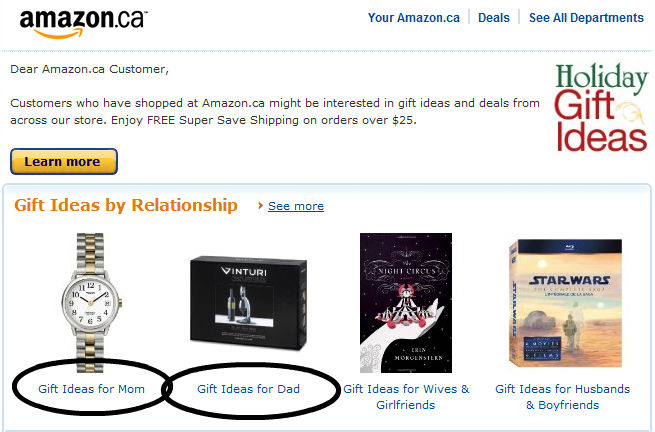
Fraulion sent in this screenshot from the Amazon.com homepage.  In case you needed help buying gifts, dads like history and politics, moms like to smell nice and look shiny, girlfriends and wives like chick flicks and cute stuff, boyfriends and husbands like classic rock and knowing what time it is, grandpas like to watch documentaries (probably about “the war”), and grandmas just want to look at pictures of their grandchildren.

Last but not least, Rob W. sent in another Amazon.com gift guide that suggests that women want a masculine-looking watch and men want a wine aerator (I don’t know what that is, but wine is woman-y right?).  So… counter-stereotypical push back against the gender machine?  Or a typo?  I’m going with typo.  Funny typo.

More after the jump:

more...

The extent of our labor market problems has been highlighted many times and in many ways.  Yet, with little being done to correct them, it is worth keeping the issue in the public eye.

What follows are three charts from the Economic Policy Institute.  This one highlights the ratio of unemployed persons to job openings.  Although the ratio has fallen since the “end” of the recession, it remains considerably higher than a decade ago.  It currently stands at 4 unemployed per job opening.

dec2011_jolts.png

This one breaks down the data by industry.  It reveals that there are problems across the board. 

unemployed_openings_by_industry.png

This final one shows that the job crisis is hitting everyone.  As the Economic Policy Institute explains: “Those with higher levels of education are leaving (or never entering) the workforce at the same rate as those with just a high school degree.” Only those with less than a high school diploma seem to be experiencing improved employment opportunities.

snapshot_labor_force_erosion_main.png

And the response of many political and business leaders to this dismal situation?  Primarily calls for austerity–or better said cuts in social spending.  Some economists have even developed a theory of austerity-led growth, arguing that slashing government spending will unleash private investment and job creation. 

We have been witnessing a test of this theory in Europe and not surprisingly it hasn’t produced positive results.  As the economist Kevin O’Rourke explains:  “One lesson that the world has learned since the financial crisis of 2008 is that a contractionary fiscal policy means what it says: contraction. Since 2010, a Europe-wide experiment has conclusively falsified the idea that fiscal contractions are expansionary.”

I am willing to bet that this outcome wasn’t a surprise to most workers.