Search results for The

It’s been way too long since we’ve talked about one of my favorite foods-lost-to-history: vegetable flavored Jell-O.  I added some more examples to the end.  They’re truly awe-some.

Another great example of how tastes are shaped by history: JELL-O in the flavor of celery, seasoned tomato, mixed vegetable, and italian:
jello

A box of various flavors:

What do you do with it? Well, fill it with things like chopped celery, olives with pimento, and squares of… something:
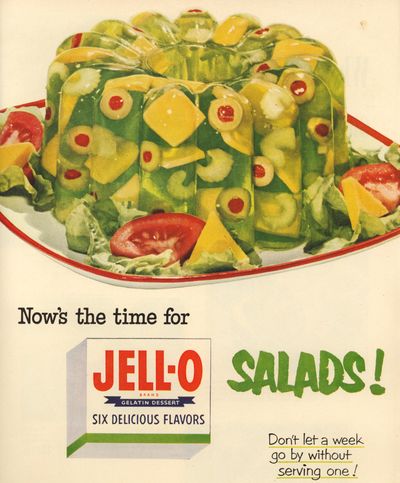

3882147687_abb2c645d9_o

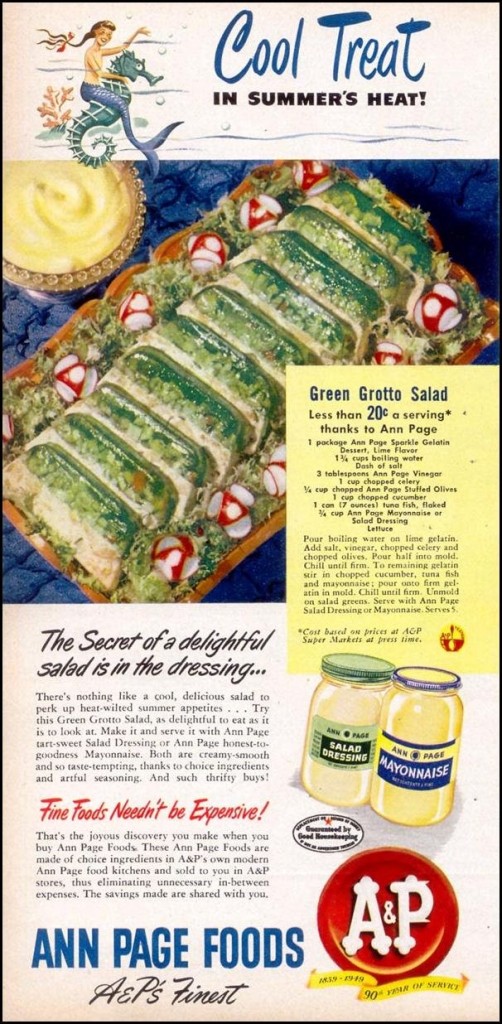
Or, um, tuna…

apday07011949022m32b1fd

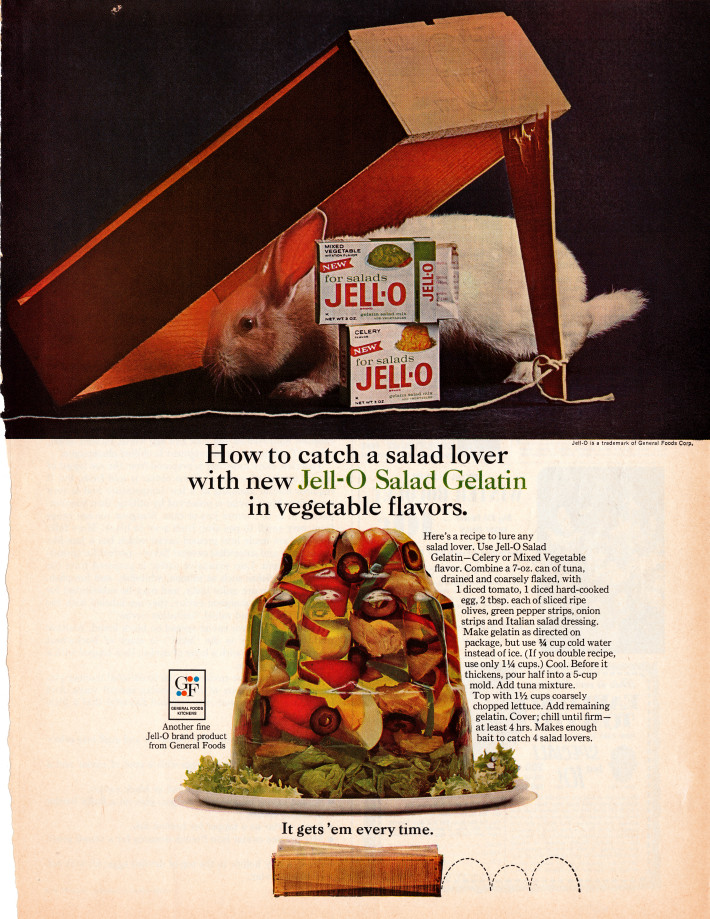
Don’t forget the hard-boiled eggs:

See also our post on aspic, meat-flavored gelatin foods.  And, for fun, here’s a history of JELL-O that includes a brief description of how you would have to make it if you had to make it from scratch, which will leave you wondering how we ever bothered to invent and make gelatin to begin with.

(Ads found at here, here, here, here, and here.)

Lisa Wade, PhD is an Associate Professor at Tulane University. She is the author of American Hookup, a book about college sexual culture; a textbook about gender; and a forthcoming introductory text: Terrible Magnificent Sociology. You can follow her on Twitter and Instagram.

As we enter the last frenzied days of Christmas shopping, Dmitriy T.M. thought it was worth looking at international comparisons in spending on the holiday. The Economist posted a graph based on Gallup polls and other data sources about how much individuals in various countries in Europe, plus the U.S. and South Africa, plan to spend on Christmas shopping this year, plotted against national GDP. Overall, Christmas spending correlates with national wealth, with the Netherlands being a noticeable outlier (spending less than we’d expect) and Luxembourg in a spending league of its own:


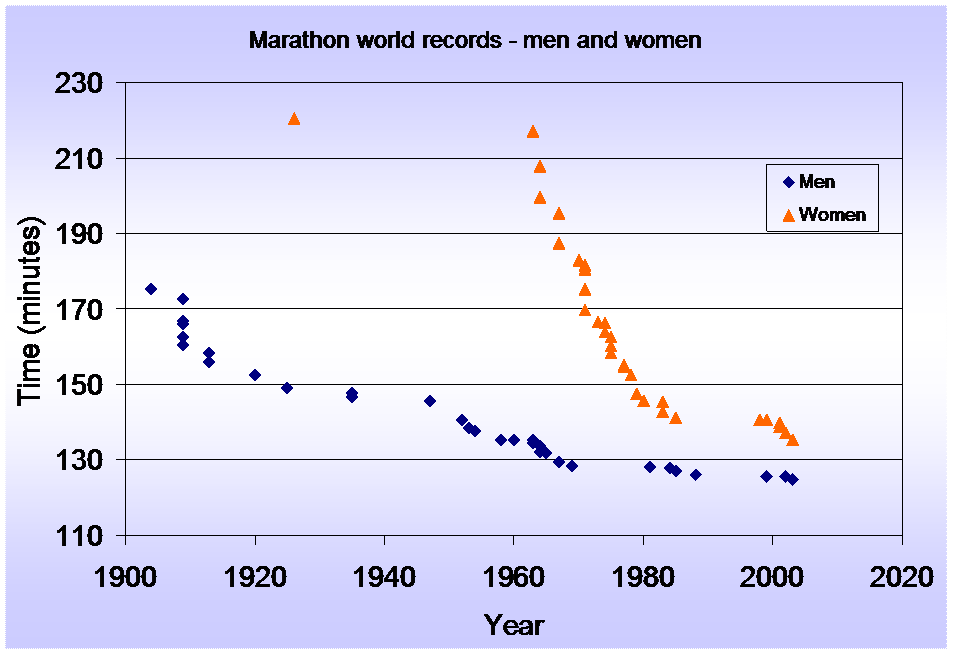
We often think of athletic ability as innate, something people are born with.  In fact, athletic performance is a combination of (at the very least) ability and opportunity.

Case in point: the marathon.

The first Olympic marathon occurred in 1896. A Grecian named Spyridon Louis won that race with a speed of two hours, 58 minutes, and 50 seconds. Women were excluded from formal competition until 1972. Once they were allowed to compete, their time dropped to an equivalent two and a half hours in just five years (source).

Today the men’s record is faster than the women’s record, but by less than 10 minutes… a much smaller difference than the one hour difference that we saw when women were first allowed to compete.  The rate at which they’ve been catching up with men has slowed though. Still, who knows how fast they’d be running if they hadn’t been excluded from competing for the 64 years between 1908 and 1972.  In any case, the quickening of both men’s and women’s times over the years shows just how contingent athletic performance can be.

Lisa Wade, PhD is an Associate Professor at Tulane University. She is the author of American Hookup, a book about college sexual culture; a textbook about gender; and a forthcoming introductory text: Terrible Magnificent Sociology. You can follow her on Twitter and Instagram.
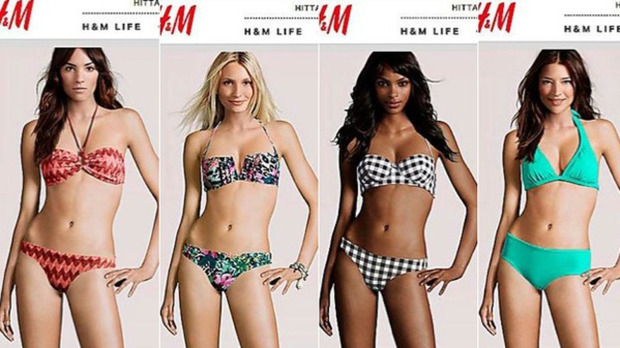
The clothier H&M is in the news this week and Craita, Ann C., and Marjukka O. all sent in links to the story.  It turns out that they are using a mannequin to display their clothes. Nothing new here.  Except that the mannequins are appearing on their website (instead of their brick-and-mortar stores) and they are photoshopping heads of real models onto the figure and changing the skin color, giving it the illusion of being a real person.

The practice is getting plenty of vaguely negative press (ABC, FOX, Guardian, Jezebel). The critique seems to be that the use of a “virtual mannequin” creates even more unrealistic bodily expectations for women than the use of “real” models (with “real” in quotes because of the degree of photoshopping that goes into creating any images of women that appear in fashion-related advertising).

To be honest, I’m having a hard  time feeling that this is either qualitatively or quantitatively different than the range of techniques used to produce impossibly idealized bodies (including photoshopping images, using mannequins in stores, using models with unusual body types, and requiring those women to exercise and diet their bodies to achieve an extreme look even given their biologies).  (In fact, Nadya Lev at Coilhouse has a positive spin on it.)

What is more interesting, in my opinion, is the way this illustrates the deskilling of labor. Models no longer have to have just the right body, nor do they have to be good at modeling (e.g., posing in ways that flatter clothes while simultaneously looking natural, not to mention the endurance and emotion work).  No, instead, modeling is reduced to a pretty face that can be nicely composed.  Everything else is done digitally.

Those in the modeling industry, then, don’t see this as an insult to women everywhere, they see it as an insult to models specifically.  FOX quotes Michael Flutie of E!’s model search show “Scouted” saying:

It is disrespectful and lazy. It is the job of the brand to properly scout for their models and find those that represent their brand in every aspect. They need to take the responsibility of looking deep into the model pool to find the right people instead of digitally creating what they need…

If this continues, models may face the same deteriorating working conditions that factory workers and many other segments of the U.S. workforce have faced: becoming increasingly obsolete.

For more on modeling, see our posts on the invisibility of labor in modeling, the dismal pay in the modeling industry, the fraudulent “model search,” and the contrasting aesthetics for “high” and “low end” modeling (all based on the work of ex-model, now-sociologist, Ashley Mears).

Lisa Wade, PhD is an Associate Professor at Tulane University. She is the author of American Hookup, a book about college sexual culture; a textbook about gender; and a forthcoming introductory text: Terrible Magnificent Sociology. You can follow her on Twitter and Instagram.
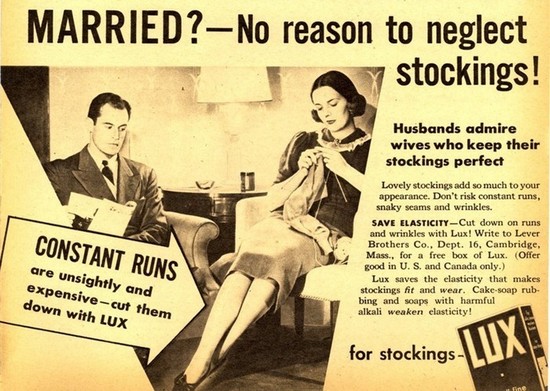
Notice how disapprovingly he is glaring at her icky, untidy stockings.

Via Vintage Ads.

Lisa Wade, PhD is an Associate Professor at Tulane University. She is the author of American Hookup, a book about college sexual culture; a textbook about gender; and a forthcoming introductory text: Terrible Magnificent Sociology. You can follow her on Twitter and Instagram.
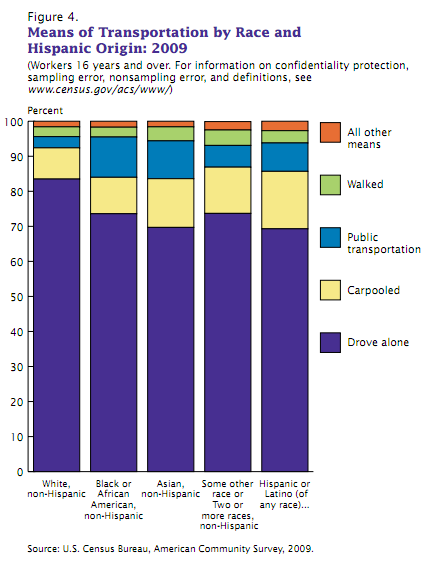
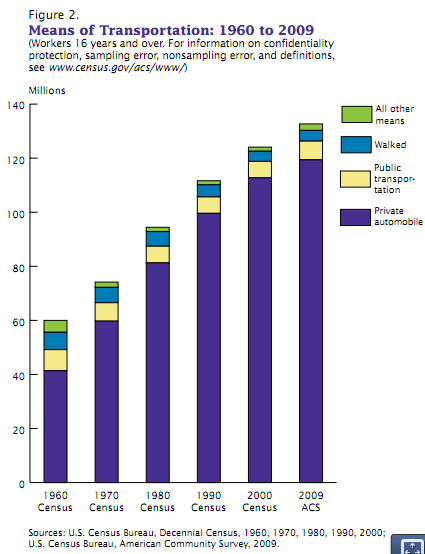
Dmitriy T.M. sent in a Census Bureau report on transportation and commuting, providing a detailed picture of how we’re getting to work. Despite constant discussions about reducing car use and encouraging mass transportation, the vast majority of people in the U.S. get to work in a car:

Not surprisingly, there are significant differences by race and ethnicity. Non-Hispanic Whites are the most likely to drive to work alone in their own car (83.5%), while only 3.2% use public transportation. Latinos are the most likely to carpool with at least one other person (16.4%) and African Americans are most likely to use public transportation (11.5%):

These differences likely reflect a variety of factors, include social class and differences in racial/ethnic concentrations in urban vs. rural areas and in different regions of the U.S., which affects how likely a worker is to have access to reliable, efficient public transportation or to realistically be able to walk to work. In fact, there were only five metro areas where at least 10% of workers use public transportation to get to work: the regions surrounding NYC, San Francisco/Oakland, Washington D.C., Boston, and Chicago.

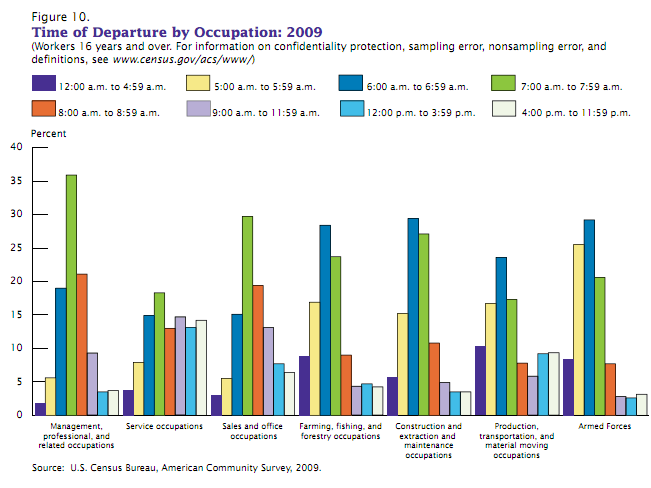
And as anyone who has taken part in a morning commute recently won’t be shocked to hear, leaving for work is still highly concentrated in the 5 to 8:59 a.m. period for most occupations, though departure times reflect the  wider range of normal working hours in the service industry compared to other economic sectors (note that the colors do not all represent equal amounts of time):

More on mode of transportation and commuting times by region and race/ethnicity in the full report.

Two new submissions inspired me to revive this post from 2008.

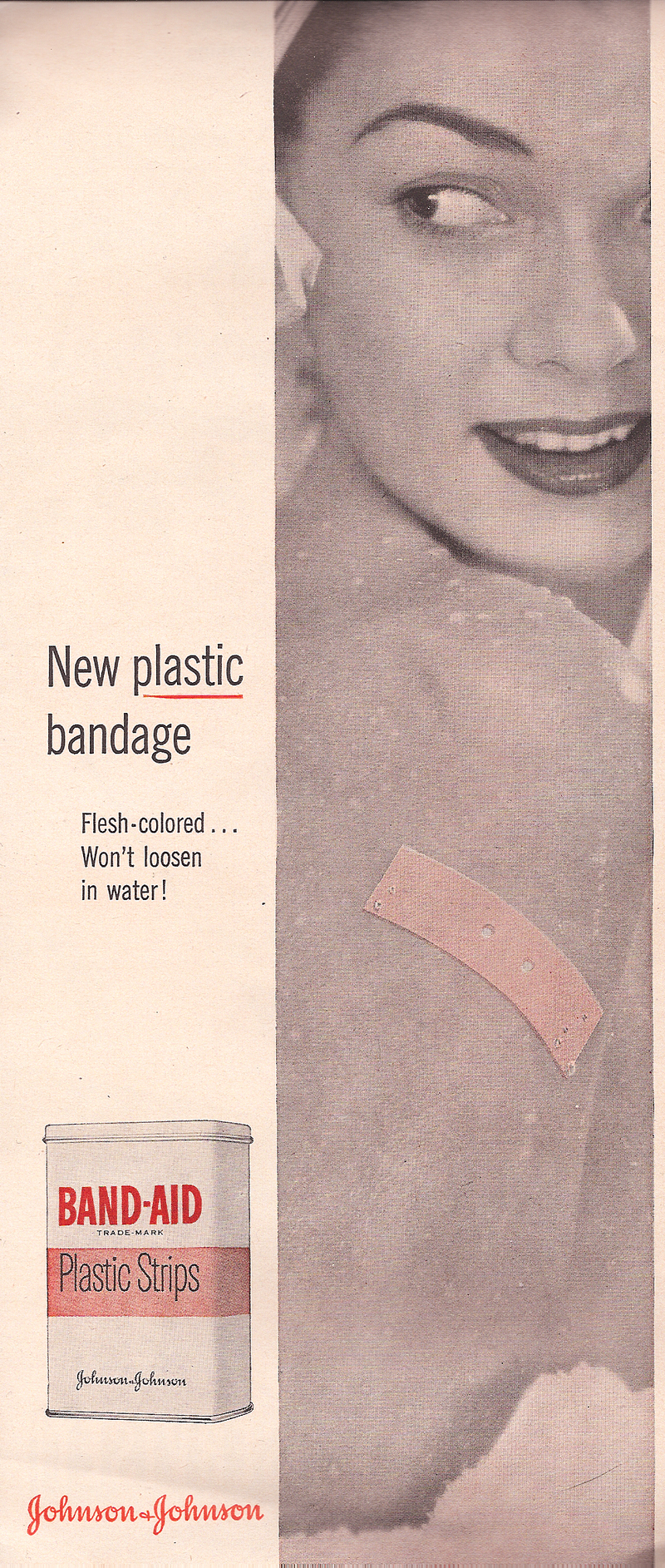
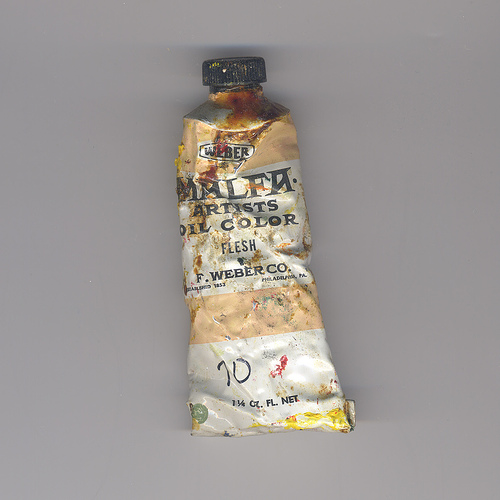
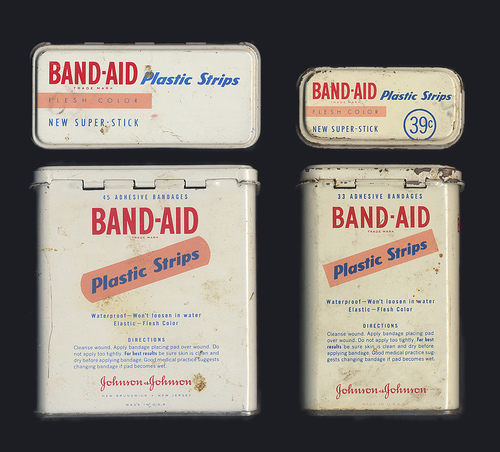
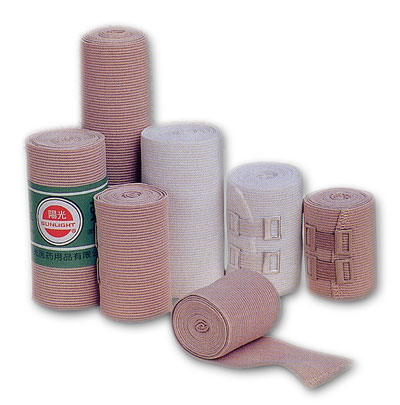
Part of the privilege of being white is having a society that considers you the norm and is, therefore, organized around you.  A really nice example of this is “flesh” color.  What is flesh color?

Ben O. sent us this 1952 ad for bandaids (from Vintage Ads)

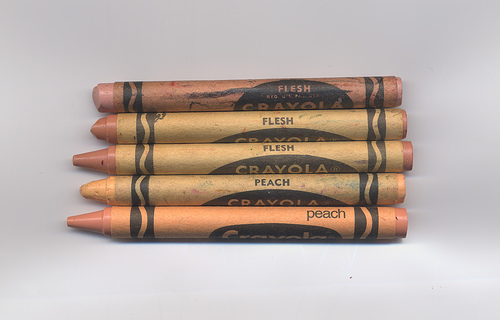
The next set of images come from Nathan Gibbs’ flickr photostream:

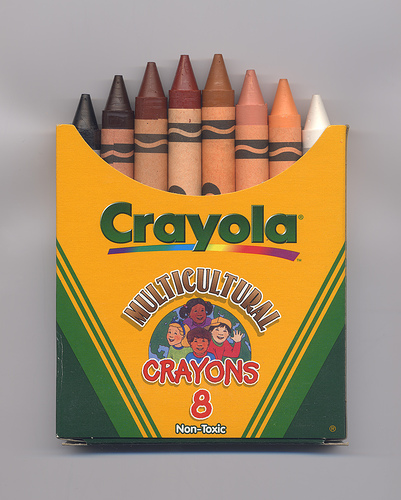
A lot of companies have gotten a clue.  Crayola doesn’t have flesh color anymore (or so I’ve heard, let me know if I’m wrong).  And now they make “multicultural crayons.”  Though, Nathan notes:

It’s interesting how “culture” here is a substitute for “race.”

“White” skin is still taken-for-granted in many products.  Here are a couple examples I’ve collected (found here and here):

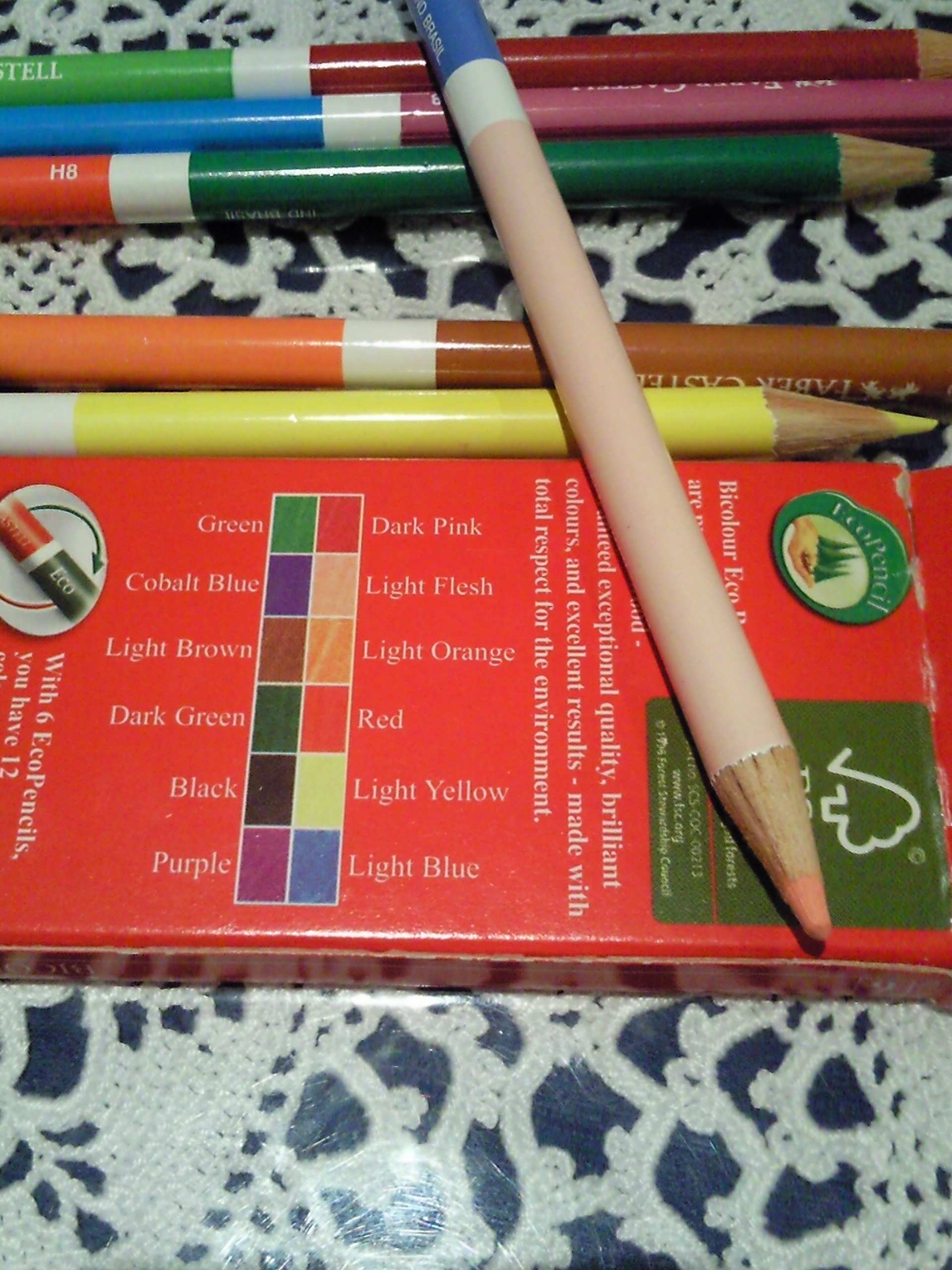
Perhaps trying to walk the line, EcoPencil has a “light flesh” color, but no other flesh colors to choose from (sent in by kelebek in Australia):

Caroline observed that Breathe Right not only centers whiteness in their logo…

…but calls white skin “normal” (see second-to-bottom line):

For more examples, see our posts on (the irony of) Michelle Obama’s champagne-colored described as “flesh-colored”, the widespread use of such language to describe light tan in the fashion world,  and lotion marketed as for “normal to darker skin.” See also our Contexts essay on race and “nude” as a color.

For contrast, see this post about how the generic human in Russian cartoons is colored black instead of white.

Lisa Wade, PhD is an Associate Professor at Tulane University. She is the author of American Hookup, a book about college sexual culture; a textbook about gender; and a forthcoming introductory text: Terrible Magnificent Sociology. You can follow her on Twitter and Instagram.
Sara P. sent in a video from The Economist that highlight women’s economic opportunities worldwide. It is based on the results of an economic index ranking of 113 nations, focusing on issues such as workplace policies (for instance, access to paid maternity leave), education, access to the financial system, and the legal and social status of women  in the economy (such as the right to work and social attitudes about women working for pay). The index also attempts to differentiate between official policy and actual practice to provide a better idea of the actual economic environment facing women in each country. The analysis is necessarily limited by the inclusion of only 113 countries (especially for Oceania, where only Australia and New Zealand were included), but it’s a worthwhile watch for a general overview:

You can read the full report here.