Search results for The

On any given workday, over 31 million lunches are served to children in school cafeterias. Part of the U.S. Department of Agriculture’s (USDA) nutritional assistance efforts, the National School Lunch Program (NSLP) aims to deliver affordable and nutritious meals to the nation’s schoolchildren. After all, food plays a key part in helping them learn, grow, and thrive.

To reach those who need it most, the federal and local governments work together to offer free lunch to children whose parents cannot afford to pay for it. But money is just one way a meal can be compensated for: the ‘free’ school lunch comes at other costs.

First, there are the health costs. At its inception, the NSLP was not designed as a social program. Instead, it was a response to agricultural overproduction and a surplus of farm produce, writes historian Susan Levine. The policymakers’ goal was to get rid of excess foods while supporting domestic production.

As a result, nutrition was of secondary concern to them: one year, eggs would be on the menu daily; another, they would hardly make an appearance. It wasn’t until the war, when politicians grew concerned about the ability of the nation’s men to fight, and until it became apparent hungry children don’t do well in classrooms they were newly required to sit in, that anyone took a serious look at what kids at school were actually eating.

By that time, it was too late. The program was already run like a business, and not even the introduction of nutritional standards helped. Today, these normatives are outdated – children snack rather than eat three square meals, and are less physically active, requiring fewer calories – and almost impossible to follow with the budget restrictions school lunch planners face.

The private industry was quick to offer solutions, but is more interested in profits than schoolchildren’s waistlines. Enriched and fortified chips and candies of otherwise dubious nutritional value appear in school cafeterias and vending machines, often a more popular choice with kids than apples. Frozen and convenience foods are replacing fresh meals cooked on premises. And the labyrinthine regulations of meal calorie contents coupled with cafeteria financial realities often mean adding more sugar to students’ plates is the only thing that can bring down its fat content, for example.

The food itself is not the only factor contributing to children’s undesirable health outcomes. Economist Rachana Bhatt finds the amount of time students have to enjoy lunch also matters. Students tight on time – they must squeeze all getting to the cafeteria, standing in line, eating their food, and cleaning up into their lunch break – might choose to skip the meal, leading them to overeat later, or eat quicker, leading them to consume more due to the delay in feeling full. Even if all school lunches offered healthy options, time would complicate their relationship with health outcomes: Bhatt found students who had less time for lunch were more likely to be overweight.

The lunch may be free when children choose their meal and sit down to eat it, then. But it may come at a substantial cost several years down the line, when a young adult is paying for diabetes medication and visits to the doctor to monitor their blood pressure.

Read Part II of “No Such Thing as a Free School Lunch.”

Teja Pristavec is a graduate student in the sociology department, and an IHHCPAR Excellence Fellow,  at Rutgers University. She blogs at A Serving of Sociology, where this post originally appeared. Cross-posted at Pacific Standard.
The short answer is, pretty well. But that’s not really the point.

In a previous post I complained about various ways of collapsing data before plotting it. Although this is useful at times, and inevitable to varying degrees, the main danger is the risk of inflating how strong an effect seems. So that’s the point about teen test scores and adult income.

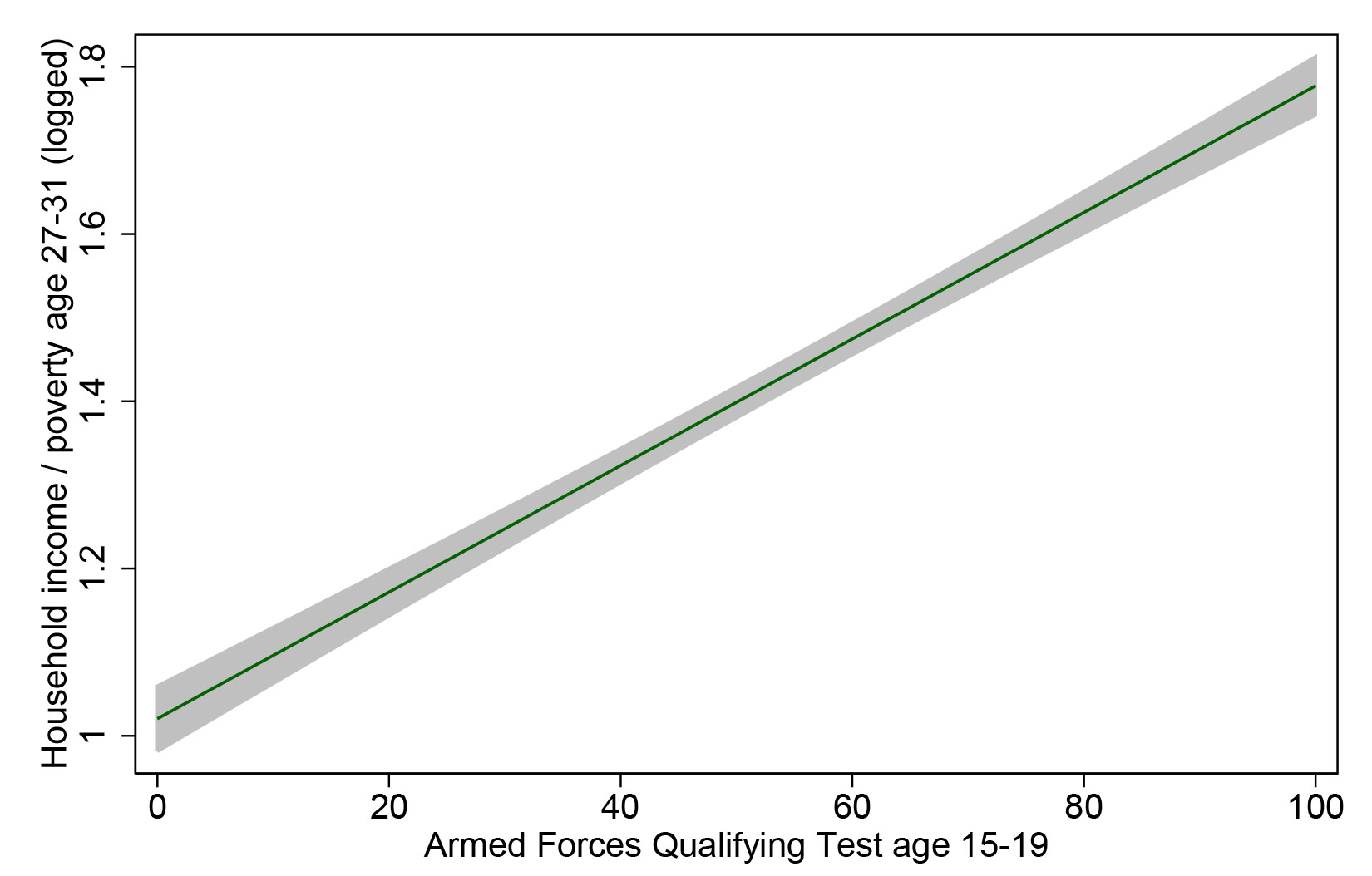
If someone told you that the test scores people get in their late teens were highly correlated with their incomes later in life, you probably wouldn’t be surprised. If I said the correlation was .35, on a scale of 0 to 1, that would seem like a strong relationship. And it is. That’s what I got using the National Longitudinal Survey of Youth. I compared the Armed Forces Qualifying Test scores, taken in 1999, when the respondents were ages 15-19 with their household income in 2011, when they were 27-31.

Here is the linear fit between between these two measures, with the 95% confidence interval shaded, showing just how confident we can be in this incredibly strong relationship:

1 (2) - Copy

That’s definitely enough for a screaming headline, “How your kids’ test scores tell you whether they will be rich or poor.” And it is a very strong relationship – that correlation of .35 means AFQT explains 12% of the variation in household income.

But take heart, ye parents in the age of uncertainty: 12% of the variation leaves a lot left over. This variable can’t account for how creative your children are, how sociable, how attractive, how driven, how entitled, how connected, or how White they may be. To get a sense of all the other things that matter, here is the same data, with the same regression line, but now with all 5,248 individual points plotted as well (which means we have to rescale the y-axis):

1 (2)

Each dot is a person’s life — or two aspects of it, anyway — with the virtually infinite sources of variability that make up the wonder of social existence. All of a sudden that strong relationship doesn’t feel like something you can bank on with any given individual. Yes, there are very few people from the bottom of the test-score distribution who are now in the richest households (those clipped by the survey’s topcode and pegged at 3 on my scale), and hardly anyone from the top of the test-score distribution who is now completely broke.

But I would guess that for most kids a better predictor of future income would be spending an hour interviewing their parents and high school teachers, or spending a day getting to know them as a teenager. But that’s just a guess (and that’s an inefficient way to capture large-scale patterns).

I’m not here to argue about how much various measures matter for future income, or whether there is such a thing as general intelligence, or how heritable it is (my opinion is that a test such as this, at this age, measures what people have learned much more than a disposition toward learning inherent at birth). I just want to give a visual example of how even a very strong relationship in social science usually represents a very messy reality.

Cross-posted at Family Inequality and Pacific Standard.

Philip N. Cohen is a professor of sociology at the University of Maryland, College Park, and writes the blog Family Inequality. You can follow him on Twitter or Facebook.

Flashback Friday.

We are a species that reproduces sexually and has a penchant for power hierarchies.  One thing that we’ve eroticized, then, is inequality.  In other words, we have sexualized power asymmetry.  I’m not necessarily talking about BDSM, though that may very well be part of it; I’m talking about the everyday gentle or not-so-gentle eroticization of power difference.   If you’ve ever been turned on by the idea of overpowering or being overpowered, that’s what I’m talking about.

An image of a pear next to and curving over an apple, used to illustrate a New York Times article about the sexual partners of vegans, is a striking example of eroticized inequality.

The image, apparently, was chosen because it was a story about sexual relationships between vegans, or “fruity” types. But in order to make fruit look sexual, they positioned them asymmetrically with the pear not just standing next to the apple, or even taller than the apple, but towering over it.  It’s the implication of power difference (and the satin sheets) that make this seem like a sexual image instead of, say, a sleepy one.

This post originally appeared in 2007.

Lisa Wade, PhD is an Associate Professor at Tulane University. She is the author of American Hookup, a book about college sexual culture; a textbook about gender; and a forthcoming introductory text: Terrible Magnificent Sociology. You can follow her on Twitter and Instagram.

You approve!  Here are our most appreciated posts this month:

Editor’s pick:

Thanks everybody!

Lisa Wade, PhD is an Associate Professor at Tulane University. She is the author of American Hookup, a book about college sexual culture; a textbook about gender; and a forthcoming introductory text: Terrible Magnificent Sociology. You can follow her on Twitter and Instagram.

Check out the comic at A Whole Lot of Something.

Lisa Wade, PhD is an Associate Professor at Tulane University. She is the author of American Hookup, a book about college sexual culture; a textbook about gender; and a forthcoming introductory text: Terrible Magnificent Sociology. You can follow her on Twitter and Instagram.

Flashback Friday.

This is a picture of a statue in Lexington, KY, in honor of Civil War general John H. Morgan. It depicts him on his favorite horse, Black Bess. The inscription is “Gen. John H. Morgan and His Bess.”

Here’s what’s interesting about this: Bess, as you might guess, was a mare — a female horse.  The statue, however, has testicles. You can see them in the picture below. The sculptor gave Bess testicles because he considered a mare an unworthy mount for a general — despite the fact that Morgan himself seemed to think she was just fine.

Flickr Creative Commons License, J Stephen Conn

I found out about this in Lies Across America: What Our Historical Sites Get Wrong by James W. Loewen. Top image borrowed from here. This post originally appeared in 2007.

Gwen Sharp is an associate professor of sociology at Nevada State College. You can follow her on Twitter at @gwensharpnv.

We all know that, on some basic level, money is purely symbolic.  It only works because everyone collectively agrees to participate in the fantasy that a dollar bill is worth a dollar, whatever that is.  Moreover, most of our money these days is purely electronic, represented by ones and zeros and real only in the most abstract sense possible.

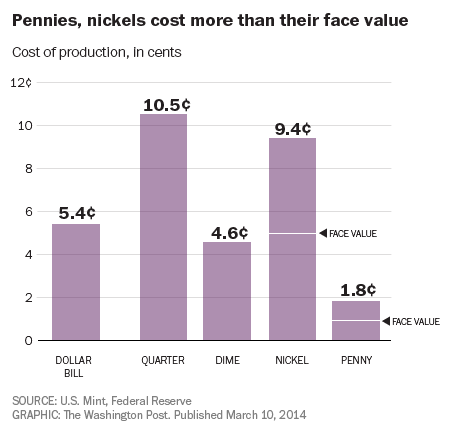
Christopher Ingraham at the Washington Post offered another way of thinking about money as a social construction: how much it costs to make it.  None of our coins are actually worth what they cost, and pennies and nickels are worth quite a bit less.

1.jpg

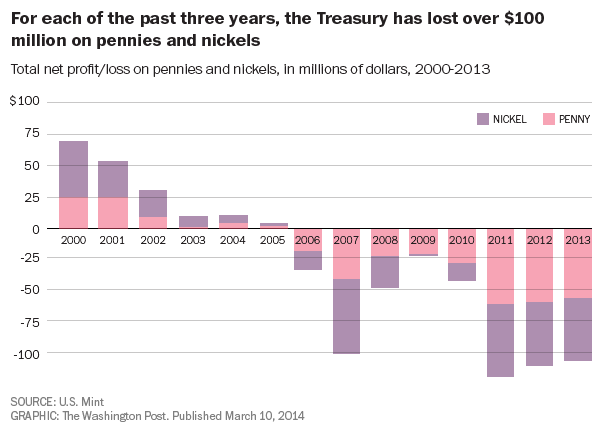
The excess cost of producing pennies and nickels means a budget deficit for the Treasury. In 2013, producing the coins cost the government $105 million dollars above and beyond the coins’ value.

1

Interestingly, moves to eliminate pennies have been successfully opposed by the zinc industry for years, illustrating another sociological phenomenon: the power of corporations to shape government decisions.

Lisa Wade, PhD is an Associate Professor at Tulane University. She is the author of American Hookup, a book about college sexual culture; a textbook about gender; and a forthcoming introductory text: Terrible Magnificent Sociology. You can follow her on Twitter and Instagram.

The Pink Lady is 15 oz. gin, 4 dashes of grenadine, and an egg white.

According to Shanna Farrell,  the Pink Lady was popularized in the ’50s.  Women were believed to have “dainty palates,” and so cocktails for women were designed to disguise any taste of alcohol.  In the ’70s, the Pink Lady was surpassed by the Lemon Drop and, in the ’80s, the Cosmopolitan.

Farrell asks “What does it mean to drink like a woman” today? Anecdotally, she finds that bartenders consistently expect her to order something “juicy or sweet” — “It’s pink; you’ll like it” — and respond with a favorable nod when she orders something “spirit forward.”

This is typical for America today: women are expected to perform femininity, but when they perform masculinity, they are admired and rewarded. This is because we still put greater value on men and the things we associate with them.

This phenomenon of valuing masculinity over femininity — what we call “androcentrism” — may be changing how women drink, since everyone likes that nod of approval.  Farrell reports that “women account for the fastest-growing segment of worldwide whiskey consumers.”  Well hello, Hilary.

I wonder how men will respond to women’s incursion into the whiskey market. Traditionally we’ve seen male flight.  As an activity, occupation, or product is increasingly associated with women, men leave.  In a society where women keep infiltrating more and more of men’s domains, this is a bad long-term strategy for maintaining dominance (see, for example, the feminization of education). As I ask in my forthcoming sociology of gender textbook: “What will happen when women are sipping from all the bottles?”

Thanks to the super-cool bartender Naomi Schimek for the tip!

Cross-posted at Jezebel and Pacific Standard.

Lisa Wade, PhD is an Associate Professor at Tulane University. She is the author of American Hookup, a book about college sexual culture; a textbook about gender; and a forthcoming introductory text: Terrible Magnificent Sociology. You can follow her on Twitter and Instagram.