Search results for The

Jane Mayer’s recent book Dark Money: The Hidden History of the Billionaires Behind the Rise of the Radical Right is a powerful account of how the Right influences public opinion via a network of think-tanks, lobbyists and other forms of direct and indirect funding in the guise of objectivity, but which in fact support right-wing values.

As someone with an interest in masculinity, one name that jumped out of Mayer’s book at me was Harvey Mansfield, a Harvard professor of government and author of Manliness published in 2006 by Yale University Press. Mansfield’s book is a lament to the loss of manliness in contemporary society (a state of being he traces back to the ancient Greeks and follows through to Rick in Casablanca), which is being eradicated by a “gender neutral” ideology. In short, Manliness is a manifesto for normative masculinity.

It always seemed curious to me why Manliness was ever taken seriously by such a prestigious publisher as Yale University Press when its argument was so outdated relative to most academic discourse on masculinity, combined with the fact that Mansfield had little research track record in the subject. Mayer’s book offers two facts that can be speculatively connected to address this curiosity.

Mansfield is cited in Dark Money as being one of numerous professors who received funding from the Olin Foundation, a trust established to promote freemarket ideology and other conservative ideas on America’s campuses. Mayer does not state that Manliness was funded by the Olin Foundation, but later she quotes Steve Wasserman of Yale University Press, who noted how the Right saw the value of funding books, whereas the philanthropic Left did not assign the same value.

In general, funding, either in full or in part, can make a substantial difference to the economic viability of a book for a publisher. In normal circumstances this is called a “subvention,” and while many believe this to be a sign of vanity publishing, it is a reality of academic publishing. Academic books in some circumstances (and in particular, some subjects), can be fully funded, which can only have a positive influence on whether or not the book sees the light of day.

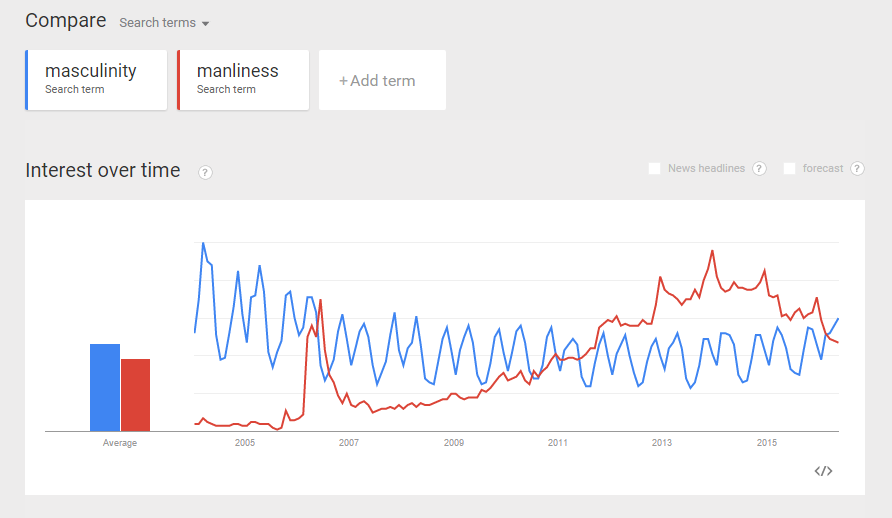
But what of it? What does it really matter if a book peddling antiquated ideas about masculinity is published? First, anything published by Yale University Press is going to be taken seriously. Further still, the support network around Mansfield and his ideas made sure that his book received more media attention than most other books on the subject that were of greater merit. Second, if we look at Google search trends we can see some interesting changes, keeping in mind that correlation does not (necessarily) imply causation. Consider the following chart that looks at the popularity of the term “masculinity” relative to “manliness”:
4

In 2005 there was a high usage of the term “masculinity” and very little usage of the term “manliness.” In 2006 there was a massive spike in the term “manliness” which immediately matches that of “masculinity.” 2006 was the year of publication of Mansfield’s Manliness. Certainly, that spike of activity swiftly drops off, but it slowly builds again until around 2011 when manliness again surpasses masculinity and this remained the case until very recently.

It is reasonable to assume that the 2006 spike in search activity using “manliness” was down to Mansfield’s book. It is less reasonable to say that the slow increase in the use of the term was discussion of Mansfield’s book, but it may well have planted a seed that might not otherwise have grown.

Do not make the mistake of thinking these are different but value-free words for describing the same thing. In general, people who use the term “manliness” are referring to a fixed and essentialist idea of sex and gender (usually glossing over the distinction between the two), whereas the use of the term “masculinity” accommodates a critique as well as celebration of normative masculinity.

And do not make the mistake of thinking this is just about sex and gender. In his book The Political Mind, George Lakoff shows how manliness (which he describes as the “strict father model”) is one of the most basic metaphors we use for constructing national identity. Lakoff actually cites Mansfield’s Manliness as being written to cement the conservative strict father model in order to consolidate conservative political power.

Locating the strict father model as one of the core metaphors of the political mind adds further understanding to how masculinity has played out in the 2016 presidential campaign. Numerous articles on this subject are chronicled at the excellent Presidential Gender Watch project which mostly argue how Trump has appealed to a specific model of masculinity in his speeches. Yes, these speeches reveal an unsavory streak of misogyny in Trump, and yes, they reveal him to be capitalizing upon a perceived crisis of masculinity, particularly among the working class. However, an explicit appeal to masculinity also mobilizes that strict father model, which enables Trump to draw on the traditional conservative base even as he critiques it.

It is also worth considering how these deep metaphors play out in the Democratic imagination. Opposite the strict father model of the conservatives, Lakoff identifies the “nurturing parent model” of the progressives. According to Lakoff, Democrats should appeal to the nurturing parent metaphor at all times. However, one could argue that despite Clinton’s playing the “woman card” her style is more that of the strict father than the nurturing parent, again appealing to that traditional conservative base. So who is the nurturing parent? As Obama quipped in his final correspondents’ dinner speech about Malia wanting to go to Burning Man, “Bernie might have let her go. Not us.”

Joseph Gelfer, PhD is a researcher of men and masculinities. He is the editor of Masculinities in a Global Era and 2012: Decoding the Countercultural Apocalypse.

Americans, and even the sociologists among us, tend to think about crime as a problem related to people and their economic characteristics. Crime, we theorize, is caused by poverty or relative poverty (larger differences between the haves and have nots), joblessness, more lucrative underground occupations, or an insufficient safety net.

Other scholars have examined non-economic correlates of crime. One study of serial killing, for example, found that these crimes were more common in big cities with higher percentages of single-person households. The anonymity of a bustling metropolis, plus the likelihood of finding people all alone in their apartment, may attract killers, tempt people who otherwise wouldn’t kill, or both. Reducing people’s isolation might be protective.

Another interesting non-economic factor that has gotten recent attention is lighting. When early lighting companies began lobbying cities to install the first street lights at the end of the 1800s, they argued that bright lights would certainly deter crime. Historian Ernest Freeberg, in his book The Age of Edison, writes that:

…lighting companies marketed their product as noting less than a police force on a pole. After nightfall, urban parks became notorious danger zones, a haven for the city’s dregs and an infernal playground of indecency. Now all that could end, not by converting sinners or reforming criminals, but by harnessing light’s power of exposure.

City leaders were swayed and artificial nighttime lighting in parks and streets eventually became an expected and routine part of city-building.

15540252507_30c511d3a7_z
Photo by Shinichi Higashi, Flickr Creative Commons.

But does it work? The consensus appears to be maybe a little and no. The no comes from a new study, a natural experiment published in 2015. Since 2000, cities in England and Wales have reduced street lighting to save money and reduce carbon emissions. The study, led by social and environmental health researcher Rebecca Steinbach, found no clear correlation between turning the lights down and a rise in crime (or car crashes, for that matter).

I’m excited by this research on the relationship between crime and non-economic characteristics of cities, whether the hypotheses bear out or not. It gives us creative ideas about how we might reduce crime — above and beyond the all-important economic issues — and may also show us where we might be wasting our resources.

Lisa Wade, PhD is an Associate Professor at Tulane University. She is the author of American Hookup, a book about college sexual culture; a textbook about gender; and a forthcoming introductory text: Terrible Magnificent Sociology. You can follow her on Twitter and Instagram.

Taking a cue from sociologists, The Nightly Show has started a segment called the “Super Depressing Deep Dive.” In the five minute segment I’ve embedded below, they explain that we’ve known that lead was highly toxic since 1904, but the US didn’t ban lead paint until 1978 and lead pipes even later. Why not?

Looking at the evidence piling up, the League of Nations encouraged all nations to stop the use of lead paint in 1922, but the United States didn’t sign on. They deferred to the industry — the Lead Industries Association and the National Paint, Varnish, and Lacquer Association — who successfully lobbied the federal government. Not only did the US decline to ban the substance, in 1938 the government actually mandated that lead paint be used in housing projects for poor people, putting the lead industries profits above the health of poor children.

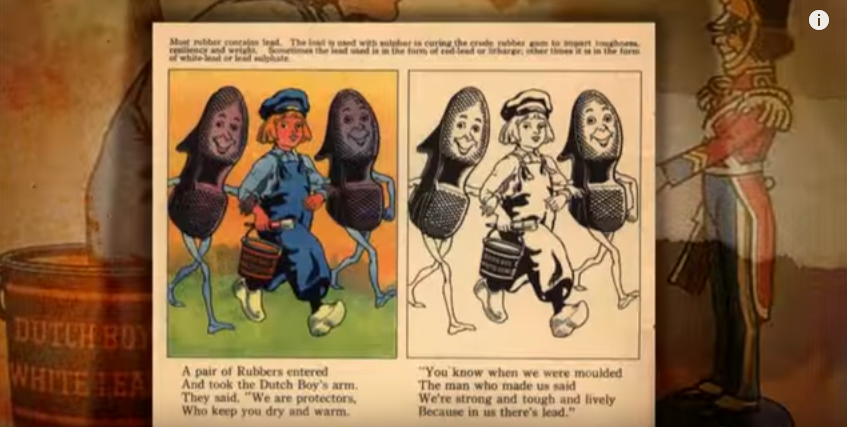
The industry also fought warning labels, criticized the science, sued at least one source — a television show — for telling the truth about lead, and blamed the victim, claiming that the real problem was “uneducable Negro and Puerto Rican” parents who failed to adequately protect their children. They even dispensed pro-lead propaganda directly to kids, like in this page from a free children’s book distributed by a paint company in which a pair of rubber boots say to the child (bottom right):

You knew when we were moulded
The man who made us said
We’re strong and tough and lively
Because in us there’s lead.

8

Because of the disproportionate impact on the poor and racial minorities, the Black Panthers made fighting lead paint a part of their mission and their work ultimately contributed to the banning of lead paint in 1978 and pipes in the 1980s. By that time, though, the damage was done. Lead pipes are still in the ground and lead paint continues to be a serious threat in poor neighborhoods, doing irreparable damage to the lives of poor children and the communities they are a part of.

Lisa Wade, PhD is an Associate Professor at Tulane University. She is the author of American Hookup, a book about college sexual culture; a textbook about gender; and a forthcoming introductory text: Terrible Magnificent Sociology. You can follow her on Twitter and Instagram.

TSP_Assigned_pbk_978-0-393-28445-4Assigned: Life with Gender is a new anthology featuring blog posts by a wide range of sociologists writing at The Society Pages and elsewhere. To celebrate, we’re re-posting four of the essays as this month’s “flashback Fridays.” Enjoy! And to learn more about this anthology, a companion to Wade and Ferree’s Gender: Ideas, Interactions, Institutions, please click here.

.

Is the “Mrs. Degree” Dead?, by Laura Hamilton, PhD

In 1998 I was a first-year student at DePauw University, a small liberal arts college in Indiana. A floor-mate of mine, with whom I hung out occasionally, told me over lunch that she was at college primarily to find a “good husband.” I nearly choked on my sandwich. I had assumed that the notion of the “Mrs. Degree” was a relic of my parents’ era—if not my grandparents’. Surely it had gone the way of the home economics major and women’s dormitory curfews.

8435526776_b47fb121c5_z
Photo via clemsonunivlibrary flickr creative commons

Years later, I — along with my co-director, Elizabeth A. Armstrong — would embark on a five year ethnographic and longitudinal study of a dormitory floor of women at a public flagship in the Midwest. As part of my dissertation, I also interviewed the women’s parents. What I found brought me back to my first year of college. A subset of parents wanted their daughters to be “cookie-baking moms”—not successful lawyers, doctors, or businesswomen. They espoused gender complementarity—a cultural model of how women should achieve economic security that relied on a co-constructed pairing of traditional femininity and masculinity. That is, men were to be economic providers and women supportive homemakers. This was a revised “Mrs.” Degree, in the sense that marriage during college, or even right after, was not desirable. College women were to build the traits and social networks that would hopefully land them a successful husband eventually, but it was assumed best to wait until men had proven themselves in the labor market before entering a marriage.

This was not the only cultural model to which women on the floor were exposed. In fact, those coming in primed for complementarity were in the minority. However, as I show in my article, “The Revised MRS: Gender Complementarity at College,” far more women left college leaning toward gender complementarity than their previous gender socialization suggested. Something was happening on the college campus — where women were, ironically, out-achieving men — that shifted them toward performing an affluent, white, and heterosexual femininity, marked by an emphasis on appearance, accommodation to men, and a bubbly personality.

I argue that gender complementarity is not just a characteristic of individual women, but is actually encouraged by the institutional and interactional features of the typical, four-year, public state school. Midwest U, like other schools of its kind, builds a social and academic infrastructure well-suited to high-paying, out-of-state students interested in partying. The predominately white Greek system — a historically gender-, class-, and racially-segregated institution — enjoys prominence on campus. An array of “easy” majors, geared toward characteristics developed outside of the classroom, allow women to leverage personality, looks, and social skills in the academic sphere. These supports make it possible for peer cultures in which gender complementarity is paramount to thrive. Women who want to belong and make friends find it hard — if not impossible — to avoid the influence of the dominant social scene on campus, located in fraternities and Greek-oriented bars.

This structure of campus life is not incidental. In recent years, cuts to state and federal support for higher education have led mid-tier public institutions like Midwest U to cater to the socially-oriented and out-of-state students who arrive with gender complementarity interests. These class-based processes have implications for the type of social and academic climate that all students find upon arriving at Midwest University.

The problem is, however, that most women need to accrue the skills and credentials that translate into a solid career. An institution supporting gender complementarity does them a serious disservice — potentially contributing to gendered differences in pay after college. The situation is particularly problematic for students not from the richest of families: Affluent women espousing complementarity form the type of networks that give them reasonable hope of rescue by a high-credentialed spouse, and heavy parental support means that they can afford to be in big cities where they mix and mingle with the “right” men. Women from less affluent backgrounds lack these resources, and are often reliant on their own human capital to make it after college.

The gradual shift from higher education as a public good — funded heavily by the state — to a private commodity — for sale to the highest bidder — has significantly stalled not only progress toward class equality, but certain forms of gender equality as well. Change is going to require unlinking the solvency of organizations like Midwest U from the interests of those can afford, and thus demand, an exclusionary and highly gendered social experience.

Laura T. Hamilton, PhD is an assistant professor of sociology at the University of California, Merced. Her recently published article, “The Revised MRS: Gender Complementarity at College,” appears in the April 2014 issue of Gender & Society; this post originally appeared at their blog. She is the author of Parenting to a Degree: How Family Matter’s for College Women’s Success and, with Elizabeth Armstrong, Paying for the Party: How Colleges Maintain Inequality.

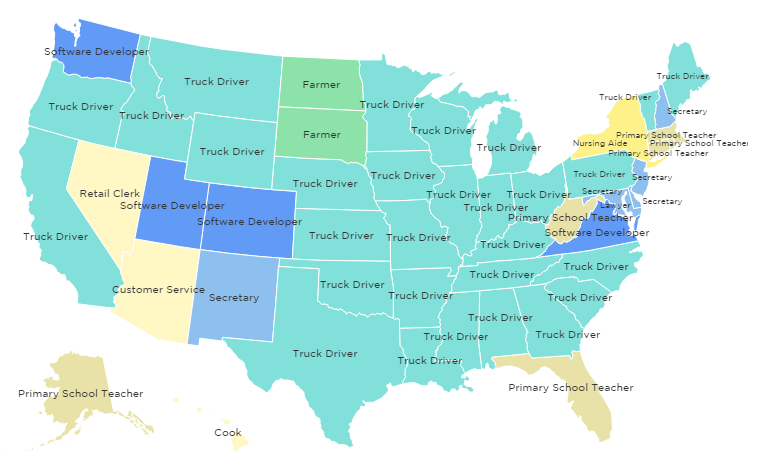
According to this graphic by NPR, “truck driver” is the most common occupation in most US states:

4

But truck driving isn’t what it used to be. In 1980, truckers made the equivalent of $110,000 annually; today, the average trucker makes $40,000. What happened to this omnipresent American occupation?

At the Atlantic, sociologist Steve Viscelli describes his research on truckers. He took an entry level long-haul trucking job, interviewed workers, and studied its history. He found that the industry had essentially eviscerated worker pay, largely by turning truckers into independent contractors, misleading them about the benefits of this arrangement, and locking them into punitive contracts.

Viscelli argues that few truckers are fully informed as to what it means to be an independent contractor, at least at first. Trucking companies sell them on the idea that they’ll be their own boss and set their own hours, but they don’t emphasize that they will pay significantly more taxes, their own expenses, and the lease on a truck. Viscelli interviews one man who took home the equivalent of 50 cents an hour one week; another week he’d ended up owing the company $100. As independent contractors, he writes, truckers “end up working harder and earning far less than they would otherwise.”

If truckers want to get out of these contracts, the companies can hold their lease over their heads. Truckers sign a years-long contract to lease their truck along with a promise not to work for anyone else. If the contract is violated, the worker is on the hook for the entire lease. This could be tens of thousands of dollars, so the trucker can’t afford to quit. He’s no longer working, in other words, to make money; he’s just working, sometimes for years, to avoid debt.

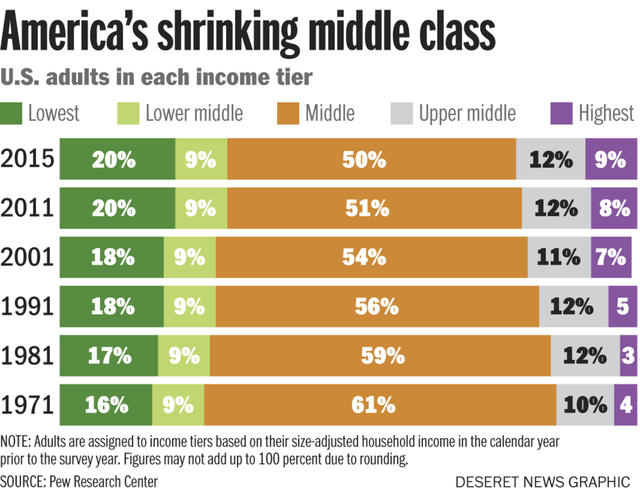
The decimation of this once strongly middle class job is just one story among many. Add them all up — all of those occupations that no longer provide a middle class income, and the rise of lower paying jobs — and you get the shrinking of the middle class. Since 1970, fewer and fewer Americans qualify as middle income, defined as a household income that is between two-thirds of and double the median, or middle, household income.

You can see it shrink in this graphic by Deseret News using data from the Pew Research Center:

4

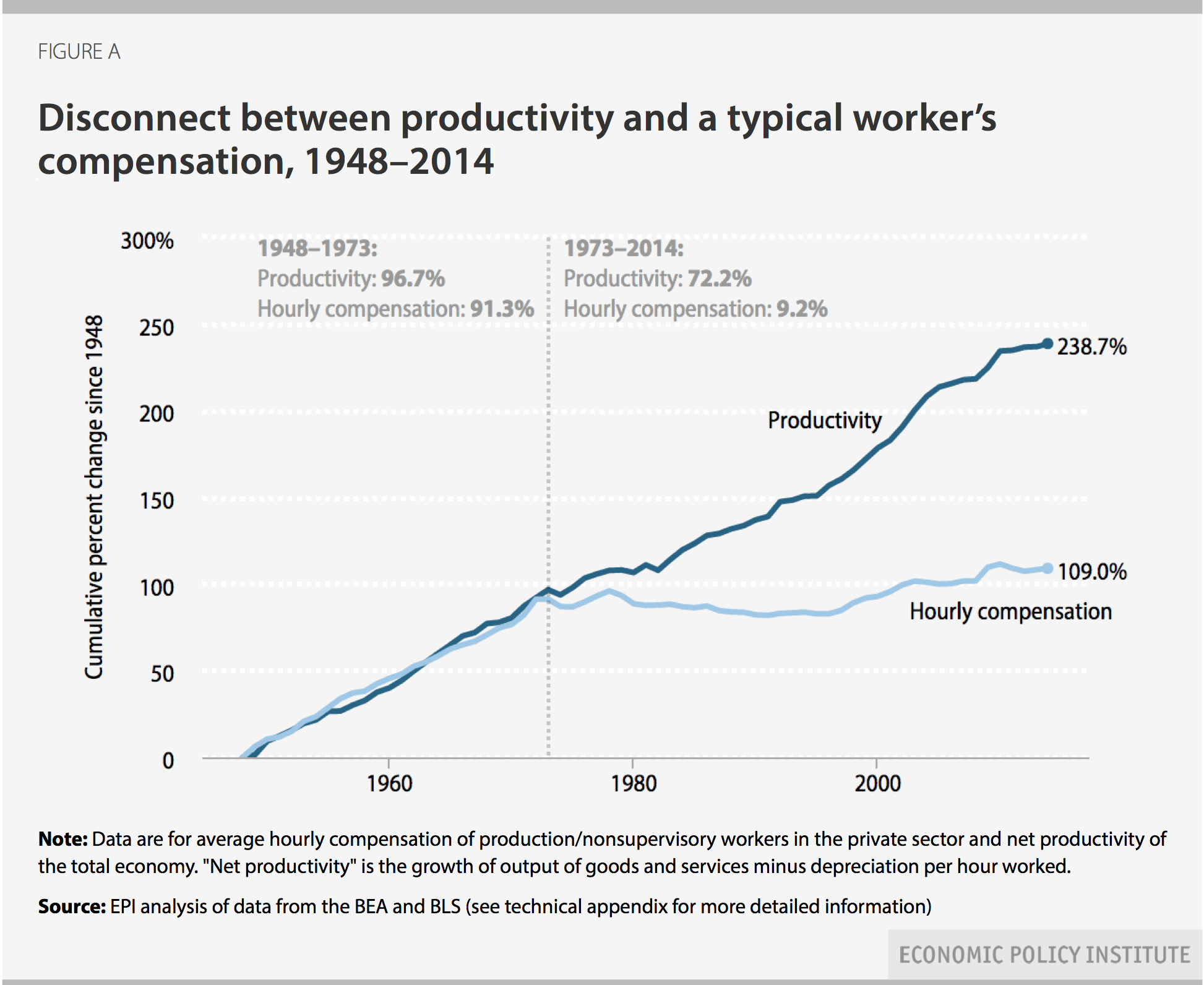
Part of the reason is that we have transitioned to an industrial economy to one that offers jobs primarily in service (low paying) and knowledge/information (high paying), but the other part is the restructuring of work to increasingly benefit owners, operators, and investors over workers. As the middle class has been shrinking, the productivity of American workers has been climbing, but the workers haven’t been the beneficiaries of their own work. Instead, employers have just been taking a larger and larger share of the value added that workers produce.

Figure from the Wall Street Journal with data from the Economic Policy Institute:

5

Between 1948 and 1973, productivity and wages increased at close to the same rate (97% and 91% respectively), but between 1973 and 2014, productivity has continued to climb (increasing by 72%), while wages have not (increasing by only 9%).

This is why so many Americans are struggling to stay afloat today. We’ve designed an economy that makes it ever more difficult to land in the middle class. Trucking isn’t the job it used to be, that is, because we aren’t the country we used to be.

Lisa Wade, PhD is an Associate Professor at Tulane University. She is the author of American Hookup, a book about college sexual culture; a textbook about gender; and a forthcoming introductory text: Terrible Magnificent Sociology. You can follow her on Twitter and Instagram.

TSP_Assigned_pbk_978-0-393-28445-4Assigned: Life with Gender is a new anthology featuring blog posts by a wide range of sociologists writing at The Society Pages and elsewhere. To celebrate, we’re re-posting four of the essays as this month’s “flashback Fridays.” Enjoy! And to learn more about this anthology, a companion to Wade and Ferree’s Gender: Ideas, Interactions, Institutions, please click here.

.

Compulsory Monogamy in The Hunger Games, by Mimi Schippers, PhD

NPR’s Linda Holmes wrote a great article about the gender dynamics in The Hunger Games: Catching Fire and concluded, “…you could argue that Katniss’ conflict between Peeta and Gale is effectively a choice between a traditional Movie Girlfriend and a traditional Movie Boyfriend.”  I do love the way Holmes puts this.  Gender, it seems, is not what one is, but what one does.  Different characteristics we associate with masculinity and femininity are available to everyone, and when Peeta embodies some characteristics we usually see only in women’s roles, Peeta becomes the Movie Girlfriend despite being a boy.

Though I find this compelling, I want to take a moment to focus on the other part of this sentence… the part when Holmes frames Katniss’ relationship to Peeta and Gale as a “conflict between” and a “choice.”  I think that, in some ways, the requirement to choose one or the other forces Katniss’ to, not only “choose” a boyfriend, but also to choose gender—for herself.

hgcf

Depending on whether she’s relating to Peeta or Gale, she is either someone who takes charge, is competent in survival, and protects her partner (traditionally the masculine role) or someone who lets another lead and nurtures instead of protects (the feminine role).  As Candace West and Don Zimmerman suggested many years ago in their article “Doing Gender,” we do gender in relationship to other people.  It’s a conversation or volley in which we’re expected to play the part to the way others are doing gender.

When Katniss is with Peeta, she does a form of masculinity in relationship and reaction to his behavior and vice versa.  Because Peeta “calls out” protection, Katniss steps up.  When Gale calls out nurturing, she plays the part.  In other words, not only is gender a “doing” rather than a “being,” it is also an interactive process.  Because Katniss is in relationship to both Peeta and Gale, and because each embodies and calls out different ways of doing gender, Katniss oscillates between being the “movie boyfriend” sometimes and the “movie girlfriend” other times and, it seems, she’s facile and takes pleasure in doing all of it.  If Katniss has to “choose” Peeta or Gale, she will have to give up doing gender in this splendid, and, dare I say, feminist and queer way in order to “fit” into her and her “girlfriend’s” or “boyfriend’s” relationship.

Now imagine a world in which Katniss wouldn’t have to choose.

What if she could be in a relationship with Peeta and get her needs for being understood, nurtured, and protective while also getting her girl on with Gale?  In other words, imagine a world without compulsory monogamy where having two or more boyfriends or girlfriends was possible.

I’m currently working on a book on monogamy and the queer potential for open and polyamorous relationships. I’m writing about the ways in which compulsory monogamy fits nicely into and perpetuates cultural ideas about masculinity and femininity and how different forms of non-monogamy might open up alternative ways of doing, not just relationships, but also gender.

Forcing Katniss to choose is forcing Katniss into monogamy, and as I suggested above, into doing gender to complement her partner.  Victoria Robinson points out in her article, “My Baby Just Cares for Me,” that monogamy compels women to invest too much time, energy, and resources into an individual man and limits their autonomy and relationships with others.  What Robinson doesn’t talk about is how it also limits women’s range of how they might do gender in relationship to others.

It also limits men’s range of doing gender in relationships.  Wouldn’t it be nice if Peeta and Gale never felt the pressure to be something they are not?  Imagine how Peeta’s and Gale’s masculinities would have to be reconfigured to accommodate and accept each other?

Elisabeth Sheff, in her groundbreaking research on polyamorous people, found that both women and men in polyamorous relationships say that the men have to rethink their masculinities to be less possessive, women have room to be more assertive about their needs and desires, and men are more accommodating.

What this suggests is that monogamy doesn’t just limit WHO you can do; it also limits WHAT you can do in terms of gender.  Might I suggest that Katniss is such a well-rounded woman character precisely because she is polyamorous?  She’s not just the phallic girl with the gun… or bow in this case… or the damsel in distress.  She’s strong, vulnerable, capable, nurturing, and loyal, and we get to see all of it because she does gender differently with her boyfriends.  And therein, I believe, is one way that polyamory has a queer and feminist potential.  It can open up the field of doing gender within the context of relationships.

I don’t know how her story ends, but I for one, am hoping that, if there is a happily-ever-after for Katniss, it’s not because girl gets boy; its because girl gets both boys.

Mimi Schippers, PhD is an Associate Professor of Sociology at Tulane University.  Her new book on the radical potential of non-monogamy is called Beyond Monogamy: Polyamory and the Future of Polyqueer Sexualities. You can follow her at Marx in Drag.

Originally posted in 2013 at Marx in Drag. Cross-posted at Huffington Post, and Jezebel. Images from IMDB

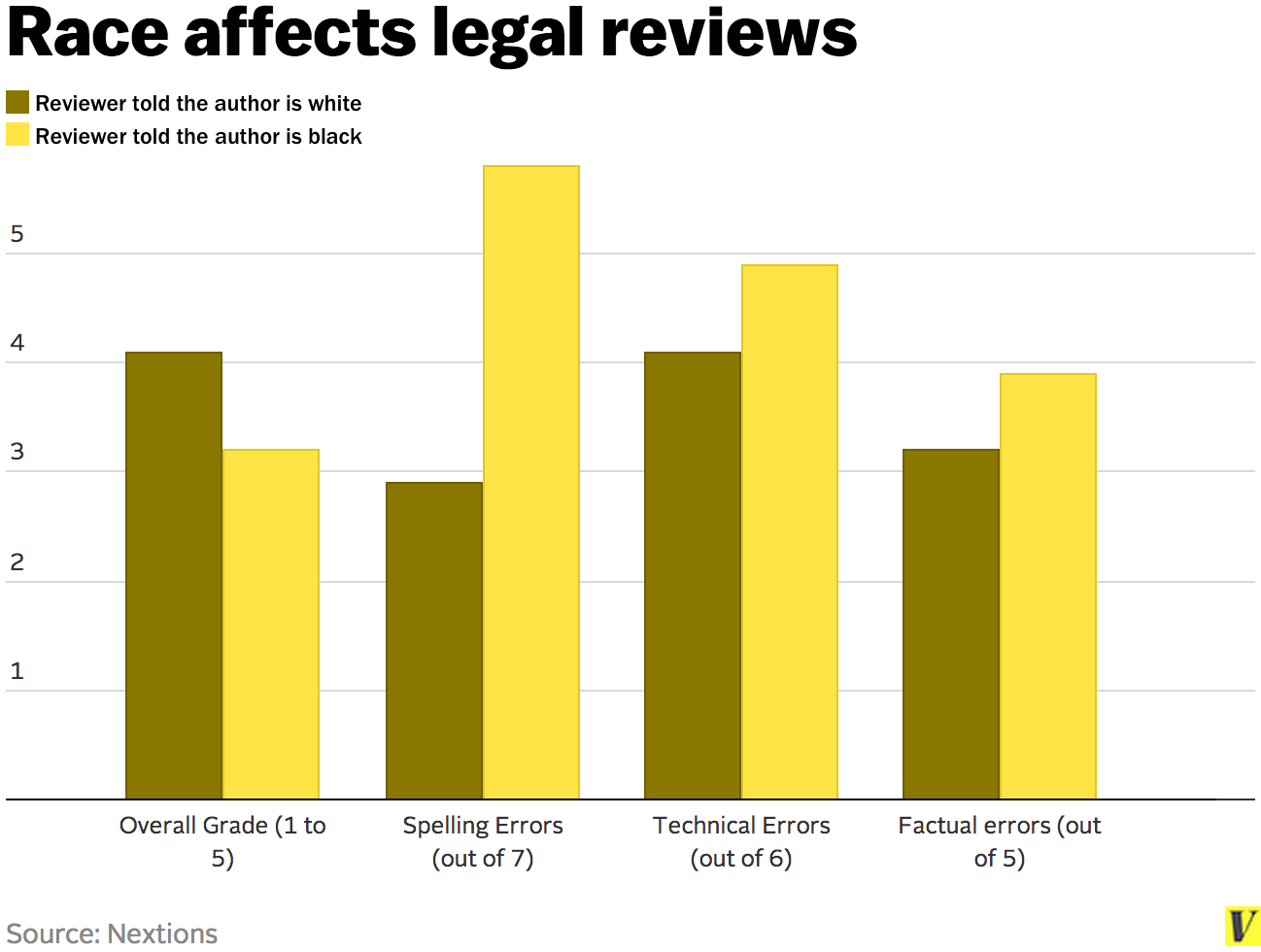
At Vox, Evan Soltas discusses new research from Nextoins showing racial bias in the legal profession. They put together a hypothetical lawyer’s research memo that had 22 errors of various kinds and distributed it to 60 partners in law firms who were asked to evaluate it as an example of the “writing competencies of young attorneys.” Some were told that the writer was black, others white.

Fifty-three sent back evaluations. They were on alert for mistakes, but those who believed the research memo was written by a white lawyer found fewer errors than those who thought they were reading a black lawyer’s writing. And they gave the white writer an overall higher grade on the report. (The partner’s race and gender didn’t effect the results, though women on average found more errors and gave more feedback.)

Illustration via Vox:

5

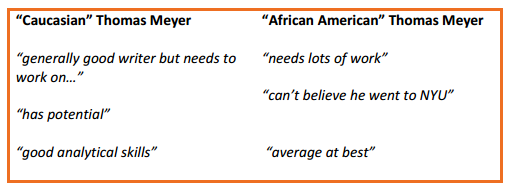
At Nextion, they collected typical comments:

8

This is just one more piece of evidence that the deck is stacked against black professionals. The old saying is that minorities and women have to work twice as hard for half the credit. This data suggests that there’s something to it.

Lisa Wade, PhD is an Associate Professor at Tulane University. She is the author of American Hookup, a book about college sexual culture; a textbook about gender; and a forthcoming introductory text: Terrible Magnificent Sociology. You can follow her on Twitter and Instagram.

Historian Molly Worthen is fighting tyranny, specifically the “tyranny of feelings” and the muddle it creates. We don’t realize that our thinking has been enslaved by this tyranny, but alas, we now speak its language. Case in point:

“Personally, I feel like Bernie Sanders is too idealistic,” a Yale student explained to a reporter in Florida.

Why the “linguistic hedging” as Worthen calls it? Why couldn’t the kid just say, “Sanders is too idealistic”? You might think the difference is minor, or perhaps the speaker is reluctant to assert an opinion as though it were fact. Worthen disagrees.

“I feel like” is not a harmless tic. . . . The phrase says a great deal about our muddled ideas about reason, emotion and argument — a muddle that has political consequences.

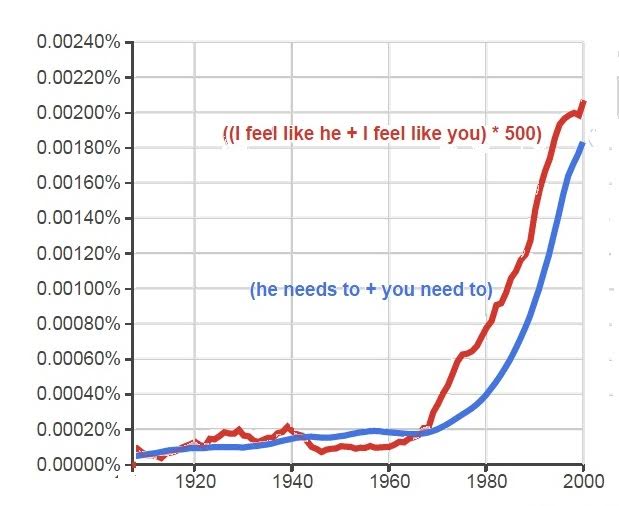
The phrase “I feel like” is part of a more general evolution in American culture. We think less in terms of morality – society’s standards of right and wrong – and more in terms individual psychological well-being. The shift from “I think” to “I feel like” echoes an earlier linguistic trend when we gave up terms like “should” or “ought to” in favor of “needs to.” To say, “Kayden, you should be quiet and settle down,” invokes external social rules of morality. But, “Kayden, you need to settle down,” refers to his internal, psychological needs. Be quiet not because it’s good for others but because it’s good for you.

4

Both “needs to” and “I feel like” began their rise in the late 1970s, but Worthen finds the latter more insidious. “I feel like” defeats rational discussion. You can argue with what someone says about the facts. You can’t argue with what they say about how they feel. Worthen is asserting a clear cause and effect. She quotes Orwell: “If thought corrupts language, language can also corrupt thought.” She has no evidence of this causal relationship, but she cites some linguists who agree. She also quotes Mark Liberman, who is calmer about the whole thing. People know what you mean despite the hedging, just as they know that when you say, “I feel,” it means “I think,” and that your are not speaking about your actual emotions.

The more common “I feel like” becomes, the less importance we may attach to its literal meaning. “I feel like the emotions have long since been mostly bleached out of ‘feel that,’ ” …

Worthen disagrees.  “When new verbal vices become old habits, their power to shape our thought does not diminish.”

“Vices” indeed. Her entire op-ed piece is a good example of the style of moral discourse that she says we have lost. Her stylistic preferences may have something to do with her scholarly ones – she studies conservative Christianity. No “needs to” for her. She closes her sermon with shoulds:

We should not “feel like.” We should argue rationally, feel deeply and take full responsibility for our interaction with the world.

——————————-

Originally posted at Montclair SocioBlog. Graph updated 5/11/16.

Jay Livingston is the chair of the Sociology Department at Montclair State University. You can follow him at Montclair SocioBlog or on Twitter.