Cross-posted at Inequality by (Interior) Design.

The problem:

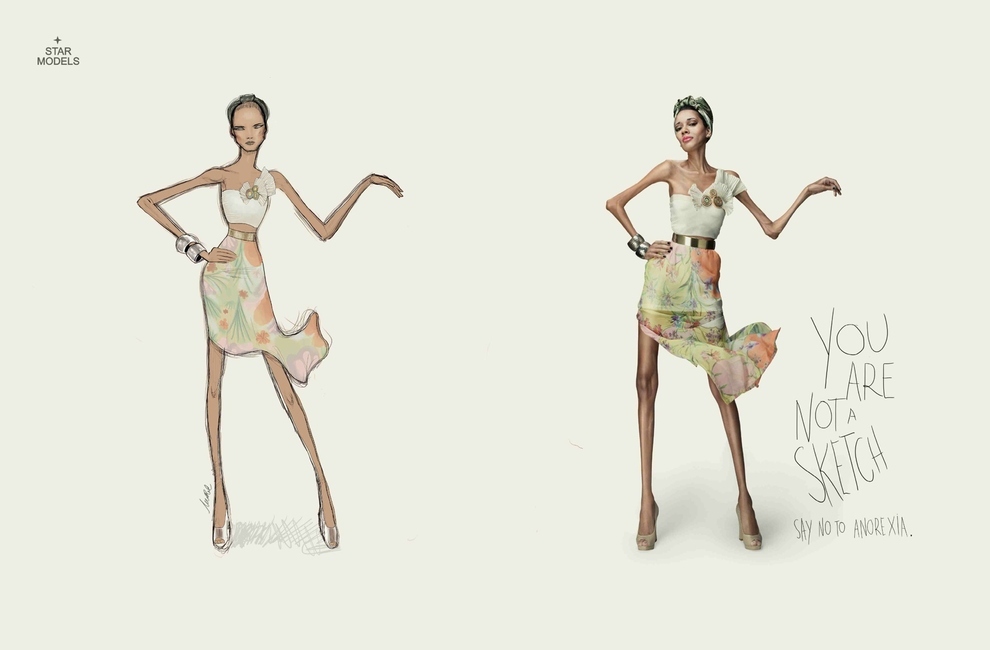
A Brazilian modeling agency, Star Models, recently released a new series of anti-anorexia PSA advertisements. They illustrate one of the ways ultra-thin body ideals characterizing women’s bodies in the fashion industry today are institutionalized, or made part of the way we “do” fashion. Fashion sketches — the way that people communicate designs to one another — idealize these bodies, with their exaggerated proportions, long slender limbs, and expressionless faces. The PSAs place real women alongside the sketches, graphically altered to similar proportions, in order to problematize the ideal.

1 2 3

Sociology professors are constantly asking students to analyze what they might be taking for granted. One issue we take for granted is that the images on the left are what “fashion” looks like and ought to look like. That they are culturally recognizable as fashion sketches speaks to the ways in which hyper-thin feminine bodies are institutionalized at a fundamental level in the fashion industry today.

The Dove Evolution video — as a part of their “Campaign for Real Beauty” — vividly illustrates the work that goes into the production of advertisements. Using a time-lapse video depicting the diverse labor that goes into the production of an ad was a simple illustration of the impossibility of contemporary beauty ideals. Viewers are left thinking, “Of course we can’t look like that. She doesn’t even look like that.”

Star Models’ anti-anorexia ads promote a similar message, but also call our attention to the more dangerous aspects of adherence to industry ideals. Similar to depictions of what Barbie might look like as a real woman, altered images of dangerously thin models aside these sketches have a very different feel from the sketches they imitate.

What is being done about it?

In 2007, the Council of Fashion Designers of America (CFDA) passed a Health Initiative in recognition of an increasingly global concern with the unhealthily thin bodies of models and whether/how to promote change in the industry. The CFDA is working to better educate those inside the industry to identify individuals at risk, to require models with eating disorders to seek help and acquire professional approval to continue working, to develop workshops promoting dialog on these issues, and more.

The CFDA’s Health Initiative, however, treats eating disorders as an individual rather than social problem. This allows the CFDA to obscure the role it might play in perpetuating cultural desires for the very bodies it purports to “help” with the Health Initiative.

Susan Bordo famously wrote about anorexia as what she termed “the crystallization of culture.” We like to draw firm boundaries between normality and pathology. But Bordo suggests that anorexia is more profitably analyzed as culturally normative than as abnormal. Similarly, Star Models’ PSAs play a role in framing the fashion industry as (at least partially) responsible for ultra-thin feminine body ideals. Yet, they arguably fall short of providing institutional-level solutions as the tagline — ”You are not a sketch. Say no to anorexia.” — concentrates on individuals.

The CFDA’s focus on health initiatives and support for individuals suffering from anorexia, bulimia and other eating disorders are critical aspects of recognizing issues that seem to plague the fashion industry. While this surely helps some individual women, the initiatives simultaneously avoid the cultural pressures (in which the fashion industry arguably plays a critical role) that work to systematically conflate feminine beauty with ultra-thin ideals. Similar to problems associated with focusing attention only on the survivors of sexual assaults (failing to recognize the ways that sexual violence is both institutionalized and embedded in our culture), these images simply illustrate that individual-level solutions are unlikely to produce change precisely because they fail to locate “the problem” and ignore the diverse social institutions and ideals that assist in its reproduction.

Thanks to a student in my Sociology of Gender course, Sandra Little, for bringing this campaign to my attention.

Tristan Bridges is a sociologist of gender and sexuality at the College at Brockport (SUNY).  Dr. Bridges blogs about some of this research and more at Inequality by (Interior) Design.  You can follow him on twitter @tristanbphd.

In the 3-minute video below, sociologist Jennifer Lee explains her research on “stereotype promise,” the idea that being viewed through the lens of a positive stereotype can act as a performance booster and enhance outcome. You can imagine how it might be applied to African Americans and certain sports like track or basketball, or how it might facilitate men’s acquisition of math ability.

Lee’s research is on Asian Americans and academic performance. Asians, she explains, are stereotyped as “smart, high achieving, and disciplined” and this might help explain why they are so academically successful.

1

It can also, however, have harmful effects.  She discusses the way that some young Asian Americans will say that an A- counts as an “Asian fail,” an example of how much pressure stereotype promise can bring.  She also notes that Asian Americans are often disadvantaged in college admissions because of an assumption that a school can have “too many” Asians and, accordingly, accept only students with the most extraordinary academic credentials.

Lisa Wade, PhD is an Associate Professor at Tulane University. She is the author of American Hookup, a book about college sexual culture; a textbook about gender; and a forthcoming introductory text: Terrible Magnificent Sociology. You can follow her on Twitter and Instagram.

Summer means writing!

We’re all breathing a sigh of relief now that the semester is over!  Gwen and I are both looking forward to making lots of progress on writing projects over the summer!  Myra Marx Ferree and I should be finishing our sociology of gender textbook within months and I can hardly wait!

Twitter love:

We reached a milestone on Twitter.  12,000 followers and counting!

12000 twitter

12,000 followers means lots of love!

1

We freaking love you too, Eli!

Upcoming lectures and appearances:

I am officially on sabbatical and writing full time, but I’d love to use my flexible schedule to do lots of public speaking as well.   I have great talks on the value of friendship, the biology of sex differencesthe politics of genital cutting and, of course, hook up culture.  And I do a pretty decent AKD induction ceremony/commencement speech.

I’ve already scheduled my first talk for next year. I’ll be part of the Bastian Diversity Lecture Series at Westminster College in Salt Lake City.  Looking forward to it already!

Virtual friends:

We continue to be thrilled to see SocImages’ posts cross-promoted on other sites.  Here are some graduation season-themed highlights of the month:

New Pinterest board on rape culture:

In response to the sudden public interest in sexual violence, we decided to begin a rape culture Pinterest board.  I recommend visiting with a stiff drink in hand.  If you’re sensitive to images of sexual violence, I wouldn’t go at all.

SocImages has 25 Pinterest boards and some of them aren’t horribly depressing!  You can visit our new guide or check out some of our more popular themes: sexy toy make-overswhat color is flesh?gendered housework and parenting“subliminal” sexual symbolism, and violence in fashion.

The national movement against sexual assault:

SocImages continues to follow the national movement to use Title IX to reform sexual assault adjudication on college — and now, rumor has it, middle school and high school — campuses.  Dartmouth, UC Berkeley, and USC, among others, are the most recent schools to file complaints with the federal government.

This month we posted about the role of social networking in the movement and covered the faculty votes of “no confidence” in higher level administrators at Occidental College.  I also had the opportunity to give a 12 minute interview to KPFK about the developments at my campus (you can listen here, starting at 28:30).

Social media:

SocImages is on TwitterFacebookGoogle+, and Pinterest.  Lisa is on Facebook and most of the team is on Twitter: @lisawade@gwensharpnv@familyunequal@carolineheldman, and @jaylivingston.

In other news…

I thought I’d share this nice shot from just after commencement at Occidental College.  To my left and right are two of the professors who have joined with students to lead the national movement against sexual assault: Dr. Caroline Heldman and Dr. Danielle Dirks.  In other words, some badass chicks right there.  Follow them on twitter @carolineheldman and @danielledirks!

20130519_120909

Lisa Wade, PhD is an Associate Professor at Tulane University. She is the author of American Hookup, a book about college sexual culture; a textbook about gender; and a forthcoming introductory text: Terrible Magnificent Sociology. You can follow her on Twitter and Instagram.

In April The Sierra Club announced that it was endorsing a path to citizenship for undocumented immigrants.  They argued that a preponderance of disempowered workers in some of the most polluted industries in the country was bad for the environment:

To protect clean air and water and prevent the disruption of our climate, we must ensure that those who are most disenfranchised and most threatened by pollution within our borders have the voice to fight polluters and advocate for climate solutions without fear.

This position nicely brings together one lefty political concern (the environment) with another (concern for undocumented immigrants).  This is probably entirely genuine, but it is also very convenient from a discursive perspective.

I tortured my Sociology 101 students this semester with the phrase “discursive opportunity structure,” which I introduce as “the arrangement of ideas in a society that constrain and enable communication and thought.”  For example, the connection between pink and femininity is automatic in our minds whether we want it to be or not, just as the letters C-A-T conjure up a cat and we couldn’t stop it if we tried.  So ideas aren’t just free floating in our collective minds, they’re built into a relationship with each other, and those relationships are part of our cognition.

Sociologist Leslie King has shown how this constrains how environmentalists can talk about immigration and how anti-immigration activists can talk about the environment.  She considers “population stabilization” activists, a group that believes that immigration is harmful to the environment (paper here, two examples here).

1King argues that the population stabilization movement has struggled largely because the two positions they bring together — pro-environment and anti-immigration — disrupt the discursive opportunity structure.  First, it’s harder for us to get our minds around the argument because it means bringing together a lefty political message and a right one.  Second, insofar as our identity categories depend on the discursive opportunity structure, it requires us to fragment them. Can one be both anti-immigration (on the right) and pro-environment (on the left)?  It takes cognitive work to think that through.

The position announced by The Sierra Club last month, however, neatly fits into our thought patterns.  Most fans of the environmental organization are on the left, so when the press release calls for a path for citizenship, it slips neatly into the political identities and cognitive structures of their audience.  That likely facilitates the likelihood that their position will be both heard and influential.

Lisa Wade, PhD is an Associate Professor at Tulane University. She is the author of American Hookup, a book about college sexual culture; a textbook about gender; and a forthcoming introductory text: Terrible Magnificent Sociology. You can follow her on Twitter and Instagram.

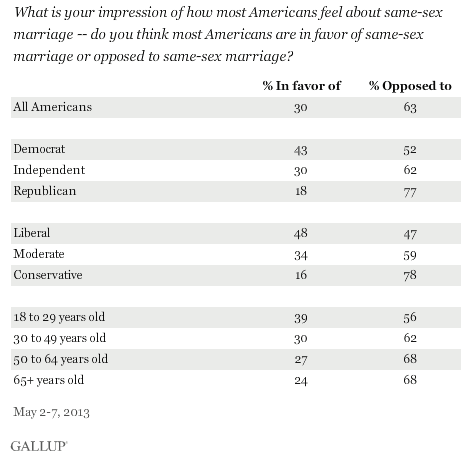
Here’s an interesting new wrinkle in the data on support for same sex marriage.  According to Gallup, 53% of Americans now favor such marriages, but we don’t necessarily think other people do.  Overall, Americans, on average, think that 63% of their fellow citizens oppose same sex marriage; in fact, 45% do.  That’s an over-estimate of 18 percentage points!

2

Interestingly, Americans of all stripes — Democrat and Republican, liberal and conservative, old and young — underestimate support for same sex marriage.  Liberals come the closest, thinking that 48% approve; conservatives are the farthest off, thinking that only 16% do.

This data resonates with the recent finding that both Democratic and Republican politicians underestimate their constituents’ progressiveness.  I suspect that these misconceptions may make politicians wary about pressing for progressive policies; I wonder how similar misconceptions among the voting public might shape the pace and trajectory of social change.

h/t @tylerkingkade. Cross-posted at Pacific Standard.

Lisa Wade, PhD is an Associate Professor at Tulane University. She is the author of American Hookup, a book about college sexual culture; a textbook about gender; and a forthcoming introductory text: Terrible Magnificent Sociology. You can follow her on Twitter and Instagram.

Screenshot_1In a wonderfully provocative article titled “Compulsory Heterosexuality and Lesbian Existence” (full text), writer and poet Adrienne Rich argues, among other things, that the assumption of heterosexuality in the context of patriarchy alternatively erases and stigmatizes woman-to-woman bonds.

Though the title specifies lesbianism, she means intense and meaningful relationships between women more generally.  In other words, an overbearing heterosexuality orients women towards men not just as sexual and romantic partners, but as the arbiters of all that is good and right. Accordingly, women don’t turn to other women to validate their ideas, their value, their beauty, or anything else about them.  This post, analyzing the reality show Battle of the Bods, is a stark example.

If only men can validate women’s worth, then other women exist only as competition for their approval.  This is good for patriarchy; it divides and conquers women, keeping them constantly looking to please the men around them and making them feel invisible and worthless if they can’t get attention from or endorsement from men.

There are various strategies for getting men’s stamp of approval: being the busy and useful mother of a man’s children is one way, while being a childless so-called “trophy wife” is another.  You can imagine, right away, that these two kinds of women might see themselves as in competition.  One may be more harried, with less time to tend to her physical fitness and keep her hair shiny and her make-up and clothes just right.  The other may have plenty of time to keep herself fit and beautiful, but knows that her connection to her husband may feel less permanent without children to tie her to him.  Moreover, the childless wife is often a second wife.  So all sexy, single, childless women are, theoretically, a threat to the wife and mother.  And all husband/dads are, theoretically, a target for wanna-be second wives.

Pop culture constantly re-affirms these narratives.  It frequently naturalizes the idea that women should turn to men, and not women, to reinforce their value. Portraying women as in competition is part of that.  The “trophy wife” vs. the “busy mom” is one of those match-ups. Enter this Volvo ad, sent in by Dolores R.:

The ad encourages us to think mean-spirited thoughts about the married but (presumably) childless woman with the puckered lips.  She clearly sees herself as in competition with the redhead, looking over to check that she is, in fact, more beautiful, and looking satisfied that she is.  The redhead, though, has (supposedly) more important things to do than check herself out in the mirror.  She’s got kids.  How shallow the blond, we’re told to think, how fake.  “Designed for real people,” the narrator explains, “designed around you.”

These battles — between childless women and mothers, one kind of mother and another, old women and young, thin women and fat, ugly women and beautifulpopular and less popular, mother-in-laws and daughter-in-laws, between strangers and between best friends — this is patriarchy in action.  It weakens women as as group and makes it more difficult to fight oppression.

As my good friend Caroline Heldman says, when we see women that excel in some way — whether they be accomplished in their career, impressive fashionistas, incredible parents, truly loved partners, inspired artists, or what-have-you —  we are taught to find something about them to dismiss because they make us feel insecure. Instead, we should think “How fabulous is she! I want to tell her how great she is and be her friend!”

Lisa Wade is a professor of sociology at Occidental College.  She elaborates on these themes in her talk, A Feminist Defense of FriendshipYou can follow her on Twitter and Facebook.

1In a really fantastic post at Shakesville, Time Machine argues that rape jokes are problematic, even when uttered by people who would never assault anyone, because they signal to actual rapists that their behavior is acceptable and normal.

A lot of people accuse feminists of thinking that all men are rapists. That’s not true. But do you know who think all men are rapists?  Rapists do.

So, when someone drops a rape joke and people laugh, the small percent of men who are rapists think that they’re surrounded by like-minded friends.  Speaking to the joke-teller:

That rapists who was in the group with you, that rapist thought that you were on his side. That rapist knew that you were a rapist like him. And he felt validated, and he felt he was among his comrades.

What’s interesting about this observation is that it reminds us that we need to be more aware of the impact of our words not on victims (as the usual argument against the rape joke goes), but on perpetrators.  This is a much-needed re-framing of the problem that we call, passively, “violence against women,” but should really be called “men’s violence against women and men.”  While both men and women are victims, the vast majority of interpersonal violence is committed by men.

The need for a shift in frame — from the survivor to the perpetrator — is also a theme of this TedTalk by anti-violence educator Jackson Katz. He uses another really interesting way of showing the linguistic erasure of men in this discussion (at 4:08).

He also dismisses “sensitivity training” because it, too, centers the survivor of the violence instead of drawing our attention to the perpetrator (sensitivity to who?).  Instead, Katz argues, men need to step up and be leaders in the fight against men’s violence against women and men.  Because violence is not a “women’s issue,” it’s a men’s issue.

Lisa Wade, PhD is an Associate Professor at Tulane University. She is the author of American Hookup, a book about college sexual culture; a textbook about gender; and a forthcoming introductory text: Terrible Magnificent Sociology. You can follow her on Twitter and Instagram.

Cross-posted at Montclair SocioBlog.

The magic of demographic knowledge is a memorable moment in John Sayles’s 1984 movie “Brother From Another Planet.” On the A train, a young man shows an elaborate card trick to the title alien, who looks like an African American but seems to have no understanding of the trick. So the magician offers another.

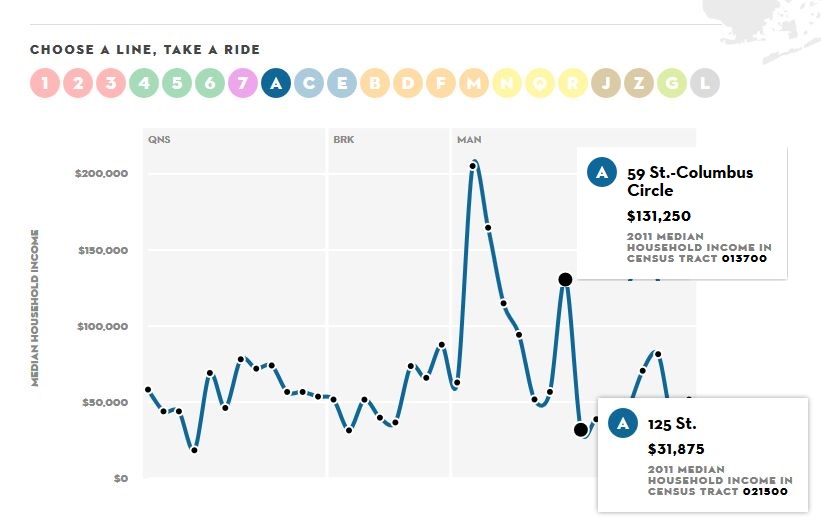
From 59th St. to 125th St. is one stop on the express.  But as the movie shows, that short ride covers a large demographic change, and it’s not just racial.  The New Yorker has posted interactive graphics showing the median income of the census tracts surrounding subway stations.

1

Take the A train one stop — from the southern border of Central Park to a few blocks above its northern border — and see median income drop by $100,000.

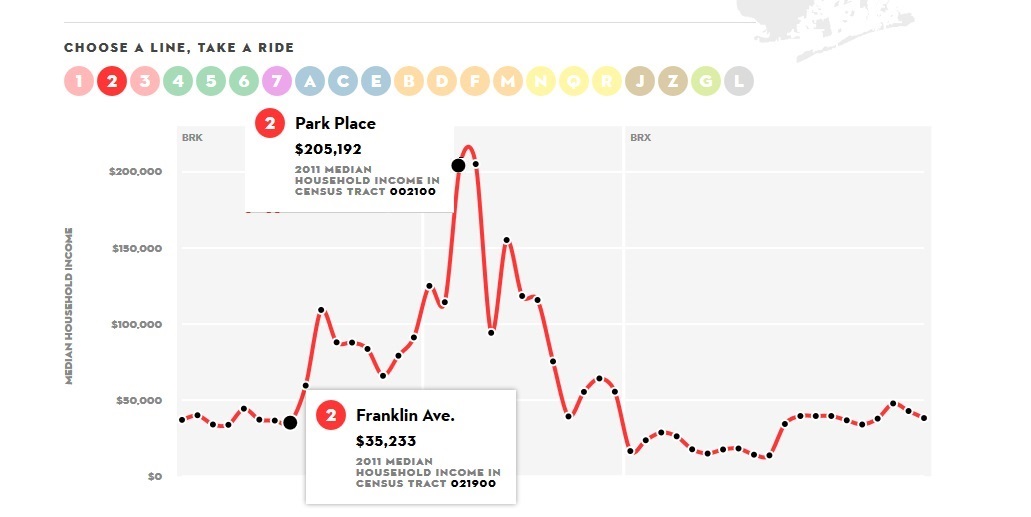
Many other lines travel the extremes of economic inequality.  My line is the 2:

2

In the early morning commute, I see blue collar workers in their hoodies or rough jackets and steel-toe boots next to well-dressed people reading The Wall Street Journal.  They didn’t get on at the same stop.  The people who live in and work in the Wall Street census tract, which includes Park Place, are not on the train.  Here’s what their housing looks like:

BATTERY PARK CITY: as a pioneer. It's all Green, environmentally friendly.

And here is Franklin St., Brooklyn:

4

The subway demographic trick is not limited to New York. Here’s a time-lapse video of the Red Line of Chicago’s CTA.

Despite the social class segregation in housing, in cities like New York and Chicago, people of vastly different economic circumstances are likely to share the same subway car, at least for a few stops.  Yet I don’t get a sense of strong resentment or even envy among the have-nots (though I wish I had systematic data on this).  This is similar to the findings of Rachel Sherman, who studied how workers at high-end hotels thought of their guests.

New York and Chicago, however, are also where the rich are more likely to be liberal and in favor of redistributionist policies.  As Andrew Gelman has shown, the wealthy in rich states are far more liberal than the wealthy in poor states.  That may be partly because in rich states, the wealthy live in the large cities.  It would be interesting to see if we saw the same effect if we looked at Upstate New York, Downstate Illinois, or Massachusetts outside Rte. 128.

HT: Jenn Lena for the link.

Jay Livingston is the chair of the Sociology Department at Montclair State University. You can follow him at Montclair SocioBlog or on Twitter.