Usually, you want to match up with someone at about your level, or a little higher.  The trouble is that many people overestimate their own level.  Maybe that’s especially true of men.

One summer many years ago at the tennis courts, a guy I didn’t know  came over and asked me if I’d like to play. I hadn’t arranged a game with anyone, but I didn’t want to wind up playing some patzer.

“Are you any good?” I asked. He paused.

“Well, I’m not Jimmy Connors,” he said (I told this was many years ago), “but neither are you.”

In chess and other games, serious players have ratings. Give a roomful of possible partners, they can sort through the ratings and find a match with someone at roughly the same level.  It’s called assortative mating, though that term usually refers to the other kind of mating, not chess.  It’s the basis of the conflict in this poignant scene from “Louie.”

Vanessa is not a ten, neither is Louie.  According to principles of assortative mating, the tens will wind up with other tens, the nines with nines, and so on down the attractiveness scale. One problem in the “Louie” scene is that Louie seems to have an inflated view of his own attractiveness.  He’s aiming higher than Vanessa.  That’s typical.  So is the importance that Louie, the man, places on physical attractiveness. This excerpt begins with Louie telling Vanessa that she’s a really beautiful . . . . He can’t bring himself to say “girl”; he’s probably going to say “person.” But he’s obviously not saying what he thinks.

Or as Dan Ariely and colleagues concluded from their study of HotOrNot members:

[Men] were significantly more influenced by the consensus physical attractiveness of their potential dates than females were. [Men also] were less affected by how attractive they themselves were . . .  In making date choices, males are less influenced by their own rated attractiveness than females are.

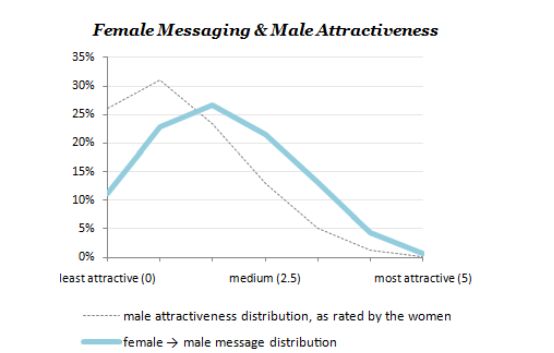
Another dating site, OK Cupid, found a similar pattern when they looked at data about who gets messages.  They asked their customers to rate profile photos of the opposite sex on a scale of 0 to 5. They then tracked the number of messages for people at each level of attractiveness.  The graph below shows what women thought and what they did – that is, how attractive they found men, and who they sent messages to.
1 (2) - Copy

Men who were rated 0 or 1 got fewer messages than their proportion in the population.  That figures. But even men who were only moderately attractive got more than their share. Generally, the fewer men at a level of attractiveness, the fewer total messages women sent. The 4s, for example, constituted only 2% of the population, and they got only 4% of all the messages.  The Vanessas on OK Cupid are not sending a lot of inquiries to guys who look like George Clooney.

But look at the men.
1 (2)

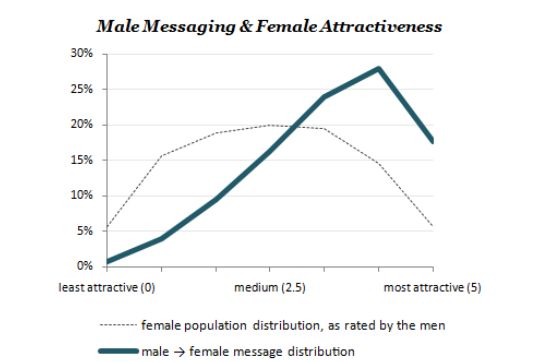
Men are more generous in their estimates of beauty than are women. But they also ignore the Vanessas of the world (or at least the world of OK Cupid) and flock after the more attractive women.  Only 15% of the women were rated as a 4, but they received about 26% of the messages.  Women rated 5 received messages triple their proportion in the population.

What about those with so-so looks?  Women rated as 2s received only about 10% of the messages sent by men. But men at that same level received 25% of the messages women sent.  The women seem more realistic.

Vanessa too has no illusions about her own attractiveness. She refers to herself as “a fat girl,” and when Louie, trying to be kind, says, “You’re not fat,” she says: “You know what the meanest thing is you can say to a fat girl? [pause] ‘You’re not fat.’” But it’s only when she challenges Louie’s view of his own attractiveness that their relationship starts to change.

Y’know if you were standing over there looking at us, you know what you’d see?

What?

That we totally match. We’re actually a great couple together.

She doesn’t explain what she means by “totally match.” It could be their interests or ideas or personalities, but the imaginary stranger looking at them from over there couldn’t know about any of that. What that generalized other could see is that they are at roughly the same place on the assortative mating attractiveness scale.

Cross-posted at Pacific Standard.

Jay Livingston is the chair of the Sociology Department at Montclair State University. You can follow him at Montclair SocioBlog or on Twitter.
1a

– PhD Comics.

Lisa Wade, PhD is an Associate Professor at Tulane University. She is the author of American Hookup, a book about college sexual culture; a textbook about gender; and a forthcoming introductory text: Terrible Magnificent Sociology. You can follow her on Twitter and Instagram.

Flashback Friday.

In Hearts of Men, Barbara Ehrenreich talks about the launching of Playboy in 1953 and how it forever changed how we thought about single men.

At that time, a man who stayed single was suspected of homosexuality.  The idea of being an unmarried heterosexual adult of sound mind and body was totally foreign.  Hugh Hefner changed all of that by inventing a whole new kind of man, the playboy.  The playboy stayed single (so as to have lots of ladies), kept his money for himself and his indulgences (booze and ladies), and re-purposed the domestic sphere (enter the snazzy bachelor pad full of booze and ladies).

With this in mind, check out an attempt to attract advertising dollars from a 1969 issue (found at Vintage Ads).  It nicely demonstrates Playboy‘s marketing of a new kind of man, one who lives a free and adventurous life that is unburdened by a boring, dead-end job needed to support a wife and kids.

Text:

What sort of man reads Playboy? He’s an entertaining young guy happily living the good life. And loving every adventurous minute of it. One recipe for his upbeat life style? Fun friends and fine potables. Facts. PLAYBOY is read by one of out every three men under 50 who drink alcoholic beverages. Small wonder beverage advertisers invest more dollars in PLAYBOY issue per issue than they do in any other magazine. Need your spirit lifted? This must be the place.

Today, we commonly come across the idea that men are naturally averse to being tied down, but Hefner’s project reveals that this was an idea that was invented quite recently and promulgated for profit.

This post originally appeared in 2008.

Lisa Wade, PhD is an Associate Professor at Tulane University. She is the author of American Hookup, a book about college sexual culture; a textbook about gender; and a forthcoming introductory text: Terrible Magnificent Sociology. You can follow her on Twitter and Instagram.

In a fancy bit of marketing, U.S. capitalists have been reborn as “job creators.”  As such, they were rewarded with lower taxes, weaker labor laws, and relaxed government regulation. However, despite record profits, their job creation performance leaves a lot to be desired.

According to the official data the last U.S. recession began in December 2007 and ended in June 2009. Thus, we have officially been in economic expansion for almost five years.  The gains from the expansion should be strong and broad-based enough to ensure real progress for the majority over the course of the business cycle.  If not, it’s a sign that we need a change in our basic economic structure.  In other words, it would be foolish to work to sustain an economic structure that was incapable of satisfying majority needs even when it was performing well according to its own logic.

A recent study by the National Employment Law Project titled The Low-Wage Recovery provides one indicator that it is time for us to pursue a change.  It shows that the current economic expansion is transitioning the U.S. into a low wage economy.

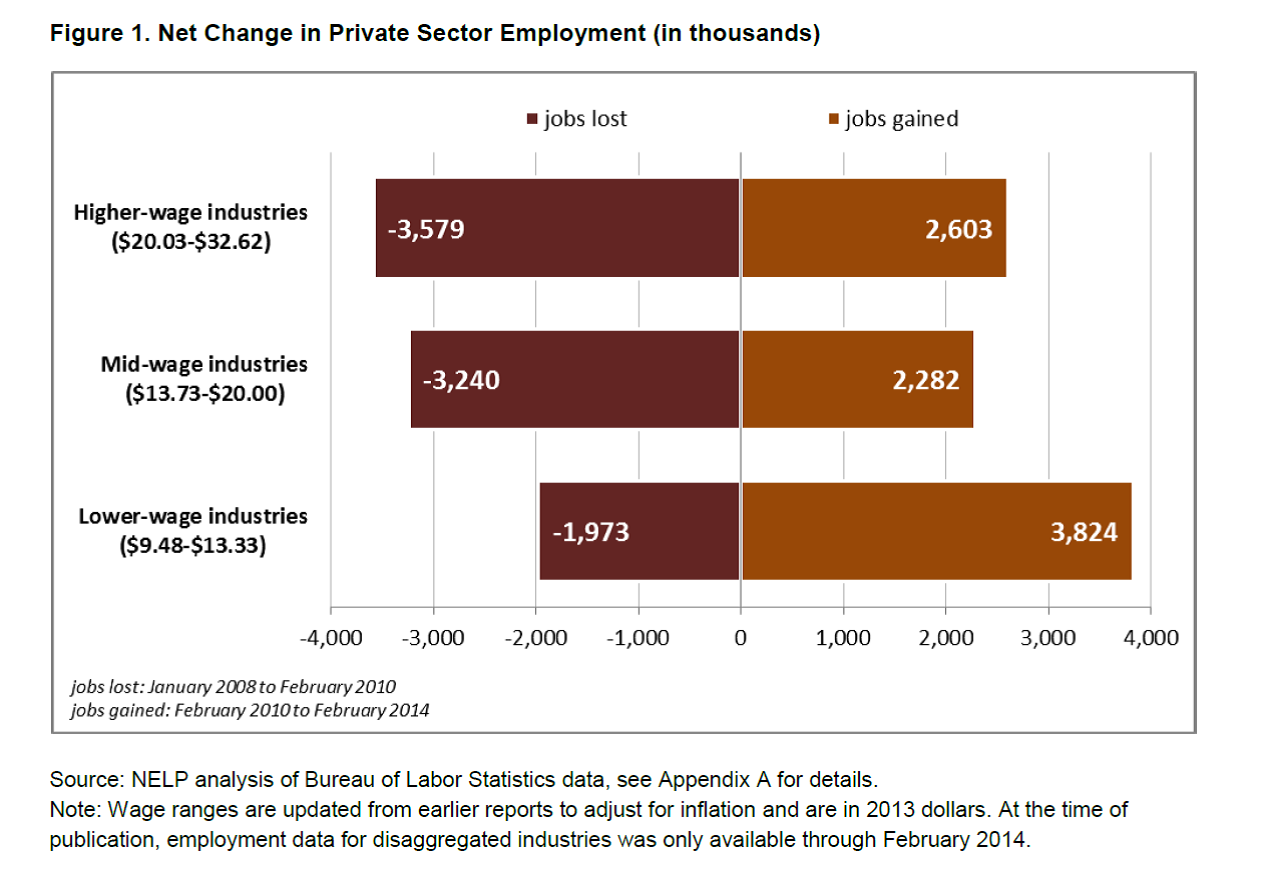
The figure below shows the net private sector job loss by industries classified according to their medium wage from January 2008 to February 2010 and the net private sector job gain using the same classification from March 2010 to March 2014. As we can see, the net job loss in the first period was greatest in high wage industries and the net job creation in the second period was greatest in low wage industries.

1 (2) - Copy

As the study explains:

 The food services and drinking places, administrative and support services (includes temporary help), and retail trade industries are leading private sector job growth during the recent recovery phase. These industries, which pay relatively low wages, accounted for 39 percent of the private sector employment increase over the past four years.

If the hard times of recession disproportionately eliminate high wage jobs and the “so called” good times of recovery bring primarily low wage jobs, it is time to move beyond our current focus on the business cycle and initiate a critical assessment of the way our economy operates and in whose interest.

Cross-posted at Pacific Standard.

Martin Hart-Landsberg is a professor of economics at Lewis and Clark College. You can follow him at Reports from the Economic Front.

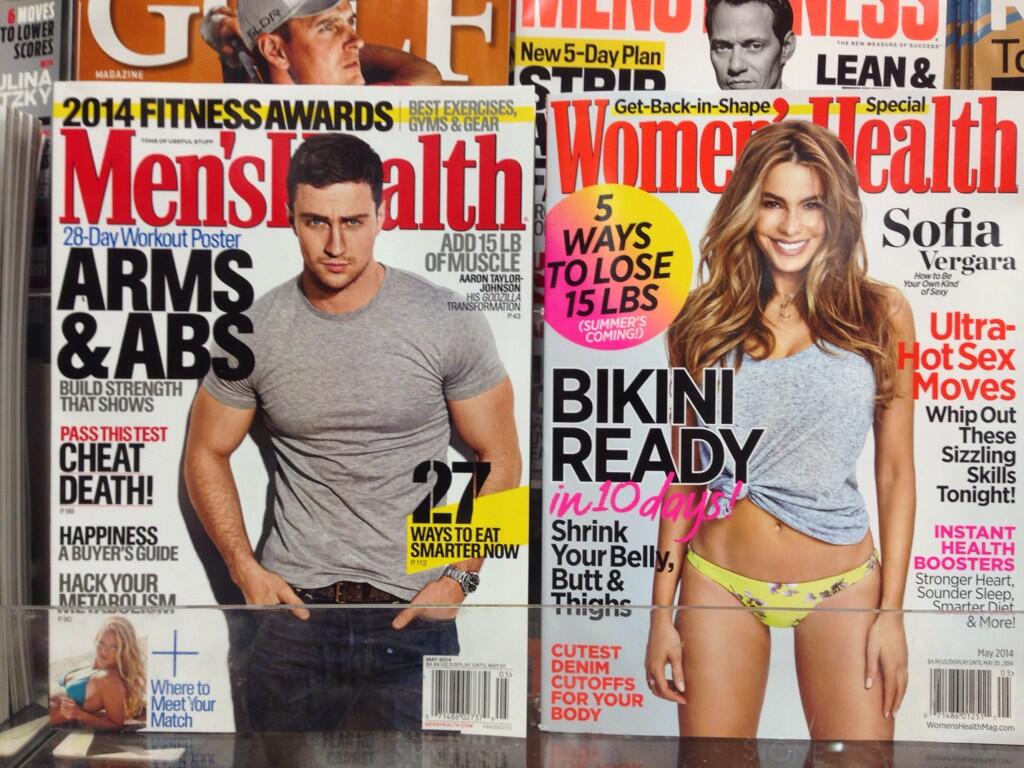
We commonly hear claims that men are naturally more muscular and physically intimidating than women.  “It’s a biological fact,” someone might say.  If that were true, though, we wouldn’t have to work so incredibly hard to make it so.

@IllMakeItMyself sent in this great example of the way in which we are pushed to force our bodies into a gender binary that we pretend is natural.  On the upper right part of the Men’s Health cover, it reads: “Add 15lb of muscle” and, right next door on the Women’s Health cover, it reads “5 ways to lose 15 lbs.”

If we have to try this hard to make it true, maybe we’re not as different as we think we are.

1

Lisa Wade, PhD is an Associate Professor at Tulane University. She is the author of American Hookup, a book about college sexual culture; a textbook about gender; and a forthcoming introductory text: Terrible Magnificent Sociology. You can follow her on Twitter and Instagram.

I am so pleased to have stumbled across a short excerpt from a talk by Alan Watts, forwarded by a Twitter follower.  Watts makes a truly profound argument about what money really is.  I’ll summarize it here and you can watch the full three-and-a-half minute video below if you like.

Watts notes that we like to talk about “laws of nature,” or “observed regularities” in the world.  In order to observe these regularities, he points out, we have to invent something regular against which to compare nature. Clocks and rulers are these kinds of things.

All this is fine but, all too often, the clocks and the rulers come to seem more real than the nature that is being measured.  For example, he says, we might think that the sun is rising because it’s 6AM when, of course, the sun will rise independently of our measures.  It’s as if our clocks rule the universe instead of vice versa.

He uses these observations to make a comment about wealth and poverty. Money, he reminds us, isn’t real. It’s an invented measure.  A dollar is no different than a minute or an inch.  It is used to measure prosperity, but it doesn’t create prosperity any more than 6AM makes the sun rise or a ruler gives things inches.

When there is a crisis — an economic depression or a natural disaster, for example — we may want to fix it, but end up asking ourselves “Where’s the money going to come from?”  This is exactly the same mistake that we make, Watts argues, when we think that the sun rises because it’s 6AM.  He says:

They think money makes prosperity. It’s the other way around, it’s physical prosperity which has money as a way of measuring it.  But people think money has to come from somewhere… and it doesn’t. Money is something we have to invent, like inches.

So, you remember the Great Depression when there was a slump?  And what did we have a slump of?  Money.  There was no less wealth, no less energy, no less raw materials than there were before. But it’s like you came to work on building a house one day and they said, “Sorry, you can’t build this house today, no inches.”

“What do you mean no inches?”

“Just inches!  We don’t mean that… we’ve got inches of lumber, yes, we’ve got inches of metal, we’ve even got tape measures, but there’s a slump in inches as such.”

And people are that crazy!

This is backward thinking, he says.  It is allowing money to rule things when, in reality, it’s just a measure.

I encourage you to watch:

Lisa Wade, PhD is an Associate Professor at Tulane University. She is the author of American Hookup, a book about college sexual culture; a textbook about gender; and a forthcoming introductory text: Terrible Magnificent Sociology. You can follow her on Twitter and Instagram.

You like!  Here are our most appreciated posts this month:

Thanks everybody!

Editor’s picks:

In other news:

We put together a new Pinterest board: Racist Antics at Colleges and High Schools.

We reached 10,000 followers at our new Tumblr page. Please feel free to follow us there. We’re putting up all our new stuff, plus the best material from our archives.

We’re so honored to receive an award from MERLOT, the Multimedia Educational Resource for Learning and Online Teaching!  We’re so grateful to know that instructors find the site useful. 1 (2)

Flashback Friday.

Non-white people are increasingly being featured in advertisements and a principled interest in “diversity” is not the only, or likely even the main motivation.

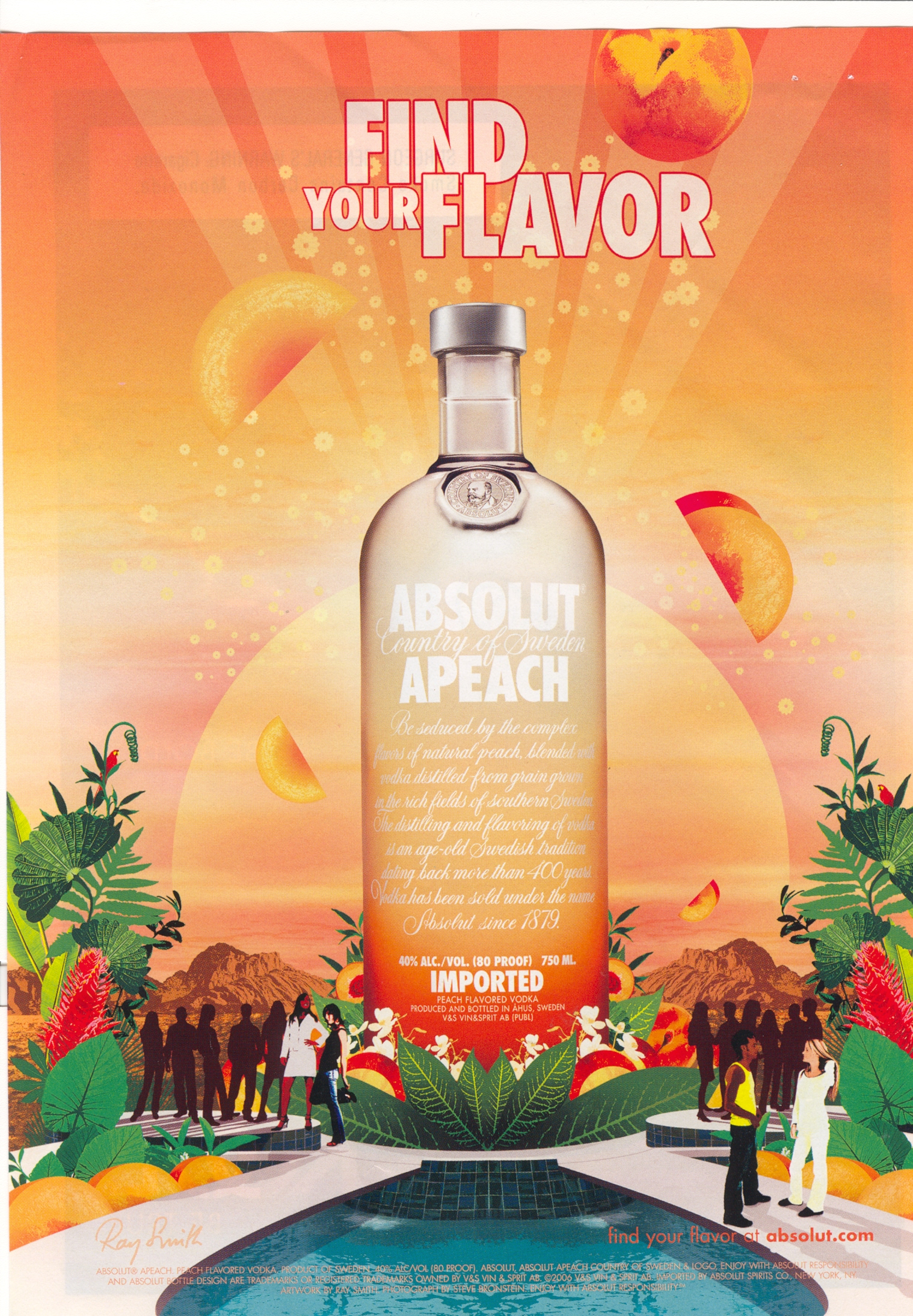
In this series, I share some ideas about why and how people of color are included in advertising aimed primarily at whites.  This post is about the inclusion of people of color in ads to invoke the idea of “color,” “flavor,” or “personality.”

Consider, this ad for Absolute Vodka Peach (“Find Your Flavor”) includes two white and two brown people, plus a set of silhouettes.

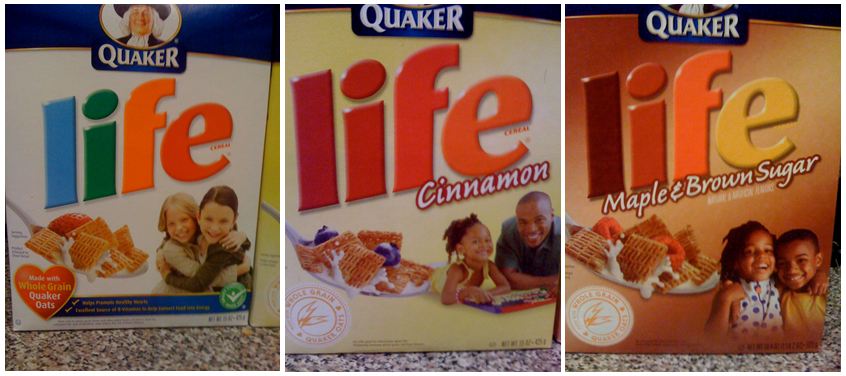
Holly F. and Lafin T.J. sent in three Life cereal box covers.  Notice that “regular” Life has white people on the cover, while cinnamon and maple and brown sugar flavors have people of color on their covers:

1

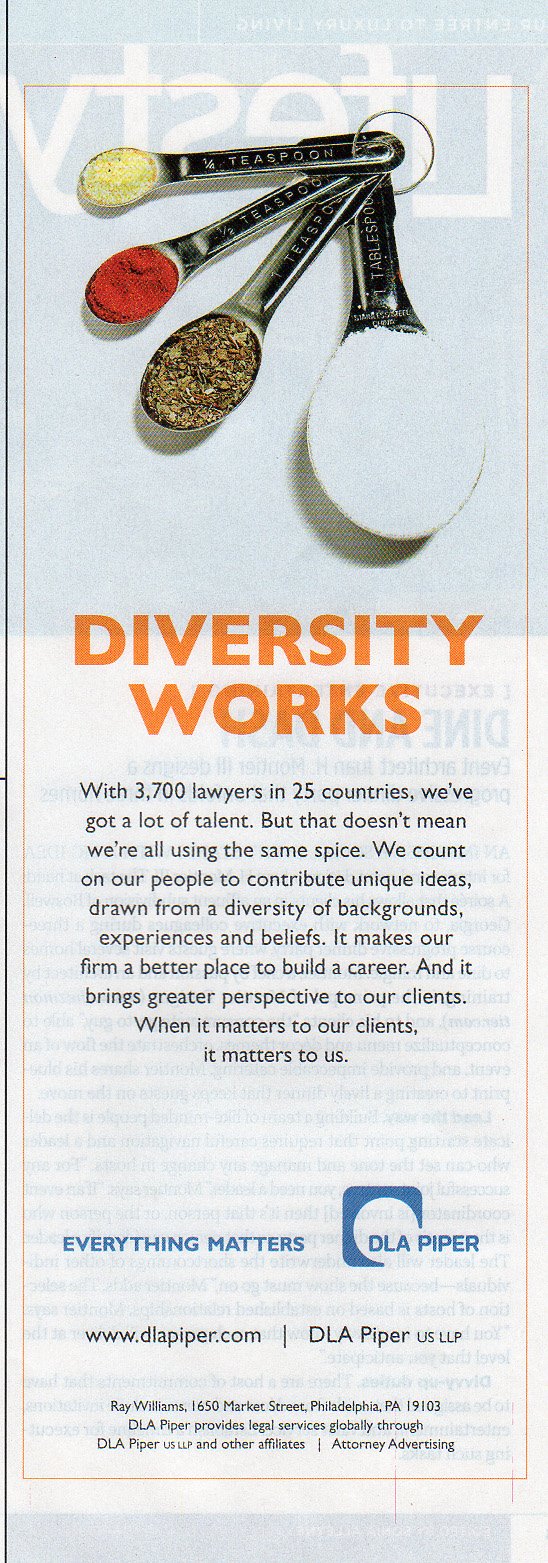
In this pro-diversity ad, spice is literally used to represent diversity (via MultiCultClassics).  (Just a bit misguided too: Just a teaspoon or less of color, please.)

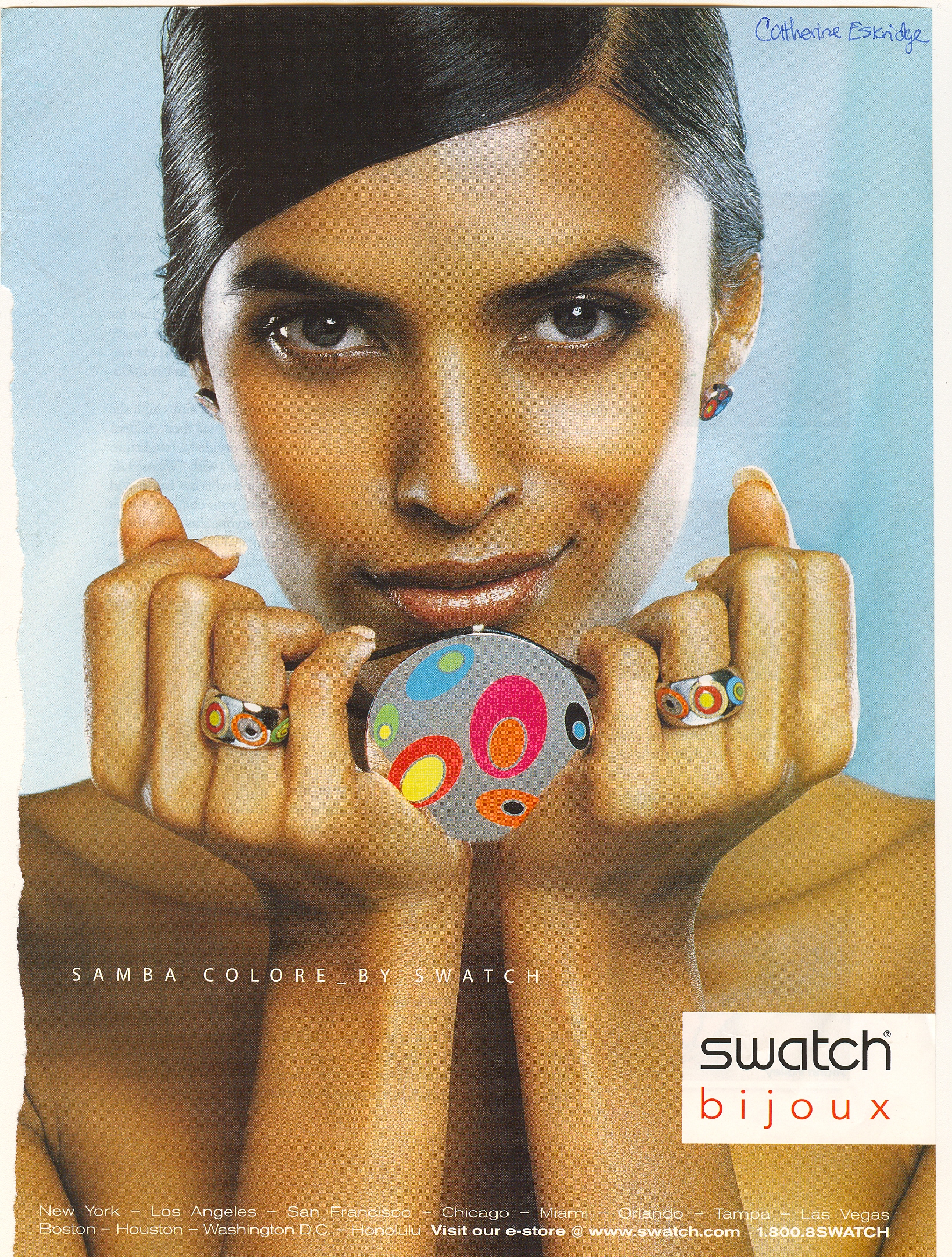
This ad for Samba Colore by Swatch also uses a model of color:

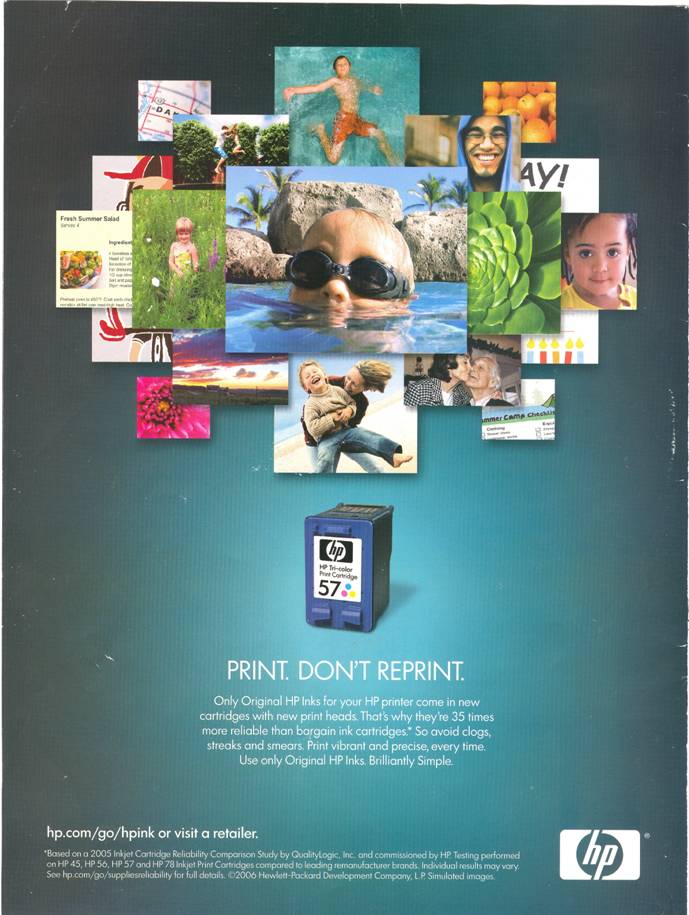
“Welcome to the Color Factory.”  These two ads for a color photo printer and a color printer cartridge both use models of color alongside white models in order to express how “colorful” their product is.

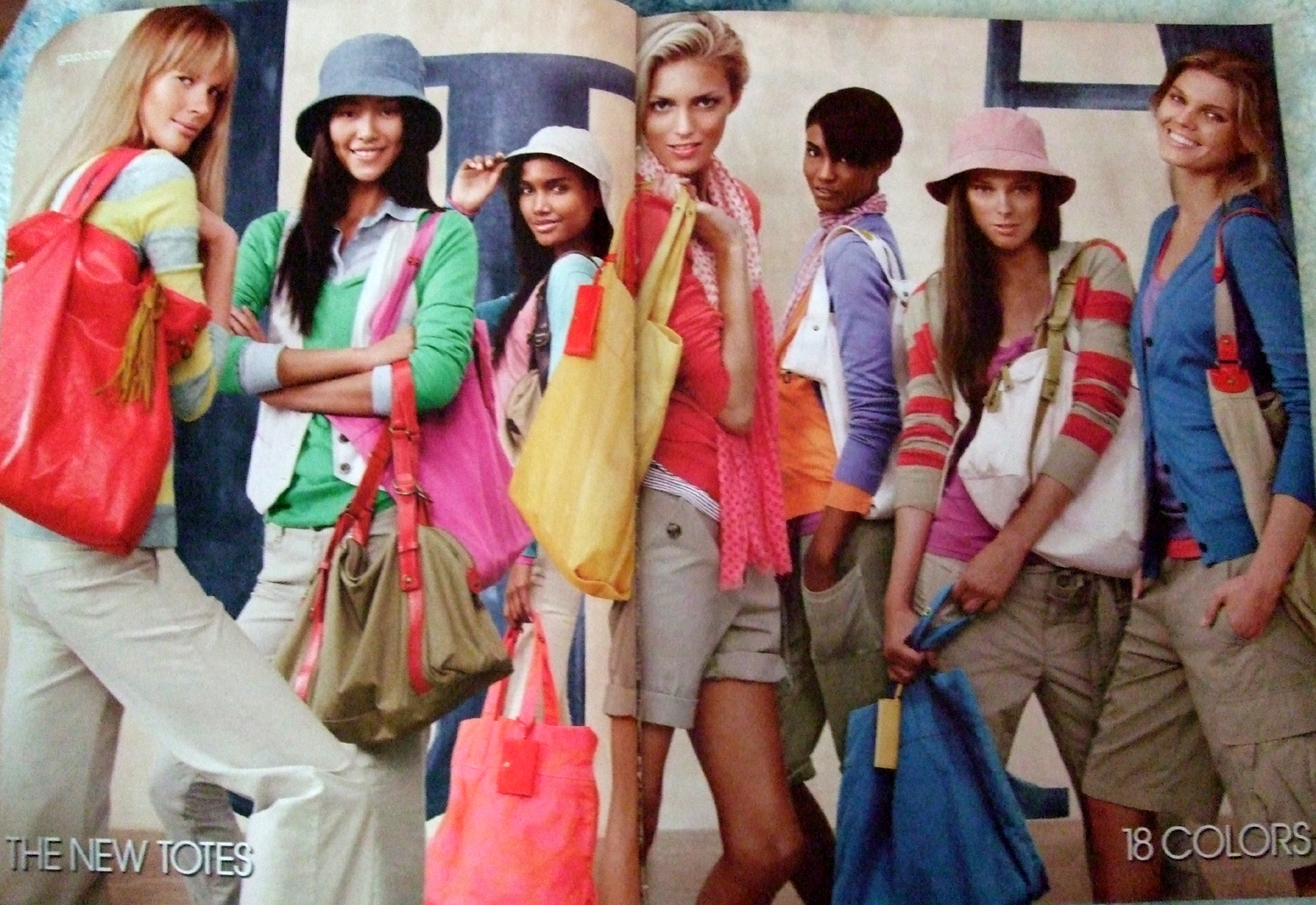
Bri sent in these four images (three from Gap and one from United Colors of Benneton).  Each Gap ad is advertising a different product, with an emphasis on how many colors they come in (bottom right corner).  They all, also, feature models of color.  Here’s just one of them:

gap03

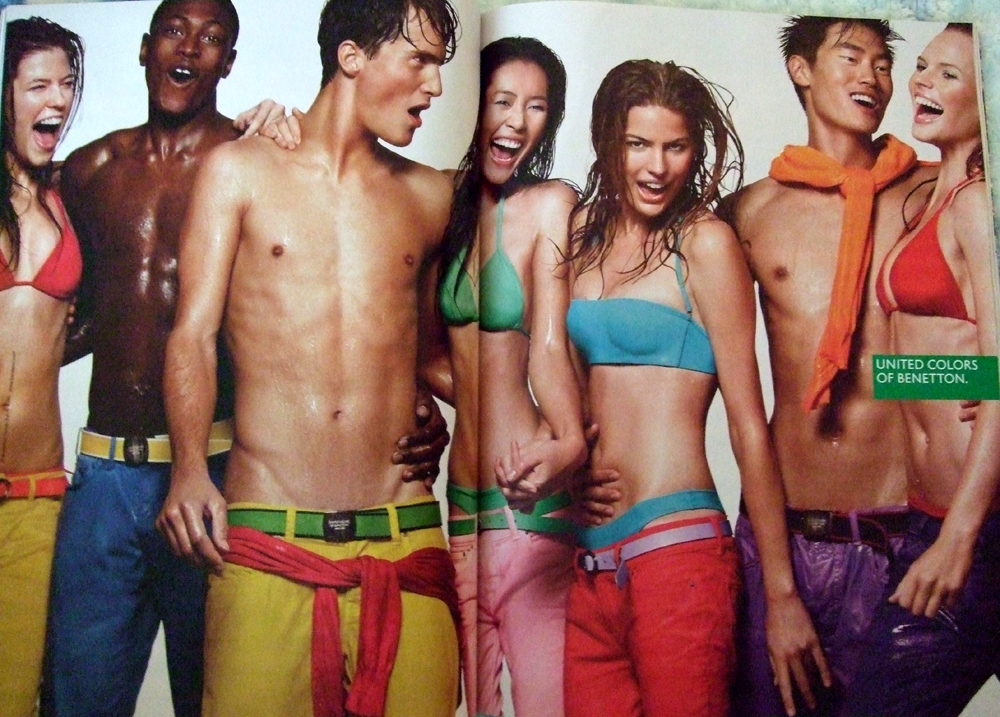
And, of course, the United Colors of Benneton is famous for its use of models of color in its ads, blending quite purposefully the idea of clothing colors and skin colors:

unitedcolors

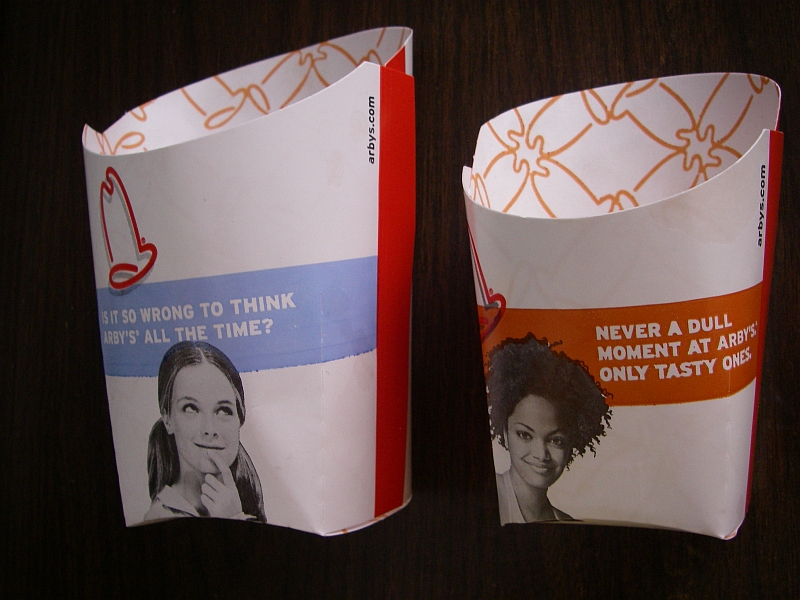
Finally Joshua B. sent in this photo of two french fry holders, one with a black and one with a white woman, reading “never a dull moment, only tasty,” and “Is it wrong to think Arby’s all the time.”  The black woman, then, is presented alongside the ideas of excitement and flavor:

Arbys

There is also this Crystal Light ad campaign that compares water to a “pale” white woman and crystal light to a “pumped” black woman and these ads for an Australian bread company that use Blackness to argue that their bread is not bland.

This kind of advertising can easily be explained away as coincidence, but I think it’s a pattern.  Feel free to send in examples and counter examples if you see them.

Next up: Including people of color so as to make the product seem “hip,” “cool,” or “modern.”  Don’t miss the first in the series: Including people of color so as to associate the product with the racial stereotype.

Lisa Wade, PhD is an Associate Professor at Tulane University. She is the author of American Hookup, a book about college sexual culture; a textbook about gender; and a forthcoming introductory text: Terrible Magnificent Sociology. You can follow her on Twitter and Instagram.