The short answer is, pretty well. But that’s not really the point.

In a previous post I complained about various ways of collapsing data before plotting it. Although this is useful at times, and inevitable to varying degrees, the main danger is the risk of inflating how strong an effect seems. So that’s the point about teen test scores and adult income.

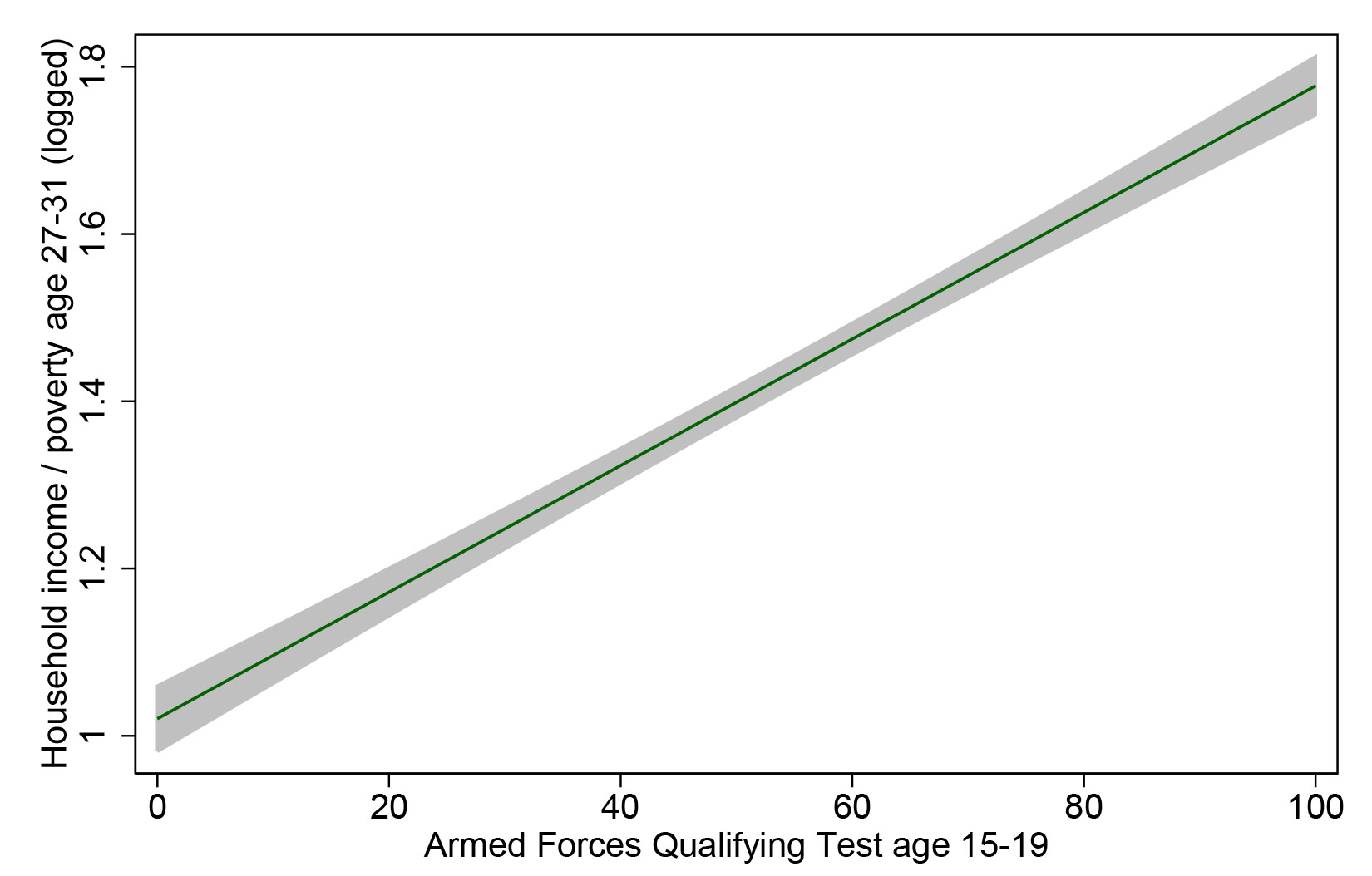
If someone told you that the test scores people get in their late teens were highly correlated with their incomes later in life, you probably wouldn’t be surprised. If I said the correlation was .35, on a scale of 0 to 1, that would seem like a strong relationship. And it is. That’s what I got using the National Longitudinal Survey of Youth. I compared the Armed Forces Qualifying Test scores, taken in 1999, when the respondents were ages 15-19 with their household income in 2011, when they were 27-31.

Here is the linear fit between between these two measures, with the 95% confidence interval shaded, showing just how confident we can be in this incredibly strong relationship:
1 (2) - Copy

That’s definitely enough for a screaming headline, “How your kids’ test scores tell you whether they will be rich or poor.” And it is a very strong relationship – that correlation of .35 means AFQT explains 12% of the variation in household income.

But take heart, ye parents in the age of uncertainty: 12% of the variation leaves a lot left over. This variable can’t account for how creative your children are, how sociable, how attractive, how driven, how entitled, how connected, or how White they may be. To get a sense of all the other things that matter, here is the same data, with the same regression line, but now with all 5,248 individual points plotted as well (which means we have to rescale the y-axis):

1 (2)

Each dot is a person’s life — or two aspects of it, anyway — with the virtually infinite sources of variability that make up the wonder of social existence. All of a sudden that strong relationship doesn’t feel like something you can bank on with any given individual. Yes, there are very few people from the bottom of the test-score distribution who are now in the richest households (those clipped by the survey’s topcode and pegged at 3 on my scale), and hardly anyone from the top of the test-score distribution who is now completely broke.

But I would guess that for most kids a better predictor of future income would be spending an hour interviewing their parents and high school teachers, or spending a day getting to know them as a teenager. But that’s just a guess (and that’s an inefficient way to capture large-scale patterns).

I’m not here to argue about how much various measures matter for future income, or whether there is such a thing as general intelligence, or how heritable it is (my opinion is that a test such as this, at this age, measures what people have learned much more than a disposition toward learning inherent at birth). I just want to give a visual example of how even a very strong relationship in social science usually represents a very messy reality.

Cross-posted at Family Inequality and Pacific Standard.

Philip N. Cohen is a professor of sociology at the University of Maryland, College Park, and writes the blog Family Inequality. You can follow him on Twitter or Facebook.
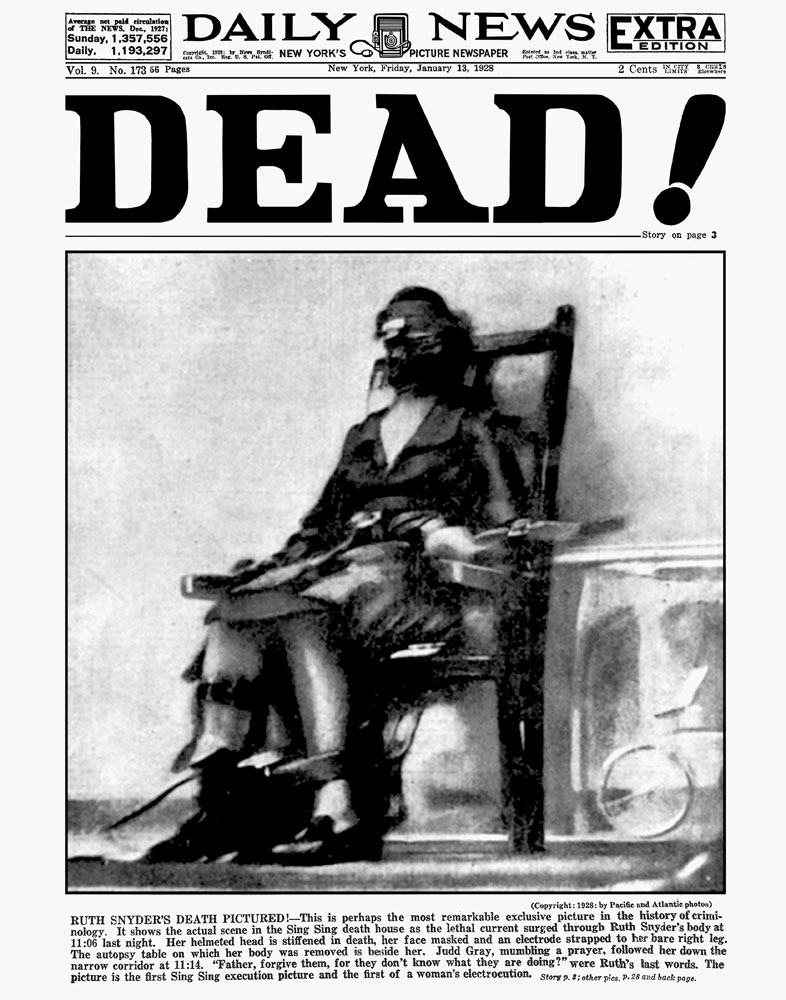
In 1928 readers of the New York Daily News were shocked by this cover.  It was the first photograph ever taken of an electrocution.

1

The executed is a woman named Ruth Snyder, convicted of murdering her husband.  The photographer was a journalist named Tom Howard.  Cameras were not allowed in the execution room, but Howard snuck a device in under his pant leg.  Prison officials weren’t  happy, but the paper was overjoyed.

The fact that the image was placed on the front page with the aggressive headline “DEAD!” suggests that editors expected the photograph to have an impact.  Summarizing at Time, Erica Fahr Campbell writes:

The black-and-white image was shocking to the U.S. and international public alike. There sat a 32-year-old wife and mother, killed for killing. Her blurred figured seemed to evoke her struggle, as one can imagine her last, strained breaths. Never before had the press been able to attain such a startling image—one not made in a faraway war, one not taken of the aftermath of a crime scene, but one capturing the very moment between life and death here at home.

It is one thing to know that executions are happening and another to see it, if mediated, with one’s own eyes.

Pictures can powerfully alter the dynamics of political debates.  Lennart Nilsson‘s famous series of photographs of fetuses, for example, humanized and romanticized the unborn.  They also erased pregnant women, making it easier to think of the fetus as an independent entity. A life, even.

Unfortunately, Campbell’s article doesn’t delve any further into the effect of this photograph on death penalty debates.  To this day, however, no prisons allow photography during executions.  What if things were different?  How might the careful documentation of this process — with all our technology for capturing and sharing images — change the debate today?  And whose interests are most protected by keeping executions invisible?

Cross-posted at Pacific Standard.

Lisa Wade, PhD is an Associate Professor at Tulane University. She is the author of American Hookup, a book about college sexual culture; a textbook about gender; and a forthcoming introductory text: Terrible Magnificent Sociology. You can follow her on Twitter and Instagram.

Screenshot_3Please enjoy these posts from Mother’s Days past:

Lisa Wade, PhD is an Associate Professor at Tulane University. She is the author of American Hookup, a book about college sexual culture; a textbook about gender; and a forthcoming introductory text: Terrible Magnificent Sociology. You can follow her on Twitter and Instagram.

There are more women in political office than ever, but the U.S. is not on the forefront of this change.  In 2013, the U.S. Congress was 18% female which, internationally, places us in the middle of the pack.

The Democrats can boast better numbers than the Republicans, but it wasn’t always this way.  At the Scholars Strategy Network, sociologist Danielle Thomsen observes that the Democratic party (green and blue) has increased female representation much quicker than the Republicans (red and purple), but only since the ’80s or so.

1

Thomsen argues that part of the reason for this difference has to do with increasing polarization in politics.  Both the Democratic and Republican parties have become more ideologically extreme, but this has hurt Republican recruitment of women more than Democratic ones.  This is because Republican women tend to be more moderate, on average, than Republican men.  Since there is less room for moderation in the party, the selection process favors more conservative politicians.  Among that group, there are very few women.

This hasn’t hurt the Democrats as much, since Democratic women are not more likely than Democratic men to hold moderate views.  The opposite, in fact, may be true, increasing the rate at which women may be picked up and supported by the party.

Cross-posted at Pacific Standard.

Lisa Wade, PhD is an Associate Professor at Tulane University. She is the author of American Hookup, a book about college sexual culture; a textbook about gender; and a forthcoming introductory text: Terrible Magnificent Sociology. You can follow her on Twitter and Instagram.

Visit A Whole Lot of Something.

Lisa Wade, PhD is an Associate Professor at Tulane University. She is the author of American Hookup, a book about college sexual culture; a textbook about gender; and a forthcoming introductory text: Terrible Magnificent Sociology. You can follow her on Twitter and Instagram.

Flashback Friday.

We are a species that reproduces sexually and has a penchant for power hierarchies.  One thing that we’ve eroticized, then, is inequality.  In other words, we have sexualized power asymmetry.  I’m not necessarily talking about BDSM, though that may very well be part of it; I’m talking about the everyday gentle or not-so-gentle eroticization of power difference.   If you’ve ever been turned on by the idea of overpowering or being overpowered, that’s what I’m talking about.

An image of a pear next to and curving over an apple, used to illustrate a New York Times article about the sexual partners of vegans, is a striking example of eroticized inequality.

The image, apparently, was chosen because it was a story about sexual relationships between vegans, or “fruity” types. But in order to make fruit look sexual, they positioned them asymmetrically with the pear not just standing next to the apple, or even taller than the apple, but towering over it.  It’s the implication of power difference (and the satin sheets) that make this seem like a sexual image instead of, say, a sleepy one.

This post originally appeared in 2007.

Lisa Wade, PhD is an Associate Professor at Tulane University. She is the author of American Hookup, a book about college sexual culture; a textbook about gender; and a forthcoming introductory text: Terrible Magnificent Sociology. You can follow her on Twitter and Instagram.

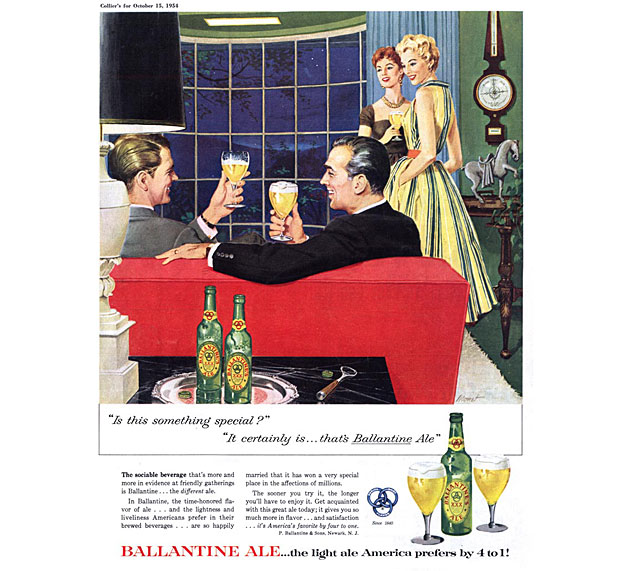
Ads are always selling more than just a product. They’re selling a fantasy.  In this case, buy Ballantine Ale and you’ll get this:

1

The this is this ad from 1954 is what interests me.  I see same-sex friendship. These are presumably two heterosexual married couples — though some would disagree — but the ad isn’t about love, marriage, or sex.  The ad is about the friendship that each spouse finds with their same-sex counterpart.  The two couples come together not for platonic cross-sex companionship, in other words, but same-sex friendship.

For much of American history, the idea that men and women could be friends made little sense.  This was not for the reason we tend to think this today (that is, sexual temptation), but because men and women were believed to be psychologically different.  Differences between the sexes were believed to make cross-sex friendship impossible and pointless.  You wouldn’t have anything in common and couldn’t understand one another.  Women needed men for marriage, domestic divisions of labor, and children — and vice versa — but true friendship was reserved for someone of the same sex.

We certainly don’t need to return to that type of thinking — even if it was adorable — but I do appreciate the way this ad is committed to the idea that simple friendship is fantastic.

Lisa Wade, PhD is an Associate Professor at Tulane University. She is the author of American Hookup, a book about college sexual culture; a textbook about gender; and a forthcoming introductory text: Terrible Magnificent Sociology. You can follow her on Twitter and Instagram.

You approve!  Here are our most appreciated posts this month:

Editor’s pick:

Thanks everybody!

Lisa Wade, PhD is an Associate Professor at Tulane University. She is the author of American Hookup, a book about college sexual culture; a textbook about gender; and a forthcoming introductory text: Terrible Magnificent Sociology. You can follow her on Twitter and Instagram.