Cross-posted at OWNI.

Something has been nagging me about the Representative Weiner (D-NY) sexting scandal: how would this story would play out differently had the sexting-congressperson been female? I wrote earlier about how differently “sexy” pictures of male and female political candidates are handled.

When Krystal Ball ran for congress, images of a past Halloween party became some of the most Google’d images in the world, unlike male politicians running for office at the same time who were also involved in scandals about images of their past behaviors. The images of women in general, and, in this case, female politicians, become poured over, detailed, dissected, analyzed and obsessed upon to a far greater extent than what is occurring with Rep. Weiner. Yes, the images he sent are being shared on and offline, but had Weiner been female the images might be shown akin to the Janet Jackson “wardrobe malfunction”: the media would scowl at the perversion while simultaneously showing them on a constant loop, dissecting every pixel in detail.

So let’s do quick Google Image searches for Krystal Ball and Anthony Weiner. (In these screenshots I am logged out of Google and “SafeSearch” is off, however, neither of those factors influenced the results much).

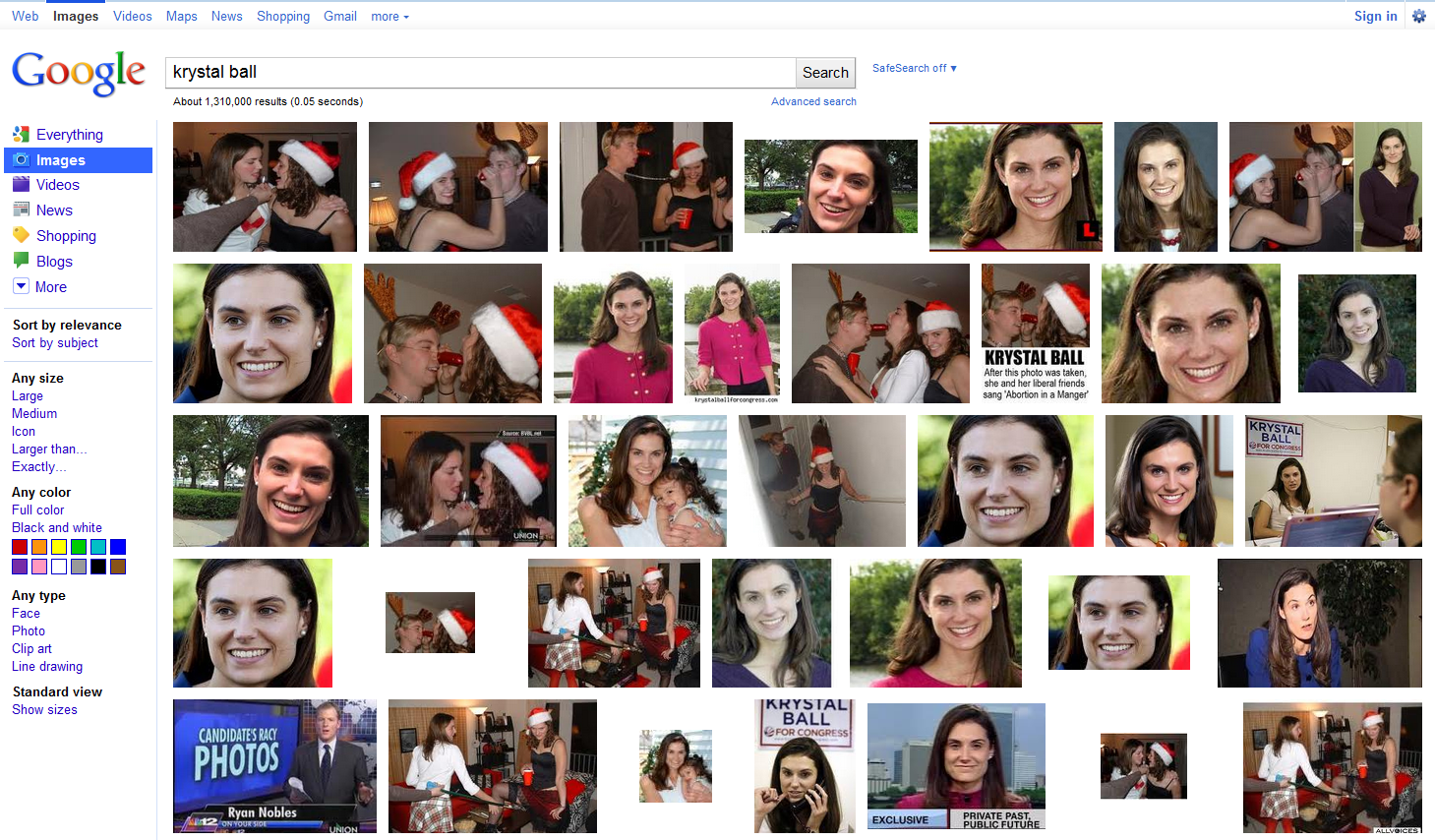

Krystal Ball’s results are dominated by the images that caused scandal. You have to scroll through pages of images in Weiner’s results to find the “offending” images. Given that Google’s resultsare based in part on popularity and website inter-linking, we have to wonder how Weiner’s post-scandal online presence would be different had he been female. [We should note that Weiner had a larger online presence before the scandal than did Ball. However, many of the top images in the search are post-scandal, so that is not a complete explanation for the discrepancy]. In fact, it is easier to find women showing skin in Weiner’s results than the so-called “lewd” images themselves.

Even Sarah Palin, who has never tweeted “lewd” photos of herself to all of the Internet, has search results more focused on her body than does Weiner.
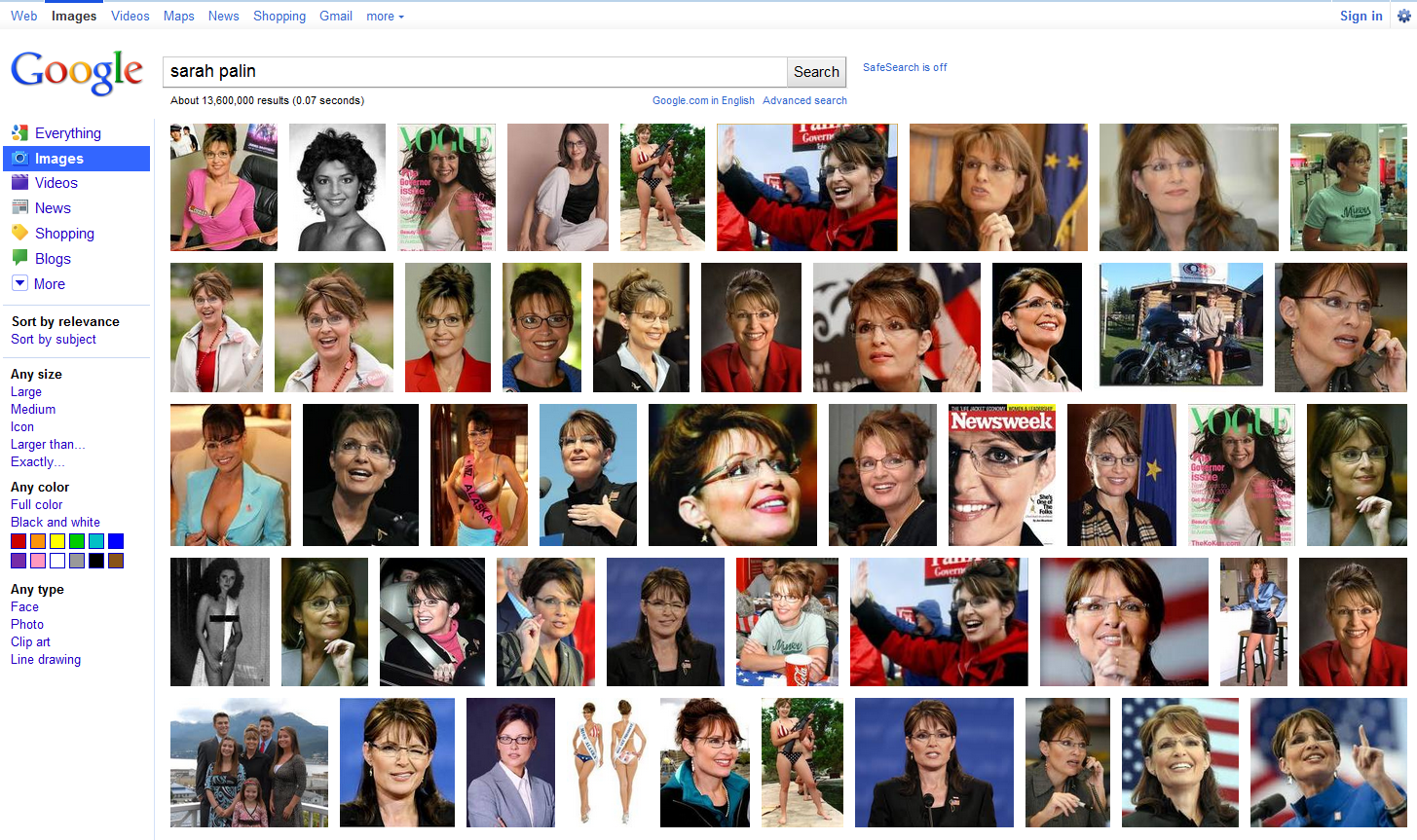
Michel Foucault noted that sexual repression is closely related with sexual obsession; and the obsessively prying “gaze” is really the regulation and controlling of ourselves and our sex. The relative lack of obsession of the images in this scandal strikes me as evidence of the weaker regulation of the male body and men’s sex.

How else would this scandal play out differently had Rep. Weiner been female?

—————————

Please welcome guest blogger Nathan Jurgenson.  Jurgenson is a graduate student in sociology at the University of Maryland and co-edits the Cyborgology blog.

Sociologists use the term “androcentrism” to refer to a new kind of sexism, one that replaces the favoring of men over women with the favoring of masculinity over femininity. According to the rules of androcentrism, men and women alike are rewarded, but only insofar as they are masculine (e.g., they play sports, drink whiskey, and are lawyers or surgeons w00t!). Meanwhile, men are punished for doing femininity and women… well, women are required to do femininity and simultaneously punished for it.

Illustrating this concept, much more concisely, is this altered photograph of James Franco in drag. Sent along by Stephanie V., the photo was originally for the cover of Candy, a “transversal style” fashion magazine.  I’m not sure who added the copy,* but I like it:

* So Caro Visi, where I found the image, credits Virus, but I can’t find it there.  I’m happy to properly credit if someone can point me in the right direction.

UPDATE: Sarah and John, in the comments thread, pointed out that the language is borrowed from a movie titled The Cement Garden.  Jennifer points out that Madonna used it, as well, in her song What it Feels Like For A Girl.

Clip from The Cement Garden:

More posts on androcentrism: “woman” as an insult, making it manly: how to sell a car, good god don’t let men wear make up or long hairdon’t forget to hug like a dude, saving men from their (feminine) selvesmen must eschew femininity, not impressed with Buzz Lightyear commercialdinosaurs can’t be for girls, and sissy men are so uncool.

Lisa Wade, PhD is an Associate Professor at Tulane University. She is the author of American Hookup, a book about college sexual culture; a textbook about gender; and a forthcoming introductory text: Terrible Magnificent Sociology. You can follow her on Twitter and Instagram.

In the contemporary Western world, naked and near-naked bodies are revealed everywhere.  But most of the bodies we see are those of models and actors, carefully cultivated, chosen, and digitally altered to look a particular way.  Except, artist Clarity Haynes notes, the “before” pictures in advertisements for diet plans and cosmetic surgeries.  She writes:

“Before” pictures pop up constantly on our computers and in magazines, as part of the daily landscape of imagery. These “before” pictures, meant to shock and scare, show bodies that are presented as needing urgent correction and control, through weight loss or plastic surgery.

In an effort to reclaim these “before” bodies, Haynes has lovingly painted a range of female bodies.  The Breast Portrait Project, she continues:

…is about finding dignity and beauty in the physical characteristics of the body that our popular culture often ridicules and heaps with shame, and in the process allowing the models who participate to feel pride in their particular selves — and by extension, the viewers of the work as well, regardless of their gender.


Visit Hayne’s gallery.  And, for more normalizing of normal bodies, see these selections of breasts,  bellies, and vulvas.

Lisa Wade, PhD is an Associate Professor at Tulane University. She is the author of American Hookup, a book about college sexual culture; a textbook about gender; and a forthcoming introductory text: Terrible Magnificent Sociology. You can follow her on Twitter and Instagram.

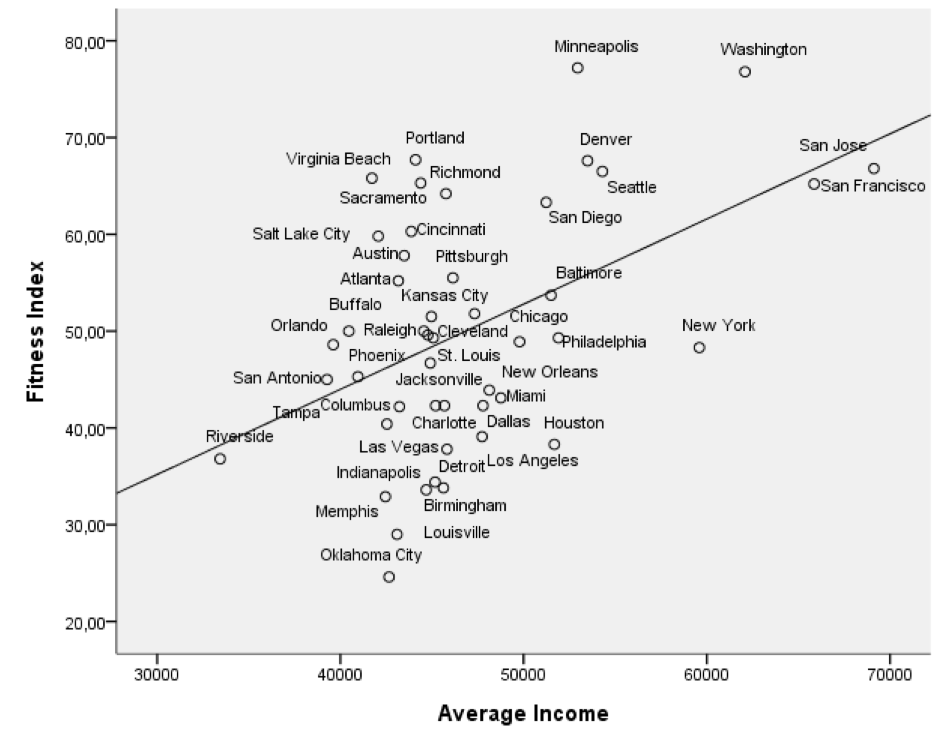
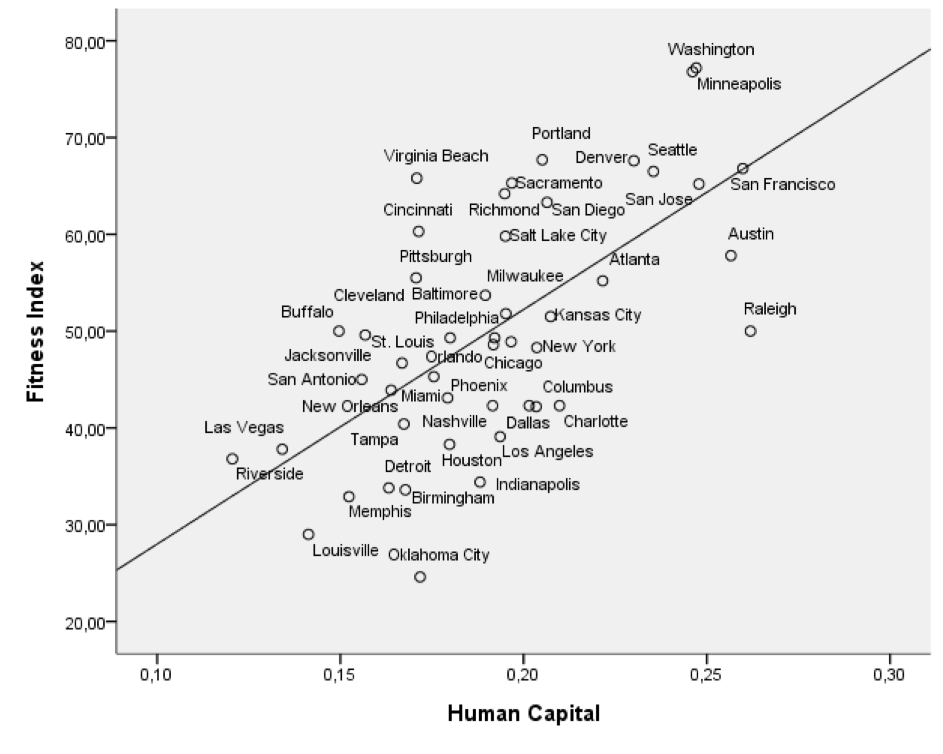
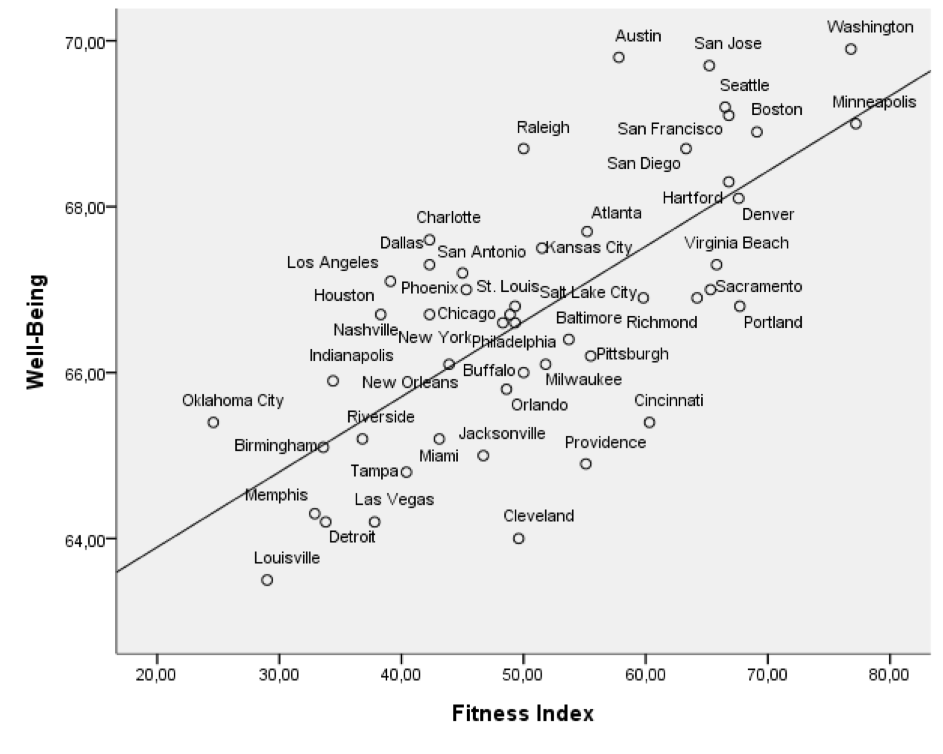
Sociologists have shown that rates of “obesity” correlate with economic class. That is, the poorer you are the more likely it is that you will be overweight.  This is, in part, because healthy, low-calorie food tends to be more expensive that calorie rich, nutrient poor food; and also because poor neighborhoods have fewer grocery stores, forcing the poor, especially if they don’t have cars, to shop for groceries at corner stores, gas stations, and fast food restaurants.  When there are so many other things to worry about, like not going hungry, food quality is not prioritized.  Level of fitness, then, correlates with social class (and the time and money it affords you) and the things that correlate with social class, like level of education.

The American College of Sports Medicine has released data showing these correlations, if measured at the level of U.S. metro areas, as reported at The Atlantic and sent along by Tracie Hitter, a doctoral student at New Mexico State University.  First, fitness level is correlated with average income in these areas:

Second, fitness level correlates with average level of education (here called “human capital”):

And fitness level correlates with overall well-being, a measure related to both fitness and socioeconomic class:

Here are some selected metro areas plotted in relation to one another:

Lisa Wade, PhD is an Associate Professor at Tulane University. She is the author of American Hookup, a book about college sexual culture; a textbook about gender; and a forthcoming introductory text: Terrible Magnificent Sociology. You can follow her on Twitter and Instagram.

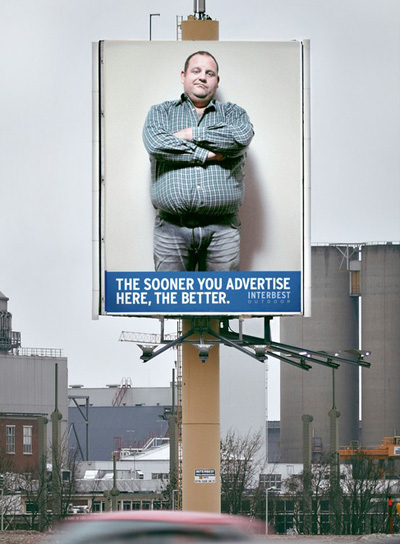
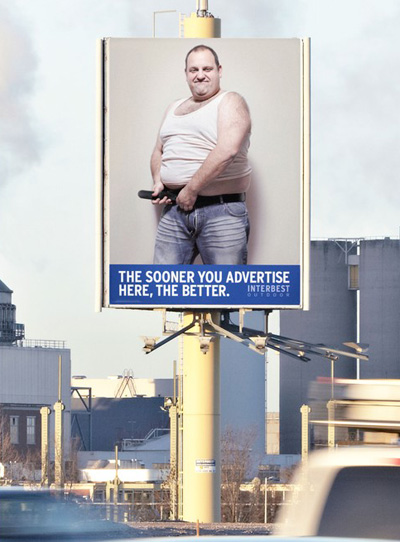
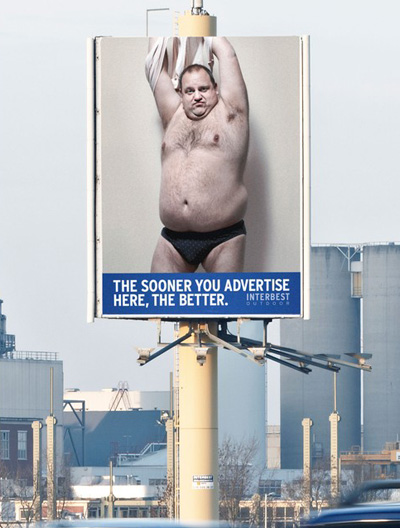
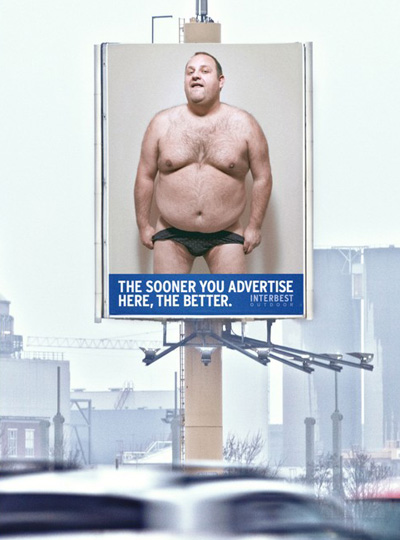
While some bodies are socially-defined as For Display, others are defined as embarrassing or disgusting.  Indigo and Artemis sent in a great example of these distinctions being reinforced. This series of billboards appeared in The Netherlands with the tagline “The Sooner You Advertise Here, the Better”:


The billboard humorously advertises the billboards availability for advertising, a clever version of “Your Ad Here.”  It does so, of course, by suggesting that the model’s body is so repulsive that the threat of simply seeing it should be enough to make us reach for our wallets.  While cultural beliefs about who is and isn’t attractive are often framed as biological or evolutionary, it can’t be denied that, at least in this case, we are receiving a strong social message as well.

Via Copyranter and The Daily Dish.

Lisa Wade, PhD is an Associate Professor at Tulane University. She is the author of American Hookup, a book about college sexual culture; a textbook about gender; and a forthcoming introductory text: Terrible Magnificent Sociology. You can follow her on Twitter and Instagram.

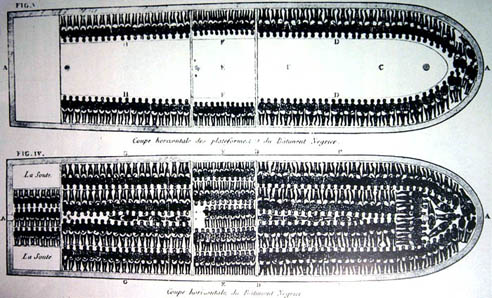
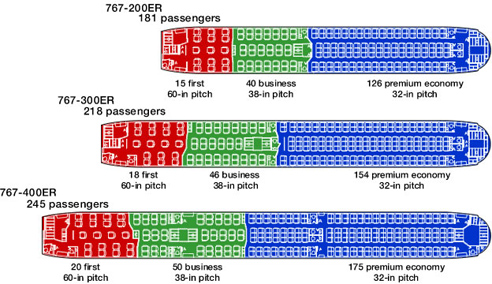
Just as “I’m not a racist, but…” is a sure sign that someone is about to say something racist, an essay that begins “I don’t want to trivialize the inhumane horrors that African slaves endured on slave ships destined for the Americas. But…” is certain to do just that.  Indeed, Steven Heller at Imprint began his post this way, going on to suggest that the design of modern airplanes “resemble[s]” that of slave ships.  As evidence, he recalls his own discomfort in coach and compares drawings of slave ships and blueprints of airplanes.

Heller prefaced his observations with a disclaimer because he knew comparing modern air travel to the slave trade was sketchy.  And it is, indeed, sketchy. The descendants of slaves live life with the knowledge that their ancestors were stolen, shackled, beaten, and denied their very humanity; at least they survived the trip across the Atlantic.  Nope, not like air travel one bit.

So, yes, it’s lovely to be clever, but it’s also lovely to be thoughtful and sensitive.  In this case, Heller’s desire to be the former won out over the latter.  Or perhaps he never really thought that anyone would seriously be upset by the comparison.  It’s obviously tongue-in-cheek right?  I mean, slavery has been over for, like, ever.  Or maybe he forgot that descendants of slaves read the freakin’ internet just like everyone else.

Who knows.  In any case, it’s a great example of the trivializing of the histories and traumas of a marginalized population.

Thanks to Dolores R. for the tip.

Lisa Wade, PhD is an Associate Professor at Tulane University. She is the author of American Hookup, a book about college sexual culture; a textbook about gender; and a forthcoming introductory text: Terrible Magnificent Sociology. You can follow her on Twitter and Instagram.

Cross-posted at Jezebel.

I recently posted some data revealing the average caloric intake across the globe.  Since then, I’ve learned of a new photo project by Peter Menzel and Faith D’Aluisio documenting individuals’ daily meals across many countries.  While the former post gave averages, the photographs in Menzel and D’Aluisio’s new book, What I Eat, offer data points.  What one person reported eating in one day.  They are suggestive of the range of caloric intakes, intersecting with genetics and physical activity, that make each individual body unique.

Menzel and D’Aluisio, through Tawanda Kanhema, gave us permission to share these three examples with you; you can see a larger sample at TIME.

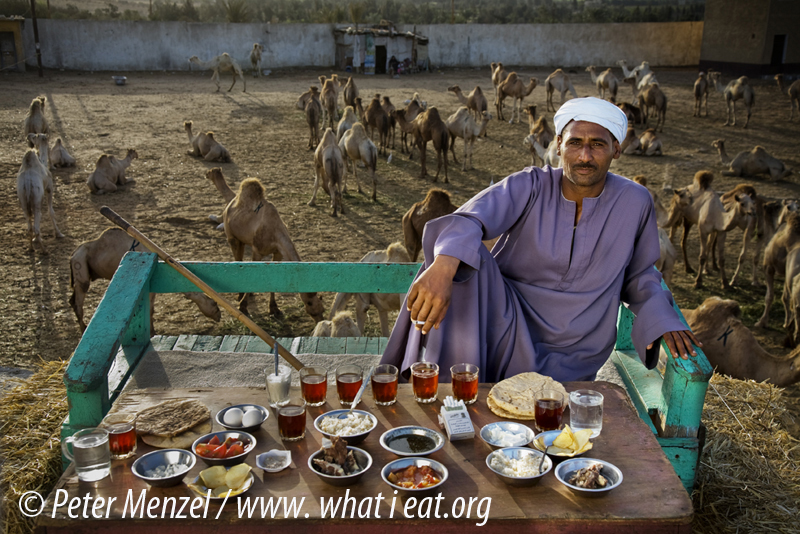
Saleh Abdul Fadlallah (Egypt), 3200 calories:

Caption:

Camel broker Saleh Abdul Fadlallah with his day’s worth of food at the Birqash Camel Market outside Cairo, Egypt. (From the book What I Eat: Around the World in 80 Diets.) The caloric value of his day’s worth of food on a typical day in the month of April was 3200 kcals. He is 40 years of age; 5 feet, 8 inches tall; and 165 pounds. Although virtually all of the camels that Saleh Fadlallah sells at the camel market are sold for their meat, he rarely eats this meat himself as it’s too expensive for everyday meals. Contrary to popular belief, camels’ humps don’t store water; they are a reservoir of fatty tissue that minimizes heat-trapping insulation in the rest of their bodies; the dromedary, or Arabian camel, has a single hump, while Asian camels have two. Camels are well suited for desert climes: their long legs and huge, two-toed feet with leathery pads enable them to walk easily in sand, and their eyelids, nostrils, and thick coat protect them from heat and blowing sand. These characteristics, along with their ability to eat thorny vegetation and derive sufficient moisture from tough green herbage, allow camels to survive in very inhospitable terrain.

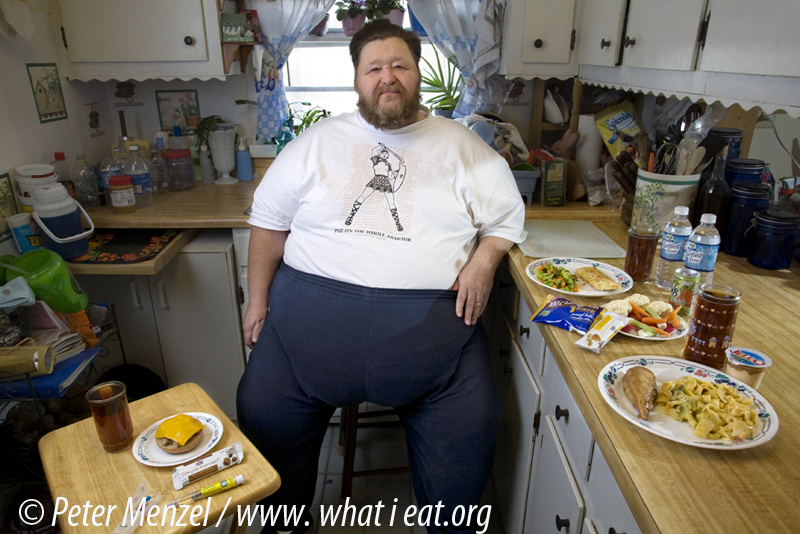
Rick Bumgardener (Tennessee, USA), 1600 calories:

Caption:

Rick Bumgardener with his recommended daily weight-loss diet at his home in Halls, Tennessee. (From the book What I Eat: Around the World in 80 Diets.) The caloric value of his day’s worth of food in the month of February was 1,600 kcals. He is 54 years of age; 5 feet, 9 inches tall; and 468 pounds. Wheelchair-bound outside the house and suffering from a bad back and type 2 diabetes, he needs to lose 100 pounds to be eligible for weight-loss surgery. Rick tries to stick to the low-calorie diet pictured here but admits to lapses of willpower. Before an 18-year career driving a school bus, he delivered milk to stores and schools, and often traded with other delivery drivers for ice cream. School cafeteria staff would feed the charming Southerner at delivery stops, and he gained 100 pounds in one year. The prescription drug fen-phen helped him lose 100 pounds in seven months, but he gained it all back, plus more.

Curtis Newcomer (Fort Irwin, California), 4000 calories:

Caption:

Curtis Newcomer, a U.S. Army soldier, with his typical day’s worth of food at the National Training Center at Fort Irwin in California’s Mojave Desert. (From the book What I Eat: Around the World in 80 Diets.) The caloric value of his day’s worth of food in the month of September was 4,000 kcals. He is 20 years old; 6 feet, 5 inches tall; and 195 pounds. During a two-week stint before his second deployment to Iraq, he spends 12-hour shifts manning the radio communication tent (behind him). He eats his morning and evening meals in a mess hall tent, but his lunch consists of a variety of instant meals in the form of MREs (Meals, Ready-to-Eat). His least favorite is the cheese and veggie omelet. “Everybody hates that one. It’s horrible,” he says. A mile behind him, toward the base of the mountains, is Medina Wasl, a fabricated Iraqi village—one of 13 built for training exercises, with hidden video cameras and microphones linked to the base control center for performance reviews.

For more from Peter Menzel, visit our posts on family food for a week and family belongings across the globe.  And also see Mark Menjivar’s You Are What You Eat.

Visit Menzel’s blog here.


Lisa Wade, PhD is an Associate Professor at Tulane University. She is the author of American Hookup, a book about college sexual culture; a textbook about gender; and a forthcoming introductory text: Terrible Magnificent Sociology. You can follow her on Twitter and Instagram.

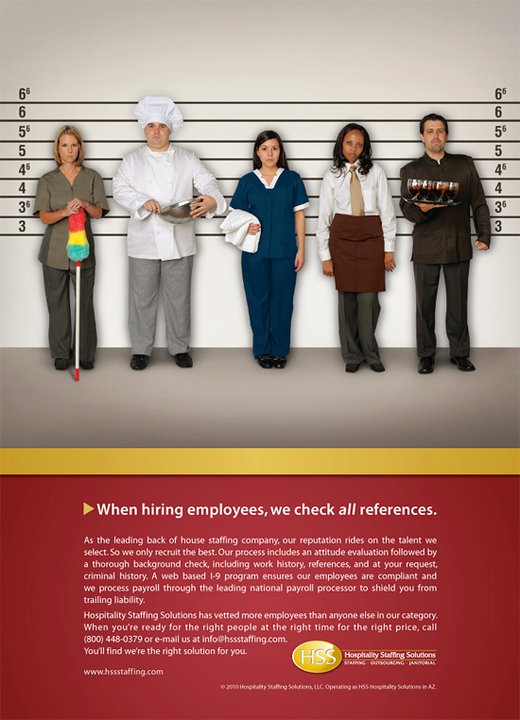
Adrienne H. sent along two print advertisements for Hospitality Staffing Solutions, a company that is hired by hotels and restaurants to provide service-level hospitality workers: janitors, maids, cooks, servers, and others.  The ads position this type of worker as inherently problematic.  The first suggests that there is a pressing need to ensure that they don’t have criminal backgrounds.  The second, with the byline “you shouldn’t have to sacrifice quality for price,” suggests that low-wage employees are typically of poor-quality — interchangeable, metaphorically junk, like junk food — but that a company should have the right to pay the bare minimum and still retain excellent workers.

Hospitality Staffing Solutions clearly believes that employers have a very low opinion of the workers to whom they pay the lowest wages.  I imagine it must be unpleasant to be a working class person employed by someone so inclined to think the worst about you, all while paying you as little as possible and monitoring you for the slightest infractions.  Many middle- and upper-class people are privileged to escape this kind of scrutiny — a scrutiny under which many of them would look quite imperfect; they are generally considered worthy of respect and their skills deserving of a living wage.  These ads suggest that working class people are not given such privileges.

Lisa Wade, PhD is an Associate Professor at Tulane University. She is the author of American Hookup, a book about college sexual culture; a textbook about gender; and a forthcoming introductory text: Terrible Magnificent Sociology. You can follow her on Twitter and Instagram.