Archive: 2014

Compared to other democracies, the U.S. has a strange penchant for passing laws that suppress voting instead of encourage it.  We are one of the few democracies, for example, that requires people to register to vote.  Most elsewhere, writes Eric Black for the Minnesota Post:

[G]overnments know the names, ages and addresses of most of its citizens and… provide the appropriate polling place with a list of those qualified to vote. The voter just has to show up.

We also hold elections on just one day instead of several and that day is an otherwise normal Tuesday instead of a weekend or a holiday.

Those are just two examples of rules and practices that reduce voting. There are many. It’s called voter suppression and it’s totally a thing. The ACLU has collected voter suppression efforts just since 2013, listing 15 states that have passed such measures.

A majority of these efforts to reduce voting are initiated by the political right, as a generic search for such stories quickly reveals. They are aimed specifically at likely democratic voters, like racial minorities and students, adding up to what political scientist David Schultz argues is the Second Great Disenfranchisement in U.S. history after Jim Crow.

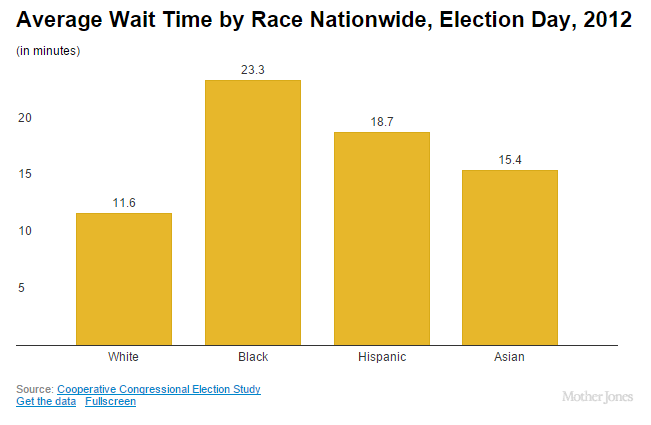
Many of these measures are overtly discriminatory and even illegal, but others are more subtle. Making voting more costly in terms of time might be one subtle way of discouraging voting by some types of people. Data collected by the Cooperative Congressional Election Study in 2012 suggests that this is, indeed, part of voter suppression, by incompetence or design.

Here is some of their data, as organized by Mother Jones. Nationwide, the average wait time to vote was longer for all non-white groups, especially blacks:
1

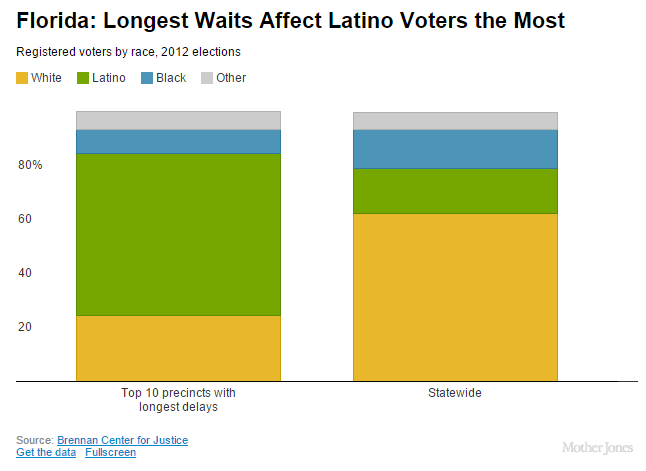
Florida had the longest delays in 2012 and these delays disproportionately affected Latinos:
2

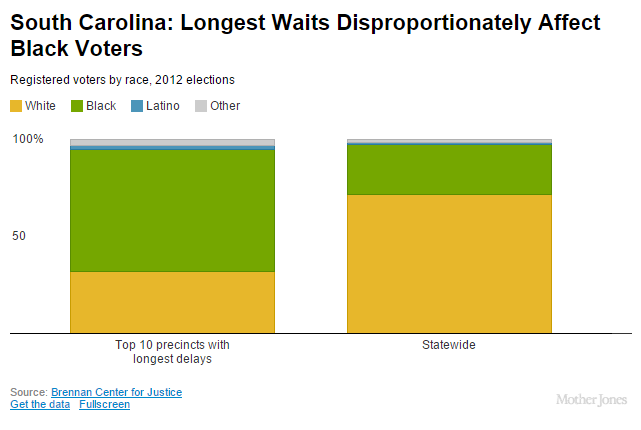
In South Carolina, the 10 precincts with the longest wait times were all in one disproportionately African American county:
3

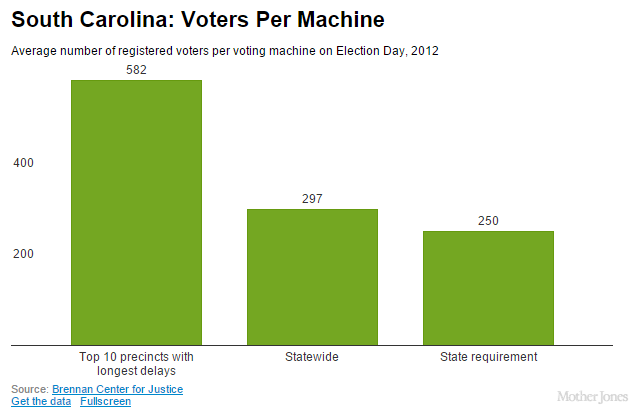
Wait times are partly the result of the number of voting machines divided by the number of registered voters. The long wait times in South Carolina, in other words, were not random. Those 10 precincts in the highly African American county had about half as many voting machines per person as the statewide average:
4

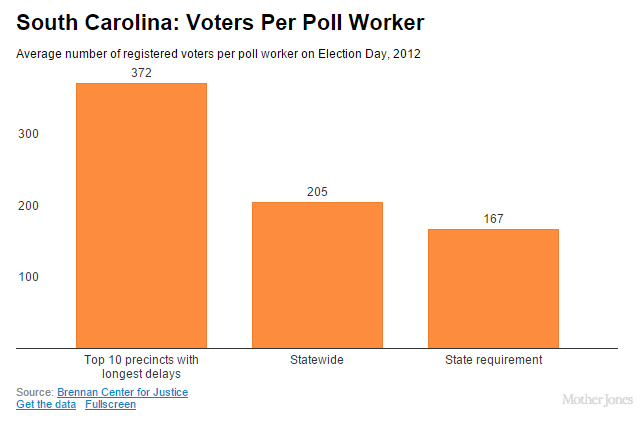
They also had significantly fewer poll workers available to help out:
5

There are more graphs and more details at Mother Jones.

Voter suppression seriously harms our right to call ourselves a democracy.  Notably, it’s significantly worse today. When the Supreme Court struck down the part of the Voting Rights Act that required oversight of states with a history of voting discrimination, the ability of the federal government to ensure equal voting rights was seriously damaged. Previously monitored states immediately began passing legislation designed to suppress voting. As I wrote previously:

This is bad.  It will be much more difficult to undo discriminatory laws than it was to prevent them from being implemented and, even if they are challenged and overturned, they will do damage in the meantime.

Cross-posted at Pacific Standard.

Lisa Wade, PhD is an Associate Professor at Tulane University. She is the author of American Hookup, a book about college sexual culture; a textbook about gender; and a forthcoming introductory text: Terrible Magnificent Sociology. You can follow her on Twitter and Instagram.
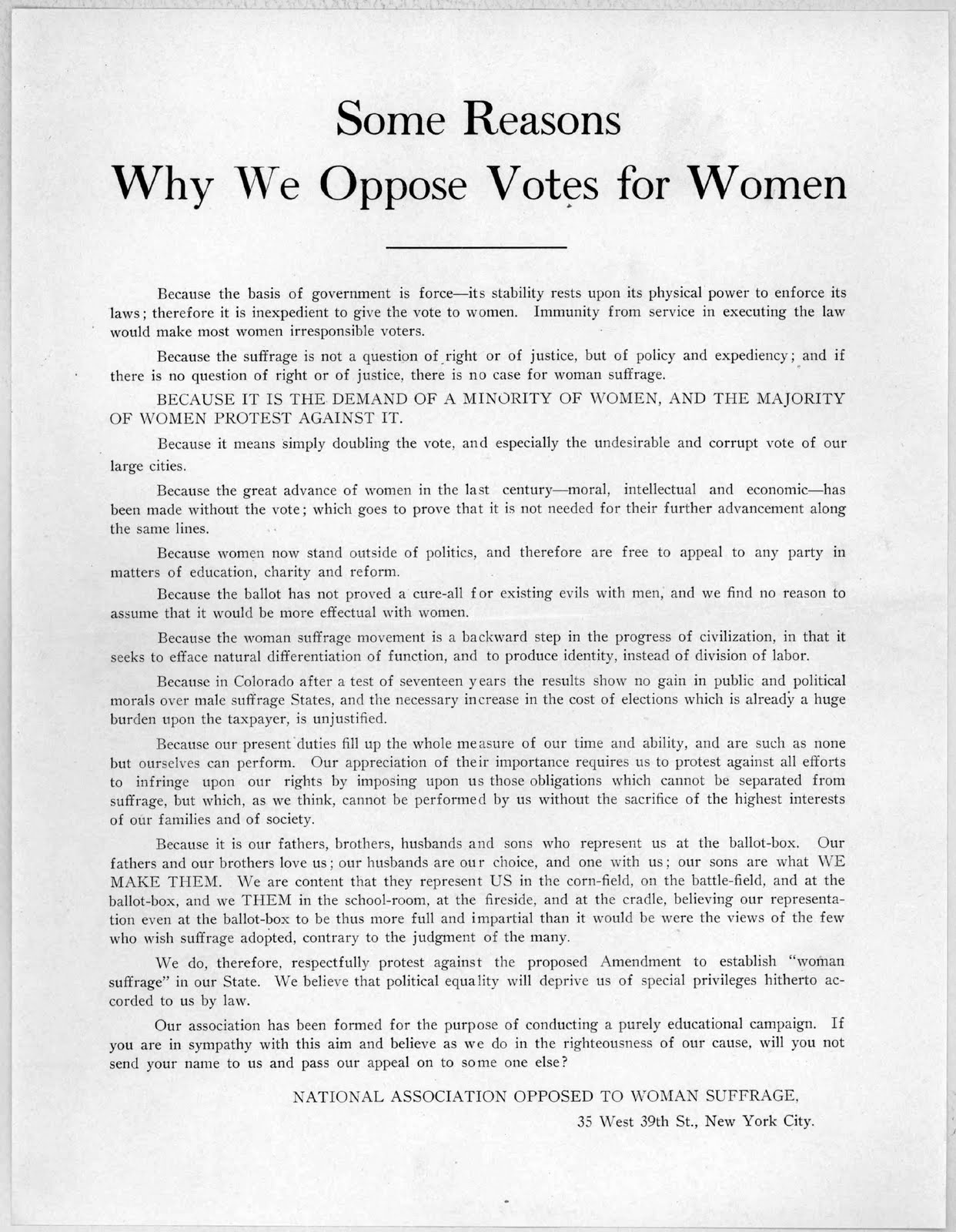
Today is the anniversary of the 34th American presidential election.  The year was 1920; it was the first presidential election in which women were allowed their own votes.  This seems like a good day to post a memento from the political battle over women’s suffrage, the right to vote and run for political office.

The fight for suffrage took decades and women were on both sides of the issue.  The document below is a copy of an argument against women’s suffrage — Some Reasons Why We Oppose Votes for Women — printed in 1894.  The National Association Opposed to Women’s Suffrage was led by Josephine Dodge.  (Open and click “full size” to read.)

1

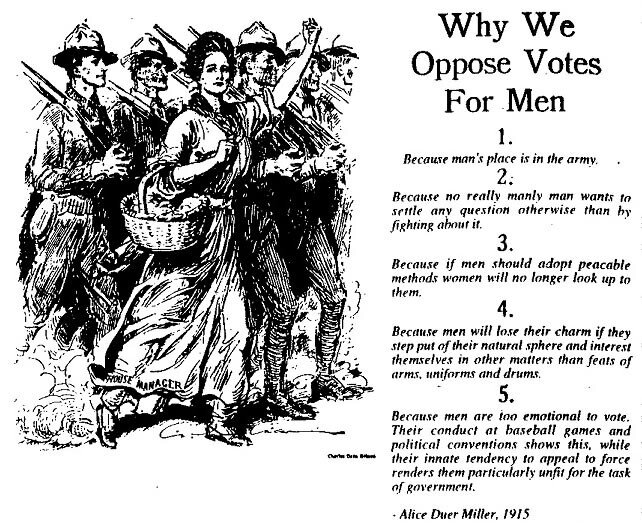
Alice Duer Miller was on the other side of the fight.  In 1915, she wrote and circulated a satirical response titled Why We Oppose Votes for Men.  Drawing on parallel logic, she made a case for why it was men, not women, who shouldn’t be voting. (Click for a larger copy.)

1aText:

1. Because man’s place is in the army.

2. Because no really manly man wants to settle any question otherwise than by fighting about it.

3. Because if men should adopt peacable methods women will no longer look up to them.

4. Because men will lose their charm if they step out of their natural sphere and interest themselves in other matters than feats of arms, uniforms and drums.

5. Because men are too emotional to vote. Their conduct at baseball games and political conventions shows this, while their innate tendency to appeal to force renders them particularly unfit for the task of government.

It helps to have a sense of humor.

Happy anniversary of the first gender inclusive American presidential election everyone.

Lisa Wade, PhD is an Associate Professor at Tulane University. She is the author of American Hookup, a book about college sexual culture; a textbook about gender; and a forthcoming introductory text: Terrible Magnificent Sociology. You can follow her on Twitter and Instagram.
Enjoy these earlier posts about Daylight Savings:

Lisa Wade, PhD is an Associate Professor at Tulane University. She is the author of American Hookup, a book about college sexual culture; a textbook about gender; and a forthcoming introductory text: Terrible Magnificent Sociology. You can follow her on Twitter and Instagram.
SocImages news!

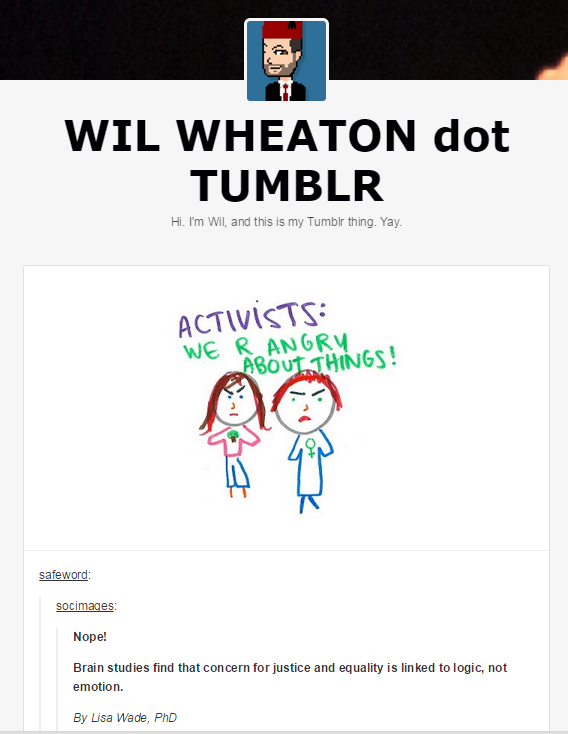
Our top post on Tumblr this month, with over 45,000 likes and re-blogs, discusses a brain imaging study that suggests that social justice is linked to logic, not emotion.

We earned some major nerd cred this month when Wil Wheaton tumbled it! Here is the awesome evidence of that fabulous day:

2

Seriously, folks. My inner 14-year-old girl downright squealed.

You like!  Here are our most appreciated posts this month:

Why do witches ride brooms was the clear winner with 9,300+ likes. And it’ll be obvious why if you click through to find out.

Other winners:

Thanks everybody!

Editor’s pick:

New Pinterest board!

In honor of Breast Cancer Awareness Month and its backlash, we put together a Pinterest board featuring the weirdest and most outrageous examples of pinkwashing. And we started it BEFORE the pinkwashed fracking drill bit was announced!

Social Media ‘n’ Stuff:

Finally, this is your monthly reminder that SocImages is on TwitterFacebookTumblrGoogle+, and Pinterest.  I’m on Facebook and most of the team is on Twitter: @lisawade@gwensharpnv@familyunequal, and @jaylivingston.

Finally…

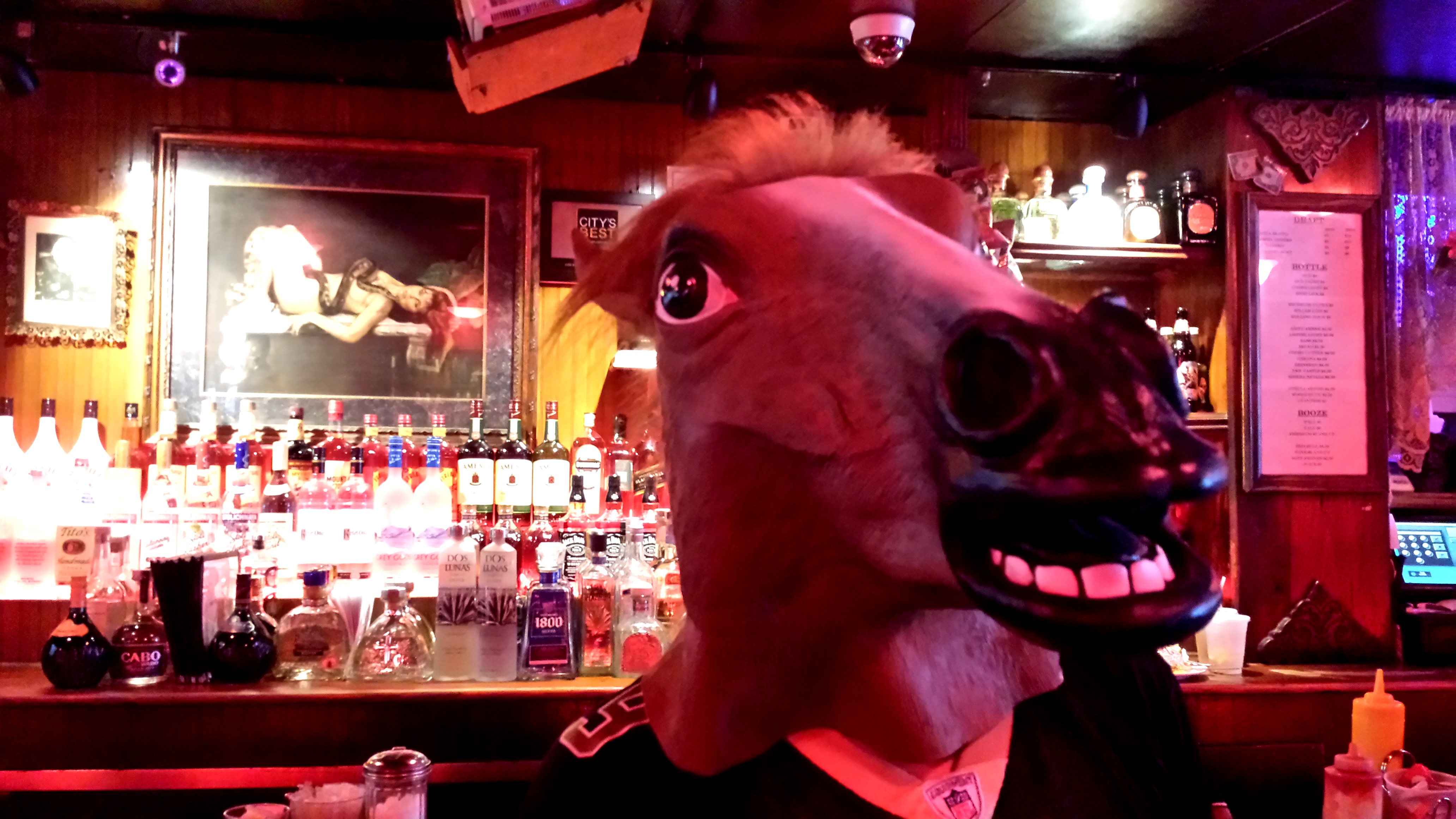
Sociologist D’Lane Compton hopes you had a happy Halloween! Follow her on Twitter!

20140921_142917

Lisa Wade, PhD is an Associate Professor at Tulane University. She is the author of American Hookup, a book about college sexual culture; a textbook about gender; and a forthcoming introductory text: Terrible Magnificent Sociology. You can follow her on Twitter and Instagram.
Joel Best, the sociologist famous for debunking the myth that your children might receive Halloween candy impregnated with poison and razor blades, wishes you a “Happy Halloween” and nothing but the Best candy:

joel_candy_big

Lisa Wade, PhD is an Associate Professor at Tulane University. She is the author of American Hookup, a book about college sexual culture; a textbook about gender; and a forthcoming introductory text: Terrible Magnificent Sociology. You can follow her on Twitter and Instagram.
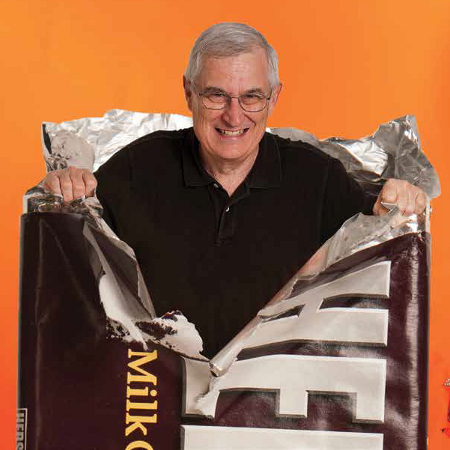
Yesterday I wrote about how the money spent on adult Halloween revelry now rivals, or even exceeds, that spent on kids. This may seem like a surprising shift, but it turns out it’s the focus on children that’s new. Halloween as the kid holiday we know it in the U.S. today was really invented in the 1950s.

This, and more fun facts about the history of Halloween, in this two-minute History Channel summary:

Lisa Wade, PhD is an Associate Professor at Tulane University. She is the author of American Hookup, a book about college sexual culture; a textbook about gender; and a forthcoming introductory text: Terrible Magnificent Sociology. You can follow her on Twitter and Instagram.
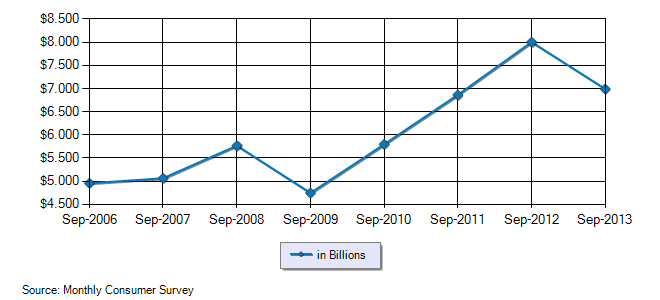
The National Retail Federation estimates that Americans will spend $7.4 billion dollars celebrating Halloween this year. In total, 74% of households will buy something for Halloween and, among those, the average will spend $125.

2

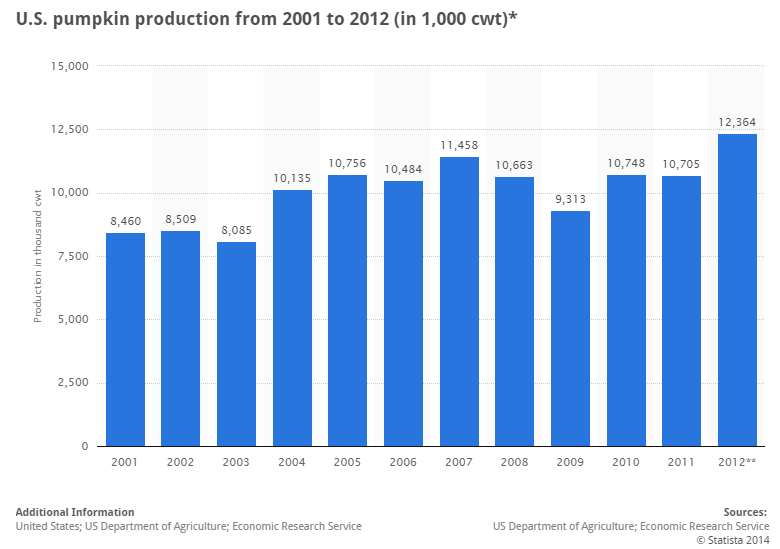
There’ll be a bumper crop of pumpkins, more than ever before, and worth about $149 million dollars.

4

A full two-thirds of the population will buy a costume, spending an average of $77.52 each. That’s a record in terms of both spending and the sheer number of costumes sold.

3

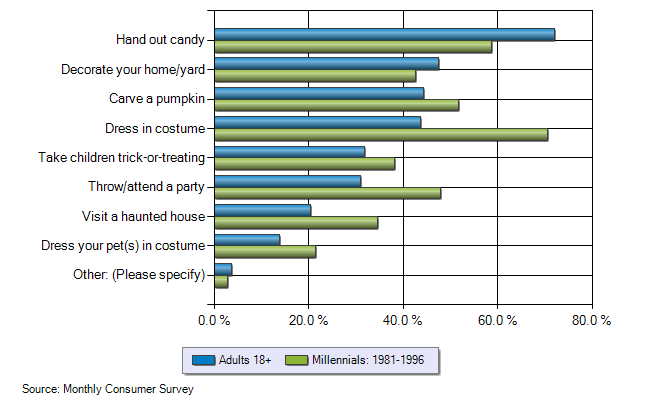
Interestingly, the holiday has evolved from primarily a children’s holiday to one celebrated by adults, especially millenials. Less than half of the money spent on costumes is going to costumes for children. Adults dress up (to the tune of $1.4 million) and their dress up their pets ($350 million). They also throw parties for other adults and patronize bars and clubs, which increasingly feature Halloween-themed events, food, and drinks.

Lisa Wade, PhD is an Associate Professor at Tulane University. She is the author of American Hookup, a book about college sexual culture; a textbook about gender; and a forthcoming introductory text: Terrible Magnificent Sociology. You can follow her on Twitter and Instagram.
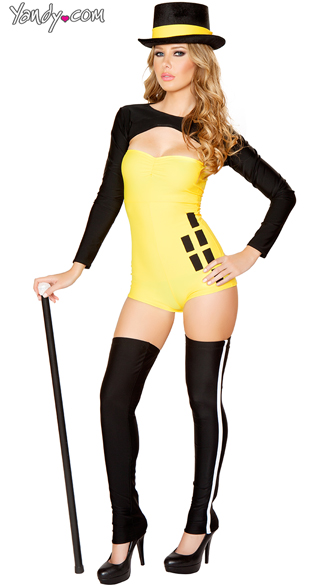
Here are my picks for the bizarrest sexy costumes this year. Enjoy!

Sexy George Washington (via):

2

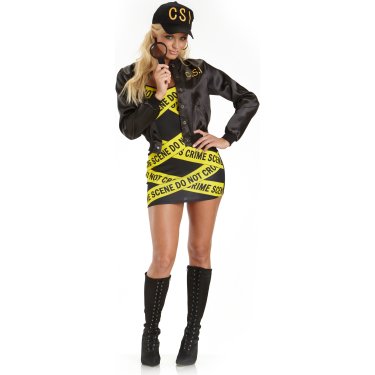
Sexy Crime Scene:13


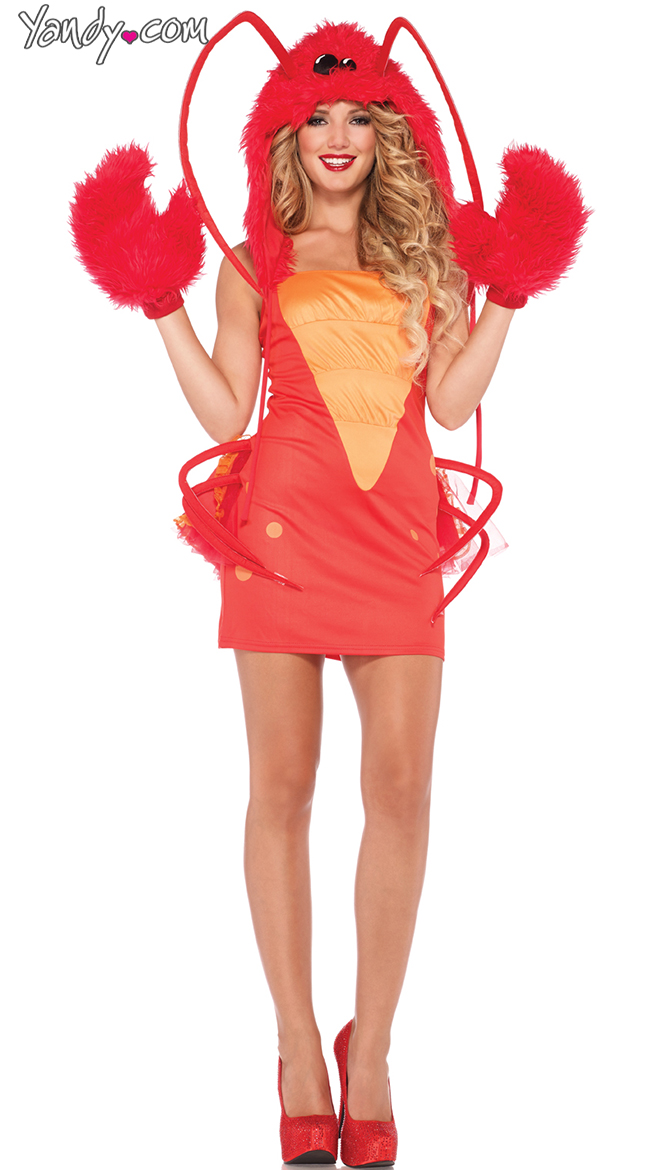
Sexy Lobster:

11

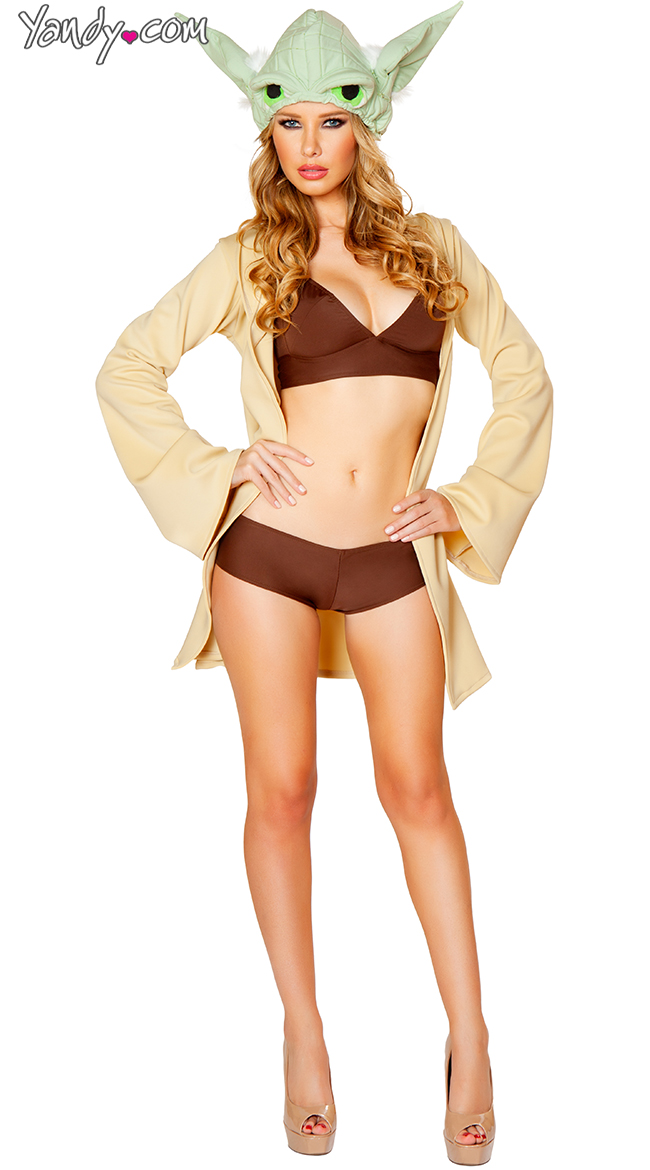
Sexy Yoda (via):

4

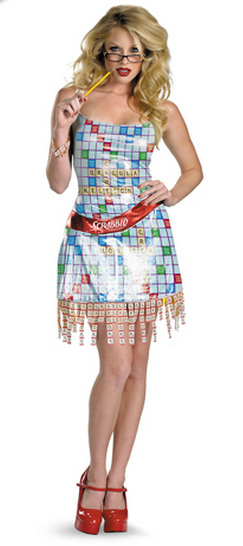
Sexy Scrabble (via):

2

Except — I know, I know — nothing’s sexier than Scrabble.


Sexy Mr. Peanut:

12

I take it back; that costume is fantastic.


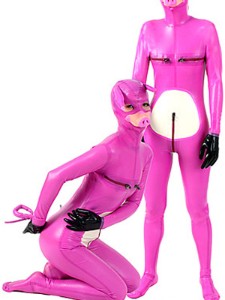
Sexy BDSM pig (via):

3

Okay, I admit. I have absolutely no idea what’s going on here.

Want more? See sexy what!? (2012) and sexy what!? (2010) or What do sexy Halloween costumes for men look like?

Lisa Wade, PhD is an Associate Professor at Tulane University. She is the author of American Hookup, a book about college sexual culture; a textbook about gender; and a forthcoming introductory text: Terrible Magnificent Sociology. You can follow her on Twitter and Instagram.