Archive: Aug 2013

Happy end of August!

SocImages News:

I had the opportunity to publish essays in Politico and Salon this month.  The first was a response to an accusation that progressives refuse to talk about race, genetics, and intelligence, so I did in “Yes, Let’s Talk about Race and IQ.”

The second sounds like it belongs better in Cosmopolitan, but I promise there’s good sociology in there: “5 Reasons Your ‘Sexual Peak’ Might be Fake.”

Backstage at SocImages, we put together a new Pinterest board aimed at collecting examples of women being presented as catty and jealous of one another (e.g., “Don’t hate me because I’m beautiful”).  We call it the Mean Girls Meme.  We’re excited to add additional examples!

Finally, Gwen and I offered some advice to new college students.

Top Posts:

Elsewhere on the Net:

This month SocImages or its authors were quoted in articles at:

Cross-Post Highlights…

Upcoming Lectures and Appearances:

My fall schedule is falling into place.  If any readers are in the Twin Cities or Salt Lake City, I’d love to schedule a meet up!

  • Citrus College (Sept. 10, 2013): “A Feminist Defense of Friendship”
  • Carleton College (Sept. 30, 2013): TBD
  • Macalester College (Oct. 2-3, 2013): TBD
  • Westminster College (Mar.  11, 2014): “‘The Night Overall Wasn’t Bad’: What College Students Really Think About Hooking Up”

Social Media ‘n’ Stuff:

Finally, this is your monthly reminder that SocImages is on TwitterFacebookGoogle+, and Pinterest.  Lisa is on Facebook and most of the team is on Twitter: @lisawade@gwensharpnv@familyunequal@carolineheldman, and @jaylivingston.

In Other News…

I enjoyed a drive to Key West thanks to my mom, Kay West.  It was pretty:

fl001_751

Lisa Wade, PhD is an Associate Professor at Tulane University. She is the author of American Hookup, a book about college sexual culture; a textbook about gender; and a forthcoming introductory text: Terrible Magnificent Sociology. You can follow her on Twitter and Instagram.
Screenshot_1This is the third post in a four part series.  Start at the beginning with: Whimsical Branding Obscures Apple’s Troubled Supply Chain.

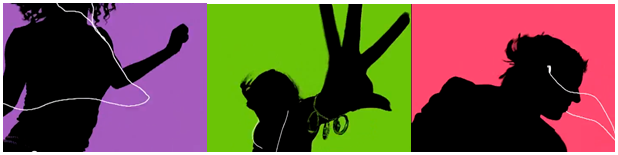
I cannot watch this 2003 Apple iPod commercial without shaking my hips, even in the midst of delivering a lecture or conference presentation. In fact, I struggle deeply to refrain from jumping around in an ecstatic dance of joy.

This commercial moves me. But, why? Yes, it has rocking music and popping colors. But, I suspect, more importantly, it has hip young things gyrating to the music, lost in the euphoria provided by an iPod and earbuds, with seemingly no cares in the world. For four years Apple aired a string of these, which became known as the “Silhouette” commercials, each featuring a different soundtrack and style of dance. In my previous posts, I’ve focused on two important elements of Apple’s brand promise: whimsicality and  sentimentality. In this post I spotlight another key finding from our research: the association of Apple products with coolness, hipness, youth, and a carefree attitude.

This trend was introduced into the brand by the iPod commercial above, and it continues to be an important part of Apple’s brand promise today. Similar qualities are present in this ad from early 2012, titled “Road Trip,” which showcases the utility of the voice-activated assistant, Siri, on the iPhone 4S:

And, early this summer, Apple released a commercial that emphasizes the musical enjoyment that an iPhone can provide. The ad, which seems a re-imagining of the “Silhouette” campaign, depicts these young, fit, and beautiful iPhone owners as indulgent in their passions, carefree, too cool to care about dancing in public, and thus hip, energetic, and fun to be around.

These ads and the many like them in Apple’s oeuvre suggest that the product makes users spontaneous, proud to embrace their unique individuality, and happy to “let their freak flag fly,” so to speak. In this case, the brand promises uninhibited enjoyment. With their bouncing, lithe bodies and shiny, happy faces, these Apple users are the epitome of cool in today’s American culture.

Like the promise of playfulness, and sentimental connection to others, this aspect of Apple’s brand promise acts as a powerful fetish, in the Marxist sense, that obscures the troubling labor conditions and environmental pollution in the company’s Chinese supply chain. Who has the presence of mind to think about global social, economic, and environmental problems when they are busy rocking out, road-tripping, and dancing in the shower?

Next: Apple’s Seductive Brand Promise of Cultural Capital & Social Mobility.

Nicki Lisa Cole, Ph.D. is a lecturer in sociology at Pomona College. She studies the connections between consumer culture, labor, and environmental issues in global supply chains. You can follwer her at 21 Century Nomad, visit her website, and learn more about her research into Apple here.

The Miley Cyrus performance at the VMAs has received quite the reaction.  She appears to have shocked celebs as well as the media, and has even been blasted by a group of angry parents. The Internet outrage over her performance has spawned multiple offshoots, including a backlash against people slut-shaming Miley, as well as criticisms about her appropriation and exploitation of black culture.

What has been largely been missing from the conversation (with a few notable exceptions) is the lack of outrage at the 36-year-old man who ground up on Miley’s 20-year-old ass while singing his summer megahit rape culture anthem.

Far fewer people are expressing concern about the catchy song in which a husband and father outlines with complete confidence his ability to infer when “good girls” “want it.”  The same guy who, when discussing the lyrics to his song, tells an interviewer:

Even very good girls have a little bad side. You just have to know how to pull it out of them.

The guy who boasts that he based his hit song on the time-honored masculine performance of hollering at bitches:

We started acting like we were two old men on a porch hollering at girls like, ‘Hey, where you going, girl? Come over here!’ That’s why, in the video, we’re doing all these old men dances. It was great.

That does sound pretty great, Robin.

Overall, the 2013 VMA debacle provides a painfully accurate example of the sexual double standard we have for women and men.  A woman who performs sexuality (for whatever reason) is to be castigated, while a man who engages in the exact same performance (and who has unabashedly doubled down on his support for the rape myth that no means yes) hardly raises an eyebrow.

Brett Wheeler is a part-time psychology professor who is pursuing a PhD in positive psychology. His research interests include human sexuality, humor, and how these variables contribute to well-being.

August 29th is the anniversary of the day that Hurricane Katrina devastated the Gulf Coast and side-swiped New Orleans, breaching the levees.  These posts are from our archives:

Was Hurricane Katrina a “Natural” Disaster?

Racism and Neglect

Disaster and Discourse

Devastation and Rebuilding

Lisa Wade, PhD is an Associate Professor at Tulane University. She is the author of American Hookup, a book about college sexual culture; a textbook about gender; and a forthcoming introductory text: Terrible Magnificent Sociology. You can follow her on Twitter and Instagram.

Screenshot_22Congratulations to everyone starting college this semester! College can be a bewildering new challenge, but a bit of advice can go a long way. Below are some of the secrets of college success from us: two sociologists — one from an open-access four-year school and one at a private liberal arts school — with over 15 years of college teaching combined.

Don’t put pressure on yourself to get straight As from the get-go.

College is a unique institution with its own rules and skills. You will not simply get an A because you are “smart.” Getting an A is a combination of effort, prior knowledge, and experience, so being smart at college means learning a specific skill set. If you are in your first year, you may find that you must work harder to get the same grade as a senior who has much more experience at excelling in college classrooms and, thus, knows better how to do it. Be patient with yourself. Acknowledge that there will be a learning curve and give yourself some time to climb it. In the meantime, look forward to when you will be the one who knows exactly what to do.

Sometimes studying hurts and that’s a good thing.

The mind is like a muscle: if you use it, it becomes stronger. You can improve your emotional intelligence, your reasoning skills, your mathematical ability, how quickly and effectively you absorb new information, and more. But it isn’t necessarily fun. Like working out your body, working out your mind can be uncomfortable, even painful. You’re not really challenging and improving your mind unless it hurts a little. So you may find that learning can sometimes feel kind of like suffering. This is normal. It doesn’t mean that you’re not smart, it means that you’re getting even smarter.

Memorize the phrase “pluralistic ignorance.”

Research shows that most college students misperceive their peers’ behaviors and attitudes. They think drug and alcohol use is higher than it is and that their peers are less concerned about it than they are. They also tend to think that everyone else might be having more fun and more sex. We suspect this is even worse now that everyone stalks each other on social networks. Keep in mind the possibility that studying a lot, having other responsibilities, and not partying all the time is normal. Because it is.

Collect as many mentors as you can.

Often new students will be assigned an advisor when they arrive on campus. That’s great. Definitely go talk to them. But don’t think that you only get to have one. Collect lots. Turn to older students, professors you like, counselors and coaches, and members of the staff or administration. Build a range of relationships with people who understand this college thing pretty well and lean on them all. You will be glad to have their advice and, later, they’ll all be lining up to write you letters of recommendation for jobs and graduate programs.

On tests, change your answers if you second-guess yourself.

Somewhere along the line, you’ve probably heard the standard advice for taking multiple-choice or true/false tests: stick with your first answer. Instructors often reinforce this adage before each exam, and students encounter it everywhere from SAT prep books to the study skills lecture in their Intro to College course. Just one problem: decades of research show it isn’t true. There’s overwhelming evidence that when students change their answers, they do better on the test. In one study of 1,561 students, 51% of the changes were from wrong answers to right ones; only 25% were from right to wrong ones (the others were from one wrong answer to another wrong one).

So why are we still so convinced we should stick with our first answer? Because we feel more regret when a bad outcome is due to an action we took than when it’s due to our inaction, and that regret makes us more likely to remember it. You shouldn’t change answers just for the sake of it, of course, but if you’re taking an exam and begin to doubt an answer, don’t be afraid to change it. You’ll be wrong sometimes, but mounds of data strongly suggest you’ll be right quite a bit more often—even though it might not feel that way.

Think hard about whether online classes are the best choice for you.

Online classes — and even entirely online degrees — are increasingly common at most campuses. They offer flexibility that can help you fit classes in around work, family life, or conflicting class schedules. But before you sign up, think honestly about your strengths and weaknesses. Ask yourself:

  • Can you keep yourself on schedule without in-person classes where instructors or other students might remind you of upcoming due dates?
  • Do you learn well independently?
  • Do you have reliable access to a decent computer and fast internet connection?
  • Do you struggle with the topic, making it likely that you might need at least some one-on-one help?

It’s not that face-to-face classes are always or inherently better than online courses. But the flexibility that online courses offer may make them particularly tempting, even when they’re unlikely to be your best choice for success. Online classes aren’t always the smartest way to go, even if they’re convenient.

When picking a major, get the facts.

Research shows that many students choose a major somewhat randomly.  In the process of fulfilling their required range of classes, they encounter a particularly inspiring or effective instructor in an intro-level course and the rest is history.

Inspiration can help narrow down your choices, but most students have to be at least a little bit practical, too. Here are some questions to ask:

  • Does the major have a rigid set of pre-reqs you have to take in order, and if so, when do you need to start taking them?  Are you “on track?”  If not, can you afford to stay in school longer to pursue a major you’re really passionate about?
  • Are lengthy unpaid internships usually required after graduation? If they are, can you or your parents afford to support you while you work for free to build up a resume?
  • Will you need to go to grad school to have many job options in the field and, if you will, are there good graduate programs in your area or will you need to move? Can you do so if needed?
  • What’s your starting salary likely to be, and if you’re taking out student loans, how much of your likely income would go to paying them each month?

Don’t get us wrong — being passionate about a topic or discovering you have a particular knack for a field should be important factors as you pick a major! But it’s a good idea to turn to older students, professors, and advisers with these questions so that you know what you’re getting into. Whatever you decide, you’ll likely be more satisfied long-term if you go into it with a clear understanding of the implications of your decision.

Finally, take the time to make true friends.

Not Facebook friends, but real, solid, good, we-can-count-on-each-other besties. We know, we know.  College is supposedly about freedom and parties and drinking and hooking up! There’s plenty of time for that. Also make friends a big priority. There’s a very strong correlation between happiness and being surrounded by friends you can really talk to. In fact, both psychological and physical well-being are more strongly related to friendship than they are to romance. So, hook up and form relationships if you want, but don’t prioritize sex and romance over friendship. The latter is equally important to a happy, fulfilling life.

Cross-posted at Pacific Standard.

Lisa Wade is a professor of sociology at Occidental College and the author of American Hookup: The New Culture of Sex on Campus. You can follow her on Twitter and Facebook.  Gwen Sharp is the Associate Dean of LAS at Nevada State College. You can follow her on Twitter.

In graduate school at the University of Wisconsin-Madison, I proctored law school exams to earn extra money.  At the end of one exam, while I was collecting the final papers, I overheard two students discussing their answers on an essay question about sentencing.  One said to the other: “I gave the rich guy a lesser sentence because I figured, since he had such a cushy life, it would take less punishment to get through to him.”  There’s your next crop of lawyers, I thought, doling out the prison sentences to the poor and letting the rich off with a slap on the wrist.

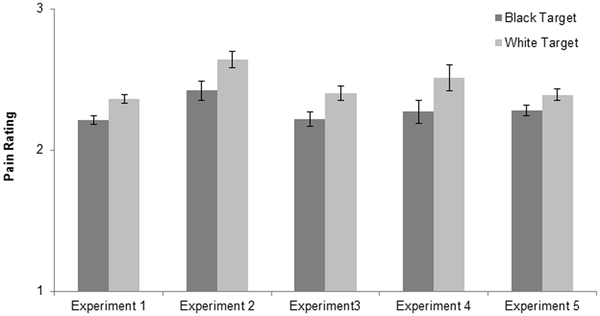
Well, it turns out that there is a well-documented psychological phenomenon behind what I’d overheard.  Morten B. sent along an essay by Jason Silverstein in which he reviews the literature on the racial empathy gap.  All things being equal, if you show a person an imagine of a dark- and a light-skinned person being harmed, they will most likely react more strongly to the latter.  Studies have found evidence of this using both self-report and measures of brain activity.  Notably, both Black and White people  respond similarly.

Here are the results of six studies using self-report; in the first four, the relationship between race and how much pain subjects attributed to the target was statistically significant:

1

What’s going on?

Silverstein explains that this isn’t necessarily about racial animosity or even identification with one’s own group (remember that both Black and White people show this response). Instead, it appears to be related to the perception that Black people have already had to cope with a great deal of pain — from racism, poverty, poor health, etc — and, as a result, have a greater pain threshold.  In other words, they are less sensitive to pain because they’ve been hardened.

Efforts to parse out whether this effect is due to race specifically or perceptions of whether a person has lived a hard life suggest that it might be primarily the latter.  But, as Silverstein points out, we tend to homogenize the Black population and assume that all Black people face adversity.  So, whether the phenomenon is caused by race or status gets pretty muddy pretty fast.

In any case, this is perfectly in line with the soon-to-be-lawyer I overheard at Wisconsin.  He gave the “hardened criminal” a harsher sentence than the person convicted of a white-collar crime because he believed that a greater degree of suffering was required to make an impact.  That was just a hypothetical case, but Silverstein reviews research that shows that the racial empathy gap has real world consequences: undertreatment of pain (even in children) and, yes, harsher sentences for African Americans convicted of crimes.

Cross-posted at Racialicious and Pacific Standard.

Lisa Wade, PhD is an Associate Professor at Tulane University. She is the author of American Hookup, a book about college sexual culture; a textbook about gender; and a forthcoming introductory text: Terrible Magnificent Sociology. You can follow her on Twitter and Instagram.

In the late 1990s, I turned down my publisher’s offer to do a third edition of my criminology textbook.  It wasn’t just that editions one and two had failed to make me a man of wealth and fame.  But it was clear that crime had changed greatly.  Rates of murder and robbery had fallen by nearly 50%; property crimes like car theft and burglary were also much lower.  Anybody writing an honest and relevant book about crime would have a lot of explaining to do.  And that would be a lot of work.

I politely declined the publisher’s offer.  They didn’t seem too upset.

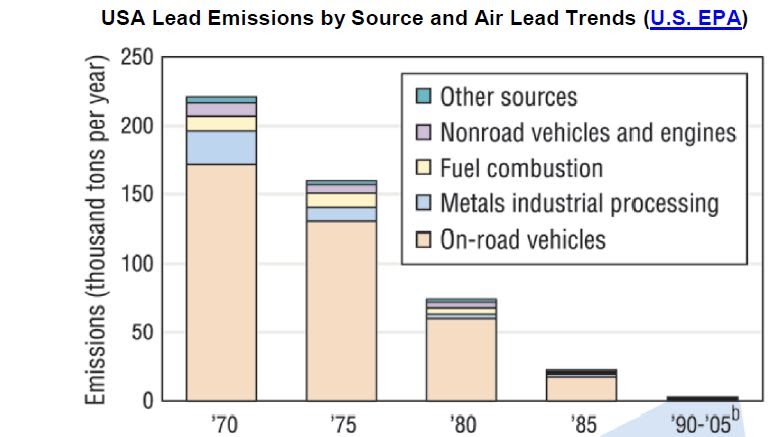
If I had undertaken the project, I probably would have relied heavily on the research articles in The Crime Drop in America, edited by Al Blumstein and Joel Wallman. They rounded up the usual suspects – the solid economy, new police strategies, the incarceration boom, the stabilization of drug markets, anti-gun policies.  But we all missed something important – lead.  Children exposed to high levels of lead in early childhood are more likely to have lower IQs, higher levels of aggression, and lower impulse-control.  All those factors point to crime when children reach their teens if not earlier.

Lead had long been suspected as a toxin, and even before World War I many countries acted to ban or reduce lead in paint and gasoline.  But the U.S., thanks to the anti-regulatory efforts of the industries and support from anti-regulation, pro-business politicians, did not undertake serious lead reduction until the 1970s.

Kevin Drum at Mother Jones has been writing about lead and crime. Because race differences on both variables are so great, it’s useful to look at Blacks and Whites separately.  In the late 1970s, 15% of Black children under age three had dangerously high rates of lead in their blood (30 mcg/dl or higher). Among Whites, that rate was only 2.5%.  By 1990, even with a lower criterion level of 25 mcg/dl, those rates had fallen to 1.4% and 0.4%, respectively.

1 2

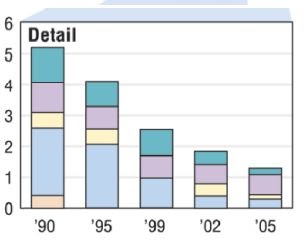
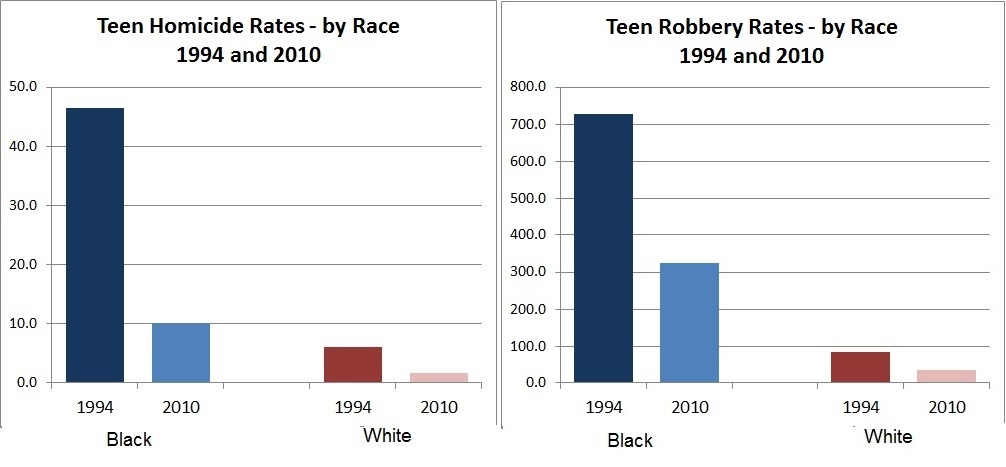
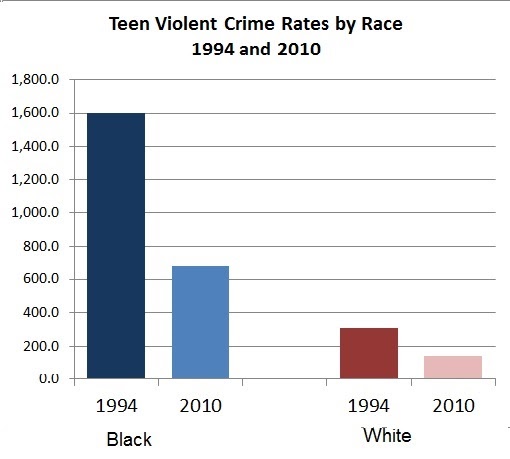
The huge reduction in lead was matched – years later when those children were old enough to commit crimes – with a reduction in crime. (note that the graphs show rates of arrest, which may somewhat exaggerate Black rates of offending):


3

4

Much of the research pointing to lead as an important cause of crime looks at geographical areas rather than individuals.  A study might compare cities, measuring changes in lead emissions and changes in violent crime 20 years later.  But studies that follow individuals have found the same thing.  Kids with higher blood levels of lead have higher rates of crime.  The lead-crime hypothesis is fairly recent, and the evidence is not conclusive.  But my best guess is that further research will confirm the idea that getting the lead out was, and will remain, an important crime-reduction policy.

Kevin Drum also emphasizes race differences.  And here the evidence is less solid:

[A]rrest rates for violent crime have fallen much faster among black juveniles than among white juveniles…  black juvenile crime rates fell further than white juvenile crime rates because they had been artificially elevated by lead exposure at a much higher rate.

But that  depends on how you intepret the data. As the graphs of arrests show, the percentage reductions are roughly similar across races.  Among Black youths, the arrest rates for all violent crime fell from 1600 per 100,000 to less than 700 – a 57% reduction.  For Whites the reduction was from 307 to 140 or 54%. But in absolute numbers, because Black rates of criminality were so much higher, the reduction seems all the more impressive. In that sense, those rates “fell further.”

Arrest rates for Blacks are still double those of Whites for property crimes, five times higher for homicide, and nine times higher for robbery.  Lead may be a factor in those differences.  Remember the lag time between childhood lead exposure and later crime. Twenty years ago, high blood levels of lead among children 1-5 years were three times as high for Blacks as for Whites.

Cross-posted at Montclair SocioBlog.

Jay Livingston is the chair of the Sociology Department at Montclair State University. You can follow him at Montclair SocioBlog or on Twitter.

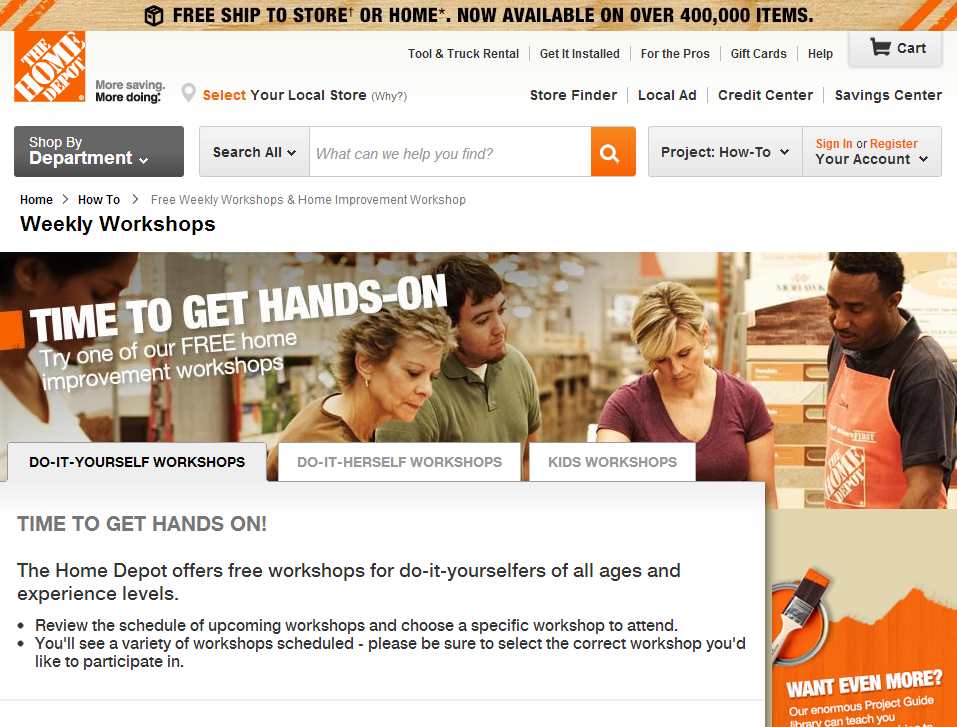
Thanks to @colleeneliza for tweeting us this great example of the centering of masculinity as “normal” and the othering of women.  Notice that Home Depot is offering “Do-It-Yourself” workshops and special workshops for women and kids (screenshot taken 8/18/13):

Screenshot_1

This is just one more example of the way in which men are regarded as people and women as a special kind of person. Like kids, in this case, needing special treatment.  We’ve got lots of them.

Lisa Wade, PhD is an Associate Professor at Tulane University. She is the author of American Hookup, a book about college sexual culture; a textbook about gender; and a forthcoming introductory text: Terrible Magnificent Sociology. You can follow her on Twitter and Instagram.