Archive: Aug 2013

Here and there the media becomes interested in the sexualization of little girls and, when they do, I often get a call from a reporter or two.  I’ve yet to see any of them pick up on what I think is the really interesting story.  They want to talk about child models, little girls in beauty pageants, and the transitional tween years for Disney star prodigies, but I always want to add into the mix the infantilization of adult women.

The sexualization of girls and the infantilization of adult women are two sides of the same coin.  They both tell us that we should find youth, inexperience, and naivete sexy in women, but not in men.  This reinforces a power and status difference between men and women, where vulnerability, weakness, and dependency and their opposites are gendered traits: desirable in one sex but not the other.

Now, thanks to @BonneZ, I know that this has something interesting to do with Mickey Mouse.

The original Mouse, Stephen Jay Gould has observed, was a kind of nasty character.  But, as he has evolved into the “cute and inoffensive host to a magic kingdom,” he has appeared increasingly childlike. This six figures below indicate Mickey’s evolution over time:

1

Childlike features, Gould argues, inspire a need to nurture: “When we see a living creature with babyish features,” he writes, “we feel an automatic surge of disarming tenderness.”   Allison Guy observes that we see a similar trend in recent toy makeovers — larger eyes, bigger heads, fatter stumpier limbs — but we see this primarily in toys aimed at infants and girls, not boys:


1 2 3

Guy interprets this trend as the “result of a cultural imperative for women to embody both the cute and the sexual.”  So, women don “cute” clothes with colorful patterns associated with children and wear “flippy skirts” and “baby doll” t-shirts. They wear eyeliner to give the illusion of the large eyes of childhood, foundation to hide the marks of aging on the face, and pink on their cheeks to mimic the blush of youth.  They are taught these imperatives from an early age.

What does it mean that feminine beauty is conflated with youthfulness, but masculine beauty is not — that we want women to be both cute and sexual?  It means that we feel comfortable with women who seem helpless and require taking care of, perhaps we even encourage or demand these traits from women.  Perhaps these childlike characteristics are most comforting in women who are, in fact, the least needy; I submit that we are more accepting of powerful women when they perform girlish beauty.  When they don’t, they are often perceived as threatening or unlikable.

So, yes, the sexualization of girls is interesting — and no doubt it’s no good for girls and likely contributes to older men’s sexual interest in young women — but it’s not just about sexualizing kids early.  It’s about infantilizing adult women, too, as a way to remind women of their prescribed social position relative to men.

Cross-posted at Jezebel and Pacific Standard.

Lisa Wade, PhD is an Associate Professor at Tulane University. She is the author of American Hookup, a book about college sexual culture; a textbook about gender; and a forthcoming introductory text: Terrible Magnificent Sociology. You can follow her on Twitter and Instagram.
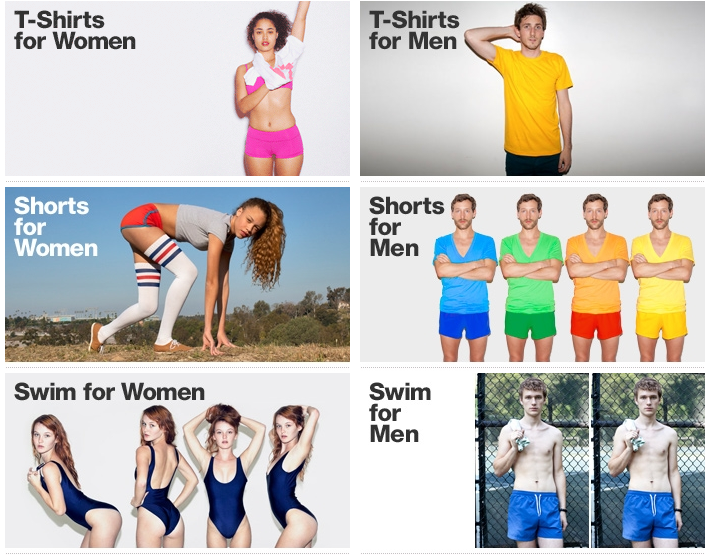
Caoileann A. sent in a great example of the way that women, but not men, are sexualized in our society.  In this case it’s a series of American Apparel ads.  I know, low hanging fruit. This example is extra great, though.

While normally it’s up to the critic to counterpose the portrayal of men and women in our society, in this case American Apparel does it for us. Here are the categories of attire for men and women exactly the way they appear on the website (i.e., side-by-side) as of Aug. 6th 5:46pm PST:

Screenshot_1Screenshot_2

The categories are exactly the same, but the way men and women are posed is strikingly different.  Only “Sweatshirts for Women” shows any commensurability.

This is — all too much — how we look at men and women in our society today. Caitlin Welsh said it nicely:

Women are presented too often not as consumers of the product, but part of the product – a sexy body sexily getting ready to surf, or a sexy body sexily wearing American Apparel. We’re used to seeing women look sexy and undressed in ads, while men in ads tend to just wear the clothes properly while also looking handsome in the face area.

Lisa Wade, PhD is an Associate Professor at Tulane University. She is the author of American Hookup, a book about college sexual culture; a textbook about gender; and a forthcoming introductory text: Terrible Magnificent Sociology. You can follow her on Twitter and Instagram.

There’s a gem of an observation in Arlie Hochschild’s classic book, The Managed Heart.  She observes that, at the same time that airlines try to ensure that planes take off with every last seat occupied, advertising for air travel typically does not depict fully booked flights.  Frequent passengers covet the flight with an empty seat to their left or right, so marketers make sure that ads and commercials suggest that they might get lucky.

Here’s how American Airlines depicts the experience of flying (from a Google Image search of “cabin” on aa.com):

1 2 3 4

What a great example of not-quite-truth in advertising.

Lisa Wade, PhD is an Associate Professor at Tulane University. She is the author of American Hookup, a book about college sexual culture; a textbook about gender; and a forthcoming introductory text: Terrible Magnificent Sociology. You can follow her on Twitter and Instagram.

If you take a close look at the stick figures in your life, you’ll notice that the “generic” stick figure is actually a great example of the way many of our societies center the male (as in, it’s generic insofar as the male is the generic human and women are, well, women).  That’s why the bathroom symbol for “men’s” is the same one you see virtually everywhere representing “person.”  Unless, of course, children or cleaning are involved and then they weirdly sprout skirts.

Today our Facebook friend Tamar G. sent us one we couldn’t resist sharing.  It’s a playground sign from Goettigen, Germany featuring an adult and child. As is common, the adult has been carefully altered to be identifiable as female because the sign is in reference to caretaking kids.  Someone in Goettigen found this as annoying as we do, however, and scribbled upon the sign: “Daddy, I also want to wear a skirt.”  What a fabulous way to fight back against rigid gender rules.

1

Lisa Wade, PhD is an Associate Professor at Tulane University. She is the author of American Hookup, a book about college sexual culture; a textbook about gender; and a forthcoming introductory text: Terrible Magnificent Sociology. You can follow her on Twitter and Instagram.

Screenshot_1In this five minutes, Jay Smooth attacks the “politics of respectability” and attacks it hard. What exactly will happen, he asks, if Black men pull their pants up?  Affordable housing? Well-funded schools? Job opportunities? What is this politics really about?  Our shame, internalized racism, and sense of helplessness, he says.

Lisa Wade, PhD is an Associate Professor at Tulane University. She is the author of American Hookup, a book about college sexual culture; a textbook about gender; and a forthcoming introductory text: Terrible Magnificent Sociology. You can follow her on Twitter and Instagram.

Screenshot_1This 4:15 minute video features women recounting instances of sexual harassment and battery by strangers. It’s a wake up call for the kinds of treatment that women routinely receive just by virtue of daring to be in public spaces.

Made by Laura Bates for the The Everyday Sexism Project. Thanks to Mytch for the tip.

Lisa Wade, PhD is an Associate Professor at Tulane University. She is the author of American Hookup, a book about college sexual culture; a textbook about gender; and a forthcoming introductory text: Terrible Magnificent Sociology. You can follow her on Twitter and Instagram.

Any improvement in living and working conditions in the United States is going to require far more than tinkering at the margins.  The fact is that U.S. economic dynamics have undergone a major transformation.

Figure 1, taken from an article by Gerald Friedman, shows that profits and investment are no longer positively related.  Since the early 2000s, profits have soared as a percent of GDP and net private investment has plummeted.  Even during the 1990s, when high-technology was celebrated as the engine of never-ending growth, net investment as a share of GDP remained below 1970s and 1980s highs.

Figure 1: Net Private Investment and Profits, 1970-2011

Our leading companies, the ones that shape government policy, are now able to make healthy profits without spending on plant and equipment much beyond replacement.  Their profits are now largely secured by globalizing manufacturing production, financialization, intensification of work, wage suppression, and government tax-breaks and subsidies.  Of course, that means that their quest for profits will continue to lead to policies likely to undermine progress in reversing negative trends in majority living and working conditions.

A case in point is their aggressive push, supported by the Obama administration, for new free trade agreements: the Trans-Pacific Partnership Free Trade Agreement and the Trans-Atlantic Free Trade Agreement. President Obama took the lead in securing passage of the Korea-U.S. Free Trade Agreement, arguing that it would improve our trade balance with Korea and by extension U.S. jobs.  Well, the returns are in, and in line with the record of past agreements, the outcome is the exact opposite.

The Eyes on Trade blog offers the following summary:

April [2013] was another record-breaking month for U.S. trade with Korea under the U.S.-Korea Free Trade Agreement (FTA).  The monthly U.S. trade deficit with Korea soared to its highest point in history, topping $2.5 billion for the month of April alone.

According to a ratio used by the Obama administration, the unprecedented deficit surge implies 13,500 U.S. jobs lost to trade with Korea in just thirty days.  April’s trade deficit with Korea was 30% higher than in April 2012 — the first full month of FTA implementation — and 90% higher than in April 2011, before the FTA took effect.

The deficit increase owes largely to a dramatic drop in U.S. exports to Korea since enactment of the FTA.  U.S. exports to Korea in April once again fell below the levels seen in any given month in the year before the FTA took effect.  The sorry track record defies the promise (FTA = more exports) that the Obama administration used to pass the FTA.  Undeterred by the facts, today the administration is using the same worn-out promise to sell the Trans-Pacific Partnership.

April 2013

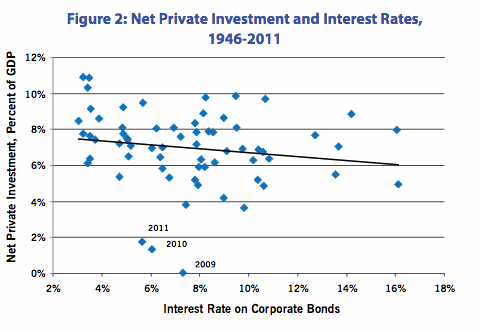
Unwilling to pursue policies that directly threaten corporate interests, the Obama administration has relied on monetary policy, or more specifically lower interest rates, to boost investment and employment.  As Figure 2 from Friedman’s article makes clear, while lower rates generally boost investment, data points for 2009, 2010, and 2011 strongly suggest that monetary policy has lost its effectiveness.

Figure 2: Net Private Investment and Interest Rates, 1946-2011

President Obama can talk all he wants about the need for more investment and better jobs, but unless he is pushed to pursue dramatically different policies, it is hard to see any real gains for working people over the next decades.

Martin Hart-Landsberg is a professor of economics at Lewis and Clark College. You can follow him at Reports from the Economic Front.

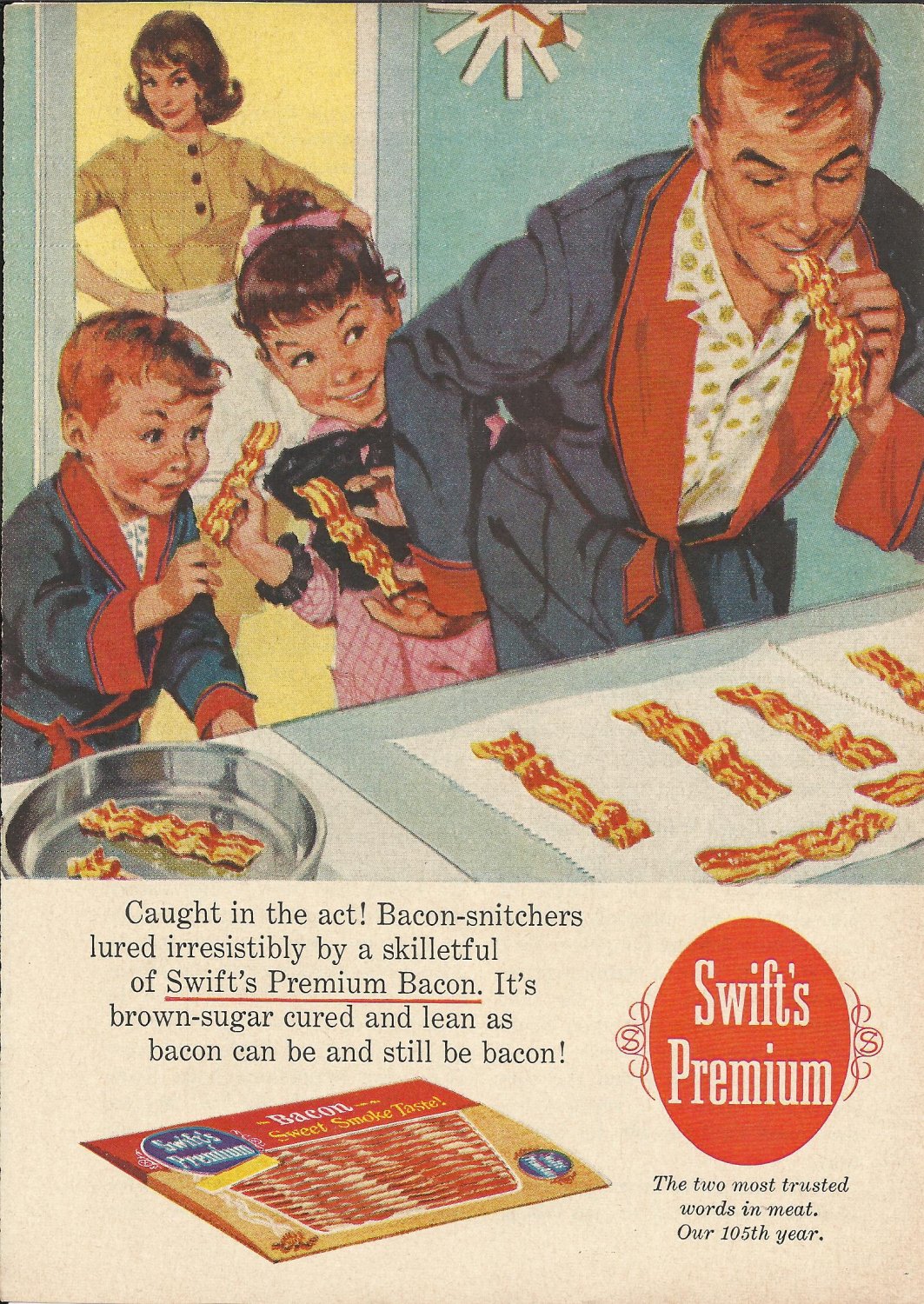
Look at this cute ad from the 1950s.  Mom is so satisfied as she watches her three children husband and two kids discover the Swift’s Premium bacon she just cooked up.  We should wax nostalgic because that kind of feminine domesticity and helpless husbandry just isn’t expected in marriage any more.  Right?

1

Wrong!  Enjoy this dizzying ad from Maple Leaf in which a woman finally gets her three children husband and two kids to be decent human beings by feeding them, you guessed it, bacon:

Thanks to Tom Megginson, The Ethical Adman, for both of these examples and the title of this post.

Lisa Wade, PhD is an Associate Professor at Tulane University. She is the author of American Hookup, a book about college sexual culture; a textbook about gender; and a forthcoming introductory text: Terrible Magnificent Sociology. You can follow her on Twitter and Instagram.