Archive: 2008

Thus far in this series I have offered five explanations of why people of color are included in advertising: (1) to associate the product with a racial stereotype, (2) give a product “color” or “flavor,” (3) invoke ideas of “hipness” or “modernity,” (4) trigger the idea of human variation itself, or (5) suggest that the company cares about racial equality.

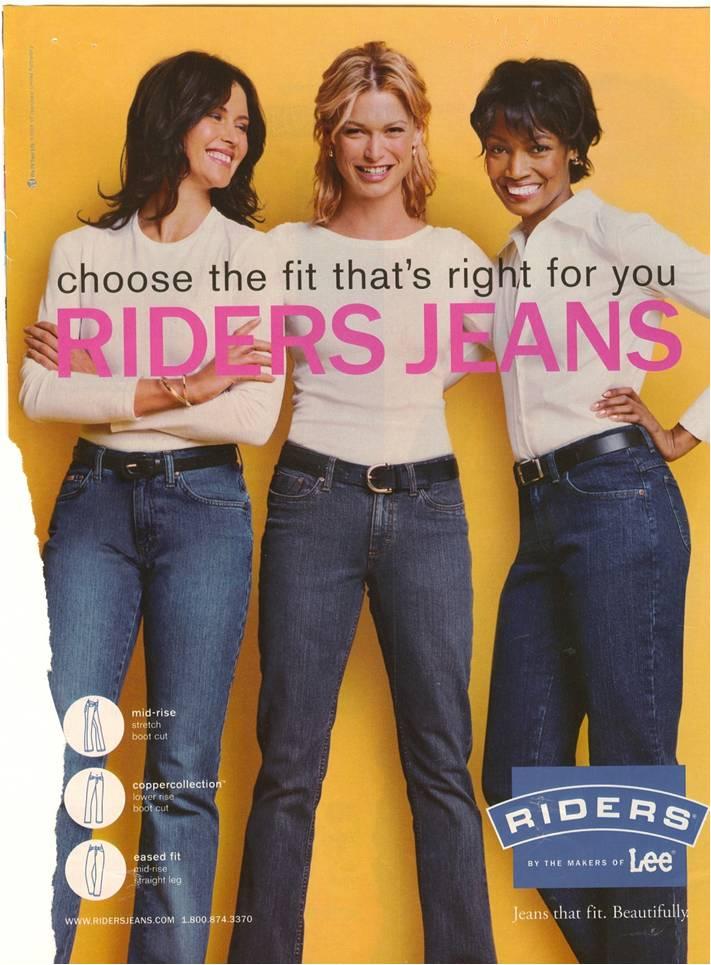
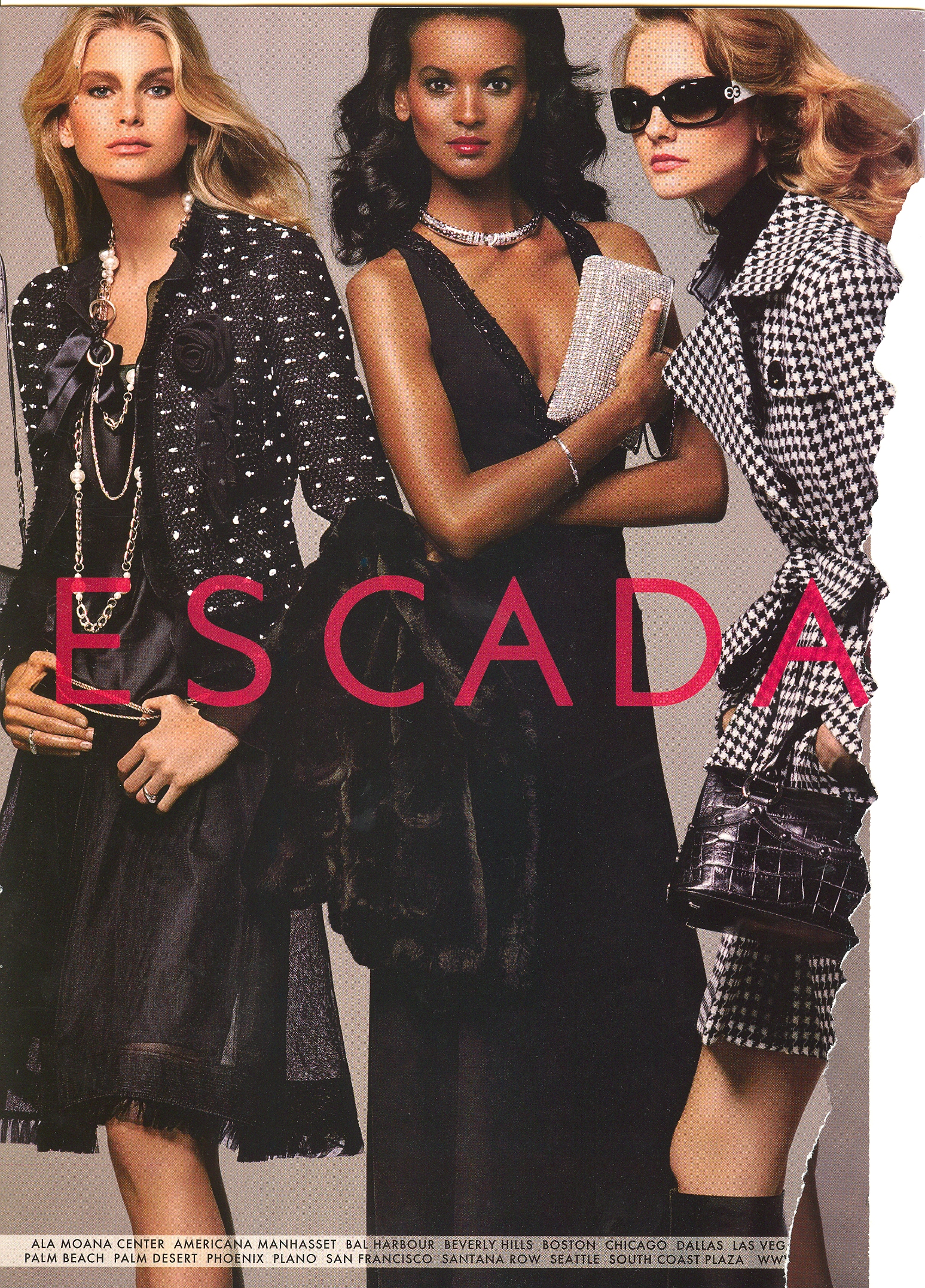
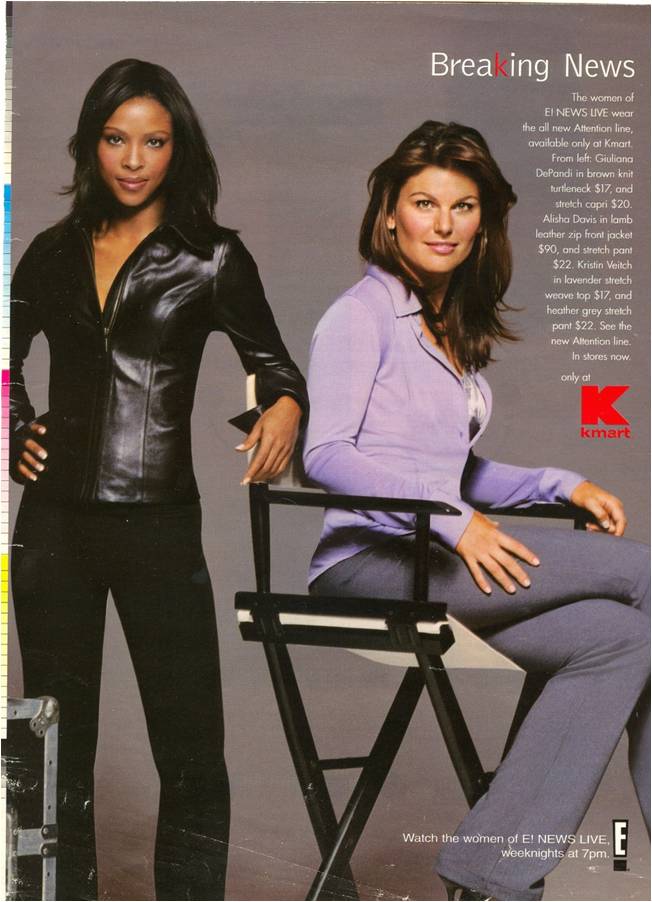
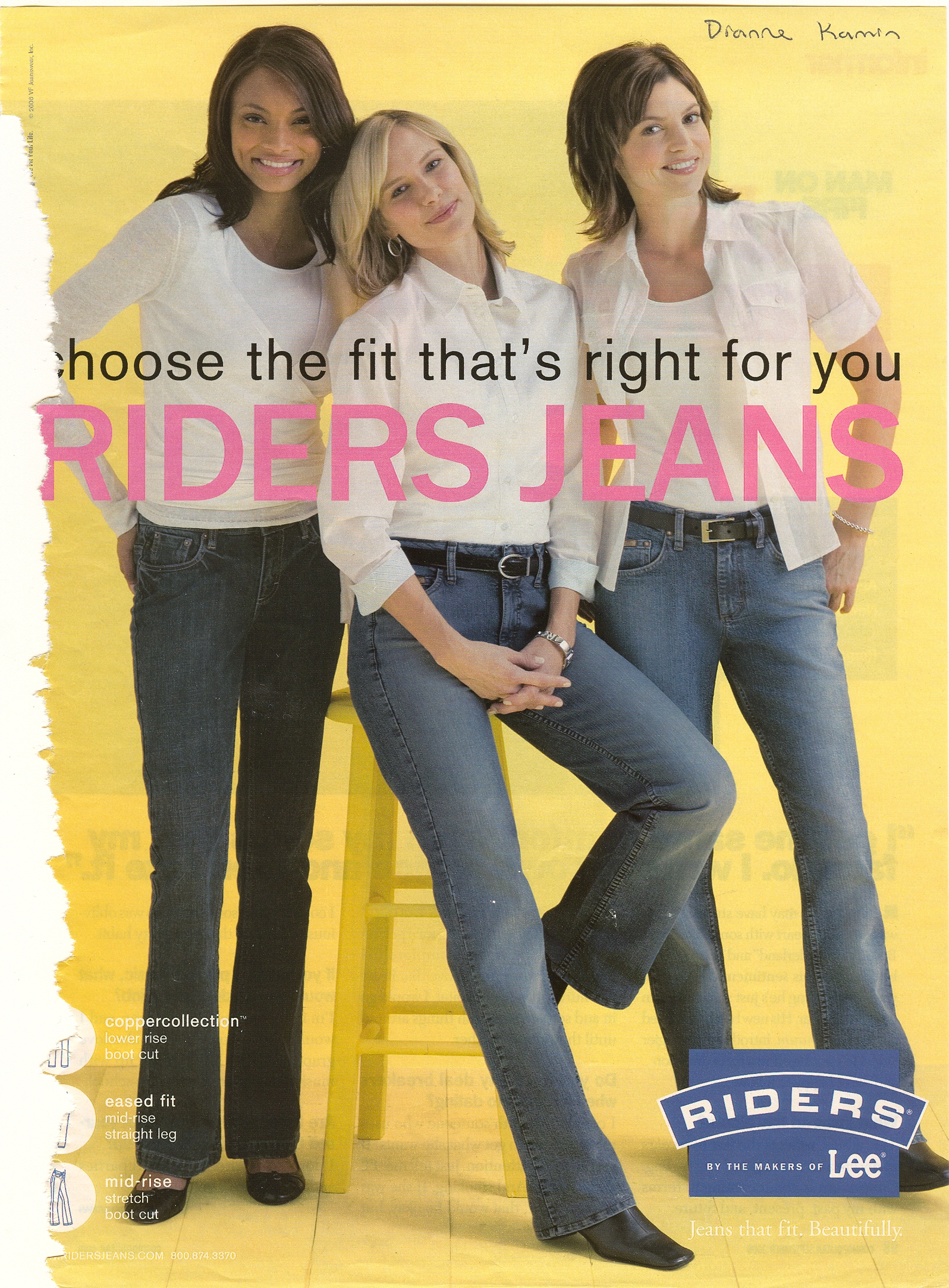
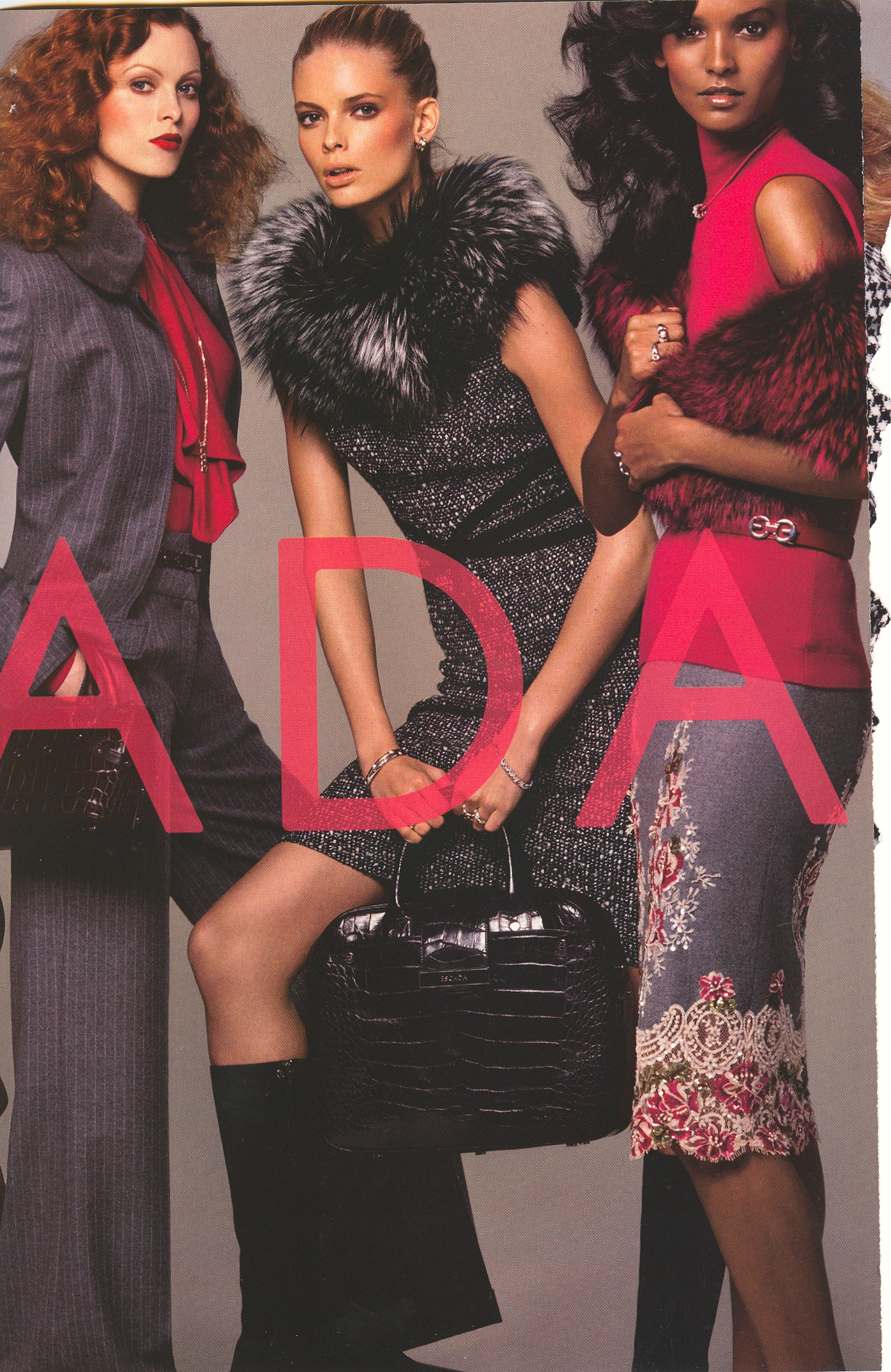
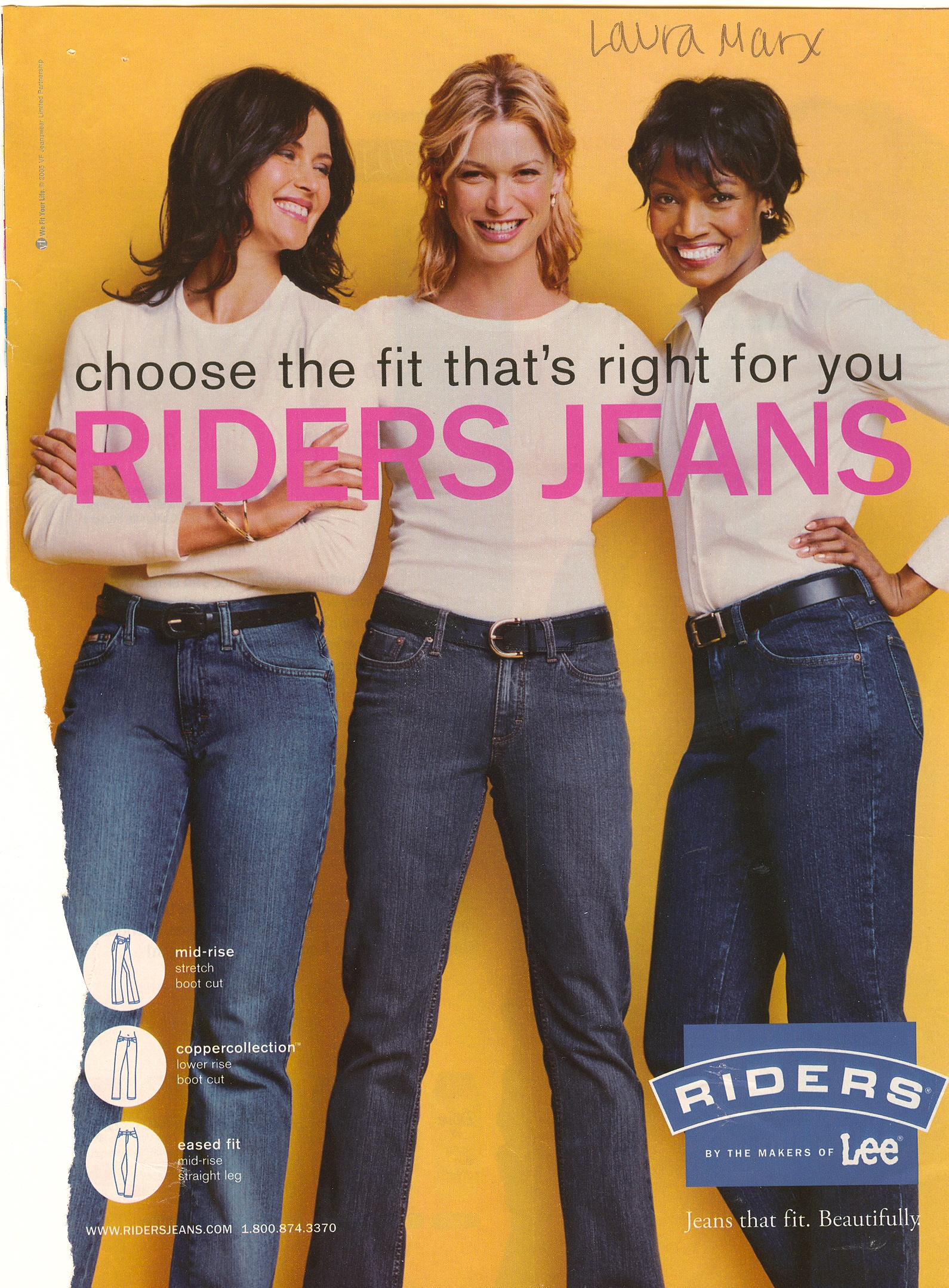
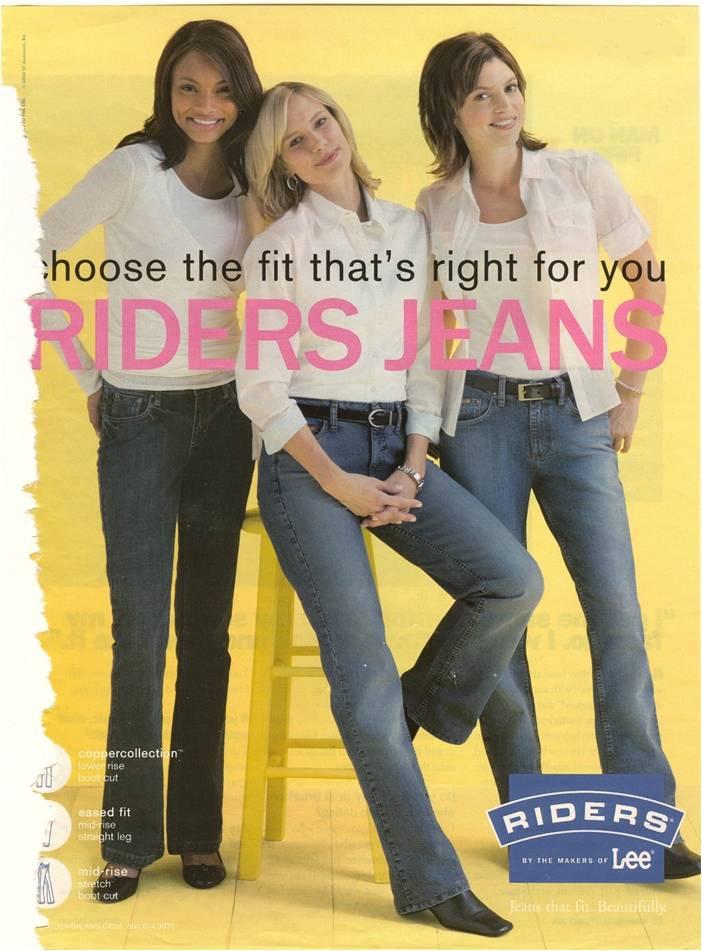
With this post, I begin illustrating how they are included. Here I show that, in many cases, people of color are included, but they are made to blend in with whiteness such that they vary only by the color of their skin.  This is related to two things (at least).

First, beauty is racialized such that what makes some darker-skinned women distinctive from some lighter-skinned women ( e.g., hair texture, nose shape, skin color) also makes them less beautiful according to mainstream cultural standards in the U.S.  When women of color are included in advertising, then, they often look very similar to the White women they are with, varying only by a few degrees (eg., straightened hair [sometimes lightened], slightly darker skin, slightly wider nose).  Check out these terrific examples.

Second, when women of color don’t conform to white standards of beauty, it is often interpreted as resistance to assimilation to whiteness and, thus, threatening.  For example, when The New Yorker wanted to parody the rumor that the Obamas were Muslim terrorists, they put an afro on Michelle.  So an advertiser will often choose women of color who look more-or-less white because to do otherwise is to send a message of non-conformity or resistance.  This is often done strategically, but if they don’t want to send this message, they will include a woman of color who look assimilated.

Here are some examples:
Next up: Chaperoning.

Also in this series:
(1) Including people of color so as to associate the product with the racial stereotype.
(2) Including people of color to invoke (literally) the idea of “color” or “flavor.”
(3) To suggest ideas like “hipness,” “modernity,” and “progress.”
(4) To trigger the idea of human diversity.
(5) To suggest that the company cares about diversity.
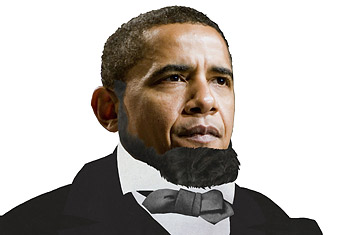
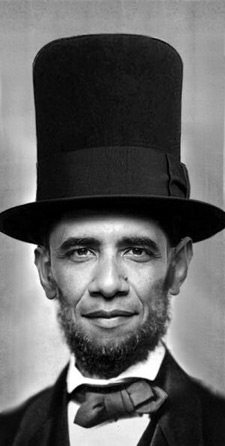
Here are a couple of pictures that morph the faces of President-Elect Obama and Abraham Lincoln. By now, I doubt people haven’t either seen or imagined such images; the comparison is pretty popular in the media. Indeed, as Time columnist Joe Klein says in this article, Obama “has never been shy about comparing himself to Abraham Lincoln.” The more obvious reasons for such comparisons have to do with his platform of change, negotiation, and most notably, his appointment of “a team of rivals” to high cabinet positions (a notion that, given the very different contexts of their presidencies, holds less water than it should– for instance, Obama is not hurtling toward a civil war).

But another less examined consequence of this type of morphing is that images like these can also unintentionally work as a strategy to produce an essentialized vision of President Obama as untouchable. Perhaps in the end, the more that we (the public) buy into this morphing of the two presidents into one, the less apt we — Democrats, or even Republicans for that matter– are to either criticize or engage in serious policy discussions and debates. In a sense, such comparisons could potentially allow President-Elect Obama to squelch, change, or appropriate differing viewpoints within his own party, and visual representation through the various morphings of Obama-Lincoln we find on the internet and in print– and the instant association we make between the two– could very well keep the American public from seriously disagreeing with his “core vision,” whether from the left or the right.

Sandra F. sent in a link to “Prop 8: The Musical,” a parody starring Jack Black, Margaret Cho, Andy Richter, John C. Reilly, Neil Patrick Harris, and other celebrities:

See more Jack Black videos at Funny or Die

The clip, though a parody, brings up a reason some groups that might not care about the reasons gays and lesbians want to get married, or about gay rights more broadly, nonetheless supported gay marriage: money. The New York Times discussed this issue here. Weddings are big business, and the more people who are eligible to be married, the more money is potentially available to wedding-related businesses. In 2004, the Congressional Budget Office estimated the impact legalizing same-sex marriage would have on the budget (end result: an estimated $1 billion a year for the 10-year estimation period). That’s just the federal budgetary effect; it doesn’t include private-sector benefits.

This anti-Prop 8 video makes an explicitly economic argument for gay marriage:

You might compare these videos to the commercials in this post; in those ads, advocates of gay marriage try to rhetorically frame the issue as being about love–that is, gay marriages are equated with straight marriages by focusing on the idea that what is important in a marriage is love, regardless of the sex of the spouses. Clearly you could use them to discuss gay marriage, but they might also be good for illustrating the idea of framing of social issues.

Thanks, Sandra!

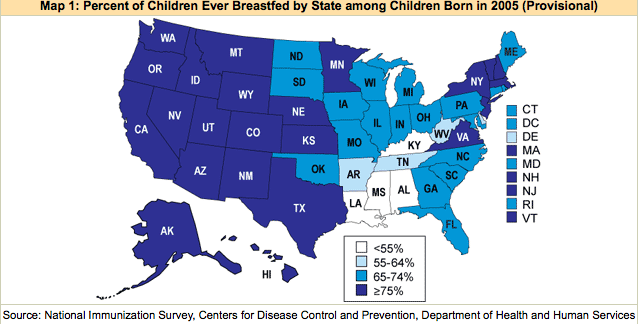
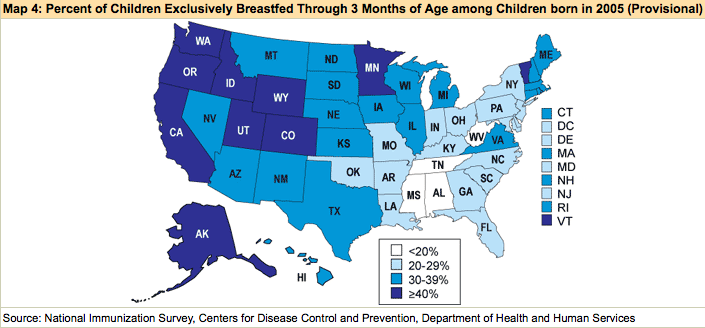
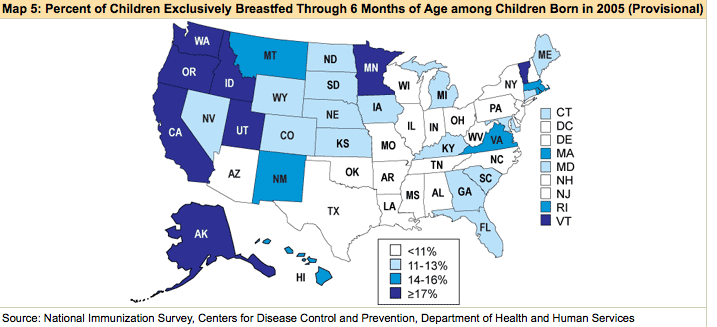
We’re talking about the medicalization of pregnancy and the natural childbirth and breastfeeding movements in my Women’s Studies class, so here are some data on rates of breastfeeding in the U.S., which you might use for a discussion of ideals of motherhood, medicalization, and the difficulties of integrating breastfeeding with full-time work. The regional patterns are also fascinating.

This map shows the percent of children born in 2005 ever breastfed at all (including those supplemented with formula):

This one shows the percent of children who were only breastfed (no formula supplementing) for the first three months:

And here we have the rates of exclusive breastfeeding up to 6 months. Notice how low the rates are, with many states having 10% or less of children breastfed exclusively for that long:

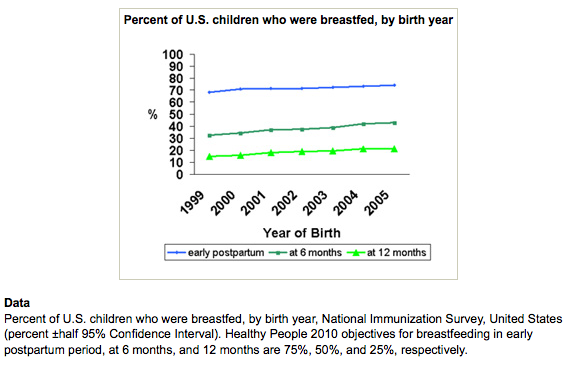
Here are overall rates:

And overall rates of kids ever breastfed, including with formula supplementing:

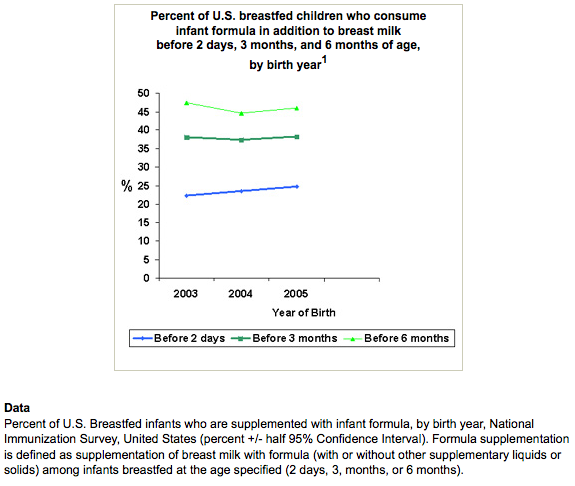
About 25% of babies are supplemented with formula within the first 48 hours:

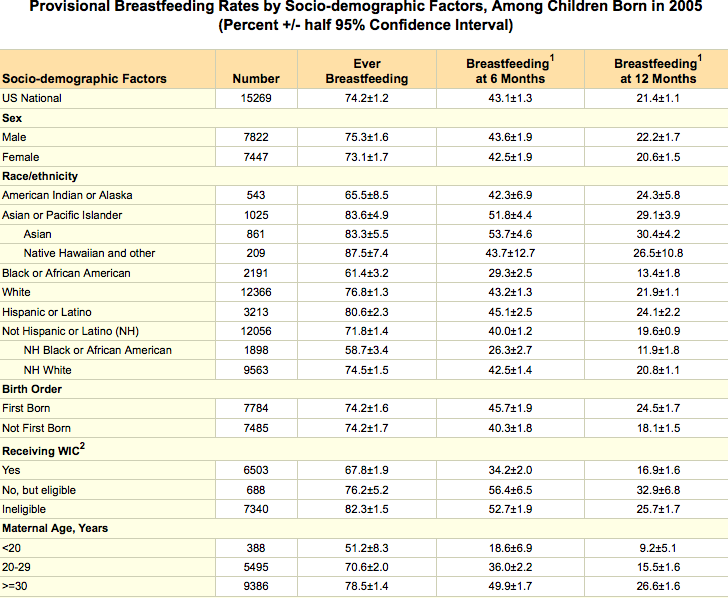
Here’s a whole lot of information on rates of breastfeeding:

In general, higher incomes are associated with higher rates of breastfeeding, which probably partially explains some of the other patterns (regional, race, etc.). My guess is many people will attribute this to cultural factors–the idea that highly-educated women with higher incomes have access to more information about breastfeeding, are more aware of how important it is, and have more access to support systems that encourage breastfeeding. I suspect part of it is also that some women–particularly those with higher incomes–are more able to take time off work to stay home for at least a short while, making breastfeeding easier. Of course, the paradox there is that the very families who can least afford expensive formula are most likely to use it.

All images found at the Centers for Disease Control and Prevention’s breastfeeding website.


Via Slate.

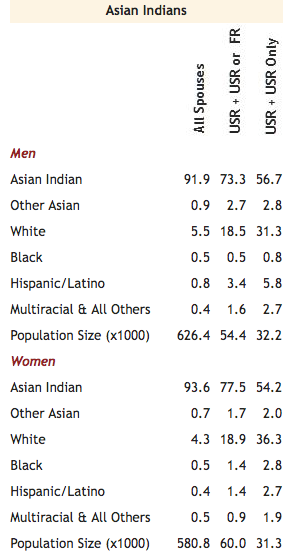
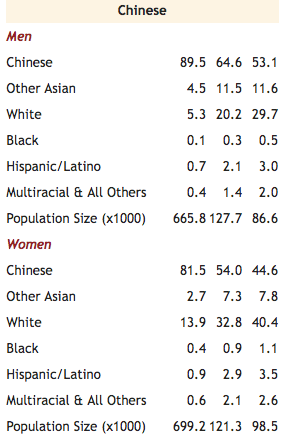
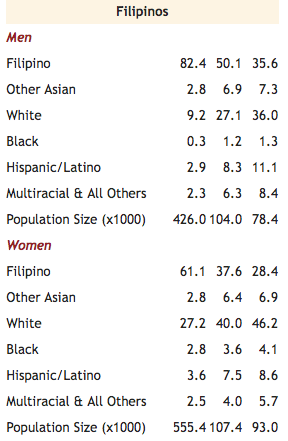
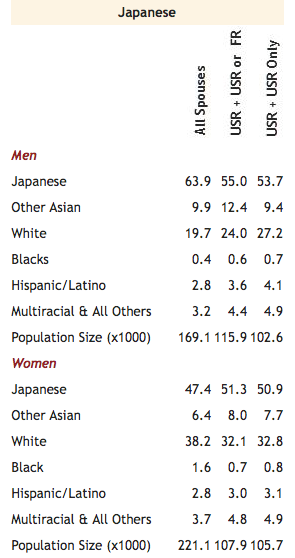
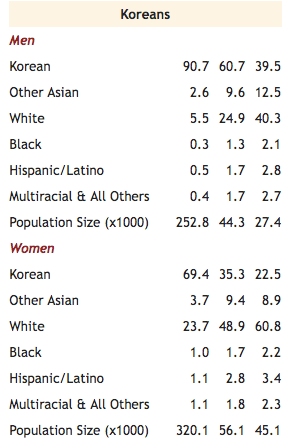
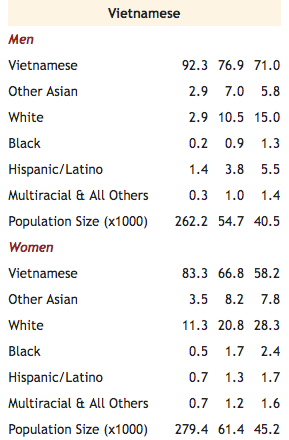
I just discovered the entirely excellent website Asian Nation, run by C.N. Le and full of great information about the Asian American community. Here are some tables showing what percent of various Asian American groups are married to spouses of the same or other groups, updated as of October 2007 using Census data (an explanation of the three columns follows):

Ok, now to explain the three columns of numbers. The first one presents data for all marriages that include at least one Asian American spouse–this will include large numbers of immigrants who were married before they moved to the U.S. The second column includes only those marriages where at least one spouse was raised in the U.S., defined as either born here or moved here by age 13. The third column includes only those marriages where both spouses were raised in the U.S. According to Le, this group represents less than 25% of all marriages including an Asian partner, but “…has the advantage of including only those who were raised and socialized within American society and its racial dynamics. It is this U.S.-raised population that best represents young Asian Americans, since they are the ones who have the most exposure to prevailing American cultural images and media.”

Not surprisingly, endogamous (in-group) marriage rates drop off significantly among U.S.-raised Asian Americans. There are other interesting gender patterns as well. Notice, for instance, that Chinese, Vietnamese, Korean, and Filipina women are quite a bit more likely to be married to a White partner (the most common out-group spouses) than are men, and for the remaining groups, women are slightly more likely to be married to a White spouse. You might discuss the social and historical factors that might cause that pattern, and compare it to the trend in marriages with a Black and a White spouse, in which the gender pattern is usually reversed–Black men are more likely to be married to Whites than are Black women. It might also be worth noting that Korean and Filipina women are significantly less likely to marry endogamously than the other Asian American ethnic groups.

In this video, Campbell Brown analyzesGov. Ed Rendell’s comments, overheard due to standing too close to an open mic, that Janet Napolitano is perfect for secretary of Homeland Security because she has no family (you can also see the video here if the CNN site doesn’t play correctly).

In fact, the wage gap between men and women is made up, almost entirely, by the comparison between men (fathers or not) and mothers. Women without children make significantly more money than mothers. Conversely, fathers make slightly more than men without children.

Women without children do pretty well at work in the U.S. Of course, about 90% of adult women are mothers.

Lisa Wade, PhD is an Associate Professor at Tulane University. She is the author of American Hookup, a book about college sexual culture; a textbook about gender; and a forthcoming introductory text: Terrible Magnificent Sociology. You can follow her on Twitter and Instagram.

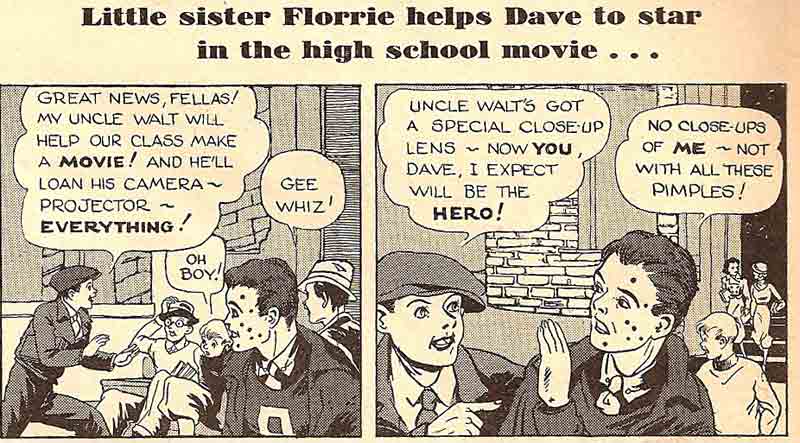
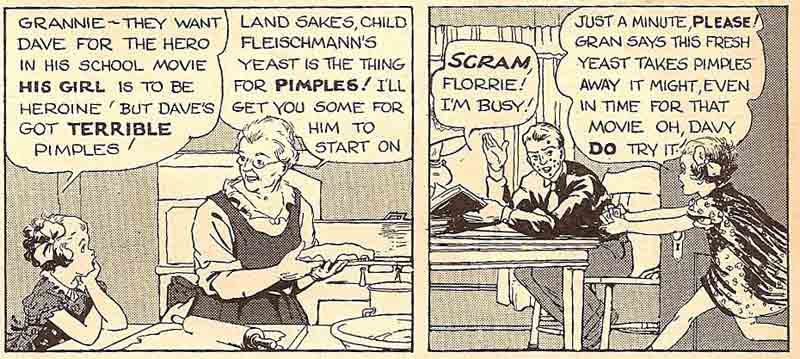
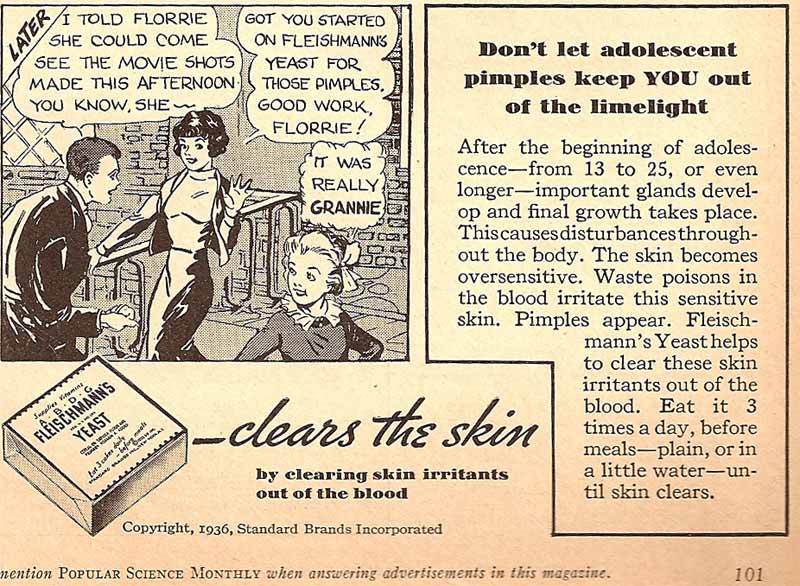
Here’s a vintage Fleishmann’s Yeast ad (found here), which presents yeast as the answer to the horrors of pimples–awful, hideous pimples!

I don’t know in what world high schools have movies, but whatever. Clearly, the message is “pimples = social death and eternal loneliness.” It’s not just that Davy can’t be in the movie due to his horrible affliction; if he can’t play the lead along with his girlfriend, he faces the possibility of losing her to a leading man with a clear complexion.

Given such messages about the importance of clear skin, it’s no wonder teens and their families were willing to shell out enormous sums of money on skin-care products. Apparently yeast didn’t catch on as a treatment, though.

For other examples of vintage ads playing on teens’ fear of facial blemishes, see here and here.