Archive: 2008

Jo B. sent us a link to Icebreaker, a New Zealand clothing company. One of their products is wool underwear. As she pointed out, there are some distinct differences in how the men’s and women’s underwear lines are depicted.

The men’s line is called beast. When you go to the site, there’s a little intro part. The following phrase shows up on the banner at the top:

As Jo says,

The overall idea seems to be that men have some kind of innate, primordial aggression (thought I’m not sure how this is supposed to relate to woollen underwear).

Indeed, socialization “cages” men’s true nature, but just barely–its hold is “frail and fragile” and, I presume, could burst forth if you aren’t really careful. I don’t quite follow how the city “brings the beast alive,” or how reconnecting with nature “balances” the beast; since the beast is supposedly men’s real nature, I think reconnecting them with nature would bring out the beast, but whatever. I’m clearly applying too stringent a level of logic. Also, for the record, if all it takes to reconnect with nature is a natural material (made from a domesticated source), then cotton, angora, and mohair would work just as well.


The women’s line is called Nature. When you go to its site there’s also an intro, but without any useful summary of what women are like to compare to the Beast.

Again from Jo:

The female models are slim, delicate, and tend to pose in a way that suggests passivity (static poses, arms held behind body…) and instability (balancing on her toes).  The images in the female range focus more on being attractive, while the men’s range is about being active and aggressive.

The marketing campaign also reinforces the difference in the way we talk about men and women and their association with nature. When we connect men to nature, it’s in an aggressive, predatory sense (the beast). When women are associated with nature, it’s often in a way that implies harmony, an appreciation for the natural world, perhaps some intuitive sense that women have (or, you know, their connection to the moon and stuff because of menstrual cycles). The background is part of this; the grey background of the men’s line doesn’t look nearly as peaceful as the serene white background for the female models.

Thanks, Jo!

FYI:  Jo sent an email to the company complaining and this was their response:

Hi Josephine,

Apologies for the delayed reply. I am writing on behalf of Jeremy Moon to thank you for taking the time to give us your views about Icebreaker’s marketing of its underwear lines for men (Beast) and women (Nature). We understand your concerns, and we really appreciate the level of thought you have put into sharing them with us.

Gender representations are a sensitive issue in marketing, and Icebreaker certainly had no intention of promoting negative or damaging images of men or women in our Winter 08 campaign.

In most of our collections, our marketing approaches to men and women are almost identical. We aim to make Icebreaker garments as stylish as possible, but our clothes are based on performance above all – regardless of the gender of the wearer.

In our Bodyfit, Icebreaker_GT and Superfine collections, for example, women are photographed in exactly the same way as men – pushing their physical boundaries in the outdoors. Our marketing for the garments in these core collections centre on photographs of athletic-looking women skiing, hiking and climbing mountains. None of the images are of women in a passive or decorative role: they’re of women who are confident, independent, adventurous and strong.

We chose a different approach for our underwear ranges. For obvious reasons, we couldn’t adopt our usual approach of showing women taking part in outdoor sports – clearly they wouldn’t play sport in their underwear alone. The other factor we took into consideration is that Nature and Beast, although both underwear collections, are very different ranges.

Men tend to buy underwear for its practical benefits. Our aim was to position Beast as a premium range that has the same performance factors (such as breathability, a critical benefit for underwear) as Icebreaker’s outdoor clothing and yet is sufficiently stylish to be worn at work. Our marketing approach refers not to aggression, but to energy – the same energy (or performance benefits) that works equally well in both outdoor and urban environments. You’ll notice our marketing refers to “creative energy” and also the “harmoniousness” of nature.

The Nature range is our most feminine range by far, and much of our marketing focuses on the way it looks – its styles and its nature-inspired designs. Nature is made from the lightest, most luxurious grade of 100% pure merino, as we understand customers’ concerns against wearing traditional wool (rather than merino) against their skin, so our marketing talks about concepts like “100% pure”. While the photography for the rest of our collections is based around the outdoors, Nature images are designed to show off the styling and softness of the garments.

Our campaigns are designed to be edgy, and we’re very sorry if in this instance you feel our approach conveyed the wrong messages. Please be assured this was not our intention. Thank you for writing, and be assured we will bear your concerns in mind when planning future campaigns. I hope this email helps lesson your disappointment with our brand,

Regards
Alice

Gwen Sharp is an associate professor of sociology at Nevada State College. You can follow her on Twitter at @gwensharpnv.
Michael Kimmel argues that, for contemporary Americans, science is a superstition.  Scientific explanations are comforting and often accepted without critical thought.  The word “natural” rolls off our tongue and frequently gets conflated with “good.”  We are obsessed with finding the biological origins of sexual orientation, gender difference, political proclivities, happiness… everything.  Once a biological basis is found, it is considered the whole explanation.  It is as if biology is more fundamental and more true than things like culture or society. 

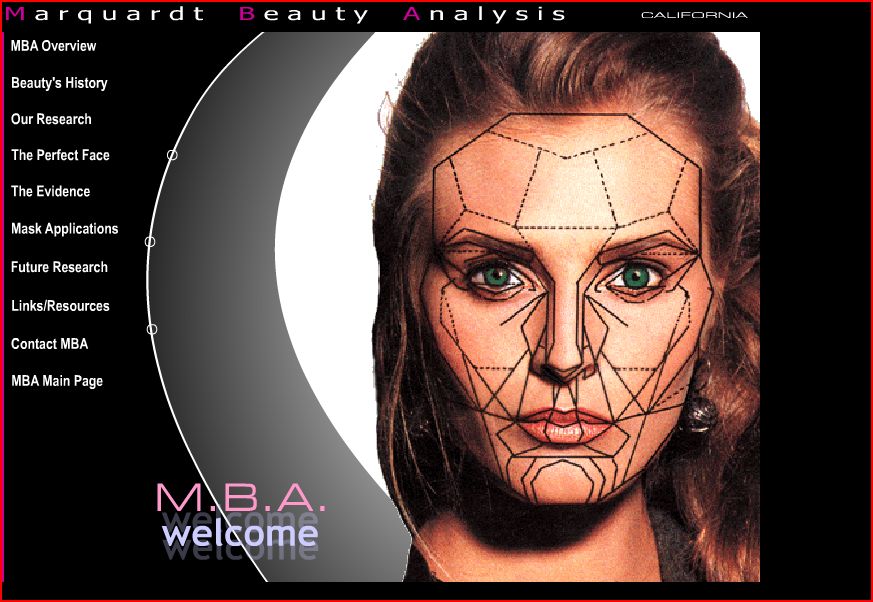
Our “faith” in science, then, is useful to marketers insofar as they can claim that their product is objectively tested, engineered, or otherwise scientifically sound.  This brings me to this Marquardt Beauty Analysis website, sent in by Kiran D.  The website explains the science behind beauty.  The main page includes a woman’s face overlaid with complex geometric shapes:


Here is part of the mission statement (emphasis mine):

MBA is dedicated to proactively researching human visual aesthetics, including its biological and mathematical bases, and to utilizing the results of that research to develop and provide information and technology with which to analyze and positively modify (i.e. improve) human visual attractiveness.

MBA further is dedicated to tailoring and formatting this technology to specific uses for direct applications in the fields where human attractivenss is a factor or parameter (i.e. those fields interested in human visual attractiveness) including medicine, dentistry, psychology, anthropology, biology, anthropometry, the arts, cosmetic makeup, and fashion, as well as for direct use by the individual consumer.

Notice how they use scientific buzzwords like “bases,” “formatting,” “applications,” and “parameter.”

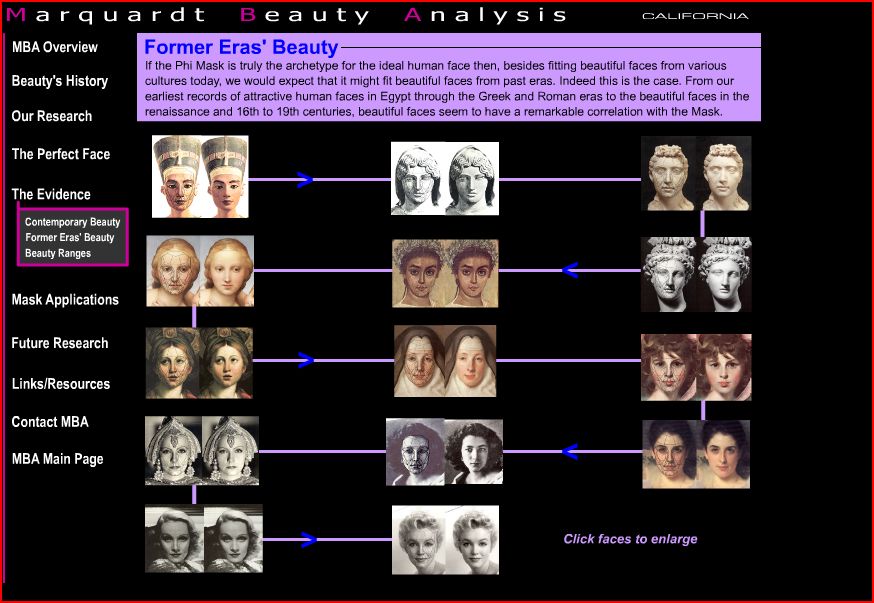
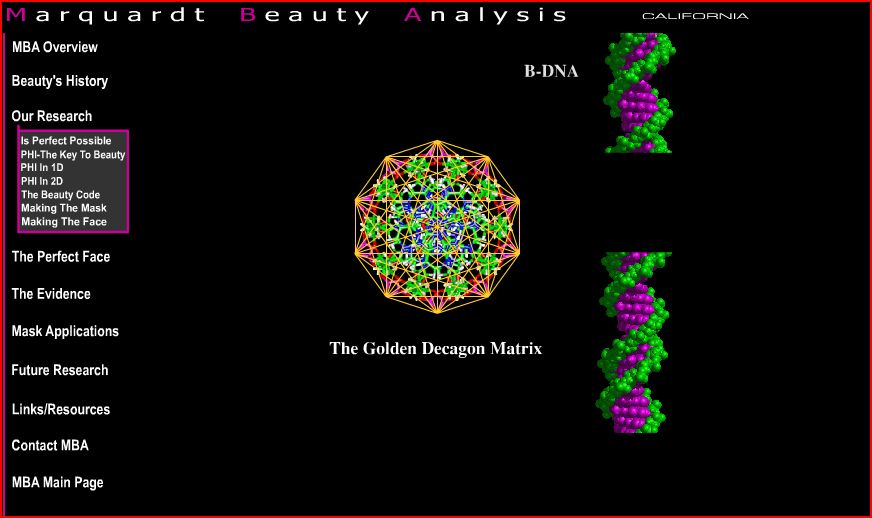
Here is a screenshot showing how they have tried to “scientize” beauty and make their endeavor look like legitimate science:


On the page below they claim that their formula works across history (elsewhere they also claim it works across race), so they argue that their science is objective and not culturally or historically contingent:

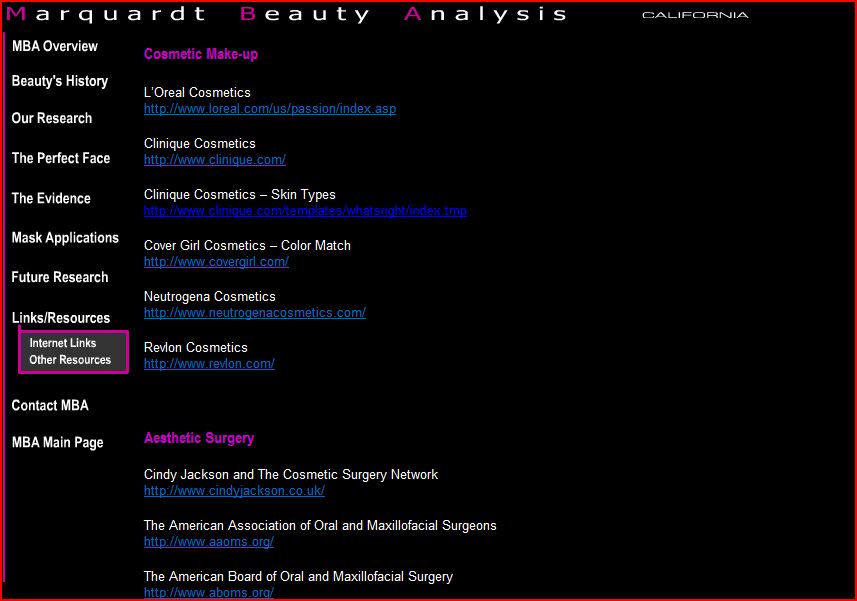
The website, of course, is not really about research on beauty; it’s a mechanism with which to sell make-up, cosmetic surgery, and other products.  Here is a screenshot of the first part of the links page:

The page includes links to L’Oreal, Clinique, Cover Girl, Neutrogena, and Revlon; five “aesthetic surgery” links; three “aesthetic dentistry” links; and a handful of academic-y sounding links.

Thanks Kiran!

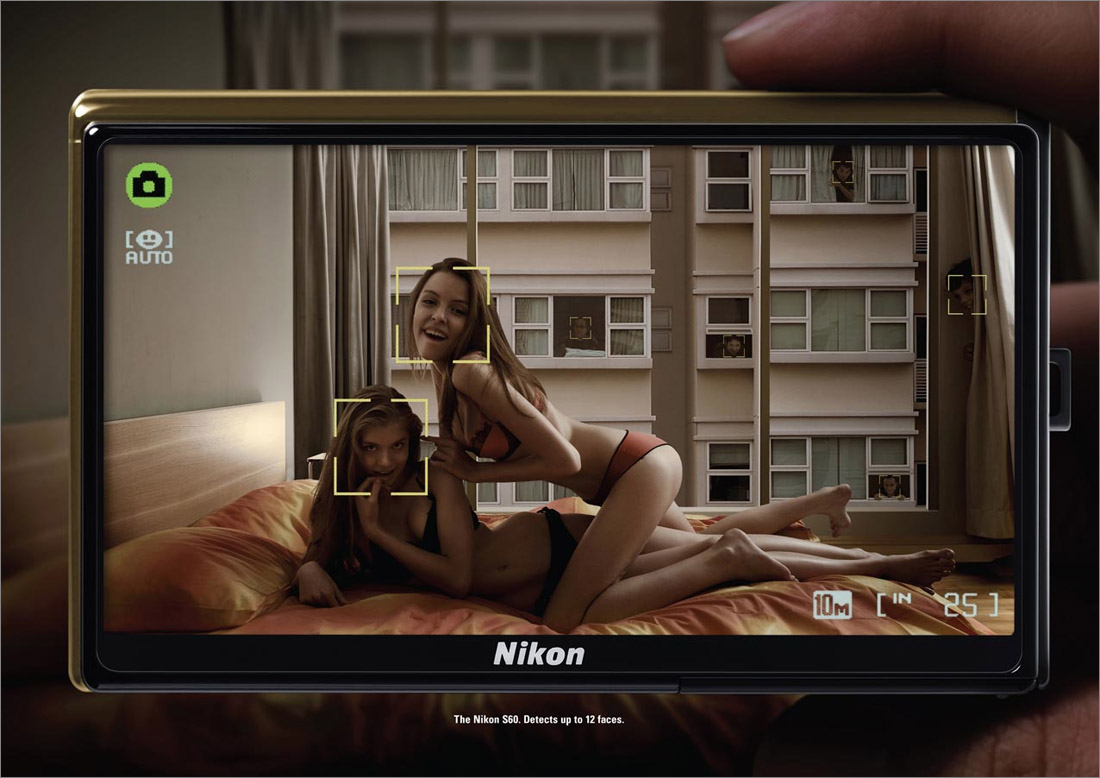
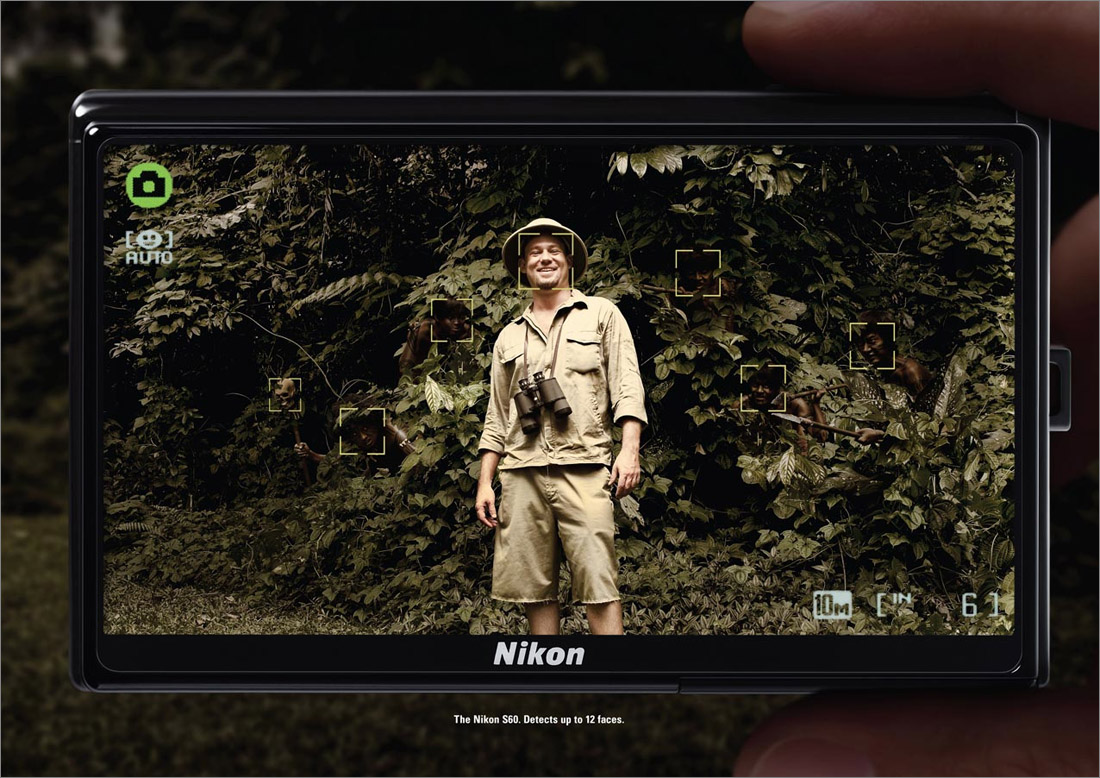
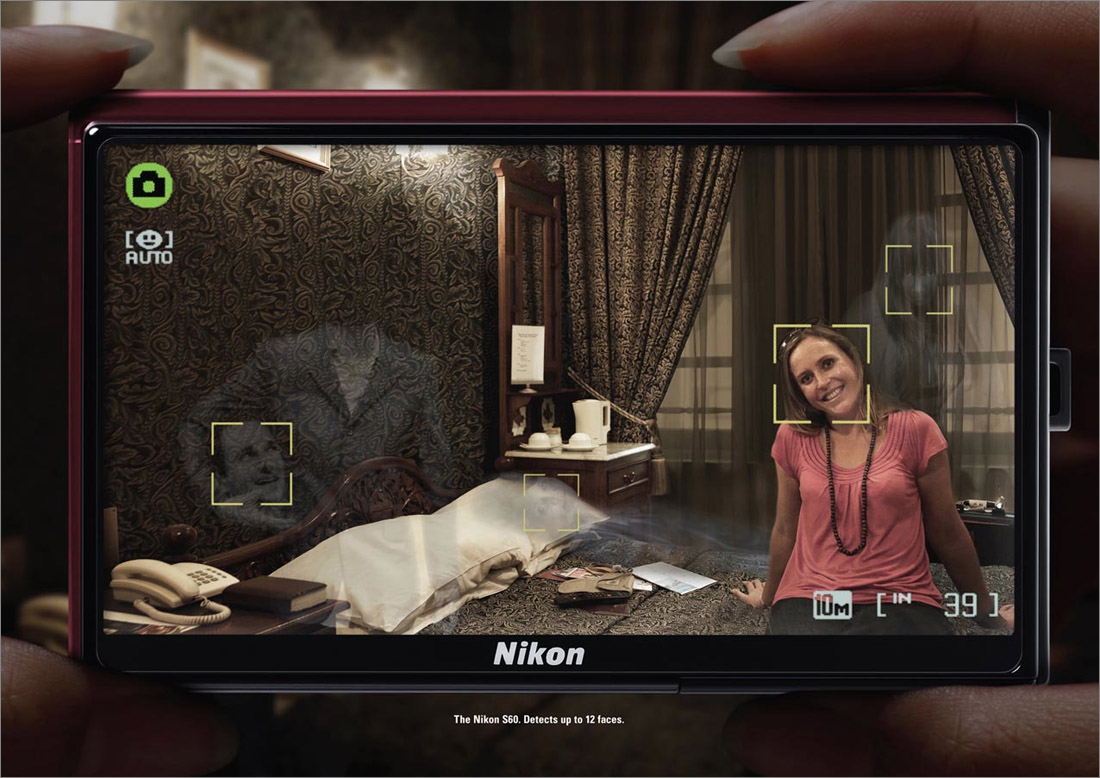
From AdGoodness come these three print ads for a new digital camera, the Nikon S60, which apparently has a feature that allows it to auto-detect and focus on faces. The three examples include a bunch of people rubber-necking at two young “porn lesbians” [the top one of which has a horribly Photoshopped head!], a bunch of people of color sneaking up on a white safari dude, and a bunch of ghosts looking at a woman in a hotel room.  Of all the possible examples that could be used to highlight this face-finding feature, who thought it was a good idea to use some hackneyed stereotypes about sexual orientation and race?

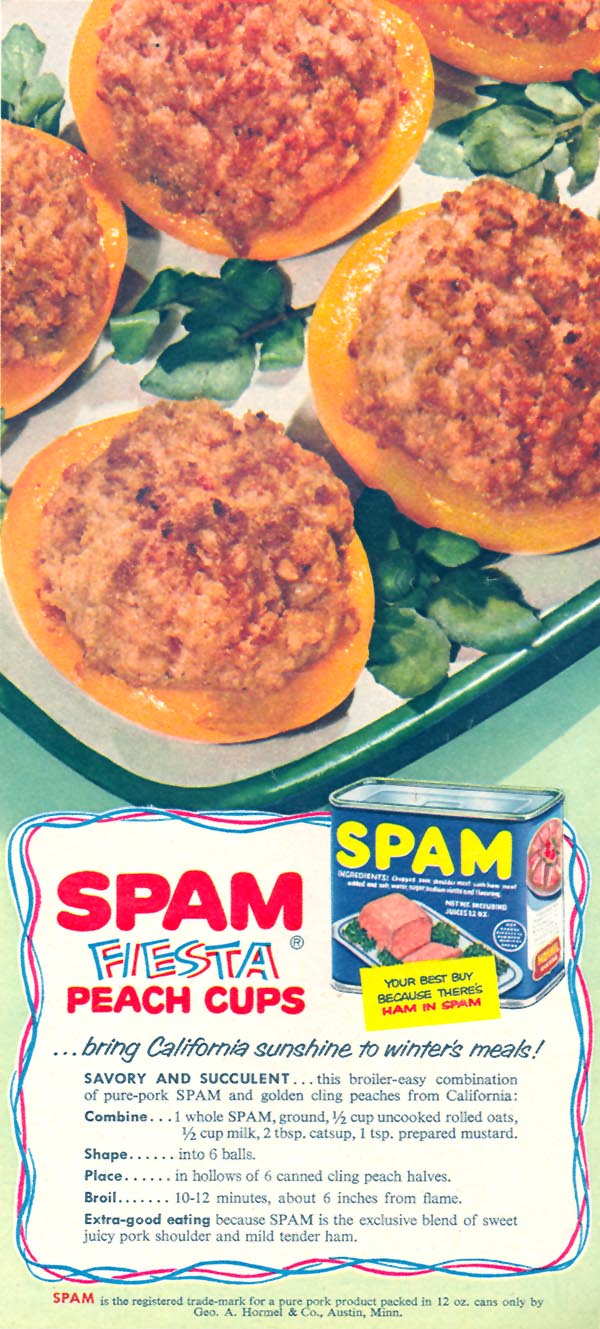
Spam Fiesta Peach Cups, Family Circle, 1956

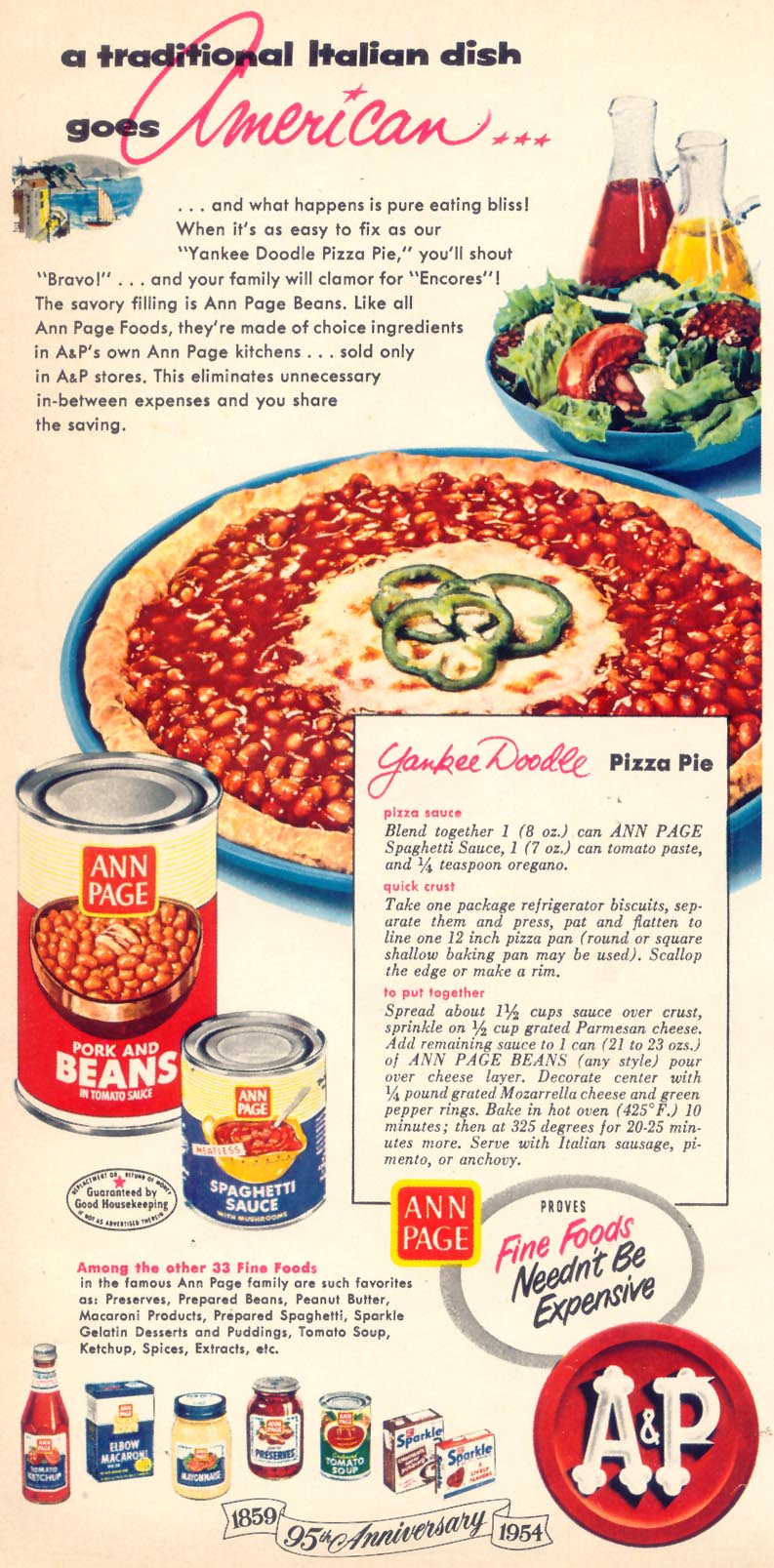
I can safely say that most readers of this blog probably think that broiled Spam + canned peaches looks and sounds unappetizing.  But this is only one of many creative food combinations that appeared in advertisers’ recipes and cookbooks during the 1950s and 1960s. Here’s another:

Yankee Doodle Pizza Pie, Women's Day, October, 1954


Why, yes, those are baked beans on pizza.

While there are plenty of interesting angles on these old recipes, from their use of color to their emphasis on saving money, I’d like to bring up the way that modern writers treat recipes from this period. James Lileks, for example, has an entire site, The Gallery of Regrettable Foods, which eventually spawned a book covering much of the same material.

As the index page to The Gallery of Regrettable Foods says,

What were they thinking? How did they eat this bilge? Good questions, but you won’t find them answered here. This is a simple introduction to poorly photographed foodstuffs and horrid recipes. It’s a wonder anyone in the 40s, 50s and 60s gained any weight; it’s a miracle that people didn’t put down their issue of Life magazine with a slight queasy list to their gut, and decide to sup on a nice bowl of shredded wheat and nothing else.

This [admittedly funny] type of snarky commentary has inspired other Web sites, such as Wendy McClure’s mockery of 1970s Weight Watchers recipe cards. The vintage_recipes community on LiveJournal frequently contains less formal versions of the snark.

Such modern commentary erases much of the historical significance and interest of these recipes. The radio program Engines of Our Ingenuity recently commented on the cookbook in episode 2403, with a special focus on recipes such as those shown above. As the transcript of episode 2403 suggests, many of these recipes relied on canned, gelled or prepared foods, highlighting both the Atomic Age’s fascination with technologically advanced cookery. But the mockery is way more popular these days.

These images could be used in a discussion about how “retro” images are regularly reappropriated as “cool” with little regard for their historical context.

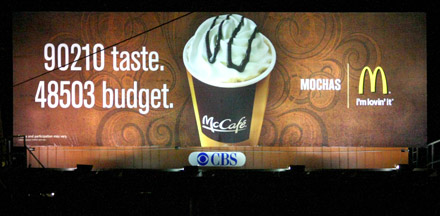
Chelsea C. brought our attention to this billboard for McDonald’s coffee or McCafe:

90210 is the zip code for Beverly Hills, a notoriously rich neighborhood in California. And, Chelsea explains, 48503 is a zip code in Flint, Michigan.

The ad is interesting to me because of the double meaning of taste (hello Bourdieu!). Taste refers to how things taste on your tongue (literally the taste of the coffee), but it also refers to who has good versus bad taste (people with good taste are “high class” and they like things like classical music and caviar). The idea that this ad is capitalizing (pun intended!) on both meanings of the word taste is supported by the use of the term “cafe” in “McCafe” and the portrayal of a fancy coffee drink (“Mochas”).

So the ad is saying that, even if you live in Flint and don’t have the economic resources of someone who lives in Beverly Hills, you can have the taste of expensive coffee because, of course, expensive coffee is to your taste.

There is something interesting here that ties into our consumer culture and wide range of advertising, television programming, and Paris Hilton-watching that encourages us to aspire to be just like the rich. This means buying expensive things that you can’t really afford and/or valuing things that mark you as a high class person with good taste (such as Mochas from McCafe, if that’s the best you can do). There is no questioning as to whether it’s a good idea for everyone to aspire to such heights, whether there is something problematic in the disparity between 90210 and 48503, or even whether it’s true that the rich have better “taste.” So, ultimately, the hierarchy goes unchallenged while we all just jocky for position.

This reminds me of the moment in the Sex and the City movie when Carrie realizes that her assistant, Louise, rents super-expensive purses even though she is too poor to buy them.  Carrie is impressed by Louise’s “taste” and her dedication to having “the best” things even if they are completely inessential and renting them only exacerbates the fact that she doesn’t have oodles of cash.

So, yeah, I think this billboard plays into that.

Parameswaran (2002) writes:

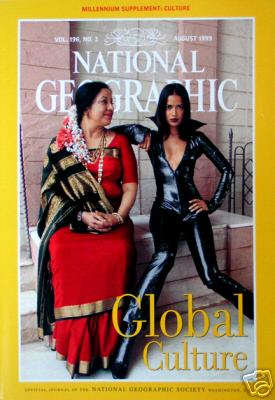
The [National] Geographic’s August 1999 cover dramatically deploys women’s bodies as detailed blueprints, maps that busy readers could use to instantly trace the passage of non-Western cultures from tradition to global modernity…

More of her description of this cover after the image (found here):


An older middle-aged Indian woman, with streams of white and orange flowers pinned to her hair at the base of her neck, symbolizes tradition. The deep red silk sari with a gold border, the gold necklaces around her neck, and the thick gold bangles on her wrists clearly mark her as a traditional upper-class woman… The older Indian woman’s body and posture also announce her alignment with tradition. She is heavyset, almost stocky, and her sari demurely covers her large breasts. Her feet are placed moderately close together and her folded hands rest in her lap. Avoiding the direct eye of the camera, her face, with the trademark dot of the Hindu tradition etched between her eyes, is turned sideways as she bestows a tender maternal gaze on the young woman sitting beside her…

In contrast to the gentle passivity and the slack middle-aged body that index tradition, bold assertiveness, feminine youthfulness, and an androgynous firm body register cosmopolitan modernity in the cover of image. These biological and emotional transformations in the modern, non-Western woman’s physical appearance and personal demeanor appear to be wrought by Westernization. The young, slender Indian woman sitting next to the middle-aged woman has short, shoulder length hair framing her face. The marked absence of the dot on her forehead as well as her clothing, instantly herald her identity as a modern woman. She is dressed in a black, shiny PVC catsuit, unzipped down to the middle of her chest to display her small, almost flat breasts, while her feel are encased in sharply pointed black boots. Disdaining the gaze of the older woman directed towards her, she defiantly stares at the camera and claims her personal space with arrogant confidence. Her legs and felt, unlike the older woman’s feet, are splayed wide apart and her knees point in opposite directions. Her left arm is poised akimbo style while her left palm grips her hip in a strong masculine gesture.

In the magazines sharply polarized, binary rendering of the “new and hip” as radically different from the “old and outmoded,” one woman symbolizes ethnic tradition and the other global modernity…

Citation:  Parameswaran, Radhika. 2002. Local Culture in Global Media: Excavating Colonial and Material Discourses in National Geographic. Community Theory 12, 3: 287-315.

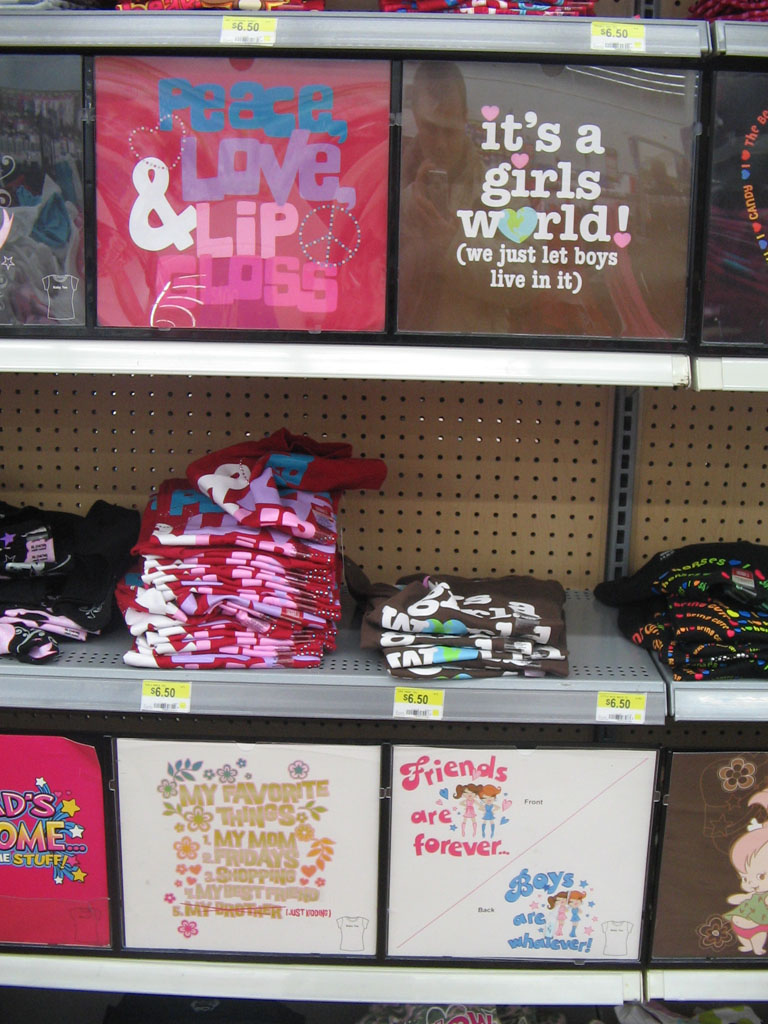
We were shopping for my 6-year-old stepdaughter in Walmart in the Boston metro area this weekend. I took a picture of a display of T-shirts for sale for girls, available in size 6X-14. Clockwise, these 4 say “Peace, love and lipgloss,” “it’s a girls [sic] world! (we just let the boys live in it),” “”Friends are forever / Boys are whatever,” and “My favorite things: 1. My mom, 2. Fridays, 3. Shopping, 4. My best friends, 5. My brother (Just kidding).”

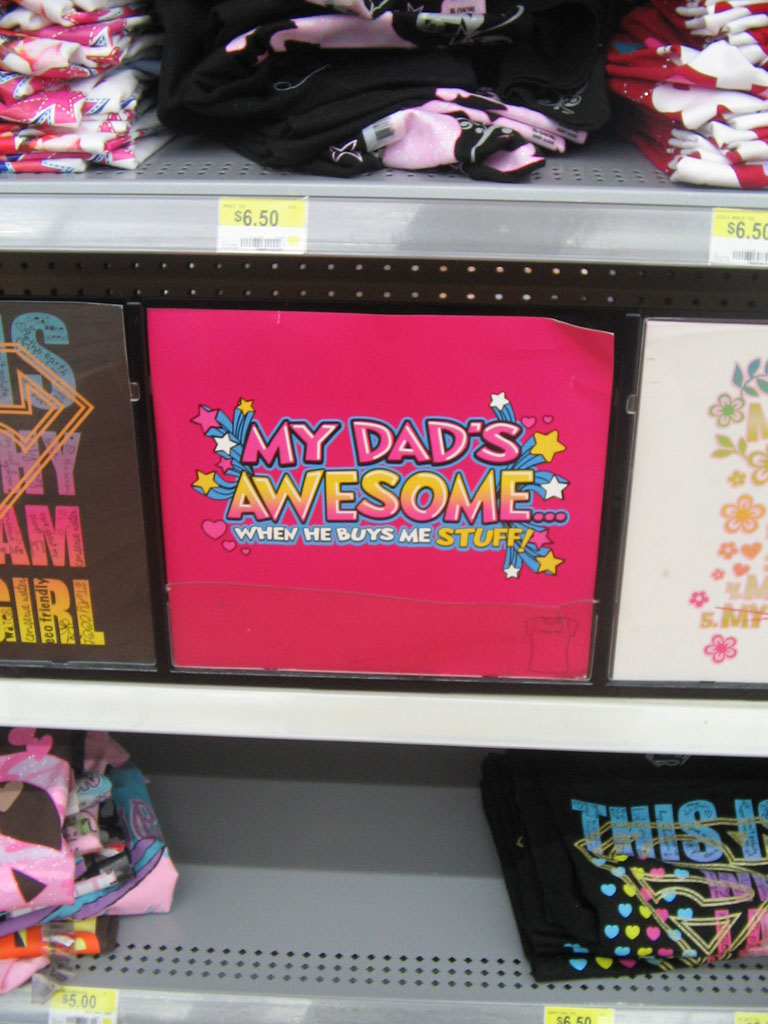
Here’s another one from the same display that says “My dad’s awesome…when he buys me stuff!” Presumably a dad is therefore not awesome when he is trying to raise a happy, healthy kid with techniques that do not include purchasing sparkly pink shirts with pro-capitalism messages.

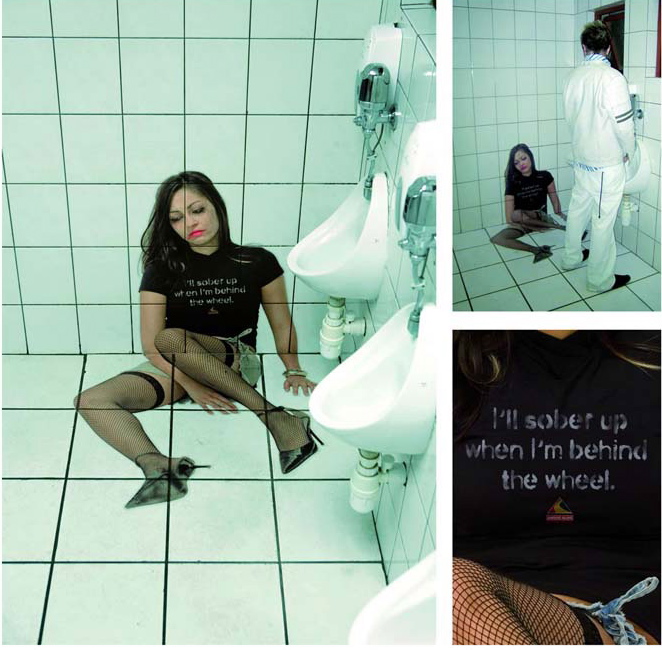
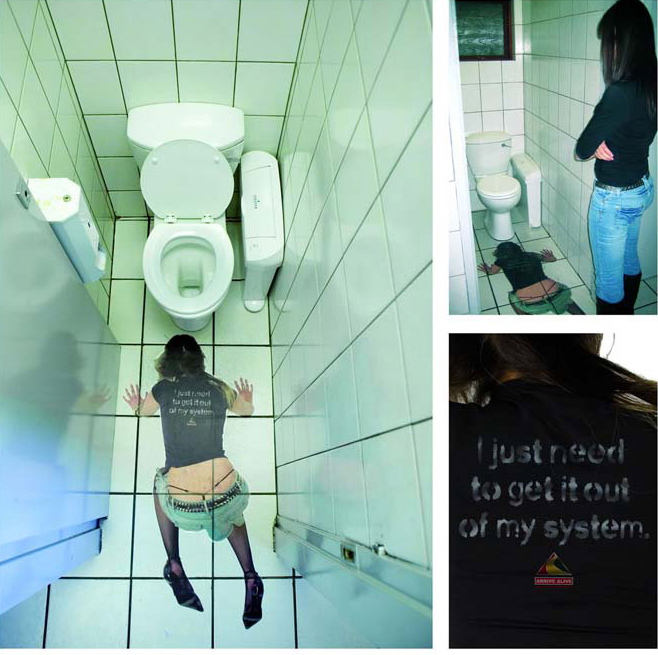
Arrive Alive is an anti-drunk driving organization. As part of one educational campaign, they designed these…stickers? posters? stick-ons? I’m not sure what you call them, but things to stick on the wall of public bathrooms to make people think before driving drunk. Here are two examples (found at copyranter):

I don’t quite know what to make of these. I mean, they definitely get your attention. But I also question the outfit they chose to show her in–what’s with sexing her up so much? With fishnet thigh-highs, a visible g-string, and stilettos, no less. And as copyranter points out, for the type of guys (and I know this is a specific group–this isn’t referring to men in general) who look for drunk women to have sex with, I think that top image might have a totally different effect than the organization is getting at. Maybe that’s part of the point–to scare women with the threat of making bad sexual choices (or being forced into sexual activities) while drunk. But then why put it in the men’s bathroom? I’m kind of stumped, really. Readers?

Just a side note, I’m thinking the poster at the top, next to the urinal, is just going to get peed on a lot (after all, there are already lots of urinals shaped like women), while the bottom one is likely to get puked on now and then.

This just strikes me as another example of a PSA that manages to be creepy without necessarily being effective.

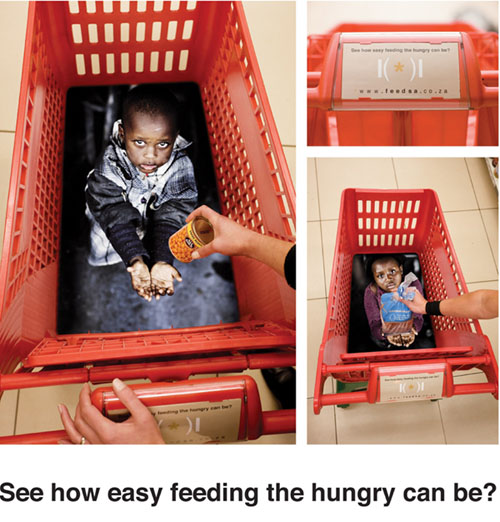
Here’s a somewhat similar example. These ads are for Feed SA, a New Zealand-based organization to provide food to people in South Africa. They paid some supermarkets to put these ads in shopping baskets (images posted by copyranter at Animal New York):

I guess part of the point here is to make people feel uncomfortable while they’re filling their baskets with lots of food, in the hopes that they’ll go home and make a donation. And that, in and of itself, doesn’t surprise me; I used to foster dogs for a dog rescue, and let me tell you, we weren’t above occasionally using guilt or desperate appeals if we were in dire shape, and I think it’s a fairly standard (though not necessarily effective) practice among charity organizations. I’m not entirely certain why I find them disconcerting. Maybe there’s no good reason for it.

Readers, what do you think?