Archive: 2008

I just saw a story about this image on “Countdown with Keith Olbermann” (image found here):
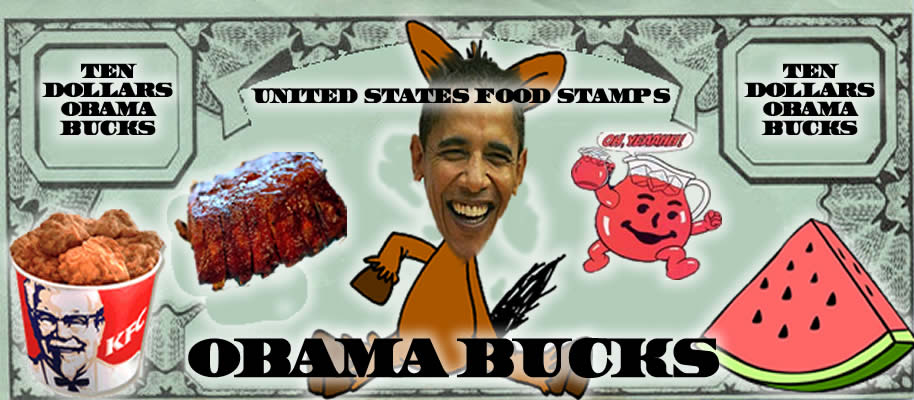
It is a “joke” included in the “October newsletter by the Chaffey Community Republican Women, Federated” (I read more about it here; the group is from San Bernardino, CA), in which they claim that if Obama wins, his face will be on food stamps, not dollar bills. From a story in The Press-Enterprise:

Fedele [the group’s president] said she got the illustration in a number of chain e-mails and decided to reprint it for her members in the Trumpeter newsletter because she was offended that Obama would draw attention to his own race. She declined to say who sent her the e-mails with the illustration. She said she doesn’t think in racist terms, pointing out she once supported Republican Alan Keyes, an African-American who previously ran for president. “I didn’t see it the way that it’s being taken. I never connected,” she said. “It was just food to me. It didn’t mean anything else.”

Uh huh. Right. Who could possibly have known that African Americans were historically portrayed in racist carictures eating fried chicken, ribs, and/or watermelon, or that there’s a long-standing political tradition of trying to connect Blacks and welfare in the public mind?

Honestly, it’s been awhile since an image of Obama actually made me gasp, but that one did.

UPDATE: Larry, from the L.A. TimesDaily Mirror blog, sent in a link to this post at the blog Please God No, in which the author claims to be the creator of the Obama bucks cartoon and says,

It was a satirical look at some of the Fox News watching right-wingers out there that are afraid of a government that sponsors welfare type programs. It was intended to poke fun at the unrealistic fears and agenda of racism that a fringe element of Republicans strongly embrace.

The author continues,

This “cartoon” (as described in the media), was meant to empower African Americans to stand up for and defend themselves against racial intolerance. This “cartoon” was prescribed to showcase the racial hatred and intolerance towards the “left” and it’s liberal “welfare” economic plan. Guess what? The radical right picked up this fumble and ran with it right into the opponents goal line. The fact that a website like this exists is not evidence of racial hatred or divide, but the fact that an image taken from this website was used in a legitimate publication to promote the Conservative agenda must be proof of either existing racism or utter stupidity.

I thought the author’s response might be interesting for a discussion of political parody and humor and the limits of satire. What makes political humor effective and what makes it, as in this case, actually appeal to the group the humorist claimed to be mocking? If people miss the satire, is that because they’re dumb or because the satire isn’t that good? If someone says they’re being satirical, does that automatically shield them from any accusations of sexism, racism, etc.? I really find the issue of humor to be fascinating–what we find funny, what happens when some groups don’t recognize what another group claims was an attempt to be humorous, and how claims of being satirical or “just joking” can be used to avoid responsibility for the content of statements or images. This seems like a particularly good example of some of those issues.

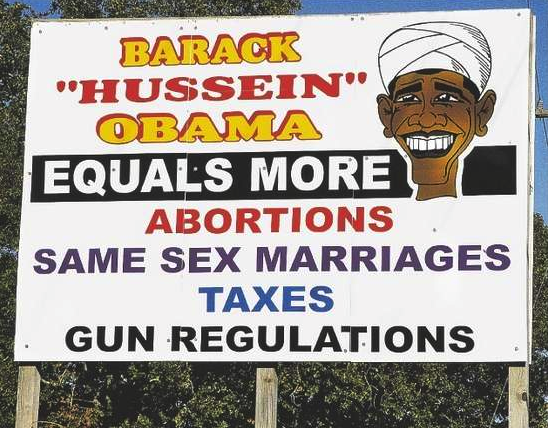
Dara G. sent in a link to this billboard in West Plains, Missouri, featuring a caricature of Obama in a turban meant to imply he’s an Arab/Muslim (found here):
NEW!  Here’s another (found here):
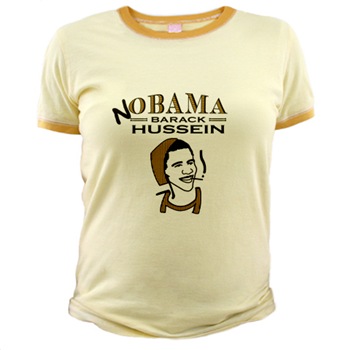
 

For other examples of accusations that Obama is Arab/Muslim (and that that is bad), see here, here, here, and here. For a non-racist caricature of Obama (showing it can, indeed, be done), see this post.

Thanks, Dara!

And I just saw on Rachel Maddow’s show that this image showed up briefly on the Sacramento County Republican Party’s website (image found here):
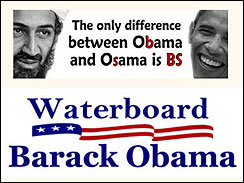
There’s more!

This image is from a recent rally (found here):
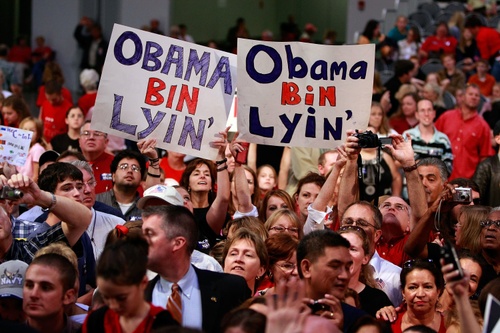
And, if you haven’t seen it yet, here is the by-now-classic video of supporters of a McCain rally yelling that Obama is a “terrorist” bound on spreading “terror” (found here):

I presume you can figure out for yourself how these might be used in classes. Negative messages about Arabs/Muslims, attempts to use fear of the connection between Arabs and terrorism, joking about torture, racist imagery, etc. etc….You don’t need me for this one.

To be fair, McCain, in at least one instance, has been attempting to temper this fervor. But, as Gwen mentioned in a previous post, those who stir up hatred often have a difficult time controlling it. I’d love to have some social psychologists weigh in on the phenomenon.

NEW! Man in Ohio hangs Obama from a tree in his front yard and boldly claims racist motivation (found here):
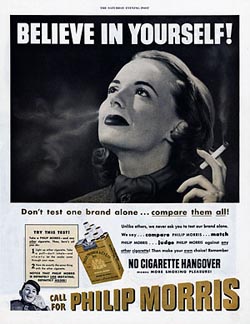
This New York Times article discusses the cigarette industries co-optation of nascent feminism.  Hat tip to Jezebel, where Sadie writes:

In the early 20th century, smoking was regarded as unladylike. In the 1920[s], realizing they were missing out on millions of potential customers PR expert Edward Bernays encouraged the American Tobacco Company to play on women’s nascent sense of modern independence… and the smoking feminist was born!

Also in co-opting feminism: make-upmore make-up and, of course, botox; cars and bras; more cigarettes; cleaning products, eyeglasses, and pants; diamond rings; credit cards, cigarettes, and cars; easing kitchen duty; and fashion (I think).

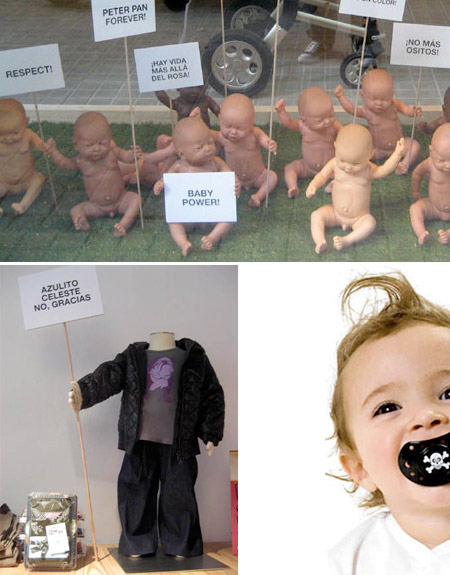
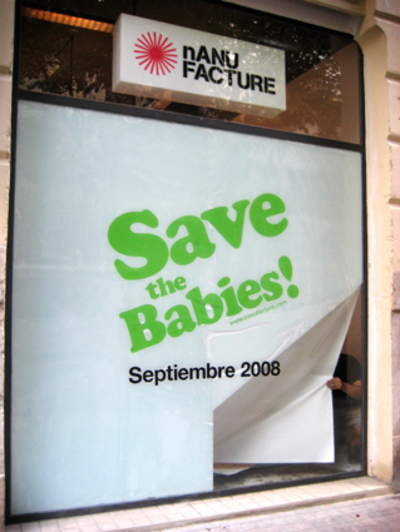
Miguel sent in these photos from nANUFACTURE, a children’s clothing store based in Valencia, Spain. The advertising campaign is “save the babies.” This first one was found at the company website:

This one was found here:

The babies in the top photo are holding signs in Spanish that say “there’s life beyond pink” and “no more teddy bears!” The sign in the lower left photo says “no sky blue, thanks.”

Given that the website includes photos of Angelina Jolie and Brad Pitt and of a scene from the “Sex and the City” movie that shows toys sold at the store, and the super-hipness of the clothing line (flared-leg kids’ jeans, anyone?), I assume the store sells expensive stuff. Their mission statement includes statements about supporting breastfeeding and natural childbirth, as well as selling children’s clothing. According to one of the owners (I think my translation is accurate enough),

Dads and moms…have their first son or daughter when they’re around age 30. That is, they’re young! But it appears that no other store owner in this sector [children’s clothes] has noticed this small detail.

They go on to talk about saving babies from ugly polka dots, teddy-bear stencils, and pastel pink and blue.

I think this is an interesting mixture of elements. It’s nice to see any store selling alternatives to the pink/blue dichotomy and providing forums for breastfeeding advocacy groups and such. But I also think the clear marketing to a certain type of parent is worthy of discussion. Obviously, kids don’t know whether they’re supposed to think polka dots are awesome or lame. This is about “saving” kids from things these young, hip parents think are lame or uncool. We’ve had a couple of posts recently about politically labeling kids (see here), but here we have an example of non-political labeling: as too hip and cool for the tastes of the masses. These images might be a useful addition to a discussion of how children’s clothing often reflects parents’ tastes and ideas about themselves (as cool, progressive, liberal/conservative, etc.), or about the rise in expensive children’s clothing marketed to the middle and upper-middle class.

Full disclosure: I do think many items of children’s clothing are hideous, but I’m probably in no position to judge, since my mom once made us shirts out of some rags she found in my grandpa’s shop that he planned to use to sop up oil. Yes, we actually wore rags.

Thanks, Miguel!

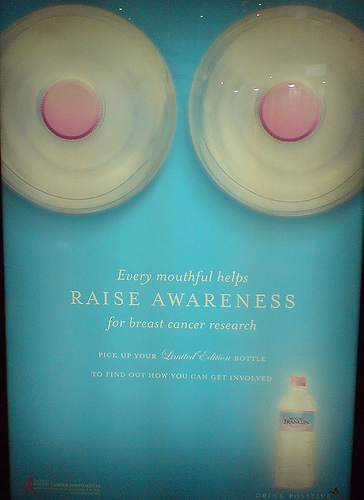
The sexualized campaign against breast cancer (i.e., “save the tatas”) is fascinating.  Why should we care about breast cancer?  Because we think boobs are hot and we like to put them in our mouths.

I think it’s the ad companies that win.  This bottled water advertisement (found here) gets to be simultaneously socially conscious and titillating:

Also in breast cancer awareness and advertising: if men had boobs, they’d care about breast cancer, gender symbolism in breast cancer ads, and objectification in the service of breast cancer awareness.

Also don’t miss boobsboobsboobsboobsboobsboobsboobsboobsboobs.

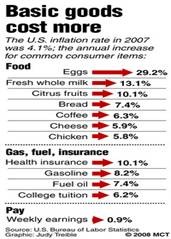
According to the U.S Bureau of Labor Statistics, weekly earnings rose 0.9 percent last year and the overall inflation rate was 4.1:


Found at Everyday Sociology.  Click to enlarge.

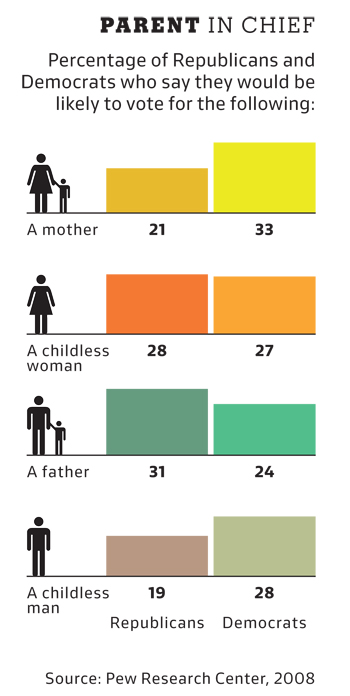
A New York Times article about politicans and parenting offered this figure illustrating what percentage of Democratic and Republican voters say they would be likely to vote for a woman with and without children and a man with and without children.

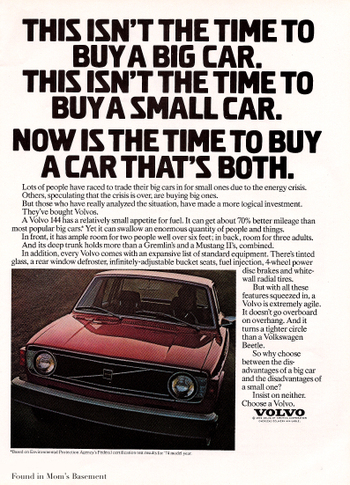
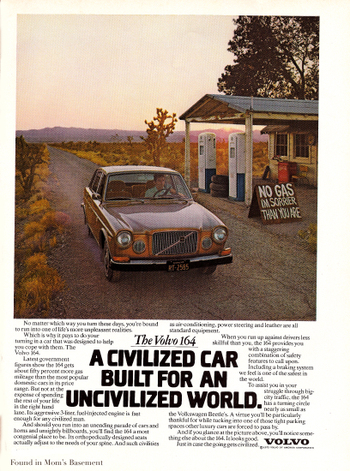
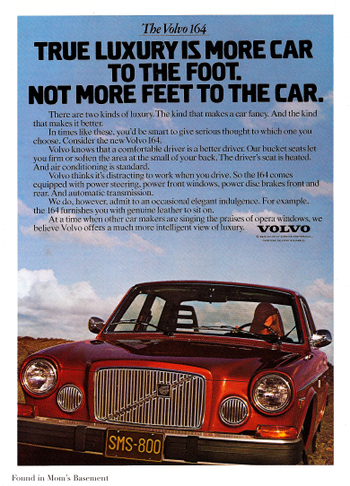
These three Volvo ads from 1974 (from Found in Mom’s Basement) remind us that this isn’t the first time there was an “energy crisis” and gas was difficult and/or expensive to get.  They put this particular crisis in historical perspective and also point to (1) how resistant Americans are to change and (2) how short our collective memory is.  That is, the problems we are facing to day are not new, but cyclic, yet we manage to forget crises as soon as they are past and revert to our familiar ways. 

The ads also demonstrate the willingness of companies to capitalize on a crisis.  See a modern version here.  And enjoy the ads:

See also these public service announcements encouraging carpooling during WWII.

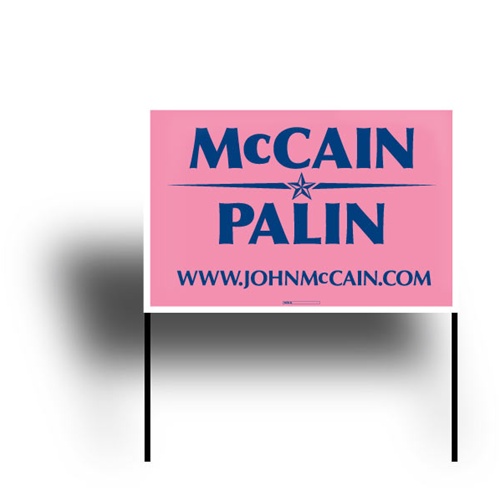
I just saw one of these signs in my neighbors’ yard (image found here):

The reason it struck me is that a) I’m quite certain it’s the first time I’ve ever seen a pink campaign sign and b) it made me remember the criticisms of the Kerry/Edwards yard signs from the 2004 campaign (see this post). The Democratic candidates’ signs were described as lacking confidence, whereas the Republicans’ logo exuded masculinity and assertiveness, which supposedly reinforced stereotypes of Democrats as weak and uncertain and Republicans as aggressive and strong. It’s a sign of the many unexpected events of this campaign season that just four years later Republicans would feel comfortable putting out a pink yard sign because they’re actively playing up the femininity of one of the candidates. It’s not just that they’re emphasizing that she’s female; I’m pretty sure if Hillary Clinton had won the Democratic nomination, she wouldn’t have pink yard signs. I have a feeling that the Democrats, facing the stereotype that they’re weak and uncertain, wouldn’t want to take the chance of having yard signs in a color associated with femininity, even if they had a female candidate, but that’s just a hunch.