Archive: 2013

Walking out of movies, I often disagree with the sentiments of the crowd. As they enthuse “That was so awesome!” and “Great action scenes!,” I silently bemoan the lack of female characters, the unnecessary booty shots (as in the recent Star Trek: Into Darkness), and the preponderance of blow-em-up-and-kill-em-dead scenes.

As I left the theatre following After Earth, the new Will and Jaden Smith movie venture, I disagreed with audience sentiment, but for different reasons. As I heard people complaining the movie was too slow, didn’t have enough action, that there wasn’t enough death, I was thinking about how great the father/son relationship was depicted, about the sister so strong she protects her brother even after death, about the tech-genius mom who lures her son and husband away from the warrior world of killing aliens.

My fondness for the film was not shared by those exiting the theatre with me – nor is it shared by other critics – at least none that have reviewed the film yet. Instead, the general reaction seems to be “yawn.”

Now, the fact some audiences judge how good a movie is by death count aside…what worries me about movies (and thrilled me about After Earth) circulates around the fact that most movies are still telling us the same old regressive, outdated, power-happy stories where men rule the universe and women get naked (or rescued). Even in futuristic, fantasy, sci-fi, super-hero and animated movies, where there is the possibility to rewrite what humanity, gender, race, existence and so on mean, more movies than not stick to the same script. Man is hero. Woman is in background. Person of color is villain. America is savior. “Others” whether they be aliens, monsters, foreigners, LGBTQ, or simply from a different neighborhood, are killed off or assimilated.

This is where After Earth is different. Yes, it has male heroes, but it also has female ones. The heroes are people of color. The “savior” is not a nation or even a planet, but a family that loves one another. There are some evil Others (ursa aliens) but the film shows that assuming evil/malice on the part of Others often is misguided – as when the young Kitai Raige (Jaden Smith) assumes the bird who will ultimately save his life is trying to kill him (this savior bird is a female while the evil ursa is a he – another nice flip of the usual script).

At the outset of the movie, we learn earth has been destroyed as images of destruction flood the screen. The images are not futuristic, but of present-day earth – humans attack one another, cars wash away in giant tsunami waves, animals struggle in the latest sludge dump from yet another mega-corporation. In contrast, the sleek world of Nova Prime (the planet humans have relocated to) looks like a lovely location kitted out by Ikea.

The United Ranger Corps (the new global military) could serve as an advertisement for diversity – they are male and female, racially diverse, differ in age and size. This future force is not your typical muscled-up, all-male fighting force. This might seem like a small matter, but how often are such filmic elite forces represented with the true diversity that makes up our world? Hardly ever. Further, how often do they not have guns? This military core does NOT have guns (nor the futuristic equivalent of guns). And this is exactly what disappoints many film critics.

While some grieve the lack of action scenes, referring to the “potential” for “intense action sequences” that bewilderingly are not taken advantage of (“it cashes in on only a few of them,”) others caustically lament the lack of guns, as here:  “the script …fails to explain why future warriors, whose technology allows for a ‘cutlass’ whose two ends morph into any type of blade the user requires, choose not to use guns or lasers against the mighty Ursa. One assumes it’s because somebody saw Darth Maul and thought his double-trouble light saber looked cool.”  Yeah, because choosing NOT to use guns is flat out CRAAAAZZZZY.

So, what did I, unlike other reviewers, like about this film?

For one, there is a powerful mother in it. She is not dead. She is not evil. She is not a cartoon of femininity. (Disney, I am talking to you.) No. She is smart, articulate, say-it-as-it-is woman. I would bet she is a feminist. She has no qualms about telling her warrior husband Cypher Raige (Will Smith) that he is failing as a father, informing him “that boy in there is trying to find you…he doesn’t need a commanding officer, he needs a father.”

And the fact the film is critical of Cypher for being such a gung-ho warrior, right down to mocking hyper-masculinity via his symbolic last name, Raige? Swoon. And that it ends with the battle weary Kitai telling his Prime Commander father that he no longer wants to be a Ranger but instead work with his tech-savvy mom? That when he says “dad, I want to work with mom,” Cypher responds “me too”? Double triple swoon.

Further, as my daughter pointed out on our drive home, the film showed heroes need more than strength and weapons – they need strategy and smarts and drive – and they need each other – as when Cypher and Kitai must help one another in order to survive, despite the animosity and hard-feelings that have built up over the years. These are no Iron Men or Men of Steel or whatever other HARD MALE super-hero you want to throw in the mix. No, they are neither uber-hard or uber-male. Rather, they are human. How sad that such a depiction is so rare in this genre of movie as to seem like a revelation.

More sad still is that reviewers are bewailing that Jaden is not ‘man enough’ to be an action hero, as in the New York Daily News review that quips “It’s not Jaden’s fault his voice is still a few octaves too high for an action star, but it doesn’t do him any favors when his character is lifted to the nest of a giant eagle that decides to mother him.” Ah, yes, how emasculating! A less-than-baritone voice and being mothered! What are these reviewers drinking? Straight testosterone with a chaser of misogyny?!?

Such critics do not mention the depiction of family relationships the film proffers. I suppose such matters don’t have enough “action” to be worthy of comment. But, the exploration of family the film offered included something not often explored in films – dealing with the death of a sibling. Young Kitai is still traumatized by watching his older sister Senshi (Zoe Isabella Kravitz) be brutally impaled by an alien, and his father still blames him for it. Said sister visits him in his dreams as he makes his dangerous trek across the now hostile earth, saving his life by waking him up when needed.

As for the father/son relationship at the heart of the film? While I was besotted by the crash scene in which dad Cypher helps the panicking Kitai breathe through his mask, I was equally enamored of the many other scenes that captured something that is not a mainstay of the big screen – a father’s love for his son. Here, and throughout, the film was refreshingly free of macho bravado.  In fact, the various nods to Moby Dick in the film hint that Cypher is debilitated by his own hunger for power, much like Captain Ahab and his relentless quest for the great white whale. (Moby Dick is the only “real” book the Raige family has ever seen in the post-book world of Nova Prime)

As with that literary classic, the film has its philosophical moments. Cypher’s refrain to his son is “take a knee” –  an action that calls for kneeling down to the ground to “root yourself in this present moment.” Intoning “recognize your power…this will be your creation,” Cypher is like a more serious, more male Oprah, cheering on his son with the power of now. In another part of the film, he echoes the sentiment that we create our own realities, noting that we are “telling ourselves a story.”

If there is truth in this idea, that we at least partially create our reality by the stories we tell ourselves, then we had better worry about the fact many film critics and film goers seem to want stories saturated with violence and action – where the violence should be action-packed and the action should be violent.

Films are telling us all a story, stories which shape our experiences of – and expectations about – reality. I enjoy stories like those told in After Earth – stories where parents love their children, where sisters protect their brothers, where giant mother birds morn the violent deaths of their baby birds so much that they turn to mothering a lost human boy on an inhospitable planet – a planet that became uninhabitable because of … you guessed it… violent action.

If you are a crazy peacenik feminist like me, with a soft spot for movies that value love and non-violence and collaboration and an image of the future that is not dominated by Tom Cruise or Chris Pine or Robert Downy Junior knock-offs, go see After Earth. If you want explosions and death and booty shots, well, I am sure there are plenty of summer blockbusters in the pipeline that will deliver.

It is wedding season, and a landmark year for marriage equality. Someone asked me what would be my feminist utopia for marriage, and I started thinking: Utopias are for Enlightenment thinkers, those expansive philosophers who made heady contributions… but who sometimes didn’t quite see around their own contradictions? Take Mary Wollstonecraft, 18th century Enlightenment feminist polemicist. She had an essentialist streak that led her to argue that women needed to be better educated–to fulfill their duties as wives and mothers. For sure, the notion of a marriage between two men or two women was inconceivable because of the necessity of the natural roles in marriage. Despite her limits, I think Wollstonecraft captures some of my thinking about marriage and utopias via her two famous lines on the topic.
The first is in Wollstonecraft’s unfinished novel, Maria, or the Wrongs of Woman (1798). The protagonist Maria proclaims from within a violent middle-class marriage, “marriage has bastilled me for life!” This politically-charged allusion to the Bastille at the time of the then, still recent, French Revolution suggests that just as aristocracy imprisons peasants, marriage—and men—imprison women.

It is too boring to catalog the subsequent 19th, 20th and 21st century complaints about marriage, one generation after the next finding novel or critical ways to look at marriage in terms of the extent to which it is an honored, covert bastille. There’s Friedan’s problem with no name! There’s the second shift for women in the workforce! Here’s the opt-out puzzle! What’s with the gender gap in depression among married people? Just today, the New York Times covered how marriage is a marker and maintainer of social class divides—more marriage for those with social advantages, and less for the rest. So, marriage even plays a role in replicating wider forms of inequality beyond gender inequality. Looking back at Wollstonecraft, I wonder how long it has been since anything new has been said by white middle-class feminists (like myself) who engage in critical thinking about marriage. It has been all imprisonment and limitations–with some bits of moving forward.

The second Wollstonecraft line appears in an earlier novel, Mary: A Fiction (1788), where she writes at the very end of a better world “where there is neither marrying, nor giving in marriage.” The heroine was on her deathbed. Her utopia was heaven, where there is no marriage. Now that’s more like it. Well, except for the death part. This was Wollstonecraft’s proposed resistance to the silliness of women’s education, which failed to parallel the reason-based training of men. Education instead socialized women into mindless versions of wives and mothers that she wrote about in A Vindication of the Rights of Woman (1792)—a political treatise in response to Talleyrand’s 1791 remarks naysaying women’s education. Wollstonecraft ended up hating her earlier novel, but she still made a nice point about no marriage.

So what is my feminist marriage utopia? I don’t care if there is or there isn’t marriage; if it is available it should be available to all. In truth, I dislike it when people weirdly change their names. I don’t like the class and commodity fetish that weddings are. And the ceremonies, like when they bless fifty-year-olds to be fruitful and multiply, are embarrassingly heteronormative. But that’s okay. I also don’t like NASCAR, or football, or seafood, and these are things that other perfectly fine people do like.

What works better than a complaint about marriage (or a paean to it, for that matter) is a complaint about inequality, which seems always at the center of our repetitive critiques of marriage. And, with that, I’ll add a complaint about essentialism—or the belief that how your body was born or modified is sensibly linked to your lot in life.

A feminist utopia is one that does not tolerate inequalities, like the inequality of handing out informal and formal advantages based on preferences for some relationships over others. Today’s Times article, “Two Classes Divided by ‘I Do’” makes the point yet again—even if the conclusions folks draw from the classes divided is either “for marriage” or “against marriage.” Generation after generation, marriage plays a role in replicating inequality. A feminist utopia is one that would not put up with sneaky ways of embedding essentialism into our institutions. Marriage, as a cultural artifact of essentialism, does that a lot. It is baked into the cake.

In the wake of Angelina Jolie’s NYT op-ed about undergoing a preventive double mastectomy, many experts have weighed in — to critique, to analyze and to correct misconceptions.  I’m keeping this month’s column short to encourage readers to explore some well-researched analyses.  I’m particularly inspired by a past guest-author for this column, Gayle Sulik, Ph.D. (author of Pink Ribbon Blues and Research Associate, Department of Women’s Studies, University at Albany – State University of New York).  Sulik’s guest post for Scientific American is a must-read for those who have questions and concerns about what Jolie’s story may or may not mean for themselves and their loved ones.  If you prefer a podcast, then listen to KCRW’s interview with a panel of experts, including Dr. Sulik along with Alice Park (author of The Stem Cell Hope and health reporter for Time magazine), Joanna Rudnick (BRCA activist and documentary filmmaker), and Ellen Matloff, M.S., C.G.C. (Director of Cancer Genetic Counseling at Yale Cancer Center).

I leave you with this quote from Sulik:

…we all deserve quality information, evidence-based medicine, and access to comprehensive and coordinated health care that is free from conflicts of interest and the profit motives of commercial enterprises that are eager take advantage of our fears while selling us superficial “solutions” to our problems.

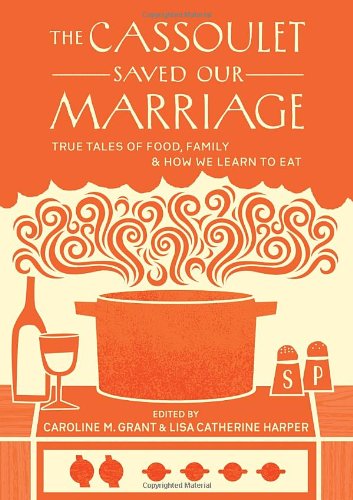
The Cassoulet Saved Our Marriage: True Tales of Food, Family, and How We Learn to Eat51h6WIJ7DNL
Ed. Caroline M. Grant and Lisa Catherine Harper
Boston: Roost Books, 2013, pp255

I begin this review with a confession: I live in Brooklyn, the east coast outpost of the current “foodie” movement. I live in a rapidly gentrifying neighborhood, have a plot in my local community garden, and shop at farmers’ markets. I try to cook seasonally appropriate meals, bake without refined sugars, and eat a lot of kale. I am white, of middle-class origin, and (very) over-educated.

Why do I tell you all this? I begin with this description because the majority of the stories in The Cassoulet Saved Our Marriage are told from a specific location. It is an urban place, one full of farmers’ markets and locally-grown produce, of cage free hens and grass fed beef, of organic baby food and school cafeterias with yogurt bars (yeah, I was floored by that last one, too).

It is also a place where food is central to our lives. Indeed, few things in life are more personal and, as such, many of the stories in the collection exude such lovingness in their descriptions that I was extremely moved – and hungry! (In this sense, the fact that each short essay is accompanied by a recipe is a lovely feature.) I was particularly touched by Aleksandra Crapanzano’s essay on how appealing to the memories of food’s pleasures was way to forge a deep and meaningful relationship with her husband’s great-aunt. Elrena Evans offers an honest and brave reflection on coping with her young daughter’s “selective eating” after her own struggles with an eating disorder. Karen Valby’s essay on her mother’s struggle with manic-depression and the resulting chronic hunger of her childhood, reminds us not to assume that all suburban households are bastions of food abundance. Deborah Copaken Kogan and Paul Kogan, in the essay from which the title of the book was taken, offer a poignant reflection of how, over the course of a long-term relationship, gathering around food comes to symbolize much more than sustenance.

The book is divided into three sections, reflected in the title itself: food, family, and learning to eat.  That said, many of the essays cover all of the themes rather beautifully, and the thematic breaks seem to exist more for the sake of readability (though the last section – “learning to eat” is more highly focused than other sections on authors’ children). The essays themselves are all of a quite readable length, particularly for someone used to the essays in academic tomes. I found myself passing through several essays in quick succession. On the wittiness spectrum, I particularly enjoyed Jen Larsen’s piece “Food Hater,” Lisa McNamara’s “Pie-Eyed,” Melissa Clark’s “Rachel Ray Saved My Life,” and Phyllis Grant’s “Recipe.”

It is disappointing, however,that the collection is lacking in diversity of perspectives. The edited volume features only two people of color and one openly-gay author. In a land where one father decries his children’s lack of taste for foie gras and another describes PTA fights over food choices with dismissive hilarity (though I did deeply enjoy Edward Lewine’s essay) – what of parents in schools in which the majority of students receive food assistance and there are no yogurt bars in the cafeteria? Including the perspectives of people speaking from multiple locations would have deeply enriched the collection. As it stands, The Cassoulet Saved our Marriage  will most resonate with those located in the privileged places described at the start of this review, including, of course, my own beloved neighborhood in Brooklyn.

In the final chapter, author Thomas Peele recounts several meetings with San Franciscan chef Dennis Leary. Here, Peele describes Leary’s approach to food as one in which “[f]ood … is not an end to itself. It’s a beginning, a starting place.” And so I hope it is with this collection – a starting place from which other collections that cover the diverse experience of and perspectives on food will spring.

Gwendolyn Beetham is an independent scholar living in Brooklyn, New York. She currently manages the column “The Academic Feminist” at Feministing.com and is a regular contributor at the University of Venus. She has a PhD from the Gender Institute at the London School of Economics. Follow her on twitter @gwendolynb

Rarely a week goes by without a news story or blog post related to single-sex public K-12 education. Coverage often focuses on the ways in which girls and/or boys benefit from these settings and the ‘research’ that allegedly supports these claims. All this numbs the mind of someone who remembers the passage of Title IX and the hopes associated with it.

I grew up in the 1950s and ‘60s. Girls took home economics, whether we wanted to or not. Boys took shop classes under the same assumptions–one was for girls and one was for boys.  I didn’t question these assumptions, but I did wish I could participate in track and field; my only school sponsored ‘sports’ options were cheerleading and girls basketball. Cheerleading wasn’t much of a sport and girls basketball was full of rules about not running across center line and how many bounces were allowed when dribbling the ball.  My father helped me set up a backyard long jump and a ‘pole vault’ with an old mattress and a stick between two poles. It was fun, but it wasn’t ‘real.’

The passage of Title IX of the Educational Amendments of 1972 prohibited discrimination on the basis of sex in any educational program receiving federal financial assistance. Some exceptions were allowed for existing single-sex schools and for instruction in specific areas such as human sexuality and for contact sports. Feminists celebrated.  No longer could schools schedule classes in advanced English and physics at the same time and steer girls to one and boys to the other. No longer would it be legal to provide unequal school-sponsored sports opportunities. Best of all, gendered stereotypes limiting options for both sexes would diminish significantly as girls and boys were educated as equals in the same schools and classrooms. Or so we hoped.

Today the idea of restricting access to course offerings on the basis of sex is as old fashioned as separate job listings for men and women. Girls and boys increasingly see each other as equally capable of achieving in a wide range of fields. But continued advocacy for single-sex public education is ample proof of the strength of outmoded gender myths.

Rather than exploring the far more common similarities among girls and boys, many educators, parents, and policy makers have succumbed to pseudo-scientific theories of large sex differences in cognitive and emotional skills and learning styles. These theories have been debunked repeatedly. Nonetheless, many remain convinced that sex segregation is the best approach when it comes to the education of our children.

In fact, so many believe this to be the case, that in 2006 the Bush Administration’s Department of Education issued a new Title IX regulation which allows more single-sex options in public schools. This regulation is confusing but does require justifying single-sex instruction by showing that it addresses specific educational needs, objectives and opportunities not otherwise met in coeducational classes, and without limiting opportunities available to any student.  However, so far the largely anecdotal evidence cited for single-sex success has faded under more careful scrutiny. To date there is no convincing evidence that single-sex public K-12 schooling is superior to coeducation.

U.S. Secretary of Education Arnie Duncan recently addressed the American Educational Research Association Annual Conference in San Francisco. Reiterating his belief in the importance of research in formulating educational policy, he noted, “We need you, the researchers, to answer the question “which approach works better—this one or that one–and then we need to move forward informed by your answer.”

If current research on the shortcomings of single sex education is not convincing enough for Secretary Duncan and other education policy makers, if they still support public funding for single-sex approaches, then perhaps it is time for increased evaluation of these offerings.

Working with educational researchers around the country, The Feminist Majority Foundation has proposed suggested guidelines for schools considering or already implementing single-sex approaches in public K-12 schools. These have been submitted to the Department of Education for comment and adoption. The guidelines recommend careful planning and process evaluation as key aspects of single-sex programs. Such steps are critical to solid evaluations of outcomes. And only careful outcome evaluation can document whether single-sex approaches have succeeded in decreasing sex discriminatory education and attaining other stated education achievement goals better than comparably well funded, staffed and planned coeducational approaches.

Particularly in tight economic times, scarce public resources must be focused on effective, legally sound, equitable education–education equally available to all. If careful research and evaluation show some single-sex approaches meet these criteria, such programs should be promoted and replicated in appropriate settings. Any single-sex approaches that do not meet these criteria should be halted immediately.  With limited public funds and clear legal requirements to address, there is no more time for programs based on what people think they know. We need educational approaches grounded in what careful research shows is effective.

51m4CwmluUL._SY300_In yesterday’s issue of The Washington Post, I review White Dog Fell from the Sky, a new novel about an unlikely friendship between an American expat and a South African refugee (“Eleanor Morse’s White Dog Fell from the Sky”).

While I liked many parts of Morse’s novel, I gave it a mixed review. I’m really grateful for the story it tells and the issues it raises, but perhaps most of all, for the author’s courage in writing about Botswana and South Africa during apartheid—places and experiences that (at least judging from her online bio) are mostly removed from the places and experiences of her own life. But in my opinion, at times the novel fails to accomplish what it sets out to do: tell the stories of both of its characters.

More broadly, I’ve been thinking a lot about the courage it takes to write across differences—in this case, race, class, gender, culture, nation, citizenship status, and education. I’ve also been thinking about the perils of this journey—specifically, the way that stereotypes and myths can sometimes surface in the writerly imagination. Even when we are trying to write past them to get to the human truth.

I don’t think the answer is to retreat to that old adage, “write what you know,” and I don’t think the answer is to clamp down on the imagination. On other hand, I think we need to talk about the power of all the stuff swirling around in our heads—with compassion and understanding, but also with an eye towards how we can create a truly diverse range of truthful, honest, and relevant stories.


ISarah Comito, Matthew Comiton my latest incarnation as a thought leadership coach, I’m often on the hunt for excellent examples of “thinking in public”—TED talks, reports, articles, blog posts, even tweets—to share with clients.  So, I figured, why not share them, when I find them, with GWP readers, too?

I’m experimenting with a new column format here (and please, please, tell me what you think!).  I envision highlighting from time to time a piece of public thought leadership that I come upon in my travels, one that translates academic or industry-specific knowledge for a broad audience in a stand-out way.  I’ll let you know why I love it, what’s surprising about it, and what’s fresh.

To start us off, I bring you Judith Warner’s first report as a Senior Fellow at the Center for American Progress.  I’ve long been enamored of Judith’s deft ability to bring a structural lens to the public debate around “domestic disturbances,” as her popular New York Times column so famously phrased it.  In this new report, Warner melds journalism and policy paper to tackle domestic disturbances writ large.

Who:

Judith Warner is a Senior Fellow at American Progress. She is also a contributing writer for The New York Times Magazine and a columnist for Time.com. She is best known for her New York Times bestseller, Perfect Madness: Motherhood in the Age of Anxiety, and her former New York Times column, “Domestic Disturbances.” Her latest book, We’ve Got Issues: Children and Parents in the Age of Medication, received numerous awards, and she is currently a recipient of a Rosalynn Carter Fellowship for Mental Health Journalism. A former special correspondent for Newsweek in Paris, she hosted “The Judith Warner Show” on XM satellite radio from 2005 to 2007 and wrote the 1993 New York Times bestseller Hillary Clinton: The Inside Story, as well as several other books.

What:

Lessons Learned: Reflections on 4 Decades of Fighting for Families, a report for the Center for American Progress

Why I Like It:

The topic is a tough one – and well traveled.  Yet I like how Warner gets in there, challenges perceived wisdom, and works to change the frame:

“It’s long been accepted wisdom that Americans view family matters as purely private concerns and that public policy solutions for families—other than the very poorest—have no place in our culture. Yet polls consistently show that support for family-friendly policies is, in fact, overwhelming.”

Based on interviews with more than three dozen veterans of the fight for family-friendly policy in America representing a variety of perspectives, generations, and stake- holder groups, she quotes all my favorite experts.

She pays close attention to language and narrative:

“Personal responsibility” plus “opportunity” was a winning message combination.  Stressing “equality” or the ending of disparities was a nonstarter for conservatives, but talk of “fairness,” “opportunities,” “choices,” and “tools” were acceptable.

And she links the issue she’s writing about to others:

“The power of the personal played a strong role in building support for the Family and Medical Leave Act, and in recent years such narratives have been essential to shifting public and political opinion on marriage equality.”

But what I like most of all is the sense of possibility Warner invokes.

Much has been written about why progress has been slow in this arena, and so paltry.  What feels different here is the emphasis on the seismic internal shift that must take place in order for the outward change to occur.  We need to “replace the belief that ‘this is just how it is’ with the argument that ‘it doesn’t have to be this way.’”

The report takes a close look at public policies promoting caretaking—through paid family leave, paid sick days, and high-quality public pre-K—that already exist in some states and cities. Warner looks at why they are proving to be highly popular and successful, and how we might replicate what works.

Refreshingly, she leaves us with hope:

Bleak though the legislative outlook now seems in our bitterly divided Congress, this is potentially a very fruitful time for thinking creatively and productively about creating a better future for our families.”

Since I’m already interested in the unfinished business of feminism, and how the issues travel and repeat across generations, Warner had me at “lessons learned.”  But the optimism in the report made me want to share it.  Warner brings a much-needed burst of energy to a topic that can easily deflate readers—especially those of us living this fight.

We know about the gendered wage gaps in the workplace. It’s old news that women are wildly underrepresented in top leadership positions at companies across the nation. And it’s clear that men need to be on board in order to for women to achieve equity in the workplace. Men have a central role in improving the workplace as we move into the future. But to be effective in accomplishing productive solutions, we need to scratch beneath the surface and look beyond salary and the corner office.

Most men believe that all people should have the same opportunities based on qualifications, not gender. What about that guy at the conference table — you know, the one who means well but still puts a sexist foot in his mouth.

Allow me to suggest a few tips to share with co-workers about why gender equity matters and what men can do in taking a lead.

As I explain in my book Men and Feminism, masculine privilege is the idea that society awards certain unearned perks and advantages on men simply because they are male. Sometimes this privilege is really obvious, like the fact that Congress remains overwhelmingly male. But masculine privilege also flies under the radar. Institutional practices and ideological beliefs about masculine superiority seem so normal or natural that we’ve learned not to notice when a man’s opinion is taken more seriously than a woman’s.

And, let’s face it. The workplace is nothing if not an institution.

As Michael Welp explains, it’s to men’s individual advantage to inquire more about others and step back a bit from chronic self-advocacy and self-promotion. Listening more and speaking less can “collectively shift the culture in organizations toward more inclusion.”

If it’s a hard sell to convince folks with power and privilege to step aside and share a bit of that pie, then it helps to remember that gender equity improves a company’s bottom line. Michael Kimmel points out that equality “increases a company’s profitability, enhances its reputation in the outside world, and boosts employee morale.”

Exposing invisible patterns and practices allows us to think critically about the links between gender privilege and sexism. One way masculine privilege operates is in how men (and women) are taught to see sexism as “individual acts of meanness,” says scholar Peggy McIntosh. What’s really going on, though, is that sexism is supported by invisible systems that perpetuate and maintain dominance for men as a group.

What Men Can Do (and Encourage Other Men to Do):

1.    Engage don’t interrupt. Be quiet. Don’t talk-over others. Communication is a two-way street, and some people have been socialized to cross that street more slowly than others. Research shows that women speak less when they’re outnumbered while men are groomed for assertiveness. Simply put: talk less; listen more.

2.    Wait for a response before continuing. Ask more questions and don’t assume you know more than the person you’re speaking to.

3.    Remember: authority, expertise and strength come in all shapes, sizes, colors, and wardrobes. A hot manicure does not preclude a hot IQ as 16-year-old Mensa-member Lauren Marbe can attest.

In my recent book Men Speak Out, a collection of first-person perspectives on gender, sex, and power, Ian Breckenridge-Jackson sums up the issues of privilege in the workplace really well. Ian was part of a mixed-gender volunteer crew working to rebuild homes in the Lower Ninth Ward in post-Katrina New Orleans. “Men would often challenge women’s competence on the worksite, particularly women in leadership positions. For instance, men often assumed women were ignorant about using tools, leading men to inappropriately offer unsolicited advice to women about how they should do their work,” Breckenridge-Jackson explains. And even though he was tempted to step in, take over, do the job himself, and explain to the women how things get done, he had to check himself. “All men owe this both to the women in their lives and to themselves.”

There might not be a perfect solution, but we can certainly start the process, and we can easily commit earnestly to change. Men have a crucial role in promoting this workplace change by refusing to be bystanders to the problem.

First published on www.onthemarc.org.

6251499620_dab1f2b75cWe’ve made the society pages!  No, not those society pages.  These ones.

For those of you know us already, the only thing that’s different, really, is our url.  Our content will remain unchanged. For those who are meeting us for the first time, allow us to introduce ourselves—and what we’re doing here.

Girl w/Pen is a group blog dedicated to bridging feminist research and popular reality. We publicly and passionately dispels modern myths concerning gender, encouraging other feminist scholars, writers, and thinkers to do the same. We’re a collective of feminist academics, crossover writers, and writers who have left the academy to pursue other thought leadership forums and forms.

Like researchers and writers themselves, blogs grow up, evolve, and shift shapes.  Such has been the story of Girl w/Pen, which began in 2007 as a way for me to keep friends and family posted as I hit the road on book tour. The name, Girl w/Pen, came in a flash, an easy way to describe myself at the time—an academic transitioning to an identity as a writer in a different realm.

Girl quickly became girls (I know, I know, women—but it was the youthful blogosphere, right?). When I started giving workshops on translating academic ideas for trade, participants of my seminars contributed guest posts.  Some became regulars.  Other fellow travelers followed suit, coming in and out as interests and workflow allowed.  In 2009, we decided to turn GWP into a full-fledged group blog, with a full roster of columns, and the name stuck.  Though admittedly anachronistic, our name continues to speak to the writerly journey many of us have taken, are on, and aspire to, as we put our thoughts to metaphorical paper, raise our collective voices, experiment, bridge research and reality, rabble rouse, and inform.

GWP has become a true interdisciplinary forum, enriched by its range.  Our current lineup of columns includes:

Bedside Manners (Adina Nack): applying the sociological imagination to medical topics, with a special focus on sexual and reproductive health

Body Language (Alison Piepmeier): Because control of our bodies is central to feminism. (“It is very little to me to have the right to vote, to own property, etc., if I may not keep my body, and its uses, in my absolute right.” –Lucy Stone, 1855)

Body Politic (Kyla Bender-Baird and Avory Faucette): A co-authored column on queer bodies, law, and policy.

Girl Talk (Allison Kimmich): truths and fictions about girl

Mama w/Pen (Deborah Siegel): reflections on motherhood, feminist and otherwise

Nice Work (Virginia Rutter): social science in the real world

Off the Shelf (Elline Lipkin): book reviews and news

Second Look (Susan Bailey): a column on where we’ve been and where we need to go

Science Grrl (Veronica Arreola): the latest research and press on girls and women in science & engineering

Women Across Borders (Heather Hewett): A transnational perspective on women & girls

We’re delighted to be teaming up with The Society Pages, where we join an active and far-reaching multidisciplinary blogging community, supported by publishing partner W.W. Norton.  When we first started looking for a home, TSP was the first that came to mind.  Major props to Adina Nack for suggesting it, Virginia Rutter and Heather Hewett for seeing it, Lisa Wade and Letta Page for brokering it, Jon Smajda and Kyla Bender-Baird for so beautifully executing it, and Doug Hartmann and Chris Uggen for having the vision in the first place—and for welcoming us in.

Here in our new neighborhood, you’ll find long-established and esteemed blog neighbors like Sociological Images, Thick Culture, and Sexuality and Society—blogs that in many ways share our DNA.  You’ll also find here roundtables, white papers, teaching resources, and Contexts magazine. Everyone here is invested in bringing academically-informed ideas to a broad public, to speaking about society with society—just like we’ve always been.

Those of us thinking in public about the way feminist research informs our surroundings and shapes our world look forward to settling into our new digs.  As ever, we invite you to join us.  We welcome your comments and critiques, your follows (@girlwpen) and your shares.  We welcome pitches for guest posts. We’ll keep evolving, enriched by our TSP neighbors, and by you.

We’re honored to be here, and to be a part of your society. Please don’t hesitate to get in touch, and let us know what you think.

High Society by jesuscm [on/off]
High Society, a photo by jesuscm [on/off] on Flickr.

xx