Archive: 2013

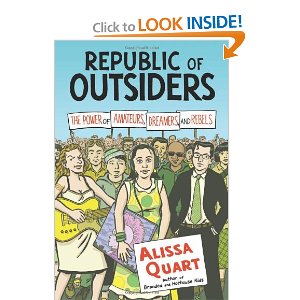
51URURQbTeL._BO2,204,203,200_PIsitb-sticker-arrow-click,TopRight,35,-76_AA300_SH20_OU01_There are many reasons to check out veteran journalist Alissa Quart’s new book, Republic of Outsiders: The Power of Amateurs, Dreamers and Rebels. And not just because I love the graphic cover or because she is my good friend. Well, maybe those are reasons 2 and 3. But don’t take my word alone.

The book is generating some well-deserved buzz: Approval Matrix of New York Magazine, Flavorwire’s top books of August, excerpts in The Nation and O.

So what’s it about? Outsiders who seek to redefine a wide variety of fields, from film and mental health to diplomacy and music, from how we see gender to what we eat. Professional and amateur filmmakers crowd-sourcing their work, transgender and autistic activists, Occupy Wall Street’s “alternative bankers.”  These people create and package new identities. They are “identity innovators”, pushing the boundaries of who they can be and what they can do–and moving the mainstream as they go.

My favorite chapter, no surprise, is the one titled “Beyond Feminism.” Here, Quart profiles a number of transpeople and reflects on how the thinking about gender-as-spectrum is moving the dial:

They were innovating their own identities but also trying to alter feminism itself. Transcending and remixing sex stereotypes, they believed, was a necessary next stage for the development of both men and women. In order to obtain greater equality for all, they thought, we must look again at how gender biases and clichés limit all of us.

Deeply reported, the book at large explores how, as stated on Amazon, “without a middleman, freed of established media, and highly mobile, unusual ideas and cultures are able to spread more quickly and find audiences and allies.” It’s a close look at those for whom being rebellious, marginal, or amateur is a source of strength.

Writes Publishers Weekly, in a starred review, “Quart’s profiles are thoroughly researched and admirably evenhanded.” Says Booklist, “Lots of good food for thought and solid inspiration for those who feel stifled by traditional choices.”

Ever feel like an outsider? Ever hunger for a sharp cultural analysis of how the margins inform the center? Folks, this book is for you.
660b_banner-large-full-color-scribbleAs someone immersed in the process of writing a graphic memoir, and a serious newbie, imagine my delight when I came upon the Ladydrawers Comics Collective. Imagine my further delight when I learned that this collective is based in my new hometown, Chicago.  I waited all of three seconds before reaching out to learn more. The result is the interview below, with three of the collective’s members who were gracious enough to answer my (myriad) questions.

Anne Elizabeth Moore is a Fulbright scholar, a UN Press Fellow, the Truthout columnist behind Ladydrawers: Gender and Comics in the US, and the author of several award-winning books including Cambodian Grrrl (Cantankerous Titles 2011),  Unmarketable (The New Press 2007), and New Girl Law. Fran Syass is a filmmaker and artist from Chicago and recently graduated The School of the Art Institute. Lindsey Smith is an undergraduate student at The School of the Art Institute of Chicago and currently pursuing a Bachelor of Fine Arts degree with a focus in Animation and Film.

Here, they talk to me about hybridity, intersectionality, love affairs with comics, gender and racial bias in the comic-book world, their new documentary film, breaking even, and what Jane Addams has to do with it all.

Enjoy! – Deborah

ladydrawers080111_2GWP: Anne, you founded the Ladydrawers Comics Collective after a decade in the comics industry and were recently called “one of the sharpest thinkers and cultural critics bouncing around the globe today” by Razorcake. I understand the collective began in 2010 as a class you taught at the School of the Art Institute of Chicago, with volunteers from outside of academia and professional cartoonists coming in to talk to the students. Three years later, what’s your vision for the collective now?

ANNE ELIZABETH MOORE: Well, the research we use began a decade ago, and I did start teaching a class in 2010, but folks didn’t really cohere as a collective until the summer of 2011.  It’s hard, as a collective member, to really have a vision for what a bunch of people will want to do for even five minutes down the line, much less six months, and our structure is pretty loose. So I’ll ask Francis to weigh in on this too. He was in that class, and is the visionary behind Comics Undressed, the documentary, so pretty heavily involved in decision-making about what we’ll be doing in the coming months. But I can tell you what we’ve committed to, besides the documentary we’re hoping to fund. In February we’ll have an exhibition in an art space in Pilsen that showcases political-themed work. And then for the next year we’ve developed a pretty amazing program for the Truthout comics I do monthly: I’ll be tracking global gendered labor issues through the production line of fast fashion and the sex trade, starting with retail workers in the US and going back through warehouses and factories—particularly in Cambodia, which I’ve written about for years. There the garment trade also raises a lot of questions about the sex industry and the really under-examined anti-human trafficking industry, which is often based on fear of sex and women’s economic power and not on facts at all. Those strips will start to appear in August, and while the first two years of the Truthout series brought in a different artist each month, these will work with an artist over a period of three months, so we can develop a better language and narrative—so it’s more evident how these things all interconnect.

Truthout’s been incredibly supportive of our work in investigative comics journalism and innovative research methodologies. We’re really excited to continue working with them.

GWP: I love Truthout, another Chicago-based gem. Next question. I’ve become intrigued with the way academic theory is increasingly, and literally, informing comics—Winnicott running through Alison Bechdel’s Are You My Mother? seems to be just one example. Women’s eNews described Ladydrawers’ work as “Making an art form out of researching and publishing findings that others might write or talk about.” What kinds of theories and research findings interest you most these days, and what makes comics an apt vehicle for knowledge dissemination?

ANNE ELIZABETH MOORE: Comics have always, always, always been a hybrid form as open to influence from the literary or academic worlds as from the pop cultural worlds. Their very hybridity makes them a good way to explore difficult ideas. But this project started as a way to look at and research first gender, and then racial bias in the comic-book world. We were never going to use a standard research paper format to present that work—that just doesn’t make sense. Still, ranking comics on a scale established by literature does the form an injustice. Comics are a visual medium. Literature isn’t. We can’t overlook that.

GWP: Speaking of overlooked, you’ve noted, Anne, that when you were editing Best American Comics (the annual anthology published by Houghton Mifflin Harcourt), there was no shortage of submissions by women, but that traditionally barriers to inclusion and visibility carry a gendered tinge. What are the continued barriers, would you say?ladydrawers081611_3

ANNE ELIZABETH MOORE: Well the first year and a half of the Truthout strips looked at the phenomenon of gender bias—and to a lesser degree, race and class bias—within comics really closely, and proved it, and provided some potential for changing it. Then more recently the last six months of Truthout strips lay out the broader cultural implications pretty clearly: there’s a historic lack of protection for women as a labor force, and a legal structure within cultural production that fails to acknowledge feminine forms or female-identified producers, which isn’t even an issue just for women, we see when we start to look at trans* identities—it’s an issue of gender policing being hidden within otherwise seemingly innocuous bodies of law like intellectual property rights. So what we end up with, which we shorthand to “misogyny” and “transphobia” when we talk about gender, and then “white supremacy” when we see the same system applied to folks with a diversity of racial identifications, isn’t actually a single, identifiable flaw within an overall system. It is endemic to the entirety of the system. The barriers are that capitalism is designed to work best for straight white men, and single-issue organizing to change it—most feminist concerns, for example—merely enfolds a new group of folks into this category of inclusion, although often for only a short time. Only an intersectional approach—that considers race and economics and physical ability and a range of gender identities—will offer possibilities for improvement, but the real, lasting barrier is getting folks who feel hurt by the system from their particular vantage point to see that.

GWP: You describe the collective as “a curiosity-driven, open-ended, exploratory body of friendly amateur researchers, concerned with who gets to say what in our culture and how they may or may not be supported in or compensated for saying it.” Any plans to collectively monetize the important work that you all do?

ANNE ELIZABETH MOORE: Interestingly, this is a project largely about, and situated within, capitalism: the “profit” to folks who work with us, while in school, are educational, and then once folks graduate, we try to make sure folks get paid or somehow compensated for their labor. But we’re also open to everyone, and part of the deal in working with us is knowing that we’ll do our best to get you something for your labor. Because comics are labor unlike any others in cultural production: it’s grueling, even compared to film, and no economy has really cohered around it for all participants. We try not to work with folks who are too ego-driven—folks who will take more than a share of the pie, whether the emotional one or the economic one—but it’s all pretty loose. Stuff happens. But the point is: establishing an economic base for underrepresented creators is important, to shift the dynamics of the industry. But to me, getting rich from doing that isn’t.

FRAN SYASS: Monetary success seems somewhat irrelevant to the Ladydrawers ethos, and I can’t find there is much profit for what we do. Though many of us are looking for our big breaks one day, this group isn’t really about that. As long as we get our research across and as long as we’re content with the work we do than, we’re just happy to break even by the end of the day.

GWP: You’re in Chicago. Erin Polgreen launched Symbolia from out here too. My partner and I are currently collaborating on a graphic memoir about the gendering of our b/g twins. Is there something about Chicago that’s conducive to innovative comics initiatives, or did I just move here at a fortuitous time?

ANNE ELIZABETH MOORE: Chicago’s been at the forefront of not just comics creation but of supporting a diversity of creators of comics for a really long time, starting with people like Jackie Ormes in the 1940s, and including folks like Dale Lavarov, Lilli Carré, Dan Clowes, and Laura Park in recent decades. Brain Frame, CAKE (Chicago Alternative Comics Expo), Trubble Club—these are some of the most innovative comics-related projects in the country right now, and what we do fits right in line with the ideas inherent in these projects: that comics can and should be parts of larger cultural movements to foster innovative dialogue. When I started the Best American Comics series, in fact, my editor sort of said, “You can move to New York now!” And I was like, I’ve already read all the Brooklyn cartoonists. This is where the real work’s at. The labor history in Chicago, in combination with the work ethic, make for really really interesting cultural production—from the social practice-based art scene to, I would argue (and will, in an upcoming essay) independent publishing in general but comics in particular. I’ve heard it echoed a lot with Ladydrawers stuff, too: we are very identified with Chicago, and I think it has as much to do with Jane Addams—who did remarkably similar research to what we do—as it does with the great comics being made here.

GWP: A number of your members are professional cartoonists, graphic artists, storytellers, zinesters, or official students of the form, but there’s also an aspiring journalist, a lingerie designer, a cashier, a fiber artist, a PhD student in rhetoric, an art professor, and a band. Many have cats. I have a cat. Can I join the collective?

FRAN SYASS: I really don’t know. I like to say you can, you already are, and you cannot, all at the same time. In my mind, it would be perfectly fine to increase the ranks of the Ladydrawers, and if you already do work similar to us or if we do work that you deeply care about why the heck not? However, there is just no official way to grant such a title to anyone, or everyone. Depending on the projects we undertake directly lead to the amount of people we need to participate in the group.

GWP: Tell us about Comics Undressed, the documentary film you’re funding through Kickstarter.  What do you hope to accomplish through the film?

LINDSEY SMITH: Comics Undressed is a documentary project that came about as an idea to formulate our findings and research into a unified piece that could easily be understood and conveyed to a larger audience outside of our ongoing comics work.  To start, Comics Undressed was sort of an idea, a project of Ladydrawers member and Director Fran Syass. When I met him he was still in the early stages of how exactly he wanted to construct the film and the best ways in which to explore the extensive research the Ladydrawers were collecting. Things really started coming together when we decided that the best way to do this was to go out into the world and hear directly from creators, readers and fans alike. What struck us most were the ways in which everyone had their own story to tell, their own love affair with comics, both good and bad. Interestingly the interviews would always end the same way, with hope for the future of comics and where it could go from here. I feel this is what we hope to accomplish overall with our film. To take a hard, long look at comics and see what is being done right and what is being done wrong and saying, “how can we make this better?”.

FRAN SYASS: I’ve always wanted to contribute more of my talents to the Ladydrawers, and most of my previous works delved less on my social, cultural, and political interests and more on my own aesthetic leanings. It seemed like the right time for the group and myself to tackle something that allowed more people to know what we were discovering about comics and popular culture. The Kickstarter we are currently running will run until the 18th of August and is our way to fund the project and hopefully break even financially in the end. The money we raise will primarily go to our equipment costs, transportation and event fees, and pay for our crew. Moreover, the financial support will help us aim for a completed film by the spring of 2014.

Editor’s note: The 18th of August is fast approaching. Help these amazing artists out by spreading this link, or considering a donation, if moved: http://www.kickstarter.com/projects/1105013300/comics-undressed. For more info, watch the video below.

You can follow Ladydrawers via:

Twitter @TheLadydrawers

Tumblr  http://ladydrawers.tumblr.com/

Check out the Truthout strip here.

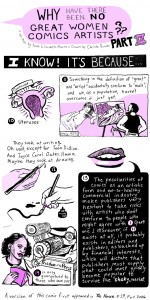
Full-page links to comics reprinted above:

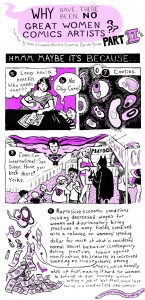
Why Have There Been No Great Women Comics Artists, Part 2

Why Have There Been No Great Women Comics Artists, Part 3


3-17-12-Trayvon-Martin_full_600Simone Ispa-Landa, Assistant Professor in the Department of Human Development & Social Policy at Northwestern University, is a new dear friend and fellow mama with a pen.  A sociologist who researches adolescence, race and ethnicity, gender, and (most recently) stigma and the effects of criminal record labeling, she teaches courses on qualitative methods. She is fiercely feminist in her intersectional approach, a passionate scholar grounded in the here and now. Below, she responds to the current conversation about what Black parents can and should tell their kids about how to stay safe. It’s not Black families that are failing in their efforts to protect their children, she reminds us. And she’s got the analysis to back it up.  Here’s Simone.  –Deborah Siegel

Three weeks after George Zimmerman’s acquittal, it’s a good time to reflect on a curious conversation that has been unfolding in its wake – one about what Black parents can and should tell their kids about how to stay safe and survive. Obviously, these are great – and unfortunately necessary – conversation for families, and especially Black families, to have.  But on a national level, I think we need a different conversation. Instead of talking about what parents can do and say to keep “at-risk” kids safe, let’s talk about how race matters for both “at-risk” and privileged kids.

Feminists working in the intersectionality framework have long noted that representations of Black women as bad mothers and Black men as absent fathers are important cogs in an ideological machine.  This is the machine that produces images of Black youth as “bad seeds” – on the way to becoming high-school dropouts, dangerous criminals, irresponsible parents, or just plain poor.

The recent events surrounding the shooting of Trayvon Martin only confirm the idea that Black youth – and especially Black males – face a world of hazard that most White people cannot even imagine.  After all, how many White parents have to worry about their teenage sons being shot and killed when they leave the house to go to the store? Or face a court system that pretends to be “race-blind” and repetitively silences the very issues of race that lie at the heart of its most troubling cases?

That said, the entirely sad and perhaps utterly predictable unfolding of the Trayvon Martin case, from the moment the 17-year old first attracted the attention of an armed neighborhood watch volunteer as “suspicious” to the defense attorneys’ devious attempts to reconfigure our image of Trayvon Martin from victim to “dangerous Black male thug” – should force the nation to rethink the spurious notion that Black families – and especially mothers – are responsible for the tragedies that disproportionately befall their children.

Black families are not failing in their efforts to protect their children.  Rather, it is the broader society – including the lingering effects of centuries of race-based exclusion, segregation, and cultural devaluation – that are making it so difficult for Black families to keep their kids safe.  In fact, it’s possible that the whole notion of “at-risk” Black youth would fade into an old-fashioned anachronism if our public institutions were half as committed to the welfare of the next generations of Black youth as their families were.

Indeed, research by people like Signthia Fordham suggests that many Black parents engage in hyper-vigilant surveillance and monitoring of their children’s whereabouts, all to guard their children against the kinds of danger that more privileged parents don’t even have to consider.  Further, while privileged suburban kids might bristle against their parents’ rules about cars, sex, homework, and drinking in bids to show off their autonomy, many Black kids in this country don’t have that luxury.

In my recent research, I examined how a sample of urban Black youth understood their parents’ rules and monitoring practices.  The participants in my sample legitimized even fairly restrictive parental restrictions as reasonable – as appropriately attuned to the hazards they faced.  The teens in my sample believed that following parents’ rules was critical for staying safe – and achieving future economic security.  In fact, the accounts of the urban Black teenagers whom I interviewed strongly diverged from accounts of more privileged American teens, who researchers like Amy Schalet, author of Not Under My Roof: Parents, Teens, and the Culture of Sex, describe as rebellious and prone to “sneaking around” behind their parents’ backs.  In my research, I theorized that the adolescents in my sample were different from more privileged (White) kids, in part because they could not afford to go off the straight and narrow. They didn’t have that freedom.

As many critical race scholars have argued, everyone in society is a racialized subject.  Part of being White means benefiting from the fact that whiteness in American society still functions as the universal, high-status, and unstated “norm,” and non-whiteness as different, low-status, and visible.   When white kids wander into their own or others’ neighborhoods, they are benefiting from the privileges that come from belonging to this “unmarked group.”  And, as Trayvon Martin’s shooting shows, belonging to a group that is marked as different, low-status, and visible can be incredibly dangerous, regardless of how well (or not) your parents prepare you for this reality.

So, instead of dissecting all the things parents of “at-risk” kids – and the kids themselves – should be doing to stay safe, let’s start a new conversation about all the ways that society can shift to make this a place where it’s easier to be a parent, and where being a kid means having the luxury (even if only occasionally) to rebel – without paying a tragic price.


On October 9, 2012, Malala Yousafzai was shot on a bus in Pakistan. Last month, she addressed the UN about the need for free, compulsory education for all children around the world.

Malala has inspired many people in the global campaign for girls’ education—a campaign that has partly provided inspiration for a new Pakistani female superhero, “Burka Avenger.” Created by entrepreneur and pop star Haroon Rashid, Burka Avenger is a cartoon series centered on the adventures of Jiya, a mild-mannered schoolteacher. Disguised as Burka Avenger, she fights for justice and education with her martial arts skills and her weapons of choice: books and pens. (Think Clark Kent in a sleek burqa.)

Much of the coverage in the West has touched on the feminist critique of Burka Avenger’s costume. The BBC quotes Marvi Sirmed, an Islamabad-based journalist and human rights activist, who observed the following problem with the show’s message: “you can only get power when you don a symbol of oppression.” Karachi-based writer Bina Shaw asked the following on her blog:

Is it right to take the burka and make it look ‘cool’ for children, to brainwash girls into thinking that a burka gives you power instead of taking it away from you?

In defense of his character’s burqa, creator Rashid said the following on NPR:

We chose the burqa because of course we wanted to hide her identity the way superheroes do. She doesn’t wear the burqa during the day—she doesn’t even wear a headscarf, or a hijab or anything like that; she goes about her business as a normal teacher would. And so she chooses to wear the burqa, she’s not oppressed… and on the other end of the spectrum, a lot of female superheroes in the West are objectified, and sort of sexualized in their costumes, like Catwoman and Wonder Woman, and that certainly would not work here.

What remains to be seen is what kids in Pakistan will make of the show—arguably what matters the most. As an English professor, I think about this all the time. As a parent, I think about this every time I talk with my kids about what they read and watch. It’s really quite remarkable, the way we all can create such different meanings out of the stories and images that surround us.

I’m reminded of a review written earlier this year by Lori Rotskoff, one of the editors of When We Were Free to Be: Looking Back at a Children’s Classic and the Difference It Made, about her experience watching “Charlie’s Angels” as a young girl in the 1970s. She observes that

In hindsight, I see that my nine-year-old mindset didn’t jibe with second-wave feminists’, who viewed the Angels as braless bimbos or, worse, as promiscuous pawns in a misogynist enterprise. While the Angels were hardly poster girls for radical feminism, many of us young female spectators regarded them as tough and talented, not titillating.

How will Pakistani children view Burka Avenger, and what messages will they take from her and her superhero costume? Only time will tell.

I enjoy going to Comic-Con. The creative costumes and the variety of people in them, old and young, fat and thin, gender normative and gender queer, as well as the diversity of non-costumed attendees gleefully taking pictures with those in costumes make the event feel like a huge, four-day long Halloween. I also enjoy the coverage of shows and movies I love, the throng of people devoted to their love of “geeky” or “nerdy” stuff, the fact that the crowds are as diverse as the shows, texts, writers, and so on the Con features. In short, I am a fan of Comic-Con. That doesn’t mean I can’t also be critical of it. What am I critical of? Well, two things in particular. One, the fact that women are now at least 40% of the attendees but are not anywhere near 40% represented on panels or in Con content. And two, the misogynistic, prurient atmosphere that sometimes rears its drooling, leering head wherein (usually females) are objectified and/or harassed by others.

Regarding content, the panels themselves are still largely a “male domain.” This has not changed in the past three years I have attended. As in the media world generally, most directors, writers, producers and lead actors featured are male. And, even when there are females on the panels, males often dominate discussion. As a case in point, the Divergent panel.

Neil Burger (the director of the Divergent film) did most of the talking even when the moderator directed questions to the AUTHOR of the series, Veronica Roth. Burger was much like the dominator of the Doctor Who panel, Steven Moffat, who did the majority of the talking. Acting as if he had CREATED Doctor Who, Moffat said at one point, “the only way to write anything is to write for yourself.” An interesting claim while sitting in a hall filled with 6,500 fans who apparently don’t mean a thing as it’s all about YOU Steven. In contrast to the egotistical-sounding Moffat, Matt Smith and Jenna Coleman were very personable and funny and THANKED the fans.

A nice variance to these white male dominators was Alfonso Cuaron, director of the upcoming Gravity, starring Sandra Bullock, who defended his choice of casting a female lead and noted his dismay that such defenses are still necessary (for a post on this, see here).

Though Cuaron displayed an awareness of the gender disparities within entertainment media, neither the Divergent panel nor the Doctor Who panel offered much commentary on gender, something that seemed glaringly absent given the Katniss-esque awesomeness of the main character Triss in Divergent as well as the recent buzz about casting the Doctor as a female (as here).

On a positive note, during the Supernatural panel, Jensen Ackles (Sam) compared the new character Kevin to Katniss (how often are males praised for being like females, let alone male characters praised for being like a female character?!?) and Felicia Day (Charlie) pointed out the nearly all male cast and creators of Supernatural, ribbing others on the panel that “I think the show needs a Teflon vagina.”

Speaking of Teflon vaginas, a show that has multiple of these is Dexter, and during the panel Michael C. Hall insisted a key part of why the show is so good and so successful is that the writing staff is half female. (Other shows, please take note!!!!)

The Vampire Diaries panel, another show with female writers, also deserves a shout-out for the panelists astute handling of the creepy question from a mother in the audience who shared that she is trying to teach her daughter the “values of abstinence” by showing her “edited” episodes of the show and asked if the panelists would support her abstinence endeavor. After friendly joking regarding how she sees viewing Vampire Diaries as “abstinence training,” the panelists vehemently refused to support her abstinence agenda with reference to sex as pleasurable, important, and natural.

And, though Comic-Con tends to be more about loving shows and geeking out over what would happen if Hans Solo met Indiana Jones (a question posed to Harrison Ford during the Ender’s Game panel), political analysis was not entirely absent. Ford, for example, made references to Ender’s Game being very much about militarism and moral complexity while Terry Gilliam mocked NSA spying practices in his spoof about his upcoming film Zero Theorem.

I was unable to attend any of the panels focused on females which tend to have the most pointed discussions of gender – an illustration of a point often made by Women’s Studies professors, that if you don’t have “Women” in the title or description of courses (or, in this case, panels) they are often left out, as if “male” equaled “human.”

Holly Derr, writing on some of these gender-specific Con panels for Bitch noted the takeaway she got was “the female experience is the human experience, people just aren’t trained to think that way.” Indeed. If they were, we would not need gender-specific panels in order to have more gender equitable panels.  Alas, as “male” is still perceived as the human norm, many Comic-Con panels are predominantly, if not all, males.

Sadly, this was the case at the “Zombies in Popular Cutlure” panel, one of the panels I was most looking forward to given I am currently working on a book analyzing the zombie genre from a feminist perspective.

Oh well, despite not one female on the panel, nor any discussion of gender in the zombie oeuvre, I did see a number of fabulous females dressed as zombies or in zombie-related costumes – one of which was a telling commentary on, well, quite a bit. She wore a tank top and shorts. Nothing unique in San Diego. What turned her outfit into a costume with a subtext of political commentary was what she had written on her shirt in blood-colored paint: “Slutty Victim.” Whether she meant this as a feminist statement or not, I do not know. But I took it as one. The cursive claim emblazoned across her chest calls to mind the rape culture in which we reside, in which women “ask for it,” as well as the Comic-Con culture wherein some attendees feel entitled to ogle and, in some cases, sexually harass and/or assault, the females that to them are no more than “slutty victims” for their violating gazes and gropes.

Admittedly, there are many positive interactions surrounding the costume features of the Con. For example, one can hear mutual compliments between those in innovative, creative costumes and witness humans of all varieties anxious to take pictures of costumed attendees, a practice that is usually filled with appreciation and revelry. As my professor friend describes it, this gives the Con a carnivalesque atmosphere that allows for positive expressions of geekdom, sexuality, and gender expression.

On her experience as a first time Con-attendee she writes, “As a feminist, I was a little nervous about what it would be like at the Con…because of the reputation of geek culture as male (or masculinist—with its scantily-clad women with impossible curves) but I really found it to be quite friendly and welcoming. In fact, for me, I felt like it was a relatively safe space for women to express their sexualities publically and positively.  I saw a range of women of different ages, body sizes, ethnicities, and class backgrounds dressed in revealing or sexualized outfits or costumes, and I personally felt safe enough to wear what I considered to be a “sexy” outfit on Saturday.  The ubiquitous presence of cosplayers is one of the (many) things that gives the Con a carnivalesque atmosphere in which certain norms about sexuality (such as who can be considered attractive, who “should” wear revealing clothes, or what it means when someone is wearing a sexy costume) can be tested and perhaps temporarily transcended.  But, among all of the costumes and scantily-clad women, there also seemed to be a profound acceptance for the “non-sexy” woman, or the awkward geek who does not perform the various rituals of femininity as expected, which added to the welcoming, carnivalesque atmosphere.”

Though I agree the Con provides a carnivalesque atmosphere, sometimes the more freeing aspects of carnival transform into behavior that is more in line with domination and assault. On that note, what I don’t love about Comic-Con are is its hyper-pornified aspects (though these are thankfully not its predominant aspects), not only because I take my 14-year-old daughter with me, but because there are LOTS of children in attendance. I could say the same thing of the world in general – it is far too hyper-sexualized in a negative, objectifying way, and there are LOTS of children in the world. Can we shield children from sex? Should we? Of course not! But must we give them the message that when other humans dress in a certain way, particularly female humans, that unwarranted grabs/comments/leering is A-ok? I think not. Admittedly, this hyper-porn feel was much more readily apparent outside the walls of the convention than inside it, especially in the surrounding Gaslamp area and the food truck lot. This inside/outside dichotomy is interesting, and one I hope to explore further next year. Is the Convention Center more “conventional” and “safe” due to the fact only ticket holders can enter, to its formal convention hall feel, to the ubiquity of Comic-Con staff and volunteers, to the fact no alcohol is sold inside? Whatever the reasons, “inside” was less-pornified than “outside” – not because there weren’t sexy, flesh-baring costumes – there were  – in spades! – but because the reactions to such costumes were generally less objectifying. To clarify, I would class “objectifying” reactions as those that treat another human as an OBJECT rather than as a person. It’s when the eyes of another takes on a leering, intrusive, non-consensual gaze that feels predatory. This objectifying gaze, when accompanied by comments or actions, can easily slide into harassment. (For posts of sexual harassment at Con’s see here and here and here. For the Con Anti-Harassment project see here.)

Thankfully, the atmosphere was overall more carnivalesque than prurient this year, a factor I appreciated very much given the first year I attended felt far more pornified and icky, especially in the exhibit hall and surrounding outside areas of the Con.

Now, if only we could have the Con content represent the fact that the female experience is the human experience by including women on the majority of panels. Even in cases where casts and creators and writers and illustrators are all male, there is no reason female moderators can’t be utilized. And, how about some acknowledgement of the fact that male dominated shows/films/comics etc are a PROBELM?

I may be waiting awhile to see gender equitable panels and a Con devoid of females treated as “slutty victims”, but, until then, I will revel in the Con’s more enjoyable aspects while keeping a critical eye on those areas in dire need of improvement.


Janelle Jones / CEPR

Janelle Jones, Research Associate at the Center for Economic and Policy Research in Washington, DC, gives Girlwpen an update on her most recent CEPR report. Janelle Jones researches and writes on a variety of U.S. labor market topics, such as unemployment, job quality, and unions. (Bio here.) Jones’ bottom line: Our better-educated, older and more experienced black workforce still has seen a fall in the share of good jobs over the last 30 years.

In a recent report, John Schmitt and I demonstrated that despite large increases over the last three decades in educational attainment, black workers are less likely to be in a “good job” than they were three decades ago. We define a good job as one with good pay, health insurance, and a retirement plan. Even with our limited definition of a good job, this disheartening pattern holds true for both black men and black women.

Between 1979 and 2011, the share of black men with a high school degree or less fell almost by half (from 72.6 percent to 43.4 percent), and the share with a college degree nearly tripled (from 8.1 percent to 23.4 percent). Despite this massive improvement at both ends of the education spectrum, black men overall and at every education level – less than high school, high school, some college but short of a four-year degree, and at least a four-year degree – are less likely to be in a good job today than three decades ago.

Over this same time period, black women have made even more educational progress. Between 1979 and 2011, the share of black women with no more than a high school degree fell from about two-thirds (66.7 percent) to about one third (34.9 percent), and the share with at least a four-year degree more than doubled (from 12.9 percent to 28.5 percent). As a result, in 2011, a higher share of black women had a college degree than black men. However, similar to black men, black women were less likely to be a good job in 2011 than in 1979 at every education level.

Although there were large improvements in educational attainment for black women and black men, only black women experienced increases in good jobs. Because the trend lines for black women and black men have moved in opposite directions, the gender gap shrank steadily since 1979. The good news is that black women have continued to improve their standing in the labor market. However, in every year since 1979, and at every education level, black women remained less likely to be in a good job than black men.

These substantial gains in education tell us that a lack of “human capital” does not appear to be causing the difficulties black workers face in the labor market. Instead, one cause of these difficulties is the deterioration in the bargaining power of low- and middle-wage workers, which includes a disproportionate amount of black workers. Decades of long-term economic trends – like a fall in the value of the minimum wage, decreased unionization, and the privatization of local and state functions – have taken away the bargaining power of workers, and had a disproportionate effect on blacks workers. Another factor in the lack of payoff for black workers is ongoing labor-market discrimination. In particular, black women must overcome a nasty form of double discrimination, which includes the need for pay equity, affordable childcare, and protection from sexual harassment at work on top of unfair practices based on race.

Black workers have made significant and often overlooked investments in education in the last three decades. The lack of growth in good jobs answers the main question of the report, has education paid off for black workers as a group? Short Answer: It has not.

Want to hear more? See Janelle’s interview at BloombergTV.

In 1968 the documentary Hunger In America aired on CBS. The film exposed the prevalence of hunger and malnutrition in the United States. I was among the many who were shocked. The sight of children with distended bellies begging on the streets of Calcutta had kept me awake nights as I traveled back from my first job teaching in Taiwan. A year later I’d married a man who worked for CARE and often accompanied him distributing food and cooking oil to villagers in the Dominican Republic. I knew too many people in too many places were hungry every day. I knew that poverty and hunger were ugly killers.  But until the documentary aired I was ignorant of the extent of hunger and malnutrition in the United States.

The film and the outcry that followed generated additional Congressional support for efforts in various areas to make good use of food surpluses and feed people in need. By 1974 the Food Stamp Program, (now known officially as the Supplemental Nutritional Assistance Program (SNAP), was operating across the nation.

Hunger continues to plague America, but for four decades food stamps have been one of the most effective and efficient federal efforts directed toward the alleviation the severe, long lasting consequences of malnutrition. The food stamps have done more than any other government program to lift children out of extreme poverty.

Thus last week’s passage of a farm bill without any consideration of food stamps and other food assistance programs, struck me as more than just another Congressional wrangle between political parties with divergent agendas. It went beyond the anti-woman/anti child proposals cloaked in pious platitudes. This was a vote in favor of hunger, a pro-poverty vote.

The republican rationale for separating farm policies from food for the hungry went like this: separation facilitates cuts to agribusiness subsidies; food stamps can be addressed later.  But few could miss the obvious agenda in conservative rhetoric: drastic cuts to ‘wasteful spending’ on nutrition programs for those seen as lazy, work adverse freeloaders responsible for swelling the ranks of program beneficiaries.

This rationale flies in the face of facts. Forty one percent of food stamp recipients live in households with at least one wage earner and less than ten percent of those receiving food stamps are also receiving welfare benefits.

Furthermore, years of data on the food stamp program indicate that in economic downturns more people need and use food stamps; but as the economy improves, the number needing assistance declines. Studies also reveal that more than seventy percent of food stamp recipients live in households with children, many headed by single working mothers; more than one-quarter live with senior citizens or people with disabilities. Put another way forty-seven percent of all those receiving food stamps are children and a significant number of recipients are unable to work due to debilitating conditions.

Far from being a rip off of taxpayer money, the SNAP program is an investment in the nation’s future. Research repeatedly shows that children with nutritious diets are healthier and do better in school than their malnourished classmates. Studies comparing children living in poverty who receive SNAP assistance with those who do not find consistent advantages in healthy development for program beneficiaries. Pregnant women with healthy diets give birth to healthier babies.

But the positive benefits of food stamps are not restricted to infants and children.  Benefits extend well in to adulthood. Last November the National Bureau of Economic Research released a working paper, “Long Term Impacts of Childhood Access to the Safety Net”, co-authored by Hilary Hoynes, Diane Schanzenbach and Douglas Almond. Their research revealed that adults with access to food stamps as children in the 1960s and 1970s, particularly in the final trimester in utero and early childhood, had significantly better health than adults from similar backgrounds who had not received nutritional assistance.  Better health included lower incidents of serious metabolic syndrome conditions such as heart disease, diabetes, and obesity.  Furthermore, women receiving food stamp assistance as children fared better economically in adulthood. They were less apt to be receiving safety net benefits than similar adult women without access to food stamps during childhood.

Giving children a nutritious start in life is the first step in raising healthy, economically productive, community-minded citizens. No democracy can succeed with out such a citizenry.  We knew this more than sixty years ago when the first major pieces of the food stamp program were initiated. Today’s willful “forgetting”  is shortsighted and dangerous. Those who do so should not be allowed to argue that they “didn’t know the facts”. Ignorance of the law is not an acceptable excuse in legal proceedings; ignorance of fact should be viewed as equally unacceptable in matters of public policy.


http://yagoshi.deviantart.com/art/Bubbles-s-Idea-155229006(Or, What All Good Thought Leaders Can Learn from Academics, and What Academics Can Learn from Business, Too)

When LinkedIn launched its thought leaders feature in October 2012 (Follow Richard Branson! Follow Barack Obama!), they were flooded with aspiring contenders who self-nominated, then closed off applications once they reached 150. No matter that the list seemed to skew (ahem) male. Some LinkedIn members created forums to figure out the formula to get in, to no avail.

But if you want to know who has really cracked the code (or, a piece of it, anyway), look to academics.  Academics are the original, not to mention some of the most original, thought leaders. They lead with their thought—always have, and hopefully, always will. The time is ripe to learn from the masters. Because as the term “thought leadership” becomes more and more widely applied, some important principles continue to get lost.

How did such a lofty term become DIY, and what does “thought leadership” actually mean, academic colleagues ask me these days, in a business sense? Coined in 1994, according to an oft-cited Wikipedia entry, by strategy+business editor-in-chief Joel Kurtzman, the term “thought leader” initially referred to interview subjects covered in his magazine. Used here and there over the next decade, “thought leader” fast became one of the cool-kid buzzwords of the 2010s, so much so that we are now seeing a backlash against the term.

In the iconoclastic spirit of Colbert, “I can thought leadership, and so can you.”

Definitions abound. Last year, Social Strand Media’s Tracy Sestili published a list of 21 of them.  In May 2013, Mashable’s James O’Brien offered a longer “true history” of thought leadership tracing the term’s origins back to McKinsey Quarterly circa 1964 and noting that while social media has since brought about an incredible democratization, it has also wrought a dilution. Self-nomination in the Twitter-sphere and on the conference circuit does not a thought leader make.

But what does?

Two core traits, I believe, define thought leadership, at heart. And academics know these traits well.  They are:

1. Long-term commitment

To all those seeking a quick fix, remember that thought leadership is cumulative. “Rather like achieving academic tenure,” says Rebecca Lieb in Mashable, “[t]hought leadership requires a continuum of wisdom, accomplishment, and a body of published work that stands the test of a degree of time.”

There’s no fast track. It takes work. And so, thought leadership can hardly be monetized right away.

2. Authenticity

Thought leaders are not manufactured. Instead, they lead from within.

Lewis Howes, who literally wrote the book on LinkedIn writes over at Clarity blog: “Thought leaders are indispensable because they’re custom made.  Their unique experiences and choices have shaped who they are and how they perceive their environment, which makes them one of a kind.”

Big agree. And more on that in a future post.

But back to my point. Aspiring platform creators, idea entrepreneurs, social entreprises, and businesses can, in cultivating authenticity and commitment, take a page from a professor’s book. In all fairness, can’t an academic (and other expert individuals seeking a public voice) learn from industry-driven thought leadership gurus, in turn?

Yes.

From Sestili’s compiled list of 21 definitions, all of which come from the business realm, here are five that I believe academics seeking a platform beyond academe would do well to absorb*:

  1. Shel Israel: A thought leader is someone who looks at the future and sets a course for it that others will follow. Thought leaders look at existing best practices then come up with better practices. They foment change, often causing great disruption.
  2. Jeanine Moss: Thought Leadership is the ability to aggregate followers around ideas to educate, influence and inspire.
  3. Tom Paul, COO Pop-Art: To be a company that exemplifies thought leadership, you need to have an idea engine, a concept forge, AS WELL AS [sic] an outward-leaning communication stance combined with a desire to raise the playing field – a capability to not only learn new things, to not only discover them for the first time, but to educate others – selflessly.
  4. TechCrunch: (on being a thought leader) someone who notices things so big and so obvious that everyone else manages to overlook them.
  5. Scott Ginsberg: A trusted source who moves people with innovative ideas.

In other words, for scholars to be thought leaders in the more popular sense of the term, they need to develop a wider platform, accrue followers beyond their students, embrace forms of communication that may be new to them, and—my personal favorite—move people, publicly, with their ideas.

How do you define “thought leadership”? Do you bristle at or embrace the term? Drop me a line in comments, or tweet me @deborahgirlwpen. I’d love to hear.


*For one of the more thoughtful takes, in the business realm, on creating thoughtful thought leadership, see this piece by Daniel W. Rasmus at Fast Company.

Image source: Yagoshi

Thanks to Chloe Bird, Ph.D., Senior Sociologist at RAND Corporation, for sharing this new health podcast.

For nearly 30 years, heart disease has killed more women than men in the United States. Yet women continue to face lower rates of diagnosis, treatment, and survival. Many other diseases are disproportionately prevalent among women and may affect them differently, requiring gender-specific approaches to diagnosis and treatment. The disparities in care might have developed unintentionally, but the time has come to narrow them deliberately. In this recording, a panel of experts discuss women’s health, heart health, and the potential effects of gender on health.

This month’s column features a new guest author: Adrienne Trier-Bieniek, Ph.D. is a sociologist and author of the new book Sing Us a Song, Piano Woman: Female Fans and the Music of Tori Amos (Scarecrow Press).

____________________

I have spent the better part of the last five years trying to understanding how women use music to heal after  experiencing trauma.  When I was interviewing women for my book, Sing Us a Song, Piano Woman, one comment stuck in my head from a woman named Madeline.  Madeline talked about how she used to be into music by hair-metal bands.  She said, “Growing up, all my favorite bands were male artists.  Um, maybe it’s just that now I see that their message is from their point of view.  And I internalize that and maybe that’s why I made all the shitty choices that I made.  I think that maybe the reason that I only listen to female artists is because I just would rather have their messages in my head.” And this comment wasn’t rare.  Many women said that they found empowerment/comfort/salvation in music written and performed by another woman.

Now, I am totally aware that women can listen to male bands to feel support and vice versa.  However, one thing that I think it missing from conversations about feminism and pop culture is how women use music by feminist musicians as a way to heal after they have experienced trauma. This was the premise of my research for Sing Us a Song, Piano Woman.  The women I spoke with selected Tori Amos’s music as their self-care guide.  They were very much aware that this help was coming from a feminist performer and, because of that, found her music to sit close to home.

From this study I took away a few helpful tips for connecting feminism with music and healing that I would like to share.  In no particular order:

Find an anthem:  I don’t think it gets much better than listening to powerful women belt out songs like it is the last time they will have the opportunity to sing in their lives.  Whether it’s Sister Rosetta Tharpe, Aretha, Tori Amos, Ani DiFranco, Janelle Monae, Beyonce etc.  Feminist musicians approach their songs with an eye toward empowerment, equality and expressing the experiences of women.  One of the reasons many of the women I spoke with enjoyed Tori’s song “Spark” was because it addressed her experience with miscarriage.  Healing from the loss of a child is hard, but hearing a performer address her emotions can be helpful.  So find your feminist anthem.  (I have many.  Some, like Aretha’s “Respect” and Ani’s song “Alla This” I will gladly cop to.  Others are embarrassing but help me get through the day!)

– Create While you Listen:  In 2007 I was a grad student at Virginia Tech  when my college became the site of the worst school shooting in U.S. history.  One activity that got me through was creating art while listening to Tori’s music and trying to use the lyrics to illustrate my feelings.  Many of the women I spoke with did the same thing with writing, crafting, singing and dancing.  Song lyrics became immortalized through their bodies, art and voices.  What is even more important is that this exercise requires you to think about the lyrics you are repeating to yourself.  What do they mean?  Are they empowering?  Of course we all can rattle off songs meant for entertainment.  But if there was ever a chance to think about the impact of music on our identities, it is when we are expressing ourselves through art and being vulnerable.

– The Feminist Standpoint:  Ok, stick with me.  In sociology (my field), the feminist standpoint basically says that women’s stories are often ignored in a culture.  So, I would encourage you to take an anthem song and use it to tell your story.  Anthems are great backdrops for activism.  They can help with speaking out about being raped, having an eating disorder, having a miscarriage etc. And, speaking out is a huge step toward breaking the culture of silence that surrounds these experiences.  I, like many of you, have found a new hero in Wendy Davis (the Texas legislator who stood for 11 hours to strike down anti-abortion laws).  She used her voice and inspired the band The Bright Light Social Hour to record this song called “Wendy Davis.”

Finding feminism in music (for both female and male artists) is key to changing the ways pop culture stereotypes women.  Finding feminism in music to help us heal from trauma is key to finding empowerment in vulnerable moments.  What do you listen to?

____________________

– Crossposted from Feministing with permission –