Archive: 2013

Recently, 26-year old YouTube beauty guru Michelle Phan launched her cosmetics brand in collaboration with beauty giant Lancome. Just shy of 5 million subscribers, her YouTube videos have made her a millionaire and an Internet celebrity.

At the beginning of American consumer culture in the early twentieth century, women owned local service-oriented shops and shared beauty rituals as a part of “the personal cultivation of beauty – the original meaning of ‘beauty culture’” (as described by historian Kathy Peiss in her book Hope in a Jar: The Making of America’s Beauty Culture). This beauty culture was contemporaneous with the first wave of feminism, and its founders employed women in their businesses, actions that Peiss characterizes as “a form of feminism.”

YouTube beauty gurus

Now, YouTube beauty gurus cultivate community around beauty, reviewing products and demonstrating various makeup “looks” through tutorials that mostly mimic those seen on fashion runways, on celebrities, and in women’s magazines. An underlying theme in their communication indicates how much more confident they feel about their appearance when they use specific products or craft their appearance in certain ways. Such declarations of empowerment are encapsulated in a former tagline of one vlogger: “conquering the world one lipgloss at a time.”

Certainly, in an environment that places immense pressure on women to improve their appearance (through makeup, hair styling, diet, exercise, cosmetic surgery, and so on), beauty vloggers have cultural cachet. Through their expertise about beauty products/techniques, they can gain subscribers and, if they develop a sufficient following, they can acquire financial power via the YouTube Partner Program, through which vloggers earn anywhere from a few thousand dollars to six figures per month. In addition, as in Phan’s case, they can leverage their online popularity/visibility to build their own beauty brand.

For many women, engaging with makeup of various colors and textures can be an aesthetic, artistic, playful, and adventurous experience. The issue becomes sticky, however, when women accept makeup as not just a means of empowerment, but as the tool for agentic self-realization. This point holds especially true when cosmetics are promoted by a beauty guru (who may be doubling as a brand ambassador for a beauty brand or for her own brand) whose primary interest aligns more with consumerism and conformity than with creativity and self-expression. In this case, beauty gurus’ expertise and their videos work more as infomercials than as vehicles for women’s inspiration via beauty, thereby benefitting corporate — instead of women’s — power.

So, then, I ask: What does the beauty expertise of vloggers and the women who watch them signal about current cultural values regarding female empowerment? Critically thinking about the role of beauty (and, specifically, the cosmetics industry) in past and present consumer culture and how these dynamics relate to women’s lives is an important place to start the conversation.

This guest post by Sarah Milstein was originally posted on The Huffington Post and is reposted with the author’s permission.

Last month, the hashtag #SolidarityIsForWhiteWomen erupted on Twitter. Started by Mikki Kendall, it immediately became a channel for women of color to call out how implicit racial bias, double standards for women of different races and overt racism are all baked into mainstream white feminism. If you’ve been following feminism for the past 150 years, you probably weren’t surprised by the range of grievances. But if you’re a white feminist and you were surprised or you felt defensive or you think you’re not part of the problem, then now is the time to woman up, rethink your own role and help reshape feminism.

While there are many reasons white feminists have to do this work, Kendall’s hashtag highlighted an important one: we cannot credibly or successfully seek societal change when we ourselves create the same injustices we rail against. In other words, the problems we face as women are often the problems we create as white people.

Since #SolidarityIsForWhiteWomen trended, I have seen excellent pieces by women of color, many suggesting steps white women can take to be better allies. Their insights are leading us toward a more conscious feminism. White women, however, need to take responsibility for educating ourselves, too. So, here are five steps white feminists — myself included — can take to check ourselves, connect more genuinely with women of color and improve feminist outcomes for people of all races. As a test of the need for these actions, consider whether you’d want the men in your life to try each step in confronting their own sexism.

1. Recognize that even when your good intentions are truly good, that’s totally meaningless. This idea is hard to accept, because our culture suggests that we should feel like heroes just for wanting not to be racist. (Plus, it’s maddening to be misunderstood.) I have gotten hung up on those two horns frequently. But what matters is your impact, not your intentions, and you don’t get credit for thinking good thoughts.

Try this on for size: when you accidentally step on somebody else’s foot, you do not make your good intentions the focus of the episode. Instead, you check to make sure the other person is OK, you apologize, and you watch where you’re going. You don’t get annoyed with the person you stepped on because you caused her pain or declare that she is too sensitive or defend yourself by explaining that you meant to step to the left of her foot. When you crush another person’s toes, as Franchesca Ramsey has pointed out, everyone recognizes that your impact, not your intention, is what’s important.

Why isn’t that the standard for saying something when you didn’t intend to cause harm? For white women interacting with women of color, we may reflexively, unwittingly assume our experience — and therefore our intentions — are (or should be) primary. I’d argue that’s rooted in our internalizing cultural messages. But whatever the root, we have to get wise if we expect women of color to take us seriously.

So, when somebody points out that you’ve said or done something racist, perhaps something that hurt them personally, the game-changing response is first to understand that your intentions are not the centerpiece of the interaction. In other words: it’s not about you, which can be a genuinely hard to see. Once you let your intentions fall away, you can focus on what the other person is saying (recommended: assume she has a very valid point and try to understand where you went wrong). It changes no games to insist that you meant to be perfectly graceful.

2. If you feel defensive when talking about race with a woman of color or reading about race in a piece written by a woman of color, assume the other person is saying something especially true. That is: use your defensiveness as a Bat Signal, alerting you to your own biases. Sure, yes, of course, the other person may have said something insensitive or unreasonable. But if you want to change the dynamics of the world (reminder: you’re a feminist, so you do), assume your discomfort is telling you something about you, not about the other person. Then use those moments to listen more carefully.

Here’s a personal example. Writing on The Toast in JulyJessie-Lane Metz, a Black woman, called out supposed white allies for a number of harmful behaviors, including writing about episodes in which a white author describes racism they have perpetrated or witnessed:

My first critique is that this [writing] re-centres whiteness. When a person of colour speaks to their own experiences of racism, they are speaking to a collective pain, and speaking truth to power. When a person with white skin privilege gives an anecdote about racism, whether their own or someone else’s, they are exposing more racialized people to this discrimination, and reasserting their own privilege. The narrative is no longer about Black victims of racist crimes and a deeply flawed justice system, it is about white feelings about Black bodies and their experiences. This is not helpful to intersectional practice, as it implies that only by making an oppression about the oppressor can power-holders work towards becoming allies. Secondly, it disregards the feelings of Black people by exposing them to further racism in an effort to work on white privilege. I do not consent to being confronted with racism in the hopes that white folks can maybe start to exorcise their own internalized issues. Allies need to do this work on their own.

The first time I read Metz’s piece, I shifted in my chair a few times, recognizing things I’d done (writing about my own racism — which I won’t link to here, out of respect for Metz’s point) and trying to justify those actions (I think I’ve helped other white people become more aware of their privilege, which is good, right?). I felt distinctly defensive. Which made me want to dismiss what she was saying. Which made me realize I should leave the tab open and re-read the post when I could do so with a focus on her experience of white allies, not mine. (Obviously, I’m made my story of reading Metz central here; I realize there’s some irony and risk in that.)

I will admit that like many would-be allies, I’d like to be recognized for my open-mindedness — however minimal it may be (in this case, I left a tab open, hello) — when I feel put off. But getting rewarded is seriously, seriously not the goal, and you have to play through that desire for a cookie. Identifying a moment when you’re shutting down, and you instead shift to listening harder, with deeper empathy, and likely with quiet self-reflection — that’s the goal.

3. Look for ways that you are racist, rather than ways to prove you’re not. There are two key ideas here. First, you can’t change behaviors you’re not aware of, and if you’re constantly trying to assure yourself you’re not racist, you’re going to miss the ways you are. Second, once you’ve accepted that you are, in fact, racist some of the time, it’s a lot easier to drop the barrier of good intentions, let go of the defensiveness and take responsibility for your actions.

For most of us, identifying our own racism dredges up shame, which is a seriously unpleasant feeling and something we want to avoid. Plus which, assuming you’re not cavorting around your neighborhood in a white hood and sheet, it may not be that obvious to you that you are racist. But the thing is: you can’t avoid it. Everyone is born with the potential for racial bias and most children acquire it very early in life, so even if you do not identify as a racist, racism is baked into you. And then it’s reinforced by our culture. No point in feeling guilty because you’re a human and the product of a racist society. But, by all means, feel bad about yourself if you choose not to identify and work against your racial bias.

As I said earlier, you’re going to have a hard time challenging your own bias if you’re not even aware of it. So, seek out ideas and people that help you see yourself more clearly. If you need a place to start, diversify your media — consume articles, books, podcasts, radio, video and TV shows made by people of color — and when white folks are portrayed critically, find ways to identify with them rather than assume that you’re different than they are. The point here isn’t to take kick off a miasma of self-flagellation, but rather to gain perspective on yourself.

For example, I was recently reading, Our Black Year: One Family’s Quest to Buy Black in America’s Racially Divided Economy. In it, Maggie Anderson, a Black corporate strategy consultant, talks about the experience she and her husband, a Black financial adviser, often have at dinner parties and office gatherings, as white people approach them:

People flock to us, asking about our backgrounds, where we live, even why my hair is “different” from most African-American women’s hair. (White folks never say “not kinky” or “more Black.” They say, “Wow, your hair is so thin!”)At some point, they tell us every detail about the lovely Black couple who attends their church or lives in their neighborhood. They want to introduce us. The logic goes something like this: They’re nice Black people. The Andersons are nice Black people. Nice people will like each other. And if both husbands play basketball, as I’m sure they must, we’re working up the Black friendship of a lifetime.

As I read, my first impulse was to think, “I’ve never mentioned (or touched) a Black person’s hair! Thank god I’m not one of those white people!” But when I let myself dwell for a minute in the scene Anderson describes, it’s clear I’ve done several of the things she rightly calls “clueless.” Centering my own behavior again: I’ve been awkwardly too friendly when introduced to Black folks at parties (see above on good intentions). When I meet people, I almost always ask where they live, without considering that my questions might come off as an investigation rather than as a way to connect (Ibid). I have definitely considered introducing Black folks in the tech sector just because they’re both Black (this, despite the fact that I really hate being introduced to women in business when the only things we obviously have in common are that we’re both women, and we both work).

These actions aren’t horribly destructive and virulently racist. But don’t be fooled by subtlety: small acts of bias make it harder to build genuine relationships. And maintaining personal distance helps white feminists stay disconnected from the concerns of people of color. So, accept that you’ll likely feel uncomfortable and embarrassed, but consider that you are like the other white folks that people of color describe.

4. Listen to people of color, even if you don’t know many. A common suggestion for white people who want to get a clue is to simply listen. Which is a critical step, and it’s especially important in your direct interactions with people of color. But what if none of your best friends are Black and you don’t work with many people of color either? As I mentioned earlier, you can make sure you’re taking in media created by people of color. You can also do a ton of thoughtful listening on Twitter — a medium that gives you legitimate access to the thoughts and conversations of people you may not know.

I’ve written before about how you can — and should — follow people of color in a respectful way on Twitter. You can also seek out some of the stellar women mentioned in the recent campaign kicked off by Feminista Jones that identified #SmartBlackWomenOfTwitter, #SmartLatinaWomenofTwitter, #SmartAAPIWomenOfTwitter, etc. If you’re already overloaded on Twitter, try a swap: for every new woman of color you follow, unfollow a white guy. You might be surprised by the effect such a simple step can have on your perspective.

5. Use your feminist powers to identify instances when people of color are under-represented or misrepresented, and speak out about it. You’re already in the habit of noticing when lists and groups include few or no women. Tweak your internal algorithm to notice when people of color are missing, too. Then say something.

Women of color don’t need us to speak for them, and there are times when standing quietly in solidarity is important. But very often, speaking up is important — not only because it may influence others, but also because it will likely influence you. As a recent Guardian piece noted: “when you’re confronted by prejudice and you don’t object to it, your own attitudes shift in a more prejudiced direction, to maintain consistency between your behaviour and your beliefs.”

Of course, there is a chance that raising an issue as a white person may help other white people see it more clearly or see it in the first place. (Indeed, if you’ve read this far, ask yourself: “Would I have stayed with the piece if it had been written by a woman of color — or might I have dismissed it early on as ‘too angry’?”) And you may wonder if inserting yourself is really progress. Instead, wonder this: If white feminists don’t strive to see what women of color see and don’t consider those perspectives as central as our own, are we truly interested in challenging injustice at all?

Attention all those of you writing a book…

In this age of the social author, those writing for broader audiences need to see themselves as disseminators of spreadable messages and sticky ideas. But how do we best position ourselves as substantive public spokespeople? What do editors really mean when they say “platform,” and how can serious writers, often more focused on content than sell, tell (and sell) the story of our expertise? How does one craft an authentic public identity by connecting connect story, self, and idea?

These are some of the questions we’ll be tackling in a 3-week webinar series I’m leading at She Writes, Thought Leadership for Writers! on Oct 1, 8, 15 @4pmPT/7pmET. Special guests Susan Cain (bestselling author of Quiet) and Christina Baker Kline (bestselling author of myriad works of nonfiction and fiction) will join me, and She Writes Press publisher Brooke Warner will be hosting. Here’s a taste, from the free sample I offered last week. The full-fledged description is below. I hope some GWP and TSP readers will join me. And thanks, too, for passing it along.


3-WEEK WEBINAR – THOUGHT LEADERSHIP FOR WRITERS!

Storytelling is the writer’s superpower. But often, we feel far less adept when it comes to broadcasting the public story of our self and our idea.  Whether we call it presence, platform, or public thought leadership, the need is the same: behind every successful author is a compelling idea to share—and the compulsion to be heard.

Join us for this 3-week online seminar with Deborah Siegel, one of the co-founders of She Writes. Siegel is an author, blogger, journalist, TEDx speaker, and coach who has tested the waters of platform-building firsthand. She  will change the way you think about platform by showing how thought leadership can organically unfold.

Join Deborah and two guest speakers (more details below) to harness your ideas and strategize an action plan that works. REGISTER HERE.

DURING THIS WEBINAR SERIES YOU WILL LEARN:

•    Ten things genuine (as in sincere!) thought leaders do
•    The power of authenticity, generosity, and “test balloons” when building your path to presence
•    How to decide which social media platforms work best for you
•    How to work on multiple planks simultaneously, without losing sleep
•    What your first, or next, step toward your Public Thought Leadership Action Plan might be
•    Why platform is a marathon, not a sprint
•    How to break through your sense of social media overwhelm
•    Best practices from leading fiction and nonfiction writers who publicly and successfully interweave self, book, and idea

CLASS 1 (Oct 1). Behind Every Successful Platform Is an Idea Worth Spreading

Special Guest: Susan Cain, bestselling author of Quiet and renowned TED speaker
• “Thought leadership,” a term historically applied to innovators in business and now cavalierly applied to anyone with a Twitter account, has become an essential element of authorial platform building. But what does “thought leadership” mean, and what does it have to do with writing, and selling, a book?  How can writers create authentic platforms that distill and spread the essence of their best self and their best ideas? We’ll start the session by learning from a master: Susan Cain.

Optional assignment: Why Me (a 1-pager describing your platform)

CLASS 2 (Oct 8). What’s My Platform? A Builder’s Guide, Board-by-Board

• The dictionary defines “platform” as follows: 1. Stage for performers or speakers 2. Flat raised structure 3. Particular policy of party seeking election 4. Opportunity for doing something. In Class 2, we’ll break it down, board-by-board, and discuss strategies for beginning or continuing our build.

Optional assignment: Thought Leadership Action Plan

CLASS 3 (Oct 15). Do’s and Don’ts: Thought Leaders Made and Born

Special Guest: Christina Baker Kline, bestselling author of Orphan Train and myriad other books
• In Class 3, we’ll take a tour through some of the most exciting current examples of author platforms and why they work. We’ll look at those who use a book to build their brand/business, and those who use a brand/business to build their book. We’ll end with targeted tips from another master, one who traverses fiction and nonfiction: Christina Baker Kline.

REGISTER HERE.

This month’s guest column* by Tristan Bridges, Ph.D., deals  with a recent research publication on a correlation between testicle size and nurturing instincts/behaviors in men.  Bridges, a sociologist at The College at Brockport, State University of New York, is currently working on a project dealing with the meanings of “man caves” in contemporary U.S. households.

__________

So…I’m going to go ahead and say that this is the wrong question to be asking. This question proceeds from a belief that testicles CAN tell us something about dads. A new study is making the rounds in the news that addresses the relationship between testicle size and parenting behavior among men (well… 70 men… not randomly sampled…). The paper is entitled “Testicular Volume is Inversely Correlated with Nurturing-Related Brain Activity in Human Fathers” in the Proceedings of the National Academy of Sciences of the United States of America. I can think of more than a few titles that might have been catchier (and clearly, journalists reporting on the research had a similar idea).

File:Paternal bonding between father and newborn daughter.jpgIn fairness, I don’t have access to the complete study (though I’ve requested it). But the problem is also in how this study gains attention in the media. It’s a great example of how a correlation combined with cultural stereotypes and assumptions can run wild. When correlations combine with popular stereotypes concerning a particular topic (like, say, the relationship between testosterone and any number of socially undesirable behaviors), questions about the science sometimes get lost because it looks like something was “scientifically proven” that we already wanted to believe anyway.

So, here’s the relationship the researchers found: men with smaller testicles tested more positively for nurturance-related responses in their brains when shown pictures of their children. The study reports that men with smaller testicles had roughly three times the level of brain activity in the area of the brain associated with nurturing. These men (with smaller testicles) were also men with lower levels of testosterone—something that has previously been shown to be associated with nurturing behavior among men.*

Side Note: Just for fun, I’d love to know how to measure testicular size. Is it a measure of circumference (in which case I’d want to know: width or height)? Is it a measure of total tissue volume? And, how is the measurement taken? There’s probably a great “How many grad students does it take to….?” joke in here somewhere. But, I’ll rise above the temptation.

The researchers, then, have found a correlation between nurturing-related brain activity and testicular volume (and, to be fair, this is right in their title). But, off the top of my head, I can think of more than a few ways of explaining this correlation differently than they have. And, if you’re not up on your research methods, a correlation simply means that two (or more) trends, variables, etc. can be shown to vary together. So, age an income might be an example. But proving that one variable or trend is actually causing another is more difficult. To prove a causal relationship, you need three things (to convince the scientists anyway):

  1. Correlation—you’ve got to be able to show that the two things you’re saying have a relationship actually have a relationship with one another.
  2. Time Order—you’ve got to be able to show that the thing you’re saying is “causing” the other thing happens prior to the change you’re claiming is “caused.”
  3. Rule Out Other Possible Explanations—even when you’ve established a correlation and can show time order in a way that favors your interpretation of the relationship, you still have to consider alternative ways of explaining the same finding.

Okay, back to the testicles. So, the study shows a correlation. And, there are really three explanations for the correlation. Either: a. testicle size is causing (or inhibiting) nurturance, b. nurturing behavior (or lack thereof) is causing testicular volume, or c. something else is to blame for both nurturing behavior and testicular volume.

Stanford neuroendocrinologist Robert Sapolsky wrote a great essay on the relationship between testosterone and violence. Sapolsky argues that there is a huge cultural bias favoring an understanding wherein higher levels of testosterone are seen as responsible for increased violence (especially in men). But, research actually favors the opposite understanding: violence causes spikes in testosterone levels (see, time order really is important). My sense is that a similar misstep is taking place in the debates about testicular volume, testosterone and nurturing behavior among men.

The authors of the testicular volume study are upfront in claiming that they are unable to actually demonstrate that testicular size is a “cause or a consequence of male life-history strategies”. However, like the relationship between testosterone and violence, they have cultural bias on their side in suggesting the relationship is causal. Cultural stereotypes surrounding testosterone create an environment in which testicle size (and associated levels of testosterone) are much more likely to be framed as the culprit.

So, a possible interpretation of this study (and the one that the media has been quick to adopt) is that some men seem biologically better suited to be fathers—to actually participate in nurturing and caregiving. But, a more complex implication could be that caregiving and nurturance are not qualities for which people are more or less biologically suited. Engagement in nurturing and caregiving behaviors causes changes in both women and men—emotional, behavioral, and, yes, physiological as well. If I had to guess what the actual relationship is between testicular volume and nurturance, I’d guess that testicular volume is a consequence, not a cause, of nurturance among men. While they haven’t proven causation, this is, biologically speaking, the interpretation with more evidence.

Why does this matter? In a culture in which women are culturally understood as responsible for the caregiving of children, it’s easy to assume that women’s nurturing qualities are somehow hardwired. Similarly, in a cultural environment in which men have (in recent history) done relatively little caregiving, it might be easy to similarly assume that they are somehow naturally ill-suited to nurture. Correlations like this let men off the hook for being bad parents. It sounds like they can’t help it. But, there are plenty of factors that work against men’s active involvement in their children’s lives in the U.S. today. They just aren’t biological.

*To be fair, this study is longitudinal and does acknowledge time order. What’s problematic is the assumption that parenting activity is the only behavior that might have this effect on men’s testosterone levels, as well as the assumption that men’s testosterone levels are naturally high prior to “partnering.” To prove that these differences in testosterone levels are naturally occurring and biologically determined, we’d need to show cross-cultural universality in men’s pre-parental and post-parental testosterone levels. I’m not aware of any research on this topic.

__________

Note: this column was originally posted on Inequality by (Interior) Design and is reposted with the author’s permission.

UCLA  Center for the Study of Women Presents

Thinking Gender

24th Annual Graduate Student Research Conference

Call for Papers

Thinking Gender is a public conference highlighting graduate student research on women, gender and/or sexuality across all disciplines and historical periods, including future ones. We invite submissions for individual papers or pre-constituted panels on any topic pertaining to women, gender, and/or sexuality.

This year, we especially welcome feminist research on: privacy, diversity, and/or demographics in the age of big data; appetites (pleasure, food, electronics); gender, sexuality, and the new brain sciences (cognitive sciences, psychobiology); the perils of “post-feminism” (feminism backlash, hypo/hypersexualities, rede­fining feminist activism); gender, sex, and criminality; pleasure and ethics (media and advertising, sexuality); gendered spaces (spatial theories, urban planning, domesticity) ; and self-staging in public discourse (reality TV, user forums, “selfi­es”/self-narration and “autographies”).

CSW accepts submissions for both individual papers and pre-constituted panels from all active graduate students. In order to give everyone an opportunity to present, we do not accept submissions from people who presented at Thinking Gender in the previous year. Also no previously published material is eligible.

Students proposing individual papers are to submit a cover page (provided on our website), an abstract (250 words), a CV (2 pages maximum), and a brief bibliography (3-5 sources), for consideration. All components are to be delivered in one document and labeled according to the submission guidelines found on the CSW website. For panels, a 250-word description of the panel topic is required, in addition to the materials that must be provided for individual paper submissions.

Please visit our website for submission guidelines:

Send submissions to: thinkinggender@csw.ucla.edu

Deadline for Submissions: Monday, Oct 14, 2013 by 12 noon

Conference is to be held on Friday, February 7, 2014, at the UCLA Faculty Center.

Event is free and open to the public, but please be aware that there will be a $35 registration fee for presenters, which will cover the cost of conference materials and lunch at the Faculty Center.

Girl w/ Pen is pleased to announced the addition of a new columnist to its team.  Dara Persis Murray is an expert in the intersections of beauty and feminism as they occur online and in consumer culture.  Her monthly column, “Mediating Beauty,” will delve into this topic. Without further ado, here’s Dara! 

Robin Thicke’s “Blurred Lines” has been heralded as the song of summer 2013. Since its release, media discourse has cited the music video for the song, in which models dance suggestively around Thicke, T.I., and Pharrell (the song’s male contributors and writers), as a blatant objectification of women. This criticism has been especially strong for the Not Safe for Work (NSFW) version of the video, in which the women are topless.

When questioned about the controversy, Thicke positioned “Blurred Lines” as “what great art does. It’s supposed to stir conversation, it’s supposed to make us talk about what’s important and what the relationship between men and women is, but if you listen to the lyrics it says ‘That man is not your maker’ — it’s actually a feminist movement within itself.”

Thicke’s perspective challenges me to ponder how meanings of feminism have become so misconstrued in popular culture that a music video depicting women in the way that “Blurred Lines” does can in any way be described as “feminist.” Which is why, when I heard recently that there was a “feminist parody” of “Blurred Lines,” I was curious to check out what themes would be drawn out from the original.

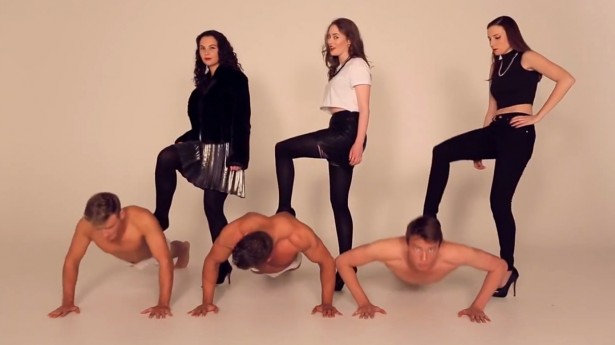
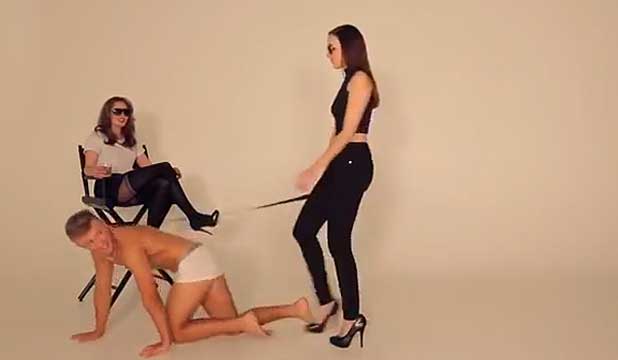
“Defined Lines,” created by a group of law students at the University of Auckland, was described by The Independent as “featur[ing] three fully dressed women responding to the attentions of scantily clad men as they sing about sexism.” After watching the video, it was evident to me that the women took issue with the lyrics in “Blurred Lines” (as new lyrics were provided) as well as with how the female body was objectified in the original (they substituted nearly naked men to make this point). Interestingly, the video offers conventionally attractive men in its effort to “objectify” them (perhaps to parallel the conventionally attractive women in “Blurred Lines”). Like so many contemporary depictions of female empowerment, though, “Defined Lines” reinforces visual codes of “acceptable” bodies in media messages. In so doing, it does not make an obvious statement about the ways in which the appearance of the women in “Blurred Lines” denotes standards of beauty that are so closely linked with the objectification of women.

Clearly, the parody’s creators wanted to “flip the script” by portraying a gender reversal of the “Blurred Lines” video. However, representations of men in (almost) the buff simply do not convey the same cultural meanings as women without clothing, as each gender’s socially, politically, and economically situated role is different. And, since beauty norms play such an important role in how women feel about their bodies and themselves, taking this issue on could have contributed to a larger conversation about the objectification of women and sexism. Instead, female “empowerment” is presented through lyrics that combat sexism in ways that pit women against men, as well as by showing women walking men on leashes or placing their stilettos on the men’s backs as the men do push-ups.

I applaud the creators of “Defined Lines” for taking “Blurred Lines” to task. Since I am writing this piece, perhaps both of these videos can be considered “art,” in that they have worked to generate conversation about media depictions of gender and messages of popular feminism. But, “objectifying” men does not help to unravel the knot between meanings of female beauty, objectification, and sexism in media messages.

leash               stilettos


I just finished reading the June issue of Poetry magazine, which features the landay, an oral form of poetry popular among Pashtun women in Afghanistan.

You should really just go read the issue here. But here’s a quick description:

The landay is an anonymous and collective tradition with origins in the Indo-Aryan caravans of thousands of years ago. These couplets were traditionally sung to the beat of a hand drum. “Landay” itself means “short, poisonous snake,” and it can indeed bite like a snake: quick and frequently acerbic, the landay is only twenty-two syllables long, with nine syllables in one line and thirteen in the other.


Here’s an example of one:

You sold me to an old man, father.
May God destroy your home, I was your daughter.

Landays are a form in which women can voice a rage of feelings—love, longing, anger, desire, lust, pride, nationalism, and grief—while remaining anonymous. Because they’re constantly repeated and remixed, they’re not about the speaker personally. At the same time, they are about the speaker, because different landays resonate with different individuals.

Landays are often shared in secret. Men don’t hear women speak or sing them. As a consequence, they can be subversive in multiple ways.

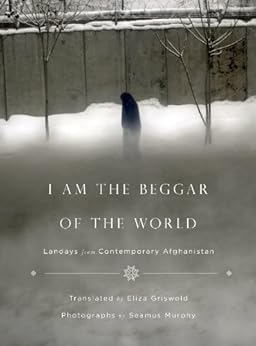
The poet-journalist who translated these landays, Eliza Griswold, worked with photographer Seamus Murphy in Afghanistan to collect as many landays as possible. Their collaboration resulted in the stunningly beautiful issue of Poetry (which also features some fabulous commentary by Griswold) as well as a forthcoming collection, I Am The Beggar Of The World: Landays From Contemporary Afghanistanpictured above.

(If you’re really interested, Seamus Murphy has made a short film, Snake, with more images and audio that includes recitations of landays in Pashto and English. There’s also an older collection of landays, called Songs of Love and War: Afghan Women’s Poetry, originally collected and translated into French by the poet Sayd Bahodine Majrouh during the civil war in the 1980s, and then translated into English by the distinguished Marjolijn de Jager. Oh, and check out the Facebook page on landays as well.)

Despite all the writing about Afghanistan in the West—the journalism, the policy papers, the political pronouncements—these poems remind us of the voices that are shut out of the halls of power. Their lines suggest deep and often bitter feelings about the U.S., the Taliban, and the years of war and foreign occupation. One landay dating back to the nineteenth century used to be about a British soldier, but today it has changed:

My lover is fair as an American soldier can be.
To him I looked dark as a Talib, so he martyred me.

Many of these poems are political and speak with rage about loss and destruction.

The speakers of these landays aren’t voiceless victims. I’m reminded of Lila Abu-Lughod’s critique of the rhetoric around “saving” Afghan women that was used to justify the U.S. invasion of Afghanistan in 2001. What happens when we construct the Afghan woman as someone as in need of saving, she asks: “What violences are entailed in this transformation, and what presumptions are being made about the superiority of that to which you are saving her?”

By contrast, these poems reveal a complex portrait. They speak of the ongoing oppression of Pashtun women, many of whom are illiterate—but they also suggest women’s agency and depth as human beings.

They also hint at the complex position of Pashtun women in ways that resonate with women’s postcolonial writing from other regions of the world. Feelings of nationalism—fostered in resistance to occupation and imperialism—vie with critiques of patriarchy. Gender matters, but it’s certainly not the only problem.

Most of all, I’m struck by how many of these landays speak openly about desire and lust. More than anything, this theme counters the image of Afghan women as victims. I won’t quote the bawdiest ones (they might make Shakespeare blush!), but here’s one to end on:

Is there not one man here brave enough to see
how my untouched thighs burn the trousers off me?

I’m eager to see more feminist scholarship on Afghan women’s poetry—and to read more landays.

kijeomaThis guest post is brought to you by Kendra Ijeoma, Engagement Coordinator at Women Employed in Chicago, Illinois. A feminist, social media junkie and aspiring social entrepreneur, Kendra mobilizes supporters online and in-person to become activists for women’s economic security, workforce development and access to education. She earned her bachelor’s degree in Sociology from Seattle University with a focus in Women’s Studies.

In a political climate that is so unfavorable for women, our rights eroded and our needs marginalized at seemingly every turn.

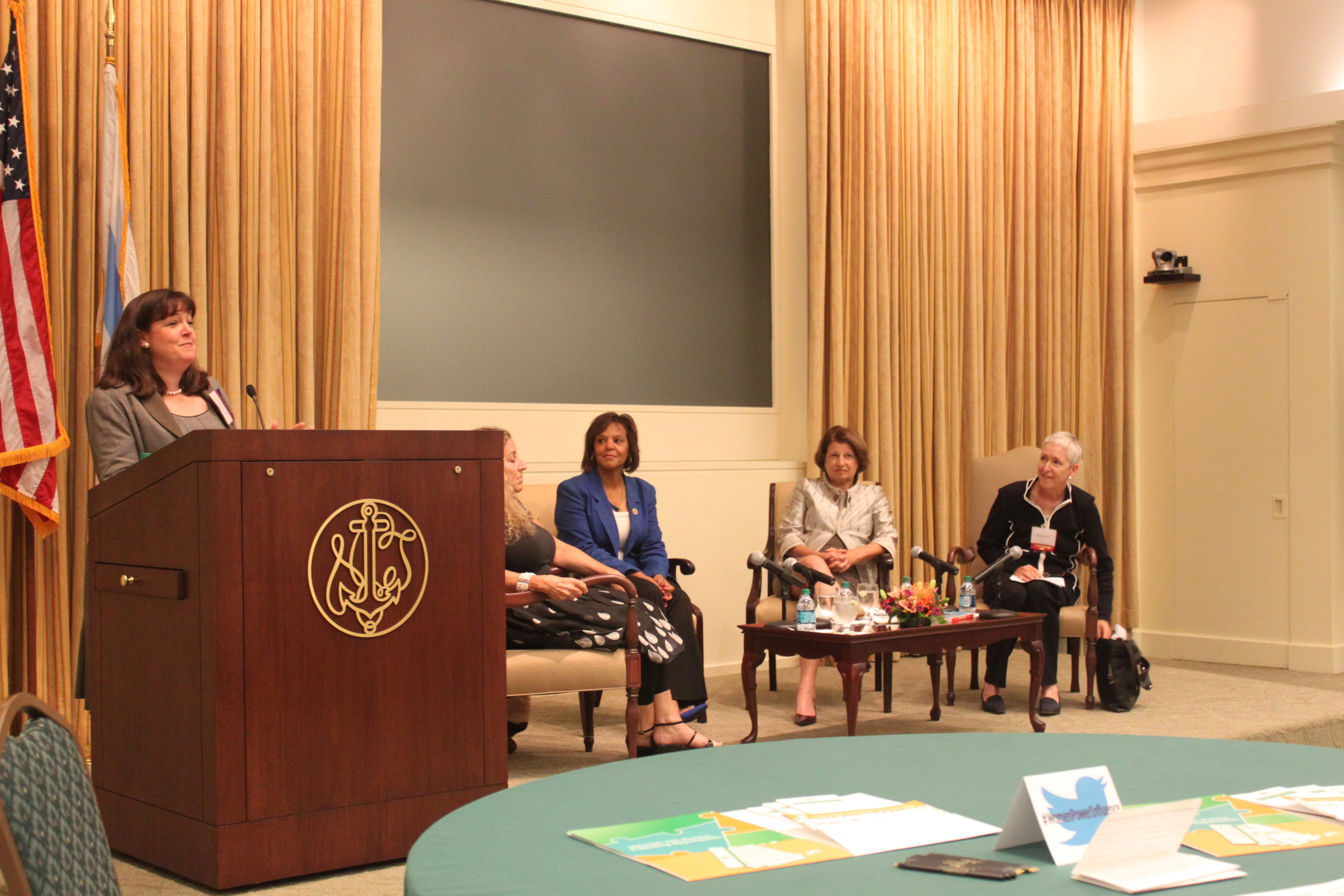
On August 5th, three powerhouse Chicago women participated in a roundtable discussion in honor of Women Employed’s 40th anniversary about how women can build power and exert influence in civic, professional, and political life. U.S. Representative Robin Kelly, author Rebecca Sive, whose new book, Every Day is Election Day, was recently released, and former Chief of Staff to Michelle Obama Susan Sher offered salient advice to women, as well as important stories about how they have achieved success and attained positions of power both in Chicago and nationally.Panelists with Board Chair Lisa Pattis

The conversation could not have come at a better time.

The takeaway? Women can and do have power and influence, but asserting that power can be tricky. For women, the route to success and to making your voice heard means walking a tightrope of proclaiming your individual qualifications and accomplishments, while also working successfully in collaboration with other women.

Susan Sher, now Executive Vice President for Corporate Strategy and Public Affairs at the University of Chicago Medical Center and Senior Advisor to the University President, advised women not to be afraid of, “shameless self-promotion. When you do a great job and you think you’ll be recognized, it just isn’t true. It’s important to take credit for what you do.”  This was a theme echoed by each of the women on the panel.

However, Sher, Kelly, and Sive also emphasized that many women are naturally self-effacing, which can undermine our interests. For that reason, banding together with other women can be powerful, and is a vital strategy to make people stand up and pay attention to women’s needs. Sive emphasized that for women, “The route to power and influence is not a route you take alone. There is strength in numbers. You can win with women and for women.” Rep. Kelly echoed that sentiment, adding that, “there’s something special about what women can do together.”

AudienceSo as a regular woman leading a regular life, where do you start? All of the panelists, as well as Women Employed Executive Director Anne Ladky, who moderated the event, stressed that while it’s important to have women in government and in the board room, the most vital agent of change will be everyday women like you and me standing up and exerting their own power. Every woman can have influence over her life and her circumstances. But we must be vocal in our churches, our neighborhoods, our book clubs, our school boards, and our offices.

As women, we need to speak up about issues like paid sick days, family-supporting wages, flexible schedules, access to affordable childcare, healthcare, and education, and countless other issues that impact us – as well as our partners and families. If we don’t take that step, things will never change.

So get out there. Make your voice heard. Shout your accomplishments out loud. Register to vote and go to the polls. Stand up for the issues you care about. Proclaim your message on social media. If you don’t, nobody will. And if you’re in Chicago, get connected with Women Employed, who has been fighting for economic opportunity for women for 40 years. We make it easy for you to make a difference. Visit www.womenemployed.org/act to find out how.

8162517
For the past few years I’ve been tracking organizations that genuinely support girls — as opposed to those who purport to support girls — while actually leveraging cultural concern about girlhood to advance other values.  Only recently I learned the term “astroturfing” to describe a faux grassroots organization that covers its tracks, and I can see, often enough, where it applies.  So nothing could have thrilled me more than learning about the newly formed alliance Brave Girls Want, which harnesses the energy of multiple organizations and individuals all working to change the expectations girls are both subject to and sold on material and deeper levels.

Brave Girls Want came together quickly as Executive Directors Melissa Wardy and Ines Almeida rounded up a coalition of allies (including our own Deborah Siegel) who are all passionate about refusing gender stereotypes and reframing childhood.  Recent triumphs include tapping into consumer outrage over a t-shirt marketed to girls and sold at The Children’s Place which left “math” unchecked among a list of “My Best Subjects” (with “shopping,” somehow, part of the intended curriculum).  Through the power of their numbers, the campaign went viral and the shirt was pulled from back-to-school shelves.  Many of the members included were active in the pushback against LEGO’s Friends line, released to “appeal to girls” but in ways that were shockingly unprogressive.  Through the power of petition, (over 60,000 signatures), social media, and persistence, a team of SPARK girls and their allies met with LEGO representatives and they have closely been tracking their progress ever since.

United, the power behind the Brave Girls Want alliance feels electric, fueled by collective passion and commitment.  Their current undertaking is to go straight into the media heartland and rent a billboard in New York City’s Times Square which will flash messages counter to the current gender expectations now set, and advance ideas that impel real progress. Importantly, girls will be actively involved in the campaign. Their goal is to raise $25,000 in time to have the billboard light up on October 11th, the second International Day of The Girl.

There is so much work still ahead to advocate for gender equity and steer change from deeply embedded stereotypes, but I’m excited to share their passion and hope for what yet can be.  “The hashtag that makes your heart smile” is part of their slogan; advocating for real revolution within media feels to me more like a full-body jolt that hopefully will wake up the world.
7632086

Two critical pieces of U.S. voting rights legislation mark anniversaries this August: the ratification of the 19th amendment in 1920 guaranteeing women the vote and the 1965 Voting Rights Act ensuring every citizen regardless of race or language equal access to the voting booth. Unfortunately, there is little time to celebrate past victories. Critical new battles are underway in the struggle for equal voting rights.

This past June the Supreme Court dismantled Section 4 of the 1965 Voting Rights Act. Section 4 required states with a history of racial discrimination to receive prior federal approval before making changes in voting regulations. Immediately some states moved to implement laws previously blocked by Section 4. Others proposed radical new legislation restricting access to voting.

Many Americans seem to forget how hard fought the battles for voting rights have been, how many suffered and died.  Maybe they don’t read their history books; maybe they don’t  pay attention to what’s happening around them. Others simply don’t care. They apparently believe in full democracy only when it suits their own purposes.

The history of the 19th amendment and the decades of effort before its final ratification were not included in my schoolbooks. I learned these lessons from my childhood friend, Miss Georgiana Fulton. She told of the suffragists who picketed President Wilson at the White House in 1917. She urged me to read about the 1848 Seneca Falls Declaration of Sentiments, and how abolitionist Frederick Douglass’s eloquent speech helped convince delegates to include Elizabeth Cady Stanton’s controversial demand for women’s suffrage.

I met Miss Fulton the spring I was eight.  She was in her seventies and lived alone in a ram-shackled cottage without indoor plumbing. Most of the other kids thought she was crazy. But I loved the sweet smelling hyacinths in her overgrown garden and one day she invited me in.

Soon I was stopping every few days on my way home from school.   Miss Fulton told wonderful stories–of leaving Shreveport, LA on her own to study art in Paris in 1900, of the artists she knew in New York, and of places nearby where wild violets grew in abundance. She helped me with my schoolwork and often asked me interesting questions I couldn’t answer. Some of the questions were about issues we now refer to as civil rights.

Miss Fulton was fierce in her determination that I understand that women had fought for the right to vote. She once lectured me when I told her girls could be class president just like boys. Her words are still alive in my mind. “That’s fine, child, but mark my words, there’s no equality yet. And don’t you ever let them say, ‘women were given the right to vote’.  They say that now, I know they say it, but it’s not true, not true!”

I was in seventh grade when the Supreme Court ruled in Brown v the Board of Education. Our teacher told us the decision was one of the most important in decades and that our lives would be better because of it.

Miss Fulton had a different reaction. “Child, listen to me. There will be trouble home in ‘Luziana; they won’t like this at all.”

I tried to argue with her. “It’s only fair, how can someone say people have to be separated because of the color of their skin? That’s not right!”

“Ah, child, you are not listening. You know nothing about this.” Miss Fulton’s voice was sharp, and her words stuck in my head, “I’m not saying the decision was wrong, I’m saying things can be right and still not succeed.”

“Change comes hard, child, very hard,” she continued, “You mark my words, girl, these things are much more complicated than you or your teacher know. You’ll learn.”

Miss Fulton was right; I had a lot to learn. And the foundation for much of my learning started with her stories.

We all have stories to tell when it comes to things we care about—our own, or those we’ve made our own because they’ve touched and impressed us. People need to hear these stories.  They convey more than information, they carry emotion, conviction and care.

Change does come hard, and people do fear it. Stories that lodge in the mind and linger in the heart can make a difference. Such stories inspire commitment and sustain perseverance. An abundance of both is required in the unfinished struggle for equal rights–in the voting booth and beyond.