Archive: 2013

Live, from the land of Betty Friedan’s homestate and the birthplace of radical feminist cells like Chicago Women’s Liberation Union and the West Side Group, it’s ChiFems!

Earlier this month, I spoke on a ChiFems panel moderated by Christine Gallagher Kearney along with my fellow Girl w/Penner Veronica Arreola, my fellow OpEd Project maven Claudia Garcia-Rojas, and fabulous feminist (and OpEd Project alum) Ashley Lauren Samsa about feminism in the Midwest, past, present, future.  ChiFems is a part-social, part-activist group that aims to bring Chicago feminists together to build relationships and work together to create change.  I adore them.

Here’s the video. Note: we didn’t all plan to wear jean jackets. Perhaps it’s a Midwestern thing?

Pallavi Banerjee at Vanderbilt University

If you haven’t already seen this column originally posted at MsMagazine Blog by Pallavi Banerjee read it below. Pallavi is a post-doctoral fellow at Vanderbilt University’s Sociology Department.

Do most of us still live in a 1950 nuclear family where dad goes off to work and mom stays home to take care of the family? Not in real life. But that lifestyle is enshrined in the United States’ dependent visa policies. According to the Immigration and Naturalization Service, the Leave it to Beaver way of life is the only way skilled workers’ migrant families ought to live.

It all begins with one simple fact. There is a shortage of high-tech workers in the United States. We don’t produce enough computer engineers, analysts, programmers, engineers, and doctors, to meet the country’s needs. The United States tries to solve this problem by allowing U.S. businesses to hire high-tech workers from other countries by granting H1-B non-immigrant visas to individuals from other countries seeking temporary work in  “specialty occupations.”

These visas allow a U.S. company to employ a foreign individual for up to six years with the possibility of permanent residency. To further entice migrant high-skilled workers to leave their homeland and come to the U.S., they offer H4 dependent visas to their spouses and children. In 2010, from India alone, 138,431 high-skilled Indian immigrants and the 55,335 Indian immigrants on H-4 dependent visas.

But the “dependent visa” puts many restrictions on the spouses, usually women, of the skilled workers who have an H1-B visa. The dependent visa holder is not allowed to work for pay until the lead migrant has gained permanent residency in the U.S., a process that can take six years or more. In some states, the dependent visa holders are not even allowed to drive.

When I studied families with an H1-B/H-4 dichotomy I found that most adult recipients of the H-4 dependent visas are highly qualified women. They experienced a loss of dignity and self-deprecation. Some women told me they felt they were thrown back into a model of the “traditional family” where women are not valued at all outside of the home. They talked about being rendered invisible, feeling lost, and for some, suicidal.

One of my study informants described her H-4 visa as a “vegetable visa meant to make you vegetate.” Others called it a “prison” or “bondage” visa. Another woman told me “You lose your individuality and in time all your confidence – and one day suddenly you realize you are just reduced to being a visa number in your head. It is scary – it’s like losing your head.”

Gaining permanent residency in the U.S., which would allow spousal employment, could take many years for H1-B workers. This means these women will be legally unable to work for years on end. Some of the women I spoke to simply could not handle their situation and decided to return to India. One high-tech worker who recently went through divorce told me, “we had absolutely no problem as a couple, it’s this visa situation…she was unhappy and depressed and it was not going to get better. We had to take the very hard and cruel way out – the many pains of being a foreign worker.”

As the U.S. debates Comprehensive Immigration Reform, and considers increasing the number of “high skilled foreign workers”, lawmakers should reconsider the constraints on spouses embedded within dependent visas.

Immigration policies designed to bring high-skilled workers and their dependents to the U.S. fill a need in the high-tech industry, but they fall short in building gender equal, stable, happy, and viable families. The 1950s are long gone. It is time to let wives work. Why force migrant families to live in the past?

My daughter Amy turned 43 last week and on Saturday we’ll have a big party for her. Amy is party girl through and through and I always look forward to her birthday with delight. But yesterday my happy anticipation was dampened by a casual comment from a friend, “I know you must be tired of having little kid birthday parties after all these years.”

What?

Yes, I’ve given and/or helped plan lots of parties for Amy, parties that still involve aspects often associated with younger children. Amy has intellectual and physical disabilities; she requires more care than my friends’ daughters and sons.  Sometimes I’m exhausted by extensive mothering duties I’ll never out grow.  But tired of parties for Amy? Never!

Harilyn Rousso’s new book, Don’t Call Me Inspirational: A Disabled Feminist Talks Back, caught my attention the instant I glanced at the title.   The anecdote above is part of the reason.  Rousso, whose complicated birth resulted in cerebral palsy and noticeable physical impairments–slurred speech, facial grimaces, an uneven gait–addresses head on the ways many well meaning people assume that anyone with a disability is to be avoided, ignored, pitied–or admired simply for living with her disability. She writes, “I know, I know, if you were me, you’d never leave your house and maybe even kill yourself. So, I am inspirational because I haven’t committed suicide…”

Parents of children with disabilities often elicit some of these same reactions, especially if they are single parents.  I have cared for Amy pretty much on my own since she was a young child. I have plenty of experience with the ins and outs of caring and advocating for first, children, and then gradually disabled people of all ages.  I know many of the realities; I know the heartaches. But I also know the joys.

Rousso gives us an intimate glimpse of how far we’ve come and how far we have to go–as a society and as individuals–in providing not simply equal access, but equal acceptance and genuine inclusion. Her searing insider’s view of feminist organizations and what they have NOT done to support and learn from women with disabilities is part of her story. It is a story that should be required reading for every feminist.

The evolution of civil rights for people with disabilities built on the civil rights movement of the 1950s and 60s. By 1975 the passage of the federal Education for All Handicapped Children Act made it illegal to deny access to public education to disabled children. But Rousso, whose mother insisted her daughter could and would do everything other children did, attended public schools years earlier.  Dealing with substantial physical challenges, but gifted intellectually, she went on to earn a degree in economics from Brandeis and to train as a therapist at a psychoanalytic institute.  She was asked to leave at the end of her first year—the leaders of the institute thought the signs of her cerebral palsy would distress clients.

Rousso writes with painful honesty of how this obviously illegal, enraging discrimination led her to a clearer understanding of prejudices against people with disabilities—her own as well as those  of others.  The incident, as hurtful as it was, helped her to move from denying her disabilities to identifying with the disabled community, and to “embrace my identity as a person with a disability still further.” Moving reminders of how slow and incomplete this process is for the author and for society are scattered throughout the memoir.

Rousso was a feminist before she was a disability activist. She was puzzled by feminist obliviousness to the double (or triple, if you were a women of color) whammy confronting women with disabilities.  As a board member of various feminist organizations, usually the first and only disabled member, she experienced the excruciatingly slow pace with which many of her new colleagues came to understand these dynamics. Her ‘outsider’ status was one often shared by women of color, she later discovered.  Writing today, she notes “[F]eminists have become more inclusive…[But] even today disabled women are more likely to be included out of obligation…They are not seen as a rich source of diversity. The welcome mat is not yet out.”

The memoir’s 52 brief chapters resemble a conversation with a new friend. We learn first a bit, then a bit more about her life; gradually additional details emerge as the acquaintance deepens. Rousso’s book has the power to trigger further conversations–conversations critical to moving beyond the damaging misconceptions and prejudice still surrounding people with disabilities.

Most feminists, particularly those of us with close personal experience with disabilities, think we understand the issues. We think we are doing what we can, maybe even all we can.  Maybe we are. Maybe we aren’t.  We need to talk about it.


Among the many things I had planned to do before the birth of my first child, one was post a review of Lisa Catherine Harper’s first book, A Double Life: Discovering Motherhood.  Now over the initial shock of transitioning into motherhood, I realize all the more how valuable this book was and still is to me, as Harper precisely chronicles a life divided by “before” and “after”— in this case, having a child.

Harper presents the idea that the deep divisions that women experience — specifically around pregnancy, gestation, childbirth, and then the encounter of a child —sunder women physically and emotionally in ways they are left to existentially and practically reconcile.  Her book is categorized into three states of being: “Inside,” which begins with the conception of her daughter and follows her pregnancy; “Inside/Out” which chronicles her labor and birth; and “Outside” which tracks her entry into motherhood as closely as it does her daughter’s new experiences in the world.

Harper holds a PhD in English with an emphasis in feminist theory and research and her book includes meticulous research as she alternates exploring the science behind what is happening to her (with information about how pregnancy alters virtually every system in a woman’s body) and the emotional resonances she feels on a deeply internal level. She also chronicles her reactions to others’ responses to her physically changing state.  At times the tacking back and forth between the more didactic writing to the lyrical can seem abrupt, but the model reflects her commitment to knit understanding of the logical and mysterious, of fact and emotion, the science and the poetry of her experiences. Although I enjoyed Harper’s sensitivity to the physical processes of pregnancy and childbirth so much I gave a copy of her book to my Ob/Gyn, what I later appreciated more was Harper’s willingness to connoiter her new role as part-time professor with fulltime mother.  In this current moment of Lean In rhetoric and new iterations of the perennial “have it all” debates, Harper is disarmingly clear about her own situation, asking, after her daughter is born: “Why didn’t motherhood matter?  Why was the home still a separate, unequal sphere? Why were mothers and children still so isolated from those things that really mattered to the childless, to the world outside the home?  Why did we talk endlessly about stupid things like Cheerios and diapers?”  And to the crux of her book: “Why did I feel so fractured?”

Searching to locate meaning in the time she spends caring for her daughter, beyond a circle of other mothers, is the axis on which identity, cultural value, and priority all spin for Harper.  Scholar that she is, she turns to the volume The American Woman’s Home, written by Catherine Beecher (sister to Harriet) who called for “a revolution in domestic arrangements” and Harper says is the “precursor to all the contemporary lifestyle magazines, TV talk shows, blogs and Websites that have reinvented the domestic arts for the post-millennial home…” Harper recognizes that for Beecher “the created home is a political act” and she wants it to be for her as well, not by redecorating it, literally or otherwise, but by having it hold broad, and real, cultural value, something I think is happening.

Harper writes, “the life of the home had to be remade… it had to matter in real and consequential ways.”  She is critical of the “modern feminist movement,” as she broadly labels it, as one that has decided to “map power where it already existed” i.e. outside the domestic sphere, while neglecting to elevate the work women (largely) do inside the home and keeping this devalued.  In order to support women’s work outside the home, Harper argues, the domestic and childrearing work so many women do needs to be legitimized and legalized, in part to help support women working outside the home.

It’s an argument whose point I see, but I think oversimplifies. While it’s clear Harper’s goal isn’t to go into detail or depth, the idea that the feminist movement, broadly painted, has roundly devalued domestic work to the elevation of work outside the home seems too one-note to me. While not necessarily her point, Harper doesn’t raise the issue of shifting the expectations of gender roles or equal parenting.

Her daughter teaches her how much “to work inside the home is a worthwhile occupation,” Harper writes, although this realization leaves her at odds with her education and expectations of the professional working world. She writes, “I belonged in neither world: much of my energy was invested in raising Ella so I couldn’t fully claim my professional identity, but neither could I identify what seemed to me the petty concerns of motherhood. I loved my daughter and I loved my home.  I did not love the stay-at-home culture of mothering.” Harper concludes that there has to be a future shift where the bifurcation into being a “work outside the home” mother doesn’t square off with “work inside the home” woman either — a “mommy war” reduction that I question as still legitimate.

Fundamentally, Harper wants the halves of her life to join, primarily by feeling each sphere is validated — the life-changing experience of motherhood co-existing with the intellectual and professional ambition she realizes, for her, has been more valorized. She concludes that insisting on motherhood and the home as generative space is an almost radical throwback to Beecher’s nineteenth-century insistence on the importance of these activities and demand for their recognition. It’s an interesting argument, in some ways provocative for its potential to twine conservative strands of thought with progressive ideals. Figuring out how child-rearing and the domestic life matters to her personally, and how to reinvent its meanings within a larger context, politically, is another parsing that Harper negotiates well in the last chapter of her book.

While driving through Los Angeles a few months ago (what else does one do here?) I listened to a new release of a song by a band called The Head and the Heart.  The tune was catchy, but what lingered in my mind was the band’s name — calling out the division of the body and the symbolic resonances each part holds.  The central tenet of Harper’s explorations remains joining what has been sundered into separate spheres: mother/scholar, domestic/public, former self/present self and the million ways identity is fractured, constantly, daily, even moment-to-moment, and the intentional work it takes to keep rearranging these pieces to make a whole.

6736150457_cfef124c1cThere’s a terrific chapter in financial journalist Helaine Olen’s new book Pound Foolish that debunks popular myths around gender and money fueling the personal finance literature aimed at women. Think women are less financially literate than men? According to research by Annamaria Luardi, a professor of economics and accountancy at George Washington University and the academic director of the Global Financial Literacy Excellence Center, men and women are both woefully financially illiterate. Think women aren’t as good with money? Research suggests that being made to feel that way may be the larger problem here.

My daughter and son are only three and a half. But I’ve been thinking a great deal about how girls learn money—or rather, about how we don’t. As the recent Pew report shows, a record 40% of all households with children under the age of 18 now include mothers who are either the sole or primary source of income for the family. Our daughters are growing up in a world where they will be expected to be breadwinners, just like our sons.

But what are they learning, early on, about money, and how it works?

I sat down with Robin Patinkin, CFA, CFP®, a Principal with Cedar Hill Associates, LLC, an investment advisory firm serving high net worth individuals, families, and foundations. Over a large helping of watermelon in a Chicago apartment high up in the clouds, Robin and I discussed myths and realities around financial literacy and young girls.

Robin has over a decade of experience in investment management and financial planning with a comprehensive understanding of family interests and issues. Working intimately with clients as well as raising two sons and a daughter now in their twenties, she’s an expert in guiding individuals through financial life decisions. She’s something of a trailblazer herself, having majored in business in the 1970s (a time when few women did) and later going back to earn an MBA from Northwestern University’s Kellogg School of Management with a concentration in finance at age 45. She became a CFA charterholder, along with her eldest son, in 2012. She’s frequently called upon as a panelist, speaks on a variety of financial issues, and acts as an expert witness in divorce cases.

Here’s how our conversation went down.

DS: You’ve raised two boys and a girl.  Did you notice any differences in the ways your children took interest in money?

RP: Yes. When each child turned ten years old, I had my first conversation with them about money and investing. I gave each an opportunity to invest in a stock they would understand at that young age as a consumer, and then we followed the stock together. There seemed to be a higher interest from the boys. That was the first signal.  Later, when they were in high school, as part of the Illinois state public school graduation requirement, they each had to either take a consumer education course or pass an exam. Academically, my children are all very similar. My sons passed the exam with very little, if any, studying.  Yet my daughter, who found the material uninteresting, asked for my help. I sat down with her and explained everything in the book page by page. She didn’t pass. We were both surprised.

DS: This story sounds like the stereotype. As a woman in the wealth management industry, how did this make you feel?

RP: A few years ago, I heard Marie Wilson speak about White House Project research that found a clear division in knowledge and acumen between boys and girls concerning financial literacy when they hit high school.  This is the very age at which my children took the exam. As you can imagine, here sits a mother who herself beat the stereotypes, was one of the few women majoring in business during the 1970s, and viewed herself as a role model who had knocked down the barriers, I thought: how can this be happening with my daughter?  I started to question what I had done wrong.

DS: What would you tell a mama like me to teach her preschoolers about dough?

RP: Now is the perfect time to start. Even Sesame Street is incorporating financial literacy in their curriculum. I would begin with the basics: put a piggy bank in the bedroom. Show them money, physically. Take them on a field trip to look at currencies of the past. Talk about bartering—use their toys—and explain how the money system developed.  Go to a coin shop. When they’re a little older, perhaps even take a trip to the US Treasury in DC. Teach the basics of saving, spending, and giving. And don’t be afraid to really talk about money. There are many wonderful children’s books that teach what money is. One of my favorites is called The Go Around Dollar, by Barbara Johnston Adams and Joyce Audy Zarins. It takes a dollar bill and dissects what every symbol on it means. It’s important to start the conversation young: “Mommy is saving this for our vacation. Mommy is spending this on food.” Play games with money. When you’re in a store, have children count the change to make sure it’s correct. Money, at a young age, can be fun.

As your children grow, add different parts of financial literacy into the conversation. It’s important for parents not only to role model, but to talk about it. So at an early age, it’s about charity, saving, spending. Children have different personalities and will exhibit varying feelings about these things. As they get older, you build in more about your personal lives: your spending, your saving habits, good debt/bad debt, things that worry you. Talk about how we work to earn money and where the money goes. Do a field trip to a bank, explain credit cards and their use, define what an asset is. When the news is on, if there’s a financial term mentioned, define it for your children right there. Use the moment, whenever and wherever you can.

DS:  In Pound Foolish Helaine Olen writes, “[T]here’s a fine line between making the [personal finance] industry more friendly to women and overtly condescending to them, and frankly, it is a line few have managed to tread successfully.” How do you think parents can be cognizant of occasional differences in attitudes between boys and girls around money, without condescending to the girls?

RP: I assumed, because I was in the business, that my children would understand equally, and there was no need to put effort into educating them differently at all.  In retrospect, I probably should have spent additional time with my daughter, who seemed less engaged, thus piquing her interest more around money and investing. I should have realized back when she was 10 that another approach was required to interest my daughter on the subject. Selecting a stock wasn’t the right fit. One size does not fit all.

I often think about what I should have done differently with my daughter, and why her financial competence was less than her brothers’. I wonder if there was some sort of emotional hook or mode of presentation that I should have employed to involve her more in the conversation and learn the lessons. I could have offered her baby steps, assignments, and tasks in a simple non-threatening way.

DS: Your daughter is currently 23. What do you do now?

RP: Marie Wilson’s presentation was a trigger for me. I am now, and have been for the past few years, making a concerted effort to get my daughter up to speed. In her early years in college, my daughter started overspending. This was not intentional by the way, but more from a lack of understanding. So I then set the stage. My husband and I were fortunate enough to be able to put money aside to support college expenses, something so many American families struggle to fund. She had a credit card, her own checking account, and was given a reasonable monthly amount to live on. We covered tuition, and she was responsible for everything else. She learned how to budget and pay bills. She caught onto the lessons of personal finance she hadn’t yet somehow received.  She’s now moving into her first apartment after college and working her first grown up job.  She’s empowered, with me in the background still coaching, but she’s as responsible now as the boys.

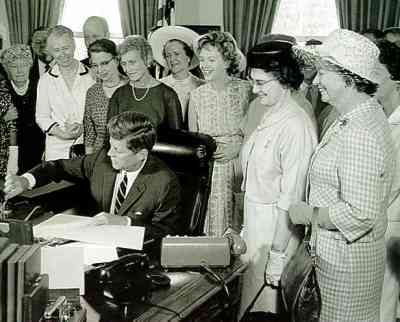
DS: It’s been exactly 50 years since President Kennedy signed the Equal Pay Act into law yet women still make $.77 to the male dollar, prompting a renewed look at a legacy unfulfilled. So much of the problem, of course, is structural. But do you think an additional problem is that girls and women need to “lean in” more to our own financial education, or that the financial literacy industry isn’t effectively leaning out to us? Are we doing a good enough job teaching our girls, and are the methods employed successful?

RP: I think we’re failing on both accounts. There are outliers of success, and we can’t group all girls into one category. Yet I do believe these discrepancies in financial literacy are a problem across race and class. From my personal observation and experience working with girls, women, boys, and men, I suggest there is much to do. Yes, there are improvements since my college days, when there were few women in business, but the stereotypes persist, especially in much of the personal finance literature. I strongly believe it is our duty as mothers and fathers to recognize this shortfall and focus on the issue of financial literacy for our daughters, our sisters, our mothers, and ourselves. And it’s important for women like myself, in the industry, who have the education, the understanding, and the acumen, to work with our colleagues in the industry to combat this dilemma. My ultimate goal for my daughter—as for all our daughters—is that she pursues her career dreams and ambitions while living a life of financial freedom and independence, so that should a crisis take place, she is not destroyed.


Add your thoughts to the conversation, and be sure to check out Olen’s book. Is there a financial literacy gender gap, and if so, to what extent is the problem structural in nature? To what extent can parents and teachers play a role? Got questions for Robin? Feel free to leave them in comments here.

8577353141_d3f5a69df4_nI can’t remember the last time I wanted to like a nonfiction film as much as I wanted to like Girl Rising. It promised to shed light on many of the issues I feel most passionately about: girls, education, gender-based oppression, and social inequality. Focused on the lives of nine girls around the world, the film’s creators paired nine women writers with each girl in order to write their story. A different American actor then narrates each story: Meryl Streep, Salma Hayek, Cate Blanchett, and so on. The roster of writers included several of my favorites (Edwidge Danticat, for one). So did the actors.

Perhaps predictably, I didn’t love it. I did like parts of it—I was moved by many of the stories and the way several of them were rendered into prose, and I left feeling with a much better sense of the complexity of the challenges facing these nine extraordinary girls. But while the film succeeded in places, it failed in others.

Let me start with what the film does well.

As Natalie X. Baker points out in Bitch Magazine, the strongest part of the film is its exploration of the “bravery and self-determination” possessed by all of these girls. Although they face significant obstacles, these girls aren’t victims. Here are some details from a few of their stories:

  • Fourteen-year-old Senna lives in poverty in an Andes mining town in Peru. Named by her father after the heroine of Xena: Warrior Princess, she discovers Peruvian poet César Vallejo and memorizes his poetry, which she reenacts with passion at school competitions.
  • On the streets of Kolkata, India, eleven-year-old Ruksana paints pictures and attends school. Both her parents work wherever they can and insist that both of their daughters will complete their education and go on to a better life.
  • In Freetown, Sierra Leone, sixteen-year-old Mariama attends school, hosts her own local call-in radio show, and dreams of becoming a scientist.
  • Eight-year-old Wadley survives the earthquake with her mother in Haiti, but they have to relocate to the Carradeux tent camp in Port-au-Prince. Although her mother can no longer afford the school fees for her daughter, Wadley pesters the teacher until she relents and lets Wadley join the class.

Like many other viewers, I found these individual stories far more compelling than what came in between: mostly, stark statistics narrated by a solemn Liam Neeson. I didn’t mind the inclusion of the actual statistics (which do provide a broader picture) as much as the mode of presentation: important facts about girls and education are presented on charming posters held by a beautiful and diverse assortment of girl child models cavorting in the fields. From garbage dumps in Cambodia to the pages of a Garnet Hill catalog.

These precious scenes on the hillside feel like ads. And they are: they are selling the issue of girls’ education. In contrast, the stories about the nine girls are moving. Even when they do not unfold in realistic modes, they generally convey a sense of the girls’ lives.

I just alluded to the fact that many of these stories push at the boundaries of documentary storytelling with playful artistic and poetic flair. Some viewers do not like this. Natalie Baker, for example, criticizes the film for letting the writers take “linguistic liberties in translating and transforming each girl’s story.” She would rather the girls speak for themselves, instead of hearing the girls’ stories as they have been shaped and crafted by writers, and then spoken by actors.

In principal, I agree with Baker—allowing subjects to speak for themselves can be crucially important for informing our understanding and knowledge about their lives and the conditions in which they live. But for some reason, the writerly interventions of Girl Rising didn’t bother me so much. For one, I trusted many of these writers, most of whom were born in the countries in which their subjects live, and many of whom have spent years navigating the tricky ethical territory of writing about others. I also liked the result in many (though not all) of the stories. And importantly, I had a sense of the process. At the beginning, the film explains that each writer spent time with her subject and then did her best to render the girl’s experience in a form that captured the truths of her life. Girl Rising isn’t “straight” documentary, and it doesn’t present itself as such.

All nonfiction is crafted, including “straight” documentary and personal narrative. So I took these stories as stories, based on each writer’s understanding of her subject. That said, I did prefer the way some of the writers approached and crafted their subject’s story more than others; some of the narratives deeply moved me, while others felt overwritten.

A larger problem emerged when stories were reenacted. In general, the girls were played by themselves—so, for example, the character of Wadley is played by Wadley, and presumably some of the other characters in her story are played by those people. But I’m pretty sure that the earthquake scene wasn’t actual documentary footage but rather a reenactment, and it seemed to me that there had to be other actors—in her story, perhaps, but also in others. (The film does tell us that the two girls who live in the Middle East, one in Afghanistan and one in Egypt, were played by actors in order to protect the girls’ identities.)

I’m not a fan of this kind of docudrama, most of all because the film didn’t signal when we were viewing reenactments. As a result, I sometimes wasn’t sure what I was watching: was it “real”? was it fiction? The film crossed some kind of line without informing me. As a result, I had difficulty gauging my emotional reactions.

If part of the success of a documentary (or of any film) is how well the story is told—how it impacts us emotionally as well as intellectually—Girl Rising failed when I didn’t know whether I should laugh or cry.

In case you hadn’t guessed, Girl Rising is a film with high production values, expertly directed by documentarian Richard Robbins, and backed by what appears to be a fair amount of money (Intel Corporation is one of the “partners” of 10×10, the “global action campaign” that produced the film, along with The Documentary Group and Paul G. Allen’s Vulcan Productions). This is neither an indie film nor the Women Make Movies documentaries that I frequently show in my Women’s Studies classes. Rather, it’s a new kind of collaboration that brings corporate money to documentary/narrative filmmaking and social issues.

This kind of collaboration generates the money and resources that documentary filmmakers, nonprofit organizations, and social programs need. But it also means that Girl Rising is part of Intel’s program of Corporate Social Responsibility. So should it really come as a surprise that the film’s good intentions get mired in what Natalie Baker calls “cinematic chivalry”? That it leaves out feminist activism on girls’ issues in these various locations? That it lacks any kind of structural analysis, as articulately pointed out by an anonymous commenter over at Bitch? (Never mentioned, for example, are the neoliberal economic policies that have contributed to the existence of school fees in countries like Haiti, or the behavior of multinational gold mining companies in countries like Peru.)

I’m not condoning these omissions. I’m just pointing out that Girl Rising isn’t about economic or political revolution. It attempts to do one thing, and to do it well: to give names and faces and stories to an issue—girls’ education—that is precisely the kind of issue that many people agree with in the abstract but which has failed to become a priority for individual governments, the United Nations, development and human rights organizations, and private foundations. 10×10 wants us to put girls’ education at the top of our list, and they want to make an impact on policy makers and donors—as well as girls in the U.S. And girls and their mothers might well constitute a major portion of the viewing audience. (While I think my nine-year-old daughter is still a little too young to watch Girl Rising, I do wonder whether the film might be particularly well-suited for middle and high school students.)

Which brings me to my last point: the film’s assumptions about its subjects and its viewers. Clearly, girls in the U.S. will be among its viewers. But what about the girls who struggle in this country? We all know that there are groups of girls in the U.S. who face extraordinary challenges in attending and graduating from school. Where are these girls? Don’t we do ourselves a grave disservice by perpetuating the idea that only girls who live elsewhere need help? How hard would it be, really, to include one segment focused on the life of one girl living in this country? That would go a long way towards breaking down the us/them binary that troubles so much U.S.-based activism—and might bring a sense of urgency to the social inequalities affecting girls’ lives here at home.

Girl Rising will premiere on June 16 at 9pm EST on CNN.

The Equal Pay Act turns 50 on Monday, June 10, 2013 and the Council on Contemporary Families has convened an online symposium representing the latest thinking from pre-eminent work-family scholars, business people, and advocates for low-wage workers and unions.

In one of the ten briefs, CUNY’s Ruth Milkman reports how labor unions—and women in them—spearheaded the campaign for the Equal Pay Act, even though they made up only 18.3 percent of members at the time. If unions had had their way the language would not have been “equal pay for equal work” but “equal wage rates for work of comparable character on jobs the performance of which requires comparable skills.” Milkman explains, this was “wording that would have forced employers to pay women in traditionally sex-segregated jobs as much as men with comparable skills in traditionally male occupations…. Given the pervasiveness of job segregation by gender, this weakened requirement for equity ensured that the law had a far more limited impact.”

How are women in unions doing? Today, women make up 45 percent of all union members, but union membership rates have declined: In 1960 one in four workers was in a union; today, that is down to about one in ten, reports Milkman. The historic decline hit private sector unions, where male unions used to be strong, first and hardest, says Milkman. But “starting in 2011, a wave of state-level legislation weakening collective bargaining rights for public sector workers has directly targeted teachers and other unionized female-dominated occupations.”  This attack is a real problem since women union workers earn an average of more than $5 an hour more than nonunion ones and have more benefits and job security as well—and nonunion workers in unionized fields benefit from this advantage.

As a public sector worker–a professor at a state university–and a proud union member, I say thanks labor movement!

For other NICE WORK posts on women in unions, read unions matter to women, waiting for superwoman, and woman’s nation = workers’ nation.

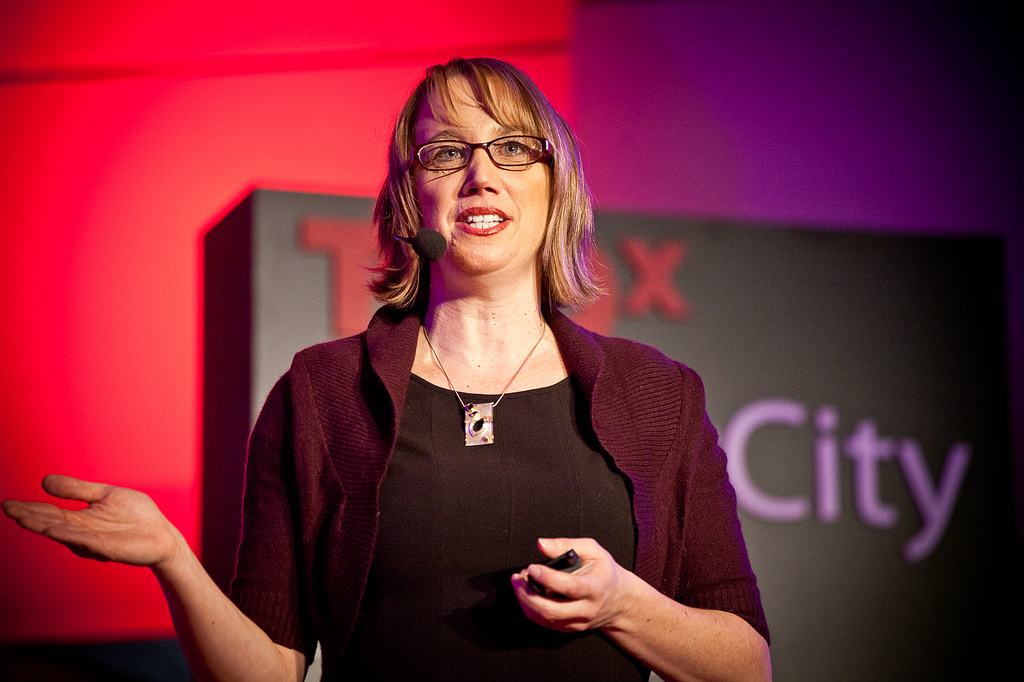
Deborah Siegel at TEDxWindyCity In February 2013, I gave a TEDx talk at TEDxWindyCity about the gendering of childhood in the earliest years of life.  TEDx events, for those who may not know what the “x” stands for, are independently organized TED-like experiences created in the spirit of TED’s mission, “ideas worth spreading,” only at the local level. So, in an auditorium along the frozen shores of Lake Michigan, I stood on a stage before a sold-out crowd of 650 smart Chicagoans, said things like “gender binary”, and wore a pair of mismatched pink and blue tights.

Preparing for and delivering this talk were some rather peak experiences this year.

I’ve since received many questions about the process: “Did you audition, self-nominate, or get tapped?” “How long did it take you to prepare?” “Did you receive training?” “How’d you do it without notes?” “Where’d you get those tights?” (A: I made them.)

There’s a real hunger, I’ve learned, to know more about what goes on behind the scenes. And I’ll tell you. But first, please know that like many public thought leadership forums, women could afford to lean in here a bit more. When speaking to my authors group back in New York City, Kelly Stoetzel, Content Director and curator for the mothership TED said that women turn down invitations to speak at TED with far greater frequency than do men. If the phone rings, lady readers, and it’s TED calling, promise me one thing before continuing to read this post.  Promise me you’ll say yes.

But you don’t have to wait for the phone to ring to speak at a TEDx event. Unlike TED, which invites its speakers, TEDx events are fully planned and coordinated on a community-by-community basis, and the organizers often outline their submission process clearly on the event’s site.

TEDx talks can lead to TED invitations. They can lead to media appearances, speaking engagements, and books. Regardless of doors opened and views accrued, preparing for and giving a TEDx talk is a valuable experience in and of itself.

I say giving this talk changed my life because it did.  It got me out of a writing rut and pushed me into multimedia. It ushered me into a new city and gave me a local calling card (I relocated from New York last July). And it taught me that I could experience more joy while giving a talk than I ever knew was possible. That’s right, people. Joy.

Much of the joyfulness I attribute to the organizers. (Shannon Downey of Pivotal Productions, you are a one-woman bundle of brilliance.)  A team of 20 volunteers (aka the Dream Team) did a seamless job producing the event, and co-sponsors included the Museum of Science and Industry and the Ravinia Festival, which catered a mid-day indoors picnic on astroturf. Ten speakers shared the stage with dancers, poets, and a comedic duo. The audience, too, was key. Everyone there was interesting. The mood was one of mutual inspiration and support. TEDx events are a reflection of their organization, and this one was tops.  Not every event will explode with this level of creativity and be this well organized, but the trick is to make the most of it, whatever the production level, because one TEDx can also lead to the next.

Here’s how mine went down:

July 2012: A friend sends me a call for speakers for TEDxWindyCity. The theme is “contrast.” I have girl/boy twins. I write about gender. I decide to propose a talk that brings to life key research about the gendering of childhood in the earliest years of life. With help from a filmmaker friend (who also happens to be a girl/boy twin mama), I prepare the requested 2-minute video submission using a 500-word script, an ultrasound video, and some stills.  I write a short proposal explaining how, adhering to the TEDxWindyCity Commandments, I intend to inspire listeners to think beyond convention; innovate by unearthing the studies that turn previous findings upside down; revolutionize the way listeners think about not only the gendering of the tiny, but the gendering of the adults who shape them; move listeners by speaking very personally about my experience as a new mother of boy/girl twins who, after years of studying and writing about gender in theory, suddenly found herself in the belly of the beast and questioning her core beliefs; influence by launching a Pinterest board in which I ask followers to post a photo of a young child breaking or upholding a gender norm; entertain with a brief slideshow; and, above all, inform. I explain that my inquiry is part of a larger project, I explain who I am, I send a few links related to the project and to previous talks and videos, and I attach a few testimonials attesting to my speaking skills.

September 2012: I’m accepted. (I think: Huzzah! Then: Oh lord, what have done?)

October 2012: I stall. Or, put another way, I try to figure out a talk that will also help me think toward the book I’m (slowly) working on. I end up going in circles, trying to do too much at once.

November 2012: I receive an email from the organizers:

As you know your TEDx talk needs to tell a story or argue for an idea.  I need you to please submit to me the title of your talk + in 5 sentences or less the thesis statement/main point of your talk.  You can find a million examples on TED.com

I’m reminded to think short, and think pithily. I come up with the following: “Learn, from kids, to embrace paradox and get out of your gender binary zone.”

December 2012: I’m freed, now, to write the talk. I come up with a simple three-part structure, and working backwards from that tagline, I pull together a narrative that interweaves my personal story with research from various fields. I get feedback from my writers group and other trusted advisors.

January 2013: I send my draft to the organizers. I have a month left to revise. The organizers hook us up with a webinar called “The Foundation of Great Presentations,” with Doug Carter and Brian Burkhart of Square Planet. From them, I learn the importance of knowing what I want my audience to know, feel, and do.

Afterwards, I receive an email from Doug:

Remember, this is an ALL IN proposition—you’ve only got one shot at this. There are no “do-overs” like we had when we were kids. No late night cramming on February 22nd hoping that it will magically sink in. You HAVE to work at it to be the best you can possibly be.

I’m inspired to go all in.

February 2013: I revise and revise, tightening and cutting wherever I can. My graphic designer husband (convenient, I know) helps me refine the slides, which I’ve by now come to realize need to be just as concise as the words.  A few weeks before the event, the organizers host a pre-show gathering so the speakers and Dream Team can all meet and greet. I spend the last week memorizing my talk, getting it down to just notes on one page, and eventually to notes on a single note card. I practice, practice, and practice some more. I video myself doing it once. The day before, I do a full run-through on stage. The event takes place. I go second and get to enjoy the rest of the day. Everyone does a great job. In the lingo of TEDx, we killed.

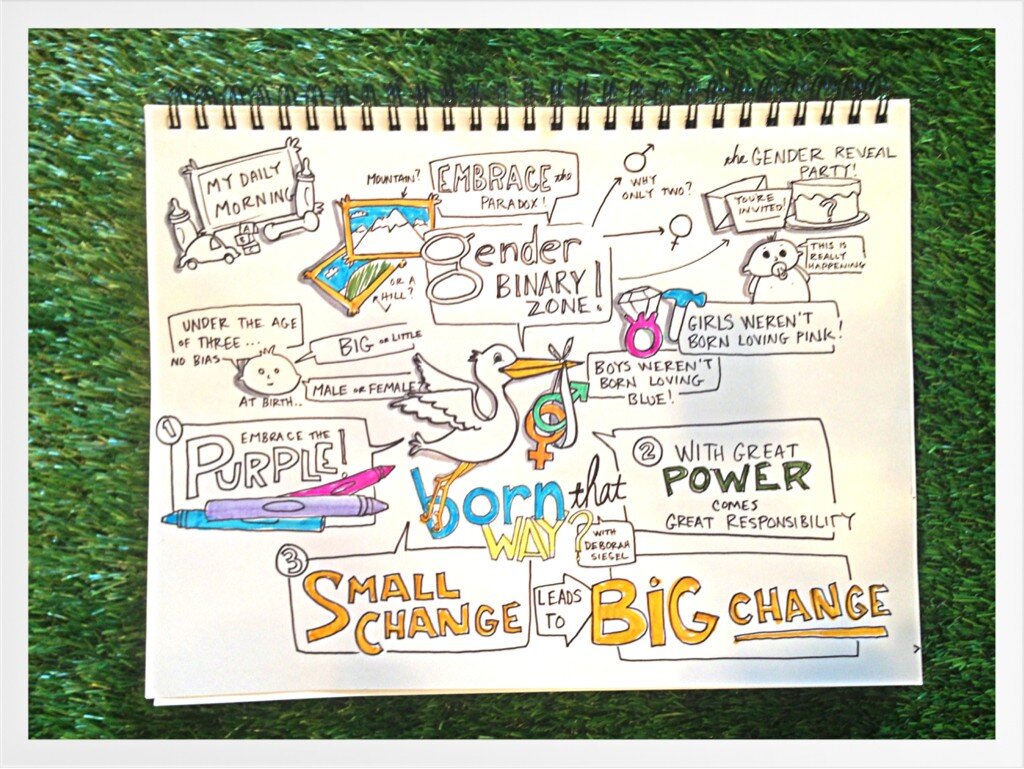
The talk resulted in views and media (like here and here).  Ink Factory Studio graphically recorded my talk (see below).

ink factory rendition of born that wayThis all, of course, was well and good, but most importantly, for me, preparing for and delivering the talk led to a loosening up.  Mixing up the visual and the verbal felt playful and expansive at the same time that it pushed me to be precise.  And now, I think I’m hooked.

To find a TEDx event to apply to near you, click here. http://www.ted.com/tedx

Watch the talk:

Visit the Pinterest Board, Tots in Genderland (and hey, if interested in becoming a pinner, drop me a line!)

Got questions? Please leave them in comments or tweet me (@deborahgirlwpen) and I’ll try my best to answer. Even if they’re just about the tights.

This week, Gender & Society released a study, “Engendering Racial Perceptions: An Intersectional Analysis of How Social Status Shapes Race,” that shows that we pile on a set of descriptions—like single, mother, and welfare-dependent—to build our most persistent stereotypes. This valuable study demonstrates intersectionality plainly enough to share with my students and broader audiences who want to understand why inequality persists even as things continue to change. When I teach this I’ll use Lisa Wade’s recent Soc Images post on managing stigma where she discusses intersectionality and the photo posted you can see below.

1 Researchers study what shapes racial classification. In a novel study that looked back at how survey interviewers racially classify people over the course of their adult lives, sociologists Andrew Penner (University of California-Irvine) and Aliya Saperstein (Stanford University) discovered that from one year to the next some people’s race appeared to change. This change occurred when the interviewer in one year wrote down one race, but in the next year the interviewer wrote down a different race. Penner and Saperstein call these changes in classification “racial fluidity,” and the researchers wanted to know what affected how a person’s race was perceived.

Drawing on nearly 20 years of longitudinal data from the National Longitudinal Survey of Youth (NLSY), the researchers found changes in racial classification occurred for six percent of people each year; over the course of the study, 20 percent of those interviewed switched racial classifications at least once. Importantly, these changes did not occur at random. The fluidity was related to both social status and gender.

Penner explained:  “We often talk about racial stereotypes as affecting people’s attitudes in the sense that knowing a woman’s race can change what you think about whether she is on welfare. Our study shows the opposite also happens–knowing whether a woman has ever received welfare benefits affects what you think about her race.”

How did the study work? NLSY interviewers spent time interviewing subjects about a range of issues like their job, their living circumstances, and their relationships. At the end of their meeting, interviewers wrote down whether the person they had just interviewed was white, black, or other. In most cases, the interviewer did not know specific details of the subjects’ ancestry or how they would have racially identified themselves. Each racial classification provided a window into how that person was likely to be perceived and treated by other people. The changes the researchers detected allowed them to look in on those perceptions.

“Instead of adjusting our stereotypes to fit the world around us,” Saperstein explained, “people are more likely to adjust their view of the world to fit our shared stereotypes.”

How did being a man or a woman make a difference? The study found that men and women had similar levels of racial fluidity overall, and some factors, such as where the people lived, resulted in similar changes for both women and men. All else being equal, people were more likely to be classified as white and less likely to be classified as black if they lived in the suburbs, while the opposite was true for people living in the inner city.

However, other factors that triggered changes in racial classification differed by gender. In particular, poverty made men and women less likely to be classified as white, but the effect was stronger for men. Penner explains, “This is consistent with traditional gender roles that emphasize men’s responsibility as breadwinners, so that poverty changes how men are seen more than how women are seen.”

On the other hand, women, but not men, who have received welfare benefits are less likely to be seen as white and more likely to be seen as black, even though the U.S. Department of Health and Human Services estimated that in 2010 70% of welfare recipients are not black. Penner continues, “This result speaks to deeply entrenched stereotypes of ‘welfare queens’ originally made popular by Ronald Reagan in the 1980s. Knowing that a women is on welfare triggers a racial stereotype that isn’t triggered for men.”

Consistent with other widespread stereotypes, being a single parent affected a woman’s likelihood of being classified as white more than a man’s, while having been in prison affected whether men were classified as white but not women. To make the point, Saperstein wrote a blog post at Boston Review, “Can Losing Your Job Make You Black?

“Not all of our stereotypes about social status are related to race or gender, or a combination of the two, and our results reflect that complexity” Saperstein said. “But, overall, it is striking how consistent the patterns of racial fluidity are with societal expectations about what white people or black people do, and even what we expect of white women compared to white men.”

What to make of this?  People often wonder why inequality is so persistent despite many societal changes. The study found that gender and social class play a part in racial perceptions, but the key to the findings is that, when it comes to creating a mental picture of a person, these factors are not separate from one another. Penner and Saperstein found that racial stereotypes are reinforced through combinations—or intersections—of positive or negative statuses. The intersection of race, gender, and social class plays a key role in why these stereotypes—and the inequality that stereotypes support—are so challenging to erase.

As University of Massachusetts sociologist Joya Misra, editor of Gender & Society, comments, “What is brilliant about Penner and Saperstein’s study is how it shows us that race is malleable – how we see other people as white or black is affected by what else we know about them. Yet even how we racialize someone draws on stereotypes that reflect both gender and race.”

The study is based on analysis of the National Longitudinal Survey of Youth, a national longitudinal survey collected by the U.S. Bureau of Labor Statistics. The data covers years from 1979 through 1998, the most recent years in which interviewers recorded their racial classification of respondents.

Having written about sexually transmitted HPV (human papillomavirus) for 13 years, I’ve been waiting for the day when  celebrity would lend his or her fame to spotlight the realities of HPV infection, especially of HPV-related oral cancers. My hopes were that big news could bring about big change.  Today is that day, but it remains to be seen if it can be long-needed catalyst for change.

File:Michael Douglas VF 2012 Shankbone.JPGWhen news first broke, about three years ago, that Michael Douglas had oral cancer, my gut instinct was that it had been caused by HPV, likely one of the same types of HPV that has been causally linked to cervical cancer. The mucus membrane tissue of mouth and throat are similar to those of genital skin, so researchers have known for some time that, like herpes, HPV could be transmitted oral to genital, as well as genital to oral.

Back in 2009, the research findings were already clear: oral transmission of cancer-causing HPV means that almost all of us are more likely at risk than we are safe from risk.  For my 2010 feature article in Ms. Magazine, I focused on the importance of not only educating the public about HPV-related cancers in men but also about the HPV-oral cancer link. In addition, I advocated for the need to destigmatize all STDs: my research and book have shown that STD stigma makes it more likely for at-risk/infected  individuals to put off getting tested and treated. STD stigma also makes it less likely for individuals to disclose their sexual health status to partners, placing those partners at greater risk for infection.  In addition, negative stereotypes about the ‘types’ of women and men likely to be infected distort our ideas of who is at risk.

I’ll wrap up this post with a call: for us to come together, to learn the facts and not be swayed by incomplete media coverage and confusing pharmaceutical claims.  We must support significant funding increases to investigate exactly how we can prevent HPV-related oral/throat cancers, which research shows to be steadily on the rise and more fatal than cervical cancers in the U.S.

Update (6/3/13): I was not surprised to read reports which broke today — that the actor’s rep is correcting one aspect of yesterday’s breaking news: “He did not say cunnilingus was the cause of his cancer.” All any cancer survivor probably knows is that his/her cancer was caused by HPV (viral tests and typing can be done in lab tests of biopsied tissue samples). Researchers have found that cancer-causing HPV can be transmitted to oral/throat area via oral sex. The point remains: Michael Douglas did a good deed by helping raise awareness that serious (often fatal) oral cancers can be caused by sexually-transmitted HPV which is likely contracted by oral sex….