gender

National Trans Visibility March, Washington, DC USA by Ted Eytan is licensed under CC BY-SA 2.0

With the increasing visibility of transgender people in media, law, and social life, many suggest that the United States reached a  “transgender tipping point” in the past decade. The term suggests a big recent increase in people identifying as transgender, yet there has been surprisingly little research into whether and how the likelihood of identifying as transgender has changed over time.  

In a recent American Journal of Sociology article, Danya Lagos put the “transgender tipping point” idea to the test. They analyzed how many people, born between 1935 to 2001, identified as transgender or gender nonconforming. In addition, Lagos looked at the influence of social demographic factors (age, race, sex assigned at birth, and educational attainment) on the likelihood of identifying as transgender. The results of the study confirmed that there has been a big increase in people identifying as transgender and gender nonconforming since 1984, and that there have been big changes in the social demographic factors that predict trans identity across different birth cohorts.

For cohorts born from 1995 to 2001, for example, white people are somewhat more likely than people of other races to identify as trans, yet the reverse was the case for older cohorts born from 1945 to 1984. For every cohort born from 1935 to 1984, people assigned male at birth are more likely to identify as trans than those assigned female at birth. But this too has changed in recent years, as sex assignment at birth no longer predicts trans identity for those born from 1985-2001. Higher educational attainment is more consistently linked to lower rates of transgender identification throughout all age cohorts. Many believe that exposure to gender theory in higher education leads to more fluidity in gender expression, but the results of this study suggest otherwise.

In short, although the number of people identifying as trans has definitely increased, there hasn’t been any singular “transgender tipping point.” Instead, it’s more complicated than that.  The effect of other social identities and statuses, including race, sex assignment, and education, actively evolves and shifts as each birth cohort grows up in a changing social world. And just as society has changed throughout the years, so too has the prevalence and predictors of trans identity.


Placing a wedding ring onto a finger. “Placing a wedding ring” by Petar Milošević is licensed under CC BY-SA 4.0.

“You may kiss the bride.” Getting married is a pivotal moment that comes with many life changes. One of the first big decisions couples must make is whether spouses will change their last names. Although increasingly women are choosing to keep their maiden names, and some couples have hyphenated, new research from Kristin Kelley shows that Americans still hold strong beliefs that women should take their husband’s last names.

Kelley asked a nationally representative sample of 1000 people to rate each spouse’s level of commitment to love and similarity to the “ideal” husband or wife in three different hypothetical situations: a wife taking her husband’s last name, a wife keeping her maiden name, or both the husband and wife hyphenating their last names. 

They found that respondents viewed women who did not take their husband’s name negatively. Specifically, respondents believed that women who kept their maiden names were 14 percent less committed and loving, and 12 percent further from the ideal wife than women who took their husband’s last name. 

Respondents viewed the women who hyphenated their last names with similar skepticism, rating them as 12 percent less committed and loving, and 13 percent further from the ideal wife. These results did not appear for men who changed their names. Surprisingly, these views of women were also true of highly educated respondents who we might expect to have more egalitarian gender expectations. 

These findings raise many questions–about the persistence of gendered double-standards that work against women, for example, or about how marital name changes might impact partners in non-heterosexual unions.  But it is not difficult to imagine that negative attitudes towards women who don’t take their husband’s names at marriage carry over to their social and professional relationships. 

Young couple putting their heads together while sitting on steps. “2019 – Mexico – Morelia – 16 – Young Love” by Ted McGrath is licensed under (CC BY-NC-SA 2.0).

Ah, young love. We tend to think of romantic relationships between teenagers as fun and fleeting: intense infatuations that may bring drama or heartbreak but are not really relevant to young people’s well-being. However, new research from Sara Villalta and colleagues finds that when adolescent relationships are high-quality, they can support emotional well-being.

Villalta and colleagues used data about teenagers’ relationships and emotional wellbeing collected over the course of a year through short surveys administered about twice a month. The teenagers who took these surveys were sixteen or seventeen as part of a larger study that has followed them from birth. Every two weeks, these now-teenagers answered questions about how they were feeling and whether they were in romantic partnerships. They were also asked about how they felt about these relationships, and reported whether they felt their relationships were high-quality, making them feel supported with little conflict, or low-quality, with frequent disagreements and little support. 

The researchers found that when teenagers are in high-quality relationships they are more likely to feel happy and less likely to feel sad. That is, teenagers’ emotional health is improved by relationships with partners that make them feel supported and with whom they infrequently have arguments.

Common  stereotypes of “boy-crazy” young women suggest that teenage girls might have more emotional investment in their romantic relationships. As a result, adolescent girls’ emotions could be more influenced by these partnerships. Contrary to these stereotypes, the researchers found that both teen boys and girls felt happier and less sad when in high-quality romantic relationships.

The researchers also tested whether teenagers who have had challenging childhood experiences, such as bad relationships with their mothers or harsh parenting, or who came from households with fewer resources were more likely to be both in low-quality relationships that are unsupportive and argumentative and feel less happy. On the other hand, results indicated that  regardless of the background of teenagers, high-quality romantic relationships made them feel happier.

This research cautions us to not dismiss teenagers’ romantic relationships as fun, ephemeral, and ultimately unimportant forays into love. Instead, Villalta and colleagues’ findings show us that when teenagers’ relationships are supportive and have little conflict they can help adolescents thrive. 

Image: A female service member stands at the front of a formation of soldiers, her gaze resolutely focused beyond the camera. “Military women, rule.” by Johnny Silvercloud is licensed under CC BY-SA 2.0.

Women who enter the armed forces are expected to be strong, tough, and masculine. Feminine insults, like being called a girl, are used to denigrate and motivate male service members. New research shows a hidden consequence of these gendered expectations: undeniably feminine moments in servicewomen’s lives, like pregnancy or entering a new heterosexual relationship, increase their risk of assault and discrimination.

Sociologist Stephanie Bonnes interviewed 50 current and former servicewomen. Over 59% of the participants experienced sexual harassment and discrimination that coincided with feminine life events like dating, engagement, marriage to a man, or  pregnancy. Feminine life events jeopardize female service members’ efforts to appear strong and masculine and put them in danger. 

One participant explains how she was victimized  after she started dating a fellow serviceman. The day that her partner left the unit for training, her superior sexually assaulted her. 

 “This NCO cornered me and grabbed and kissed me. I was completely caught off guard. I mean it was right in front of his home, with his wife inside.

The participant described how this had shocked her. Not only was this very public, she had also never had any issues with this coworker before. The timing of the incident led her to believe that her superior waited for her new boyfriend to leave before assaulting her. 

Discrimination against servicewomen who are pregnant or in heterosexual relationships is also deeply ingrained in military institutions. One woman described how her she was treated differently by the military organization after she told her unit she was pregnant.

 “So, I got pregnant and of course they’re liable for lots of things, so God forbid I pick up  a single chair. But then they went and made me go clean the bathrooms for the company.”

The findings show how the undeniably feminine moments in servicewomen’s lives put them at risk for both sexual harassment and workplace discrimination – and how women in the US military are put in harm’s way by their fellow soldiers.

Stefanie Mollborn, Aubrey Limburg, Jennifer Pace, and Paula Fomby, “Family Socioeconomic Status and Children’s Screen Time,” Journal of Marriage and Family, 2022
A white finger scrolls on a smart phone, only the finger is illuminated by the glow. “Untitled” by Japanexperterna.se is licensed under CC BY-SA 2.0

Parents must decide how much “screen time” is okay for their kids and how they are going to control technology use for their families. In new research, Stefanie Mollborn and colleagues examined how higher socioeconomic status (SES) families control their children’s technology use. They were surprised to find that families with higher socioeconomic status don’t set hard limits on technology use. Instead, parents and youth collaborated on setting boundaries around technology. 

Millborn and her team conducted 77 interviews with higher SES families. One of their most basic findings is that parents believe there are good and bad ways of using technology. “Good” uses of technology included reading, information gathering, producing content, developing computer skills, and family time like watching tv or a movie together. “Bad” uses of technology included watching TV content individually and playing non-educational video games. 

Although parents identified “good” and “bad” uses of technology, they didn’t want to set hard limits on technology. The reason? Because they felt this would not help their children learn how to communicate with adults, a skill that they thought would benefit their children when they speak with adults in power outside of the home. 

Instead of setting limits on “bad” technology use, these parents sought to work collaboratively with their children. For instance, when April saw her daughter texting while doing her homework, she didn’t tell her not to do but but instead said: “Use it [technology] when it’s helpful. Have fun with it … but don’t let it consume you.”She then asked her daughter,“How does it feel to be sitting there doing your homework and you ‘get the ding’? Is that distracting? Would you like me to help you with a boundary?”

This study highlights that parents with high socioeconomic status want to communicate about technology with their children, rather than setting hard limits. While parents tried to work collaboratively to set media limits with their children it produced conflict when youth pushed for technology use. Many high-income parents talked about just having to give in to their children at times because of the emotional effort involved in saying “no” so many times.

Benjamin R. Karney, Jeffrey B. Wenger, Melanie A. Zaber, and Thomas N. Bradbury, Journal of Marriage and Family , 2022
A plastic model of a white and red home sits on top of one hundred dollar bills. (Marcho Verch Professional Photography/flickr/some rights reserved)

Across the United States, campaigns have pushed for higher minimum wages. Many are motivated by the economic benefits of these changes. New research suggests that increasing the minimum wage can also have substantial effects on non-economic domains of life such as marriage rates, family formation, and relationships.

Benjamin Karney and colleagues examined recent data on marriage and divorce rates in cities that had a minimum wage increase of $1 an hour. Their research revealed that small increases in the minimum wage have a significant effect on relationship patterns. Karney and his coauthors uncovered surprising, and somewhat contradictory, patterns.

In cities that raised the minimum wage, for example, there was actually a 5% decrease in marriage rates for men and 4.5% for women. On the other hand, researchers found that divorce rates fell by 10% for men and 7% for women after a year in these same cities.

The authors suggest that these decreasing marriage rates may result from higher minimum wages. When young people are more financially independent they can prolong their search for a better partner. Since marrying later usually results in longer-lasting unions, this change may spell stability for future families. 

Conversely, the researchers speculated that lower divorce rates are also due to worker’s lessened financial stress. By relieving economic concerns, the chances of divorce for couples are lessened.

Increasing minimum wages have many economic benefits. This research show that they also have significant effects on non-economic concerns such as relationships and families. These impacts may differ from our long-held assumptions about relationships. These non-economic changes are important to consider as communities work to raise wages. 

Video imagery courtesy of canva, canva licensing

Young men in gangs are often thought to always practice masculinity by engaging in violent behavior like fighting and shooting, which many attribute to systemic inequalities like mass incarceration, scarce jobs, and racism. New qualitative research by John Leverso and Chris Hess shows that as male gang members age, they remain committed to masculinity but they relate to their manhood differently. 

Leverso and Hess asked about important life events that changed the way respondents understood what being a good man is in 29 in-depth interviews with current and former gang members in Chicago. These interviews showed how masculinity endures and evolves into new phases of adulthood, particularly fatherhood. the ways gang members accomplish masculinity changed drastically as they became fathers, caregivers, and husbands.

From the perspective of these current and former gang members, the ideal man is “hardworking, no punk, tough, and loyal.” Their concept of the ideal man reflects a tough, hardworking, and heterosexual ideal of manhood. These foundations of masculinity were consistent among men when describing both their past and present lives, regardless of whether they remained involved in a gang. However, despite this consensus, the ways gang members accomplish these goals of masculinity changed drastically as they became fathers, caregivers, and husbands.

Even current gang members still value family as an important part in accomplishing masculinity. One example is Jason, a gang member who claims that he “will always be a Pope,” or a part of his gang. However, he now valued his role as a father more and put his daughter’s needs in front of the gang. For instance, Jason claimed he would only help his fellow gang members financially if they were desperate, but would not do anything dangerous for the gang, and if anyone asked him to do something dangerous he would “smack them silly.”

This change in understanding of being a good father was also observed with those who had left gang related activity. As a gang member, Juan expressed the importance of “putting in work” (violent or non-violent actions in service of the gang) to show he was “faithful, loyal and respectful.” For Juan today, however, “putting in work”  means “spending time with his son, making money as a truck driver, and being a family man.” While no longer a gang member, loyalty and faithfulness to his family and children are still central to his ideas of manhood.

The article highlights that gang members, like non-gang members, change how they ccomplish masculinity over the course of their lives. It also challenges assumptions about gang members as having radically different understandings of manhood. Like many men who were never in gangs, they prioritize being a family man and providing for their families. 

Vincent Roscigno, Jill Yavorsky, and Natasha Quadlin, “Gendered Dignity at Work,” American Journal of Sociology, 2022

A white blond-haired woman sits in front of her laptop, her head resting on her fist, staring off into the distance. Image via pixabay, pixabay license.

Gender and work researchers have long encountered a puzzle: despite persistent gender discrimination, pay gaps, sexual harassment, and segregation within workplaces, women report approximately the same levels of job satisfaction as men. A new American Journal of Sociology article shows how “dignity” at work, measured in terms of respect and recognition, helps resolve this paradox. 

To consider whether work experiences of respect and recognition are gendered, Roscigno, Yavorsky, and Quadlin use nationally-representative survey data from 2002 to 2018. Specifically, the authors examined self-reported measures of job satisfaction, respect at work, fair pay, and fair promotional procedures. 

Although men and women in this time span report roughly equivalent job satisfaction, women are approximately 20% less likely to say that their pay is fair, and about 27% less likely to perceive fairness in promotion and experience respect at work. In addition, women who had experienced sexual harassment or gender discrimination at work were less likely to report feeling respected at work. 

Taken together, these findings indicate that women experience less dignity at work than men, despite reporting comparable levels of job satisfaction. Additionally, what the authors call power-laden, gendered interactions like sexual harassment play a strong part in undermining women’s sense of dignity and respect in the workplace.

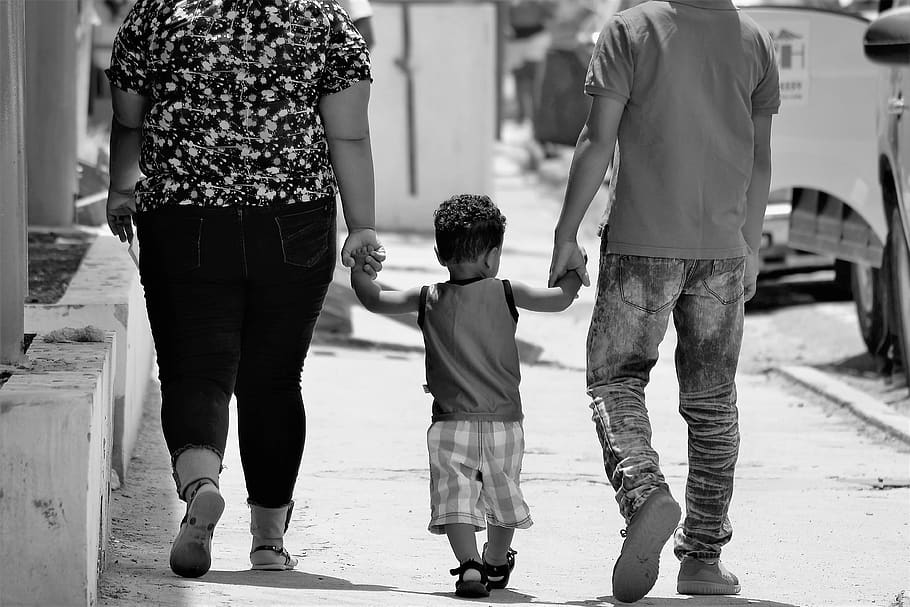
A black and white photo of a young child of color walking and holding the hands of two adults, a woman on his left, and a man on his right. Image use under CC0.

Young men in gangs are often thought to always practice masculinity by engaging in violent behavior like fighting and shooting, which many attribute to systemic inequalities like mass incarceration, scarce jobs, and racism. New qualitative research by John Leverso and Chris Hess shows that as male gang members age, they remain committed to masculinity but they relate to their manhood differently. 

Leverso and Hess asked about important life events that changed the way respondents understood what being a good man is in 29 in-depth interviews with current and former gang members in Chicago. These interviews showed how masculinity endures and evolves into new phases of adulthood, particularly fatherhood.

From the perspective of these current and former gang members, the ideal man is “hardworking, no punk, tough, and loyal.” Their concept of the ideal man reflects a tough, hardworking, and heterosexual ideal of manhood. These foundations of masculinity were consistent among men when describing both their past and present lives, regardless of whether they remained involved in a gang. However, despite this consensus, the ways gang members accomplish these goals of masculinity changed drastically as they became fathers, caregivers, and husbands.

Even current gang members still value family as an important part in accomplishing masculinity. One example is Jason, a gang member who claims that he “will always be a Pope,” or a part of his gang. However, he now valued his role as a father more and put his daughter’s needs in front of the gang. For instance, Jason claimed he would only help his fellow gang members financially if they were desperate, but would not do anything dangerous for the gang, and if anyone asked him to do something dangerous he would “smack them silly.”

This change in understanding of being a good father was also observed with those who had left gang related activity. As a gang member, Juan expressed the importance of “putting in work” (violent or non-violent actions in service of the gang) to show he was “faithful, loyal and respectful.” For Juan today, however, “putting in work”  means “spending time with his son, making money as a truck driver, and being a family man.” While no longer a gang member, loyalty and faithfulness to his family and children are still central to his ideas of manhood.

The article highlights that gang members, like non-gang members, change how they accomplish masculinity over the course of their lives. It also challenges assumptions about gang members as having radically different understandings of manhood. Like many men who were never in gangs, they prioritize being a family man and providing for their families. 

A white hand dials a number on an office phone, the receiver for the phone held in the other hand. Image via pixabay, Pixabay License.

In the United States there are 14 million formal child support cases, meaning that one in five children are dependent on child support payments. To ensure that these children receive financial support from noncustodial parents (that is, parents who are not the primary caretaker), child support agencies employ punitive strategies such as garnishing wages, suspending public assistance, suspending driver’s licenses, and even jail time.  

Unsurprisingly, previous research has found that noncustodial parents were dissatisfied and frustrated with child support agencies and their harsh sanctions. However, when Daniel Meyer and Yoona Kim used a larger, nationwide sample to test whether noncustodial parents actually disliked the child support system, their analysis told a different story.  

Unlike previous studies, which have generally used small interview-based methods, the researchers used surveys to assess satisfaction of 1,800 noncustodial parents in seven states who were behind on payments and had difficulty holding a job. They found that the majority of noncustodial parents were actually satisfied or indifferent about the child support agencies – the opposite finding of previous qualitative studies.  

They also discovered that one of the largest predictors of satisfaction was personalized service.  More specifically, when noncustodial parents knew the name of a child support worker that they could call for questions, they were 56% more likely to be satisfied with the child support system.

Statistics can tell us a story that sometimes counters our assumptions and previous understandings – and multiple methods are likely needed to address a complex question like satisfaction with the child support system.  Understanding such questions is likely essential to encouraging timely and complete payments which support children. With millions of children depending on child support to stay housed, clothed, and fed, this research shows how “putting names to systems” can help humanize government services and institutions.