
gender

A patient signing a form in a doctor’s office. Image by SHVETS production under Pexels license.

Reproductive rights are considered a hot-button topic by many, but different groups can face different pressures in exercising these rights. Moreover, rights around fertility-affecting operations like the removal of one’s uterus (hysterectomies), are often left out of the discussion. To shed light on these issues, recent research examines how gender and race affect those seeking a hysterectomy, usually seen as the most extreme birth control option. 

Andréa Becker, a postdoctoral researcher and instructor at the University of California San Francisco conducted 100 in-depth interviews with a diverse set of individuals who have undergone or are considering a hysterectomy. These operations were sought in many cases to remedy painful reproductive conditions like endometriosis, uterine tumors, or for gender-affirming care. 

She discovered that while white cisgender (cis) women are routinely blocked from accessing desired hysterectomies, cis women of color are pressured into having hysterectomies by medical professionals they are relying on for responsive treatment. Even in cases where a woman of color desires to preserve her fertility, she may experience unwanted pressure to have her uterus removed instead of seeking other treatments for painful reproductive conditions. For example, here’s how a Black woman named Kat described her struggle to preserve her fertility despite the medical establishment’s pressure.

“Every time I had a physical exam, every time I had a vaginal exam, every time I had a pelvic exam every time, it was like “hysterectomy, hysterectomy, hysterectomy,” it was it was definitely pushed.”

Women who did not have or intend to have a male partner or desire kids also experienced differential treatment when seeking a hysterectomy. One lesbian woman even described how medical practitioners did not consider her wishes on the matter at all and were more concerned with the fertility wishes of a fictitious future husband.

Perhaps surprisingly, trans men and non-binary patients reported having a comparatively easy experience getting a premenopausal hysterectomy if they wanted one and were readily offered the procedure or even directed to it as it reinforced societal gender norms.

The study clearly shows a systematic disregard for women’s agency by the medical community, especially that of women of color. The pressure exerted by practitioners to sterilize women of color, even when it contradicts their wishes and goals, has links to a much longer history of medical abuse of such patients. These findings reinforce the need for medical institutions and practitioners to understand and address how racial prejudice and other forms of discrimination affect their treatment of patients.

A bare prison cell with a bunk bed, metal chair, and toilet. Image from RDNE Stock project under Pexels license.

Gender segregation is a core feature of American prisons, with men and women separated out into separate facilities. So how do gender nonconforming prisoners fit into this system? 

In a study of California men’s prisons from 1941 to 2018, Joss Greene finds that the response to gender-nonconforming prisoners varied historically. As attitudes towards both punishment and gender changed over time, prison administrators shifted their approach to managing gender-nonconforming prisoners. 

1941-1954: Segregation

Beginning in the early 1940s, California promoted prisons as sites of rehabilitation. However, from 1941 to 1954, prison administrators viewed gender nonconformity as a contagion that threatened both the overall health of the prison and the prison’s rehabilitation efforts. Prisoners who were identified as “effeminate homosexuals” were segregated from the rest of the prison population, stigmatized, and excluded from educational and work opportunities.

1955-1981: Treatment

From 1955 to 1981, prison administrators approached gender-nonconforming prisoners as “medicalized subjects”, meaning that their homosexuality or gender expression was considered a psychiatric or medical condition. 

Gender-nonconforming prisoners were subjected to psychological studies and “treatment” (in the form of harsh medical experimentation) at a newly constructed California prison medical facility. However, many prisoners were able to use their new medical label as leverage to demand access to some gender-affirming care.

1982-1998: Risk Management

In the late 1970s, California’s “tough on crime” approach led to a historic rise in prison populations. To increase efficiency, prison administrators classified prisoners into four risk levels, based on their sentence, behavioral record, and other factors. Those classified as high-risk were subject to harsher punishment. Under this system, all “known homosexuals” were automatically classified as a Level 3 risk (the second-highest level). They were grouped in with individuals convicted of more serious crimes, faced increased restrictions within the prison, and were frequently targets of violence. Victims of violence often increased their risk score by defending themselves, as the system did not distinguish between the risk of harm to the prisoner and the risk of the prisoner harming others.

1999-2018: Legal Status

Finally, from 1999-2018, there were growing social movements opposing mass incarceration, and “transgender” became a recognized legal status. Prison administrators, seeking to avoid legal battles, created a “transgender” prisoner category and expanded their medical services, including gender-affirming hormone treatments.

Despite these legal advances, most transgender prisoners have been unable to access hormone treatments and still face widespread suffering in prisons. They remain a protected group in name, but not in reality.

Advancing Rights

Greene’s work highlights how institutions (and their underlying logic and resources) can shape how gender boundaries are defined, reproduced, and changed over time. In California prisons, views on crime and punishment, incarceration rates, prison resources, and anti-incarceration social movements all shifted gender boundaries within prisons. These historical shifts should provide hope for some trans rights advocates, who view changing prison policies as an opportunity to provide relief for transgender prisoners. That said, fully addressing the suffering of gender-nonconforming prisoners will require more fundamental changes to both societal gender boundaries and the nature of prisons themselves.

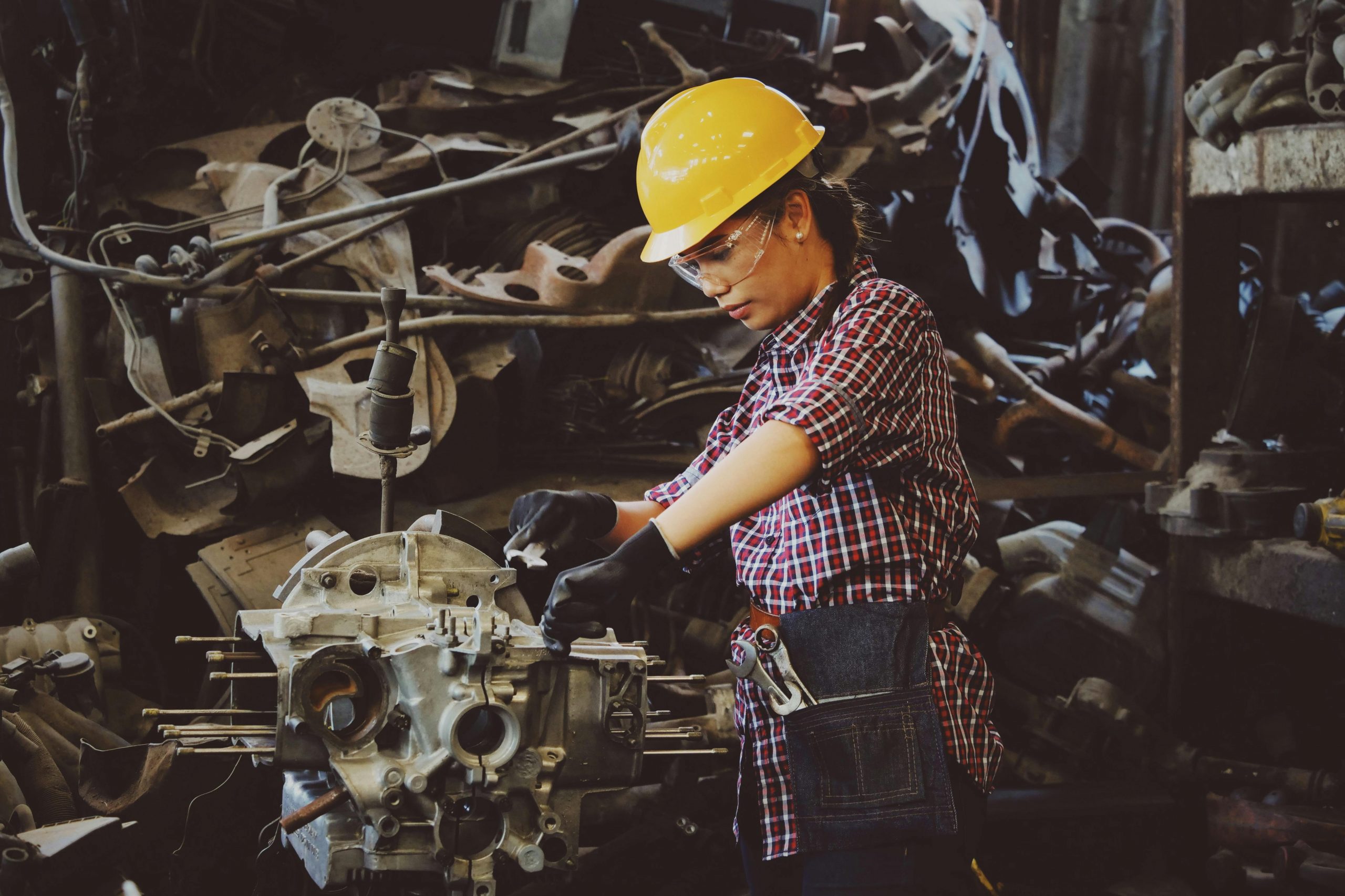
A woman wearing a hard hat and safety glasses working on an engine. Image from Chevanon Photography under Pexels license.

Unionizing and strikes continue to maintain headlines, but labor unions and strikes have been intertwined with American industry for decades. That said, many of these historic strikes have been by unions representing traditionally male-dominated positions, whereas today women are increasingly taking on unionizing challenges. This changing gender balance was recently highlighted by Margarita Torre in her recent study.

Torre analyzed the General Social Survey data from 2002-2021 and found that supportive attitudes around labor unions have increased across the board. Younger women, women with less than a high school education level, and those in female-dominated occupations were even more favorable towards unions compared to other groups of women. 

There are good reasons for this. Historically, as Torre writes, women have “tended to work in a much narrower range of occupations than men and are overrepresented in low-paying, part-time, and temporary jobs with fewer opportunities for advancement.” Unions provide greater benefits (healthcare or retirement plans) and higher wages which can help reduce gender inequality in the workforce, especially in labor markets that offer a wider range of job opportunities and hours compared to previous decades. 

Race is also a big part of the story. About 11% of Black women in the U.S. are part of unions, higher than both White and Hispanic women. Women and people of color stand to benefit greatly from joining a union as particularly vulnerable groups. 

While only about 4% of 24-year-olds and younger express their intention of joining a union when entering the workforce, Torre explains that the favorability of unions among young women may increase as more women enter the workforce and begin to see the benefits of unionization.

A music studio mixing board. Image by Lukas from Pexels is licensed under Pexels license.

Collaboration is the key to spurring creativity…or is it? Research suggests that women are often undervalued on creative project teams, receiving harsher evaluations and fewer opportunities to participate. However, as new technologies allow for asynchronous work (with team members working independently at different times, and in different spaces), the structure of creative teams is changing.  

Aruna Ranganathana and Aayan Dasa studied how asynchronous teamwork affects performance for Baul sangeet folk-music ensembles in eastern India. Most ensembles have several instrumentalists – who are typically men – and a single singer. The ensembles collaborate to decide what music to play and how to shape each song musically. Because each ensemble member plays a unique part, the music can be recorded either synchronously (with all ensemble members performing live together) or asynchronously (with each musician recording their part independently). The researchers interviewed musicians and observed recording sessions. They also conducted an experiment in which Baul singers recorded the same song both synchronously and asynchronously. Their performance was then assessed by musical experts on singer performance, vocal tone, vocal range, and overall group cohesion. 

From the interviews and observations, the researchers found that men and women experienced the synchronous recording environment differently. The men enjoyed the synchronous recording and thought that the group brought out their best creative work. They enjoyed creative discussions with other musicians, valued the feedback they received, and felt motivated. “People were encouraging me throughout, which further boosted my confidence; it felt like they were guiding me. I also got respect from all the people here. I also had a great experience interacting with the music producers; they were all very good,” a male musician described. 

Although some women also preferred synchronous recording and felt they performed best in a group environment, others preferred recording asynchronously. These women described receiving unnecessarily critical feedback or a lack of support and respect from the male musicians in synchronous recording. Some said they couldn’t express creative ideas or concerns. 

“The person who was playing the flute was trying to establish himself as a big shot and was constantly boasting about himself,” said one female singer. “He was trying to hint that I was not singing properly at certain points. . . . When I pointed out his mistake, and he was offended by it, no one else supported me even though they knew what I was saying was correct…I felt really bad today.”

Working asynchronously, in contrast, many women felt that their performance improved and that they could express themselves better. One woman described: “Whatever I had within me related to that song, I was able to provide all of it.” 

The experimental study appeared to bear this out, as the asynchronous environment improved ratings of women’s performance by nearly 30%. Even the women who preferred working synchronously received better performance ratings in an asynchronous environment.

While we don’t know whether asynchronous options have similar effects for other types of work, this study suggests that changes to the structure of work in creative teams can reduce gender disparities in performance and allow women to fully realize their creative potential. 

Kristin Turney, Katelyn Rose Malae, Mackenzie A. Christensen, and Sarah Halpern-Meekin., ““Even though we’re married, I’m single”: The meaning of jail incarceration in romantic relationships,” Criminology, 2023

A jail cell, partially open with two uncomfortable mattresses on a bunk bed. Image by RDNE Stock project from Pexels is licensed under Pexels license.

Almost one in five adult women in the United States is a romantic partner or co-parent with a currently or formerly incarcerated person. In other words, roughly 33 million women in America have had to manage a relationship behind bars. 

Unlike previous studies of long-term prison incarceration, new research by Kristin Turney, Katelyn Rose Malae, MacKenzie A. Christensen, and Sarah Halpern-Meekin asks how shorter-term jail incarceration affects romantic relationships and family structures for women in relationships with incarcerated men. This research addresses a lack of focus on jail incarcerations. Jail sentences often come more suddenly and are less predictable than prison sentences, leaving families less time to plan for the future. 

Turney and colleagues analyzed interview data from the Jail and Family Life Study of incarcerated fathers and their family members. The researchers had three main findings. First, women whose partners were incarcerated in jail felt their relationships were in a period of transition where their roles and expectations were uncertain. Arrests meant that families were suddenly separated for unknown amounts of time. Some interviewees spoke about their partners’ unclear release dates making them unsure of their relationship status and how things might change after release. Many interviewees described feeling both “connected” and “disconnected” from their incarcerated partners, with some describing their relationships as “long-distance” even though they still lived in the same county as their partners. Because of the forced separation, some interviewees even described themselves as newly “single” although they still felt committed to their partners.

“We were kind of at a standstill. We’ve just been dealing with Manny being gone, having to just go through life, I guess, without him. Raising his son, raising my daughter as a single mom. Because that’s what it is. Even though we’re married, I’m single,”

Second, many women whose partners were incarcerated in jails took on new or increased responsibilities when their partners were incarcerated, often becoming their family’s only breadwinners. Being in charge of their family’s finances, women were often responsible for the court fees of their incarcerated partners, creating new, challenging relationship dynamics. Without their children’s fathers, the interviewees also described difficulty in parenting alone, especially when speaking to their children about their partner’s absence. These often led to shifts in how interviewees viewed themselves with some finding a new sense of independence, such as seeing themselves as more positive, self-reliant role models for their children 

Finally, the researchers found that women with partners in jails reevaluated their relationships and priorities. Some interviewees felt the incarceration strengthened their relationships, as they became more committed to their partners. Some described feeling as though their partners focused on them more after being incarcerated which led to their relationship roles becoming more stable.  Others, because of their new responsibilities or the uncertainty of their relationship status, took the opportunity to reexamine their relationships, choosing to focus on themselves and their children while finding their relationships less important and feeling less committed to their partners.

Jail is an isolating experience for those incarcerated but it also affects relationships back home. Turney and colleagues show how separation complicates these relationships and, more generally, how the criminal justice system can impact relationships and inequalities among families outside of jail.

A young woman wearing college a graduation cap and gown walking down a sidewalk by Stanley Morales. Image from Pexels is licensed under Pexels license.

Many pursue college as an avenue of economic mobility, but gender and sexuality can also influence the decision to attend and move away from home. For young Latinas, in particular, household and family responsibilities and traditional gender norms can shape such decisions. Sociologists Michelle Gomez Parra and Lorena Garcia argue that desires to break free from these gendered expectations are an important part of Latinas’ decisions to move away for college. 

Parra and Garcia interviewed 31 Latinas who were enrolled in or graduated from a four-year university. The women were all from poor and or working-class families and 2nd generation (born in the U.S., but had a parent who immigrated) or generation 1.5 (immigrated to the U.S. before the age of 12). While the women saw college as an opportunity for economic mobility, they also described gender-related desires for individual freedoms. 

The women shared how going away to college lowered the burden of household responsibilities. For example, ‘Emma’ said: “After school, my sister and I washed the dishes, cleaned up the living room, helped my mom with dinner when she got home from work. And weekends we’d go [to] the lavanderia [laundromat]. My brothers didn’t have to do any of that, it was annoying as hell!” 

By going away to college, the women could escape these responsibilities and focus on their studies. ‘Yolanda’ explained: “I didn’t want to always be stuck doing los quehaceres [housework], I didn’t want to deal with that and try to focus on my studies at the same time…I was like, ‘nope,’ I gotta go away for college.” 

The desire to move more freely outside the home also influenced the women. They described how their parents – in an attempt to prevent their daughters from sexual activity or “quien sabe que” (who knows what) – limited or closely supervised their social activities. ‘Erica’, a college graduate, explained: “My dad was always so strict about everything!…I thought, ‘This is my chance to not have anyone putting so many limits on everything I do.’” In terms of identity, being a college-bound teen also allowed the women to distance themselves from the stereotype that working-class Latinas often become “teen moms.” 

Economic mobility and the promise of a bright future are important factors in the decision to go to college, but not the only factor. Rather, for these working-class Latinas, their decisions provided an opportunity to break free of gendered expectations.

An older couple walking closely together along a gravel path on a cloudy autumn day. Image by EddieKphoto from Pixabay is licensed under Pixabay license.

Are you looking for love? Above the age of 60? Well, you’re in luck. With the advent of online dating, older singles are beginning to reenter the dating world. Social science research has mainly focused on the online dating experiences of twenty-somethings, but new research from Lauren Harris explored the dating preferences and patterns of older adults.

Harris interviewed 50 men and 50 women, ages 60-85, through four online dating sites. Three of the sites were for the general public and one was specifically targeted towards older adults. Harris asked participants questions about their motivation and interests in online dating such as: “What are you looking for in a romantic partner?,” “Do you have any deal breakers?,” and “What do you notice when looking through someone’s online dating profile?”

Harris discovered that family caregiving responsibilities played an important role in how older singles viewed potential matches. Oftentimes, older adults will still provide care for their adult children or grandchildren. Harris found that these caring responsibilities actually changed the desirability of singles online in gendered ways. 

Women with family care obligations were seen as less desirable. For example, one of the men interviewed explained his irritation with this dynamic saying, “Why are you teasing me and wasting my time when you have the responsibilities? …It just gets frustrating. Do you want a relationship or do you not? So if you’re always taking care of your grandkids, why are you on a dating site when you don’t have time to get into a relationship?”

In contrast, men who had similar care responsibilities were seen as more desirable to women. As one woman explained in her interview, “A lot of times they’ll say something about how they love their children and their families and spend a lot of free time with their family. I like that. I like a family man.” At the same time, however, if men appeared to be in poor health or have young children of their own their desirability decreased. Women tended to shy away from men which might add to their care work responsibilities. As one woman described,  “What they’re looking for is women to take care of them… Or they’re having health problems. Maybe the wives [were] taking care of them in life or whatever…I’m not your nurse.”

Harris highlighted the gendered role family care responsibilities play in selecting potential love interests at an older age. Many older adults have care responsibilities and are subsequently experiencing unequal gendered impacts on their dating life. Because romantic relationships can be a major source of support and improve overall well-being, the influence of gender inequality on the dating experiences of older adults is important to consider. Technology has allowed more older adults to re-enter the dating world, but it has also highlighted the persistent caregiving double standard. 

A white father and son place plants in a garden bed together. Image 11481 by Cade Martin, Dawn Arlotta CDC is licensed under CC0.

“He’s on paternity leave,” is a phrase that seems to spell success for gender equality. While previous research has focused on how mothers affect children’s gender views, new research from Australia looks at the role of fathers in the development of children’s and adolescents’ gender values. Tomas Cano and Heather Hofmeister found that when fathers are more engaged with their kids and do more housework, their children are more likely to feel that men and women should have equal power and status in the workplace, world, and home. 

Cano and Hofmeister analyzed 10 years of data from the Longitudinal Study of Australian Children which gathers information about the opinions and routines of children and parents as they age. They used measures of the quality of father-child relationships, and father’s involvement in housework and childcare to assess how different kinds of parental involvement from fathers influences their children’s views on gender equality.

The study found that when fathers spent more time on childcare when children were young, kids are more likely to feel that men and women should be treated equally. When children got older and reached adolescence, different kinds of involvement from fathers had more effect. When fathers with older children take on housework, even in smaller amounts than their wives, their adolescent child is much more likely to express egalitarian views on gender.

The socialization of gender values in Australian adolescents can help us imagine how we could shift the behavior of fathers to promote more egalitarian gender values elsewhere. Further research is necessary to determine if the relationship between these fathering behaviors and children’s gender values is relevant across cultural lines. But the more that is learned about how values are internalized from paternal parenting, the more parents may pay attention to modeling not just what is polite or successful, but also what habits and actions communicate their values. 

Six bronze bullets on top of a reflective surface, two fired and four not. Image by MasterTux from Pixabay is licensed under Pixabay license.

According to the Centers for Disease Control, more women are killed by their current or former partners than by strangers, and the millions of women in physically abusive relationships are at even greater risk. Because most intimate partner homicides are committed with guns, many states have implemented firearm restrictions on persons convicted of domestic abuse.

Victims of domestic violence often seek emergency restraining orders to help protect themselves and their children. In some states, judges are legally required to order the confiscation of firearms when restraining order petitions contain allegations of physical abuse or threats. These statutes are designed to prevent perpetrators from escalating violence against their current or former partner because firearms are commonly used in intimate partner murders. Research has even shown that this mandatory firearm confiscation lowers homicide risk. Given the importance of mandatory confiscation, judges should be ordering the removal of firearms, right?

Not exactly. Recent research from Julie Kafka, Kathryn Moracco, Deanna Williams, and Claire Hoffman found that judges in North Carolina failed to order firearm confiscation in 61% of protective orders, even when physical violence and/or threats to kill were present. This runs against North Carolina’s mandatory firearm confiscation law in emergency restraining order hearings, and the researchers observed judges failing to verbally announce firearm restrictions during hearings in two-thirds of cases. In other words, judges pick and choose when to follow the law and enforce firearm restrictions for people accused of domestic violence; in most cases, they do not order confiscation. 

This research shows that leaving the confiscation of firearms up to judges maintains access to firearms even after allegations of physical abuse and threats. Kafka and colleagues suggest making confiscation the default or removing the “open-to-interpretation” language in the law. The researchers suggest that better training for judges, monitoring the whereabouts of guns in households with a history of intimate partner violence, and greater domestic rights education for victims could prevent further tragedy.

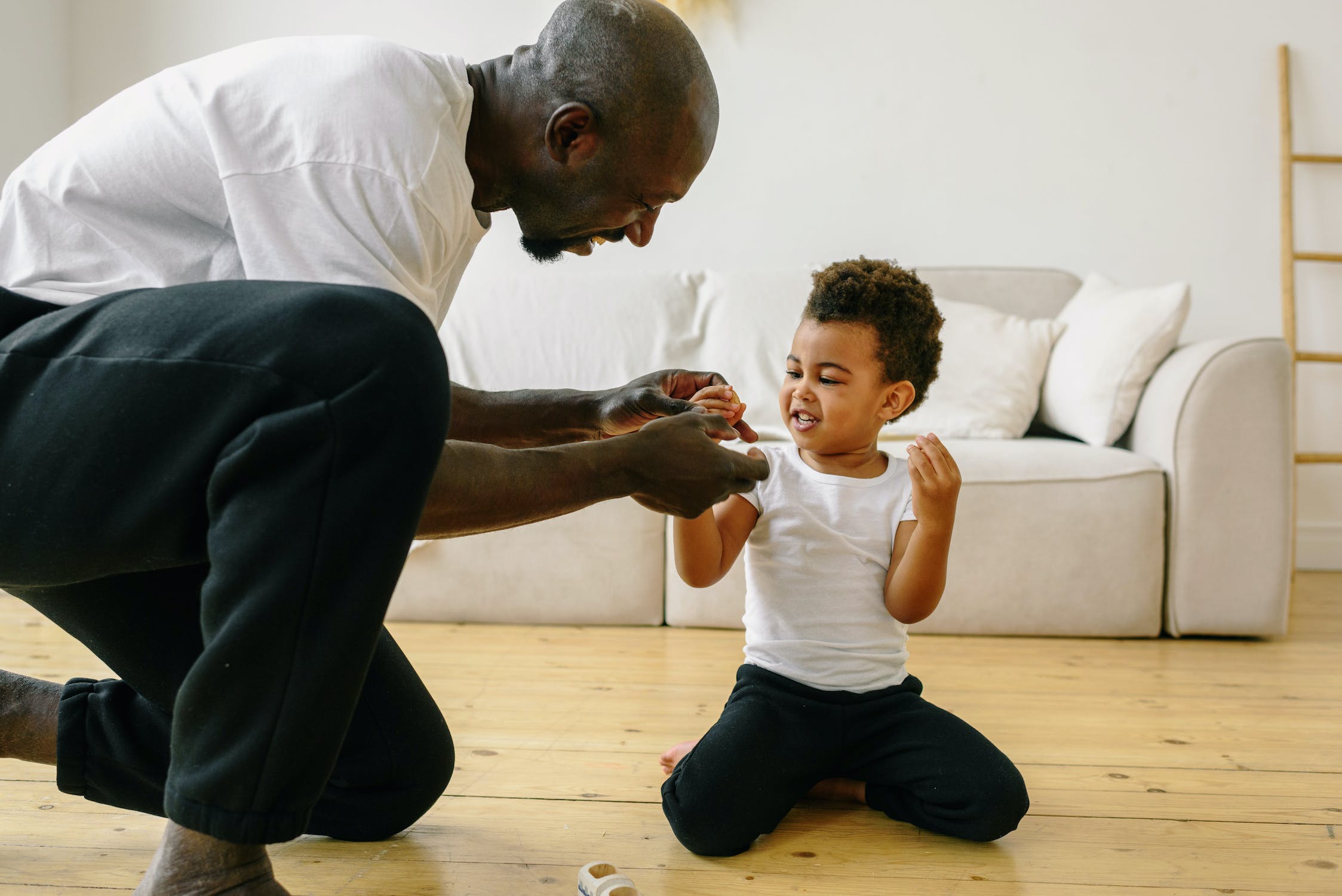
A smiling black father kneels, holding one of his child’s hands. “Father Playing With Little Son at Home” by Ksenia Chernaya is licensed under pexels license.

Bundles of joy? Previous research suggests that having children may not be joyful for all parents, especially those who juggle high expectations with inflexible and demanding workplaces or raising children of color in a racially inhospitable world. However, new research from Jennifer Augustine and Mia Brantley finds that the happiness of parents varies by race and gender and in ways that were not entirely expected, especially in comparison to adults without kids.

The study is based upondata from the General Social Survey, a nationally representative survey of adults in the United States, between 2010 and 2018. Researchers used questions where participants are asked to rate how happy they are and provide information about  their race and if they have children who they live with. This study also took into account what respondents reported for  r items such as income  or church attendence that previous research has shown influences happiness.

Augustine and Brantley found that there is not a difference in happiness between white fathers and nonfathers, but that white mothers are less happy than white women who are not parents. The existence of a “happiness gap” for white women but not white men may result from cultural expectations that  White mothers be totally devoted to their children despite the necessity for most white moms to work outside the home. Conversely, the fact that white dads are not expected to take equal responsibility for caring for kids might help explain why they are about as happy as men without kids.

This analysis also revealed no difference in happiness between black parents and nonparents. In fact, it found that black fathers are actually happier than their peers without children. These findings suggest that fatherhood is an important and meaningful part of life for many black men, whileblack moms might have ways of coping that help them manage the stress of raising children that white moms lack. Black mothers also may not exhibit a “happiness gap” compared to black nonmothers because black motherhood views work and parenting as complementary and emphasizes the importance of communal care for children, providing important support for moms. 

This study only analyzed data up to 2018, prior to the COVID-19 pandemic and racial unrest following the murder of George Floyd. Future research will have to examine how changing demands on parents during the pandemic, especially virtual schooling, as well as greater attention to police brutality and racial injustice shaped differences in happiness between black and white parents and nonparents. But what this research clearly demonstrates is whether there is a “happiness gap” between parents and adults without children depends on who is doing the parenting and how they are expected to manage their parenting responsibilities with other aspects of their life.