Archive: 2011

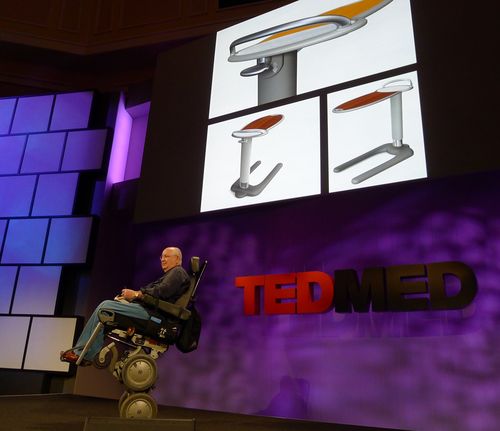
Technologies are, by nature, biased. They are biased by the humans who create them. They are biased by the cultures in which they are produced. They are biased by the perceived needs of intended consumers and they are biased by agentic practices of consumption. A recent TEDMED talk (Why Hospital Rooms Don’t Work) by architect Michael Graves highlights the biased nature of technologies. Specifically, he demonstrates the embeddedness of privilege.

Michael Graves is a renowned architect. In 2003, Graves developed a rare (and still mysterious) illness that left him paralyzed. While fighting the illness and then undergoing rehabilitation, Graves spent a significant amount of time in hospitals. He found the facilities not only to be aesthetically displeasing, but impractical and sometimes downright inaccessible for a person with mobility impairments. He describes unreachable light switches and faucet handles, rooms so small that maneuverability is impossible, really ugly floral patterns, and an overall requirement that he, as a person in a wheelchair, ask for help with tasks that he should be able to complete independently. Summarizing these shortcomings he says: more...
Review of ‘Digital Natives and the Return of the Local Cause’ by Anat Ben-David. Essay from the Digital AlterNatives with a Cause? book collective, published by Centre for Internet and Society, India and HIVOS, The Netherlands

Ben-David’s piece is an informed attempt to resolve the conceptual fuzziness of the term “Digital Native.” She attempts this in a philosophical manner: trying to move away from the ontological “who are Digital Natives?” to an epistemological “when and where are Digital Natives?” Her reasoning is that this change in perspective will allow us to unpack the hybrid term and thus  determine if it refers to a unique phenomenon worth exploring.

To answer the when and the where, Ben-David situates the term into its constituencies: digital and native, contextualizing the words using two approaches; historiographical (when) for the digital and geopolitical (where) for the native.

Digital” is situated, semantically, in the broader framework of technology-mediated social activism. The author applies the concept placing two events side-by-side: First, the 1999 manifestations against World-trade Organization protests in Seattle and then the 2011 Tahir Square protests in Egypt. Are these two phenomena different in nature? Is Tahir Square a more technologically advanced version of Seattle? Are the basic mechanisms the same, albeit with new faces and shinier phones? more...

Photo of the week

This week at Cyborgology…

Dave Strohecker is back at theorizing hipsters and authenticity, this time comparing them to “indie”

Editors Nathan Jurgenson and PJ Rey live-tweeted and archived the Twitter stream of the recent flash-conference on Occupy, the Tea Party and networked democracy

Jenny Davis writes on “responsible Googling,” or how teachers should best use the Web in the classroom

Nathan Jurgenson asks if Occupy can survive a winter without tents, arguing that most analyses of the movement has looked too much at space and not enough at time

David Banks writes his second post on Actor Network Theory, compares it to “augmented reality”  and again comes down hard on Latour and his disciples. The post continues to spark a terrific discussion in the comments

Sarah Wanenchak responds to Nathan’s previous post arguing that, yes, Occupy can withstand a winter without tents. Memories are strong, and people will not forget about what made the movement powerful. 

Photo by David Shankbone, September 30th, NYC

Two days ago, Nathan Jurgenson wrote on what has become one of the central questions around Occupy Wall Street: Now that the encampments are closing up and the winter is coming on, can Occupy survive? The crucial point that Nathan makes is that we need to think about Occupy not just in terms of space but in terms of time – that permanence has been a part of what’s given the movement so much symbolic and discursive power. Nathan brings up an additional point, to which I want to respond here: that the role of physical permanence that the encampments represented was powerful because it resulted in a form of cognitive permanence in the minds of everyone who saw them (and heard them; the auditory side of Occupy is also vital to pay close attention to).

While I clearly agree with Nathan that the physical permanence that tents represent has been what’s given Occupy a lot of its power, I think we can glean enough evidence from how things have proceeded so far to at least make an educated guess at an answer to his question. For me, the answer is yes: I expect that Occupy will survive the winter and emerge in spring, albeit – like a bear emerging from hibernation – perhaps in somewhat of a different shape. There are several reasons why I come down on this side of things.

more...

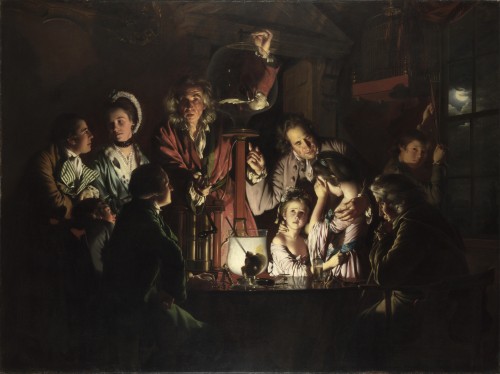
Joseph Wright's "An Experiment on a Bird in the Air Pump" Depicts the beginnings of Enlightenment science

Two weeks ago, I wrote a Brief Summary of Actor Network Theory. I ended it by saying,

My next post will focus on ANT and AR’s different historical accounts of Western society’s relationship to technology. While Latour claims “We Have Never Been Modern” we at Cyborgology claim “we have always been augmented.” I will summarize both of these arguments to the best of my ability and make the case for AR over ANT.

The historical underpinnings of ANT are cataloged in Laotur’s We Have Never Been Modern and are codified in Reassembling the Social. I will be quoting gratuitously from both.

In We Have Never Been Modern, Latour comments on a debate between the political philosopher Thomas Hobbes and natural philosopher Robert Boyle. Latour describes the debate this way: more...

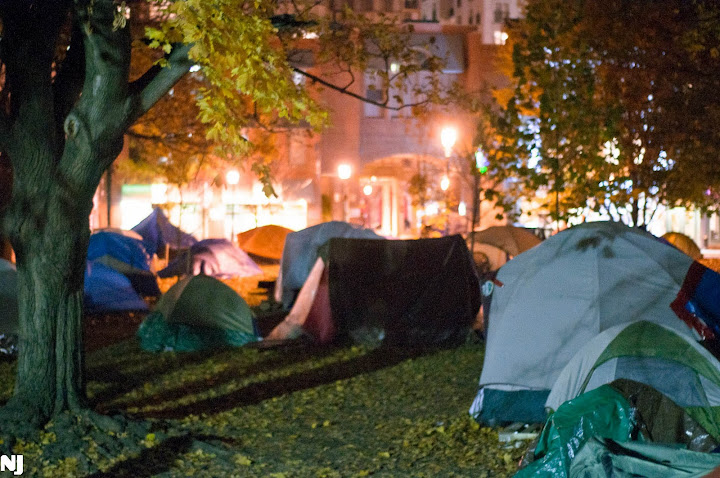
photo by nathan jurgenson, taken at Occupy Toronto, November, 2011

At exactly the moment when tents are disappearing, when, at least for the winter, Occupy is trading long-term omnipresence for short-term actions, Occupy DC made news for building a large, wooden, winterized structure in a city park. The Occupy DC barn fiasco can be understood, in part, as a move to double-down on the endurance of the Occupy movement precisely when it is at risk of losing that secret ingredient that made it powerful: time.

As Sarah Wenechak wrote, tents pitched in city parks come to be more than practical but also symbolic. And part of this value is that they represent time. Overall, much of the writing about Occupy has focused on space. Traditional protest actions, like marches, claim physical space but merely do so for short periods of time (especially as the march moves from location to location occupying any particular space for a only very brief amount of time). While that big umbrella term “occupy” certainly refers to space, there has also been a special focus on time.

A tent, for example, proclaims that more...

Finals are a stressful time for students, as numerous deadlines—often requiring the accumulation of a semester’s worth of work—converge into one terrifying week. Pajamas stay on. Coffee gets brewed. Some thrive.  Some sink. And a few, in a panic, copy/paste something directly from Wikipedia.

From the instructor side, finals are also stressful, but in a different way. Not only do we have to rush through stacks of papers, inputting senior grades in time for graduation, but we have to do so with the knowledge that this is the moment of truth—the moment where we find out how effective we have been all semester (if effective at all). Like our students, this process can bring  moments of great triumph, such as grading a perfect test or reading a profound paper—one that perhaps even teaches us something. It can also bring defeat, where we must acknowledge that some students never truly engaged with the material. And finally, it brings sleepless nights (and probably an indignant Facebook status update) as we inevitably find the direct Wikipedia quote copied, pasted, and sometimes linked in a final paper. more...

Credit: Andrew Hoppin

Cyborgology editors Nathan Jurgenson (@nathanjurgenson) and PJ Rey (@pjrey) live-tweeted Personal Democracy Media’s From the Tea Party to Occupy Wall Street and Beyond: A Flash Conference. Below is an archive of the conference backchannel (also here) as well as the video from the event. more...

“From the Tea Party to Occupy Wall Street and Beyond–The Future of Networked Democracy” is starting now. Cyborgology Editors Nathan Jurgenson are live-tweeting the event.

Follow Nathan here: @nathanjurgenson

PJ here: @pjrey

The conference hashtag here: #PDMteaows

The conference is streaming here: http://personaldemocracy.com/teaowslive

Since these hipster blog posts are generating so much great discussion I thought I would bring you another example of the subculture. I came across this website after my girlfriend attempted to get me to listen to some folk bands or something that she liked. I can’t exactly recall how it happened, but I do recall her sending this website to me.

The entire website for Plan-It-X Records is a simple .jpg image seen above.

more...