race

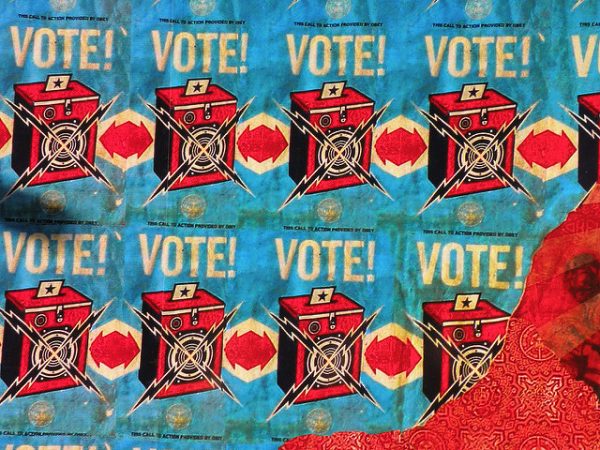
Shepard Fairey’s work on the streets of San Francisco. Photo by Michael Pittman, Flickr CC

Political spectators anxiously await a final decision from the Supreme Court on the Wisconsin gerrymandering case, Gill v. Whitford. Gerrymandering occurs when legislators redraw voting districts in order to concentrate their electoral dominance. This highly anticipated judicial decision could stop gerrymandering practices and require courts around the country to search for bias in their district maps. While voting is the cornerstone of democracy, social science research on gerrymandering suggests that democratic ideals may not match up to how voting works in practice.

Wisconsin redistricting plans that were ratified in 2011 gave Republicans an advantage over Democrats in translating votes into seats in the legislature. Computer simulations can diminish partisanship in district drawing, but it remains unclear how effective this would be in reducing political polarization in Congress. One study suggests that redistricting does appear to diminish electoral competition, but does not appear to exacerbate polarization along party lines.  
Political sociologists have shown that full voting rights are not as guaranteed in the United States as in many other major democracies, and gerrymandering is just one example of practices that lead to the under-representation of low-income voters and communities of color in the electoral process. For example, partisan gerrymandering reduced access to communication between ward residents, local nonprofits, and their political representatives in Chicago. There is also evidence it changed voters’ choices in Georgia. In short, gerrymandering has real consequences for racial inequalities and representation in the United States.
Photo by Harold Navarro, Flickr CC

Immigration is a hot-button issue in American politics today. President Trump’s proposed border wall, rescinding of DACA, travel bans for multiple majority-Muslim countries, and increased detention and deportation have meant that the debate has focused almost exclusively on Hispanics and Muslims. This is the latest in a long history of misgivings towards immigrants that has obvious racial dimensions. It’s easy to forget that much anti-immigrant rhetoric is based on American attitudes about who is white, or who has the potential to become white. Social science research reminds us how certain groups who were once cast as racial outsiders eventually came to be seen as “white,” while others have been consistently denied white status and the full citizenship that comes with it.

The meaning of “white” has changed through the course of American history. From the 19th century into the early 20th century, “white” only incorporated Anglo-Saxon, Protestant Americans. American voters and policymakers were concerned that “non-white” immigrant groups such as the Irish, Poles, Jews, and Italians lacked the ability to assimilate into American society. Gradually, however, these immigrants became incorporated into the dominant racial category and were thus no longer considered outsiders.
This did not apply to all immigrant groups, however. Despite the historical flexibility of the category, whiteness never encompassed everybody. Courts, laws, and pseudoscience defined whiteness in ways that excluded some groups from full citizenship in America. Many immigrant communities—such as West Indians, Hispanics, and the Chinese—found themselves in racial categories that shaped their access to various socioeconomic opportunities, belonging, and citizenship.
Photo by Gage Skidmore, Flickr CC

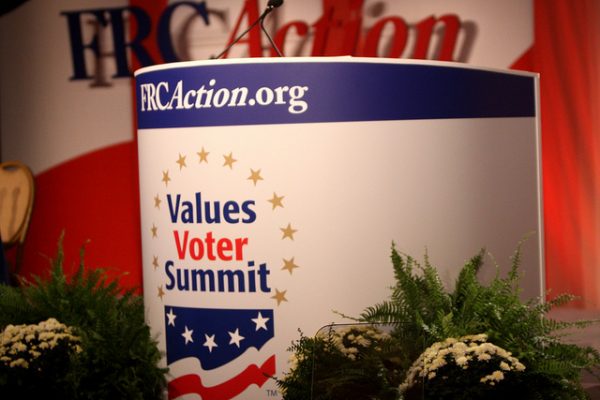
Donald Trump was recently the first sitting president to address the Values Voter Summit in Washington, D.C., where he referenced “attacks” on Judeo-Christian values. But what does this “Judeo-Christian” buzzword really mean? Social science research shows us that national identity is a style of political engagement that can change over time, but also that these cultural changes have real stakes for the way Americans think about their fellow citizens. While the U.S. is becoming an increasingly racially and religiously diverse nation, this demographic change comes up against the persistent cultural assumption that Americans share a distinct Christian identity and heritage.

The meaning of “Judeo-Christian” has changed over time. Once referring to progressive political coalitions, it became a rallying cry that designated socially conservative positions in the “culture wars” of the 1980s and beyond. This case shows us how nationalism is a cultural style comprised of different beliefs and identities. This means that political leaders and everyday citizens can draw on different styles of nationalism.
And these styles of nationalism have real stakes. An emerging trend in public opinion literature shows that Christian nationalism in particular is a strong predictor of negative attitudes toward minority groups. For example, respondents high on this kind of nationalism are also less likely to support interracial and same-sex marriage.
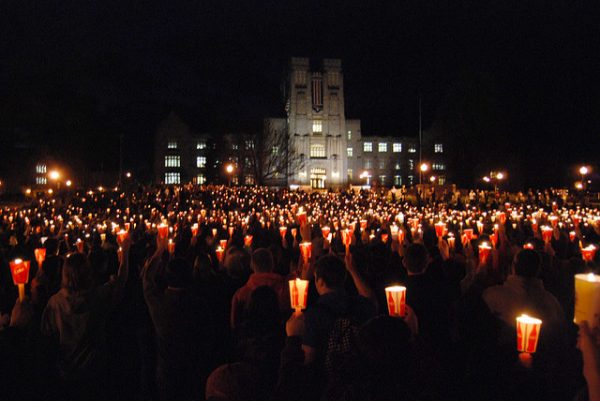
A candlelight vigil outside Virginia Tech’s Burruss Hall after the 2007 mass shooting. Photo by Kate Wellington, Flickr CC

The nation remains in mourning as we struggle to make sense of this week’s tragedy in Las Vegas, where 59 people were killed and over 500 wounded. Many are referring to the attack as the “deadliest shooting in modern US history.” Through their grief and shock, some now question how local law enforcement, politicians, and news media outlets will characterize the shooter, a middle-aged white man, who, according to family members and the early stages of the investigation, had no known ties to religious or political groups. Investigative authorities link terrorism to violent acts, the motives behind those acts, and affiliation with known terrorist organizations. Yet, several activists have argued that the media’s characterization of mass shooters depends upon their race, ethnicity, and religious beliefs, noting that “Whiteness, somehow, protects men from being labeled terrorists.” Examining the role of media discourse regarding mass killings might help us make sense of these acts of violence.

Mass shootings have been covered extensively by the U.S. media since the late 1990s Columbine shooting. What began as a focus on the two perpetrators and 11 victims developed into a moral panic regarding youth delinquency, mental illness, discipline, and even terrorism. Yet, the media does not treat all mass shootings equally — several factors come into play, including the availability of iconic images, media access, and the race and socioeconomic status of the perpetrator. Shootings that occur in seemingly quiet suburbs by white youth are more shocking because the perpetrators and victims are considered to be “people like us.” In contrast, shootings where the perpetrators are persons of color or reside in working-class neighborhoods produce less shock, as news producers and consumers presume that violence is somehow normal or inherent to those communities.
One comparative study defined mass shootings as “homicide offenses that require firearms as the weapon of attack, and they often end in the offender’s suicide or orchestration of ‘suicide by cop’.” By this definition, the U.S. has likely had more public mass shootings than other comparable nations over the past 50 years. Mass shootings are more likely to take place in countries with higher levels of gun ownership and, in the case of school shootings, have been linked to aggressive performances of masculinity by predominantly young, white, suburban students. While mass shootings frequently involve multiple casualties, authorities rarely refer to such acts as terrorism — the designation of “terrorist” is generally reserved for “foreign-based terrorist organizations.” 
One concern about the coverage of such events is that the publicity and sensationalization surrounding mass killings may inspire other “copycat” crimes. Potential mass killers may use media reporting as a way to create a fictive bond with other mass murderers as a “comradery-focused fantasy.” Seung-Hui Cho, for example, idolized Dylan Klebold and Eric Harris (Columbine shooters) for several years, before carrying out his own deadly attack at Virginia Tech. Other potential mass murderers intensely scour news clippings of prior mass killings to find the perpetrators’ weaknesses and compete with them. Before killing 20 children and 6 adults at Sandy Hook Elementary School, shooter Adam Lanza’s correspondence illustrates that he critiqued James Holmes, the Aurora movie theater shooter, for what he saw as a weak effort to murder multiple people.
Photo by Frank de Kleine, Flickr CC

Several abortion providers have come under intense criticism for offering free abortions to women affected by Hurricane Harvey. While this criticism echoes decades of social and political debates regarding women’s reproductive rights, the control over women’s bodies extends far beyond the second-wave feminist movement during the mid-20th century. For example, recent calls for the removal of a statue honoring J. Marion Sims, a doctor known for medical contributions to the field of gynecology and who performed experimental surgeries on non-consenting enslaved black women without anesthesia, illustrate the historical links between reproductive control, gender, and race. Sociologists allow us to trace the long history of controlling black women’s reproduction.

While historical accounts of reproductive rights rhetoric in the 19th century point to the gendered issue of men’s control over women’s bodies and the valorization of traditional motherhood, they neglect how political rhetoric also drew on ideas of white superiority. As more immigrants migrated to the U.S., Anglo-Saxon political elites worried that greater migrant representation would quickly dismantle their political power, and so American physicians encouraged Anglo-Saxon women to bear children for the sake of continued political power among whites.
Even though white women were subjected to political rhetoric that sought to control their reproduction, their capacity to reproduce the white race meant they were privileged relative to black women. This privilege was shaken when white women gave birth to mixed-race children, however, and these women were sometimes forced into indentured servitude. On the other hand, racially mixed children born to black women during slavery were not threatening to a white racial order. Instead, they were viewed as symbols of white men’s social and economic control over black women.
During and after slavery, black women were commonly depicted as sexually deviant, hypersexual and promiscuous. State-sanctioned practices to control black women’s reproduction–like coercive birth control and mass sterilization campaigns where doctors performed hysterectomies on black women that were not medically necessary–reflected these cultural images. When black women did have children, restrictive welfare policies limited the state support they could receive, further drawing on racialized constructions of black women as lazy, ignorant, “welfare queens.” Both sets of state practices reflect the attempt to control black women’s sexuality, reproduction, and families.

For more on the ways mothers are controlled and policed, check out this TROT on morality and maybe-moms.

Photo by Phil Roeder, Flickr CC

Many of us can recall at least a few teachers who influenced our career interests. At the same time, contentious relationships with educators may discourage class participation and extracurricular involvement. Social scientists of education provide important insight into how teachers and school administrators’ perceptions and disciplinary actions often stem from race, class, and gender stereotypes. They find that these early educational challenges may widen social inequalities later in life.

Several studies suggest that white teachers often view black students less favorably than their white students. These negative perceptions result in lower grades and student evaluation scores for minority youth. Non-white teachers, however, are less likely to hold more negative views towards minority students. But not all minority students are viewed less favorably. One study indicated that teachers’ perceptions regarding Hispanic students were similar to those of white students, while many teachers reported more favorable views of Asian students than white students.
Teachers’ perceptions also rely on cultural beliefs of female intellectual inferiority, especially in mathematical subjects. Minority boys and girls are overrepresented in lower level math courses and are more likely to obtain lower test scores than their white peers, which partially explains teacher differences in student perceptions. Yet, even when considering GPA and test scores, “high school math teachers are less likely to judge white females as being in a class that is too easy for them” (312). White boys are then perceived as the group to which all others – white girls, minority boys, and minority girls – are compared.
Negative views of students also affect school disciplinary actions. Though many schools espouse the idea of helping ‘at-risk’ youth, organizational policies and practices may actually push students out of school. Observations from one high school suggest that teachers construct images of “troublemakers” based not only upon the student’s behavior, but also their prior academic performance (e.g. grades, truancy record, status on the honor roll). Thus, administrators and teachers were less likely to view students who maintained higher academic performance but misbehaved as “troublemakers.” These images, however, vary across gender and race. Teachers and school administrators often punish Black girls more than white girls through referrals, suspension, and expulsion for exhibiting what they deem as loud, disruptive, and aggressive behavior. In other words, behavior that fails to conform to traditional norms of femininity.
Photo by Elvert Barnes, Flickr CC

“They use their media to assassinate real news…all to make them march, make them protest, make them scream racism, and sexism, and xenophobia, and homophobia. To smash windows, burn cars, shut down interstates and airports, bully and terrorize the law abiding, until the only option left is for the police to do their jobs and stop the madness.”

Last month, NRA spokesperson Dana Loesch spoke these words in a new video campaign targeting progressive political protesters. The ad features black and white media footage of protest signs with the words “RESIST” and shows protesters looting, breaking windows, and starting fires in the street. Loesch and the NRA have since received widespread criticism for the advertisement’s seemingly pro-violence rhetoric, even evoking a video response from BlackLivesMatter. While the NRA maintains that the advertisement is not intended to encourage violence against progressive political protest, the black and white imagery depicting protesters as criminals is eerily reminiscent of political campaigns (e.g. the civil rights movement of the 1960s and 70s) that used political action as a call for criminalization and law and order.

In times of spiraling economic instability, political divisiveness, and social inequality — such as the Great Depression or the Civil Rights Movement, the result is often public unrest and widespread protest. In order to quell state criticisms, elite political actors on both sides of the political spectrum develop campaigns that heighten public anxiety of crime by conflating political dissent with criminal activity. President Nixon, for example, ran on a campaign of “law and order” and called himself part of the “silent majority” on this issue. Regardless of actual fluctuations in crime rates, the public often accepts these messages of criminalization and tough on crime policies. This law and order rhetoric then legitimizes police and military aggressive surveillance – and at times, physical confrontation – against protesters.
We can link the current tide of mass incarceration to these types of campaigns in the 1960s and ’70s. Though the Johnson administration is lauded for taking important legislative steps in welfare reform, Elizabeth Hinton’s recent work argues that the administration simultaneously developed legislation, like the Law Enforcement Assistance Act (LEAA), that expanded police control through federal funding and toughened criminal sanctions amid a time of sit-ins, boycotts, and marches by (young) black advocates against Jim Crow practices. The Johnson administration helped create the “War on Crime,” and their political rhetoric rested upon the notions of black urban pathology and individual (as opposed to structural) economic failure.
Photo by David Wilson, Flickr CC

While social scientists have long talked about globalization, a new concept called “glocalization” has emerged as a way to highlight the ways that global patterns are accepted and interpreted by localized populations. Sport sociologists have been among the leaders in developing this concept, and the International Champions Cup (ICC), a soccer tournament making its way around the United States, helps illustrate and explain why.

By combining local customs and traditions with global trends, communities engaged in globalization have control over how the global viewpoint is digested. And this combination of the outside world with the inside world has become a highly effective tool of capitalism — jumping on recognized trends while providing a local twist makes glocalizing of certain products more appealing.
When it comes to the ICC, we see American promoters and communities taking the world’s most popular sport and infusing it with traditional American sporting values. Club chants have been replaced by pop music that plays over the sound system like at many basketball and baseball games. Marching to the stadium with team banners and flags is replaced by exclusive fan party zones during tailgating. And players are elevated to celebrity status rather than community heroes.
Glocalization,  however, comes at the risk of loosing those who support what is already established. The ICC, for example, has created an artificial experience for hardcore fans  because of the domination of casual fans — known as “post fans” — as the main spectator group.  Post fans are casual supporters who have a certain expectation of what the event is supposed to entail, and often the experience they seek is very homogeneous with every other Western, middle class sporting experience.  With the event being catered to post fans, hardcore soccer fanatics are left with a watered down experience.  And within the context of the United States, Hispanics, Africans and other minority and immigrant groups are the primary soccer supporters. However, these groups are often at an economic disadvantage, which makes attending these games very difficult, further strengthening the post fan’s position in the glocalizing of the the global product of soccer.
Photo by Steven Guzzardi, Flickr CC

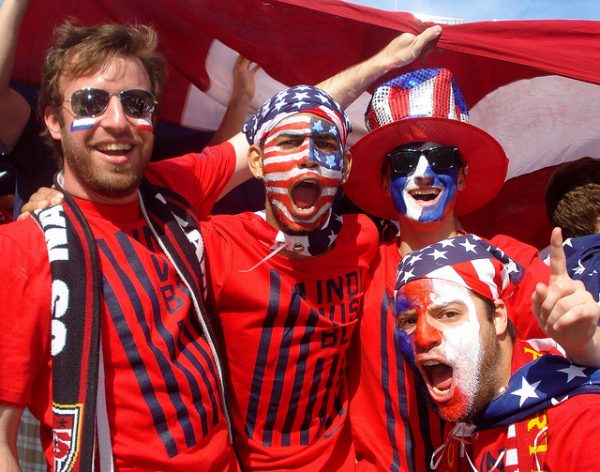
Another U.S. Independence Day came and went, along with cheers of ‘Murcia! and sentimental Facebook posts about American pride. But how do racial and ethnic minorities experience being “American” while systemic racial oppression continues to target people of color in the U.S.? A lot of the focus has been on the experiences of Black Americans, but social science shows that other racial minorities are similarly marginalized when they are excluded from whiteness.

For example, while stereotypes like the “model minority” myth seemingly valorize Asian American achievement, other stereotypes exclude them from the “American” label by depicting them as foreign. Moreover, Asian Americans are a pan-ethnic group – meaning there are many nationalities included under the umbrella term “Asian American.”  And darker-skinned, poorer Asians, like Cambodian refugees, are excluded from characterizations of excellence and success.
Even though many Arab Americans have lighter skin, enjoy middle class success, and identify as White, they are still “not quite White” because of the ways they are racialized. Negative stereotypes about Arab people as “backward” and “uncivilized” have resurfaced in recent years as the racialization of Arab and Muslim men as criminals and threats to national security became mainstream talking points in the War on Terror.
Institutions may also dismiss important differences among various Black ethnic groups. For Somalis who come to America, it is often the first time they are considered Black. However, their religion, language, and cultural identities may be more salient, differentiating them as “foreign” from Black Americans.
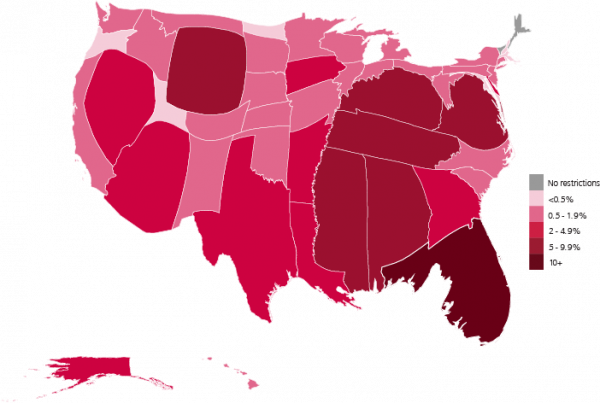
Cartogram of Total Disenfranchisement Rates by State, 2016. The Sentencing Project.

Amy Bach, a lawyer and criminal justice journalist, built a free public tool titled “Measures for Justice” that contains data on over 300 county court systems in 6 states. The nonprofit has received funding from the burgeoning activism of the tech community — Google gave Measures for Justice a grant for $1.5 million dollars and the Chan Zuckerberg Initiative recently announced they would be awarding the nonprofit $6.5 million. Due to the fragmented nature of the criminal justice system, the Measures for Justice research team frequently had to travel to individual counties in order to request records.

Sociologists who study punishment have long recognized the importance of geography in structuring disadvantage, at multiple levels. For instance, there are tremendous differences between states in the scope and impact of felon voting restrictions. Florida, for instance, contains 27% of all disenfranchised felons in the United States—in large part due to its policy of disenfranchising people after they have completed their sentences.. On the other end of the spectrum, Vermont and Maine allow even prisoners to vote.  Another way that geography structures punishment is through children’s experiences of parental incarceration, which varies substantially by region. Moreover, the extent of racial disparity also varies regionally, with African American children experiencing the highest risks in all regions, and Latinos experiencing the most disadvantage in the West and Northeast.   
In a similar vein, even new forms of cybercrime are structured by geography. Sociologists have recently started to explore how these new types of crimes, such as cyber-victimization, are shaped by state-level characteristics.
These efforts could prove useful for scholars and for the public. For example, Measures for Justice developed a “Fair Process” indicator, which is closely tied to the social science concept of procedural justice — the idea that citizens will be more likely to comply with the law and requests of law enforcement if they perceive the system as fair. Recently, reforms and police training based on procedural justice have begun to be widely implemented.

Veronica Horowitz is a Ph.D Candidate in sociology at the University of Minnesota who studies punishment, mercy, and gender in the U.S. criminal justice system.