crime

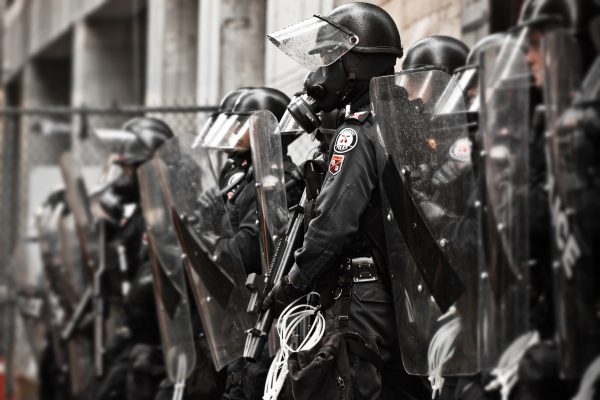
Police form a line in riot gear. Violence against citizens by police is often perceived as legitimate. Image via Flickr.

Can your country be a criminal? Until recently, the legal answer has often been no. Today, sociologists answer: it depends. For instance, this past summer, the federal government resumed executing death row inmates, and more recently, officer-involved shootings have drawn attention to how police officers are entrusted with violent force as part of their duty to protect and serve the people. In many circumstances, these killings are defended as legal or legitimate forms of violence. But many other kinds of killing, such as genocide or murder, are not.

Early sociologist Max Weber argued that countries have historically been defined by the power and right to exercise “legitimate violence,” or violence that is normalized and legal. Although they are entrusted to use violence  to protect their citizens from violence, countries routinely use violence against their own citizens.
Legitimate violence, often carried out by a country’s police forces or military, is typically reserved for those that are marginalized or alienated.  When a nation commits violence against criminals, those who present security risks, or even those whom we fear, it is often accepted  as a “reasonable” use of force.  Some scholars argue that most forms of police violence, in particular, are difficult to recognize as anything but legitimate and necessary for protection. For example, we often presume that police violence is committed against criminals, in an effort to protect innocent citizens.
It wasn’t until WWII and the Holocaust that the international community questioned a nation’s right to perpetuate violence against its people. For example, Hitler’s murderous campaign against the Jews and other social outcasts was, in fact legal, as genocide was not yet a crime. A state’s right to legitimate violence has only diminished with the recent development and globalization of human rights.

Both police violence and mass violence committed by states against their own populations are beginning to be understood as crimes. Internationally, we have seen this with the creation of the International Criminal Court. Closer to home, we see this with the calls to prosecute police officers who have engaged in police brutality. Yet many forms of violence committed by the state are still perceived as legitimate, despite the fact they involve the same type of violence. For example, intentionally targeting and killing a civilian may be labeled an illegal crime against humanity or the legal result of a capital criminal prosecution.

It’s Black History Month, and we at TSP have rounded up some of our favorite, timeless posts about the history, meaning, and importance of celebrating black history. These #TSPClassics include articles about Black History Month itself, as well as articles about research related to racial identity, racism, and anti-racism. Read about Black scholars’ early contributions to social sciences, recent innovations in scholarship about race, ongoing issues of racism and inequality, new strategies and actions in advocacy, and much more below; happy Black History Month!

From Our Main Page

Did you know W.E.B DuBois was a pioneering sociologist? Read more at “What Would W.E.B DuBois Do?
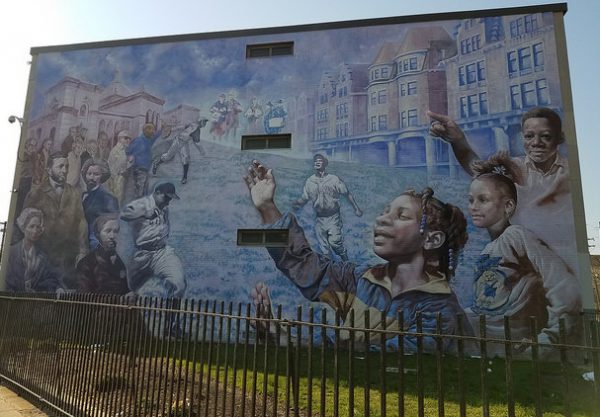
Photo of a mural honoring black history in Philadelphia. Photo by 7beachbum, Flickr CC.
Read about black women’s advanced sociology and social science at “Unearthing Black Women’s Early Contributions to Sociology.”
Read about why the idea of a “white history month” ignores the history of race and racism at “Why We Don’t Need a White History Month.”
“Black Panther,” one of the most successful movies in the Marvel universe, was a momentous film for black representation and imagery in Hollywood. Read more at “Black Panther as a Defining Moment for Black America.”
The word “racism” can mean a lot of different things in different contexts; read about different definitions, forms, and research traditions regarding “racism” in the USA at “Different Dimensions of Racism.” 
Even in the 21st century, Black Americans have to navigate racist stereotypes, imagery, and perceptions, and many learn such strategies at a young age. Read about related parenting strategies and challenges at “How Black Mothers Struggle to Navigate ‘Thug’ Imagery.”
Recent research about black identities, experiences, and community analyzes how themes studied by early sociologists of race relate to twenty-first century technology, such as social media platforms and digital communication. Read more about these and other new research directions at “A Thick Year For Tressie McMillan Cottom.” 
Tressie Mc Millan Cottom displays her essay collection Thick, which was nominated as a National Book Award Finalist. Photo via Wikimedia Commons.
Black athletes represent a new generation of leaders and anti-racist advocates; read more at “A New Era of Athlete Awareness and Advocacy.” 
Should educators promote colorblind rhetoric in the classroom? Read about problems with colorblind teaching practices at “Color-Blind Classrooms Socialize Students to Disregard History.”
Research shows that skin color intersects with race and racial identity in ways which perpetuate racial inequality. Read more at “Skin Color, Self-Identity, and Perceptions of Race.” 
Social norms, rules, and laws about mixed-race relationships have changed drastically across history, but many issues of inequality and identity remain for contemporary multiracial families. Read more at “Navigating Multiracial Identities.” 
Photo of a multiracial family by taylormackenzie, Flickr CC.

From Our Partners and Community Pages

Soc Images

Rural Appalachia is often discussed as a mainly-white region, but did you know about the richness of black history in the mountains? Read more at “Hidden Black History in Appalachia.”
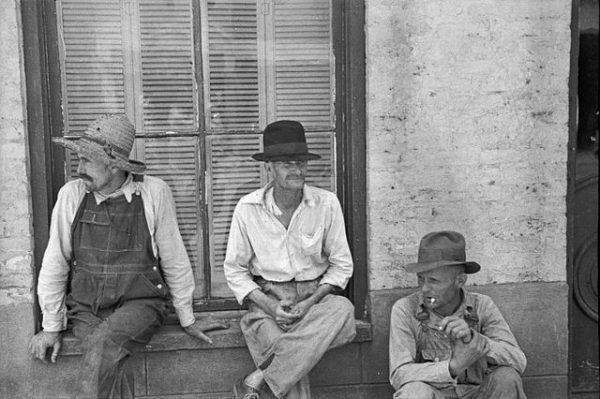
Rural sharecroppers in Appalachia. Source: Wikimedia Commons
Sometimes, businesses, corporations, and groups try to celebrate Black History Month in ways which are tone-deaf, ignorant, and just plain racist. SocImages archives several cringeworthy incidents over the years at “From Our Archives: Black History Month.”

Contexts

The field of sociology studies racism, but we’re not above criticism; read about why social science must divest from whiteness and white-centric logic at “Yes, Sociology is Racist Too.”
Why don’t we make WEB DuBois’ birthday a holiday? Read more at “A New Black Holiday, or Why W.E.B. DuBois’s 150th birthday matters.”
Well into the 21st century, discrepancies in the justice system are still a major site of racial inequality; read about racial inequality and policing at “Black and Blue.”
Photo by Andrew Turner, Flickr CC

Originally posted July 8, 2019.

On July 4th, 1776, signers of the Declaration of Independence declared their intent to “dissolve the political bands” holding the United States and Great Britain together. That subtle language quells the imagery of violent revolution — over nearly a decade of warfare, thousands died in the conflict. Today, in the midst of flags and cookouts, the violence of the revolution may yet again fade to the background. But many social scientists examine such violence deeply, and in doing so showcase the power of violence to remake identity, redraw state boundaries, and bring power to marginalized groups.

Acts of violence can redefine the boundaries of groups. During crises like civil war or political upheaval, political elites may seek to unite ethnic, racial, or religious groups to consolidate power. Threats of violence may motivate these groups, for fear or for self-protection, to mobilize. Historically, these changing groups have influenced national boundaries — indigenous groups were often targeted for violent elimination in order to conquer a space for a particular identity group, or areas were conquered to make more space for a group in power. In these ways, many of the symbolic and physical boundaries in the world around us carry traces of violence.
Violence and conflict can also create opportunities for those with limited political power. Elisabeth Jean Wood, for example, analyzed how insurgent groups of impoverished and exploited workers could use organizing and sometimes violent tactics to convince powerful leaders to negotiate, thus installing democratic governments. Marie Berry examines political power in the aftermath of conflict, showing how the participation of women in traditionally male spaces after violence enabled political organizing and gains in power. Though the extent and longevity of these changes differ between conflicts, violence and its aftermath have the capacity to result in political change.
While the transformative power of violence looks different across cases, its power doesn’t exist in a vacuum — global norms and regulations around violence often impact its destructive and constructive capacities. Today’s belligerents are often aware of laws surrounding the use of violence, like regulations about who or what can be targeted and what types of strategies are permitted. To garner favor with powerful international actors, many combatants abide by these regulations. Others abide selectively, like signing onto treaties in order to partake in other forms of violence with less oversight.

In the centuries that have passed since the revolution, many Americans now think of July 4thas a day of parades and parties, as representations of conflict have faded over time. But amongst the fireworks, social science shows the centrality of violence in national histories, international relations, and the relative power of social groups. 

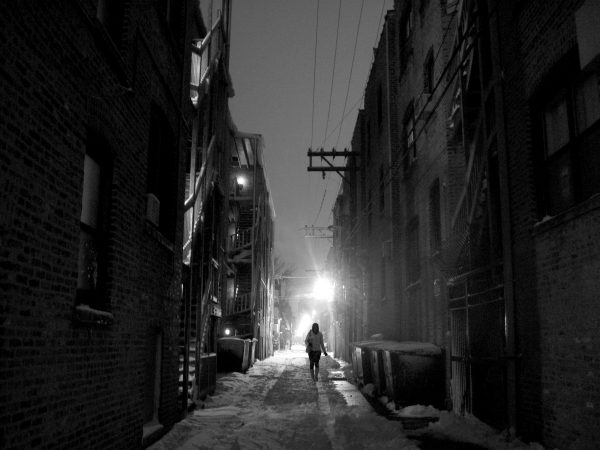
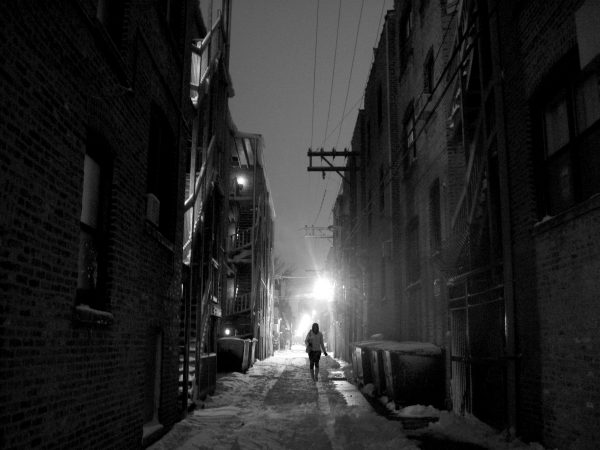
A woman walks alone in a dark alley. Photo by renee_mcgurk via Flickr.
While opinions of particular environments, situations, or objects may appear to be objectively dangerous or safe, sociologists argue otherwise. Instead, they find that opinions about safety are subjective. While there is a physical reality of harm and fear, beliefs about safety and danger spread through socialization, rather than direct observation. For example, Simpson notes that snakes and turtles can both cause illness and death through the transmission of venom or bacteria, yet snakes are seen as dangerous and turtles as benign. In other words, danger and safety do not exist on their own; they are contextual.
Socialized beliefs about safety and danger are also raced, classed, and gendered. While statistics indicate that men are predominantly the victims of violent crime, women express greater fear of crime. This fear often acts as a form of social control by limiting women’s daily activities, like when they leave the house and what they wear. Furthermore, the construction of fear and crime is often tied to racist legacies. In the United States, white women express prejudicial fear about areas marked as “dangerous” or “sketchy,” due to the occupation of this space by men of color.
Safety and danger are also constructed at the international level, as national security is politicized. For example, instances of large-scale political violence, such as genocide, war, and acts of terrorism revolve around the social construction of an enemy. More generally, national enemies are constructed as dangerous and a threat to the safety of a nation’s people. This construction of the enemy and perception of fear can move people to join terrorist organizations, participate in genocidal regimes, and enlist in state militaries.
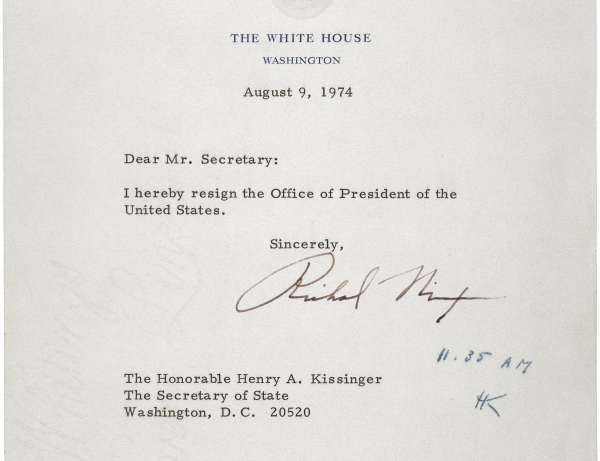
Richard Nixon’s resignation letter from August 9, 1974. Photo via Wikimedia Commons.

The impeachment proceedings have sparked contentious public debates about what should and should not be considered a “scandal” today. From the earliest days of the discipline, sociologists have employed theory and research to study why some incidents and individuals who seem scandalous have major impacts and lasting legacies, while others seem to make no mark whatsoever. They also help us see how both scandals and the public outcry that they can occasion are socially constructed by norms and values, organizational processes, and inequalities that extend well beyond any one individual person or event. It’s so sociological, it’s almost scandalous!

To begin, the identification of something as a social problem or “a scandal” requires that an issue is well known in society and intersects with a meaningful moral set of concerns. The construction of a scandal also involves who or what has the power to apply and enforce social norms about right and wrong. For example, public sanctions and normalized stigma against prominent queer citizens and pro-gray groups reinforced widespread bigotry, marginalization, and violence.
Media obviously plays an important role in creating and framing a scandal. Its coverage is shaped by often invisible social factors such as media businesses’ goals, newsroom budgets, and journalistic practices. In addition, the activities of political groups, social movements, and civic organizations can drive public debate and attention to certain issues or problems. Such groups’ impact is not necessarily a product of their moral beliefs or strength of conviction, but factors such as their name-recognition, finances, and networks. Thus, institutional processes, civic organizations, and material factors shape how a scandal is socially constructed.
Sociological factors such as status, gender, and race intersect with organizational contexts, media factors, and broader public norms to shape the aftermath of scandals as well. In political or corporate contexts, the power and resources of an individual or organization often determine whether and how they are punished for transgressions (or exonerated) and what kinds of reforms must be undertaken. Furthermore, the aftermath of a state scandal can be greatly determined by whether the government has a system of checks and balances, as well as whether criticizing state actors comes with consequences of its own. Unweaving such complex webs can show why some shocking scandals leave affected parties unscathed, while others leave long-lasting scars.

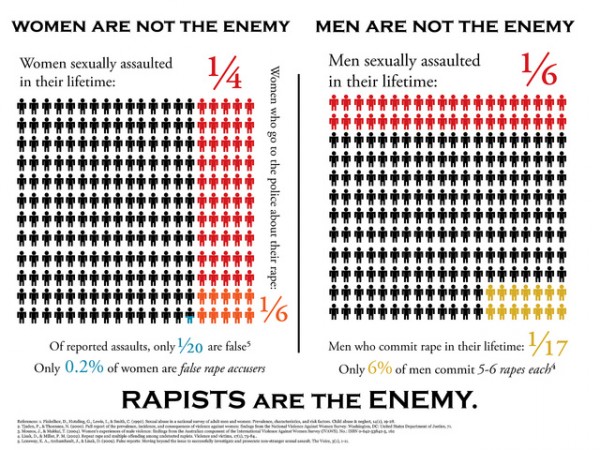
Infographic by snipergirl via Flickr CC.

Originally posted March 12, 2016.

Last week, a civil judge ruled that singer Kesha must fulfill her music contract despite allegations that her producer sexually assaulted her. While Kesha received an outpouring of support from fellow artists and fans creating the hashtag #FreeKesha, entertainment show host Wendy Williams critiqued the singer for not disclosing the “alleged” rape earlier. The media frequently questions the credibility of women like Kesha and the accusers of famous men like Mike Tyson and Bill Cosby because their stories deviate from what are perceived as “real rape” experiences (those committed by strangers and with a deadly weapon). Social science research helps us sort out how and why institutions risk “revictimizing” survivors as they navigate the criminal justice process.

The majority of victims do not report assaults to police, often because they don’t think they’ll be believed. Unsurprisingly, the cases most reported to police are those perpetrated by strangers and/or involving a weapon—what victims (and police) believe best constitute criminal, “authentic rapes.” Further, police treat victims perceived as “professional” as more credible than prostitutes.
Victims can also be revictimized if they opt to undergo a physical examination. Forensic nurse examiners often prioritize the preservation of forensic evidence while unintentionally neglecting the emotional care of the victim in service to the criminal investigation.
The court process is distinctly difficult for victims, too. They must attempt to satisfy the expectations of prosecutors and withstand cross-examination by defense attorneys. Prosecutors may prepare victims for testimony by encouraging them to use certain vocabulary, dress in a way that suggests they did not “ask for it,” and show emotion to convey the specific feelings expected of a rape survivor. Despite rape shield laws that prohibit attorneys from disclosing a victim’s sexual history, defense attorneys may still question the victim’s morality, interrupt victims, ask confusing questions, and limit their responses in an effort to transform sexual violence into mutual consent in the eyes of a judge and jury.
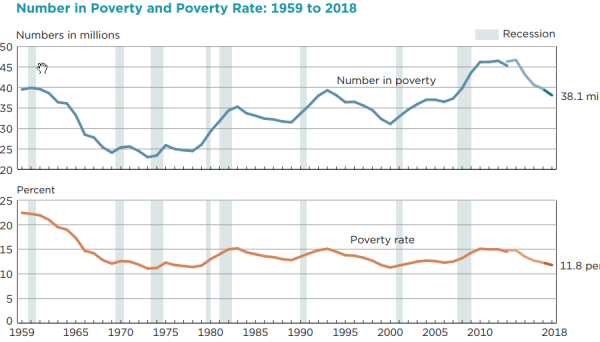
Source: U.S. Census Bureau, Current Population Survey, 1960 to 2019 Annual Social and Economic Supplements

In the United States, poor people are judged harshly — especially when they receive government assistance or “welfare.” Yet, over 38 million people live in poverty. What people often forget, though, is that poverty itself is expensive. Social science research demonstrates that the poor pay more for necessities like housing and food, and debt can have serious consequences beyond just financial.

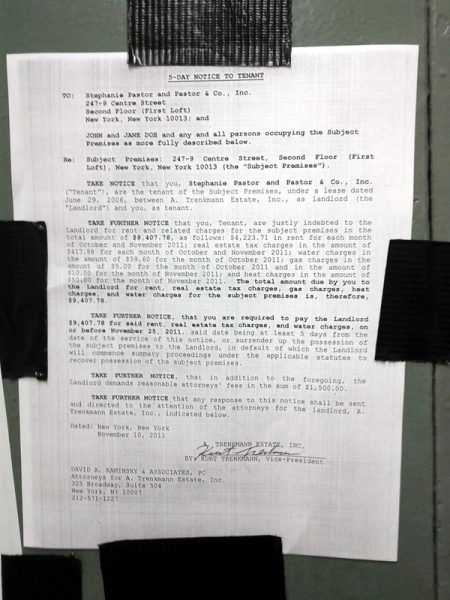
Eviction notice. Photo by Corey Doctorow, Flickr CC

The poor pay significantly more for housing than others — sometimes 70% or 80% of their income. In 2018, low-income households paid over half their income for rent or lived in substandard housing. Further, landlords overcharge tenants in high poverty neighborhoods and those with higher concentrations of African Americans relative to the market value of the property. When families cannot afford basic needs they will make calculated tradeoffs to keep their housing, paying for rent instead of utilities to avoid eviction. Such tradeoffs often lead to compounded costs from late fees, and families living without water, electricity, or heat. 

Poor families tend to pay more for food, too. Families with precarious housing situations especially struggle — If they do not have a stove or oven to cook with, or space to prepare meals, they must rely on food that can be prepared quickly, like microwave meals or fast food. And even when families are equipped to prepare meals at home, they often do not have the money upfront to buy in bulk, meaning they pay more for food in the long run. According to the USDA, a “thrifty meal plan”– choosing the cheapest options — costs a family between $567 and $651 per month, and this cost does not include home labor. One study estimates families of four would need to spend almost $400 on top of their food stamps to meet guidelines for a healthy diet. 

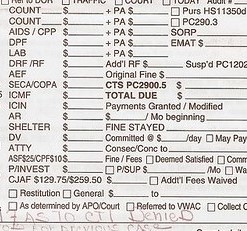
Fines on a court appearance document. Photo by Elle Ko,
Flickr CC

When poor people face fines and fees, their inability to pay or keep up with payments means they go further into debt. When these fees are part of the criminal justice system, failure to pay can also result in jail time. Anyone convicted of any type of crime is subject to fines and fees, from traffic tickets to felony convictions. And sometimes, these fees are not even dependent on a conviction: In North Carolina all felony defendants pay a “cost of justice” fee ($151.50) whether they are convicted or not. Until the costs are paid off, that person is tied to the criminal justice system — for the poor, this can be a lifetime.

In the wake of the most recent proposed cuts to food stamps — a blip in a long U.S. history of cutting benefits for its poorest citizens — it is important to remember that poverty is not cheap. 

A woman walks alone in a dark alley. Photo by renee_mcgurk via Flickr.
While opinions of particular environments, situations, or objects may appear to be objectively dangerous or safe, sociologists argue otherwise. Instead, they find that opinions about safety are subjective. While there is a physical reality of harm and fear, beliefs about safety and danger spread through socialization, rather than direct observation. For example, Simpson notes that snakes and turtles can both cause illness and death through the transmission of venom or bacteria, yet snakes are seen as dangerous and turtles as benign. In other words, danger and safety do not exist on their own; they are contextual.
Socialized beliefs about safety and danger are also raced, classed, and gendered. While statistics indicate that men are predominantly the victims of violent crime, women express greater fear of crime. This fear often acts as a form of social control by limiting women’s daily activities, like when they leave the house and what they wear. Furthermore, the construction of fear and crime is often tied to racist legacies. In the United States, white women express prejudicial fear about areas marked as “dangerous” or “sketchy,” due to the occupation of this space by men of color.
Safety and danger are also constructed at the international level, as national security is politicized. For example, instances of large-scale political violence, such as genocide, war, and acts of terrorism revolve around the social construction of an enemy. More generally, national enemies are constructed as dangerous and a threat to the safety of a nation’s people. This construction of the enemy and perception of fear can move people to join terrorist organizations, participate in genocidal regimes, and enlist in state militaries.
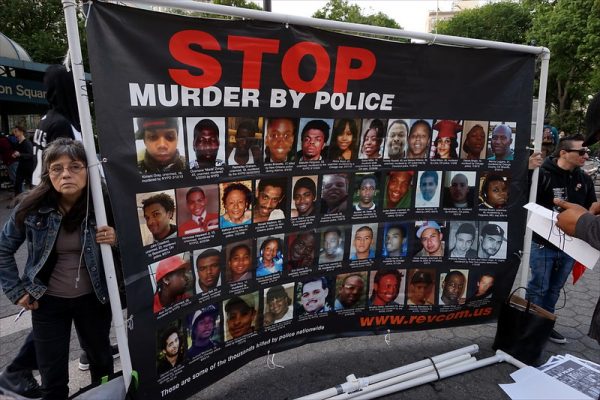
Photo shows a large sign that reads, Stop Murder by Police, and shows pictures of women and girls killed by police.
Photo by The All-Nite Images, Flickr CC

Earlier this month another Black American, Atatiana Jefferson, was fatally gunned down by a Fort Worth police officer in her own home. In the weeks since her death, community activists and residents have called for law enforcement accountability and reform of the police department’s use of force policies. As the Fort Worth community continues to grieve and fight for justice, Jefferson’s death reminds us Black women must be included in conversations around police violence, reform, and accountability. After a decades long struggle for visibility, Black women activists created the hashtag #SayHerName to bring awareness to the growing number of Black cis- and transgender women killed by law enforcement — a list Jefferson has now joined at just 28-years-old. A small but impressive group of sociological works have highlighted Black women’s experiences with police and the racialized and gendered challenges that lie ahead in developing police-community trust.

Similar to Black men and boys, Black women and girls also hold higher levels of legal cynicism (distrust) in law enforcement than whites. They report being stopped and facing verbal harassment for traffic incidents or, in the case of Black girls, breaking curfew — especially when in the presence of Black male peers. Black women and girls also distrust police due to their unresponsiveness to serious calls involving interpersonal, domestic, and sexual violence. For many Black women and girls living in low-income communities, police violence is simply one form of a larger “matrix of violence,” where they must also navigate interpersonal and neighborhood violence. At times, police are the perpetrators of these gender-specific forms of violence. These matrices remain interconnected, as cynicism towards law enforcement hinders reliance on police to address other forms of violence.
Motherhood also brings distinct challenges that shape Black women’s attitudes towards police. Black women are targeted through “family criminalization,” where they fear law enforcement will target both their children and themselves for being “bad mothers.” Since motherhood places Black women responsible for the safety of their children, they attempt to protect Black youth from police suspicion by sharing cautionary tales, sheltering them, and teaching them to comply with police demands. Black women’s cautionary tales, however, often emphasize the police assaults against Black sons, while treating police violence against Black daughters as improbable and less violent. While Black mothers often view police as illegitimate and unresponsive, they may also use police services to help (mostly male) loved ones when other resources remain scarce.

Photo by the euskadi 11, Flickr CC

Originally posted April 2017. We’re reposting this in light of California’s recent decision to prevent the renewal of contracts with for-profit prison companies.

Last month, Attorney General Jeff Sessions reinstated the use of private prisons in the federal system. This move is welcome news to top corrections corporations such as CoreCivic, but human rights activists are concerned about this shift. Opponents claim that these corporations bring in large profits while their prisons remain rife with safety and healthcare deficiencies, as well as underpaid employees. While these concerns are important to consider, the private prison industry represents a small segment of the American correctional system. According to the Bureau of Justice Statistics, only 17% of inmates in federal prisons and 7% in state prisons were held in private facilities in 2015.

During their initial inception, private prisons were believed to be a cost-effective option that could provide better services than government facilities. Despite these goals, much of the current evaluative research suggests that private facilities are no more cost effective than public facilities. Likewise, private prisons appear to perform worse in reducing recidivism than public correctional facilities and have similar (and sometimes worse) conditions than public facilities. In contrast, some evidence suggests that private prisons may be less overcrowded. Due to these ambiguities, scholars of the privatization debate are calling for more research into the qualitative differences between the private and public sector of prisons.
Regardless of their effectiveness, research suggests that the demographic composition of private prisons is racially disparate. In an analysis of adult correctional facilities in 2005, private prisons had significantly fewer white and more Hispanic populations when compared to their public counterparts. As to why racial and ethnic disparities exist, research points to the role of private prisons in immigrant detention, which has lead some scholars to argue that the private prison industry is just a small segment of a massive immigrant industrial complex. This line of research posits that this complex perpetuates the criminalization and stigmatization of immigrants, especially among Latinos, and as a result comes at a significant cost to immigrant families and communities.