
crime

Photo by Steve Snodgrass, Flickr CC

This past week, the Philadelphia Board of Pensions and Retirement voted to withdraw its investments in the for-profit prison industry. However, the prison industry depends on more than just investors to finance its operations. It also relies on resources from defendants, inmates, and their families. Social science research demonstrates the far-reaching consequences of the penal systems’s money leveraging strategies.

Federal and state criminal justice agencies and correctional institutions charge defendants and inmates with the costs of arrest, prosecution, conviction, incarceration, and supervision. For example, fees include the cost of electronic monitoring and registration for people convicted of sex offenses. In some states, defendants pay for their hearings (court-fees). If found guilty, they also pay room-and-board fees while in prison (pay-to-stay fees).
As a form of punishment, judges impose monetary sanctions for misdemeanor and felony crimes alike. Monetary sanctions disproportionately disadvantage defendants from low-income communities through three different mechanisms: reducing family income, limiting their access to jobs or educational opportunities, and increasing the likelihood of ongoing criminal justice system involvement. These consequences challenge the assumption that monetary sanctions serve as a more favorable alternative to incarceration or supervision.
Correctional authorities outsource the operation and provision of services within correctional institutions to generate revenues for both public and private institutions. Contracts to run prison services – commissaries, telephone services, or online banking, for example – are based on commissions (what critics call “kickbacks”), which generate incentives for corruption and disproportionate profit-making at the expense of inmates and their families. This means companies have higher incentives to increase their profit margins by charging higher prices and fees.
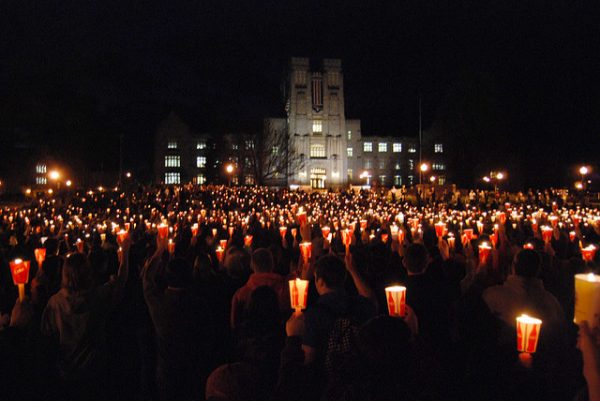
A candlelight vigil outside Virginia Tech’s Burruss Hall after the 2007 mass shooting. Photo by Kate Wellington, Flickr CC

The nation remains in mourning as we struggle to make sense of this week’s tragedy in Las Vegas, where 59 people were killed and over 500 wounded. Many are referring to the attack as the “deadliest shooting in modern US history.” Through their grief and shock, some now question how local law enforcement, politicians, and news media outlets will characterize the shooter, a middle-aged white man, who, according to family members and the early stages of the investigation, had no known ties to religious or political groups. Investigative authorities link terrorism to violent acts, the motives behind those acts, and affiliation with known terrorist organizations. Yet, several activists have argued that the media’s characterization of mass shooters depends upon their race, ethnicity, and religious beliefs, noting that “Whiteness, somehow, protects men from being labeled terrorists.” Examining the role of media discourse regarding mass killings might help us make sense of these acts of violence.

Mass shootings have been covered extensively by the U.S. media since the late 1990s Columbine shooting. What began as a focus on the two perpetrators and 11 victims developed into a moral panic regarding youth delinquency, mental illness, discipline, and even terrorism. Yet, the media does not treat all mass shootings equally — several factors come into play, including the availability of iconic images, media access, and the race and socioeconomic status of the perpetrator. Shootings that occur in seemingly quiet suburbs by white youth are more shocking because the perpetrators and victims are considered to be “people like us.” In contrast, shootings where the perpetrators are persons of color or reside in working-class neighborhoods produce less shock, as news producers and consumers presume that violence is somehow normal or inherent to those communities.
One comparative study defined mass shootings as “homicide offenses that require firearms as the weapon of attack, and they often end in the offender’s suicide or orchestration of ‘suicide by cop’.” By this definition, the U.S. has likely had more public mass shootings than other comparable nations over the past 50 years. Mass shootings are more likely to take place in countries with higher levels of gun ownership and, in the case of school shootings, have been linked to aggressive performances of masculinity by predominantly young, white, suburban students. While mass shootings frequently involve multiple casualties, authorities rarely refer to such acts as terrorism — the designation of “terrorist” is generally reserved for “foreign-based terrorist organizations.” 
One concern about the coverage of such events is that the publicity and sensationalization surrounding mass killings may inspire other “copycat” crimes. Potential mass killers may use media reporting as a way to create a fictive bond with other mass murderers as a “comradery-focused fantasy.” Seung-Hui Cho, for example, idolized Dylan Klebold and Eric Harris (Columbine shooters) for several years, before carrying out his own deadly attack at Virginia Tech. Other potential mass murderers intensely scour news clippings of prior mass killings to find the perpetrators’ weaknesses and compete with them. Before killing 20 children and 6 adults at Sandy Hook Elementary School, shooter Adam Lanza’s correspondence illustrates that he critiqued James Holmes, the Aurora movie theater shooter, for what he saw as a weak effort to murder multiple people.
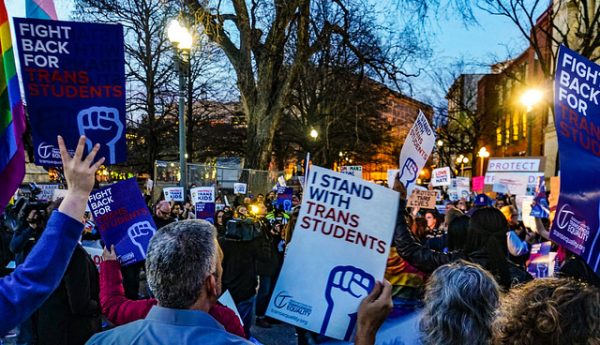
Photo by Ted Eytan, Flickr CC

Despite increased awareness surrounding transgender identities and experiences, the National Coalition of Anti-Violence Programs (NCAVP) has tracked 36 anti-LGBTQ homicides in 2017 alone, 16 of whom were transgender women of color. Along with President Trump’s recently proposed military ban of transgender persons, there is evidence that personal prejudices and institutional discrimination continue to affect the lives of those in the trans community.

One way institutions like the military discriminate against transgender individuals is by advancing the assumption that trans bodies are a problem and should conform to “normal” standards. For example, medical professionals that work with transgender patients often discourage them from undergoing transitional surgery too soon. This discouragement reinforces traditional ideas that treat gender and sex as the same thing, and recognize both as binary. This discrimination shapes psychological and physical well-being, as transgender people who appear as gender nonconforming have a greater risk of engaging in self-harm acts, including suicide.
Transgender people are also at a greater risk of being the victims of violence. Surveys indicate that roughly 50% of transgender people report experiences of sexual violence or assault. The continuous threat of violence influences everyday decision making and quality of life across communities. For example, transgender women are more likely to perceive an association between acts of physical violence with sexual assault. Moreover, individuals transitioning from male-to-female are more likely to experience violent victimization than those transitioning from female-to-male, with a heightened risk during periods of transition and gender ambiguity.
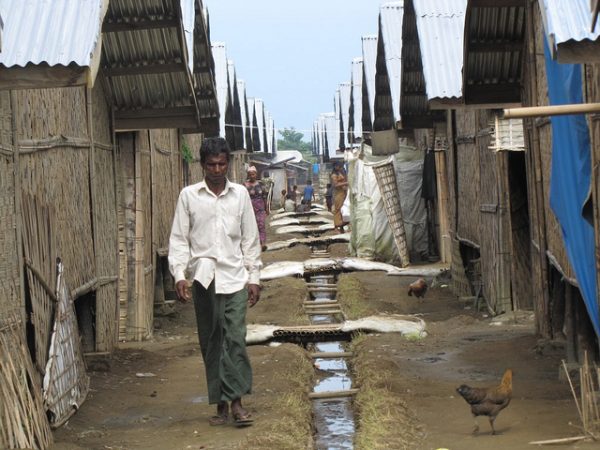
Photo by Mathias Eick, EU/ECHO, Rakhine State, Myanmar/Burma, September 2013. Flickr CC

The Rohingya, a Muslim minority group, have been the target of violence for years in Myanmar, also known as Burma. But in recent weeks, international media coverage has surged following a spike in violence that has led to over 120,000 Rohingya fleeing their homes. The increased media attention, however, has also provided a platform for an anti-Rohingya propaganda campaign that argues the Rohingya are “terrorists” and deserve the violence that befalls them. Sociologists have brought new insight into how propaganda enables the acceptance of atrocities and how it can directly impact rates of violence.

Propaganda campaigns often demonize a group by characterizing them as less-than-human. Refugee communities, for example, are often treated with fear and suspicion by members of their host nation. This can also negatively impact individual-level interactions with the mistrusted group, such as higher rates of expressed aggression and contempt. Studies show that when a group is dehumanized, those outside of the group find it easier to exclude them and assume that they are more deserving of problems in their lives.
Scholars have also examined patterns of violence and how perpetrators make decisions through the use of propaganda. Radio propaganda played a key role in the Rwandan genocide; on hills where radio reception was better, the rate of killing was higher than in areas where reception was limited. Groups such as ISIS use social media to motivate and recruit individuals. With the increasing prominence of social media, understanding how these mechanisms enable the acceptance and perpetration of violence is essential. They also indicate that positive social media campaigns could help to counter propaganda.


Photo by Elvert Barnes, Flickr CC

“They use their media to assassinate real news…all to make them march, make them protest, make them scream racism, and sexism, and xenophobia, and homophobia. To smash windows, burn cars, shut down interstates and airports, bully and terrorize the law abiding, until the only option left is for the police to do their jobs and stop the madness.”

Last month, NRA spokesperson Dana Loesch spoke these words in a new video campaign targeting progressive political protesters. The ad features black and white media footage of protest signs with the words “RESIST” and shows protesters looting, breaking windows, and starting fires in the street. Loesch and the NRA have since received widespread criticism for the advertisement’s seemingly pro-violence rhetoric, even evoking a video response from BlackLivesMatter. While the NRA maintains that the advertisement is not intended to encourage violence against progressive political protest, the black and white imagery depicting protesters as criminals is eerily reminiscent of political campaigns (e.g. the civil rights movement of the 1960s and 70s) that used political action as a call for criminalization and law and order.

In times of spiraling economic instability, political divisiveness, and social inequality — such as the Great Depression or the Civil Rights Movement, the result is often public unrest and widespread protest. In order to quell state criticisms, elite political actors on both sides of the political spectrum develop campaigns that heighten public anxiety of crime by conflating political dissent with criminal activity. President Nixon, for example, ran on a campaign of “law and order” and called himself part of the “silent majority” on this issue. Regardless of actual fluctuations in crime rates, the public often accepts these messages of criminalization and tough on crime policies. This law and order rhetoric then legitimizes police and military aggressive surveillance – and at times, physical confrontation – against protesters.
We can link the current tide of mass incarceration to these types of campaigns in the 1960s and ’70s. Though the Johnson administration is lauded for taking important legislative steps in welfare reform, Elizabeth Hinton’s recent work argues that the administration simultaneously developed legislation, like the Law Enforcement Assistance Act (LEAA), that expanded police control through federal funding and toughened criminal sanctions amid a time of sit-ins, boycotts, and marches by (young) black advocates against Jim Crow practices. The Johnson administration helped create the “War on Crime,” and their political rhetoric rested upon the notions of black urban pathology and individual (as opposed to structural) economic failure.
Photo by Jason Howie, Flickr CC

In recent months, Facebook faced intense scrutiny due to the streaming of violent acts on their live streaming service. Beyond the live sharing of violent crimes, the proliferation of social media has transformed criminal activity, ranging from the advent of cyberbullying to the widespread dissemination of terrorist propaganda and recruitment. And social science research also suggests that gang members are also employing social media. These gang affiliates, typically adolescents and young adults, use their online presence to promote their gang identity and gain notoriety, in a phenomenon often called “cyberbanging.”

Gang members use the internet at equal rates and in similar ways to their non-gang peers, but their online behavior serves an additional symbolic purpose: demonstrating a gang affiliation. A survey of 137 adolescent gang members found that 74% reported using the internet to show or gain respect for their gang. Therefore, the Internet does not appear to be a tool that gang members use to further the interests of their group by recruiting members or promoting activities; rather, the web is a space for existing members to demonstrate and solidify gang status by watching videos of gang fights or posting taunts against competing gangs. Gang members are increasingly aware that the police monitor their activity online, so they attempt to avoid posting anything publicly about specific criminal acts, which could threaten the gang as whole.
Like other groups, however, the social organization of gangs determines their behavior both offline and online. Gangs that have been around longer, have an established hierarchy, and have a set of rules and responsibilities are more likely to have a website and organize or post activities online, while newer gangs are more likely to use the internet as a recruitment tool. This pattern would be predicted by sociological research on organizations , which finds that the social context of a group’s founding shapes its future development. Preliminary evidence also suggests that gang members are engaging in more online criminal activity, such as pirating music or selling drugs, than non-gang or former gang members, but this online criminal activity is, as expected, more common among those with higher levels of computer skills. Despite these emergent trends, we still know very little about how gangs use the internet and what role social media plays in gang culture and crime. Gang researchers are therefore looking beyond “gangbanging” on the streets and into the “cyberbanging” on the web.
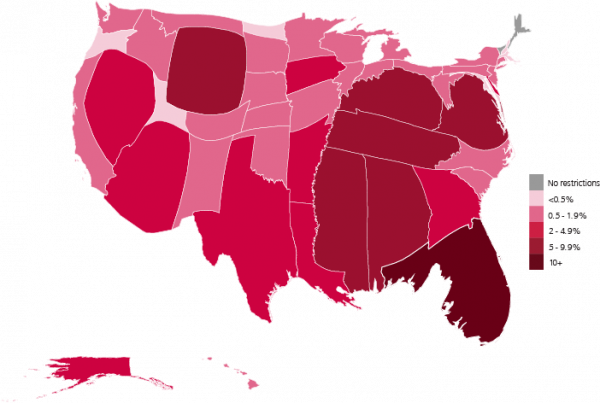
Cartogram of Total Disenfranchisement Rates by State, 2016. The Sentencing Project.

Amy Bach, a lawyer and criminal justice journalist, built a free public tool titled “Measures for Justice” that contains data on over 300 county court systems in 6 states. The nonprofit has received funding from the burgeoning activism of the tech community — Google gave Measures for Justice a grant for $1.5 million dollars and the Chan Zuckerberg Initiative recently announced they would be awarding the nonprofit $6.5 million. Due to the fragmented nature of the criminal justice system, the Measures for Justice research team frequently had to travel to individual counties in order to request records.

Sociologists who study punishment have long recognized the importance of geography in structuring disadvantage, at multiple levels. For instance, there are tremendous differences between states in the scope and impact of felon voting restrictions. Florida, for instance, contains 27% of all disenfranchised felons in the United States—in large part due to its policy of disenfranchising people after they have completed their sentences.. On the other end of the spectrum, Vermont and Maine allow even prisoners to vote.  Another way that geography structures punishment is through children’s experiences of parental incarceration, which varies substantially by region. Moreover, the extent of racial disparity also varies regionally, with African American children experiencing the highest risks in all regions, and Latinos experiencing the most disadvantage in the West and Northeast.   
In a similar vein, even new forms of cybercrime are structured by geography. Sociologists have recently started to explore how these new types of crimes, such as cyber-victimization, are shaped by state-level characteristics.
These efforts could prove useful for scholars and for the public. For example, Measures for Justice developed a “Fair Process” indicator, which is closely tied to the social science concept of procedural justice — the idea that citizens will be more likely to comply with the law and requests of law enforcement if they perceive the system as fair. Recently, reforms and police training based on procedural justice have begun to be widely implemented.

Veronica Horowitz is a Ph.D Candidate in sociology at the University of Minnesota who studies punishment, mercy, and gender in the U.S. criminal justice system.

Photo by Wayne Silver, Flickr CC

Last month, a Texas law enforcement officer opened fire on a van of several Black teenage boys, killing 15-year-old Jordan Edwards. His death reminded many of the cell phone footage showing a Los Angeles off-duty white officer dragging a 13-year-old Latino boy by the collar while pointing a gun, or the McKinney, TX officer who drew his gun on multiple Black youth at a pool party in 2015. During media coverage of Edwards’ death, the media emphasized his honor roll status and the fact that he was a “good student,” and thus not deserving of this treatment. This is not always the way mistreatment of minority youth is framed, however, and sociological research on youth victimization finds that minority youth are often excluded from the category of “true” or “ideal” victimhood, which ultimately works to legitimize their victimization.

Societal notions of childhood characterize children as innocent and pure in contrast to the deviant adult world. Society employs these images of innocence to address children’s vulnerability to physical, sexual, and emotional abuse. However, when children’s behaviors contradict traditional notions of innocence and purity, adults tend to exclude them from the social and legal protection that childhood often affords. 
This inclusion and exclusion of some children from social and legal protection is highly racialized. Images of childhood innocence and victimization typically feature mainstream images of white girls and boys, leaving minority children excluded. Not only that, schools and law enforcement view Black and Latino boys as dangerous and often ignore or downplay their everyday experiences of violence.
Despite encountering high levels of street and interpersonal violence, Black and Latina girls’ victimization remains largely neglected in comparison to their white female peers. Minority girls living in high crime environments often feel pressure from adults to adhere to notions of being “good girls.” Yet, to survive such environments, many minority girls feel they must forgo traditional feminine roles and engage in physical confrontations with other girls and/or men. In doing so, they are criminalized, depicted as bad girls and “ghetto chicks,” and excluded from societal ideals of victimhood.
Photo by ktus16, Flickr CC

Public outrage about missing Black and Latina girls struck the nation’s capital in March, with many calling the number of missing girls of color a crisis. While the number of disappearances has not risen considerably in recent years, and there weren’t actually 14 Black girls missing in 24 hours in DC, the question is an important one for sociological analysis. Who is considered a “victim” of violent crime and whose victimization goes unnoticed?  

Whites, particularly white women, are the most likely to be framed as victims of crime. Take laws named after victims in the U.S. (e.g., Megan’s law) — while Blacks suffer far more victimization from violent crime than whites, of the 51 laws named after victims in the U.S. from 1990-2016, 86.3% are named after white victims. Only four are named after Black victims, and three after Hispanic victims. Additionally, 65% of these laws were named after female victims.
The construction of whites as victims and Blacks as offenders extends to the reaction of law enforcement when girls are reported as runaways. Scholars argue that running away from home is particularly gendered, pointing to the high number of girls that run away compared to boys and their reasons for running away. Of girls that were considered runaways in the U.S. from 1997-2003, Black and Hispanic girls were significantly more likely to have a runaway charge than white girls. White girls were more likely to get off with a warning.
Similarly, Black girls are more likely to be punished in schools. A recent study showed that Black girls are three times more likely than white girls to get an office referral, a higher likelihood than white boys in the same school. Black girls also got referrals for more ambiguous infractions like dress code violations or disobedience.

What does all of this mean in the context of missing Black girls? It means that institutions, like schools and law enforcement, are far more likely to criminalize Black girls than their white counterparts, which means that they are less likely to see them as victims.

Photo by Andrew Petro, Flickr CC

With Arkansasrecent attempts to execute seven inmates in the course of eleven days, and the Supreme Court’s upcoming oral arguments surrounding McWilliams v. Dunn , there has been a lot news about the death penalty this month. Although it is abolished in many other industrialized nations, 31 U.S. states still retain the death penalty, and there is extensive research on this “peculiar institution” and why it remains resilient today.

Despite a multitude of studies, current research remains inconclusive on the deterrent effects of capital punishment. These ambiguous findings are due to a lack of attention to “noncapital sanctions” for homicide like life sentences and incomplete data on potential murderers’ perceptions of capital punishment. What is clear is that there is an extreme racial divide in support for the death penalty, with Black Americans being consistently less likely to support capital punishment than whites. This divide is partly attributed to racial prejudice against Blacks, so much so that one study suggests that if you exclude whites with extreme racial attitudes, support for capital punishment between Black and white Americans is not nearly as bifurcated. Death sentences are also applied disparately across racial lines, with defendants convicted of killing white females most likely to receive a capital punishment sentence, while those convicted of killing Black males are afforded more leniency.
Scholars argue that the death penalty is nested within an exceptionally punitive American carceral state. Capital punishment stems from an unparalleled American political culture that centralizes issues of crime and the criminal justice system. Unlike their European counterparts, American judges and prosecutors are locally elected, allowing much of the criminal justice process to be subject to electoral cycles and public outcries. This political structure, combined with a history of racial conflict and segregation, perpetuates low levels of social solidarity and an underdeveloped state, which allows retributive punishments to flourish. This is especially evident in the American South, a region that has a long history of collective, racialized violence and where death penalty support is particularly embedded.