vintage stuff

As an exercise I sometimes ask the students in my gender class to try on the pants of their friends of the opposite sex. That is, I ask women to try on men’s pants and men to try on women’s pants. They often react with surprise at how effectively the jeans make their bodies look like the bodies of their opposite sex friends. (Women often complain that their guy friends look “better” in their jeans than they do!) This starts a discussion of the many ways that our choices about what to wear make it appear as if our bodies are in fact “opposite” when, in fact, they’re not quite as different as we often believe.

We dress ourselves to emphasize certain beliefs about what men’s and women’s bodies should look like by choice, because not doing so carries some negative consequences, and because doing so is institutionalized. It’s institutionalized insofar as department stores have separate men’s and women’s sections (and no unisex section) and jeans are made for and marketed as men’s and women’s.

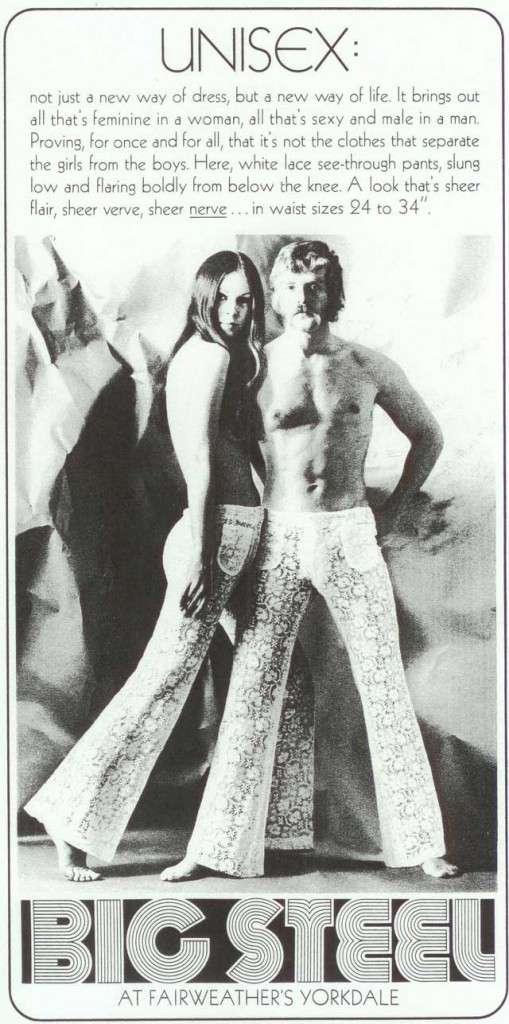
It doesn’t have to be this way, and wasn’t always. Check out these ads from the 1960s and ’70s:
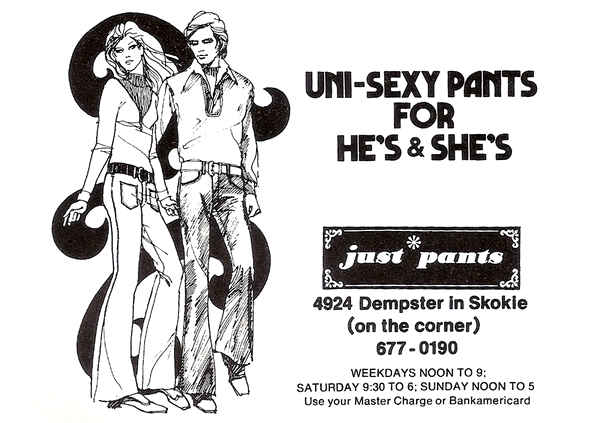
3601168205_0e393b852c_o2007_06_19unisex

Found at Vintage Ads and the Torontoist.

—————————

Lisa Wade is a professor of sociology at Occidental College. You can follow her on Twitter and Facebook.
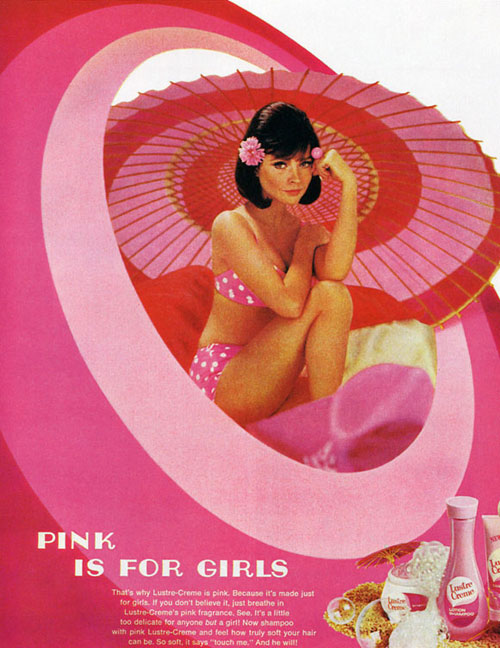
“Pink is for Girls” (found at Vintage Ads):

0_2520e_f01d0eb5_xl

Pink. Pink. Pink. Pink. Pink. Pink. Pink. Pink. Pink. Pink. Pink. Pink. Pink. Pink. Pink. Pink. Pink. Pink. Pink.

That is all.

Lisa Wade, PhD is an Associate Professor at Tulane University. She is the author of American Hookup, a book about college sexual culture; a textbook about gender; and a forthcoming introductory text: Terrible Magnificent Sociology. You can follow her on Twitter and Instagram.

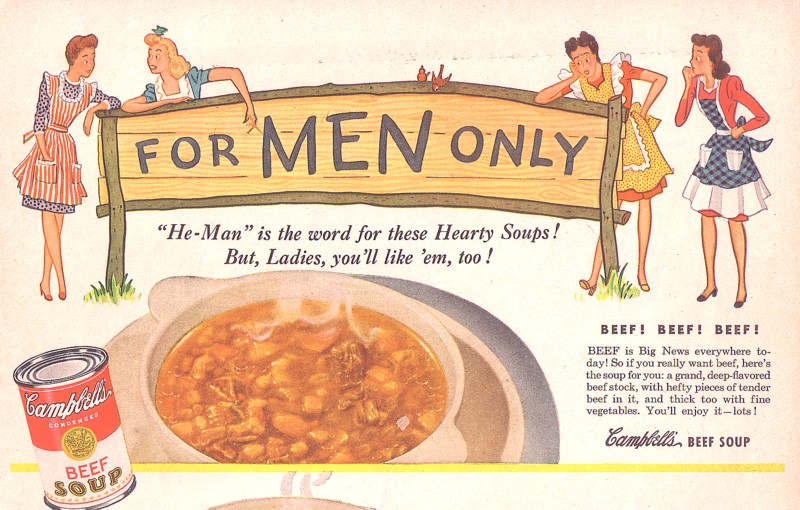
Since I’m visiting my family in Oklahoma, and they raise cattle, I thought it was appropriate to post this Campbell’s soup ad from the 1940s (found at Vintage Ads):

campbells_soup_formenonly_1940s1

Of course, there’s a long history of associating masculinity with meat, with poor families often reserving meat and other foods considered particularly nutritious for men, since they were believed to need it most in order to perform hard physical labor. Writing about the British working class during the late 1800s in his book Sweetness and Power, Sidney Mintz argues, “…wives and children were systematically undernourished because of a culturally conventionalized stress upon adequate food for the ‘breadwinner'” (p. 130). Men’s privileged access to meat actually spurred the consumption of sugar: “…while the laboring husband got the meat, the wife and children got the sucrose…” (p. 145). Sugar provided a relatively cheap source of calories for women and children’s diets to make up for the fact that they got less of other foods. Of course men also ate sugar, but historical evidence indicates that their diets were made up of more protein and less sugar compared to women and children. Sugar provided an energy boost and source of calories for women and children, but at the cost of providing little nutritional value.

Mintz also describes how cultural beliefs emerged to justify this consumption pattern:

One (male) observer after another displays the curious expectation that women will like sweet things more than men; that they will employ sweet foods to achieve otherwise unattainable objectives; and that sweet things are, in both literal and figurative senses, more the domain of women than of men. (p 150).

And of course this belief that women like sweet things more than men, and use them to “achieve” objectives (say, eating chocolate to soothe a broken heart after a breakup) is still with us today.

Gwen Sharp is an associate professor of sociology at Nevada State College. You can follow her on Twitter at @gwensharpnv.

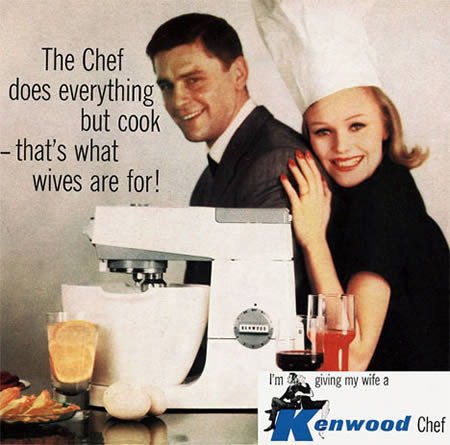
This vintage add (found here) for Kenwood appliances is a nice example of how the act of preparing food is gendered, and how one side of the gendered dichotomy is valued more than the other. Men are chefs– professionals, with careers. And their wives are cooks– they cook at home. Men have prestige as professional chefs outside the home, and women have value as caregiver cooks inside the home.

I guess that this ad is from the early-1980s. How much of this gendering of cooking changed over the years?

a96674_wivesarefor

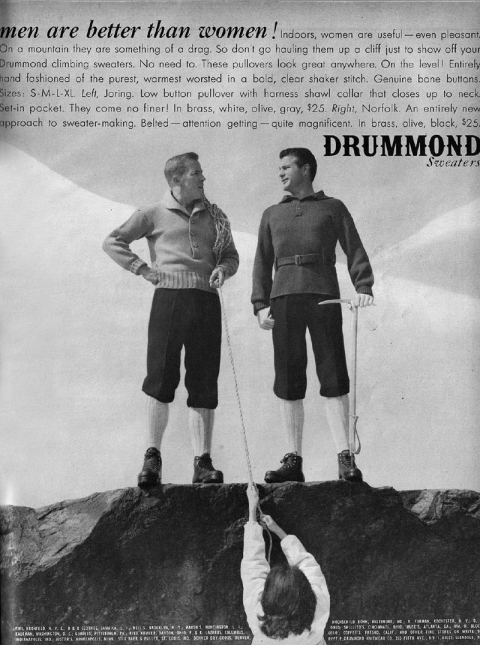
Taylor sent in this ad, found at Blame It on the Voices:

small_men-are-better-then-women

It ran in Esquire in 1959 and our post on the emergence of Playboy Magazine may give the ad some interesting context.

In this cartoon, titled “Plane Dumb” (1932), Van Beuren’s Tom and Jerry put on black face in order to disguise themselves in Africa.  Putting on black face affects their intelligence as they go from being smart to dumb. Idoicy ensues. The “natives” come out at the very end:

Thanks to Steve W. for the link!

For more vintage racist cartoons, see these clips from Fantasia, these Bugs Bunny stills, this racist reinterpretation of Snow White, and this Bugs Bunny cartoon that caricatures the Japanese.

And this one’s just for fun.

We’ve offered many examples of companies co-opting feminism in order to sell products.  In the video below, we see that the co-optation of feminism is nothing new:

(At Vintage Videosift.)

Actually, I shouldn’t be so flippant.  Inventions like the washing machine did, indeed, save women a great deal of time and effort.  From what I understand, however, as women’s cleaning became more efficient, standards of cleanliness rose.  So even as time-saving devices were introduced, the time women spent cleaning did not substantially change.  I’d love to hear more from scholars who have a better handle on this history.

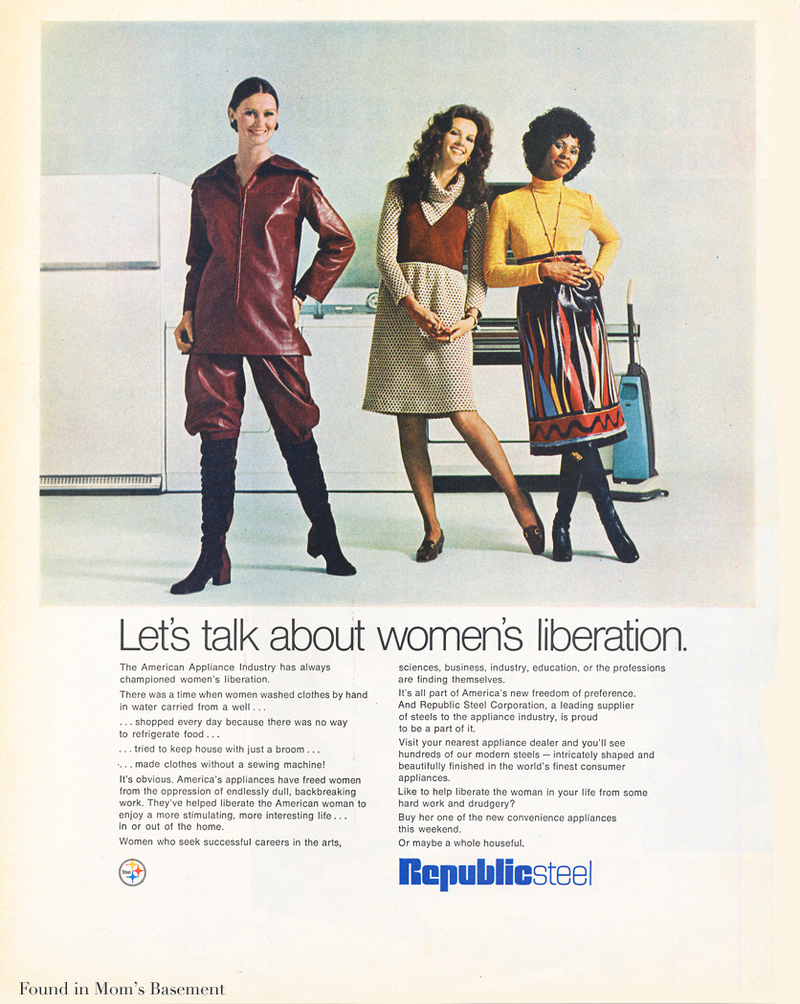
Here’s another step in the trajectory, this one from 1971, also about cleaning appliances (found here):

6a00d83451ccbc69e2010535973e25970c-800wi2

Text:

The American Appliance Industry has always championed women’s liberation.

There was a time when women washed clothes by hand in water carried from a well…

…shapped every day because there was no way to refigerate food…

..tried to keep house with just a broom…

…made clothes without a sewing machine!

It’s obvious.  America’s appliances have freed women from the oppression of endlessly dull, backbreaking work.  They’ve helped liberate the American woman to enjoy a more stimulating, more interesting life…

In or out of the home.

Women who seek successful careers in the arts, sciences, business, industry, education, or the professions are finding themselves.

It’s all part of America’s new freedom of preference.  And Republican Steel Corporation, a leading supplier of steels to the appliance industry, is proud to be a part of it.

Visit your nearest appliance dealer and you’ll see hundreds of our modern steels — intricately shaped and beautifully finished in the world’s finest consumer appliances.

Like to help liberate the women in your life from some hard work and drudgery?

Buy her one of the new convenience appliances this weekend.

Or maybe a whole houseful.

Notice that women’s liberation DOES NOT involve men sharing housework responsibilities, but men replacing women’s labor with tools he purchases for her.  Ultimately, even if she has a “successful career” in “the professions,” it is her responsibility to make sure that the housework is completed (and apparently still wouldn’t be able to buy herself one of these machines).

For contemporary examples, see these posts on make up (here and here), botox, cigarettes (here and here), right-hand diamond rings, cooking and cleaning products, fashion, and other miscellaneous products (here, here, and here).

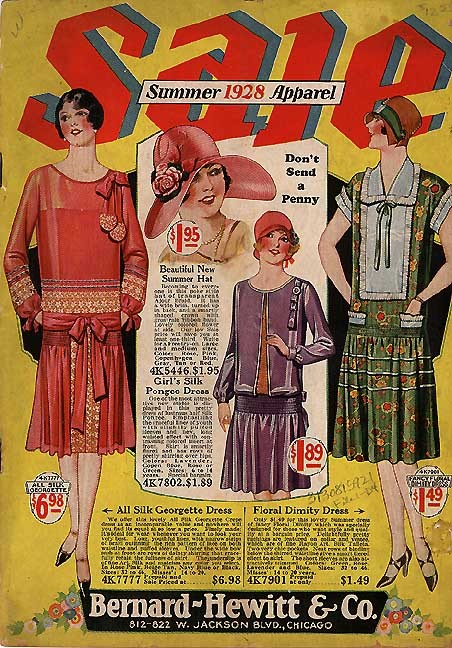
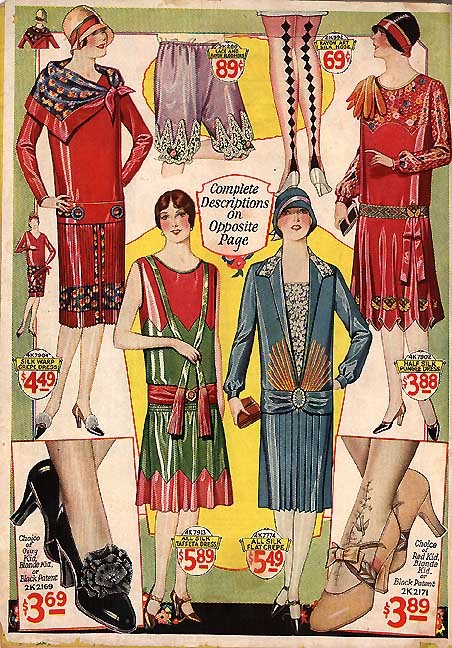
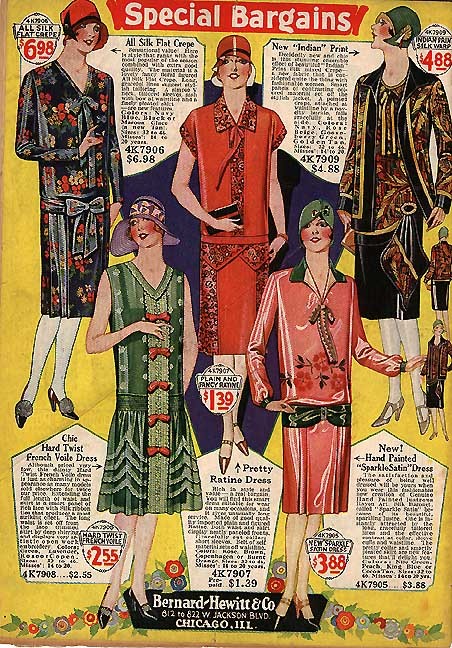
These clothing ads from 1928, featured on Jezebel, portray an ideal female form that is wildly different than the one we have today.  Note the straight lines (no hips or boobs) and very short hair cuts:

summer1928

1928shoesundies

specialbargains

I also like how the first image reads “Summer 1928 Apparel.”   Seasonal fashion, it appears, is nothing new.