politics: the state

The great majority of Americans might find the post-recession expansion disappointing, but not the top earners.

The following table reveals that our economic system is operating much differently than in the recent past.  The rightmost column shows that the top 1% captured 68% of all the new income generated over the period 1993 to 2012, but a full 95% of all the real income growth during the 2009-2012 recovery from the Great Recession.  In contrast, the top 1% only captured 45% of the income growth during the Clinton expansion and 68% during the Bush expansion.

piketty_saez

Of that weren’t enough, the next chart offers another perspective on how well top income earners are doing. In the words of the New York Times article that included it:

…the top 10% of earners took more than half of the country’s total income in 2012, the highest level recorded since the government began collecting the relevant data a century ago… The top 1% took more than one-fifth of the income earned by Americans, one of the highest levels on record since 1913 when the government instituted an income tax.

We have a big economy.  Slow growth isn’t such a big deal if you are in the top 1% and 22.5% of the total national income is yours and you can capture 95% of any increase.  As for the rest of us…

One question rarely raised by those reporting on income trends: What policies are responsible for these trends?

Cross-posted at Reports from the Economic Front.

Martin Hart-Landsberg is a professor of economics at Lewis and Clark College. You can follow him at Reports from the Economic Front.
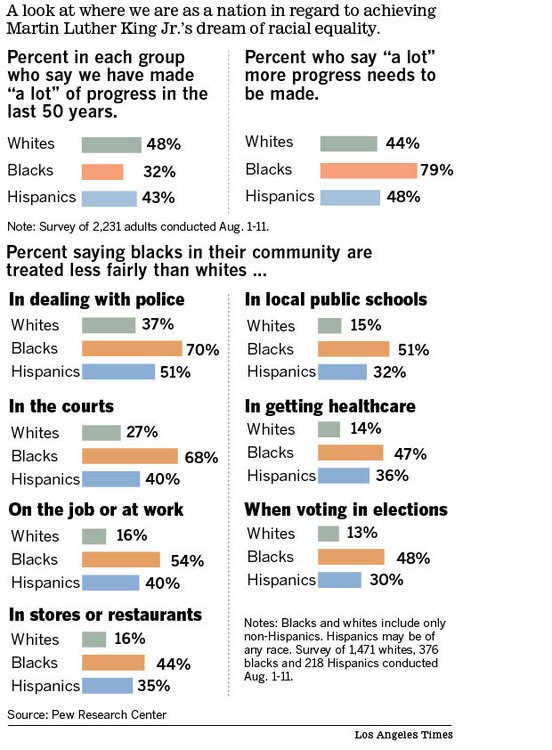
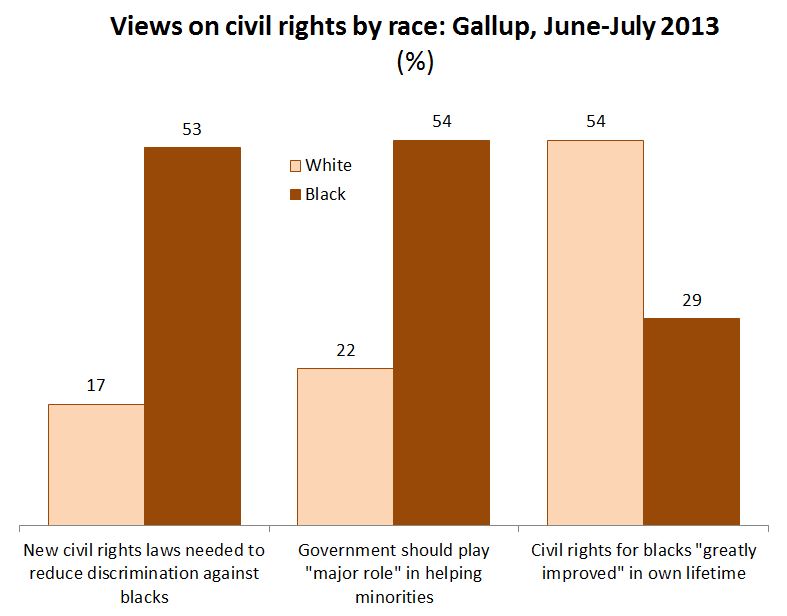
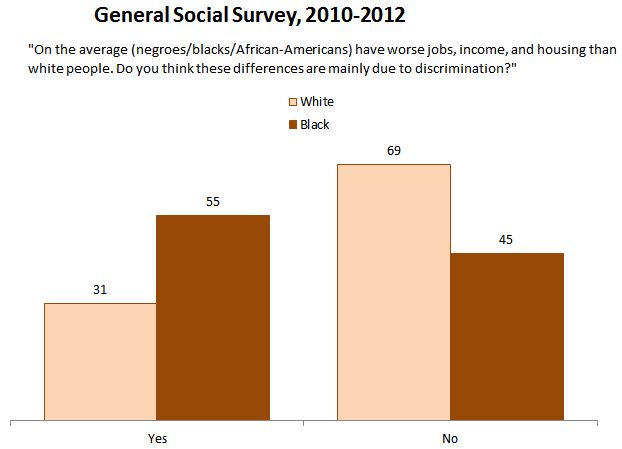
Last week sociologist Philip Cohen, who blogs at Family Inequality, attended the 50th anniversary of the March on Washington.  He noted that the crowd was primarily Black; you can see participants in his photoset here.  Are White people unenthusiastic about Civil Rights?  Perhaps.  There is evidence, in any case, that they are less likely than Black Americans to think that ongoing activism is necessary.  Cohen offers the results of a series of polls.

Pew Research Data published in the Los Angeles Times reveals that Black people are less likely than White people to think we’ve made  a lot of progress in the last 50 years.  They are also substantially more likely to believe that Blacks are treated less fairly than Whites in a wide range of circumstances:

1

Gallup poll confirms that Black Americans are less likely than Whites to feel that race-related rights are “greatly improved.”  It also reveals that they are more than twice as likely to endorse new civil rights laws and government intervention to assure non-discrimination.

2

Finally, the General Social Survey asks whether the fact that Blacks are worse off than Whites is due to mainly to discrimination or because of some other cause.  More than half of Blacks and a third of Whites say “yes, it’s discrimination.”

3

These data reveal that plenty of White Americans are concerned with racial equality, believe we have a long way to go, and support working to improve the treatment of Black Americans. There are also plenty of Black Americans that think things aren’t so bad. Nonetheless, there is a significant and persistent racial gap between the two groups.

Cross-posted at Pacific Standard.

Lisa Wade, PhD is an Associate Professor at Tulane University. She is the author of American Hookup, a book about college sexual culture; a textbook about gender; and a forthcoming introductory text: Terrible Magnificent Sociology. You can follow her on Twitter and Instagram.

Paraphrasing Donald Rumsfeld, there are things we know and things we don’t know, and things we know we don’t know, and things we don’t know we don’t know.

One thing many working people in American don’t know that they don’t know is how poor our social benefits are compare with those enjoyed by workers in other countries.  No doubt one reason is the general media blackout about worker experiences in other countries.  A case in point: vacation benefits.

The Center for Economic and Policy Research recently completed a study of vacation benefits in advanced capitalist economies.  Here is what the authors found:

The United States is the only advanced economy in the world that does not guarantee its workers paid vacation. European countries establish legal rights to at least 20 days of paid vacation per year, with legal requirements of 25 and even 30 or more days in some countries. Australia and New Zealand both require employers to grant at least 20 vacation days per year; Canada and Japan mandate at least 10 paid days off. The gap between paid time off in the United States and the rest of the world is even larger if we include legally mandated paid holidays, where the United States offers none, but most of the rest of the world’s rich countries offer at least six paid holidays per year.

vacations

Even though paid vacations and holidays are not legally required in the United States, some employers do provide them to their workers. The table below shows the paid vacations and paid holidays offered in the U.S. private sector based on data from the 2012 National Compensation Survey.  The first two columns show the percentage of private sector workers that receive paid leave, vacation and holidays.  The next two columns show the average number of paid vacation and paid holidays provided to those employees that receive the relevant benefit.  The last two columns show the average number of paid vacation and paid holidays for all private sector workers, meaning those that receive and those that do not receive the relevant benefits.

US data

Thus, on average, private-sector workers in the United States receive ten days of paid vacation per year and six paid holidays.  This total still leaves U.S. workers last in the rankings even when compared with the legal minimums highlighted above.  And many employers in these other countries also offer more paid leave than legally required.

Moreover, several countries require additional paid leave for younger and older workers, additions that are also not included in the legal minimums highlighted above.  For example, “in Switzerland, workers under the age of 30 who do volunteer work with young people are entitled to an additional five days of annual leave. Norway offers an additional week of vacation to workers over the age of 60.”

And some countries provide additional leave for workers with difficult schedules.  For example, “Australia offers some shift workers an additional work week of leave. Austria offers workers with ‘heavy night work’ two to three extra days of leave, depending on how frequently they do this shift work, and an additional four days of leave after five years of shift work.”

Several countries offer additional paid leave for jury service, moving, getting married, or community or union work.  For example, “French law guarantees unpaid leave for community work, including nine work days for representing an association and six months for projects of ‘international solidarity’ abroad and leave with partial salary for ‘individual training’ that is less than one year. Sweden requires employers to provide paid leave for workers fulfilling union duties.”

Austria, Belgium, Denmark, Greece, and Sweden even require employers to pay workers at a premium rate while they are on vacation.

There is more to say, but the point should be clear.  Ignorance of experiences elsewhere has narrowed our own sense of possibilities.

Martin Hart-Landsberg is a professor of economics at Lewis and Clark College. You can follow him at Reports from the Economic Front.
1Excellent Occidental College student Ryan Metzler made a great 7 minute documentary about the decline of heteronormativity. Interviewing me and several other scholars and activists about the history of marriage and the changing definition of family, he offers a quick and optimistic analysis of what it means for this country to be changing.

Lisa Wade, PhD is an Associate Professor at Tulane University. She is the author of American Hookup, a book about college sexual culture; a textbook about gender; and a forthcoming introductory text: Terrible Magnificent Sociology. You can follow her on Twitter and Instagram.

Cross-posted at Pacific Standard.

Last week the U.S. Supreme Court struck down the part of the Voting Rights Act of 1965 that required states with a documenting history of discrimination to get federal approval before changing their voting laws.  When the law was passed in 1965, one of its main targets were “literacy tests.”

Ostensibly designed to ensure that everyone who voted could read and write, they were actually tools with which to disenfranchise African Americans and sometimes Latinos and American Indians.  Minority voters were disproportionately required to take these tests and, when they did, the election official at the polling place had 100% jurisdiction to decide which answers were correct and score the test as he liked.  The point was to intimidate and turn them away from the polls.  If this sounds bad, you should see the range of disturbing and terrifying things the White elite tried to keep minorities from voting.

The tactics to manipulate election outcomes by controlling who votes is still part and parcel of our electoral politics.  In fact, since most voters are not “swing” voters, some would argue that “turnout” is a primary ground on which elections are fought.  This is not just about mobilizing or suppressing Democrats or Republicans, it’s about mobilizing or suppressing the turnout of groups likely to vote Democrat or Republican.  Since most minority groups lean Democrat, Republicans have a perverse incentive to suppress their turn out. In other words, this isn’t a partisan issue; I’d be watching Democrats closely if the tables were turned.

Indeed, states have already moved to implement changes to voting laws that had been previously identified as discriminatory and ruled unconstitutional under the Voting Act.  According to the Associated Press:

After the high court announced its momentous ruling Tuesday, officials in Texas and Mississippi pledged to immediately implement laws requiring voters to show photo identification before getting a ballot. North Carolina Republicans promised they would quickly try to adopt a similar law. Florida now appears free to set its early voting hours however Gov. Rick Scott and the GOP Legislature please. And Georgia’s most populous county likely will use county commission districts that Republican state legislators drew over the objections of local Democrats.

So, yeah, it appears that Chief Justice John Roberts’ justification that “our country has changed” was pretty much proven wrong within a matter of hours or days.  This is bad.  It will be much more difficult to undo discriminatory laws than it was to prevent them from being implemented and, even if they are challenged and overturned, they will do damage in the meantime.

In any case, here are two examples of literacy tests given to (mostly) minority voters in Louisiana circa 1964.  Pages from history (from Civil Right Movement Veterans):

Louisiana circa 1964a Louisiana circa 1964bThanks to @drcompton for the tip!

Lisa Wade, PhD is an Associate Professor at Tulane University. She is the author of American Hookup, a book about college sexual culture; a textbook about gender; and a forthcoming introductory text: Terrible Magnificent Sociology. You can follow her on Twitter and Instagram.

Cross-posted at The Wild Magazine.

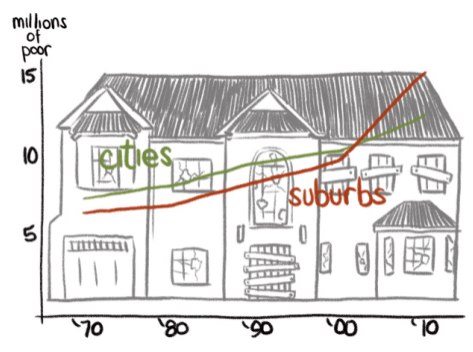
Poverty in the United States is stereotypically associated with racial minorities in urban centers. However, a closer look at social geography reveals a more complex situation: a majority of poor people are white and live in the suburbs. This makes sense when you consider that whites are the largest racial group in the U.S., making up 75% of the population, and that there are three times as many suburbanites than urbanites.

A majority of Americans are losing wealth, and we know it’s going straight to the top. This is not a conspiracy theory, but the economic arrangement of the last 40 years. The New Deal, which created the middle class and the American Dream, was systematically dismantled by elite interest. The revolving door, the shuffling of elites in top positions of power between the public and private sectors, made this possible. The New Deal was abandoned for neoliberal policy. As a result, the comfortable middle class lifestyle was replaced by unemployment and working class struggle.

Suburban poverty normally reflects the spread of metropolitan poverty, but in recent years, suburban poverty has been growing at a faster rate. From 2010-2011, poverty in America’s 100 largest metro areas increased by 5.9% overall. Suburban poverty grew at a rate of 6.8%, while urban poverty grew only 4.7%. In general, the poverty rates in urban areas are still higher (21%) than those in the suburbs (11%). Most notable is the rate of change in the suburbs, which can be attributed to increasing inequality, the housing market crash, gentrification, efforts to make low-income people more mobile, and public housing vouchers.

Screenshot_1

For the past decade, suburbanites commuted between suburbs rather than into cities for work. More affluent, nearby suburbs provide low-wage service jobs in food and retail. Poverty rates in suburbia are rising due to a crumbling middle class, but the poor are still mainly concentrated in inner-ring suburbs close to cities, and on the fringe — former rural areas consumed by suburban sprawl.

Poverty’s expansion to the suburbs is a symptom of an increasingly unequal society. The geographic isolation of the suburban poor in the inner and outer rings of suburbia troubles the validity of the claim that poverty moved to the suburbs. More accurately, people are getting poorer and more people live in the suburbs—or areas now designated as such. It’s plausible that economic inequality and leapfrog developments have changed the sociogeographic landscape. Low-income earners are displaced to the outskirts of the city (inner-ring of the suburbs) due to gentrification, and the rural poor are now more easily counted among the suburban poor due to suburban sprawl. Whatever the case, suburban poverty presents unique challenges to policy makers because federal antipoverty resources are tailored for densely populated urban areas. The stereotypical images of inner city poverty and suburban affluence are the ultimate fiction.

Kara McGhee is a PhD student in sociology at the University of Missouri specializing in culture, identity, and inequalities. She is a regular contributor for The WILD Magazine

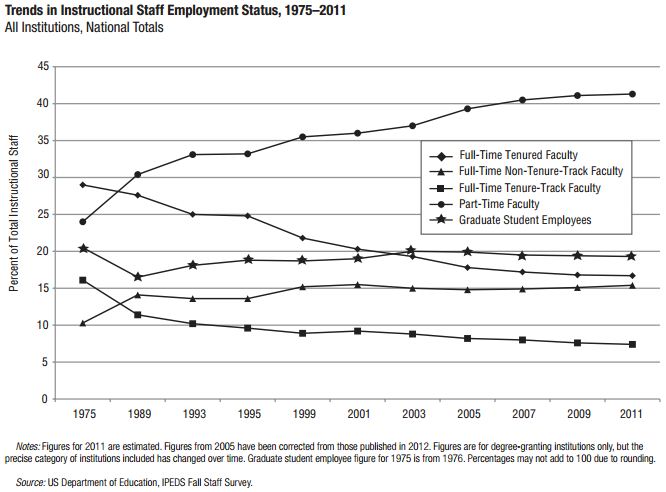
While the stereotype of the college professor might still be an elbow-patched intellectual cozied up in an office, it might be more accurate to place him in his car.  A new report from the American Association of University Professors finds that more than 40% of college instructors are part-time, often driving from campus to campus to cobble together enough classes to enable them to pay rent.  These types of employees far outnumber tenured and tenure-track faculty, who make up less than a quarter.

1

This data suggest that the term “precariat” applies well to a significant proportion of college and university professors. Coined by economist Guy Standing, the term is meant to draw attention to the economic fragility of many lower wage workers in today’s labor market.  It’s a combination of the word “precarious” and “proletarian,” a word that is used to refer to the working class under capitalism.

Part-time faculty count as part of the precariat because their jobs are contingent (renewed semester to semester), low paid, and bring little or no benefits.  Let me put it this way.  I just finished my first year as a tenured professor after six years on the tenure track.  I teach five classes.  An adjunct at a public research university would have to teach more than twenty-three classes to earn my salary (average pay is $3,200/class); someone teaching at community colleges would have to teach more than thirty-three (at $2,250/class).  Of course, my salary also reflects research and institutional service, but my hourly wage is obviously far out-of-proportion to that of part-time faculty.  Plus I get a wide range of benefits; adjuncts usually get nothing.

When government funding of higher education shrinks, colleges and universities respond by cutting corners where they can.  Hiring adjuncts is one way to do that.  It’s important to remember, then, that funding cuts hurt not only students; they also hurt jobs.

See also How Many PhDs are Professors?

Via Jordan Weissman at The Atlantic. Cross-posted at Pacific Standard.

Lisa Wade, PhD is an Associate Professor at Tulane University. She is the author of American Hookup, a book about college sexual culture; a textbook about gender; and a forthcoming introductory text: Terrible Magnificent Sociology. You can follow her on Twitter and Instagram.

Cross-posted at The Atlantic and Family Inequality.

In 1996 the Hoover Institution published a symposium titled “Can Government Save the Family?”  A who’s-who list of culture warriors — including Dan Quayle, James Dobson, John Engler, John Ashcroft, and David Blankenhorn — were asked, “What can government do, if anything, to make sure that the overwhelming majority of American children grow up with a mother and father?”

There wasn’t much disagreement on the panel.  Their suggestions were (1) end welfare payments for single mothers, (2) stop no-fault divorce, (3) remove tax penalties for marriage, and (4) fix “the culture.” From this list their only victory was ending welfare as we knew it, which increased the suffering of single mothers and their children but didn’t affect the trajectory of marriage and single motherhood.

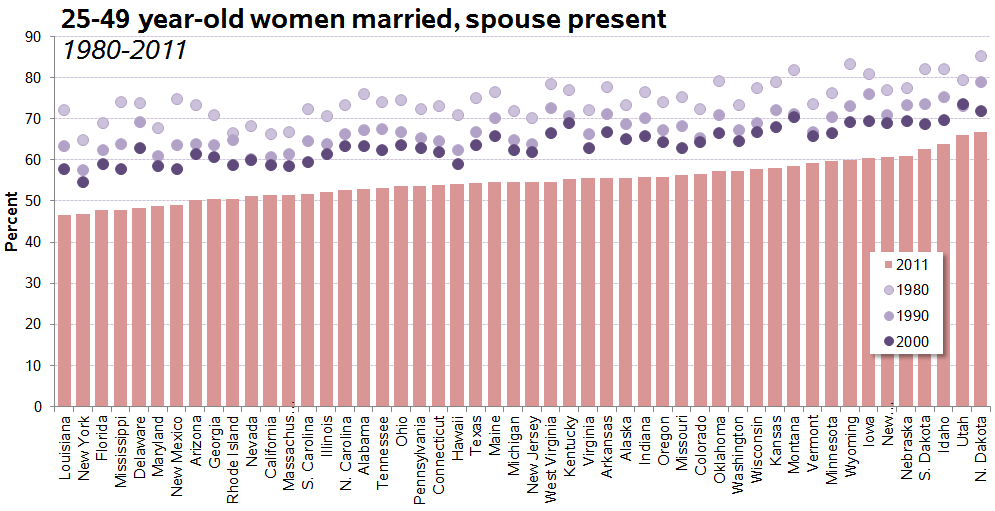
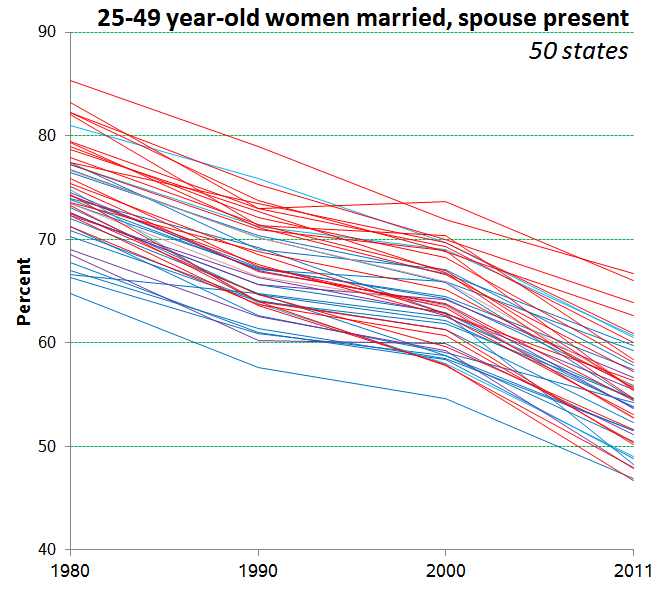
So the collapse of marriage continues apace. Since 1980, for every state in every decade, the percentage of women who are married has fallen (except Utah in the 1990s):

1

Red states (last four presidential elections Republican) to blue (last four Democrat), and in between (light blue, purple, light red), makes no difference:

2

But the “marriage movement” lives on. In fact, their message has changed remarkably little. In that 1996 symposium, Dan Quayle wrote:

We also desperately need help from nongovernment institutions like the media and the entertainment community. They have a tremendous influence on our culture and they should join in when it comes to strengthening families.

Sixteen years later, in the 2012 “State of Our Unions” report, the National Marriage Project included a 10-point list of familiar demands, including this point #8:

Our nation’s leaders, including the president, must engage Hollywood in a conversation about popular culture ideas about marriage and family formation, including constructive critiques and positive ideas for changes in media depictions of marriage and fatherhood.

So little reflection on such a bad track record — it’s enough to make you think that increasing marriage isn’t the main goal of the movement.

Plan for the Future

So what is the future of marriage? Advocates like to talk about turning it around, bringing back a “marriage culture.” But is there a precedent for this, or a reason to expect it to happen? Not that I can see. In fact, the decline of marriage is nearly universal. A check of United Nations statistics on marriage trends shows that 87 percent of the world’s population lives in countries with marriage rates that have fallen since the 1980s.

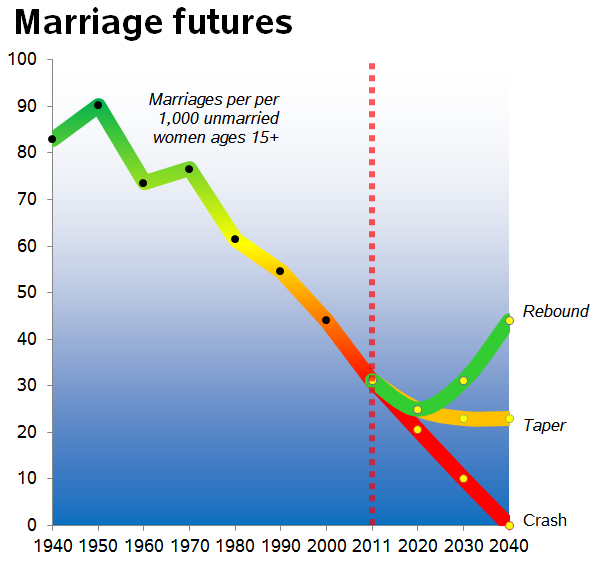
Here is the trend in the marriage rate since 1940, with some possible scenarios to 2040 (source: 1940-19601970-2011):

3

Notice the decline has actually accelerated since 1990. Something has to give. The marriage movement folks say they want a rebound. With even the most optimistic twist imaginable (and a Kanye wedding), could it get back to 2000 levels by 2040? That would make headlines, but the institution would still be less popular than it was during that dire 1996 symposium.

If we just keep going on the same path (the red line), marriage will hit zero at around 2042. Some trends are easy to predict by extrapolation (like next year’s decline in the name Mary), but major demographic trends usually don’t just smash into 0 or 100 percent, so I don’t expect that.

The more realistic future is some kind of taper. We know, for example, that decline of marriage has slowed considerably for college graduates, so they’re helping keep it alive — but that’s still only 35 percent of women in their 30s, not enough to turn the whole ship around.

So Live With It

So rather than try to redirect the ship of marriage, we have to do what we already know we have to do: reduce the disadvantages accruing to those who aren’t married — or whose parents aren’t married. If we take the longer view we know this is the right approach: In the past two centuries we’ve largely replaced such family functions as food production, healthcare, education, and elder care with a combination of state and market interventions. As a result — even though the results are, to put it mildly, uneven — our collective well-being has improved rather than diminished, even though families have lost much of their hold on modern life.

If the new book by sociologist Kathryn Edin and Timothy Nelson is to be believed, there is good news for the floundering marriage movement in this approach: Policies to improve the security of poor people and their children also tend to improve the stability of their relationships.  In other words, supporting single people supports marriage.

To any clear-eyed observer it’s obvious that we can’t count on marriage anymore — we can’t build our social welfare system around the assumption that everyone does or should get married if they or their children want to be cared for. That’s what it means when pensions are based on spouse’s earnings, employers don’t provide sick leave or family leave, and when high-quality preschool is unaffordable for most people. So let marriage be truly voluntary, and maybe more people will even end up married. Not that there’s anything wrong with that.

Philip N. Cohen is a professor of sociology at the University of Maryland, College Park, and writes the blog Family Inequality. You can follow him on Twitter or Facebook.