politics: the state

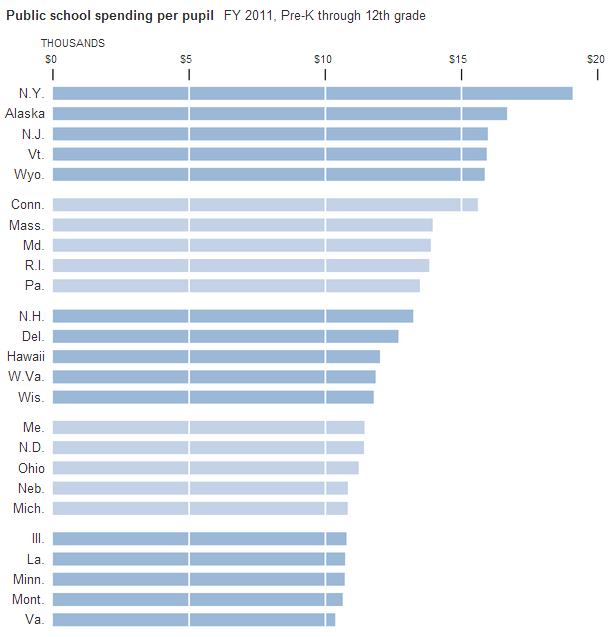
“The United States is one of few advanced nations where schools serving better-off children usually have more educational resources than those serving poor students,” writes Eduardo Porter for the New York Times.  This is because a large percentage of funding for public education comes not from the federal government, but from the property taxes collected in each school district.  Rich kids, then, get more lavish educations.

This means differences in how much we spend per student both across and within states.  New York, for example, spends about $19,000 per student.  In Tennessee they spend $8,200 and in Utah $5,321.  Money within New York, is also unequally distributed: $25,505 was spent per student in the richest neighborhoods, compared to $12,861 in the poorest.
Screenshot_1 Screenshot_2

This makes us one of the three countries in the OECD — with Israel and Turkey — in which the student/teacher ratio is less favorable in poor neighborhoods compared to rich ones.  The other 31 nations in the survey invest equally in each student or disproportionately in poor students.  This is not meritocracy and it is certainly not equal opportunity.

Lisa Wade, PhD is an Associate Professor at Tulane University. She is the author of American Hookup, a book about college sexual culture; a textbook about gender; and a forthcoming introductory text: Terrible Magnificent Sociology. You can follow her on Twitter and Instagram.

A new study has discovered that 48% of the nation’s 50 million public school students are in poverty, as measured by whether they qualify for free or reduced-priced lunches.  In 17 states, the majority of schoolchildren are poor.  Poverty rates are led by Mississippi, where 71% of children are in poverty.

These data represent a startling rise since 2000:

Screenshot_1

While the statistics are the worst for states in the South and the West, the percent increase in poor children was the highest in the Midwest (up 40% since 2001, compared to 33% in the South, 31% in the West, and 21% in the Northeast).  All, of course, extraordinary increases.

h/t @Miel_Machetes.  Cross-posted at Pacific Standard.

Lisa Wade, PhD is an Associate Professor at Tulane University. She is the author of American Hookup, a book about college sexual culture; a textbook about gender; and a forthcoming introductory text: Terrible Magnificent Sociology. You can follow her on Twitter and Instagram.

The current economic recovery officially began June 2009 and is one of the weakest in the post-World War II period.  This is true by almost every indicator, except growth in profits.

One reason it has offered working people so little is the contraction of government spending and employment.  This may sound strange given the steady drumbeat of articles and speeches demanding a further retrenchment of government involvement in the economy, but the fact is that this drumbeat is masking the reality of the situation.

The figure shows the growth in real spending by federal, state, and local governments in the years before and after recessions.  The black line shows the average change in public spending over the six business cycles between 1948 and 1980.  Each blue line shows government spending for a different recent business cycle and the red line does the same for our current cycle.  As you can see, this expansionary period stands out for having the slowest growth in public spending.  In fact, in contrast to other recovery periods, public spending is actually declining.

government spending

According to Josh Bivens:

…public spending following the Great Recession is the slowest on record, and as of the second quarter of 2013 stood roughly 15 percent below what it would have been had it simply matched historical averages… if public spending since 2009 had matched typical business cycles, this spending would be roughly $550 billion higher today, and more than 5 million additional people would have jobs (and most of these would be in the private sector).

The basic stagnation in government spending has actually translated into a significant contraction in public employment.  This figure highlights just how serious the trend is by comparing public sector job growth in the current recovery to the three prior recovery periods.

figure21

As Josh Bivens and Heidi Shierholz explain:

…the public sector has shed 737,000 jobs since June 2009. However, this raw job-loss figure radically understates the drag of public-sector employment relative to how this sector has normally performed during economic recoveries… [P]ublic-sector employment should naturally grow as the overall population grows. Between 1989 and 2007, for example, the ratio of public employment to overall population was remarkably stable at roughly 7.3 public sector workers for each 100 members of the population. Today’s ratio is 6.9, and if it stood at the historic average of 7.3 instead, we would have 1.3 million more public sector jobs today.

In short, the challenge we face is not deciding between alternative ways to further shrink the public sector but rather of designing and building support for well financed public programs to restructure our economy and generate living wage jobs.

Martin Hart-Landsberg is a professor of economics at Lewis and Clark College. You can follow him at Reports from the Economic Front.

I once heard a transgender woman give a talk about the process of socially transitioning to being recognized as a woman. She discussed various decisions she made in taking some final critical steps toward the social identity of woman.  She talked at length about her hair. She asked, “What kind of woman am I and how is my haircut going to indicate that?”  She talked about being preoccupied with her hair for a long time as she attempted to figure out a cut and style that “felt right.” But what struck me the most was her discussion of carrying a purse.

She said that getting used to carrying a purse everywhere was one of the more challenging elements of the transition.  If asked what I thought would be a significant everyday challenge if I were a woman, I don’t think purse would have been high on my list.  But, it was high on hers.  She discussed remembering to bring it, how to carry it, norms surrounding purse protection in public, but also more intimate details like: what belongs in a purse?

Purses and wallets are gendered spaces.  There’s nothing inherent in men’s and women’s constitutions that naturally recommends carrying money and belongings in different containers.  Like the use of urinals in men’s restrooms, wallets and purses are a way of producing understandings of gender difference rather than as a natural consequence of differences.

I got the idea for this post after reading Christena Nippert-Eng’s book, Islands of Privacy — a sociological study of privacy in everyday life.  One chapter deals specifically with wallets and purses.  In it, Nippert-Eng discusses one way she interviewed her participants about privacy.  She used participants’ wallets and purses as a means of getting them to think more critically about privacy.  Participants were asked to empty the contents of their wallets and purses and to form two piles with the contents: “more private” and “more public.”  As they sifted through the contents of their wallets and purses, they talked about why they carried what they carried as well as how and why they thought about it as public or private.

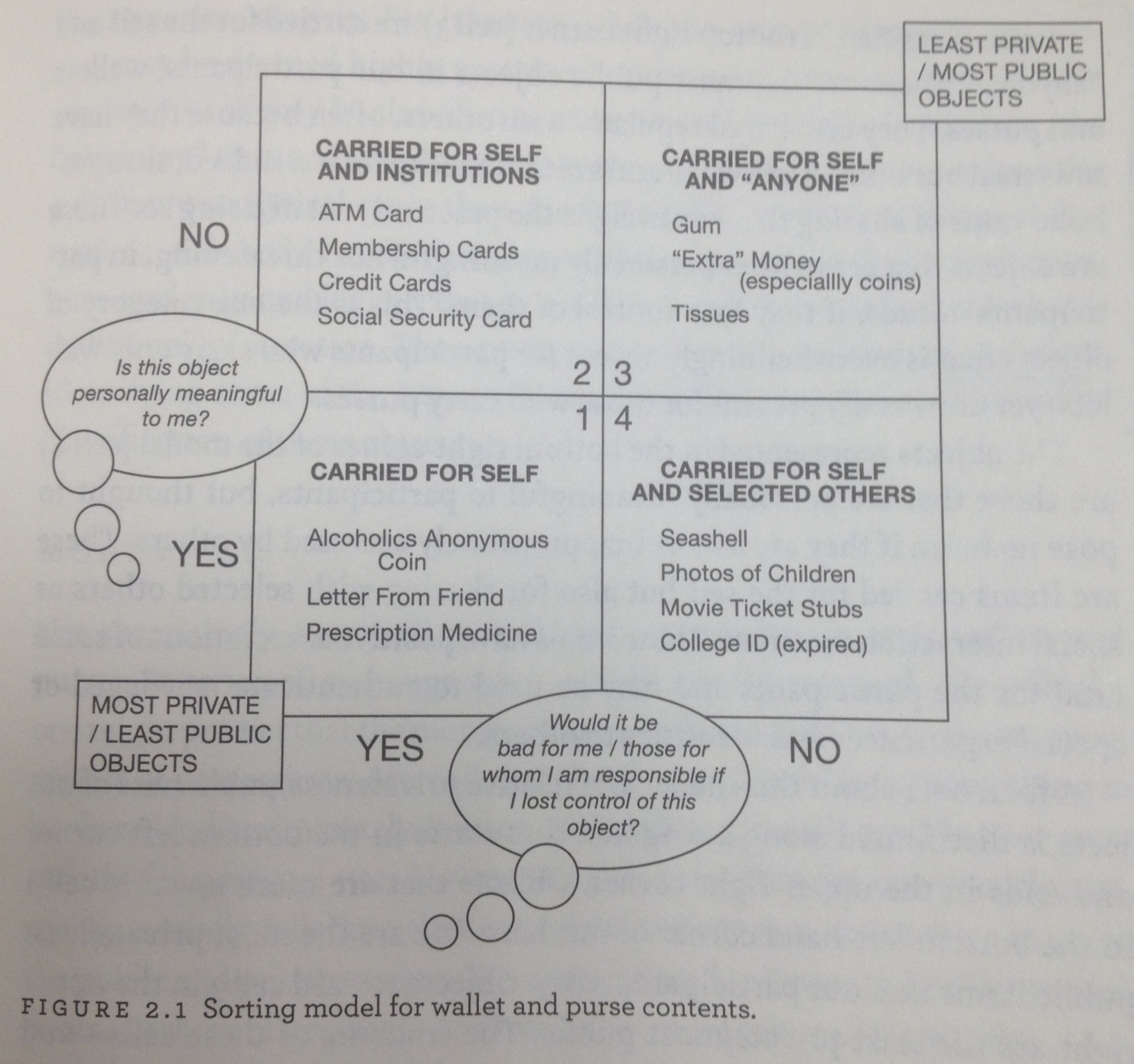
After collecting responses, she documented all of the contents and created categories and distinctions between objects based on how people thought about them as public or private.  One question that was clearly related to privacy was whether the objects were personally meaningful to the participant.  Invariably, objects defined as more personally meaningful were also considered more private.

Another question that routinely arose as participants made sense of the objects they carry around everyday was how damaging it might be for participants if a specific object was taken.  Based on this findings, she creates a useful table delineating participants concerns surrounding and understandings of the objects they carry with them (see left).

photo1

Just for clarification, there’s sort of a sliding scale of privacy going from most to least private as one proceeds from the bottom left cell to the top right cell.  Thus, items classified by participants in the lower left cell (1) are the most private objects.  Here, participants identified things like prescription medications, letters from friends, and a variety of personally meaningful objects that were thought of as completely private and carried only for the self.

Other items were still considered private, but “less private” than objects in cell 1 because they were shared selectively.  Consider cell 2.  While credit cards, bank cards, memberships, credit cards and money were all classified as “private,” individual’s also thought of them as “more public” than object in cell 1 because they were required to share these objects with institutions throughout their lives.

Similarly, some objects were thought of as “private,” but were also carried to share with certain others, such as photographs of children (cell 4).  Finally, items classified in the top right cell (3) are the most public objects in wallets and purses—carried for the self and, potentially, “anyone” else.  Items here include things like tissues, lip balm, money classified as “extra,” gum, breath mints, etc.

Objects from most of the cells exist in both wallets and purses, but not all of them.  The contents of cell 3 (containing the “most public” objects in wallets and purses) are inequitably distributed between wallets and purses.  As Nippert-Eng writes, “This is the one category of objects that is overwhelmingly absent for participants who carry only wallets, yet universally present for those who carry purses” (here: 130).  She also found that some of her participants only carried objects all fitting the same cell in the above table.  These participants — universally “wallet carriers” in her sample — carry only objects necessary for institutional transactions (cell 2).

This is, I believe, a wonderful analysis of one of the more subtle ways in which gender is accomplished in daily life. Certain objects are simply more likely to be carried in purses.  Interestingly, this class of “feminine” objects are also objects that play a critical role in social interactions.  Indeed, many of us are able to travel without these objects because we can “count on” purse-carriers as having them.  Things like packs of gum, tissues, breath mints and more might seem like inconsequential objects.  But, they play a crucial role in social interactions, and many of us count on purse-carriers to provide us with these objects when we are “in need.”  It’s an aspect of care work by which some (those carrying purses) care for others (those without purses).  And if they’re any good at it, the caring goes virtually unacknowledged, though potentially highly acknowledged when these objects are absent in purses.  Children routinely ask their mothers for objects they presume they’ll be carrying in their purses.  Indeed, these objects may be carried in anticipation of such requests.  It’s a small aspect of doing gender, but a significant element of social interactions and life.

When I was learning about interviewing and ethnography, I was told to always carry a pack of gum, a pack of cigarettes (something “lite”), and a lighter.  My professor told me, “It opens people up.  It’s a small gesture that comforts people–puts them at ease.”  These are the ways you might want people to feel if you’re asking them to “open up” for you.  I still remember my first foray into “the field.”  I bought my gum and cigarettes (objects I don’t typically carry) and the first thought I had was, “Where the heck am I going to keep these things?”  What I didn’t realize at the time was that I was asking an intensely gendered question.

Tristan Bridges is a sociologist of gender and sexuality at the College at Brockport (SUNY).  Dr. Bridges blogs about some of this research and more at Inequality by (Interior) Design.  You can follow him on twitter @tristanbphd.

Republicans tend to be Second Amendment absolutists.  The NRA and their representatives in Congress haven’t yet weighed in on the specific issue of, say, banning assault rifles in LAX, but they just might argue that such a law would be an unconstitutional infringement of the right to bear arms.

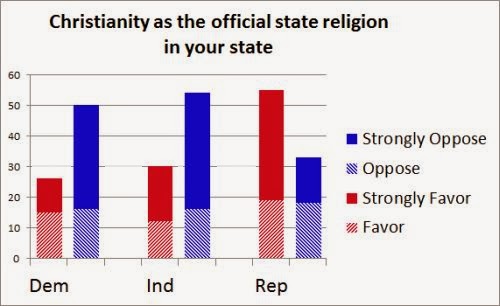
The  First Amendment begins, “Congress shall make no law respecting an establishment of religion,” and when it comes to the Establishment Clause, Republican ideas become a bit more nuanced.  Here are the results of a recent YouGov survey.  The question was, “Would you favor or oppose establishing Christianity as the official state religion in your state?”

1

Democrats and Independents oppose the establishment of Christianity – “strongly oppose” is their modal response.  But a majority of Republicans favor making their state a Christian state, and of those, most (two-thirds) are in the “strongly favor” pew.

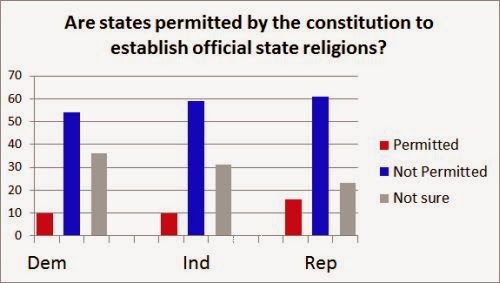
This is not to say that Republicans are unaware of the Establishment Clause.  “Based on what you know, would you think that states are permitted by the constitution to establish official state religions, or not?”

2

Republicans are slightly more likely than Democrats to say that the Constitution does not permit state religions.  They just think that on this one, the framers of the Constitution got it wrong.

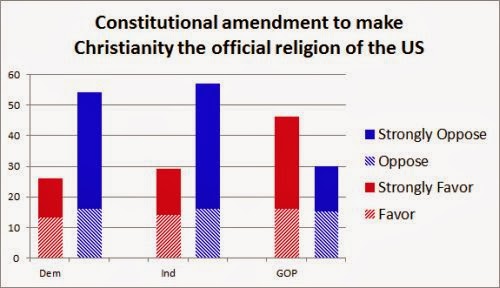
Republicans are only a bit less enthusiastic about establishing Christianity as the official religion of the entire country.  “Would you favor or oppose a Constitutional amendment which would make Christianity the official religion of the United States?”

3

A plurality, 46% – almost a majority – want to correct the Framers’ careless omission by amending the Constitution.  We can’t know specifically what the people who favor this have in mind. Republicans themselves probably differ in their ideas. Maybe only symbolic gestures, like invoking Jesus’s blessing on public events. Maybe public indoctrination – requiring Christian prayer and Bible reading in the public schools. Or maybe more tangible forms of support – giving taxpayers’ money directly to Christian organizations for explicitly religious purposes.

In any case, this is an interesting piece of data to keep in mind for next time a representative of the political right argues that the Constitution is unamendable and inflexible.

Cross-posted at Montclair SocioBlog.

Jay Livingston is the chair of the Sociology Department at Montclair State University. You can follow him at Montclair SocioBlog or on Twitter.

The Federal Reserve Bank has said it will maintain its stimulus policy as long as the economy remains weak. One of its key indicators for the strength of the economy is the unemployment rate, which has been steadily falling for several years, from 10% in October 2009 to 7.3% in August 2013.  However, this decline in the official unemployment rate gives a misleading picture of economic conditions, at least as far as the labor market is concerned.

The reason, as the Economy Policy Institute explains, is because of the large number of “missing workers.”  These missing workers are…

…potential workers who, because of weak job opportunities, are neither employed nor actively seeking a job. In other words, these are people who would be either working or looking for work if job opportunities were significantly stronger. Because jobless workers are only counted as unemployed if they are actively seeking work, these “missing workers” are not reflected in the unemployment rate.

We are seeing many more missing workers now than in recent history.  The chart below shows the Economic Policy Institute estimate for the number of missing workers.

missing workers_Page_1

 The next chart compares the estimated unemployment rate including missing workers (in orange) with the official unemployment rate (in blue).

unemployment rates_Page_1

As you can see, while the official unemployment rate continues to decline, the corrected unemployment rate remains stuck at a rate above 10%. In other words labor market conditions remain dismal. And here we are only talking about employment.  If we consider the quality of the jobs being created, things are even worse.

Martin Hart-Landsberg is a professor of economics at Lewis and Clark College. You can follow him at Reports from the Economic Front.

20131008_112648

He’s makin’ more money than you’ll ever see.

That was the preferred argument of my friend, Tommy, a classmate who lived across the street when I was a kid.  I sometimes would disagree with Tommy about the talents or behavior of some celebrity — a rock star or an actor.  Today’s equivalent might be Ke$ha or a Kardashian. Tommy’s response was usually, “He’s makin’ more money than you’ll ever see.”  And that settled the issue as far as Tommy was concerned.  A huge income trumped just about anything.

In sociology, we talk about values. Introduction to Sociology texts usually define values as abstract ideas about what is good, ideas that people use as guides to action.  Maybe. But the definition I prefer sees values as “legitimations” — ideas about what is good that people use to justify behavior or to win arguments.  For Tommy, money was this kind of ultimate legitimation. His behavior did not evidence a strong value on money — we were only about eleven at the time — but his judgments did. Values are what we use to evaluate.

I thought of Tommy and values today when I read the transcript of a CNBC interview with Alex Pereene.  Pereene has recently gone on record criticizing Jamie Dimon, the CEO of JPMorgan. That bank currently faces an $11 billion fine for having dealt in shoddy mortgage-backed securities.  JP Morgan can afford it, of course, but $11 billion begins to be real money.  The question on CNBC was whether Dimon should continue as its CEO.

Pareene says no. The CNBC anchor, Maria Bartiromo then says.

Legal problems aside, JP Morgan remains one of the best, if not the best performing major bank in the world today. You believe the leader of that bank should step down?

Or as Tommy Fiedler would have put it, “His bank is makin’ more money than you’ll ever see.”

Here’s Pareene’s response:

If you managed a restaurant, and it got the biggest health department fine in the history of restaurants, no one would say “Yeah, but the restaurant’s making a lot of money. There’s only a little bit of poison in the food.”

CNBC then brings in a Dimon booster, Duff McDonald. Asked to respond to Pareene’s charge of corruption, McDonald says,

It’s preposterous. The stock’s touching a ten-year high. It’s a cash-generating machine. Sure they’ve had their regulatory issues . . .

In McDonald’s view, the charge of corruption is preposterous because JP Morgan is makin’ more money than you’ll ever see.

Bartiromo’s reaction is especially telling. She seems to take Pereene’s criticism of JP Morgan personally. I thought that anchors were supposed to be neutral and try to  draw guests out. But Bartiromo is openly hostile. She loudly interrupts Pereene and demands evidence of the bank’s questionable tactics. When Pereene gives an example, she defends Dimon by again appealing to the value on profits above all else.

Even with all these losses, the company continues to churn out tens of billions of dollars in earnings and hundreds of millions in revenues. How do you criticize that? [emphasis added]

Her assumption is that anyone who makes so much money cannot be criticized. Such criticism is immoral. The reporting about JP Morgan’s shortcomings is, she says,  “a witch hunt.”

The problem with legitimations is that they work only if everyone in the room shares the same values. Members of the same culture, almost by definition, share values, and effective arguments apeal to those values. Americans, for example, are suckers for arguments based on appeals to individual freedom. We find them very hard to resist. But people in other cultures might not find those arguments so persuasive.

This brief CNBC interview hints at cultures or moral worlds in collision. In the CNBC world, people take the value on making money for granted. When they encounter someone who does not share that value, who is not persuaded by arguments based on it, they act as though threatened by some uncomprehending and dangerous alien, a creature from another world. It is a clash of cultures, a clash of values, and the way we discover those is not by watching what people do (values as guides to action)  but by listening to how they justify what they and others do (values as legitimations).

Cross-posted at Montclair SocioBlog.

Jay Livingston is the chair of the Sociology Department at Montclair State University. You can follow him at Montclair SocioBlog or on Twitter.

Screen Shot 2013-09-19 at 8.08.15 AM

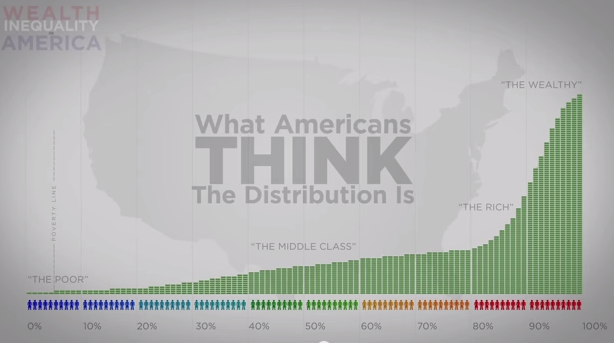
Earlier this week, Marty posted about the increasingly huge share of income going to the richest Americans. And as we’ve seen in the past, Americans tend to way — way — underestimate how unequal the U.S. is.

This video (via Upworthy) does a great job illustrating the distribution of wealth, and how it compares to Americans’ perceptions of both the real and ideal distribution. Even if you know all this stuff, and can recite the statistics, the visual representation of exactly what that means is still jarring.

Gwen Sharp is an associate professor of sociology at Nevada State College. You can follow her on Twitter at @gwensharpnv.