nation: United States

How does the U.S. compare to other developed countries on measures of social justice? According to the New York Times, not very well.  The visual below compares countries’ poverty rates, poverty prevention measures, income inequality, spending on pre-primary education, and citizen health.  The “overall” rating is on the far left and the U.S. ranks 27th out of 31.
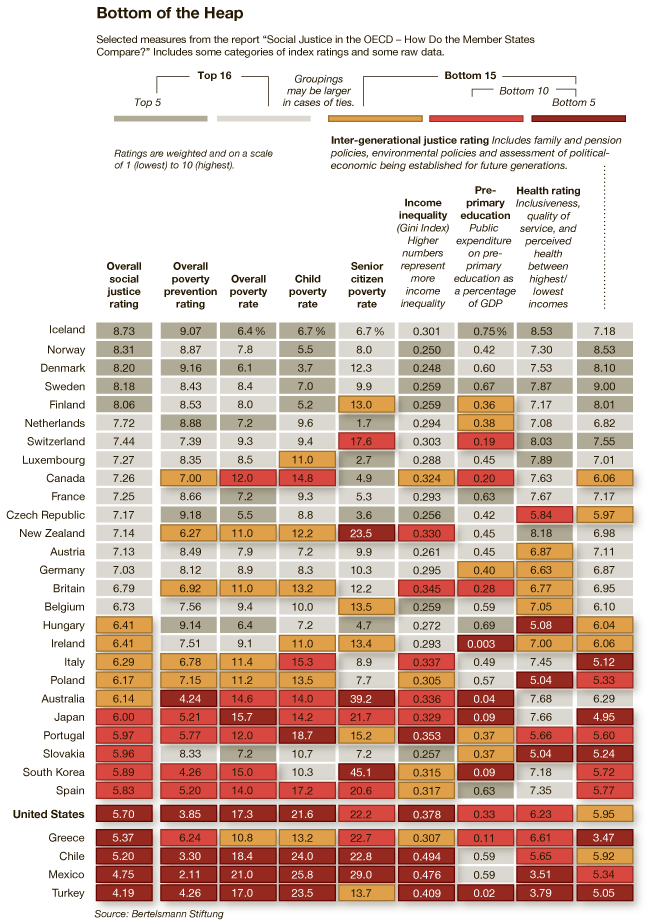

Via Feministing.  See also how the U.S. ranks on measures of equality and prosperity(33 out of 33, for what it’s worth). Thanks to Dolores R. for the link!

Lisa Wade, PhD is an Associate Professor at Tulane University. She is the author of American Hookup, a book about college sexual culture; a textbook about gender; and a forthcoming introductory text: Terrible Magnificent Sociology. You can follow her on Twitter and Instagram.

Cross-posted at Citings and Sightings.

In an interview discussing whether teen sleepovers can actually prevent teen pregnancy, CNN’s Ali Velshi says flatly, “This is a little bit counter-intuitive.” But as his interviewee, UMass sociologist Amy Schalet (who wrote on this subject in Contexts in “Sex, Love, and Autonomy in the Teenage Sleepover” in the Summer of 2010), explains:

Let me clarify: it’s not a situation where everything goes… It’s definitely older teenage couples who have established relationships and whose parents have talked about contraception.

Which is to say, as Velshi puts it, sex and sex education in countries like the Netherlands, in which parents are more permissive—or as Schalet says, “parents are more connected with their kids”—about allowing boyfriends and girlfriends to sleep over, take “a holistic approach.”

Schalet’s research, explored more deeply in her new University of Chicago book Not Under My Roof, takes a look at American parenting practices surrounding teen sex and the practices of parents in other countries. Using in-depth interviews with parents and teens and a host of other data, she finds:

The takeaway for American parents… isn’t necessarily “You must permit sleepovers.” Many parents are going to say, “Not under my roof!” That’s why it’s the title of my book. The takeaway is that you can have more open conversations—you should probably have more open conversations—about what’s a good relationship, sex and contraception should go together, what does it mean to be “ready,” how to get rid of some of these damaging stereotypes (gender stereotypes). Those are all things that are going to help promote teenage health and better relationships between parents and kids.

Schalet is clear that parental approaches are nowhere near the only factor in the stark differences in teen pregnancy rates between the U.S. and the Netherlands, but says they are, in fact, particularly important. “Kids are having sex, clearly,” Velshi says. And that’s precisely the point, no matter whether parents believe their kids should be able to have sex in their own homes, Schalet believes: “I think what you emphasize is that, above all, the conversation is important, and the conversation itself does not make kids have sex.” Ideally, she points out, that conversation will take place at home with parents, but a holistic talk about sexuality, relationships, and health can also take place in schools, with clergy, and in many other locations.

Dr. Schalet on CNN (we apologize for the commercial):

Amy Schalet’s new book is Not Under My Roof: Parents, Teens, and the Culture of Sex.

—————————

Letta Page is the Associate Editor and Producer of The Society Pages. She has a decade of experience in academic editing across a range of disciplines, including two years as the managing editor of Contexts. Page holds degrees in history and classical studies from Boston University and an art degree from the University of Minnesota.

If you would like to write a post for Sociological Images, please see our Guidelines for Guest Bloggers.

For the last week of December, we’re re-posting some of our favorite posts from 2011.

————————

The US economy faces a number of challenges—among them a lack of job creation and an ever-growing trade deficit. Many policy-makers believe that encouraging business innovation is the best response to these particular challenges. Sounds plausible but experience suggests otherwise.

The best example of why simply encouraging business innovation is not the answer for our employment and trade problems is Apple and its iPhone.

The iPhone was introduced in 2007 and has been incredible successful.  U.S. sales soared from 3 million units in 2007 to over 11 million in 2009.  Global sales topped 25 million in 2009.

While the iPhone is designed and marketed by Apple, almost all the phone’s components are produced by foreign companies operating outside the United States.  These components are then shipped to China where Foxconn, a Taiwanese company, oversees their assembly and their export to the United States and other countries.  As a result, the iPhone generates few jobs in the United States.

Two economists, in an Asian Development Bank working paper, examined the iPhone 3G production process in some detail.  The table below, taken from their study, highlights the main suppliers and the costs of the components they produce for a single phone.  Most of the components are supplied by Japanese, South Korean and German firms, although there are also some U.S. suppliers (although who knows where they actually produce their compnents).

The total component cost of an iPhone in 2009 was $172.46.    Workers in China assemble the iPhone, but because their wages are low the assembly cost per phone (labeled manufacturing costs in the table below) is quite small, only $6.50 a phone.  The total production cost per phone is $178.96.

costs.jpg

Because the iPhone is assembled in China all sales in the U.S. mean an increase in Chinese exports (even though the phone is largely composed of inputs produced outside of China) and an increase in U.S. imports.  In 2009, China exported more than $2 billion worth of iPhones to the United States.  Thus, the iPhone, because of the Apple’s production strategy, also adds to the U.S. trade deficit.

Apple is not alone in embracing China as its production base.  China is now the world’s largest exporter of manufactured goods. And, as the chart below shows, the share of Chinese exports that are labled high technology is growing.  This trend has encouraged many analysts to claim that the U.S. is now locked in fierce economic competition with China.

hitech.jpg

However, as we see next, more than 80% of China’s high technology exports are actually produced by foreign companies operating in China.  Moreover, these foreign companies have significantly increased their control over this production.  In 2002 foreign owned firms that were 100% foreign owned (which means that they had no Chinese partner) accounted for only 55% of Chinese high technology exports.  In 2009 they accounted for 68%.

foreign-owned.jpg

Why do so many transnational corporations choose to locate production in China?  The answer is obvious: profits. Apple again serves as a good example.  The table below, taken from the Asian Development Bank working paper cited above, shows Apple’s profit-margin on the iPhone.  In 2009 it was a whopping big 64%.

profits.jpg

Struck by the size of Apple’s profit-margin, the authors of the Asian Development working paper considered whether the iPhone could reasonably be made in the United States.  As they note:

The role of the PRC in the production chain of iPhones is primarily the assembly of all parts and components into the final product for re-shipment abroad. The skills and equipment required for the assembly are very basic and there is no doubt that American workers and firms are capable of assembling iPhones in the US. If all iPhones were assembled in the US, the US$1.9 billion trade deficit in iPhone trade with PRC would not exist. Moreover, 11.4 million units of iPhone sold in the non-US market in 2009 would add US$5.7 billion to US exports.

For the sake of discussion, they assumed that assembly line wages in the U.S. are ten times higher than in China.   Given that Chinese production workers earn roughly $1 an hour, that is not an unreasonable assumption.  The higher wages would mean that the total assembly cost per phone would rsie to $65 and the total manufacturing cost would approach $238.  If Apple continued to sell the iPhone for $500, the company would still earn a very respectable 50% profit margin.

Moreover, as the authors point out:

In this hypothetical scenario, iPhones, the high-tech product invented by the U.S. company, would contribute to U.S. exports and the reduction of the U.S. trade deficit, not only with the PRC, but also with the rest of world. More importantly, Apple created jobs for U.S. low skilled workers; those who could not be the software engineers needed by Apple. Giving up a small portion of profits and sharing them with low skilled U.S. workers by Apple would be a more effective way [than depreciation of the exchange rate] to reduce the U.S. trade deficit and create jobs in the United States.

Of course, shifting production to the United States would mean that Apple would earn less money and there is little reason to believe that the company is prepared to sacrifice its profits for the good of the country.  If we want to tackle our employment and trade problems were are going to have to do more than promote more attractive conditions for business.


For the last week of December, we’re re-posting some of our favorite posts from 2011.

————————

It seems obvious that basic cognitive perceptions shouldn’t vary by society.  That is, that our eyes should see, and our brains should process, essentially the same no matter what we call ourselves, what language we speak, or what holidays we observe.  It turns out, however, that even basic cognitions vary across the world.

Most Americans, for example, perceive the two lines in this optical illusion to be of different lengths, with line a shorter than line b.  In fact, they are the same length.

But, as argued by Joseph Henrich and colleagues in the Journal of Behavioral and Brain Sciences, our susceptibility to this illusion varies by culture.  On average, line a needs to be another fifth longer than line b before the average American undergraduate evaluates the lines to be equal in length.  Most other societies that have been tested on this illusion, however, require substantially less manipulation.  The figure below compares how individuals in different societies perform on this test.  The measures are tricky, and you can read more about them here; what you need to know for now is that the societies on the right are more susceptible to the illusion and the societies on the left less.

Observing that individuals in more developed societies (e.g., Evanston, Illinois) tend to be more vulnerable to the illusion — indeed, that in some societies, such as the San foragers of the Kalahari, it doesn’t qualify as an illusion at all — Henrich and his co-authors argue that exposure to “modern environments” may be the culprit:

…visual exposure during ontogeny to factors such as the “carpentered corners” of modern environments may favor certain optical calibrations and visual habits that create and perpetuate this illusion.  That is, the visual system ontogenetically adapts to the presence of recurrent features in the local visual environment.

Even basic cognition, that is, varies across cultures.

As Henrich et al. argue, this calls into question all of the truisms of psychology based, primarily, on experimental research with Western subjects.

Lisa Wade, PhD is an Associate Professor at Tulane University. She is the author of American Hookup, a book about college sexual culture; a textbook about gender; and a forthcoming introductory text: Terrible Magnificent Sociology. You can follow her on Twitter and Instagram.

Cross-posted at Montclair SocioBlog.

Children in American movies are typically superior to adults.  The kids are not only all right, they are wiser, less corrupt, and more competent.  “Home Alone” is a classic example, where the plucky, resourceful kid triumphs over both the vindictiveness of the burglars and the mindlessness of his parents.  (An earlier post on children in films is here.)

“The Descendants,” the recent film with George Clooney (I saw it last night), starts more like a French film, where children are, well, children, and it’s the parents who must endure and learn to cope with the kids’ immaturity and thoughtlessness.

Clooney is Matt King, and the name is a deliberate irony.  Kinglike, he must decide the fate of a huge tract of pristine Kauai land that his family has owned for many generations.  The money from the sale will make him and his many cousins and their families rich.  Which developer will he sell the land to?But as a husband and father he is far being monarch of all he surveys.  His wife has been in an accident and lies in a coma.  His two daughters are unapologetically impudent and insufferable.  As the film starts, Scottie, age ten, has sent a nasty, obscene text to a classmate.  Alex, seventeen, now at an expensive private rehab/therapeutic school, first appears on screen drunk, having  sneaked out of her room at night with another girl.  Then there’s Sid, Alex’s friend, a slightly older boy, all stupidity and insensitivity, a chubby incarnation of Beavis and Butthead.Then the film magically transforms the kids.  Each has been introduced as obtuse, obscene, or obnoxious. But now Alex, it turns out, knows more than her father does, at least in one crucial area – that his wife, now on life support, had been cheating on him.

The kids change from being French, a burden for the grown-up, to becoming almost classically American, not superior but equal.  They are now his partners.  Teens and adult are a team trying to discover the identity and location of the seducer so that King can confront him.  The teenagers are suddenly much less difficult and much more helpful, while King sometimes appears uncertain and even silly, peering over hedges to spy on his wife’s lover.   He asks his daughter for advice.  He even asks Sid what he should do.(You can get some sense of this transformation in the trailers here and here, which also outline the rest of the story.)

Still, the movie doesn’t go pure Hollywood.  It does not present the world as a character contest where good faces evil, where the right action is clear and the only question is how the hero will come to make it.  Instead, it shows a grown-up trying to understand and cope with problems and people he cannot really control.

And nobody blows up a helicopter.

As we enter the last frenzied days of Christmas shopping, Dmitriy T.M. thought it was worth looking at international comparisons in spending on the holiday. The Economist posted a graph based on Gallup polls and other data sources about how much individuals in various countries in Europe, plus the U.S. and South Africa, plan to spend on Christmas shopping this year, plotted against national GDP. Overall, Christmas spending correlates with national wealth, with the Netherlands being a noticeable outlier (spending less than we’d expect) and Luxembourg in a spending league of its own:


Cross-posted at Montclair SocioBlog.

The equation of wealth and virtue seems to come almost naturally, at least among the wealthy.  The logic is simple:  Virtue leads to success, therefore wealth is evidence of one’s virtue.  Virtue, in this case, means the Protestant Ethic – hard work and a willingness to forgo or postpone pleasures.  It follows then that those who are not wealthy must have turned their back on virtue.

David Brooks, in his Friday column (here),  applies this explanation to the wealth of nations.

Why are nations like Germany and the U.S. rich? . . . It’s because many people in these countries believe in a simple moral formula: effort should lead to reward as often as possible.

People who work hard and play by the rules should have a fair shot at prosperity. Money should go to people on the basis of merit and enterprise. Self-control should be rewarded while laziness and self-indulgence should not.

The US, Germany, and the Netherlands are Brooks’s exemplars of these virtues (Brooks uses the word ethos).  The bad countries, the ones whose economies are teetering on the brink, are the grasshoppers to our ant.  There they were – Brooks points his finger at Greece, Italy, and Spain – fiddling and dancing the summer away, refusing to live within their means or “reinforce good values.”

This seems accurate, doesn’t it – the dolce far niente Italians and other Mediterraneans, taking hours at midday for meals and siestas while the industrious Americans, Germans, and Dutch are working away, wolfing down a sandwich at their desks.

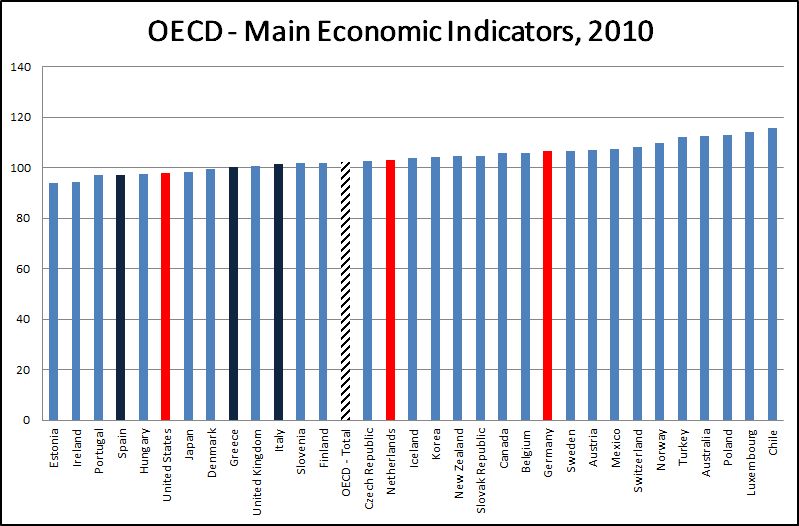
Just to be sure I downloaded some OECD data from 2007 – the last year before the big crash – on the number of hours people in different countries work. (Brooks’s three “ant” countries are red, the “grasshoppers” dark blue.)This is puzzling.  The US is slightly above the OECD average, but workers in Greece and Italy spend more hours at work than do Americans, while the Dutch and Germans are down at the low end of the scale.  (I do not know why the OECD still gives data for West Germany as well as Germany.)

I noticed that the OECD also had a measure of “employment protection,” which is basically how hard it is to fire someone.  I figured that workers in non-virtuous countries would be highly protected.  Since it’s nearly impossible for them to be fired, they know they can slack off on the job.  By contrast, virtuous countries would foster Brook’s ethos of “effort, productivity and self-discipline”  in workers, rewarding the industrious, firing the lazy and self-indulgent.I wasn’t surprised that the US anchored the low end of the scale.  Workers here have less job-protection than those in any of the other countries.  And Greece and Spain are above the average.  But so are Germany and the Netherlands, though only slightly, while Italy is slightly below the average.  There’s really not much difference between these three.  And if you look at the array of countries, there seems to be no strong connection between job protection and how well the country is weathering the current long recession.  I’m not sure what the best measure of the overall economy is, but the OECD has composite figure made up from ten main economic indicators.* I just wish we had better measure of Brooks’s “ethos.”

——————-

*  “The Labour Force Survey (MEI) dataset itself covers countries that compile labour statistics from sample household surveys on a monthly or quarterly basis. It is widely accepted that household surveys are the best source for labour market key statistics. In such surveys, information is collected from people living in households through a representative sample. Surveys are based on standard methodology and procedures used all over the world. The 10 subjects available cover labour force, employment, unemployment (including harmonised unemployment), and employees.”


Updated; originally posted July 2009.

Americans are notorious for their ignorance of global issues and international news.  This may be because Americans aren’t interested or it may be that our news outlets feed us fluff and focus us only on the U.S.  Probably it’s a vicious cycle.

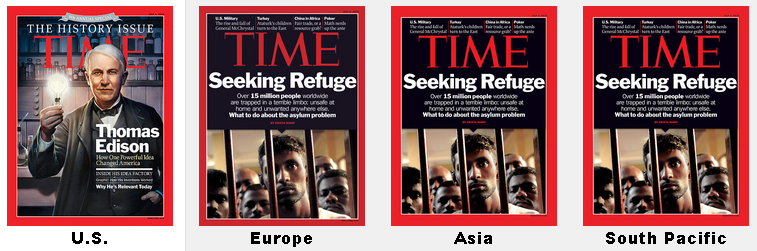
This month, for example, Time magazine’s cover story is about the political strife in Egypt… everywhere except the U.S. that is.  Americans get “pop psychology” (via Global Sociology):

It turns out you can go to the Time website and compare covers from previous issues going back a long ways.  Here are some more examples from the last couple years (I cherry picked just a bit):

Dmitriy T.M. sent in these previous examples a while back.

The cover story for Newsweek magazine’s September 2006 edition was “Losing Afghanistan” in Europe, Latin America, and Asia.  It was “My Life in Pictures,” a story about the photographer Annie Liebovitz in the U.S. (via):

newsweek

The cover story for Newsweek magazine’s October 2006 edition was “Global Warming’s First Victim” in Europe, Latin America, and Asia.  It was “Off Message,” a story about Republican Congressman Mark Foley’s sexually suggestive emails and IMs to teenage boys (via):

frogs

The cover story for Time magazine’s April 2007 edition was “Talibanistan” in Europe, Latin America, and Asia.  It was “Why We Should Teach the Bible in Public Schools” in the U.S. (via, also see Time):

Capture2

As SocProf writes:

Talk about self-fulfilling prophecy: Americans are assumed to not be interested in international and global affairs… ergo, Time decides to replace a perfectly legitimate and newsworthy cover on a significant event in Egypt with some pop psychology item. As a result, Americans are less informed and knowledgeable on global affairs because they do not get intelligent coverage on that topic.

Lisa Wade, PhD is an Associate Professor at Tulane University. She is the author of American Hookup, a book about college sexual culture; a textbook about gender; and a forthcoming introductory text: Terrible Magnificent Sociology. You can follow her on Twitter and Instagram.