Search results for embed

Last month, Lisa posted a video of Jennifer Lee discussing the U.S. racial ideology with Dalton Conley. Jennifer (who teaches sociology at the University of California-Irvine) emailed us to let us know there’s now a second video, in which she discusses the difference between race and ethnicity, as well as how racial ideologies are socially constructed:

Peter Nardi, of Pitzer College, sent in an image that illustrates the social construction of race. He visited the Apartheid Museum in Johannesburg, South Africa, and took a photo of a plaque on the wall that reprinted information published in the Johannesburg-based newspaper The Star on March 21, 1986. The article reported on changes in the official racial classification of over 1,000 South Africans in 1985:
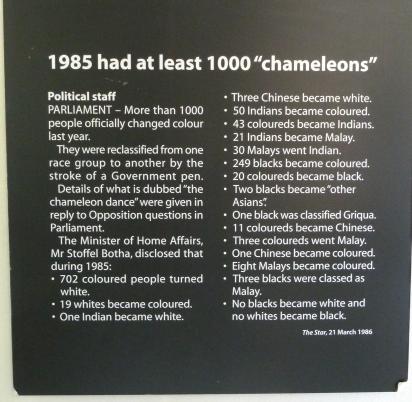
Because race is socially constructed, racial classifications change as underlying racial ideologies shift, sometimes opening up opportunities (for instance, allowing groups to be classified as a less stigmatized race) but also often reinforcing racial stratification (such as when the U.S. made the “one-drop” rule, by which you were African American if you had even one Black ancestor, official policy, preventing mixed-race individuals from avoiding the stigma of being Black).

And I’m visiting my family until the 28th, so I will have very sporadic internet access. I’ve scheduled posts for the whole week, but I won’t be able to update/correct/respond much, so I apologize in advance. On the upside, my trips home often provide material for at least one post, so yay!



Stephen Colbert reports, and mocks, some pretty stunning product placement on Days of Our Lives:

Thanks to Dmitriy T.M. for the tip!

Lisa Wade, PhD is an Associate Professor at Tulane University. She is the author of American Hookup, a book about college sexual culture; a textbook about gender; and a forthcoming introductory text: Terrible Magnificent Sociology. You can follow her on Twitter and Instagram.


Andi M. sent in a video created by J.C. Penney called “The Doghouse.” The ad tells the story of men sent to the doghouse by their wives for various bad behaviors, but mostly for giving bad Christmas gifts. A bad gift is a non-romantic gift, or a gift that is related to housework, or that implies a woman needs to lose weight or change her appearance:

As Andi points out, the ad portrays men as idiots or even actively mean-spirited. But I’m also interested in the way we define what are appropriate gifts for women. We often see “practical” gifts as perfectly acceptable to give to men. But increasingly, gifts for women are supposed to be essentially romantic, a symbol of love, not usefulness, a cultural trend the jewelry industry, in particular, has encouraged and benefited from.

In this ad, we have several “bad” gifts — more computer memory, a vacuum cleaner, facial hair remover, and a work-out accessory. All are presented as equally idiotic choices for men to make. So getting a woman something that might significantly improve her computer is just the same as giving her something to work out with, while actively mocking her body and eating habits. Any non-romantic gift is risky, even if accompanied by an attempt to be sweet (see the poor computer memory guy).

I’ve discussed before research on low-income women who complain when they feel that men waste money on romantic but non-essential gifts rather than stuff they actually need. On the other hand, I asked one of my classes about what they would consider an acceptable gifts, and I was (probably stupidly) surprised that many of the women in the class were adamant that useful or helpful items were nice to get, but only in addition to a romantic gift, never as the “main” gift itself. A couple said they’d feel bad if their female friends were showing off jewelry they got for Valentine’s Day or Christmas and they didn’t have anything to show, because their friends would assume their boyfriends/husbands weren’t romantic or didn’t love them very much. So it was less about whether they wanted jewelry than that they knew other women did, and thus feared their friends would judge their relationships if they didn’t get the right gift to “prove” they had good partners.

I think ads like this both reflect and reinforce this social pressure to buy the “right” kind of gifts for women. J.C. Penney tapped into an existing cultural norm about what kinds of gifts women want, and then reinforces it by presenting jewelry as the only means available to men to get out of the doghouse, and shows all women as being in complete agreement about what an acceptable gift is.

UPDATE: Reader Josh Leo pointed out that the ad also portrays the doghouse as a place men are tortured by having to do feminine things:

…all they are fed in “the doghouse” is Quiche and Chai Latte’s. This is clearly a statement that these foods are feminine an almost a form of torture for “Real Men.”


In this six-minute video from the New York Times, past residents and developers describe how Times Square was transformed from “the sleaziest block in America” to the corporate palace that it is today.  Thanks to Dmitriy T.M. for the submission!

Lisa Wade, PhD is an Associate Professor at Tulane University. She is the author of American Hookup, a book about college sexual culture; a textbook about gender; and a forthcoming introductory text: Terrible Magnificent Sociology. You can follow her on Twitter and Instagram.


This one-minute video exposes how one person is made to look his worst and his best for a sequential photo shoot. He is both a “before” and an “after” version of himself on a single day. It is as you have always suspected:

Borrowed from Body Impolitic.

Lisa Wade, PhD is an Associate Professor at Tulane University. She is the author of American Hookup, a book about college sexual culture; a textbook about gender; and a forthcoming introductory text: Terrible Magnificent Sociology. You can follow her on Twitter and Instagram.


This fascinating three-and-a-half-minute excerpt from the BBC’s Horizon illustrates the McGurk Effect. What does your brain do when the information it is receiving from different senses doesn’t match? It’s solution is an example of just how much interpretive work our brain is doing all the time.

Via Blame it on the Voices.

Lisa Wade, PhD is an Associate Professor at Tulane University. She is the author of American Hookup, a book about college sexual culture; a textbook about gender; and a forthcoming introductory text: Terrible Magnificent Sociology. You can follow her on Twitter and Instagram.


Delia B. sent along this 80s-riffic, apocalyptic music video featuring Gossip Girl’s Taylor Momsen singing Make Me Wanna Die. Momsen is a 17-year-old teen idol who strips naked over the course of the video. Her naked body is eventually obscured, but not before we get a good look at her in her bra and underwear.

On the one hand, because Momsen is 17, one could argue that this video is encouraging the sexualization of underage girls and child pornography (which involves, by definition, children under age 18).

On the other hand, this video is, relatively speaking, pretty sexually tame.  I imagine that most Americans would not think that this would incite pedophiles and that many would argue that she’s perfectly old enough, given that she’s an actress/rock star, to be stripping down to her undies. Not to mention the fact that the average age of virginity loss in the U.S. is about 16.

The video is a great opportunity, then, to have a discussion about the social construction of age.  To start: What age is “too young” and what age “old enough”?  What’s the difference between 17 and 18?  Is the difference equally meaningful for everyone?  Should we codify such meanings into law?  And do today’s laws reflect our contemporary culture mores?  According to who?

Lisa Wade, PhD is an Associate Professor at Tulane University. She is the author of American Hookup, a book about college sexual culture; a textbook about gender; and a forthcoming introductory text: Terrible Magnificent Sociology. You can follow her on Twitter and Instagram.

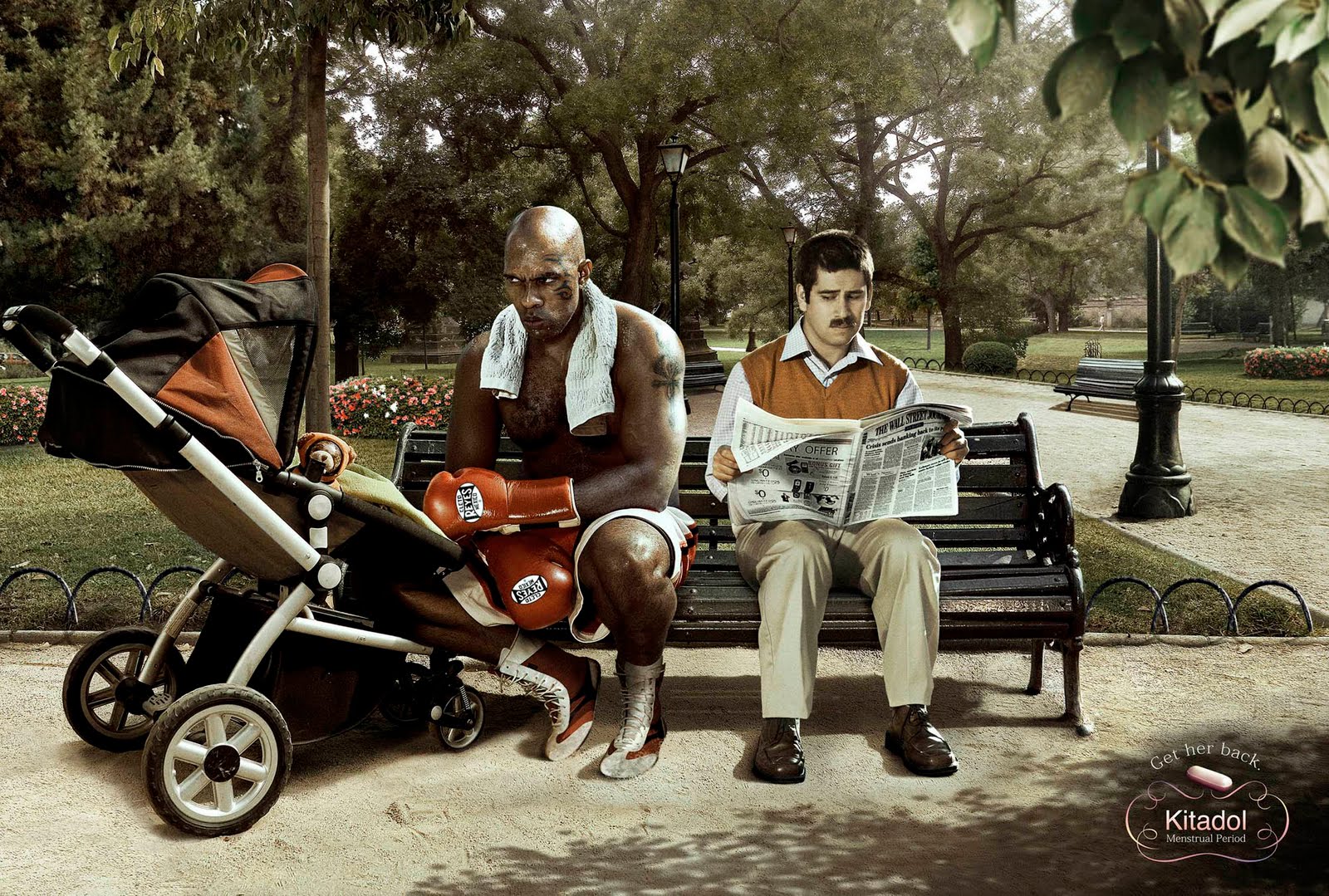
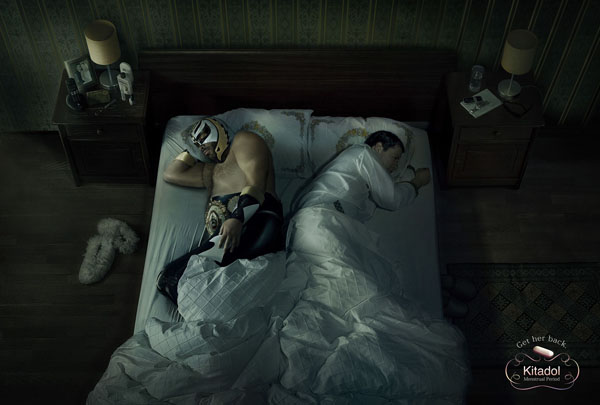
Dmitriy T.M. sent in a Chilean ad for menstrual relief pills, posted at Copyranter. The ad plays on the old trope that during their periods, women turn into savage beasts, unrecognizable compared to their normal selves. In this case, menstruating women turn into burly, hairy, enormous Vikings:

Going with the same theme, another ads for the same company depicted a woman as a large Black boxer:

And another includes a Mexican wrestler:

What I find fascinating here is the presentation of menstruation as something that masculinizes women. We’re talking about a biological process unique to women, the foundation of women’s ability to reproduce; if you were a biological essentialist, you could argue that it is, in fact, the essence of womanhood. Yet here, the message is that menstruation steals femininity, temporarily turning women into large, intimidating, unattractive, violent non-women who must be managed and tamed by the men in their lives, with the help of the right medication.