
Search results for embed

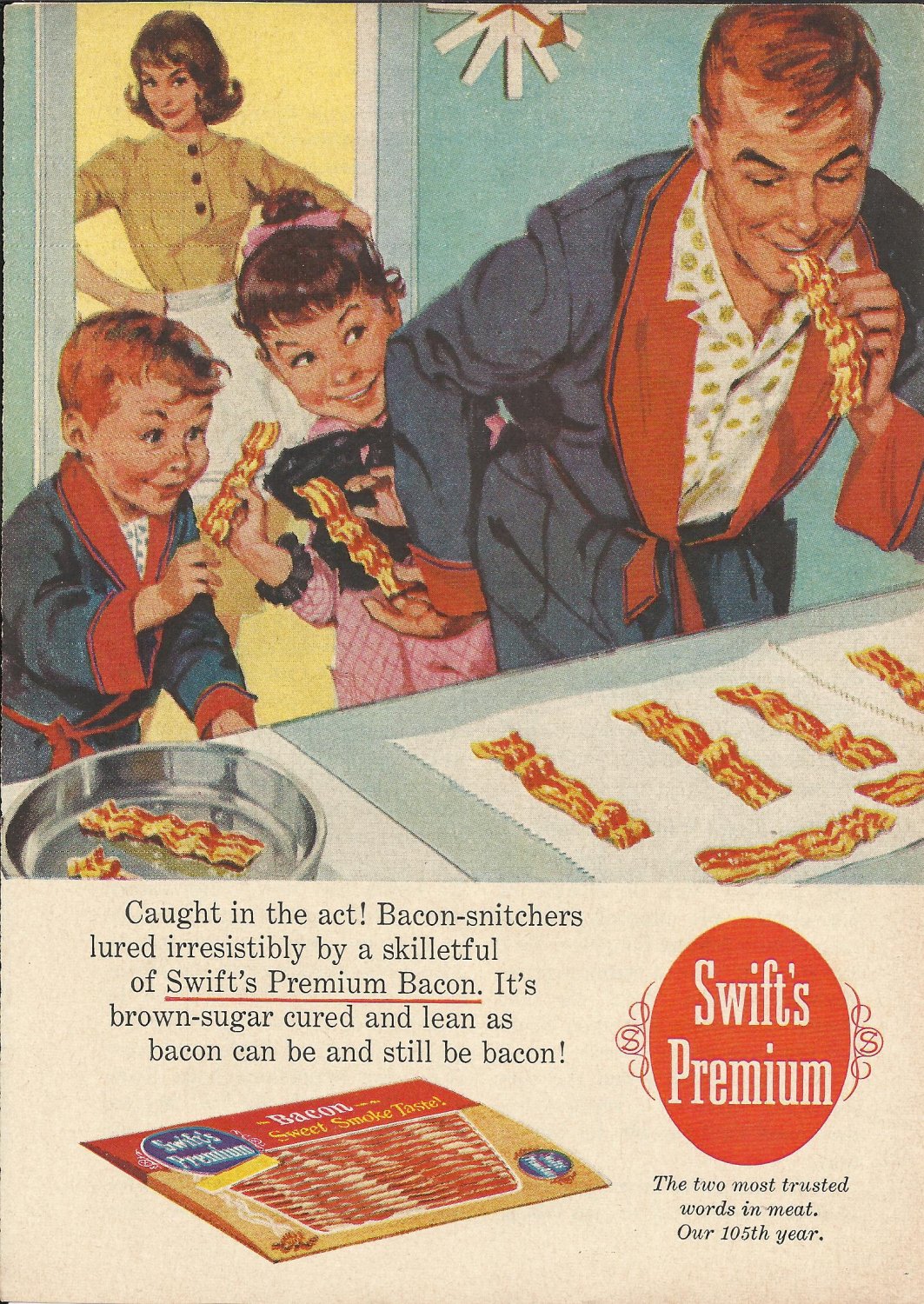
Look at this cute ad from the 1950s.  Mom is so satisfied as she watches her three children husband and two kids discover the Swift’s Premium bacon she just cooked up.  We should wax nostalgic because that kind of feminine domesticity and helpless husbandry just isn’t expected in marriage any more.  Right?
1

Wrong!  Enjoy this dizzying ad from Maple Leaf in which a woman finally gets her three children husband and two kids to be decent human beings by feeding them, you guessed it, bacon:

Thanks to Tom Megginson, The Ethical Adman, for both of these examples and the title of this post.

Lisa Wade, PhD is an Associate Professor at Tulane University. She is the author of American Hookup, a book about college sexual culture; a textbook about gender; and a forthcoming introductory text: Terrible Magnificent Sociology. You can follow her on Twitter and Instagram.

Sociology represent!  Watch Kjerstin Gruys, UCLA sociology Ph.D. student, on The Colbert Report.  Her new book is called Mirror, Mirror Off the Wall: How I Learned to Love My Body By Not Looking at It.

See also a previous guest post where she answered the question, Can a Feminist Diet?

Lisa Wade, PhD is an Associate Professor at Tulane University. She is the author of American Hookup, a book about college sexual culture; a textbook about gender; and a forthcoming introductory text: Terrible Magnificent Sociology. You can follow her on Twitter and Instagram.

Trayvon Martin was a black teenage boy. He was walking home from the convenience store when he caught the attention and ire of George Zimmerman. Perceived as a “punk” and a threat, Martin was accosted by the older man, and a physical altercation ensued. Trayvon Martin died when he was shot through the heart at close range. Though Florida’s expansive “Stand Your Ground” laws were invoked in media conversations, that defense never even entered into the trial. Zimmerman was acquitted when a jury decided he’d killed Martin in self-defense. Zimmerman has since said Martin’s death was “God’s plan.”

Some Americans believe that race was not central to this killing or to the case that followed—they have believed it from February 2012 right up until today. But ask yourself: How many times you have been stopped and harassed because you looked threatening or suspicious wearing a hooded sweatshirt? For me, an Asian American female, that number is zero.

Yes, my gender alone distinguishes me from Trayvon Martin, but my partner Mike is a white male, and he, too, can only say “Zero.” We have never been stopped nor questioned, no matter how many times we’ve pulled on our hooded sweatshirts for warmth (and, in my case, to hide sea-tangled hair) after early morning surfing.

Stopping for breakfast or to run errands, Mike and I may not look polished in our hoodies, but we’ve also never had to worry that our appearance would cause suspicion. That’s privilege. It’s such a privilege, this presumed innocence of ours, that the morning after Zimmerman was acquitted, we went ignored even while acting suspiciously. Hoodies up, we casually stopped to look at a condo for rent in an affluent beach community in southern California. We knew from the online ad that the condo was vacant, so we parked outside, walked up the stairs to the unit, and peered into its windows. We sauntered around the grounds and walked into the unlocked community laundry room and garage. Several neighbors saw us, and they smiled.

I couldn’t help but think that the scenario would have been very different if Mike and I were black. Mike and I don’t have to wear our class in order to obviate being treated like threats or criminals; we can wear hoodies and board shorts without worrying that others will be suspicious, fearful, or make assumptions about our class status. Just being “not black” affords us this benefit of the doubt. It is a privilege because it is not something we have earned, but it is gifted to us every day regardless. I have always known about my privilege intellectually, but I felt it keenly last Saturday.

That some are afforded this privilege while others are systematically denied should make us all more empathetic. People perceive and experience the same event differently, depending on visible status markers such as race, gender, age, and class. Such status markers are more than just categories, they form a “system of social practices” that organize social relations. Status markers presume difference, and so people will react to and engage with Mike or with me differently than they would with someone like Trayvon Martin, even when we’re dressed the same.

We would like to believe that we don’t make assumptions based on race or gender, but evidence proves otherwise, as this social experiment of three individuals (a white male, a black male, and white female) trying to steal a bike clearly reveals:

As the sociologist Robert K. Merton insightfully observed nearly three-quarters of a century ago, “The very same behavior undergoes a complete change in evaluation in its transition from the in-group to the out-group.” As the video above indicates, the behavior of a black male (an out-group member) is regarded entirely differently than the same behavior of a white male and white female (in-group members).

The in-group/out-group divide goes further, with grave consequences in our criminal justice system. For example, Jennifer Eberhardt’s research has shown that race affects the severity of sentences that juvenile offenders receive, even for the same crime. Just the idea of a black juvenile offender leads people to imagine juveniles more like adults. Even liberal white Americans who claim low levels of prejudice project more blame onto black boys and sentence them more harshly. As Eberhardt has shown, “race has the power to dampen our desire to be merciful.”

I don’t have children, but if I did, I don’t know how I would explain Trayvon Martin’s death or the acquittal of his killer. But even just imagining being a parent to a black son makes me feel immense empathy for the parents of young black men. Can just that simple exercise make others more aware of race and class privilege, more aware of the power they have to recognize and even challenge that privilege and its consequences? As Henry David Thoreau asked, “Could a greater miracle take place than for us to look through each other’s eyes for an instant?”

References:

Jennifer Eberhardt and Aneeta Rattan, “The Race Factor,” New York Times, June 12, 2012.

Robert K. Merton. 1968 [1948]. “Self-fulfilling Prophecy,” in Robert K. Merton, Social Theory and Social Structure, 2nd edition. New York: Free Press.

Cecilia L. Ridgeway. 2011. Framed by Gender. New York: Oxford University Press.

Cross-posted at The Society Pages.

Jennifer Lee is a sociologist at the University of California, Irvine. Her book, The Diversity Paradox, examines patterns of intermarriage and multiracial identification among Asians, Latinos, and African Americans.

Screenshot_1When white Americans are in trouble, they rarely hesitate to call the police. That’s because most of them trust the police. They rarely realize the significance during encounters with the police of their own protective “white” skin.

Many white folks also have trouble understanding the deep distrust of the police in other racialized communities. That’s because they fail to realize how quick many police officers are to harass non-white people, and how much less they tend to value non-white lives.

White Americans should listen, with sincerity and respect, to the reported experiences of others with the entrenched racist attitudes among the police, and the rampant abuse such attitudes inspire. They should also listen to the corrosive effects on non-white communities of the relative impunity with which police repeatedly harass, and murder, non-white people.

In the following short film, Stacey Muhammad’s “I AM SEAN BELL, black boys speak,” black Americans effectively explain their reasoned fear, distrust, and dismay regarding the police. I think that for starters, this film is perfect discussion material for all American classrooms. And any other gatherings that include white eyes and ears.

See a complementary post, featuring a great clip from Michael Moore, at Stuff White People Do here.

[h/t: Kai @ Zuky]

Originally posted in 2009. Re-posted in solidarity with the African American community; regardless of the truth of the Martin/Zimmerman confrontation, it’s hard not to interpret the finding of not-guilty as anything but a continuance of the criminal justice system’s failure to ensure justice for young Black men.

—————————

About himself, Macon writes, “I’m a white guy, trying to find out what that means. Especially the ‘white’ part. I live in that heart of the heart of American whiteness, the ever-amorphous ‘Midwest.'”  Macon’s blog, Stuff White People Do, is an excellent source of insights about race and racism. 


Leontine G. sent in a troubling example of the framing of children’s deviance, and their own complicity in this framing. She included two links: one to a Today show story about a 7-year-old boy who took his family’s car on a joyride and got caught by police, and one to a CNN story about a 7-year-old boy who took his family’s car on a joyride and got caught by police.  Different 7-year-olds.  One white, one black.

The white boy, Preston, is interviewed with his family on the set of the Today show.  Knowing his kid is safe, his Dad describes the event as “funny” and tells the audience that if this could happen to a “cotton candy all-American kid like Preston,” then “it could happen to anybody.”

When the host, Meredith Vieira, asks Preston why hid from the police, he says, “cause I wanted to,” and she says, “I don’t blame you actually.”  With Preston not too forthcoming, his Mom steps in to say that he told her that “he just wanted to know what it felt like to drive a car.”  When Vieira asks him why he fled from the police, he replies with a shrug.  Vieira fills in the answer, “You wanted to get home?”

Vieira then comments on how they all then went to church.  The punishment?  Grounded for four days without TV or video games.  Vieira asks the child, “Do you think that’s fair?”  He says yes.  And she continues, “Do you now understand what you did?”  He nods and agrees.  “And that maybe it wasn’t the smartest thing?”  He nods and agrees.  “You gonna get behind the wheel of a car again?”  He says no.  Then she teases him about trying out model toy cars.

They conclude that this incident just goes to show that “Any little kid, you never know what can happen…” and closes “I’ll be seeing you at church buddy boy!”

The video:

All in all, exactly what you’d expect from the Today show: a heartwarming, human interest story with a happy ending. The child is framed as a fundamentally good kid who was curious and perhaps a bit impetuous. When he has no answers for Vieira’s questions, she slots in innocent ones.  And the mild punishment is seen as incidental to the more important idea that he learned something.

This story contrasts dramatically to the CNN story about Latarian Milton, a black 7-year-old who took his family’s car on a joy ride.  I’ll put the video first, but be forewarned, it’s disturbing not only because of the different frame placed on the boys actions, but because of the boy’s embracing of the spoiled identity (apology for the commercial):

With an absolutely polar introduction of “Not your typical 7-year-old,” this story is filmed on the street. Whereas the Today show screened the chase footage in real time, this one is sped up, making it seem even more extreme.

The interviewer, off-camera, asks Latarian why he took the car. He replied: “I wanted to do it ’cause it’s fun, it’s fun to do bad things.” The interviewer asks further, “Did you know that you could perhaps kill somebody?” And he replies: “Yes, but I wanted to do hoodrat stuff with my friends.”

The interviewer asks him what punishment he should receive and Latarian offers a punishment very similar to Preston’s: “Just a little bit… no video games for a whole weekend.” In a longer version of this news story, now taken down, the camera focuses on a reporter who explains that the police plan to go forward with charges of grand theft against him.  While he’s “too young to go into any type of juvenile facility,” he says, “police say they do want to get him into the system, so that they can get him some type of help.”

The implication here, of course, is that this child is not innocent or impetuous like Preston, he’s a pre-criminal who needs “some type of help.” The sooner they get Latarian into “the (prison?) system,” the better. No cotton candy kid this one.

Unfortunately, Latarian says all the right things to make the narrative fit. He says he likes to do “bad” things, calls himself a “hoodrat,” and seems unremorseful, even defiant, for at least part of the interview (he looks a bit sheepish in the end when he finds out his grandmother is going to have to pay for the damage he did to other cars).

One way to interpret this is to say that Latarian IS a pre-criminal. That he DOES need to get into the system because he’s clearly a bad kid.  Someone inclined to believe that black people were, in fact, more prone to criminal behavior could watch these two videos and feel confirmed in their view.

But there is good evidence that people, beginning as children, internalize the stereotypes that others have of them.  As Ann Ferguson shows in her book, Bad Boys: Public Schools in the Making of Black Masculinity, black children, especially boys, are stereotyped as pre-criminals; not adorably naughty, like white boys, but dangerously bad from the beginning.  And studies with children have shown that they often internalize this idea, as in the famous doll experiment in which both black and white children were more likely than not to identify the black doll as bad (see this similar demonstration of white preference on CNN and a discussion of the original doll experiment at ABC).  So I think this terribly sad story of Latarian is showing us how children learn to think of themselves as deviant and bad from the society around them.  Latarian, remember, is seven, just like Preston.  They’re both children, but they are being treated very differently, as these programs illustrate, and it is already starting to sink in.

Originally posted in 2010. Re-posted in solidarity with the African American community; regardless of the truth of the Martin/Zimmerman confrontation, it’s hard not to interpret the finding of not-guilty as anything but a continuance of the criminal justice system’s failure to ensure justice for young Black men. Crossposted at Racialicious, the Huffington Post, and Love Isn’t Enough.

Lisa Wade, PhD is an Associate Professor at Tulane University. She is the author of American Hookup, a book about college sexual culture; a textbook about gender; and a forthcoming introductory text: Terrible Magnificent Sociology. You can follow her on Twitter and Instagram.
In the early 1990s, Bill Moyers began following two Milwaukee families, the Neumanns and the Stanleys, as they struggled to keep a foothold in the middle class in the face of economic changes that largely destroyed the city’s decently-paid, unionized manufacturing jobs. An earlier documentary, Surviving the Good Times, showcased the two incredibly hard-working families’ efforts to adapt to the new economic reality. Their stories highlight the difficulty of trying to achieve the American Dream on a series of jobs that rarely pay a living wage or offer any benefits.

And how about now? Twenty years after he first started following their lives, Moyers returned to Milwaukee to see how they had fared during the housing bubble and subsequent economic crisis. Two American Families shows the increasing economic precariousness each family experiences over two decades and the impacts this has on the opportunities they can provide their children. It’s a heartbreaking look at the effects of large-scale economic changes on individual families.

PBS has also posted interviews with a few of the family members about why they participated in the new film, as well as an update on how they’re doing since they were last filmed. And you can find a number of charts on the changing economy and its impacts on families here, and some data about Milwaukee specifically here.

Gwen Sharp is an associate professor of sociology at Nevada State College. You can follow her on Twitter at @gwensharpnv.

1Excellent Occidental College student Ryan Metzler made a great 7 minute documentary about the decline of heteronormativity. Interviewing me and several other scholars and activists about the history of marriage and the changing definition of family, he offers a quick and optimistic analysis of what it means for this country to be changing.

Lisa Wade, PhD is an Associate Professor at Tulane University. She is the author of American Hookup, a book about college sexual culture; a textbook about gender; and a forthcoming introductory text: Terrible Magnificent Sociology. You can follow her on Twitter and Instagram.

As part of an ongoing series about inequality in the U.S., tonight PBS will air a segment on the psychology of wealth: that is, how the experience of being (or feeling) well-off impacts our attitudes and behaviors.

As this video clip explains, having wealth appears to affect us in a number of ways. Having more tends to make individuals feel entitled to even more; research shows they feel less generous and more entitled to take resources (such as candy they have been told is for children coming in later), more willing to cheat, and more accepting of unethical behavior. Privileged individuals — even those whose privilege is just having Monopoly rules rigged to ensure they win in an experiment — tend to believe they deserve their privilege.

These patterns show up regardless of political orientation, affecting both liberals and conservatives. Whatever good intentions we might have, the experience of being wealthy appears to affect us in ways it may be hard for individuals to notice, making privileged people feel they deserve their position and justifying behaviors that consolidate even more advantages.

Transcript available at the PBS website. Also check out our earlier posts presenting PBS clips on Americans’ misperceptions of the level of inequality in the U.S. and the health impacts of inequality.

Gwen Sharp is an associate professor of sociology at Nevada State College. You can follow her on Twitter at @gwensharpnv.