Search results for embed

1In a really fantastic post at Shakesville, Time Machine argues that rape jokes are problematic, even when uttered by people who would never assault anyone, because they signal to actual rapists that their behavior is acceptable and normal.

A lot of people accuse feminists of thinking that all men are rapists. That’s not true. But do you know who think all men are rapists?  Rapists do.

So, when someone drops a rape joke and people laugh, the small percent of men who are rapists think that they’re surrounded by like-minded friends.  Speaking to the joke-teller:

That rapists who was in the group with you, that rapist thought that you were on his side. That rapist knew that you were a rapist like him. And he felt validated, and he felt he was among his comrades.

What’s interesting about this observation is that it reminds us that we need to be more aware of the impact of our words not on victims (as the usual argument against the rape joke goes), but on perpetrators.  This is a much-needed re-framing of the problem that we call, passively, “violence against women,” but should really be called “men’s violence against women and men.”  While both men and women are victims, the vast majority of interpersonal violence is committed by men.

The need for a shift in frame — from the survivor to the perpetrator — is also a theme of this TedTalk by anti-violence educator Jackson Katz. He uses another really interesting way of showing the linguistic erasure of men in this discussion (at 4:08).

He also dismisses “sensitivity training” because it, too, centers the survivor of the violence instead of drawing our attention to the perpetrator (sensitivity to who?).  Instead, Katz argues, men need to step up and be leaders in the fight against men’s violence against women and men.  Because violence is not a “women’s issue,” it’s a men’s issue.

Lisa Wade, PhD is an Associate Professor at Tulane University. She is the author of American Hookup, a book about college sexual culture; a textbook about gender; and a forthcoming introductory text: Terrible Magnificent Sociology. You can follow her on Twitter and Instagram.
Cross-posted at Montclair SocioBlog.

The magic of demographic knowledge is a memorable moment in John Sayles’s 1984 movie “Brother From Another Planet.” On the A train, a young man shows an elaborate card trick to the title alien, who looks like an African American but seems to have no understanding of the trick. So the magician offers another.

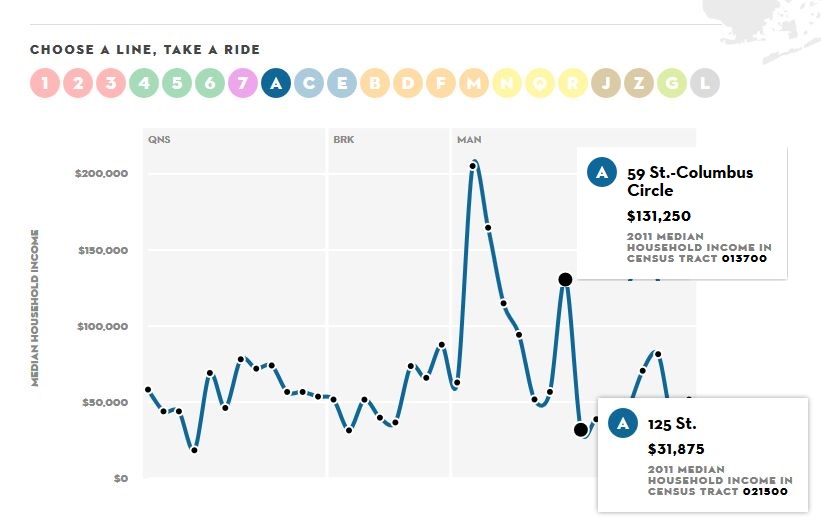
From 59th St. to 125th St. is one stop on the express.  But as the movie shows, that short ride covers a large demographic change, and it’s not just racial.  The New Yorker has posted interactive graphics showing the median income of the census tracts surrounding subway stations.

1

Take the A train one stop — from the southern border of Central Park to a few blocks above its northern border — and see median income drop by $100,000.

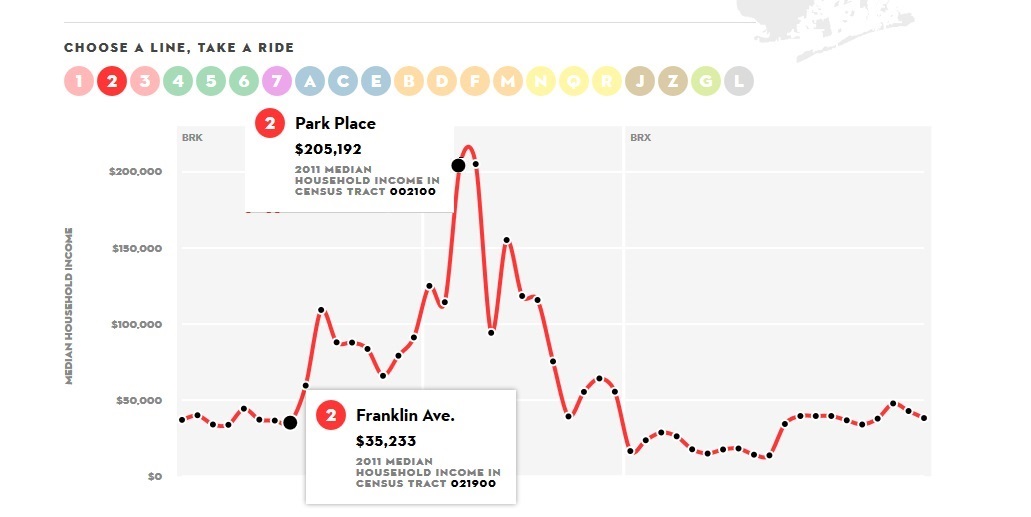
Many other lines travel the extremes of economic inequality.  My line is the 2:

2

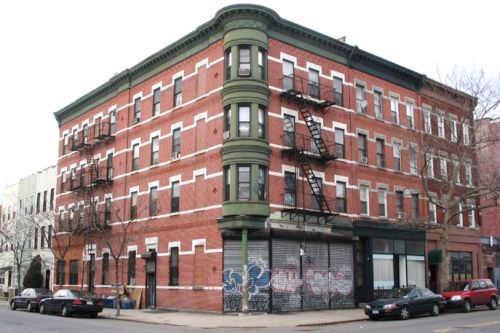
In the early morning commute, I see blue collar workers in their hoodies or rough jackets and steel-toe boots next to well-dressed people reading The Wall Street Journal.  They didn’t get on at the same stop.  The people who live in and work in the Wall Street census tract, which includes Park Place, are not on the train.  Here’s what their housing looks like:

BATTERY PARK CITY: as a pioneer. It's all Green, environmentally friendly.

And here is Franklin St., Brooklyn:

4

The subway demographic trick is not limited to New York. Here’s a time-lapse video of the Red Line of Chicago’s CTA.

Despite the social class segregation in housing, in cities like New York and Chicago, people of vastly different economic circumstances are likely to share the same subway car, at least for a few stops.  Yet I don’t get a sense of strong resentment or even envy among the have-nots (though I wish I had systematic data on this).  This is similar to the findings of Rachel Sherman, who studied how workers at high-end hotels thought of their guests.

New York and Chicago, however, are also where the rich are more likely to be liberal and in favor of redistributionist policies.  As Andrew Gelman has shown, the wealthy in rich states are far more liberal than the wealthy in poor states.  That may be partly because in rich states, the wealthy live in the large cities.  It would be interesting to see if we saw the same effect if we looked at Upstate New York, Downstate Illinois, or Massachusetts outside Rte. 128.

HT: Jenn Lena for the link.

Jay Livingston is the chair of the Sociology Department at Montclair State University. You can follow him at Montclair SocioBlog or on Twitter.

1I know this is boring and it should go without saying, but apparently it hasn’t been said enough: this idea that fembots are the perfect women is just wrong.  It suggests that men want someone over which they have perfect control.  And that’s creepy… and boring.

Here’s an example of the phenomenon (via About-Face):

That part where they make eyes at each other, he instructs the GPS to take them home, and she hits the button to heat up her (cold, hard) “seat.”  Just… ew.

Here’s another especially troubling example, sent in by a reader.  It’s some sort of ad for Play Station 3. It features a fembot being assembled and “woken.”  The narration explains that she will “cook, watch the house, take care of the kids” and be “entirely at your disposal as a sexual partner.”

At some point the fembot realizes she is being sold and expresses shock and disappointment.  The man in charge explains, “Of course you’re merchandise, baby.”  When she says that she’d thought she was alive, he labels her “defective.”  That thought was not “part of the protocol,” he says, “You’re not supposed to think at all.”  He then decides to destroy her, but succumbs to her pleas to let her “live” after all.  Again, a super creepy story about the ideal woman.

Lisa Wade, PhD is an Associate Professor at Tulane University. She is the author of American Hookup, a book about college sexual culture; a textbook about gender; and a forthcoming introductory text: Terrible Magnificent Sociology. You can follow her on Twitter and Instagram.
Fashion designer Vera Wang is known world-wide for her bridal gowns, costing from thousands of dollars to tens of thousands of dollars.  She opened her first store — in New York City — in 1990.  In 2011, her gowns started appearing at the discount David’s Bridal, for as little as $600.  Today she has a line at Kohl’s.

Why would someone who can sell a $25,000 wedding dress turn around and sell their name to a low-end department store?  The answer has to do with money, of course, but it also tells a story about class and distinction.  Typically trends start at “the top” with wealthy and high-profile elites.  Elites embrace an expensive new look, designer, or product (e.g., men and high heels) in order to distinguish themselves from the rest of the population.  The rest then imitate the trend-setters, such that the trend diffuses down throughout the population one class strata at a time.  That’s why Wang’s David’s Bridal and Kohl’s collections are called “diffusion lines.”

Vera Wang is hanging in there, but lots of trends die when they diffuse down to the working class.  If the working class can take part in the trend, the rich can’t use it to show that they’re special (which is why they sometimes defend their exclusive rights).  So it gets dropped.  Once the elites move onto something new, the process begins again.

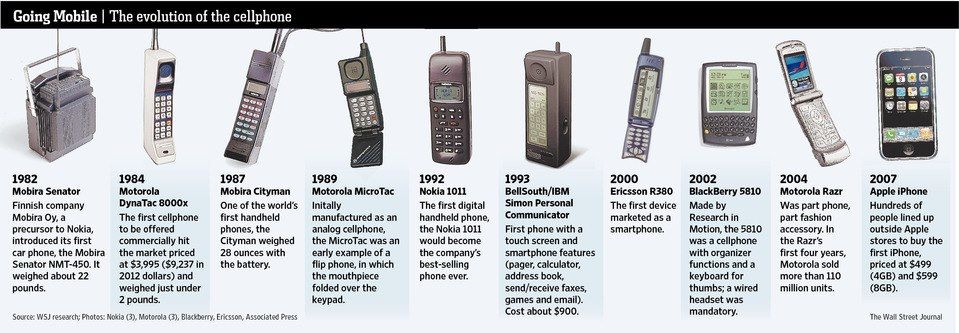
Interestingly, Whitney Erin Boesel, writing for Cyborgology, applies this process to cell phones, or what are better described as “mobile devices.”  It applies, of course, to the never-ending stream of newer, faster, shinier devices, but also to the very idea of a cell phone/mobile device.  As much as we make fun of the clunky cell phones of the 1980s and ’90s, very few people had them, so having one suggested that you were a Very Important Person. She writes:

When you picture someone using one of those cumbersome early cell phones, whom do you picture? Is it a white guy in a suit, maybe wearing a Rolex and 1980s sunglasses? Yeah, I thought so. When they first came out, cell phones — like pretty much every brand new, expensive technology — were status markers. A cell phone said, “I am wealthy, I am powerful, and I am so important that people must be able to reach me even when I am away from my home or office.”

1Today, of course, though certain models do a little to distinguish one user from another, the possession of a mobile device doesn’t signify elite status.  As Boesel points out, more people have cell phones than toilets.

Enter Google glass.

Slate reports that Google co-founder Sergey Brin is arguing that smart phones are “emasculating.”  Using masculinity is a metaphor for power, he is appealing to the elite to move on to the next technology.  A smart phone, in other words, “no longer signifies [that is a person is] a member of the power elite.”  It’s a pretty snappy — and downright Bourdieuian — way of marketing a new technology to the very people who will drive its success.

Brin starts his discussion about this at 4 minutes, 25 seconds:

Cross-posted at Pacific Standard.

Lisa Wade, PhD is an Associate Professor at Tulane University. She is the author of American Hookup, a book about college sexual culture; a textbook about gender; and a forthcoming introductory text: Terrible Magnificent Sociology. You can follow her on Twitter and Instagram.

Cross-posted at Pacific Standard.Screen Shot 2013-05-07 at 7.33.46 PM

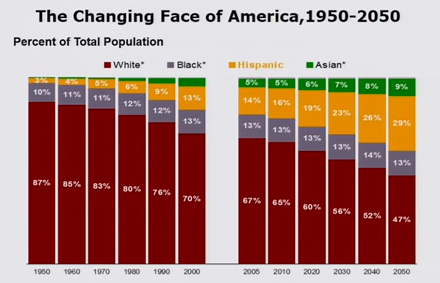
In this 20-minute video, the Pew Research Center’s Paul Taylor discusses trends in the racial/ethnic breakdown of the U.S. population over the last century. Taylor discusses a number of related issues, including the income and wealth gap, perceptions about interracial relations, and the electoral implications of the demographic changes. For instance, while Ronald Reagan once said Hispanics are “Republicans who don’t know it yet,” there’s no evidence that they’re any closer to realizing it. As Hispanics and Asians make up an increasing proportion of the voting population, old electoral strategies based on winning most of the White vote are no longer sufficient to win a national election.

I’d skip the introductory remarks and start just after the 2-minute mark.

Gwen Sharp is an associate professor of sociology at Nevada State College. You can follow her on Twitter at @gwensharpnv.

1I was so honored to be invited to give the AKD Induction Ceremony Address for the University of Akron this year.  It was an opportunity to give a speech about something in which I deeply believe: the awesomeness of sociology.  So, here it is!

My 13 minute ode to the discipline, featuring (an attempt at) self-deprecating sociology humor and a few personal confessions regarding my own rough start with sociology:

Lisa Wade, PhD is an Associate Professor at Tulane University. She is the author of American Hookup, a book about college sexual culture; a textbook about gender; and a forthcoming introductory text: Terrible Magnificent Sociology. You can follow her on Twitter and Instagram.
Last week the U.S. Congress made headlines when it quickly adjusted the sequester cuts that affected air traffic control. How quickly?  Parts of it were hand-written (via The Daily Show):
1 The move was interpreted as one meant to a certain class of voters, but it was also as a purely self-interested move, since Congress members fly quite frequently.

Riffing on this, Bloomberg Businessweek put together a short video about a little-known congressional perk: free and convenient parking at Reagan National Airport.

This little perk, saving congress members time and $22-a-day parking fees, is a great example of the way that privilege translates into being “above society.” The more power, connections, and money you have, the more likely you are to be able to break both the legal and social contract with impunity. Sometimes this just means getting away with breaking the law (e.g., the fact that, compared to the crimes of the poor and working classes, we do relatively little to identify and prosecute so-called “white collar” criminals and tend to give them lighter or suspended sentences when we do). But these perks are also often above board; they’re built into the system. And who builds the system again?

In other words, some of the richest people in the world get free parking at the airport because they’re the ones making the rules. I like this as a concrete example, but be assured that there is a whole universe of such rules and, like this sudden revelation about free parking, most of them go entirely unnoticed by most of us most of the time.

Lisa Wade, PhD is an Associate Professor at Tulane University. She is the author of American Hookup, a book about college sexual culture; a textbook about gender; and a forthcoming introductory text: Terrible Magnificent Sociology. You can follow her on Twitter and Instagram.

1Research has shown that college students largely think that asking for sexual consent — “Do you want to have sex?” — “ruins the mood.”  This is partly because it violates their sexual script, the norms and expectations that guide sexual encounters.

If explicit consent violates the sexual script, then students are left trying to discern consent from more subtle and implicit verbal and non-verbal cues.  I did a research project to determine how they do this, interviewing 19 college students about their perceptions of sexual consent in popular television programs. 

I discovered that students often interpreted the same scenes dramatically differently. For example, I showed them this scene from The Vampire Diaries:

Eleven of my 19 respondents brought up the issue of verbal consent.  Five said the verbal interchange in the scene indicated consent; six said it did not.  Their contrasting perceptions focused on the male character’s statement, “Let’s get out of here.”  The five students who saw the scene as consensual were inclined to classify the declaration, “Let’s get out of here” as the moment where verbal consent is given.  For example, Hannah said:

…like I mean he doesn’t outright say “do you wanna have sex” but he says “do you want to get out of here” and she’s like “yes.”  That’s like the only one where there’s like an actual yes! [giggling] I mean like a verbal yes.

Hannah said the scene indicated consent because she equated “getting out of here” with sex.

In contrast, Natalie and five others disagreed with Hannah and those who considered the verbal exchange between Tyler and Caroline to be a form of verbal consent:

No, I would say, there was like no talk of consent, really… In the Vampire Diaries one, by him saying like, “let’s get out of here,” there might be an assumption associated with that and then her saying, “Okay,” like could be consent, quote, unquote.  But, I don’t really think that qualifies, either.

Natalie believed there was a correct way to obtain verbal consent.  When I asked her what would make this scene consensual, Natalie replied, “Basically saying ‘Do you want to, do you want to go through with this?’—something like that.”  Obviously, Natalie viewed consent as a different kind of verbal question.

The differences in these responses to The Vampire Diaries scene are striking. While verbal consent is often held up as the gold standard, I found disagreement as to exactly which statements constitute consent.  This disagreement sets the stage for serious miscommunication about students’ sexual intentions.  Some students interpret a phrase such as “Do you want to leave?” as “Do you want to leave this party and have sex at my house?” while other students believe that only a phrase such as “Do you agree to have sex with me?” communicates sexual consent.

Nona Gronert will graduate from Occidental College this May with a degree in Sociology and Spanish Literary Studies.  She aspires to become a professor of Sociology.