Search results for embed

In a recent post I discussed ways in which companies market beauty products to men, who traditionally aren’t supposed to worry about things like their pores. Here are a couple more examples.

Axe has a body scrubber for men (pointed out by akamarkman):

To differentiate it from girly body scrubbers, it’s called the Axe Detailer Shower ToolAxe Shower Scrub (or body wash, if you’re female) comes in varieties including Snake Peel, Skin Contact, and Glacier Water (scroll a little less than halfway down to see the varieties).

Here is an ad for the Detailer Shower Tool that shows a man being treated like a car in a car wash (cleaned by futuristically-attired women):

Gillette 2-in-1 Body Wash helps men prevent skin dehydration. And that helps them get hot girls at work:

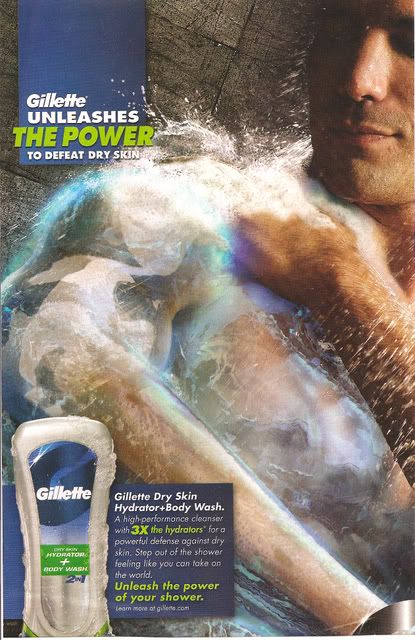
This Gillette ad tells men to unleash “power” to “defeat dry skin:

Notice how buff he is. We also learn that this body wash is a “hydrator” (not a moisturizer) and that it’s “high-performance” to provde a “powerful defense” that leaves you with the sense you “can take on the world.” So macho!

Andrew F. sent in a link to a post at DirectDaily about the Axe Schedule ad. In it, we see that a set of dorm rooms is overlaid with a calendar, the idea being that you get a different girl each day:

preview_600_424


Gwen Sharp is an associate professor of sociology at Nevada State College. You can follow her on Twitter at @gwensharpnv.

CORRECTION/CLARIFICATION: I am reposting this because I want to make clear that a couple of things that people picked up on in the comments are MY mistakes/confusing wording, not Jackson Katz’s. First, in regards to the Rambo movies, I was confusing Rambo:First Blood Par I, which came out in 1982, with Rambo:First Blood Part II, which came out in 1985, which is what Katz is quoting in the movie. I just googled the movie to find the year it came out and didn’t notice it was for Part I, not Part II. I have corrected that below.

As for the Terminator image, that is entirely my fault. I could not find the exact image Katz used in the documentary, though I searched for quite a while. I just put up an image I meant to be representative of both Terminator movies, and the one I used, as the commenters point ou, was not a good example of what I was saying. Since I can’t find the image Katz used, I have taken the Terminator image out of the post.

I just wanted to a) correct those two things and b) make it clear that they were my mistakes, not Katz’s.

*****

In the documentary Tough Guise: Violence, Media & the Crisis in Masculinity, Jackson Katz discusses how images of masculinity in pop culture have changed over time, and particularly how in the 1980s and 1990s images of male heroes got larger and more menacing, as well as hyper-violent. He uses Humphrey Bogart, Clint Eastwood, Sylvester Stallone, and Arnold Schwarzenegger as examples. I’m basing my discussion of the images from movies on Katz’s analysis.

In this image of Humphrey Bogart (found here) in The Maltese Falcon (1941), his gun is very small compared to his body. His body language is not particularly imposing or threatening. Keep in mind this was during World War II (though the U.S. had not joined yet) and that machine guns had been invented during the Civil War. So Humphrey Bogart conceivably could have been shown holding some sort of automatic weapon instead of a small handgun.

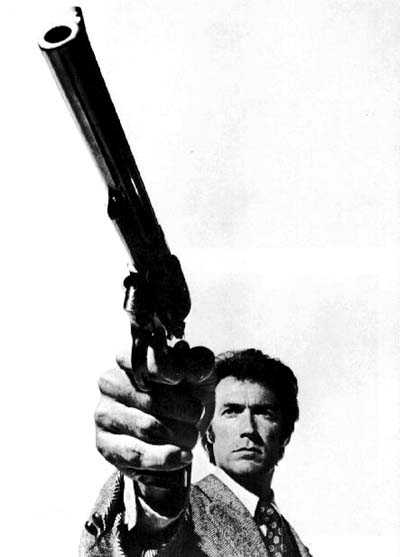
Then we have Clint Eastwood in Dirty Harry, from 1971 (found here). The gun has gotten much bigger and the body posture a bit more threatening.

And in 1985 we get Rambo:First Blood Part II (found here), a military revenge fantasy in which a Vietnam vet gets to finish the war the U.S. military wasn’t “allowed” to win, presumably because of weak, feminized elements that controlled the government. Stallone’s body is huge and muscular, and the gun has gotten larger and more deadly.

Katz attributes these changes in images of masculinity to a growing concern in U.S. culture that we are somehow being “feminized” and becoming weak. He argues that the loss in Vietnam (or lack of an outright win, if you prefer) as well as political and economic gains by women and non-whites caused a cultural panic about the status of white men. As these men were supposedly losing power and status in everyday life, cultural images of them emphasized strength, power, and aggression as a version of ideal masculinity.

Here is a clip from Tough Guise:

And here’s a clip that takes the Tough Guise intro but adds some other images:

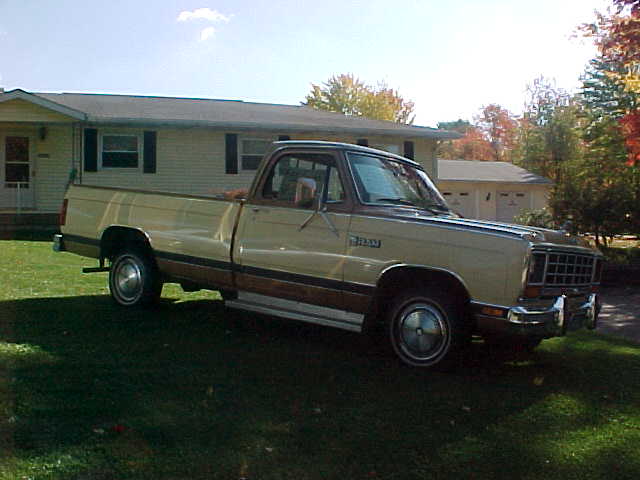
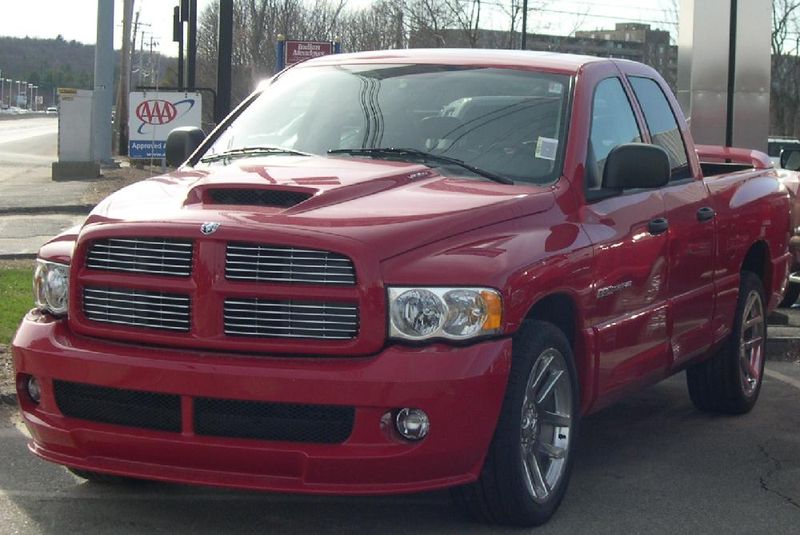
I was thinking about this because when I was in Oklahoma, I was around a lot of trucks, and specifically, a lot of old farm trucks. And one day when I was standing next to an old Dodge Ram, it hit me how much less…I don’t know…imposing it was than newer trucks. It seemed like a cute little toy truck. Here’s a picture of a 1985 Dodge Ram (found here):

The 2005 version of the Dodge Ram (found here):

Looking at my family’s old farm trucks (and we’ve got a collection of rotting, rusting trucks dating from the 1950s on; I did not post pictures of our trucks because my grandma would kill me for exposing our farm junkiness to the world), I kept thinking, “We used to haul cattle with that?” or “That was considered sufficiently masculine at one point?” And the answer is, yes. Yes, they were.

Now, I’m certain that a lot of the redesigns had to do with advances in safety and efforts to improve fuel efficiency (by making the truck body more rounded, for instance). But there also seems to be a pattern in trucks today to design their headlights and grills to look sort of “mean,” if you will–like they’re snarling or growling.

I’m not necessarily saying there’s a connection between Katz’s work and the way trucks have been redesigned to look meaner and more aggressive…but it just got me thinking.

Of course, as a farm kid, what strikes me about trucks is the way the newer designs make them less functional for the types of things you see people doing in truck ads. While the cabs have gotten larger, making room for more passengers (that is, more like a car), the beds have gotten smaller, so you can’t carry as much (or as long of) stuff in them–and carrying stuff in the back is what you supposedly need a truck for. Yes, you can still stick more stuff in the back of, say, a new Dodge Ram than in a lot of cars, but I’m just sayin’. (Also, you’d be shocked at how much stuff I can get in the back of a Honda Civic if I lay the seat down and am really motivated. And my mom once brought a 130-pound calf home in the backseat of a car–I had the fun job of trying to keep him from attempting to crawl into the front. And we had a woman in my hometown who used to haul pigs around in the backseat of her Caddy.) A lot of things we used to haul around in the back of our trucks wouldn’t fit in the beds of new trucks, or you couldn’t fit nearly as much of them. And of course the majority of people who buy trucks for their big motors aren’t doing the types of things (driving through extremely rocky or muddy country, hauling trailers full of cattle, etc.) that require such a huge motor in the first place. So why not just buy a car?

Just some thoughts that struck me while hanging out on the farm.

Maybe you’ve never noticed, given that feminists are always talking about the ladies, that there are lots and lots and lots of things that (real) men are not supposed to do. For instance: drink fruity drinks, wear pink shoes, look at their fingernails the wrong way, enjoy a “chick flick,” like a girl, like cats, prefer not to fight, care about grades, eat salad… should I go on? You get the gist.

Comparably, women have got it good. We’re allowed to knit and play soccer, be a mom and be a lawyer, take dance and karate, wear skirts and pants!

How do we make sense of this? Crash course: Femininity is just for chicks. When men do feminine things, they are debasing themselves. Masculinity is awesome and for everyone. When women do masculine things, they’re awesome. This is sexism: Masculinity rules, femininity drools. Men are encouraged to stay away from femininity, so their individual choices are constrained, but they also are staying away from something debasing. In contrast, women are required to do a least some femininity, so women are required to debase themselves, at least a little bit, even as they are given more options.

I say this all to introduce these two hilarious examples of men and how they have to worry about doing masculinity (sent in by Vesko J.).

How To Give The Perfect Man Hug

How I Sit On The Bus

Lisa Wade, PhD is an Associate Professor at Tulane University. She is the author of American Hookup, a book about college sexual culture; a textbook about gender; and a forthcoming introductory text: Terrible Magnificent Sociology. You can follow her on Twitter and Instagram.

The things here trivialized… not trivial. This ad made me shudder more than once. If you’ve ever been stalked, peeped, or sexually assaulted, you may want to skip this one.

It’s an ad for a cell phone kind of like the iphone (sorry iphone people, I’m sure it’s nothing like the iphone).

The phone doesn’t appear to be sold in the U.S. Via AdFreak.


Matt W. sent us links to a whole set of very popular videos on the theme “My New Haircut.” Here is the original, which, as Matt says, is “mocking popped-collar ‘bro’ masculinity.” Note: the language is not safe for work.

[youtube]https://www.youtube.com/watch?v=Q5QJ9i_o5vo[/youtube]

After the first video came out, people began making other versions, such as the “Jewish edition” and the “Senior Citizen edition.” As Matt points out, “It seems to be a mix of people of different ethnicities making fun of themselves/how they’re perceived, and outsiders indulging in outright bigotry.”

Asian edition:

Mexican edition (sadly, my rural poor-white upbringing led me to think, in response to him saying he is wearing a wife-beater shirt, “That’s not a wife-beater, that’s a muscle-shirt. Not the same thing.”). His Spanish accent sounds fake to me, but I might be totally off there. Also, the video is by “Mr. Fagg” productions.

Gay edition. The actors say, “For all you haters…we’re not gay were just acting as you can probably tell by how ridiclous we act.”

Jewish edition:

Black edition, featuring drug use and general criminality:

There are tons of others, but you get the point. If you watch any of these, the sidebar will have lots of other editions.

Whether or not you could use these videos in classes probably depends a lot on where you’re at and how much trust you’ve built up with your students. They might be interesting for discussions of humor–are there things that are funny when some people say them but not when others do? Does it make a difference whether a person using stereotypes is a member of the group being laughed at or not? When is humor being used to point out and undermine stereotypes, and when does it just reinforce them? Who has the authority to decide these things?

Thanks, Matt W.!

Gwen Sharp is an associate professor of sociology at Nevada State College. You can follow her on Twitter at @gwensharpnv.

Brook M. brought our attention to Al Jazeera’s English-language coverage of Arab women athletes training for the 2008 Olympics. They include a Moroccan runner, Israeli Arab boxers, a Qatar race-car driver, and Egyptian soccer players. Among other topics, the segments address opposition the women have faced being female Arab Muslims in sports, especially concerning their clothing. The first segment is about 11 minutes long; the second one is about 12 and a half.

One thing I like about these videos is they show the diversity of Arab Muslim women, a group often depicted as a homogeneous, passive, subordinate group all wearing veils. Some of the women in the clips do not cover their hair while some wear hijab. Among those who wear hijab, some cover every bit of their hair, others do not; some head scarves are lace and fairly transparent, while others are dark and solid. The women talk about how they feel about mixing religion and sports and being female athletes, and again, they differ in their perspectives.

While the sports element is interesting, seeing the diversity among Arab women, as well as Arab women actively discussing religion and resisting gender roles, may be very useful for students who usually encounter portrayals of Arab women as completely oppressed victims of a sexist culture/religion, so I can imagine using it in classes that aren’t about sports.

Thanks, Brook M.!

Miguel pointed out that AskMen.com collected a list of “worst male-bashing ads,” all of which represent men as morons or useless oafs. Here are some of them:

1st for Women, a South African auto insurance company that only insures women:

A Domino’s ad in which the wife laughs at her husband’s sexual overtures:

A Sony Cyber-shot ad that depicts men as a horse’s ass (it’s the first clip; for some reason there are some FedEx clips afterward):

Men as easily manipulated by flirty women:

These might be useful for a discussion of masculinity and portrayals of men as idiots and morons, especially regarding family life, which serves to reinforce the idea that men can’t be trusted to cook or clean or care for children because they’ll just mess it up. Although it doesn’t come up in these ads, it’s also good to bring in the class element we see in shows like “King of Queens,” “The Simpsons,” “According to Jim,” and “Married with Children,” which all have working-class, generally pot-bellied idiot husbands married to smart, gorgeous women who sigh and put up with their childish behavior.

Also see the earlier post of a Roomba ad that portrays the husband as a literal ass (this ad also made it into the AskMen list).

Thanks, Miguel!

Gwen Sharp is an associate professor of sociology at Nevada State College. You can follow her on Twitter at @gwensharpnv.

Daniel F. (who has a blog here) sent us this Temptation cookie ad from Mexico, which plays on the idea that men fear independent, strong women:

Daniel’s translation:

Host: Gentlemen, what we feared has happened. You have the new Mexican woman; she is more independent and gives more importance to what she wants.
First man: But, does she cool our beers?
Host: No, never again. And that’s not all. She also wants us to take our children to the pediatrician.
Second man: What’s that?
Host: Pediatrician is the doctor for kids.
Second man: No, the other thing, “children.”
Host: Children are the little people who call us dad.
Third man: And what is that she has in her hand?
Host: This, my friends, is the new Temptation cookie, because the new Mexican woman has her pleasures without guilt and, what’s worse, she doesn’t share.
Woman: Gentlemen, I’m leaving. I have things to do.
Narrator: There’s a new woman and she has new cookies.

The ad also connects sex and food and, in fact, replaces sexual pleasure (and men) with food, a theme Jean Kilbourne mentions in “Killing Us Softly 3”–that women are encouraged to use food to replace sex or console themselves when they have romantic troubles.

It’s also interesting that the ad plays on the idea of old-fashioned Mexican men who expect women to serve them.

Thanks, Daniel!