
Search results for embed


Alicja W. told me about this Barbie commercial from 1959 (which may be the first Barbie TV commercial, but I’m not positive about that) in which girls are encouraged to identify with, and aspire to, Barbie’s charm and beauty:

It’s not just that Barbie is fun to play with; she’s overtly presented here as a role model for girls, who can dream of someday being “exactly like” her–petite, popular (“at parties she will cast a spell”), and beautiful. And until they can actually become that person, they can “make believe” they’re Barbie. It’s a great example of how toys can be an important part of childhood socialization. In this case, it’s not just a set of behaviors girls were encouraged to mimic (caring for a doll, for instance); the toy is presented as something they should actually aspire to be.

The Texas Board of Education is currently holding hearings about textbook standards and changes they want publishers to make for their texts to be adopted. Texas and California have great influence over what textbooks contain since they are such enormous markets; while the standards are only specific to each of them, very similar (or identical) versions of the texts are then sold to other states as well.

Here is a clip of standards advisor Don McLeroy explaining that textbooks should recognize the fact that women and racial minorities got more liberties because the majority gave it to them (from TPM):

Technically, he is exactly right: it did take a majority of votes in Congress to pass the Civil Rights Act, and the majority then (and now) was White (men). But to say that the majority did it “for the minority” erases an awful lot of struggle and organizing on the part of disadvantaged groups, as well as the foot-dragging and opposition so many members of the majority engaged in to try to prevent such changes. Before men “passed it for the women,” both women and men worked for decades to get women the vote, often being harassed and even jailed as a result. But to hear him describe it, you’d think the majority just happily passed these types of bills, with maybe just a tiny bit of prodding from minorities.

Here’s a clip of Barbara Cargill explaining that we need to take “negative” elements of American history out of textbooks and focus more on “American exceptionalism”:

Her opposition to the idea that the U.S. ever used “propaganda” is somewhat undermined by her blatant effort to rewrite history texts to be what, if it happened in another nation, we’d call propaganda.

Using maternal mortality, Hans Rosling illustrates the uncertainty in different ways of measuring variables:

Found at GapMinder.

—————————

Lisa Wade is a professor of sociology at Occidental College. You can follow her on Twitter and Facebook.

Jean Piaget, a psychologist who published his most influential works from the late 1920s through the 1950s, is most known for his theory of stages of cognitive development. He suggested a four-stage model that children go through as they develop more complex reasoning skills.

Children start out in the sensorimotor stage, which lasts until they’re roughly 2. They have no sense of themselves as individuals, obviously, and wouldn’t recognize their hand as “theirs.” They aren’t afraid of heights or touching something hot because they can’t grasp the idea of falling or something being hot–those ideas are too abstract.

Here’s a video that illustrates some of the limits of reasoning at this age:

In the preoperational stage (Piaget said it lasted from around age 2 until about 7), kids start being able to grasp symbols. For instance, they can draw a series of squares with a triangle on top to represent a house. They also start to learn the alphabet, which is, of course, the set of symbols we use to read and write.

On the other hand, they don’t understand abstract concepts like amounts, speed, or weight. In one of Piaget’s most famous experiments, he showed that children at this stage can’t comprehend that if you pour liquid from a short, wide glass into a tall, narrow glass, it’s still the same amount:

By the concrete operational stage (roughly 7-12 years old) kids comprehend ideas like weight, amount, and speed, and can understand that the amount of liquid in the two glasses is the same:

They can also understand causal relationships, though not necessarily explain the reasoning behind them. Here, the younger kid says what would happen if you hit a glass with a feather based on what he knows about feathers, whereas the older child reasons from the previous statement and answers according to the logic proposed (despite it being obviously inaccurate):

Finally, Piaget said that in the formal operational stage (after about age 12) kids can understand abstract concepts and reason logically. If you ask them what “justice” means, they can explain it. The girl in the last video, who reasoned from the previous statement (which had been presented as true), illustrates formal operational thinking.

Of course, there are questions about Piaget’s model (described in Kimmel and Aronson, 2009, Sociology Now). Do we really only go through each stage once? Might we have to go through some of them again when we hit new life challenges or milestones? Do we have to completely master one stage before we can progress, or is it possible to have some overlap? Are these stages universal? Would we expect childhood mental development to occur in the same way in a society where people are middle-aged by 20 as they would in one where they aren’t middle aged until 35 or 40? Might the fact that kids in some societies are given more “adult” tasks at a young age affect their mental development?

Of course, another issue comes up about the formal operational stage…Kohlberg and Gilligan (1971, “The Adolescent as Philosopher,” Daedalus, p. 1051-1086) estimated that about 30% of people in the U.S. never actually develop advanced abstract reasoning skills. I will make no further comment on that.

Gwen Sharp is an associate professor of sociology at Nevada State College. You can follow her on Twitter at @gwensharpnv.

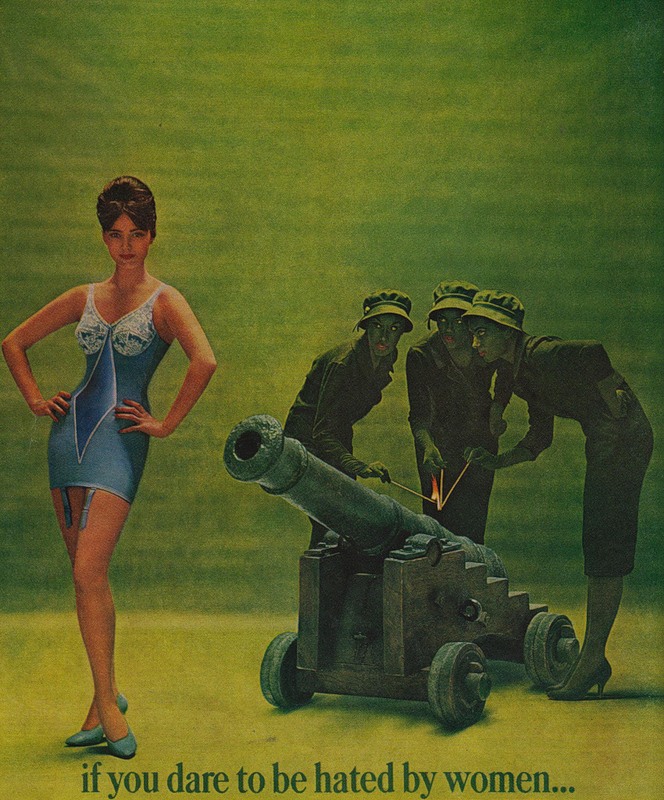
From Vintage Ads, another great example of the propagation of the stereotype that women are jealous of and hateful towards one another:

0_2c7f5_85a5b5d3_XL

The ad reminded me of the Pantene commercials from the 1980s with the slogan “Don’t hate me because I’m beautiful…”  The real message not being “Don’t hate me because I’m beautiful…” but, “Don’t hate me because you could be beautiful too, and if you can’t, well then I suppose you’re going to have to hate me”:

More examples of this meme here, here, here, and here.

I discuss the phenomenon, and how sexism (NOT estrogen) produces this situation, in a post about Battle of the Bods.

—————————

Lisa Wade is a professor of sociology at Occidental College. You can follow her on Twitter and Facebook.

Brian Safi offers a fun tripartite typology of (mostly) gay men in advertising: (1) homoeroticism as simultaneously hilarious and disgusting in ads aimed at straight men, (2) coded gay cues in ads aimed at a general market, and (3) parallel ads, differing only slightly from each other, playing in straight and gay media. The second set of ads = especially hilarious. Enjoy.

—————————

Lisa Wade is a professor of sociology at Occidental College. You can follow her on Twitter and Facebook.

Lisa Wade, PhD is an Associate Professor at Tulane University. She is the author of American Hookup, a book about college sexual culture; a textbook about gender; and a forthcoming introductory text: Terrible Magnificent Sociology. You can follow her on Twitter and Instagram.

Kelebek sent in an Australian commercial for Brut deodorant. In it, a male robot transforms various objects (a motorcycle, a drink) into “better” versions, more fitting of a super macho robot. One of the improved items is a Barbie doll/woman:

The woman is, quite literally, an object, to be “modified,” and then posed with his other belongings. And as we see, being “brutally male” is associated with drinking a lot, driving powerful vehicles, having hot women, and probably engaging in the type of risky behaviors that partially explain why men in many industrialized nations live shorter lives than women.

The commercial was pulled from TV by the Advertising Standards Bureau after they determined it was offensive to women. The commercial had to be recut…so that the woman isn’t one of the “objects” in the back of his vehicle at the end. The scene where he modifies the Barbie to be a live woman, and the phrase “reject, modify object,” weren’t removed. And:

Brut brand manager Deane De Villiers defended the ad, saying the robot carried the woman with the utmost of respect “as one would carry one’s bride”.

Yes. If your bride were an object you created to your very own specifications.

And for fun, read the comments to that Sun-Herald article.

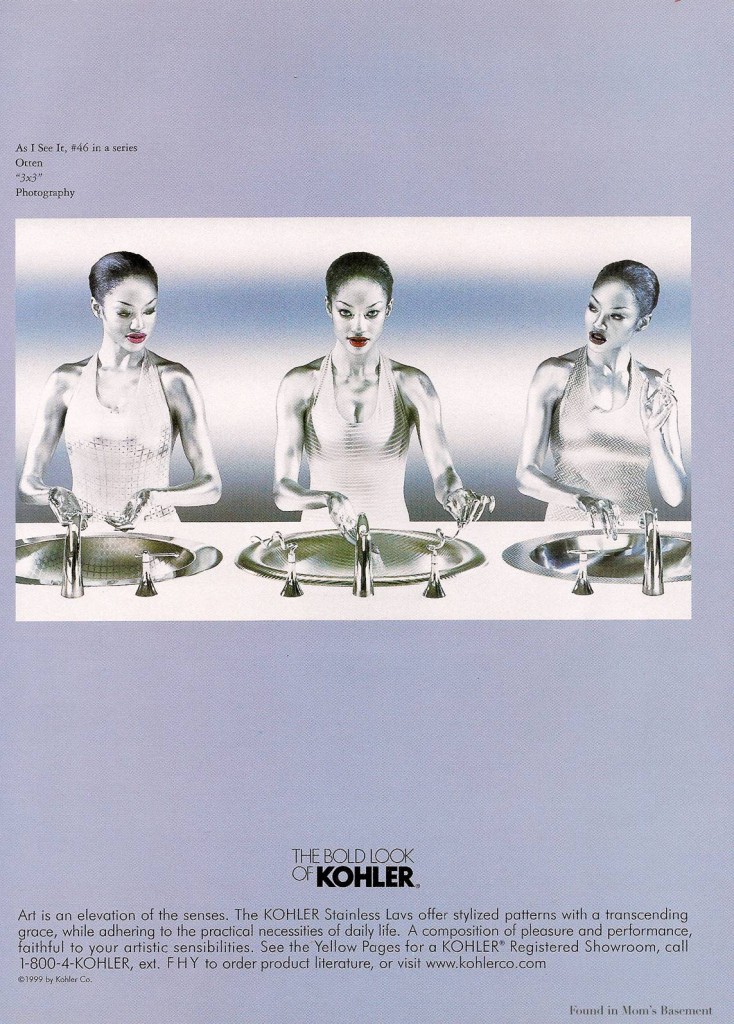
This ad from 2000 (found here) is an opportunity to differentiate between types of objectification, in its most literal sense.  Instead of making a product into the shape of a woman (see here and here), the woman is made into the product.

Picture1

See also this post on where there’s a similar example in which a woman’s curves are meant to reflect the curves of a kitchen counter, this one in which a woman is made into a glass of beer, and, to a slightly lesser extent, this ad in which a white and black woman are used to represent a boring and tasty beverage respectively.

—————————

Lisa Wade is a professor of sociology at Occidental College. You can follow her on Twitter and Facebook.