Search results for embed


The “Got Milk” campaign is funded by the California Milk Processor Board, a marketing organization funded collectively by California dairies.  In a recent comment thread, Adam linked to the clip below in which ABC does a segment about the awesomeness of milk.  It’s a great example of the way that the news media in not independent of business.

UPDATE! Abby, in the comments thread, linked to another great example:

—————————

Lisa Wade is a professor of sociology at Occidental College. You can follow her on Twitter and Facebook.

Hellman’s Mayonnaise, a brand owned by the multinational corporation Unilever, currently has an “eat local” campaign in Canada. As part of it, they put out this video (found at BrandFreak) highlighting how much food Canada imports:

Hellmann’s – It’s Time for Real from CRUSH on Vimeo.

What I find odd here is that Unilever owns a large number of food brands (as well as non-food ones), including Hellman’s, Wishbone, Ben & Jerry’s, Bertolli, Lipton, Knorr, and Slim-Fast (check here for some images of organic brands owned by Unilever). The Lipton web page notes that Lipton is “…making a big splash in the global beverages market…” The main Unilever food page announces,

We have the heritage and knowledge to move effortlessly between cuisines and countries.

So on the one hand, according to wikipedia,

The company promotes sustainability and started a sustainable agriculture programme in 1998.[7] In May 2007 it became the first tea company to commit to sourcing all its tea in a sustainable manner, employing the Rainforest Alliance, an international environmental NGO, to certify its tea estates in East Africa, as well as third-party suppliers in Africa and other parts of the world. It declared its aim to have all Lipton Yellow Label and PG Tips tea bags sold in Western Europe certified by 2010, followed by all Lipton tea bags globally by 2015.

Covalence, an ethical reputation ranking agency, placed Unilever at the top of its ranking based on positive versus negative news coverage for 2007.

Those are admirable goals by any standard, and food/globalization activists often push for that type of responsible corporate citizenship.

On the other hand…Unilever owns 400+ brands, many of which are dependent upon global sourcing and distribution; they in no way contribute to or encourage local eating, and if people really began eating locally, Unilever’s market share would suffer dramatically. And there are questions about how well it lives up to its sustainability goals.

We’ve seen these contradictions from Unilever before: the company owns both Axe and Dove, brands that are often marketed in ways that conflict with one another.

One way to look at this is that Unilever is making efforts to encourage sustainability and other policies that many critics would appreciate, within a global marketplace that constrains their efforts. The more cynical view is that such contradictory messages in effect allow corporations to “have it all.” Don’t care about sustainability, working conditions, and so on? Chances are you’re buying Unilever brands by default. But if you do care about such issues, you can feel good about buying at least some Unilever brands–those that have a marketing strategy designed to appeal to you. And doing so in no way threatens Unilever’s overall profitability.

So, readers, whatcha think?


This clip from The Daily Show nicely illustrates how ridiculous and utterly meaningless the statistics we encounter can be:

This probably goes without saying, but there are multiple problems here:

1. Viewers of these shows are a self-selected group who are quite likely watching because they agree with the hosts to some degree, so it wouldn’t be surprising they’d agree with the hosts’ views.

2. Viewers who care enough to text are an even more unusual group, likely to be those who feel most passionately about an issue.

3. Only those people watching the show and are able to text right then are able to vote.

4. The wording of the questions is clearly intended to lead to a particular answer, using leading phrases like “are you outraged,” which responsible social scientists would never use–any question that uses something along the lines of “don’t you agree” or “wouldn’t you say that” makes it more likely the respondents will, indeed, agree with the point.

5. The hosts actively cajole viewers to give a specific answer if they aren’t getting as many of that answer as they wanted.

Of course, the hosts aren’t trying to present factual, useful information and almost certainly know very well that they’re manipulating questions to get results that will appear to overwhelmingly support their position. But we’re inundated with “statistics” such as these every day that are completely meaningless, but many many people don’t know how to evaluate them. This little clip shows some of the things a person should look for as an indication that a number was created to support a particular viewpoint and should be viewed with extreme skepticism, if not dismissed altogether.

Gwen Sharp is an associate professor of sociology at Nevada State College. You can follow her on Twitter at @gwensharpnv.

Hans Rosling illustrates the change in the percentage, but not the number, of people living in extreme poverty:

Found at GapMinder.

Lisa Wade, PhD is an Associate Professor at Tulane University. She is the author of American Hookup, a book about college sexual culture; a textbook about gender; and a forthcoming introductory text: Terrible Magnificent Sociology. You can follow her on Twitter and Instagram.

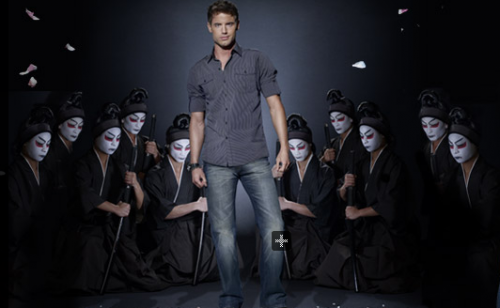
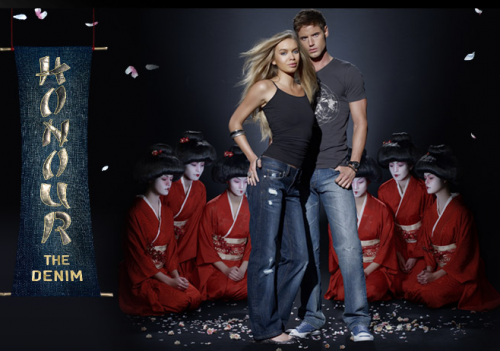
Tristian B. told us about Jeanswest Australia’s Authentic Japanese Vintage Denim ad campaign, which features images of White people surrounded by groups of kneeling Japanese men or women:

Picture 1

Picture 2

Oddly enough, Andrea J. recently sent us a link to the Palm Pre “Flow” ad, which has a White woman using the Palm Pre while a group of identically-dressed Asians, none shot in a way that presents them as individuals, dancing around her as she discusses how nice it is when everything rearranges itself to do just what you want:

NEW! (Oct. ’09) Macon D. found another example of the use of generic, undifferentiated Asians as props.  This time in a performance by Shakira:

[youtube]http://www.youtube.com/watch?v=6bZxN1Qq9K4[/youtube]

She gives the same performance on Saturday Night Live.

Gwen Stefani’s Harajuku Girls are another great example.

This reminds me a lot of some images from Britain’s Next Top Model that Lisa posted about last year, in which Africans were used as background props in a photo shoot with the contestants. The Asian individuals in these two ads are an undifferentiated mass, strikingly dressed and posed to show off the subjects of the ads–the White people who are foregrounded and depicted as specific, individual human beings rather than an interchangeable member of a group.

For other examples of non-Whites used as props, see our post about a fashion spread in Vogue Italia and this photo from NYLON magazine.

Gwen Sharp is an associate professor of sociology at Nevada State College. You can follow her on Twitter at @gwensharpnv.

Jay L. sent in this Brylcreem commercial from the 1950s, in which men are warned that if they don’t have well-styled, healthy hair, they won’t get the girl next door:

Notice the creepy cartoon characters at about 0:48. Jay says,

He is obviously turned on by the girl, so he elbows the tube, which ejaculates a white blob that falls onto his head. The girl returns to run her hands through it.

Here’s another commercial that tells men if they don’t use Brylcreem, they’ll actually disgust women and make them run away:

Also see this Just for Men commercial that tells men grey hair will hurt them on the dating scene, this one about career insecurity, and this one that equates grey hair with a loss of masculine virility.


I love how this ad from the 1950s acknowledges how exhausting and mind-numbing housekeeping and childcare can be!

The ad also illustrates the post-WWII efforts to cultivate a market for new food technologies (easy and instant foods that were developed for the war).  This ad for Campbell’s soup describes the phenomenon in more detail.

For another vintage Jell-O ad that takes an entirely different approach, see here.

—————————

Lisa Wade is a professor of sociology at Occidental College. You can follow her on Twitter and Facebook.
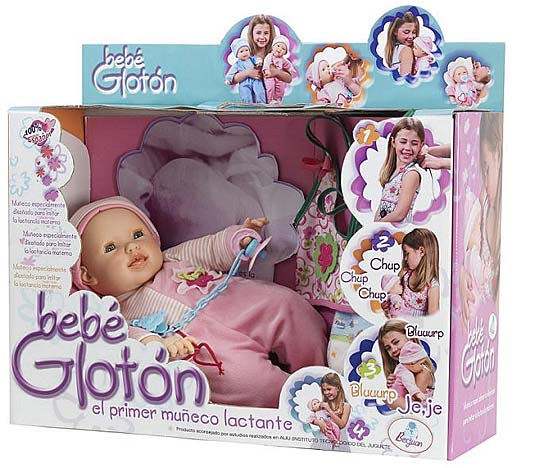
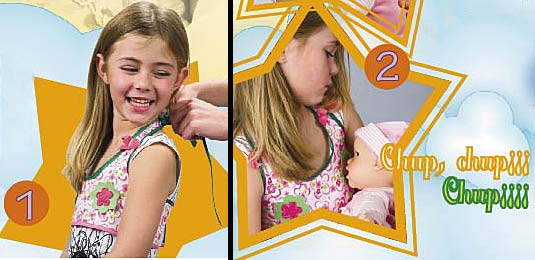
Tara C., fds, Dimitriy T.M., Wendy C., and Breck C. all sent in images of the Bebé Glotón, a doll that comes with a sort of bra that lets a child pretend to breastfeed (found at Thingamababy):

gluton1

gluton2

According to Thingamababy,

Bebé Glotón is a infant doll made by Berjuan, a toy maker in Spain, for the express purpose of promoting breastfeeding. The idea is to impress upon kids that breastfeeding is natural.

Here’s a demonstration video:

The doll has sparked quite a bit of controversy. From a story in the Mail Online:

Posting a comment after watching a demonstration video online, one user wrote: ‘This toy would never work in the U.S. because the public would sexualize the act of breastfeeding, thereby deeming it inappropriate for little girl to engage in.’

Another wrote: ‘ Honestly, I think this is awful. Now let me just be clear, I think breastfeeding is wonderful and wholeheartedly encourage it, however, it is completely inappropriate to allow a young girl to mimic it.’

And from Fox News:

Dr. Manny Alvarez, managing health editor of FOXNews.com, said although he supports the idea of breast-feeding, he sees how his own daughter plays with dolls and wonders if Bebe Gloton might speed up maternal urges in the little girls who play it.

Um…okay. Why this would “speed up maternal urges” any more than bottle-feeding a doll, I don’t really know.

While my first reaction was that the doll is creepy and weird, on second thought I couldn’t see that it’s stranger than the doll one of my cousins got a few years ago that “pooped” and “peed” some bright yellow and green substances that I did not ask any details about. I dunno. Is this really “sexualizing” girls? That implies that breastfeeding, real or simulated (through layers of clothing), is a sexual activity. I think it’s kind of fascinating that so many people, including myself, have had such an immediately negative reaction to the doll.

The more I think about it, the more it seems that my, and others’, negative reaction is based on a premise that anything involving breasts is sexual…a premise that many breastfeeding advocacy groups such as La Leche League have fought as they try to expand the ability of parents to breastfeed in public (or to have access to clean spaces to breastfeed in places such as malls, religious and government buildings, and so on).

Is our problem with the doll really more about the social construction of breasts as sexual? What is the primary problem with this doll? What’s driving our disgust?

Thoughts?