

Stephen W. sent in an amazing 9-minute cartoon touting the superiority of capitalism:
—————————
Lisa Wade is a professor of sociology at Occidental College. You can follow her on Twitter and Facebook.
Stephen W. sent in an amazing 9-minute cartoon touting the superiority of capitalism:
—————————
Lisa Wade is a professor of sociology at Occidental College. You can follow her on Twitter and Facebook.

In the early 1980s the Reagan Administration engaged in an active campaign to demonize welfare and welfare recipients. Those who received public assistance were depicted as lazy free-loaders who burdened good, hard-working taxpayers. Race and gender played major parts in this framing of public assistance: the image of the “welfare queen” depicted those on welfare as lazy, promiscuous women who used their reproductive ability to have more children and thus get more welfare. This woman was implicitly African American, such as the woman in an anecdote Reagan told during his 1976 campaign (and repeated frequently) of a “welfare queen” on the South Side of Chicago who supposedly drove to the welfare office to get her check in an expensive Cadillac (whether he had actually encountered any such woman, as he claimed, was of course irrelevant).
The campaign was incredibly successful: once welfare recipients were depicted as lazy, promiscuous Black women sponging off of (White) taxpayers, public support for welfare programs declined. The negative attitude toward both welfare and its recipients lasted after Reagan left office; the debate about welfare reform in the mid-1990s echoed much of the discourse from the 1980s. Receiving public assistance was shameful; being a recipient was stigmatized.
Abby K. recently found an old Sesame Street segment called “I Am Somebody.” Jesse Jackson leads a group of children in an affirmation that they are “somebody,” and specifically includes the lines “I may be poor” and “I may be on welfare”:
(Originally found at the Sesame Street website.)
I realized just how effective the demonization of welfare has been when I was actually shocked to hear kids, in a show targeted at other kids, being led in a chant that said being poor or on welfare shouldn’t be shameful and did not reduce their worth as human beings. Can you imagine a TV show, even on PBS, putting something like this on the air today? Our public discourse at this point says that being on welfare is shameful, and that those receiving it in fact aren’t “somebody.” They are dependents, lazy loafers, and their kids are just additional burdens on the state; they don’t have the same rights to dignity and respect as other citizens, and they certainly shouldn’t expect to get it.
Of course, the totally confused looks on some of the kids’ faces are hysterical.
In an earlier post I discussed how men, these days, are less likely than women to enroll and graduate from college. One theory for why involves an anti-intellectualism that is specifically male. That is, many men learn that to be a real man means rejecting prissy intellectual pursuits. Thinking is for chicks (and fags).
This commercial for Wrangler, aimed at men specifically, asserts this exactly:
—————————
Lisa Wade is a professor of sociology at Occidental College. You can follow her on Twitter and Facebook.
U.S. civilians, by virtue of geography and geopolitics, have rarely experienced war firsthand. The possibility of the destruction of our infrastructure or civilian casualties on our land has remained remote. Today, for example, though we are waging war in Iraq and Afghanistan, non-military Americans do not expect to personally suffer (with the significant exception of harm to and the loss of loved ones).
That civilian populations can experience war in vastly different ways is illustrated by this photograph:
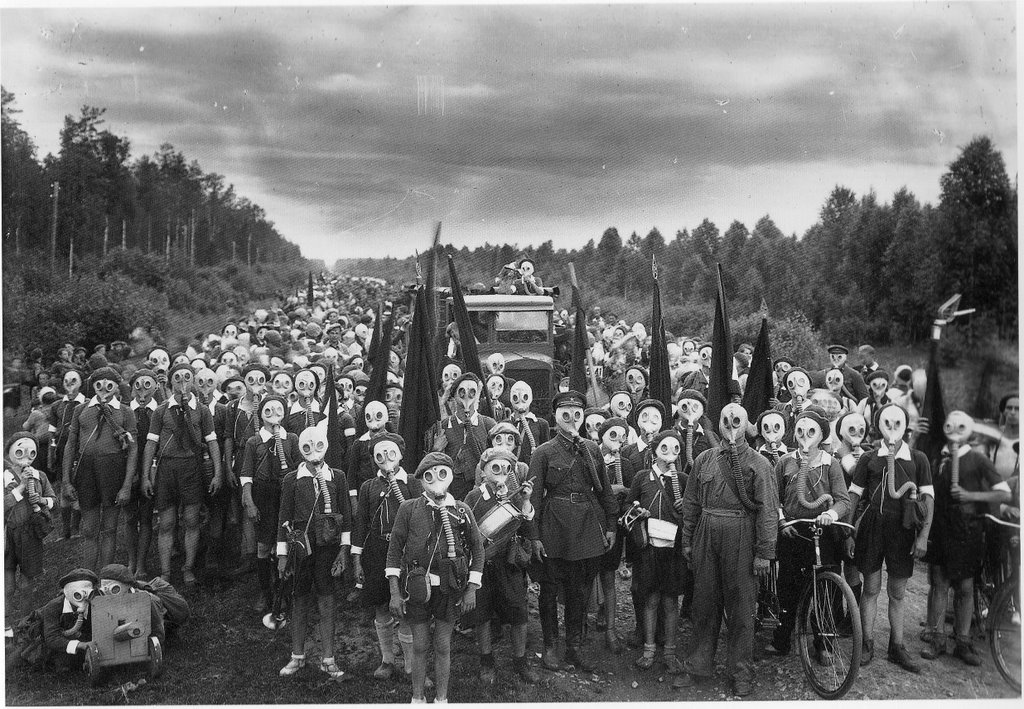
It is the early 1920s and the Soviet Union has been at war with much of Europe for several years. In the photograph, children practice their response to being gassed in an attack.
The Vietnam War was the first televised war and some sociologists credit the visual images returning from the war for increasing opposition. But the idea that an understanding of the horrible, destructive, and deadly effects of war would require the mass media is predicated on U.S. geographical detachment. That is, the mass media would be less necessary if the war was happening on our soil.
Earlier this month, the U.S. military hardened its rule against publishing photographs of dead or dying U.S. soldiers. The rule for embedded journalists states that:
Media will not be allowed to photograph or record video of U.S. personnel killed in action.
This separates U.S. civilians from war in a second way, by politics. So a civilian population can be isolated from its own wars by geography or by politics and, largely, the U.S. is separated by both.
Thanks to Dmitriy T.M. for this great photograph.
For more posts discussing the impact of war on civilians, see license plate patriotism, sex protest, war is boring, WWII civilian sacrifices (carpooling and staying off the phone), war and euphemism, framing “their” deaths, the silent ranks, U.S. non-news about war, and reframing the “atomic bomb” (the evolution of the term and mushroom clouds have a silver lining).
—————————
Lisa Wade is a professor of sociology at Occidental College. You can follow her on Twitter and Facebook.

Lindsay H. sent in a Kingsford Charcoal ad, in which we learn the proper cooking roles for men and women–men cook outside, women cook inside:
It’s just like how men are supposed to do their cleaning outside by mowing the lawn! Glad we cleared all that up, and also instructed women how to avoid embarrassing their male partners in front of their guy friends.
Adeste S. sent in this performance by two women about the difficulties and frustrations of being transgendered:
Performed at Brave New Voices.
NEW! (Mar. ’10): Ryan sent in this video of Sass Rogando Sasot speaking to the United Nations about transgender rights. From an article at Coilhouse:
Her speech, titled “Reclaiming the Lucidity of Our Hearts”, addresses the need for vastly improved acceptance, support and protection of transgender citizens worldwide.
Her entire presentation is very moving, but about 8 minutes into this clip, something shifts in Sasot’s voice and delivery. What began as an engaging speech swiftly transforms into something far more urgent, immediate, and beautiful.
Our intern, Velanie, forwarded us a link to a clip from an Australian variety show called Hey Hey It’s Saturday. In the clip a group called the Jackson Jive perform in blackface. Steel yourself; maybe skip it if you’re not up to being reminded, again, of white racism against blacks.
Sometimes people wonder why black people are not more open or trusting of whites. This is why. Harry Connick Jr., bless his heart, did what he could to try to make it clear that the performance was not acceptable. And, to be fair, the producers (?) gave him an opportunity to object more articulately. Here is a part of what he said at the end of the clip:
I just wanted to say on behalf of my country, I know it was done humorously but we have spent so much time trying to not make Black people look like buffoons that when we see something like that we take it really to heart… if I knew it was gonna be a part of the show I definitely wouldn’t have done it. So I thank you for the opportunity. I give it up cause Daryl said on the break you need to speak as an American. Not as a Black American or a White American but as an American I need to say that, so thank you for the opportunity.
I’m sure that many people appreciated that Connick stood up against blackface. But he is the exception. The host of the show didn’t apologize, he just pleaded ignorance and felt bad that Connick was offended. The rest of the people, including the unrepetant performers, the judges, and (it appears) the majority of the audience, had absolutely no problem with the performance. Further, the majority of Australians are defending the minstrelsy. Mary Elizabeth Williams, at Salon, summarizes:
In a poll on PerthNow.com.au, 81 percent of respondents said the sketch was not racist, with other newspapers clocking in with similar percentages. Punch deputy editor Tory Maguire glumly asserted that “The 2.5 million Australians who were watching were looking for nostalgia, so a returning act like the Jackson Jive was always going to appeal to them.” It’s a sentiment echoed by the show’s host, Daryl Somers, who told reporters that Australian audiences “see the lightness of it.”
Dr. Anand Deva, who appeared as Michael in the sketch, told an Australian radio station this week, “This was really not intended … [to be] anything to do with racism at all…
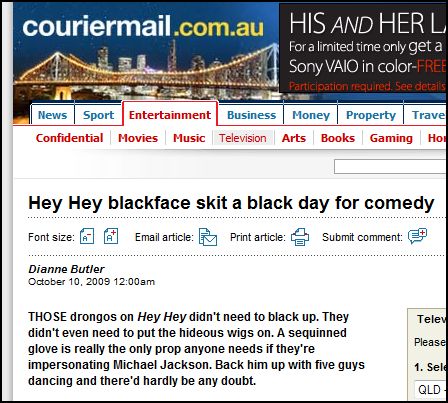
Couriermail decides it’s a great opportunity for a cheeky pun:
Williams continues:
What should be obvious to anyone who isn’t a complete moron is that a little something called the entire history of Western civilization — what with the slavery and the colonization and the genocide — disqualifies us from mocking people for their color as grounds for entertainment. It’s just that simple.
It is just that simple. But so many white people still defend it.
This is why black people don’t trust white people. Because they never know what kind of white person they’re dealing with and it’s not worth the risk because, a good portion of the time, they’re dealing with the host who is “sorry that you were offended” (as if the offense is your own personal defect) or the lady in the audience who is just really excited to be on TV.
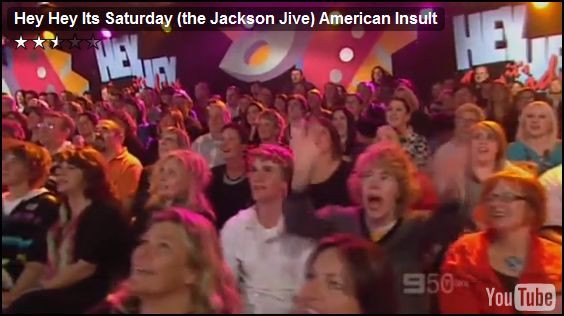
Via Shakesville and Womanist Musings.
—————————
Lisa Wade is a professor of sociology at Occidental College. You can follow her on Twitter and Facebook.
Lisa Wade, PhD is an Associate Professor at Tulane University. She is the author of American Hookup, a book about college sexual culture; a textbook about gender; and a forthcoming introductory text: Terrible Magnificent Sociology. You can follow her on Twitter and Instagram.
Sometimes you see an image or video that is pretty subtle and complicated, and it takes some mental wrangling to figure out what it’s conveying and what cultural ideas it’s drawing on or contradicting.
And then there are things like this, sent in by Joshua B.:
1. Normalization of heterosexual male gaze (until the very end)
2. Girls getting naked
3. While washing a car ‘n stuff
4. And they come in various ethnic flavors
That’s pretty much it.
About the man at the end, reader Victoria says,
I think it’s still the male gaze – just adding gay men to the mix at the end. The “Or, if you prefer” (or whatever they say) seems to clearly speak to the men in the audience.
I agree.