Search results for The

Each year the Department of Housing and Urban Development (HUD) calculates the fair market rents for apartments throughout the U.S. in order to set standards for housing assistance payments and vouchers for Section 8. Using data from the Census and the American Community Surveys, HUD figures out the average cost for various sizes of apartments. You can easily look up data for fiscal year 2012 here.

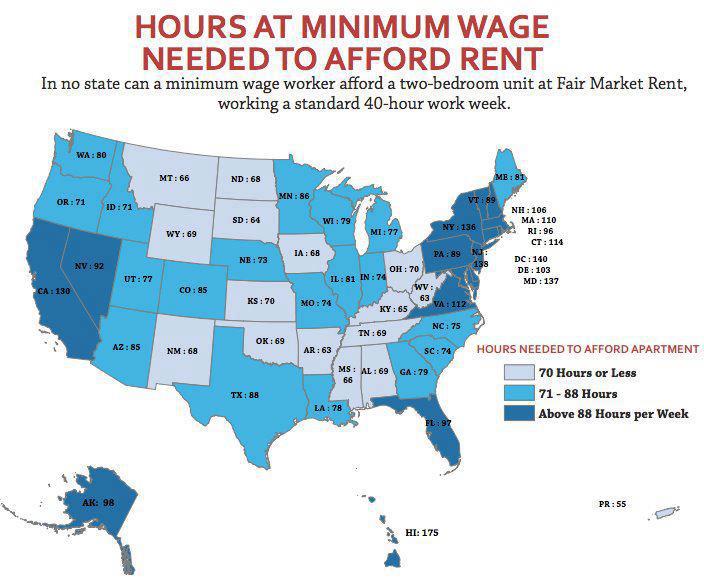
The generally-accepted standard for affordable, sustainable housing costs is that they should be about a third of a household’s income. The National Low Income Housing Coalition recently released a report on the mismatch between minimum wage — currently set at $7.25 nationally, with some states and municipalities having higher minimum wages within their boundaries — and the standard of living. The NLIHC report included this map showing the hourly wage that would be required for the HUD-calculated fair market rent to be about 30% of a full-time worker’s income:

In no state does the minimum wage pay enough to hit the 30%-of-income standard of affordable housing costs. How many hours would a minimum-wage worker need to work per week to make enough that the fair market rent would be about a third of their income? A lot, from a low of 63 hours a week in West Virginia to a high of 175 in Hawaii:
Thanks to Dmitriy T.M. for the tip!
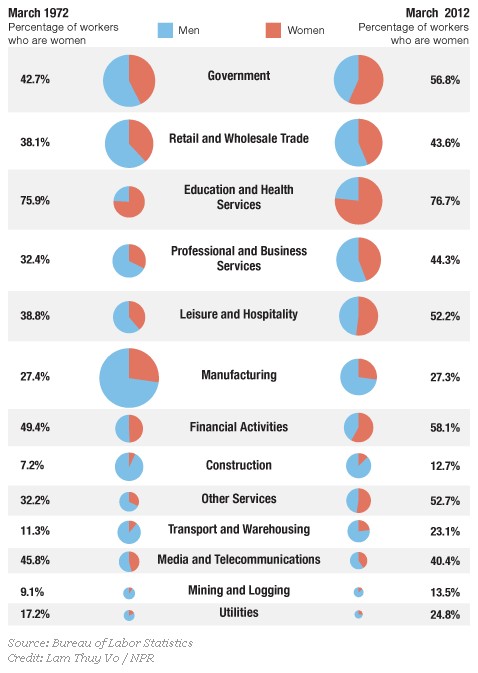
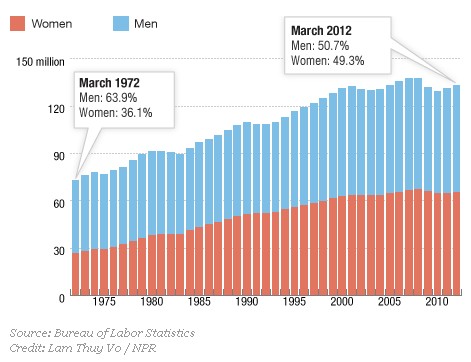
NPR’s Planet Money asks an interesting question.  If there are more women in the workforce now than there were forty years ago (and there are), where did all the additional jobs come from?

The pie charts below tell some of the story.  On the left are charts representing the percentage of women in various occupations in 1972.  The size of the circle corresponds to the size of the sector: larger is equivalent to more total jobs; on the right are the same charts for 2012.

Notice two trends: first,  in almost all categories today women are a larger percentage of the workers than they were in 1972 and, second, many of the occupational sectors that have high percentages of women have grown (e.g., education and health), whereas many in which men dominate have shrunk (e.g., manufacturing, media/telecommunications).

So, as women have joined the workforce, they’ve contributed to the overall growth of the American workforce and, specifically, filled the demand for employees in growing occupations.

Lisa Wade, PhD is an Associate Professor at Tulane University. She is the author of American Hookup, a book about college sexual culture; a textbook about gender; and a forthcoming introductory text: Terrible Magnificent Sociology. You can follow her on Twitter and Instagram.

The prisoner’s dilemma is a concept used to help explain situations in which individual actors may pursue their own self-interest even in situations where they would all be better off if they cooperated and acted for the good of the group. In this short video posted at Scientific American, Michael Moyer explains the prisoner’s dilemma puzzle and how it helps explain situations such as the global nuclear arms race:

See also: Game Theory and the Prisoner’s Dilemma.

The splashy introduction of the new LEGO friends line earlier this year stirred up a lot of controversy. My goal with this set of posts is to provide some historical perspective for the valid concerns raised in this heated debate. 

This is Part IV, see also:

—————————

2012: LEGO Friends and the Ensuing Backlash

In Parts I through III, I’ve discussed the history of LEGO’s attempts to capture (or abandon) the imagination of girls and boys.  In this final installment, I discuss their newest effort to market to girls, LEGO Friends.

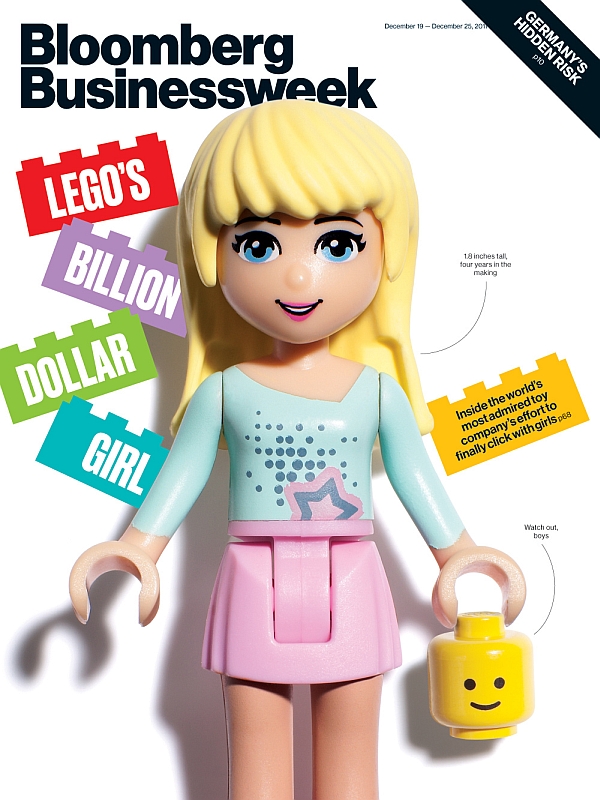
Several weeks before the first wave of LEGO Friends sets were available in U.S. retail stores, Bloomberg Businessweek ran a cover story that presented an in-depth look at TLG’s thought process in creating the sets. This was a very deliberate move on the part of TLG: it got their version of the story out there first (“four years of marketing research show this is what girls want”) and it made a bold statement about the LEGO brand (“like it or not, the minidoll is LEGO now”).

This move implies that they foresaw the backlash this line would inspire and hoped to mitigate it. The article portrays TLG sympathetically, as a company that wants to help girls build important skills and is trying to figure the most effective way to reach them. This idea is echoed in TLG’s official press release responding to the controversy. To a certain degree, this maneuver has been successful on TLG’s part. I have seen plenty of people point to the quote about “four years of marketing research” to dismiss the arguments that LEGO Friends perpetuates harmful gender stereotypes. But the attempt to integrate the minidoll into the LEGO brand is ultimately doomed.

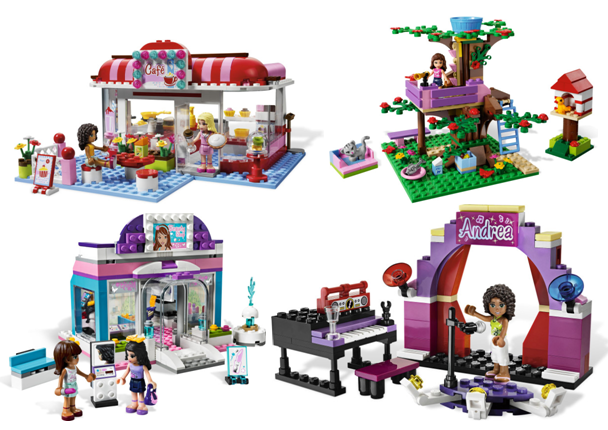
In many ways, LEGO Friends is an improvement over the previous “girls only” themes. Even more so than Paradisa, for example, LEGO Friends has a building experience that is on par with other currently available LEGO sets (mostly City and Castle, as the action themes use more complex techniques.)

The interests/occupations of the female characters are just a little bit broader than previous lines. While Andrea and Emma have clear predecessors from Belville, Olivia the inventor, Sophie the Veterinarian, and Stephanie the farmer/pastry chef (?) broaden the range of possible careers just a little bit.

Despite the presence of a beauty salon and a fashion designer, the clothing options in Heartlake City are also very limited. There is only one pair of full length pants available and threes shirts with sleeves, everyone else has skirts or capri pants with tangtops and sleeveless blouses. Olivia will have to raid her dad’s wardrobe if she wants to make her laboratory OSHA compliant.

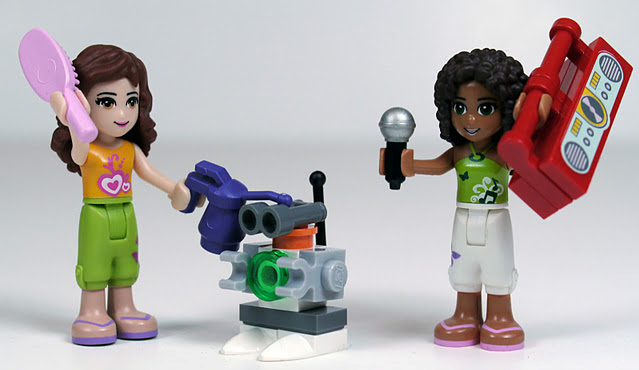
The minidolls may be the biggest barrier to efforts to use LEGO Friends as a gateway to the rest of the LEGO product.  In addition to being sexified and out-of-proportion to the classic minifig, their articulation makes them simply less interesting than the classic LEGO person.  The classic minifig has 7 points of articulation (8 if you count the hairpiece’s ability to move rotate independently of the head) whereas the minidoll only has 4 points (5 with the hair.) Minidolls can’t rotate their hands (which limits the ability to accurately pose accessories) or move their legs independently (which prevents them from being posed in active positions like running, they can only sit, stand or bend over).

The value of the LEGO system is the ability to connect all the different pieces to each other. The only compatibility between minidolls and minifigs is the hairpieces and accessories (think about the message that sends.) More, unlike the legs and torsos of minifigs, which easily connect to standard LEGO bricks so you can build any type of legs you want, the leg to torso connection on the minidoll is not compatible with any standard LEGO connection.  Additionally, the minidolls do not have LEGO connections on the back of their legs like minifigs do, making it impossible to securely attach to vehicles in seated positions.

To be fair, the minidoll has a slight advantage over the minifig in regards to racial diversity. Though darker skin tones were introduced to minifig in 2003 with Lando Calrissian, there has yet to be an identifiably feminine, dark-skinned minifig. Andrea (and Sarah) are therefore trailblazers. Friends is also the first instance of a LEGOLAND scale theme that integrates realistic flesh colors and is not connected to an external franchise (movies, comics, sports, etc.). This is a topic I’d like to discuss at length another time, but I hope this is the start of a trend that leads to a more ethnically diverse range of minifigures.

In sum, LEGO Friends is far from perfect, but it is a decided improvement over previously girly-LEGO iterations.  Still, many consumers object to the line vociferously, coining the clever slogan: “LEGO for girls already exist – it’s called LEGO.” 

TLG seems to fundamentally misunderstand this argument. In a press release, for example, they explained:

We want to correct any misinterpretation that LEGO Friends is our only offering for girls. This is by no means the case. We know that many girls love to build and play with the wide variety of LEGO products already available.

This isn’t satisfying to detractors because the critique of Friends (as I understand it) is not that it is being presented as the only LEGO product line for girls, but that TLG is so clearly marketing LEGO Friends only to girls. Rather than creating themes that appeal to both boys and girls and marketing them to both boys and girls, TLG is creating products for boys and products for girls. The fact that the focus groups for LEGO friends consisted of girls and women and the focus groups for lines like Power Miners and Atlantis consisted primarily of young boys proves that TLG fundamentally believes that boys and girls have entirely separate needs and desires. This is a harmful belief that we as a culture need to rid ourselves of.

—————————

David Pickett is a social media marketer by day and a LEGO animator by night.  He is fanatical about LEGO and proud to be a nerd. Read more from David at Thinking Brickly.

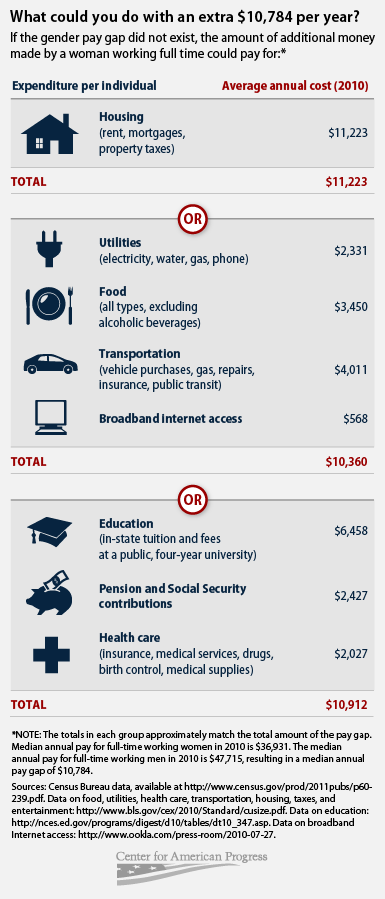
While income inequality between the sexes has decreased in recent decades, women still only make seventy-seven cents for every dollar a man is paid. Matt Separa from the Center for American Progress illustrated what could be bought with those lost wages to help us conceptualize how wide the wage gap is.

His first chart shows how the $10,784 in underpaid wages would almost cover annual housing costs or could pay the combined costs of a year’s worth of utilities, food, transportation, and internet access with a few hundred dollars to spare. The lost wages could also almost pay all the expenses for annual in-state tuition at a public university, twelve months of contributions to Social Security, and basic medical care for a year:

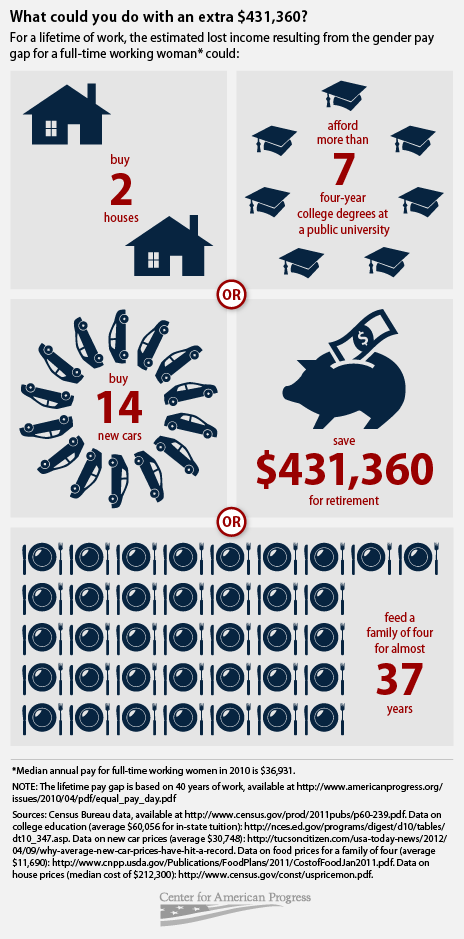
His second chart illustrates how across a lifetime, the lost wages ($431,360) could buy two houses, seven degrees from public universities, fourteen cars, or pay for a family of four to eat for thirty-seven years.   Many of Spera’s examples, including real estate, tuition and retirement savings, are especially powerful because they show how the lost wages could be turned into capital and wealth that would pay even more dividends on top of the lost income:

Overall, the graphs do a nice job of making the implications of the gender wage gap concrete.

—————

Jason Eastman is an Assistant Professor of Sociology at Coastal Carolina University who researches how culture and identity influence social inequalities.

The splashy introduction of the new LEGO friends line earlier this year stirred up a lot of controversy. My goal with this set of posts is to provide some historical perspective for the valid concerns raised in this heated debate. 

This is Part III, see also:

—————————

2004-2011: Lean LEGO Fighting Machine

As discussed in Part II, between 1989 and 2003, LEGO had introduced a stream of lines aimed specifically at girls.  None were particularly successful and the company was in trouble.  So, what next?

Those of us who follow every move TLG makes are well familiar with the company’s near collapse in 2004 and subsequent renaissance. This is a really important moment for our story, because this is the year when TLG stopped being a family run business and brought in a non-Kristiansen CEO, Jorgen Vig Knudstorp. With Knudstorp’s arrival came a change in philosophy. Quoted from the DailyMail article linked above:

Instead of “nurturing the child” – as Knudstorp puts it – [employees’] primary goal now had to be, “I am here to make money for the company.”

I, like many LEGO fans, am very grateful for what Knudstorp did to save and revitalize the company. The post-2004 era has seen a flourishing of LEGO themes and sets aimed at advanced builders. The LEGO minifig has been injected with more personality and variety than ever before. However, part of TLG’s new strategy also involved abandoning efforts the girl market and focusing exclusively on boys.

Abandoning schlock like Belville and Clikits is not a bad thing, but the push toward conflict and hyper-masculinity in classic themes (and a whole host of new ones) made LEGOLAND inhospitable for femininity.  Here are a couple more telling quotes from the Daily Mail article:

As always with Lego, this [action-oriented theme] was developed at every stage… with the help of focus groups, mostly comprising boys aged between six and 12.

In this new world focused on profit, the company sees no shame in admitting that, like it or not, what most excites little boys is conflict.

Which is to say, LEGO City is not the tranquil place LEGO Town was.

Notice the substantial hike in the m/f ratio in 2007. This ratio had been gradually approaching 1 throughout the 90s, but jumped back up to 1992 levels in 2007 (male/female ratio = 8).

Girls also disappeared from LEGO commercials and marketing collateral. LEGO produced a series of commercials encouraging fathers and sons to build together; the utter lack of anything similar for girls sends a clear message about who is expected to play with LEGO, it has entirely entered the masculine domain. With girls being actively excluded from TLG’s marketing efforts it’s no surprise that we see such a low percentage playing with them now.

In the final installment of this series, I’ll offer my perspective on the controversy over the new line aimed at girls, LEGO Friends.

—————————

David Pickett is a social media marketer by day and a LEGO animator by night.  He is fanatical about LEGO and proud to be a nerd. Read more from David at Thinking Brickly.

Lisa Wade, PhD is an Associate Professor at Tulane University. She is the author of American Hookup, a book about college sexual culture; a textbook about gender; and a forthcoming introductory text: Terrible Magnificent Sociology. You can follow her on Twitter and Instagram.

We seem to have a way of regularizing the pain felt by working people—worsening living conditions become little more than background noise to business as usual. 

The situation for the unemployed is a case in point.  We have a complex, but comparatively miserly, unemployment compensation system. 

Workers are generally entitled to 26 weeks of unemployment benefits.  However, there are two programs that potentially extend the benefit period for the unemployed. The first is the Emergency Unemployment Compensation (EUC) program, which was enacted in 2008 in response to the economic crisis.  As the table below shows, the EUC offers workers in states with high rates of unemployment up to 53 additional weeks of benefits. 

weeks-of-benefits.jpg

Workers who exhaust both their regular unemployment insurance and EUC benefits can receive additional support through the second program, the permanent federal-state Extended Benefits (EB) program.  As the table above shows, that program offers a maximum of 20 extra weeks of benefits depending on state unemployment rate levels.  However, there is an additional provision to the EB program that is now coming into play with negative consequences.  

As Hanna Shaw, of the Center on Budget and Policy Priorities, explains: 

A state may offer additional weeks of UI benefits through EB if its unemployment rate reaches certain thresholds . . . and if this rate is at least 10 percent higher than it was in any of the three prior years.  But unemployment rates have remained so elevated for so long that most states no longer meet this latter criterion (referred to as the “three-year lookback”). 

Because of this lookback provision hundreds of thousands of unemployed workers are now losing benefits, not because conditions are improving but because they are not continuing to worsen. The table below highlights the 25 states that have been forced to stop providing EB benefits this year and the number of workers in each state that have been cut adrift as a result.  Look at California–more than 95,000 workers have lost their benefits so far this year despite the fact that the state unemployment rate is almost 11 percent.

5-14-12ui-table.jpg

This is no accidental outcome.  In fact, according to Shaw,

Policymakers could have addressed the “lookback” when they extended federal UI at the beginning of the year, but they didn’t.  Instead, Congress not only allowed EB payments to fade out, but it also made changes that over the course of the year will reduce the number of weeks of benefits available in the temporary Emergency Unemployment Compensation (EUC) program, which provides up to 53 additional weeks to the long-term unemployed based on the unemployment rate in their state.

How serious is the long term unemployment problem?  Check out the chart below.  As it shows, the share of the labor force that is unemployed for more than 26 weeks is higher than at any point in the last six decades.  Perhaps even more striking is the fact that 41.3 percent of the 12.5 million people who were unemployed in April 2012 had been looking for work for 27 weeks or longer.

 222-ltu-opt.jpg

In terms of the master narrative, this is just another of the necessary adjustments required to stabilize the “system;” no need for alarm.  Makes you wonder about the aims of the system, doesn’t it?


Martin Hart-Landsberg is a professor of economics at Lewis and Clark College. You can follow him at Reports from the Economic Front.

Every once in a while we post something for those of us who are teaching (and learning) how to write.  This is one of those times.

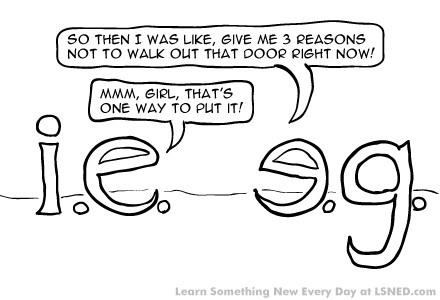
Get it!  Because you use “i.e.” to mean “what I mean to say is” and you use “e.g.” to mean “for example.”  Cute.

From Learn Something New Every Day.

Lisa Wade, PhD is an Associate Professor at Tulane University. She is the author of American Hookup, a book about college sexual culture; a textbook about gender; and a forthcoming introductory text: Terrible Magnificent Sociology. You can follow her on Twitter and Instagram.