Search results for The

Halle T. (of Yoga Bear) sent in this example of corporate philanthropy.
Halle says,

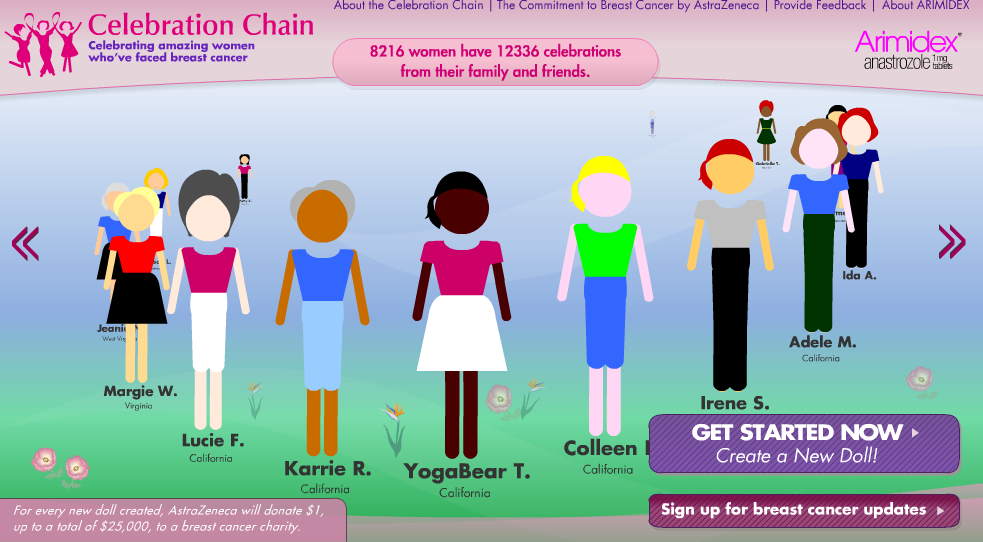
Arimidex, a prescription drug for breast cancer has created a site called the “Celebration Chain”. According to their promotion, the “Celebration Chain is a way to honor special women in our lives who have overcome or are fighting breast cancer…”. Users create a virtual doll in honor of someone they know, then send (spam?) it to everyone they know.

I’m always interested in corporate-sponsored philanthropy and the ways in which companies use things like donating to breast cancer research to improve their image. On the one hand, does it really matter who provides the money as long as it goes to a good cause, even if the motivation behind it is PR or marketing? On the other…the corporate giving often requires a purchase, such as when you have to buy yogurt and send in the lids so the company will donate a small amount (though in this case you don’t have to buy anything–you just have to spend time on the drug company’s website making a virtual doll).

The other thing that concerns me is that these programs are usually not very transparent. Halle sums it up nicely:

For every doll created, Arimidex donates $1 to “a breast cancer charity”, up to $25,000. But no where on the site do they disclose which charity; and for all we know, they could consider their R&D team a charitable unit. Arimidex also fails to mention if they donate the revenue or proceeds from the program, i.e. do they take marketing and website development costs out of the amount donated?

For other examples of corporate philanthropy, look here, here, here, here, and here.

Thanks, Halle!


Annie G. sent in this ad for the Baby Wee Wee doll, which was sold in the UK and Ireland for a while but was manufactured by a Spanish toy company (and is also called Piolin Pipi):

Notice that, although it’s girls who are shown playing with the doll, the parent they’re showing it to and playing with is the father, which is pretty unusual. Also, the doll is uncircumcised, which could be used for an interesting discussion of culture and representations of the body–if the doll had been manufactured in the U.S., it almost certainly would have been circumcised, and that’s the image of what penises look like that the kids playing with it would get. I find that more interesting than the gendered element of the ad–the way that the male body is being depicted, how that might be different depending on where the doll was manufactured, and how that reflects cultural norms about circumcision and what a “normal” penis looks like.

Of course, you could also discuss parenting styles and the types of parents who might find this appropriate, and why parents who might find the “girl-style” peeing dolls (i.e., those that “pee” through a hole between their legs) perfectly fine might still be offended by this doll (I’m just guessing that a lot of people would not want to buy this for their kid and might think it’s inappropriate for little girls to be playing with a doll with such a “lifelike” penis, but maybe I’m wrong). And there’s the whole issue of whether different viewers and/or regulators would find this ad appropriate for TV (I’m guessing it wouldn’t run in the U.S. Actually, I’m just gonna make a declarative statement: this ad would not run on TV in the U.S.).

Thanks, Annie!

More ads portraying men as stupid and trivial. Click here for more.

Miguel E. found all of these here!

NEW: In our comments, Pharmacopaeia pointed us to this commerical from New Zealand:

See also bros before hos.

Lisa Wade, PhD is an Associate Professor at Tulane University. She is the author of American Hookup, a book about college sexual culture; a textbook about gender; and a forthcoming introductory text: Terrible Magnificent Sociology. You can follow her on Twitter and Instagram.

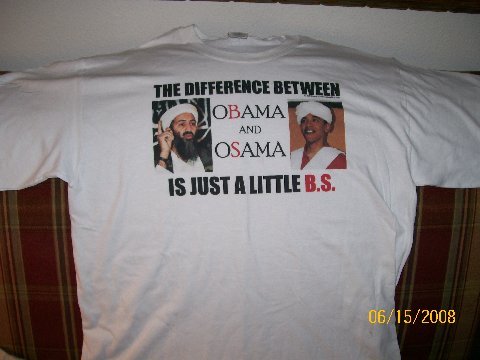
This is why Gwen was pessimistic about the New Yorker cover.  Another product sold at the Texas Republican Convention:

Also sold at the Texas Republican Convention: If Obama is President… Will We Still Call it the Whitehouse?

Found here via Copyranter.

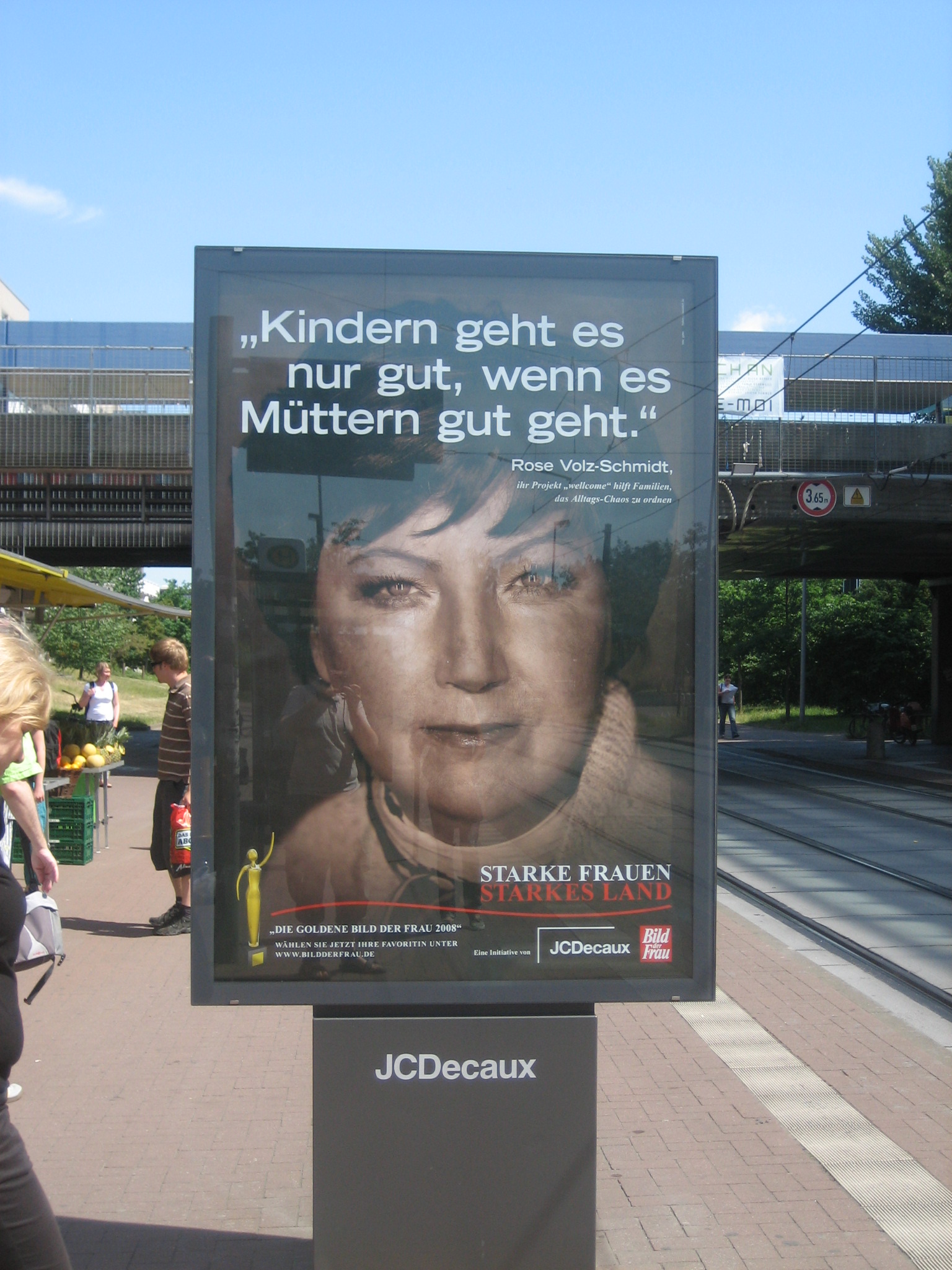
Susanne T. sent us this image of an ad at a busy stop at the University of Bremen, Germany (comments after the image).  Susanne translates the ad to read:

Kids are only well when mothers are well.  Her project ‘wellcome’ helps families to order the everyday chaos.  Strong women, strong country.

Feminist theorists note that there are two ways to integrate women into a society as equals to men: as citizen-workers (who perform the same tasks as men, namely breadwinning) or as citizen-mothers (who perform different tasks than men, namely parenting). If, and this is a big if, we truly valued parenting as much as we valued breadwinning, then the latter is a perfectly viable strategy with which to bring about a gender egalitarian society.

In the U.S., we conflate the idea of equality with gender sameness, assuming that any difference between men and women is a sign of oppression.  So, to many Americans, the fact that this ad makes fathers invisible and holds women alone responsible for parenting is problematic (as Susanne noted).  But different isn’t necessarily unequal and Germany (as well as France) has a tradition of supporting women as mothers.  By “supporting” I mean generous social policy that rewards women in concrete ways for reproducing the nation.

I’m not sure to what extent Germany still supports mothers with pro-natal policies.  Susanne’s critique may very well be more accurate than my comments about different ways of integrating women into the state.  However, I think it’s useful to problematize our assumptions about what equality would look like.  If women were truly valued for their unique contributions, that would be okay.  The problem in the U.S. is that we hold women responsible for childcare and also devalue that work. 

Adding freedom to that equality, of course, means state support for both citizen-workers and citizen-parents (of both sexes) and equally valuing both contributions.

Also see this post on equating motherhood and military service in the Third Reich.

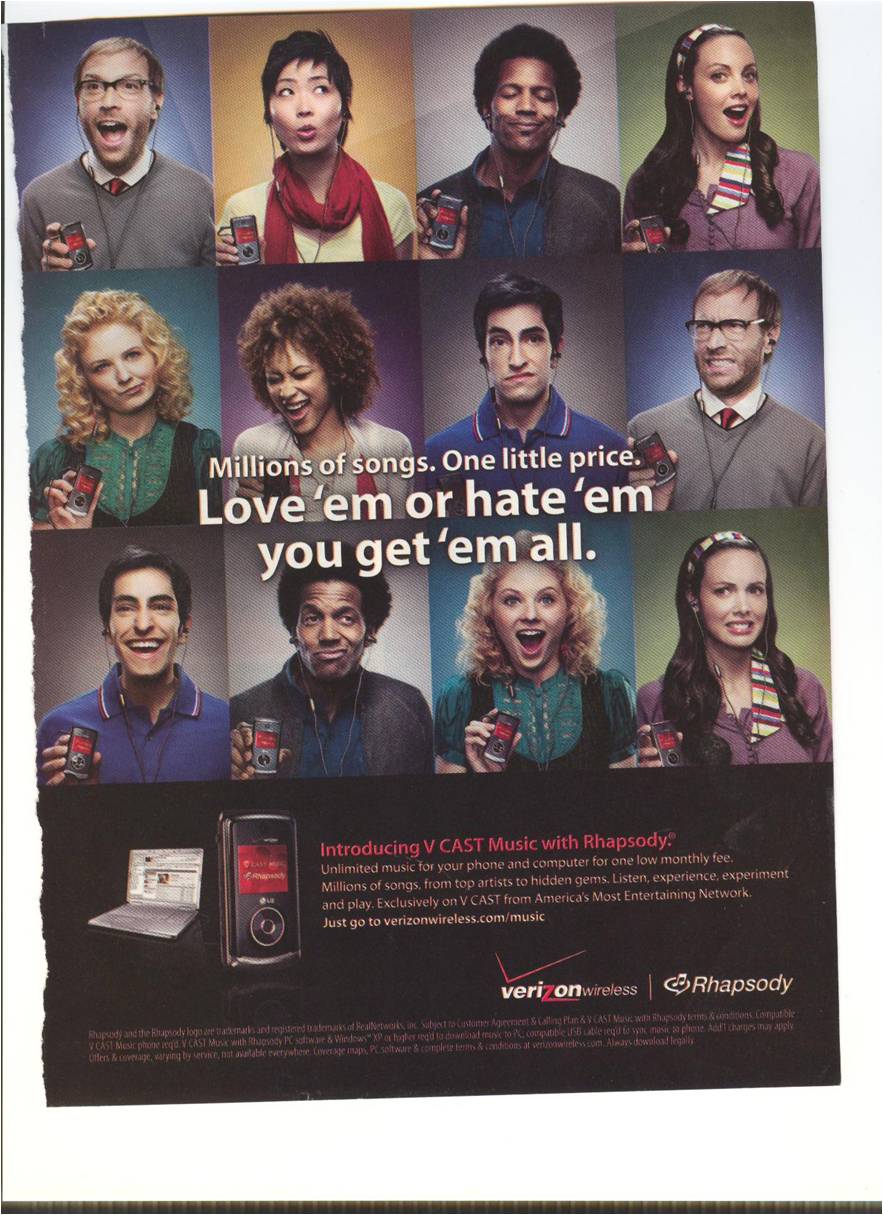
This is the fourth installment in a series on why and how people of color are included in advertising aimed primarily at white people.  In the first installment, I argued that people of color are included in such advertising in order to associate the product with a racial stereotype (i.e., hipness, intelligence).  In the second, I showed how people of color can be used to give a product “color” or “flavor.”  And, in the third, I argued that people of color are used to invoke ideas of “hipness,” “modernity,” “progressive” politics and other related ideas.  In this post, I suggest that people of color are used to trigger the idea of human variation itself.

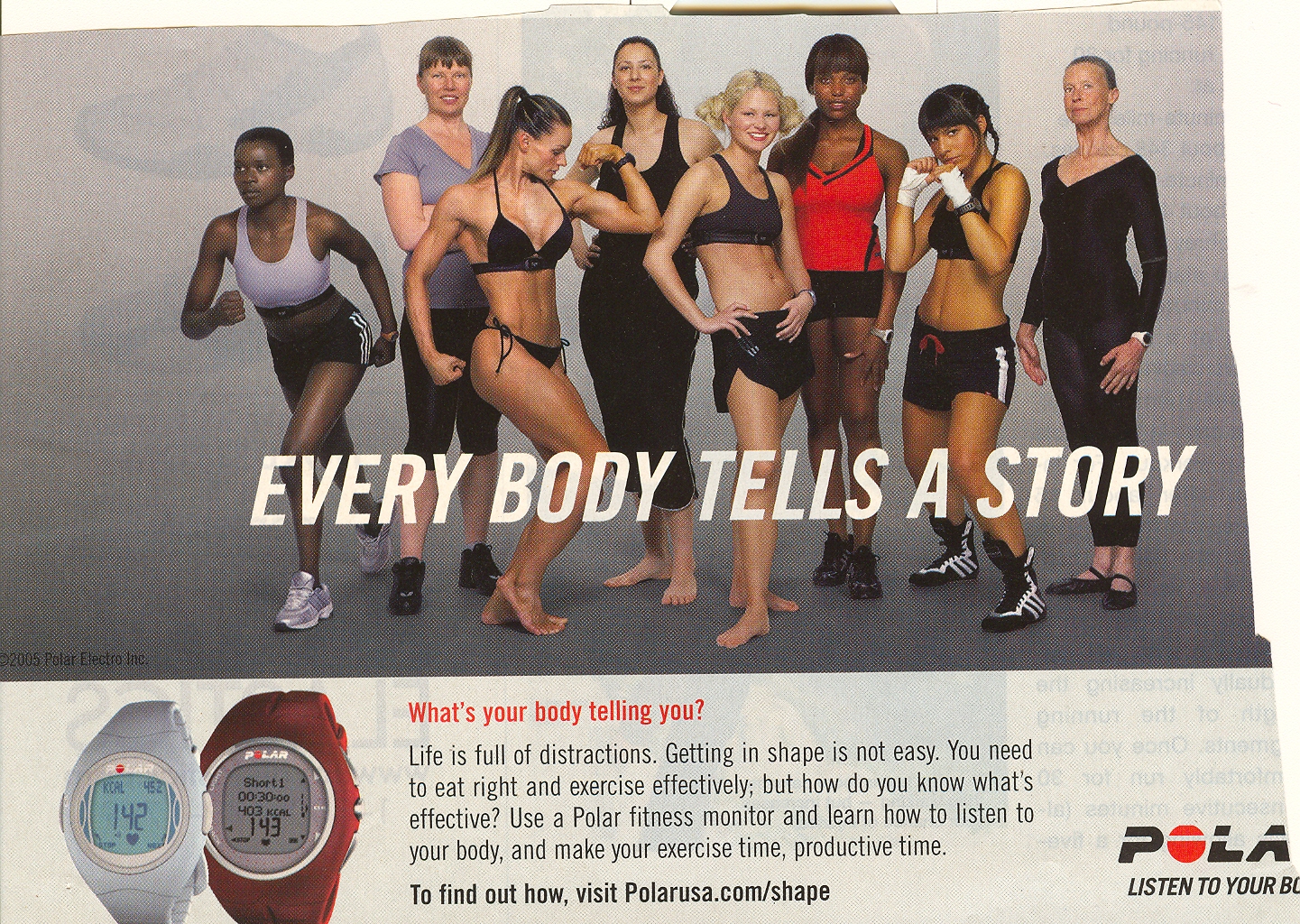
In this first ad the idea that each body is different is illustrated by including women of different fitness levels, ages, and races.

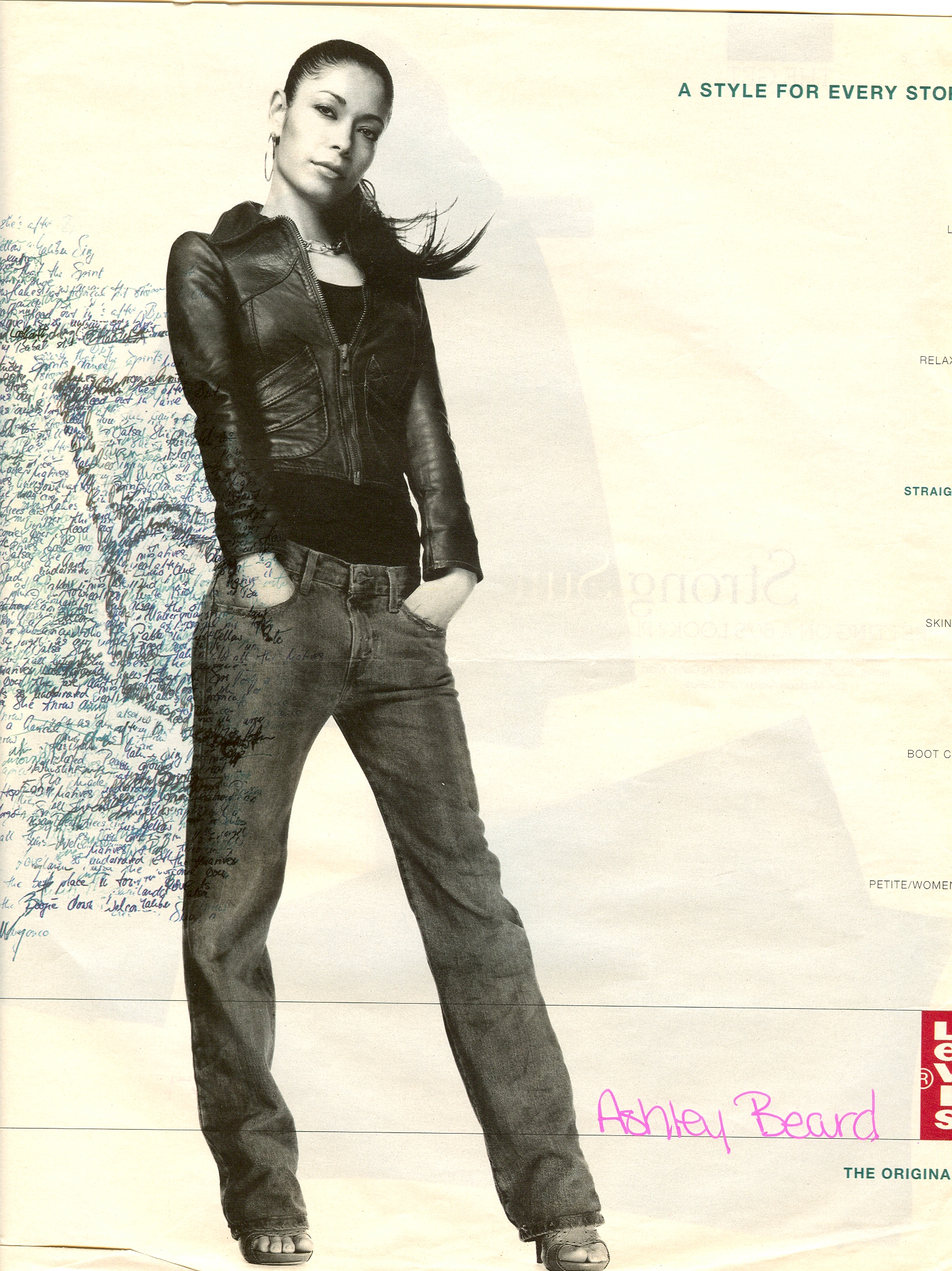
In this ad, Levi’s uses a woman who appears Latina to sell their jeans, which come in various fits because there is “a style for every story.”  The idea is that people are different; not everyone wants the same cut of jeans.

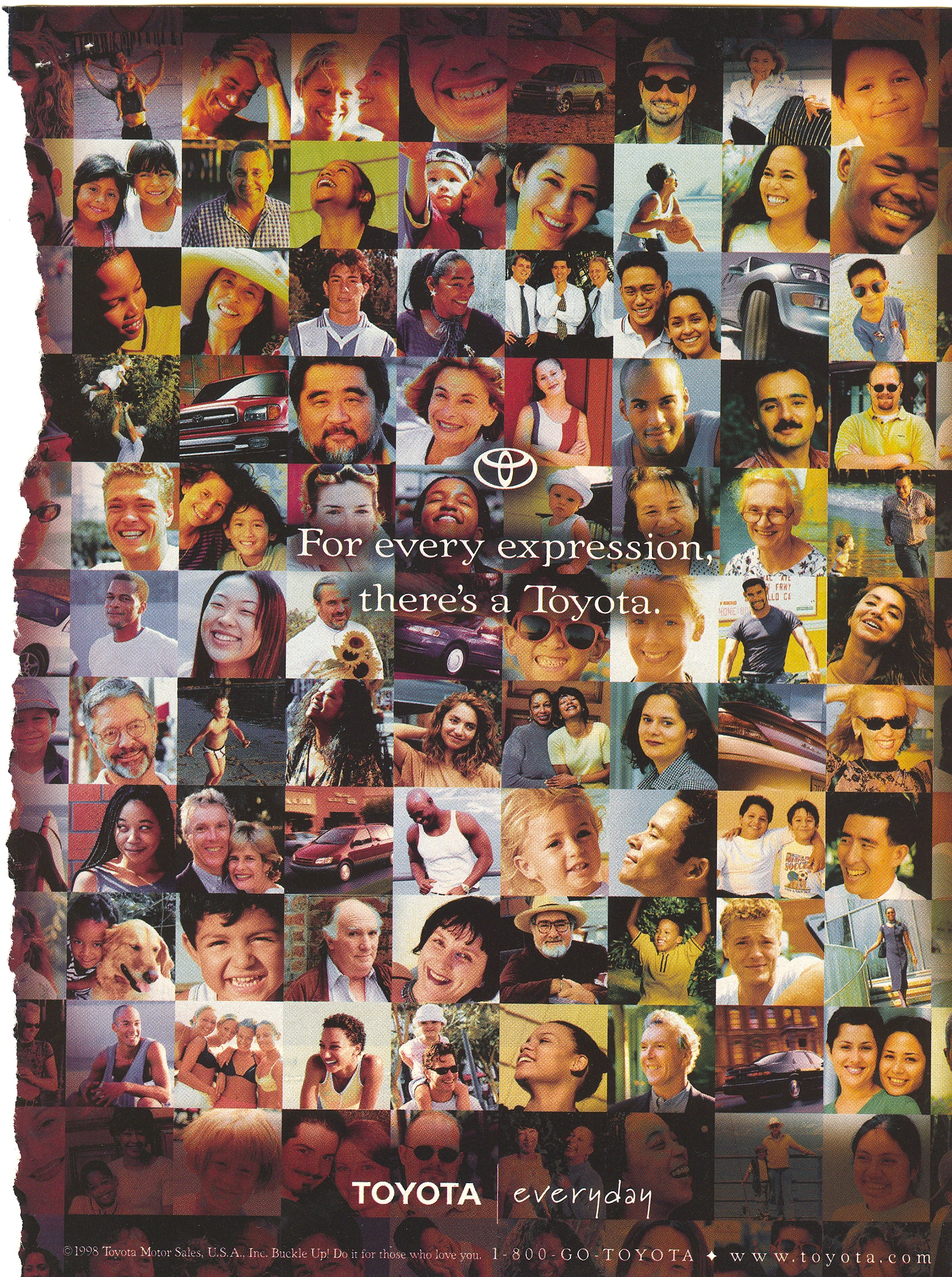
In this Toyota ad, the copy says “For every expression, there’s a Toyota.”  People are unique and so, apparently, are Toyotas.  Race is used to communicate the notion of human diversity.

This is an ad for Playtex bras with half sizes.  The implication is that people’s bodies are more variable than the A, B, C etc sizes suggest, so half sizes accomodate that variety.  I think this ad is particularly interesting because the model is racially ambiguous.  Maybe she’s half Asian, Latina, or white, and she’s being used to sell a product that now comes in half sizes.


NEW:

Next up: Including people of color so as to suggest that the company is concerned with racial equality.

See the other posts in the series:
(1) Including people of color so as to associate the product with the racial stereotype. 
(2) Including people of color to invoke (literally) the idea of “color” or “flavor.”
(3) Triggering ideas like “hipness,” “modernity,” and “progress.”

One thing I do in my classes is show my students evidence that things that seem very individualistic and unique are often influenced by social patterns to a much higher degree than they’d think. I often bring up the example of baby names. On one level, it’s an extremely personal and individual-(family)-level decision: people pick names they like and that are meaningful to them, and many would deny that larger social influences had anything to do with what they named their child. And yet names come into and out of fashion quite abruptly among lots of people at the same time, indicating that either a whole lot of people somehow independently make the same decision or that there’s a social aspect to baby naming–so naming your baby “Isabel” might not be the totally unique, personal decision you thought.

Well, now I can quantify this. It turns out the Social Security Administration has this nifty little website where you can put in any year since 1880 and find out the most popular names (from the top 20 up to the top 1000) boys’ and girls’ names for that year, including percentages of babies born that year given each name.

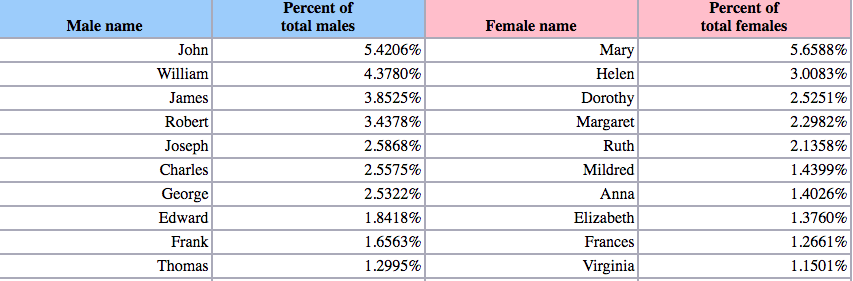
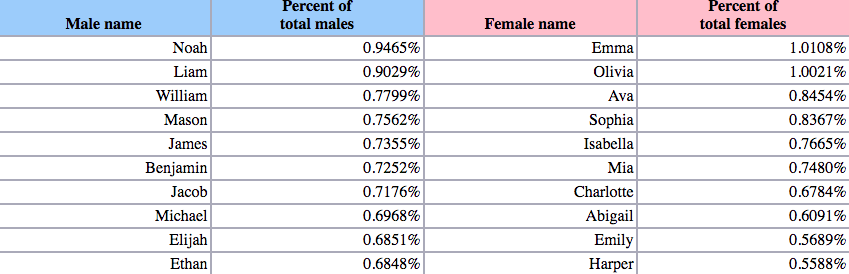
Here are the top 10 names for boys and girls in 1916 and 2016.

From 1916:

From 2016:

Only 1 name (William) that was most popular in 1916 was still in the top 10 in 2016. There was also a lot more concentration in 1916 than in 2016. For boys, the top name in 1916 made up 5.4% of names, while in 2016 the most popular name was only 0.9% of all names. For girls it went from 5.7% to 1.0% (I rounded all percentages to the nearest tenth of a percent). Also, in the past there was more clumping in boys’ names than girls’ names, though this is no longer the case. So in addition to just pointing out that preference for names has changed over time, it might be interesting to discuss the increasing emphasis in our culture on trying to have a “unique” name for kids that express their personality, so that there is more diversity in kids’ names today than in the past, and why until recently this was more true for girls than boys.

Jay L. provided a link to this neato site where you can type in any name and get an immediate graphic of its frequency per million babies. Totally addicting!

NEW: Abby sent in a link to Freakonomics Watch with the following explanation:

The other day a friend of mine said he was reading Freakonomics and there is a chapter on baby naming…the chapter presents a theory for how baby names become popular. People of higher education and socioeconomic status tend to seek out unusual names for their babies, which are then increasingly adopted by the masses.  Once the names become popular, cultural elites seek out a new batch of unusual names, and so on.  Based on this theory, the book gives a list of names that they predict will be popular by 2015.

You can find a table tracking the popularity of the Freakonomics predictions here. Abby was embarrassed to see that her 3-month-old son’s name is on the list.

Gwen Sharp is an associate professor of sociology at Nevada State College. You can follow her on Twitter at @gwensharpnv.

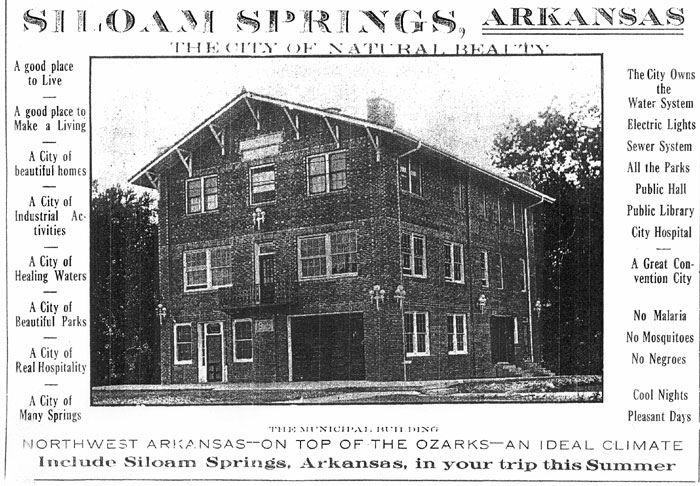
In his book Sundown Towns: A Hidden Dimension of American Racism (2005; New York: Touchstone), James Loewen discusses cities that had a “no Blacks after dark” policy. They were called “sundown towns” because African Americans were actively informed that they should be out of town by sundown; if not, they were subject to arrest or violence. Of course, the purpose of these regulations was to keep Blacks from settling permanently in these towns. If they couldn’t be in town limits after dark, they clearly couldn’t live there. Here is an example of a sundown town: this ad encouraging people to move to Siloam Springs, Arkansas, says, over in the lower right corner, “No Malaria, No Mosquitoes, No Negroes.”

Found here.

NOTE: As Mr. Loewen pointed out in a comment, I had originally said he discussed “cities in the South,” as though that was all his book concentrated on. That was poor wording on my part, as I had been reading the sections of the book that covered some areas in the South I was specifically interested in (particularly Oklahoma). I did not mean to imply that sundown towns existed only in the South or that Mr. Loewen only discusses the South.