Search results for The

liar_cover

Why did Bloomsbury Press choose this cover for a YA novel about a short-haired black girl? Maybe because, according to publishers, “black covers don’t sell.”

Justine Larbalestier, author of Liar, says she wanted an American cover similar to the Australian cover, which depicted the word “liar” in red letters. But Bloomsbury “has had a lot of success with photos of girls on their covers and that’s what they wanted.” So why a white girl? Larbalestier says not all the girls Bloomsbury proposed were white, but the one they went with may have to do with some upsetting prejudices in the publishing and bookselling industries. She writes:

Since I’ve told publishing friends how upset I am with my Liar cover, I have been hearing anecdotes from every single house about how hard it is to push through covers with people of colour on them. Editors have told me that their sales departments say black covers don’t sell. Sales reps have told me that many of their accounts won’t take books with black covers. Booksellers have told me that they can’t give away YAs with black covers. Authors have told me that their books with black covers are frequently not shelved in the same part of the library as other YA-they’re exiled to the Urban Fiction section-and many bookshops simply don’t stock them at all.

So basically bookstores are acting like restaurants in the Jim Crow South, segregating “black covers” in a special section, or refusing to allow them at all. This may be causing presses like Bloomsbury to whitewash their covers, resulting in confusion and anger, at least among Larbalestier’s readers. One blogger asks,

Did the publishers not want to put a black girl on the cover for fear of not selling enough books to their white customers? Or is the cover supposed to be what Micah [the main character] really looks like, and her description in the book is just another of her lies?

Larbalestier says she never intended for Micah’s race to be in doubt. Nor, obviously, did she want parents not to buy the book because “my teens would find the cover offensive.” But the whitewashing of covers has implications beyond Larbalestier’s readership. She asks, “How welcome is a black teen going to feel in the YA section when all the covers are white?” And she points out that the idea that “black covers don’t sell” is a self-fulfilling prophecy:

I have found few examples of books with a person of colour on the cover that have had the full weight of a publishing house behind them. Until that happens more often we can’t know if it’s true that white people won’t buy books about people of colour. All we can say is that poorly publicised books with “black covers” don’t sell. The same is usually true of poorly publicised books with “white covers.”

Larbalestier says that publishers have historically underestimated the size of the African-American leadership, and that the music industry has no problem selling album with black artists on the cover. The supposed inviability of the “black cover” may have more to do with racist assumptions — that white people won’t be interested in a book with a black protagonist, or that black people won’t buy books — than they do with actual commercial realities. According to Larbalestier, these commercial realities haven’t even really been tested yet. But they could be — if Bloomsbury does what Larbalestier now wants, and puts a short-haired black girl on the cover of Liar.

Ain’t That A Shame [Justine Larbalestier]
YA Critics Feel Cheated By Liar Cover Girl [GalleyCat]
Liar, Liar, Pants on Fire [The LibrariYAn]

————————–

Anna North recently received an MFA in Fiction from the Iowa Writers Workshop, and is working on a novel.  She writes about books for Jezebel, among other topics.

If you would like to write a post for Sociological Images, please see our Guidelines for Guest Bloggers.
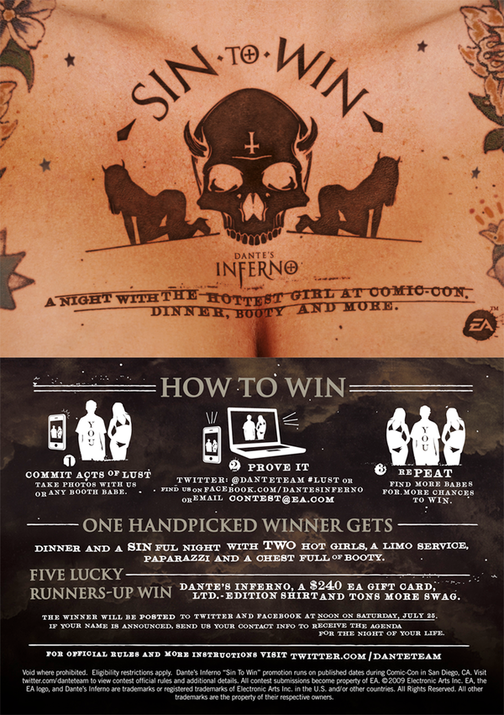
Comic-Con ended yesterday, so I’m afraid you’ve already missed out on a wonderful opportunity. I don’t mean attending Comic-Con itself. I’m referring to a contest that S. and Mordicai K. told us about, the Sin to Win contest from video game company EA (image from Kotaku; also see the discussion at ars technica):

504x_custom_1248458621930_sintowin

The text about the “steps” of the contest:

1. Commit acts of lust. Take photos with us or any booth babe. 2. Prove it. [Gives Twitter and email address]. 3. Repeat. Find more babes for more chances to win.

Brian Crecente at Kotaku says,

Despite the tone of the contest, the rules state that judge’s reserve the right to disqualify any submission that are “inappropriate for any reason, including without limitation, for depicting or mentioning sex, violence, drugs, alcohol and/or inappropriate language.”

Um…ok…Mixed messages, anyone?

As S. pointed out in the email to us, the “You” figure in the instruction is almost certainly meant to be male (though it theoretically could be a short-hair female), and the prize is specifically a woman–not a date with an attractive person. So we see the reinforcement of the presumption that “gamer = heterosexual male.” S. also says,

You can take photos of “us” (presumably EA employees or possibly developers) instead of or in addition to “booth babes”, but you cannot apparently win dinner with one of “us” — only with “two hot girls.”

So the possible prize isn’t to maybe hang out with some of the people who maybe create or market games, because apparently, who’d want to do that? Or, perhaps, what developer/EA employee wants to spend an evening being forced to hang out with some random contest winner?

For other examples of women being offered as (less explicit) rewards to men, see this post about Tag, a Dell Computer ad, and an Air Conditioning Technical Institute van. I was going to post links to posts about the presumption that gamers are male, but there were so many, it’s easier just to tell you just to go to the “More” tag and then search for “video games” or “video games gender.”

As the Obama adminstration presses for health care reform and members of congress are deciding the fate of the American people, pharmaceutical companies do more than just watch. According to NPR, in the last three months (THREE), they have spent $6.15 million dollars lobbying congress.  To show which companies are spending what, NPR has put together an interactive graphic.  It also allows you to view lobbying reports for each firm.  Click hereto learn more.

—————————

Lisa Wade is a professor of sociology at Occidental College. You can follow her on Twitter and Facebook.

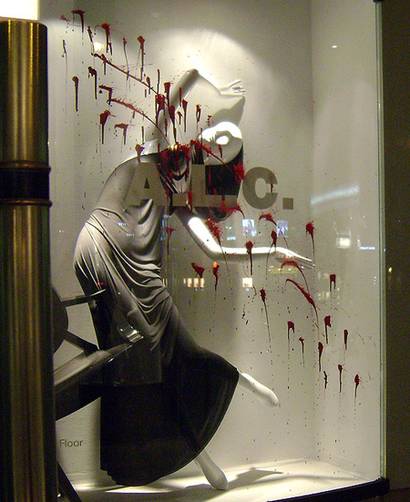
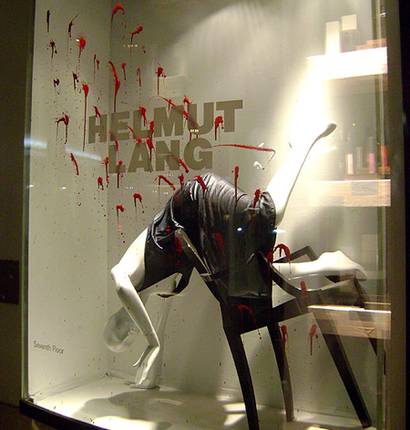
These displays, featuring mannequins posed as if they are being attacked by an invisible assailant, could be seen in the windows at Barneys New York this week:

barneys1__oPt

barneys2__oPt

They were disassembled when shoppers complained.

Daily News, via.

—————————

Lisa Wade is a professor of sociology at Occidental College. You can follow her on Twitter and Facebook.

fail-owned-tanning-fail

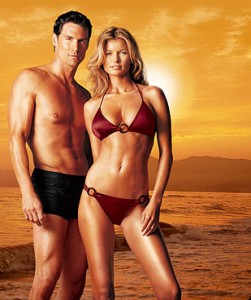
This image from the FAIL blog nicely illustrates the distinction between tanning to have darker skin and being born with darker skin– when is dark skin acceptable/desirable and when isn’t it? Presumably, this advertisement comes from somewhere near the U.S./Mexico border, and although it is probably meant to be funny, the point it makes is real. A white person (the blond pictured in the ad) can tan until they’re dark– which is acceptable and often highly desirable (which still surprises me in the day and age of skin cancer). But, getting a very dark tan, or being born with darker skin in the first place, means that near the border you might be “held by security” (although with the blond on the billboard, I doubt that mistake would be made).

And here are some images of desirable tans from tanning company websites:

tanned_up

tanning-info


In this video clip, Naomi Klein, author of The Shock Doctrine and other works on globalization and economic change, discusses what she calls “disaster capitalism,” or the use of disasters or “shocks” (whether natural or human-caused) as an opportunity to impose a certain type of global free-market capitalism that often would be impossible during “normal” times. At the beginning she’s discussing the specific example of the Iraq War, but that’s just one of many examples you could use.

Klein’s argument is that globalized free-market capitalism didn’t spread around the world by some natural process, or by simply winning in a “battle of ideas,” but rather was often opportunistically extended by companies in the wake of disasters, when nations and citizens were often in no position to debate or resist economic change in the face of more immediately pressing matters.

If you are very interested in the topic, here’s a lecture by Klein:

[youtube]http://www.youtube.com/watch?v=hA736oK9FPg[/youtube]

See also our post on The Story of Stuff, Mickey Mouse Monopoly, and old pro-capitalism propaganda.

Gwen Sharp is an associate professor of sociology at Nevada State College. You can follow her on Twitter at @gwensharpnv.

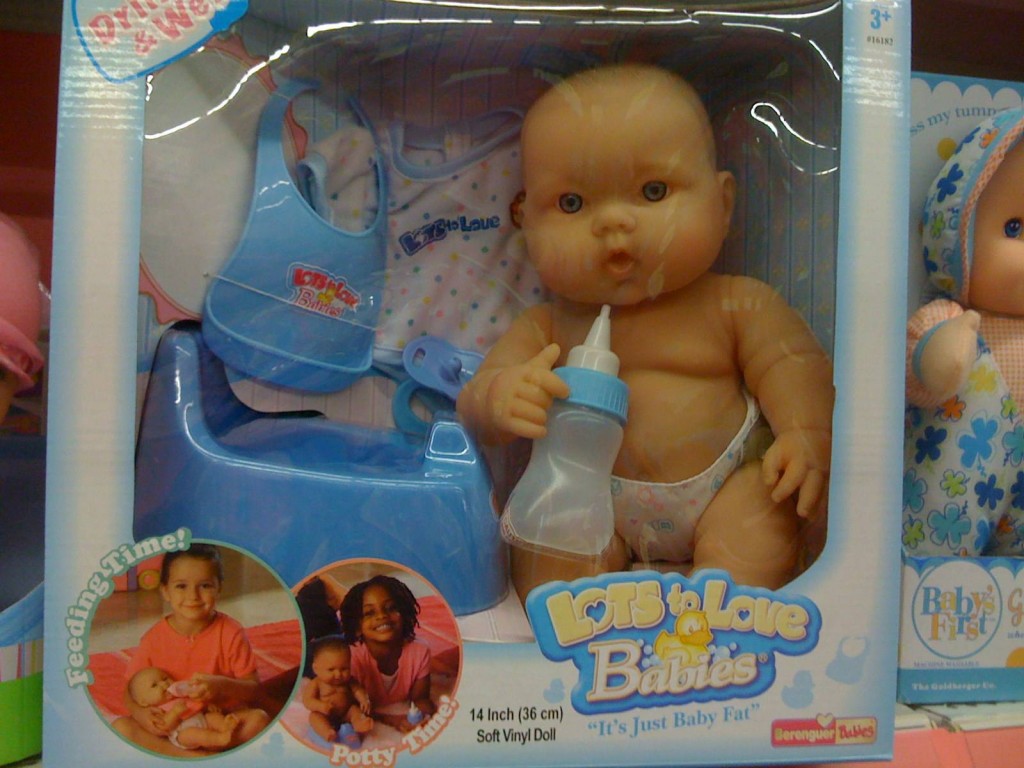
Angela B. and Jessica B. sent in this photograph of a baby doll toy called the “Lots to Love Baby.”  Angela notes that “lots to love” is a slogan of the fat acceptance movement.  So, apparently these babies are extra fat (aren’t babies supposed to be fat?) and, also, we’re not supposed to be concerned about that because “it’s just baby fat.”  Is it me or is this a bizarre projection of unrealistic BMI expectations and, simultaneously, fat phobia onto infants?

Picture1

(And also, is that a potty training seat?  I think Freud would be horrified.)

—————————

Lisa Wade is a professor of sociology at Occidental College. You can follow her on Twitter and Facebook.

We often talk about things being gendered or racialized on this blog, but we haven’t talked much about how race is gendered and gender racialized.  In a previous post, I wrote:

According to American cultural stereotypes, black people, both men and women, are more masculine than white people. Black men are seen as, somehow, more masculine than white men: they are, stereotypically, more aggressive, more violent, larger, more sexual, and more athletic. Black women, too, as seen as more masculine than white women: they are louder, bossier, more opinionated and, like men, more sexual and more athletic.

Conversely, Asian people, both men and women, are often stereotyped as more feminine than white people.  Asian men are seen as small and less muscular than white men; Asian women are seen as more passive and deferential than white women.

Interracial marriage rates bear out this asymmetry: black women are less likely to marry white men than vice versa and Asian men are less likely to  marry white women than vice versa (see here and here).

The idea, specifically, that Asian women are more passive and deferential than white women, has been used to explain white men’s fetish for Asian women, Western men’s sex tourism in Asian countries, and Western men’s use of Asian mail-order bride services.   Some of these men, it is argued, want a subordinate partner and they find it difficult to meet a white/American woman who is willing to play that role.  You can actually hear a male sex tourist make this argument in this post.

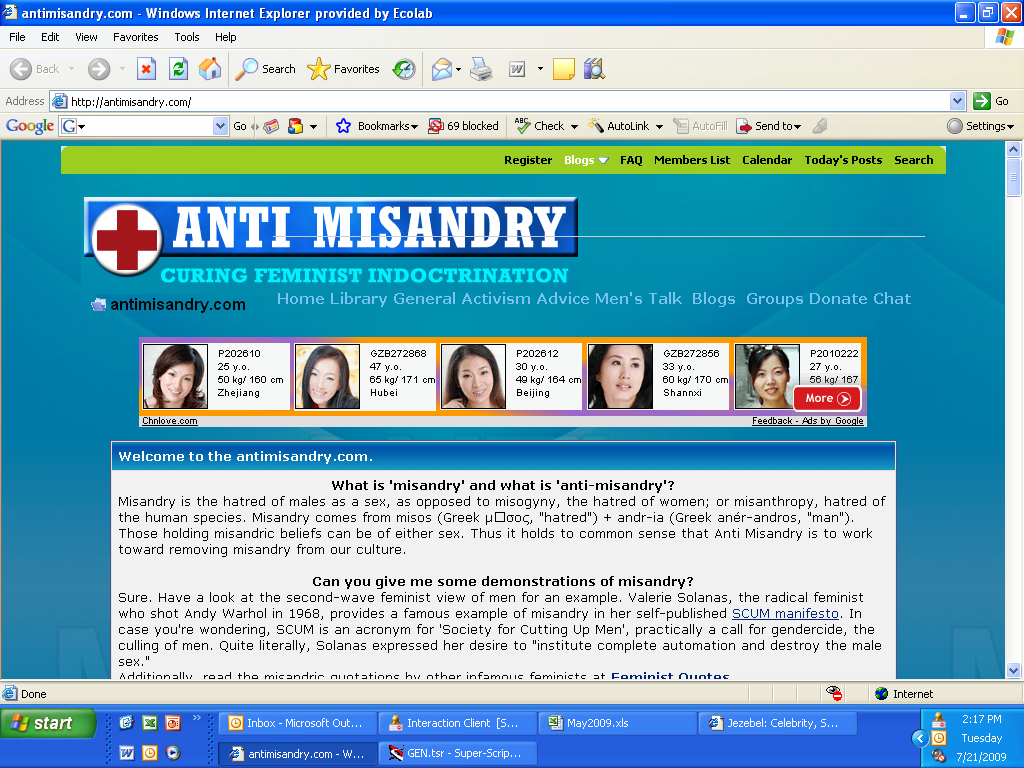
I introduce all of these ideas in order to frame a screenshot sent in by Megan S.  The screenshot is of the front page of a website (antimisandry.com) devoted to fighting misandry, or the “hatred of males as a sex.”  The website purports to “cur[e] feminist indoctrination.”  You’ll see that it is also advertising a dating site specializing in matching up white men with Chinese women:

Picture1

So… I’m going to guess that, in this case, “anti-misandry” isn’t so much about encouraging women to stop hating men as it is about telling men they are entitled to a woman who will defer to them.

Either that or… unfortunate random ad placement.

Megan also thought this post on men choosing fictional female characters as lovers was related; you might also check out our post on the documentary Guys and Dolls about men who have relationships with expensive and “functional” (if you know what I mean) life-size dolls.

UPDATE: The comments thread on this post is closed.  I strongly suggest reading them, especially if you think that this post was reaching. Very interesting.

—————————

Lisa Wade is a professor of sociology at Occidental College. You can follow her on Twitter and Facebook.