Search results for The

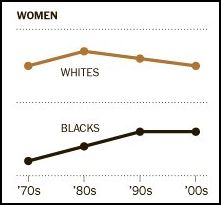
The New York Times reports that there has been an increase in the percent of Black Americans reporting that they are “pretty” or “very” happy (though Blacks lag behind Whites in happiness).  Indeed, while their happiness quotient appears to have dipped a bit this decade, Blacks have reported significantly higher rates of happiness in the ’80s, ’90s, and ’00s, compared to the ’70s.
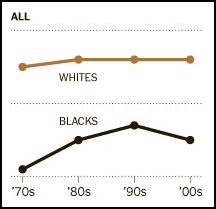
Still, the article entirely skips over the fascinating gender difference.  While American Black men’s happiness appears to have peaked in the ’80s and ’90s, they show real losses in reported happiness in the ’00s.  In contrast, Black women’s happiness has been steadily rising; they  neither express the same rapid increases or decreases that characterize the trend among men.
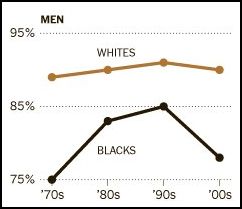
When we look at race and gender together, Black men are often among the most disadvantaged groups in society.  They are among the most hard hit by the recession in terms of joblessness.  They are less likely than Black women to enroll in and complete college.  That said, I am hardly an expert in happiness studies… any ideas as to why the gender disparity in self-reported happiness would be so much stronger among Blacks than Whites?

Via Racialicious, and sender-inners Patricia P. and Dmitriy T.M.

Lisa Wade, PhD is an Associate Professor at Tulane University. She is the author of American Hookup, a book about college sexual culture; a textbook about gender; and a forthcoming introductory text: Terrible Magnificent Sociology. You can follow her on Twitter and Instagram.

One thing we’ve been interested in, and posted various images about, here at Soc Images is the different ways people experience the current economic crisis. Obviously people will suffer more or less depending on their personal situations — if they had any savings, if they lose their jobs or not, if there are other wage-earners in the household, and so on. While we’re all affected by the recession at least indirectly, for some it’s a much more immediate personal problem than for others. And demographic factors outside our control, such as race/ethnicity, gender, and so on, play a large role in the distribution of the negative impacts (or, for some, the positive ones) of the recession.

Dmitriy T.M. sent in a story from the NYT that looks at the particular hardships faced by older workers. I’m interested in the graph on the left below, which shows historic jobless rates for those over age 55:

On the one hand, the unemployment rate for that group (7.3%) is certainly higher than at any point since the mid-’70s. On the other hand, the jobless rate for 55+ -year-old workers is lower than the overall unemployment rate right now, which is still hovering at about 9.6% (Bureau of Labor Statistics). It’s a case of the decontextualized graph: one that isn’t technically misleading, and that presents data in a straightforward manner, but that, without providing comparisons to other groups, makes it hard to know what to think about the data.

That’s not to discount the difficulties experienced by workers over age 55; it’s surely not comforting to know that the unemployment rate for your age group is below the national average if you, yourself, lose your job. And the graph on the right presents another aspect of joblessness: how long it lasts. When workers over 55 lose their jobs, it tends to take them quite a bit longer to find a new one. As the NYT article points out, with the overall higher rates of unemployment for all age groups, that gap becomes increasingly important: “because it will take years to absorb the giant pool of unemployed at the economy’s recent pace, many of these older people may simply age out of the labor force before their luck changes.” At the same time, the hits many retirement accounts have taken is pushing more people over age 65 to look for work, while others are forced into early retirement simply because they can’t find jobs.

More on race, age, gender, and the recession here.

No one knows.

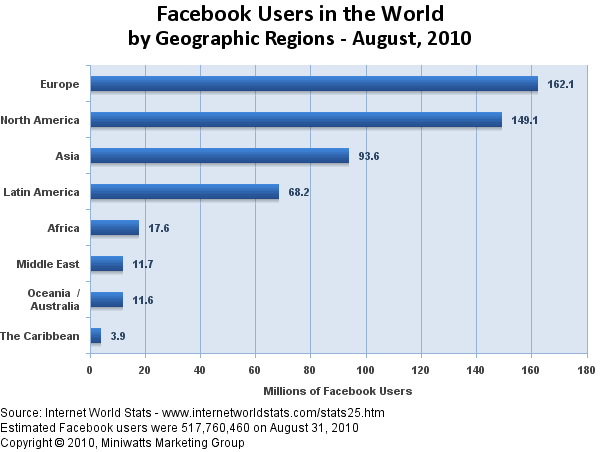
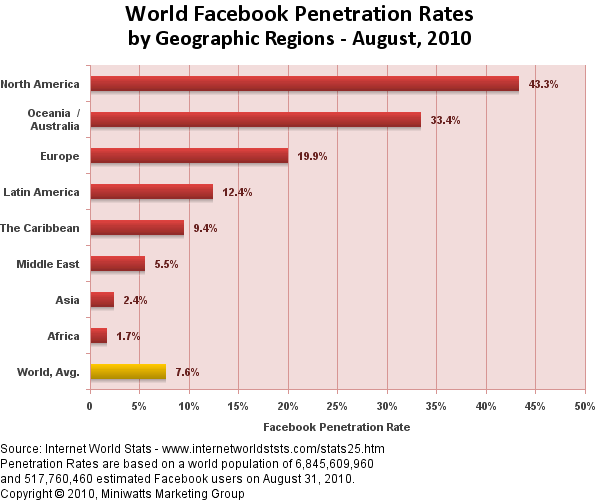
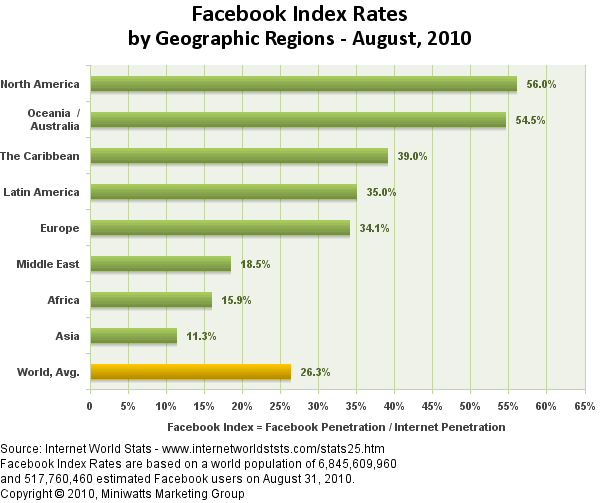
But here is some rather fascinating data about exactly how HUGE it is in Europe and North America (with many other parts of the world not too far behind).

How many people are on Facebook?

What percent of people are on Facebook?

What percent of internet users are on Facebook?

Lots and lots of people are on Facebook.  I suppose what this means has everything to do with what we do with it.

Via Thick Culture.

Lisa Wade, PhD is an Associate Professor at Tulane University. She is the author of American Hookup, a book about college sexual culture; a textbook about gender; and a forthcoming introductory text: Terrible Magnificent Sociology. You can follow her on Twitter and Instagram.
Right?

Or, at least, we’re constantly told that men hate shopping.

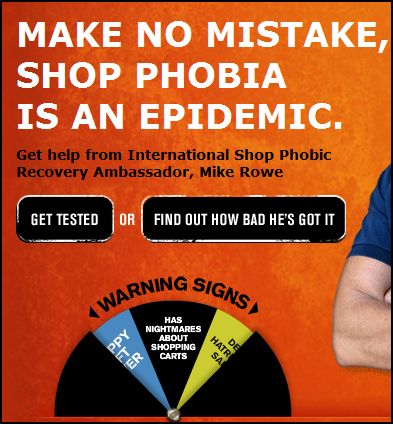
Ben K. pointed us to a new Lee Jeans ad campaign revolving around a fictional “epidemic among the male population” called “shop phobia” (website):

These ads argue that men don’t shop or are even afraid of shopping.  They tell us what men are like.  Ben begs to differ, but feels the pressure to be the man they insist he is:

As a man in my mid-twenties who actually does enjoy clothes shopping from time to time, I am, nevertheless, totally complicit in propelling the stereotype that clothes shopping is for women and not men – a stereotype reinforced out by mass culture and my experiences growing up with two younger sisters and a dad who taught me well the ways to keep myself from “losing my manhood” when going shopping with my mom (bring a book, find the chairs near the dressing rooms).

Ben’s confession illustrates how cultural rules about behavior actually create that behavior, thereby making the behavior seem natural instead of rule-driven.  Men hate shopping, we learn, and so it appears they do.  (See also our post on the self-fulfilling stereotype.)

On a different note, Ben had a really interesting thought about what is so scary about shopping:

I wonder if it has to do with anything about men being seen as in positions of authority or that their work necessitates certain types of clothes (police officers, construction workers), and, so clothing becomes a matter, in the cultural mind, of pure function related entirely to the public work of men. Thus shopping for extra clothes is irrelevant, even dangerous… perhaps because any indication of leaving that world of authority, and public work is also an indication of loss of “manhood.”

See also: Women Love Shoes.

Lisa Wade, PhD is an Associate Professor at Tulane University. She is the author of American Hookup, a book about college sexual culture; a textbook about gender; and a forthcoming introductory text: Terrible Magnificent Sociology. You can follow her on Twitter and Instagram.
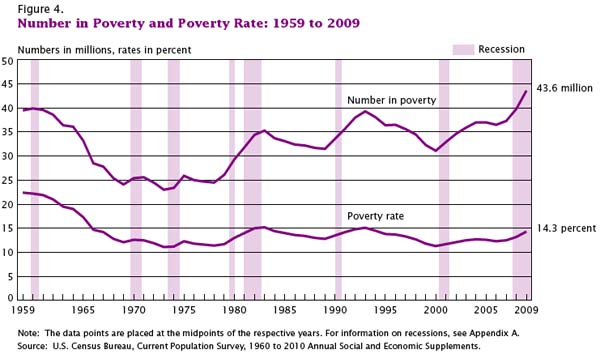
This week the U.S. Census Bureau reported that the American poverty rate has reached 14.3%, the highest it has been in 15 years:

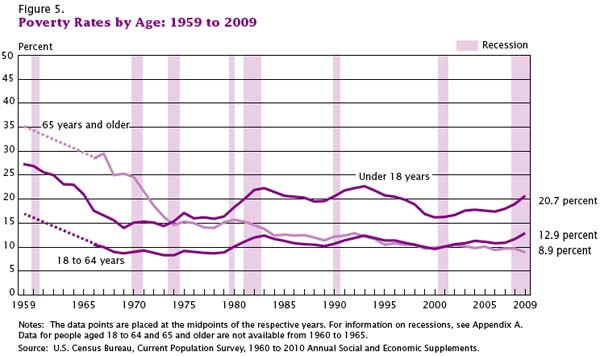
Children are over-represented among the poor; among those  less than 18-years-old, the poverty rate is 20.7%:

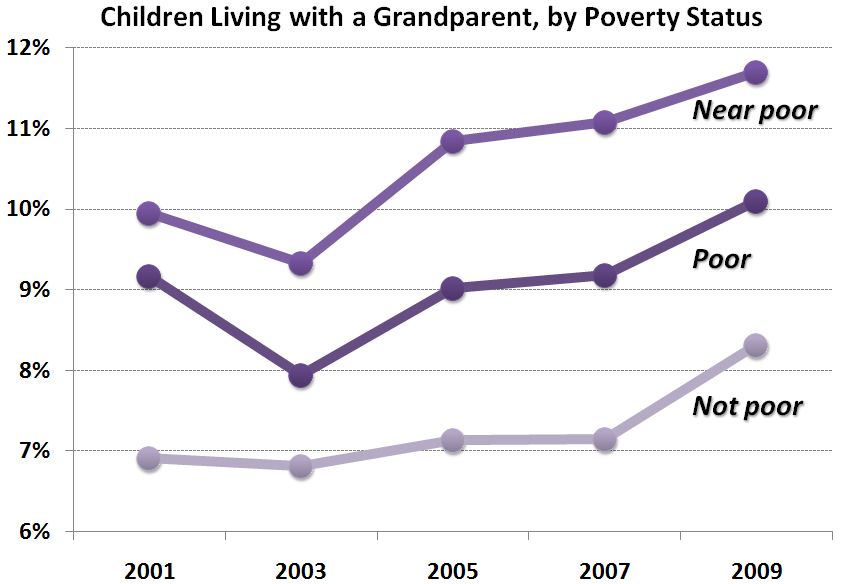
The Census report suggests that the poverty rate would be even higher if it weren’t for an increase in non-nuclear family households.  Over the last two years, an additional 11.6 percent of households now include non-family or family members from three generations or more.  Consider this data from Philip Cohen’s Family Inequality blog (and notice that the near poor are more likely to be living with a grandparent than the poor, who may not have this option):

So, the economic recession is correlated with an increase in poverty, but what does “poverty” really mean?   The New York Times reports that in 2009 it meant a pretax income of $10,830 for a single person with no dependents and less than twice that, $22,050, for a family of four.

Trying to imagine keeping a roof over my head, sufficient food in my belly, and clothes on my back on that amount of money is difficult.  But even if this was possible, human beings  need more than food, shelter, and clothes.  Try to imagine, with this amount of money, maintaining friendships and romantic partnerships, nurturing your children’s emotional health and educational potential, having pride and comfort in your home and personal appearance, finding the resources to invest in your own human capital, or giving yourself a modicum of leisure.  Poor people are human too and these numbers only begin to scratch the surface of the kind of deprivation many Americans suffer every day.

Images borrowed from Graphic Sociology.

Lisa Wade, PhD is an Associate Professor at Tulane University. She is the author of American Hookup, a book about college sexual culture; a textbook about gender; and a forthcoming introductory text: Terrible Magnificent Sociology. You can follow her on Twitter and Instagram.
As Anthropologist Peggy Sanday has shown, societies can be more or less rape-free or rape-prone.  A rape-prone society is characterized by a rape culture, one in which women’s desires are unimportant and emotional, psychological, and physical sexual coercion is normative.   In the U.S., pressuring or convincing women into sex is, in fact, well-tolerated.  So goes the saying, ” ‘No’ doesn’t mean ‘no’; it’s just the beginning of negotiations.”

Claire B. and Sylvia M. sent in matching sartorial testaments to the dismissal of the requirement that women consent to sex.  The first, on a website called teesbox (trigger warning), is a t-shirt that reads “I heart drunk girls.”  In case you don’t get the point, along with the shirt are photos of drunken or incapacitated women and captions like, “She’ll let you do anything you want to her, any hole, any time (as long as it’s while she’s still wasted).”

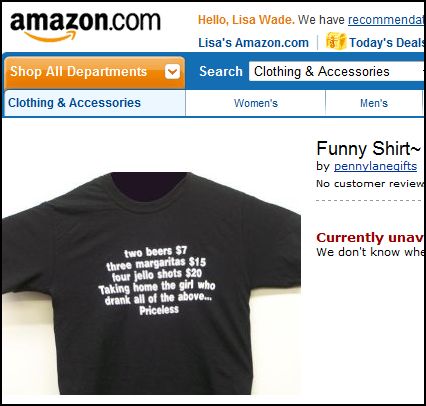
This second t-shirt (text below) is sold on Amazon.com:

Text:

two beers $7
three margaritas $15
four jello shots $20
Taking home the girl who
drank all of the above…
Priceless

Lisa Wade, PhD is an Associate Professor at Tulane University. She is the author of American Hookup, a book about college sexual culture; a textbook about gender; and a forthcoming introductory text: Terrible Magnificent Sociology. You can follow her on Twitter and Instagram.

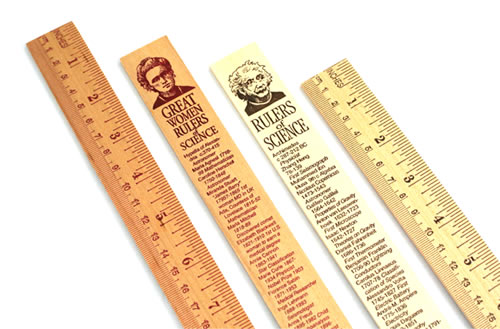
In case you haven’t yet seen enough evidence that men are treated as the neutral category, and women as a sub-category, Arielle C. and Ellie B. sent in another example, found on Neatorama. Here we have two rulers that list some important scientists throughout history, helpfully separated into Rulers of Science and Great Women Rulers of Science:

The only full image I could find of them is small, but I do see Marie Curie listed on both rulers. I can’t make out any other women on the Rulers of Science, but the text is very small and blurry in the image.

The point here isn’t really about the rulers themselves. I’ll give the company credit for trying to create a product that highlights women’s contributions to scientific discovery, only one of which would apparently be considered important enough to get a mention if we didn’t get a whole ruler all to ourselves. What’s noteworthy is the cultural repetition, experienced over and over in myriad large and small ways, of the message that default humans are male unless specifically marked otherwise, and that women aren’t neutral humans.

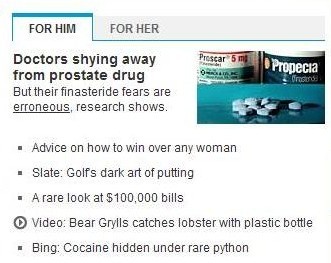
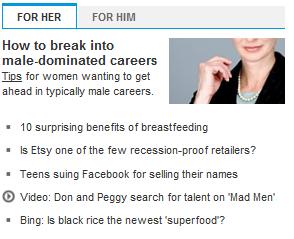
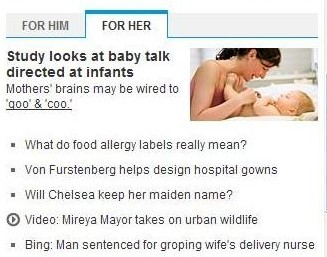
Stephanie L. and Amie A. both sent in screen shots of the MSN tabs “for him” and “for her.”   It’s not particularly surprising that MSN segregates its content by sex, but the gendered themes were interesting, especially given that Stephanie and Amie captured two moments in time.

First, notice that the information MSN chose as relevant to him is almost always leisure related:

The two lists above include how to build a man cave (where men escape daily responsibilities), the new Nikes, technological innovation and great inventions to read about, sports news, dating advice, and wacky stories about cocaine, $100,000 dollar bills, catching lobster, and urine.  Except for a non-leisure-related, health story, all are either about leisure activities or a way to provide leisure with wacky, weird or fun news.

What about for her?

Her stories are about work (male careers), sexual harassment, babies (breastfeeding and baby talk), teenagers, the economy, and food (superfoods and allergy labels).  The video on wildlife, the story about Chelsea Clinton, the piece on Mad Men, the new hospital gown design (???)  can be interpreted as leisure-related in that they’d be fun to read.

Overall, then, the material aimed at men is almost entirely related to leisure, whereas the material aimed at women is heavily tilted towards her responsibility for work and the family and serious topics like sexual harassment and the economy.   Perhaps MSN knows what it’s doing.  In fact, men do have more leisure time than women.  So this is a structural problem related to how we organize work and family, as well as a cultural problem in how we represent and relate to men and women.

Lisa Wade, PhD is an Associate Professor at Tulane University. She is the author of American Hookup, a book about college sexual culture; a textbook about gender; and a forthcoming introductory text: Terrible Magnificent Sociology. You can follow her on Twitter and Instagram.